The FDA Peptide Crackdown of September 2026 Explained
Recovery protocolsSeptember 22, 20268 min read
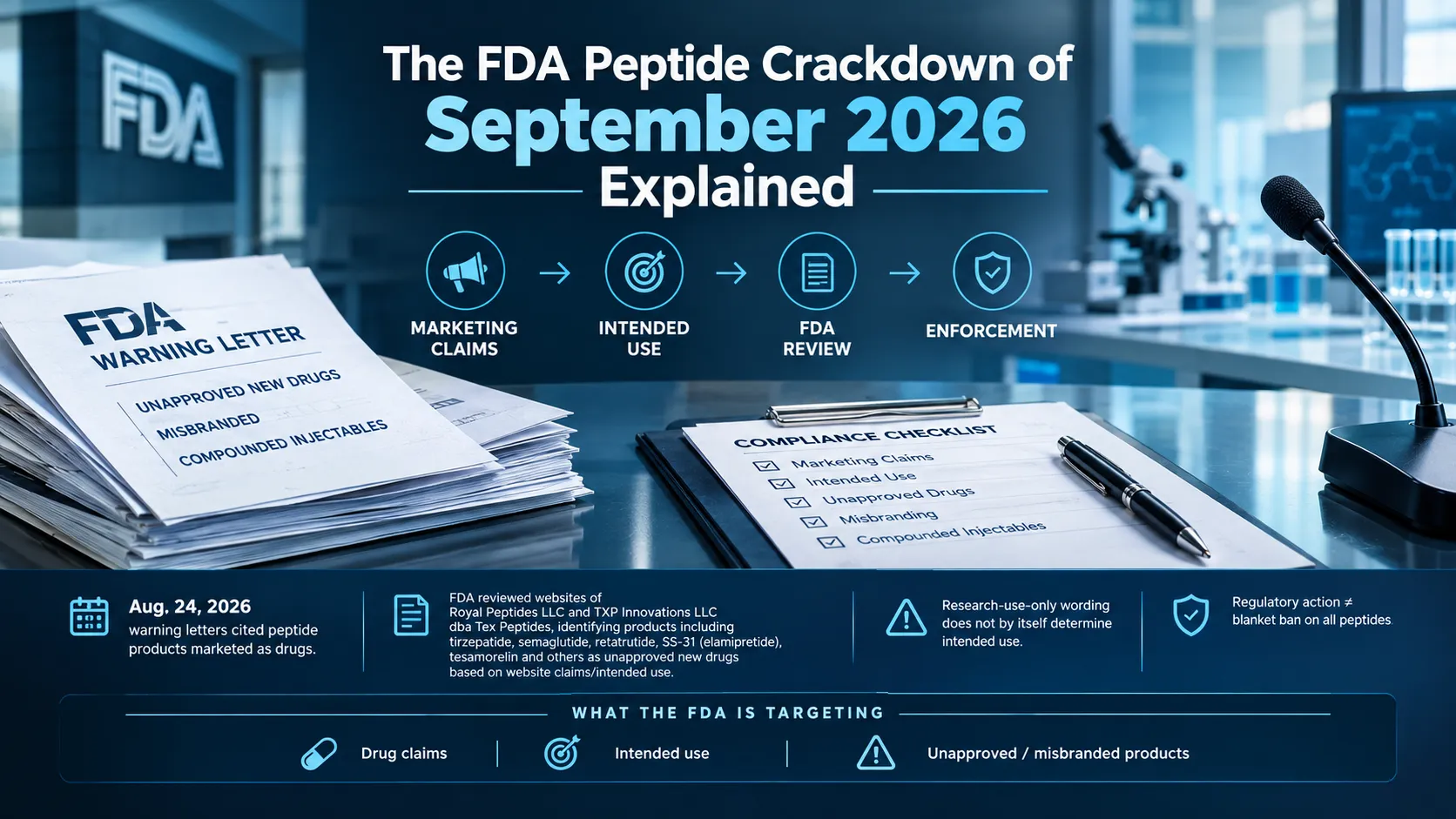
The FDA warned five online peptide sellers in letters posted September 1, 2026, alleging unapproved drug sales, including retatrutide, under research labels.
On September 1, 2026, the FDA posted warning letters dated August 24 to five US online peptide sellers.
The recipients were Peak Performance Peptides, Royal Peptides LLC, NuScience Peptides LLC, Peptide Partners LLC, and TXP Innovations LLC (Tex Peptides).
The FDA alleges each company sold unapproved new drugs in violation of sections 301(d) and 505(a) of the Federal Food, Drug, and Cosmetic Act.
Retatrutide, an investigational Eli Lilly drug with no approval in any market, appeared across all five letters.
The FDA found that health claims, bundled bacteriostatic water, and reconstitution calculators showed intended human use despite research-use-only labels.
Warning letters record FDA allegations rather than court findings, and each company had 15 working days to respond.
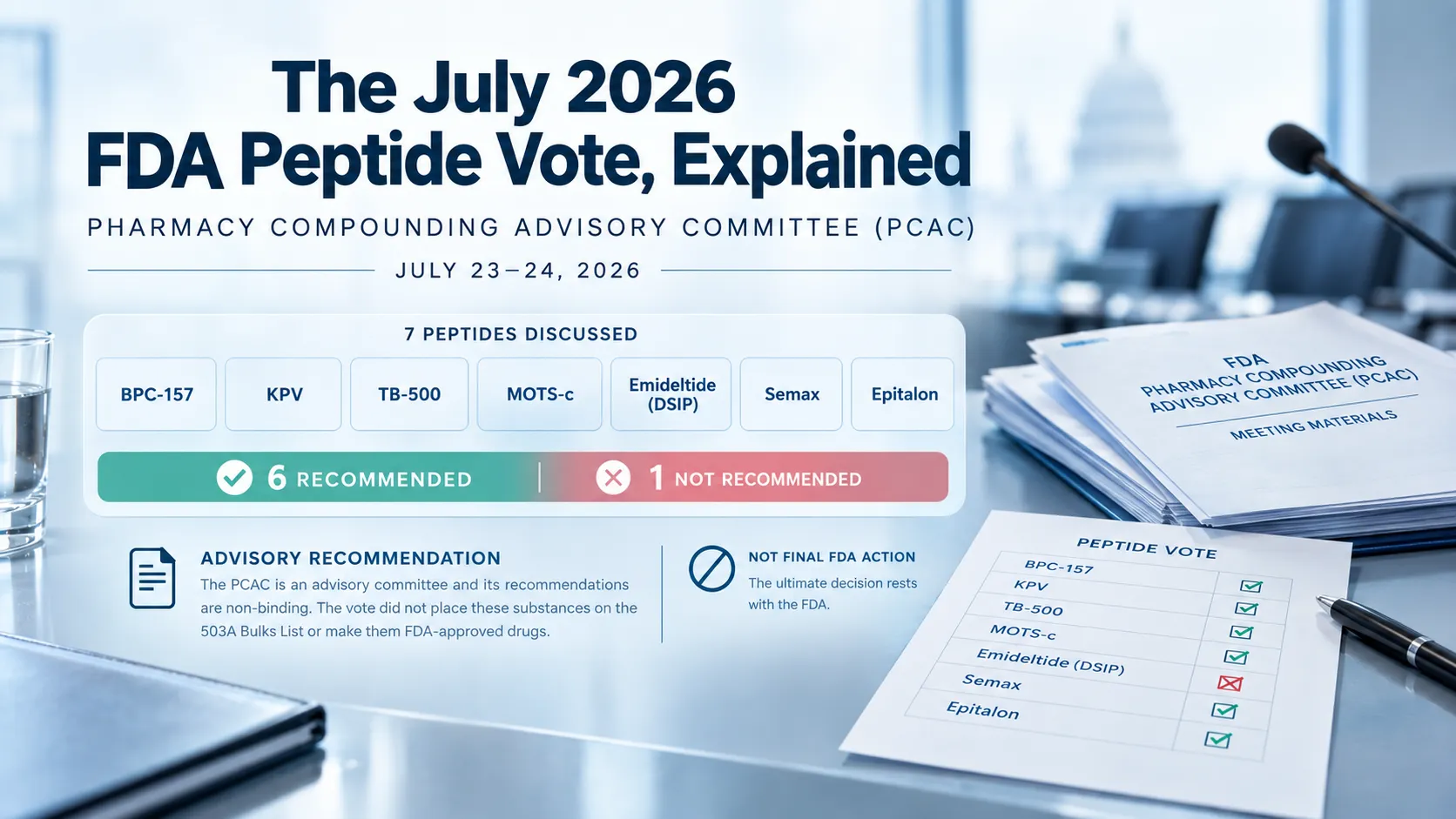
The July 2026 PCAC vote on six peptides is a separate advisory compounding process, and none of those six appeared in the August letters.
The FDA applies a net-impression standard, so a research-use-only disclaimer is one input among many and the rest of a website can outweigh it.
Three of the five warning letters were publicly linked at the time of writing, and the full roster of five companies comes from ArentFox Schiff's summary of the letters.
On September 1, 2026, the FDA posted warning letters to five US peptide sellers at once. Every letter carried the same August 24 date and made the same core charge. The sellers were allegedly marketing unapproved new drugs, including semaglutide copies and Eli Lilly's experimental retatrutide, under "research use only" labels.
That label sits at the heart of this story. The FDA looked past it and judged each website by everything else it said and sold.
Last updated: 22 September 2026. This is a regulatory explainer for laboratory researchers and informed readers, not legal or medical advice. Warning letters record FDA allegations, not court findings. Helix Bio products are sold for laboratory research use only, not for compounding, human use or veterinary use.
Quick answer: what was the September 2026 FDA peptide crackdown?
The FDA warned five online peptide sellers that it considers their products unapproved new drugs. It did not ban any peptide and it did not create a new rule. Warning letters record allegations rather than court findings, and each company had 15 working days to respond.
Key facts, as of 22 September 2026:
Who: Peak Performance Peptides, Royal Peptides LLC, NuScience Peptides LLC, Peptide Partners LLC and TXP Innovations LLC (Tex Peptides).
When: letters dated August 24, 2026, posted publicly September 1, 2026.
Allegation: introducing unapproved new drugs into interstate commerce, violating sections 301(d) and 505(a) of the FD&C Act.
Why the research label failed: the FDA judges intended use by the net impression of an entire website, not by a disclaimer.
What did the FDA do to peptide sellers in September 2026?
The FDA's Center for Drug Evaluation and Research sent the five letters. They went to Peak Performance Peptides, Royal Peptides LLC, NuScience Peptides LLC, Peptide Partners LLC, and TXP Innovations LLC, which does business as Tex Peptides. Each letter is dated August 24 and became public in the FDA's warning letter database on September 1.
Semaglutide, tirzepatide, and retatrutide appear across several of the letters, so the product lists overlap heavily. Individual letters also name tesamorelin, SS-31 (elamipretide), PT-141 (bremelanotide), survodutide, mazdutide, and bacteriostatic water sold for reconstitution.
Some of those molecules exist as FDA-approved medicines. Tesamorelin is the active ingredient in Egrifta, elamipretide in Forzinity, and bremelanotide in Vyleesi. Approval covers a specific company's product, though, not every vial that shares its name. Retatrutide has no approval in any market.
What the FDA alleges is not a labeling technicality. According to the agency, each company introduced unapproved new drugs into interstate commerce. That conduct violates sections 301(d) and 505(a) of the Federal Food, Drug, and Cosmetic Act. Section 505(a) bars selling a new drug without an approved application in effect.
Retatrutide connects all five letters, and the retatrutide black market now faces pressure from two directions. Eli Lilly has filed six federal lawsuits against unauthorized retatrutide sellers, according to law firm ArentFox Schiff. The firm also reports that Lilly referred more than 200 entities to regulators, prosecutors, and licensing boards.
Why didn't the "research use only" label protect these sellers?
The FDA decides whether a product is a drug by its intended use. Intended use comes from the whole picture: website copy, bundles, tools, and claims. A disclaimer counts as one piece of evidence, and these letters show it rarely outweighs the rest.
Each letter makes the point in a footnote. Whatever the product labels said, the agency wrote, evidence from the website showed the products were intended as drugs for human use.
That placement is worth a second look. ArentFox Schiff notes the same finding sits in a footnote of every letter, built around the same core wording. Putting it there, rather than arguing it in the main text, suggests the agency sees the question as settled. In our reading, the research label no longer gets treated as a live legal debate.
The standard the agency applies is net impression. It reads a website as a whole rather than weighing any single line, so a disclaimer counts as one input among many and the rest of a site can outweigh it. That is why the same wording on the label produced the same outcome five times over.
The principle holds across all five cases. A disclaimer can't override what the rest of a website does.
How did the 2026 peptide enforcement wave build up?
Those August letters capped a year of steady pressure. Over twelve months, the FDA, state boards, and federal prosecutors each moved against a different part of the peptide market.
When
What happened
What it changed
September 2025
FDA opened a crackdown on misleading drug advertising, including letters to GLP-1 compounders and telehealth firms (reported counts vary)
GLP-1 marketing became a standing enforcement priority, and the FDA later said it sent more misleading-ad letters in six months than in the prior decade
March 3, 2026
30 warning letters to telehealth firms over compounded GLP-1 claims, with a public warning from Commissioner Makary
Two violation patterns got named: implying sameness with approved drugs, and branding that hid who actually compounded the product
April 2026
FDA removed 12 peptides from 503A Category 2 after their nominations were withdrawn
Set up the July compounding review, though removal did not move any of them into Category 1
April 30, 2026
FDA proposed excluding semaglutide, tirzepatide, and liraglutide from the 503B bulks list (still a proposal; the comment period closed July 30, 2026 and the FDA has announced no final decision)
Pressure moved from ads to compounding supply, since 503B facilities generally can't use a bulk substance that isn't on the list outside a shortage
Two patterns stand out across these rows. Each wave reached a new link in the supply chain, from advertisers to compounders to direct sellers. The July 2026 FDA advisory vote is the only entry that moved in the other direction.
What happens after a company gets an FDA warning letter?
A warning letter gives the company 15 working days to respond. The reply is expected to describe the specific steps taken to fix each violation and prevent repeats. Companies can also dispute the FDA's findings in that response.
If the problems continue, the FDA can escalate without further notice. Its main tools are product seizure, a court injunction ordering the company to stop, and referral to the Department of Justice for criminal prosecution.
That last step has already reached this market. Matthew Kawa, who ran Paradigm Peptides, pleaded guilty to selling unapproved drugs and illegal importation, CBS News reported. In late July 2026 a federal judge sentenced him to 70 months. His plea admitted he knew the products were sold for human consumption despite the research-use claim.
One limit deserves attention here: a warning letter records the FDA's allegations, not a court's findings. None of the five companies has been convicted of anything based on these letters. Whether any of them will face further action is unknown.
Why is the FDA easing and tightening peptide rules at the same time?
Readers see two headlines and assume they conflict. One says the FDA is loosening rules on peptides. The other says it's cracking down. Both are true, because they describe separate tracks.
The compounding track runs through licensed pharmacies filling prescriptions. Section 503A covers state-licensed pharmacies compounding for individual patients, overseen mainly by state boards of pharmacy. FDA-registered outsourcing facilities fall under Section 503B, compounding in larger volumes against a separate bulks list, which is the one the April 30 proposal addresses.
In July, an advisory committee recommended six peptides for the 503A bulks list. That vote approved nothing and skipped no clinical testing. It was advice, and adding any peptide to the list still requires formal FDA rulemaking. As of September 2026, none of the six appears on the codified list at 21 CFR 216.23(a).
Enforcement, meanwhile, targets sellers who bypass every checkpoint: no prescriber, no pharmacist, and no approved product. None of the peptides in the August letters is among the six the committee recommended. Retatrutide can't be compounded under 503A at all.
Five sellers received warning letters for marketing unapproved drugs under research labels. The FDA rejected that label wherever the rest of the website pointed to human use. Enforcement has escalated all year, while the legal compounding pathway moves on its own separate track.
No. The FDA applied existing drug law to five specific companies, and no new category of banned substances was created. Many peptide medicines remain FDA-approved and legally prescribed.
Peak Performance Peptides, Royal Peptides LLC, NuScience Peptides LLC, Peptide Partners LLC, and TXP Innovations LLC (Tex Peptides) received the letters, as reported by ArentFox Schiff and listed in the FDA's warning letter database. The letters to Peak Performance Peptides, Royal Peptides and NuScience Peptides are linked in our references below.
All five letters are dated August 24, 2026, and the FDA posted them publicly on September 1, 2026. That posting date is why coverage calls this the September crackdown.
Retatrutide is an investigational drug with no approval in any country, and ArentFox Schiff reports that Lilly plans to seek FDA approval in early 2027. Until then, lawful human exposure runs through clinical trials under FDA oversight. Selling retatrutide for human use is selling an unapproved new drug.
Only when the rest of the business matches the label. The FDA weighs the label alongside product pages, bundles, and tools. In the Paradigm Peptides case, the owner's own guilty plea admitted the research claim was false.
The FDA doesn't switch sites off directly, but it can seize products, ask a federal court for an injunction, and refer cases for prosecution. The Paradigm Peptides case shows where the criminal route can end, with a guilty plea and a 70-month federal sentence for the owner.
The state boards restricted licensed providers rather than banning the substances outright. Alabama's May 26, 2026 notice and Mississippi's August 19, 2026 joint statement bar licensees from compounding, administering, dispensing, prescribing, or recommending non-FDA-approved research-grade peptides. Both say patient consent forms do not change that duty.
The July vote was an advisory recommendation about compounding six peptides through licensed pharmacies. The August letters were enforcement against unapproved drug sales, and the peptides named in each do not overlap.
Not as a category. The FDA acted against five specific sellers because, in its view, their websites showed the products were intended as drugs for human use. Legality turns on intended use, not on the word "peptide". A product marketed and sold for human use without an approved application is an unapproved new drug under section 505(a) of the FD&C Act.
Intended use is what the FDA concludes a product is for, judged by the net impression of everything a seller says and does rather than by the label alone. In the August 2026 letters the agency stated in a footnote that, despite statements on the product labeling, evidence from each website established that the products were intended as drugs for human use.
The FDA can escalate without further notice. Its main tools are seizing the products, asking a federal court for an injunction, and referring the case to the Department of Justice for criminal prosecution. In the Paradigm Peptides case that criminal route ended in a guilty plea and a 70-month federal prison sentence for the owner.