TB-500 Peptide Research: Identity, Thymosin Beta-4 and Evidence
Recovery protocolsSeptember 17, 202613 min read
TB-500 is a seven-residue acetylated fragment, not full-length thymosin beta-4. Which evidence belongs to which molecule, and how a lab tells them apart.
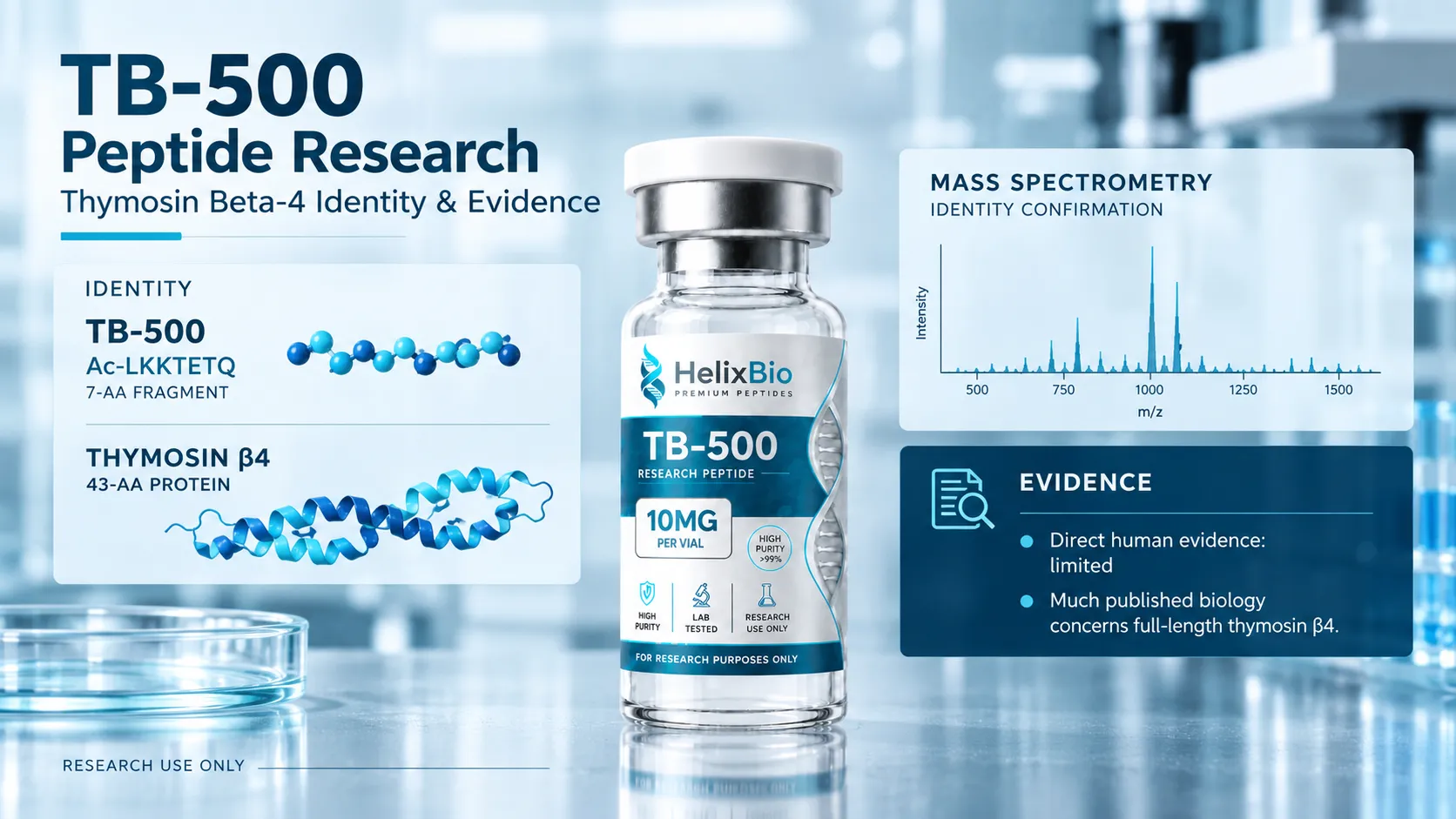
FDA describes TB-500 as the N-acetylated seven-residue peptide Ac-LKKTETQ, corresponding to residues 17 to 23 of thymosin beta-4.
Descriptions of TB-500 as a 17-amino-acid peptide misread the residue range; the fragment has seven residues.
TB-500 free base is C38H68N10O14 at 889.01 g/mol; the acetate salt is about 949.1 g/mol, so the stated form determines the mass basis.
Full-length thymosin beta-4 is a 43-residue protein of roughly 4,963 Da in its native acetylated form, about 4,000 Da heavier than the fragment, so one intact-mass run distinguishes them.
FDA stated in July 2026 that it found no published study in which TB-500 was administered to humans.
FDA cites a 2024 in-vitro study in which TB-500 did not promote closure in a fibroblast scratch assay, while a shorter metabolite was active.
Published pharmacokinetic data for the fragment comes from horses, with plasma concentrations peaking one to two hours after a single subcutaneous dose.
The 2026 WADA Prohibited List names thymosin beta-4 and its derivatives including TB-500 under section S2.3, growth factors and growth factor modulators.
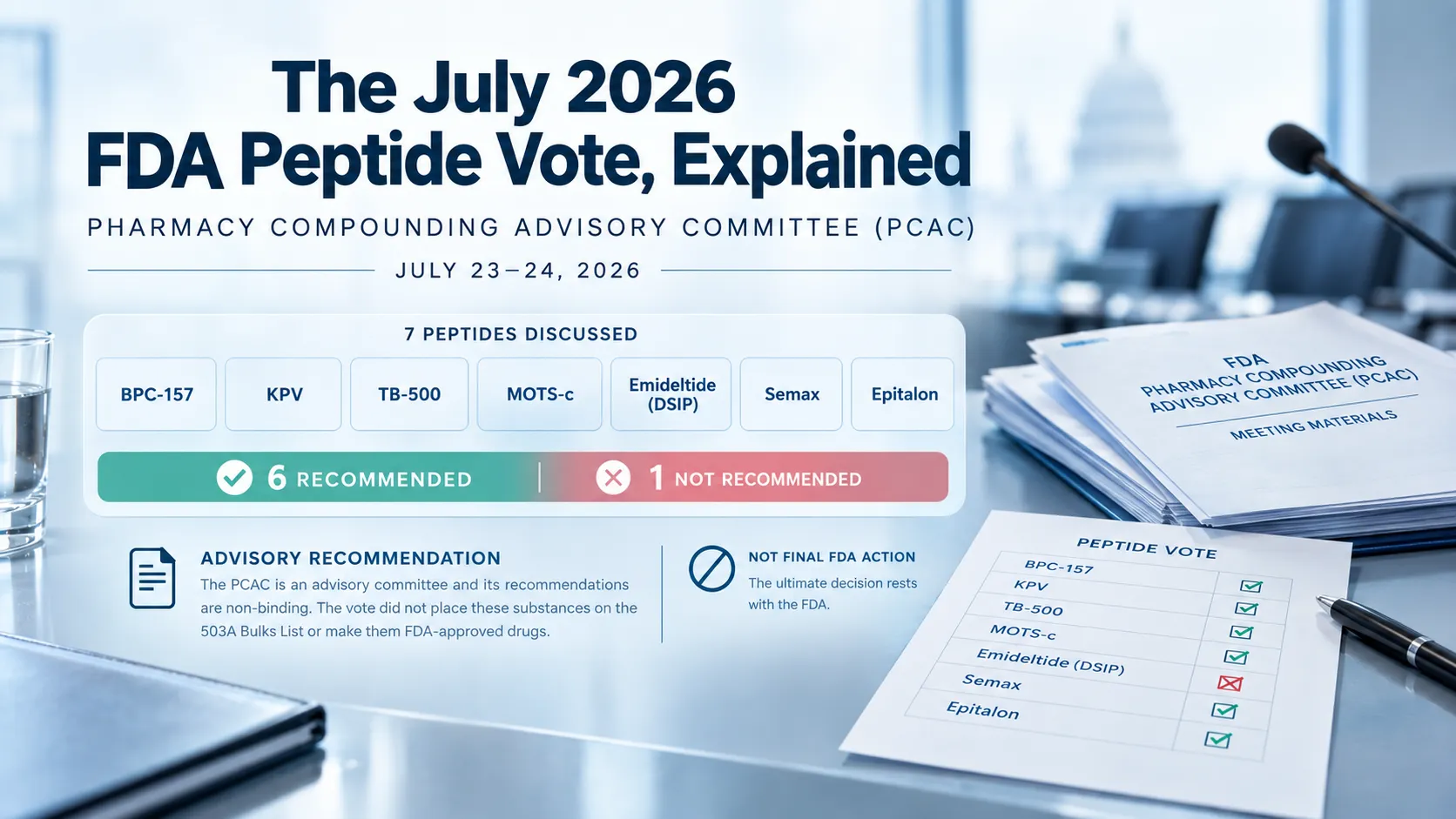
FDA staff proposed that TB-500 free base and acetate not be added to the 503A Bulks List; the advisory committee recommendation to include them is not final agency action.
Human trials of full-length thymosin beta-4 formulations do not establish efficacy of the Ac-LKKTETQ fragment.
TB-500 is a trade designation, not a chemical name. The US Food and Drug Administration describes TB-500 as a seven amino acid synthetic fragment of thymosin beta-4 carrying an acetyl group on its N-terminal residue, written Ac-Leu-Lys-Lys-Thr-Glu-Thr-Gln-OH, or Ac-LKKTETQ. Thymosin beta-4 is a different molecule. It is the full-length 43-residue protein from which that fragment is drawn. The two are related the way a single sentence is related to the page it was cut from, and that relationship does not make their evidence interchangeable. Most of the human research people cite for TB-500 was run on the full-length protein. On the fragment itself, the strongest published work is analytical and veterinary rather than clinical, and the FDA states that it found no published study in which TB-500 was administered to humans. This article separates the two evidence tracks and shows how a laboratory tells the two molecules apart in a vial.
Featured In This Article
TB-500
RESEARCH PEPTIDE
Highly purified synthetic peptide prepared for rigorous laboratory research.
Four terms circulate as though they were synonyms. They are not.
Entity
What it refers to
Which evidence belongs to it
Thymosin beta-4 (Tβ4)
The full-length 43-residue protein found in most mammalian cells
Nearly all the actin, angiogenesis, cardiac and corneal literature, including every human trial
LKKTETQ
A seven-residue sequence, residues 17 to 23 of thymosin beta-4
Used as a fragment in some laboratory work; the unacetylated form
Ac-LKKTETQ
The same seven residues with the N-terminus acetylated
The form FDA and anti-doping laboratories identify as TB-500
TB-500
A commercial and regulatory name, not a chemical one
Depends entirely on what a given vial contains
FDA states the position plainly in its July 2026 evaluation. TB-500 is a common name rather than a United States Adopted Name, an International Non-proprietary Name or an IUPAC name. The agency adds that it has encountered multiple salts and derivatives, including different active moieties, sold commercially under that same common name. So the label on a vial is a claim about identity. It is not a measurement of it.
A study belongs to the TB-500 evidence track only when the authors identify the tested material as TB-500, LKKTETQ, Ac-LKKTETQ or a chemically equivalent defined fragment. Work using recombinant, synthetic or ophthalmic full-length thymosin beta-4 belongs to a separate track.
The seven-residue figure corrects a common error
A great deal of published commentary describes TB-500 as a 17-amino-acid peptide. That number is a misreading of the residue range. Residues 17 to 23 of thymosin beta-4 span seven positions, not seventeen. Esposito and colleagues reported the identification in 2012, describing the N-terminal acetylated 17-23 fragment of human thymosin beta-4 detected in TB-500 by high-performance liquid chromatography with high-resolution mass spectrometry. FDA uses the same seven-residue description. Anyone repeating the 17-residue figure is quoting a mass and a molecule that do not exist.
Which mass belongs to which form
A molecular weight is only meaningful once the form is named. FDA's evaluation lists both forms of the substance separately.
Form
Molecular formula
Molecular weight (g/mol)
UNII
CAS
TB-500 free base
C38H68N10O14
889.01
QHK6Z47GTG
885340-08-9
TB-500 acetate
C38H68N10O14·CH3COOH
949.1
Not available
Not available
The gap between those two figures is about 60 g/mol, the mass of one acetic acid molecule. On material sold by weight, that difference decides what fraction of the fill is the peptide itself. A certificate reporting 889 and a certificate reporting 949 are describing different substances, and neither number is wrong on its own terms. FDA also reports the free base as a white to off-white solid soluble in water at 50 mg per mL.
For comparison, native thymosin beta-4 is acetylated at its N-terminus and has an average mass of about 4,963 Da; Ho and colleagues quote 4,921 Da for the unacetylated 43-residue chain. The difference between the fragment and the parent is therefore roughly 4,000 Da. That is not a subtle separation. One intact-mass run distinguishes them without ambiguity.
TB-500 set against full-length thymosin beta-4
Attribute
TB-500 (Ac-LKKTETQ)
Full-length thymosin beta-4
Length
7 residues
43 residues
Approximate mass
889 Da free base
About 4,963 Da (acetylated native form; 4,921 Da unacetylated chain)
N-terminus
Acetylated
Acetylated in the native protein
Origin
Synthesised as a fragment; FDA reports first synthesis around 2003
Endogenous, present in most mammalian cells
Human trial record
No published trial identified by FDA
Phase 3 ophthalmic programme, plus phase 1 and 2 intravenous recombinant protein
Regulatory identity
The structural relationship is real. It does not establish biological or clinical equivalence. A seven-residue fragment is not assumed to reproduce every property of a 43-residue protein, and nothing in the published record shows that it does.
What has actually been measured on the fragment itself
The fragment-specific record is thin, and it is mostly analytical.
Esposito and colleagues identified Ac-LKKTETQ in material sold as TB-500 and then synthesised the peptide independently to confirm the assignment. That work establishes what was in the tested material. It says nothing about biological effect.
Ho and colleagues developed detection methods in horses and administered a single dose of TB-500 containing 10 mg of N-acetylated LKKTETQ. The peptide and its metabolites were confirmed in equine plasma and urine, down to 0.02 ng per mL in plasma and 0.01 ng per mL in urine. FDA summarises the resulting profile: plasma concentrations peaked between one and two hours after treatment and became unquantifiable between six and ten hours. This is real pharmacokinetic data for the fragment, and it is equine data.
The most pointed fragment-specific finding runs against expectation. FDA cites Rahaman and colleagues, 2024, reporting that TB-500 at 50 micrograms per mL did not promote closure when applied to cultured fibroblasts scratched to create uniform wounds. The same work reports that a shorter metabolite, Ac-LKKTE, was active in that assay while the parent compound was not. FDA states that it identified no published non-clinical in-vivo studies assessing the effects of TB-500 on wounds.
What the thymosin beta-4 literature shows, and why it does not transfer
The parent protein has a deep and genuinely interesting literature. It binds G-actin, and that binding underlies its role in cell migration. It has been studied in angiogenesis, inflammation, corneal repair and cardiac models. Human work on the full-length protein has reached phase 3 in ophthalmology, where a preservative-free thymosin beta-4 eye drop has completed phase 3 dry-eye trials and has a phase 3 neurotrophic keratopathy trial under way, and separate programmes have taken intravenous recombinant thymosin beta-4 through phase 1 and phase 2. None of that work used the seven-residue fragment.
None of that is TB-500 evidence unless the tested material was the defined fragment. The molecule differs, the formulation differs, the route differs, and the pharmacokinetics of the fragment in humans are unknown. An endpoint measured on one molecule does not carry to the other by inheritance.
The common error is easy to state. Writing that TB-500 has been shown in humans to improve corneal healing is not supported. Writing that human studies have evaluated specific full-length thymosin beta-4 ophthalmic formulations for corneal healing, and that those studies do not establish efficacy of the Ac-LKKTETQ fragment, is supported and says the same thing accurately.
Mechanism, labelled by the molecule actually studied
FDA's own framing is careful and worth following. The agency notes that TB-500 contains the six-residue LKKTET sequence that makes up the actin-binding region thought to contribute to the wound-healing properties of the full-length peptide. The words doing the work there are "thought to contribute". That is a mechanistic rationale drawn from parent-protein biology, not a demonstration of equivalent fragment activity.
So the honest split looks like this. Actin binding, G-actin sequestration and migration effects are established for the full-length protein. The fragment carries the region implicated in that activity. Whether the fragment reproduces the function is a hypothesis, and the one published scratch assay named by FDA did not support it for the parent fragment.
What a certificate of analysis can and cannot settle
Method
Supports
Does not establish on its own
HPLC
Chromatographic purity and a retention profile
Molecular identity, peptide content, counterion
LC-MS or high-resolution MS
A mass consistent with the target molecule
Complete purity, absence of co-eluting impurities
MS/MS
Sequence-supporting fragment ions
Sterility, content, formulation
COA
Batch-specific documentation, when methods and results are stated
Anything, merely because the document exists
Here the identity question is unusually easy to answer and unusually often skipped. Because the fragment and the parent protein differ by roughly 4,000 Da, a single intact-mass measurement settles which molecule is present. A purity percentage cannot do that. A figure of 99 percent describes how much of the detected material is the main peak. It does not say which molecule that peak is. The certificate of analysis guide covers the field-by-field reading, and what contamination testing has found covers how far those documents can be trusted.
On material sold as TB-500, read the mass before the purity figure. A measured mass near 889 or 949 indicates the acetylated seven-residue fragment as free base or acetate. A mass near 4,900 indicates the full-length protein. Then check that the stated mass basis matches the form named on the label.
The identity paperwork problem, shown in FDA's own file
The clearest demonstration that this is a live problem comes from the regulatory record rather than the laboratory. FDA's July 2026 evaluation tabulates what the withdrawn TB-500 nomination actually contained, and the entries do not agree with each other.
The nominated substance was TB-500 free base, and the UNII code given matched the free base.
The certificate of analysis supplied with it was for TB-500 acetate, a different substance.
A second CAS number offered in the package matched neither the free base nor the acetate.
The molecular formula provided was C38H66N10O14, which FDA records as matching neither form, while the formula printed on the certificate itself was not legible.
That is four identity fields on one submission, pointing in three directions. It is a useful checklist in reverse. Any certificate that names a form, a CAS number, a UNII, a formula and a mass should have all five describing the same substance. The same discipline applies to multi-component preparations containing the compound, covered in the GLOW component evidence and KLOW four-component verification articles.
Where TB-500 stands with regulators
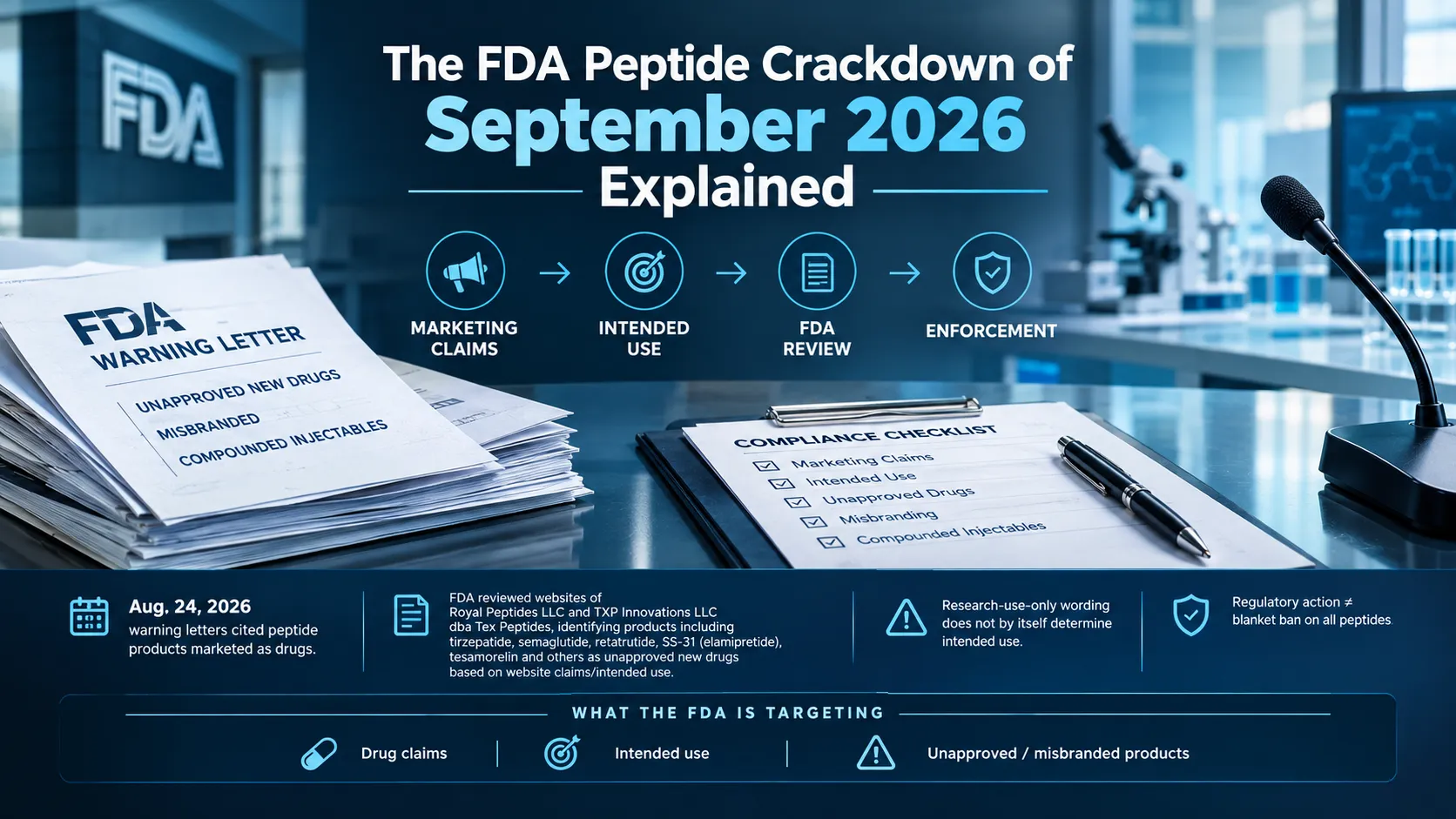
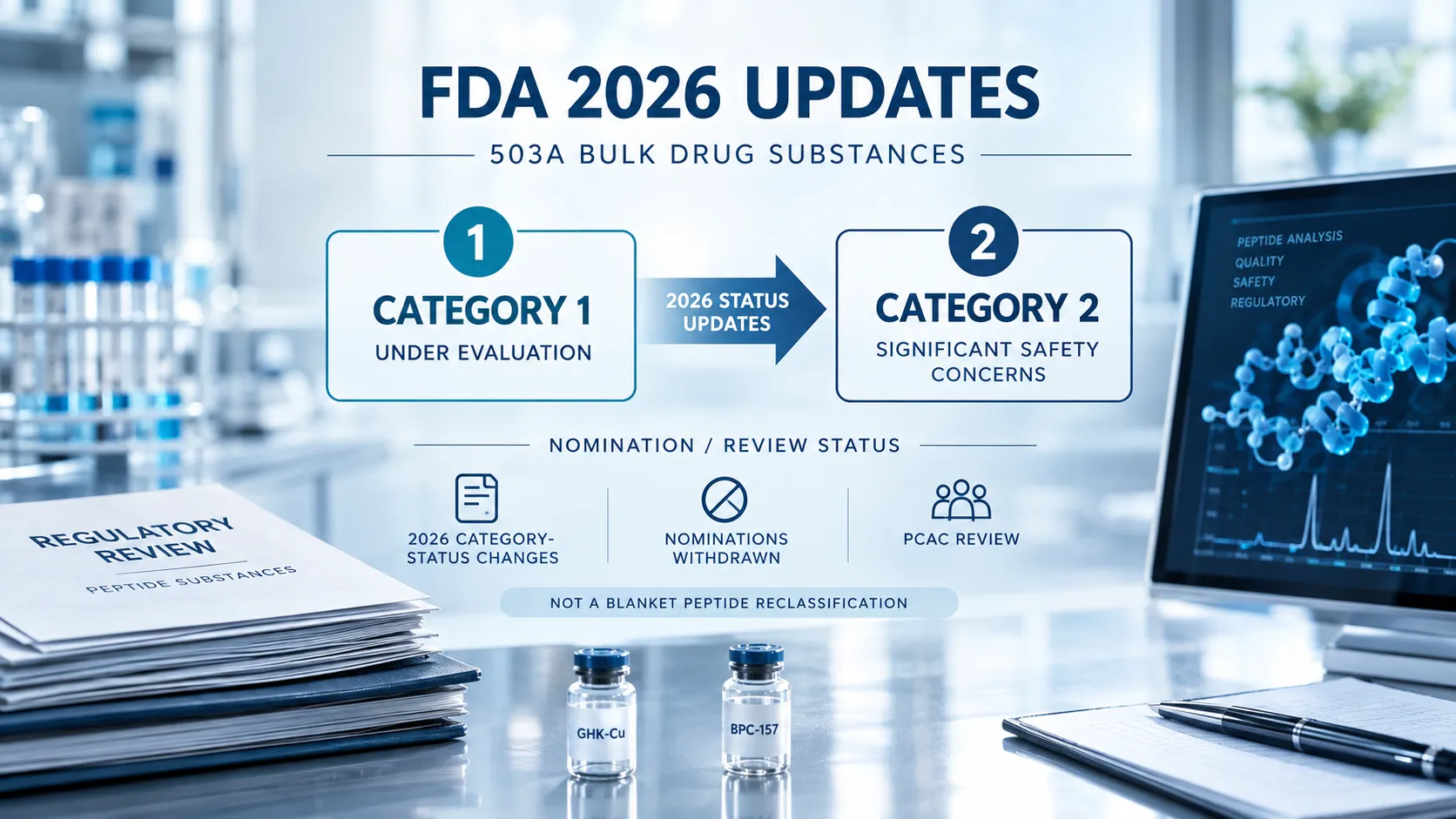
FDA evaluated TB-500 free base and TB-500 acetate at the Pharmacy Compounding Advisory Committee meeting on 23 July 2026, after the original nomination had been withdrawn. Agency staff proposed that neither form be included on the 503A Bulks List, citing poor physicochemical characterisation, unknown extent of use in compounding, and absence of information on use in humans. The committee voted to recommend inclusion against that staff recommendation. A committee vote is advisory. It is not a rulemaking, an approval, or a change in status, and the 503A bulks list explainer sets out what the vote did and did not change.
In sport, the 2026 World Anti-Doping Agency Prohibited List names the compound directly under S2.3, growth factors and growth factor modulators, as "Thymosin-β4 and its derivatives e.g. TB-500". Some secondary sources place it under S0 instead. The List itself and FDA's evaluation both give S2.3. Sport prohibition is a separate question from FDA approval and from general legality, and none of the three answers the others. Research-use-only status is a fourth question again, covered in the RUO compliance guide.
Evidence matrix
Question
Molecule studied
Evidence level
What is shown
What is not established
Molecular identity
Ac-LKKTETQ
Analytical
Material sold as TB-500 was identified as the acetylated 17-23 fragment
That every product under the name has that composition
Pharmacokinetics
Ac-LKKTETQ
Animal, equine
Plasma peak at 1 to 2 hours, unquantifiable by 6 to 10 hours after a single dose
Human pharmacokinetics of any kind
Wound closure in vitro
Ac-LKKTETQ
Cell culture
The parent fragment did not promote closure in a fibroblast scratch assay
What this evidence does not establish
Several limits follow directly and are worth stating without hedging.
Full-length thymosin beta-4 evidence is not TB-500 evidence. Mechanistic similarity is not biological equivalence. Animal and equine findings do not establish human outcomes. A published human trial of the parent protein is not a trial of the fragment. HPLC purity is not molecular identity, and a confirmed mass is not proof of purity or content. A label is a claim, not a measurement. An advisory committee recommendation is not final agency action, absence of FDA approval is not illegality everywhere, sport prohibition says nothing about approval status, and research-use-only labelling is not a therapeutic clearance of any kind.
FDA also states that potential safety risks of TB-500 in humans are unknown, and flags immunogenicity and aggregation as concerns it could not assess for lack of data. An absence of adverse event reports is not evidence of safety. It is an absence of data.
For material sourced for laboratory work, Helix Bio's TB-500 research material is supplied with a batch certificate of analysis and a lot number. Read it against the checklist above: confirm the form named, and confirm that the methods reported are sufficient for the identity question rather than purity alone.
Got Questions?
Frequently Asked Questions
TB-500 is a commercial name for an N-acetylated seven-residue peptide, Ac-LKKTETQ, described by FDA as a synthetic fragment of thymosin beta-4. It is a common name rather than a formal chemical designation, so the contents of any given vial need analytical confirmation.
No. Thymosin beta-4 is the full-length 43-residue protein, and TB-500 refers to a seven-residue fragment drawn from it. They differ by roughly 4,000 Da and are distinguishable in a single mass measurement.
FDA gives the peptide sequence as Ac-Leu-Lys-Lys-Thr-Glu-Thr-Gln-OH, written in single-letter form as Ac-LKKTETQ. The acetyl group sits on the N-terminal leucine.
Residues 17 to 23 of human thymosin beta-4. Esposito and colleagues identified this N-terminal acetylated 17-23 fragment in material sold as TB-500 using HPLC with high-resolution mass spectrometry in 2012.
No, and this is a common error. The figure 17 comes from the residue range 17 to 23 within the parent protein, which spans seven positions. Both FDA and the original analytical paper describe a seven amino acid fragment.
It depends on the form. FDA lists the free base as C38H68N10O14 at 889.01 g/mol and the acetate salt at about 949.1 g/mol. A molecular weight quoted without naming the form cannot be checked against a certificate.
FDA stated in its July 2026 evaluation that it found no published study in which TB-500 was administered to humans, and no clinical studies or human exposure data by any route. That is a statement about the located literature rather than a claim that no human has ever received it.
No. Those studies used the full-length protein in specific formulations, and the molecule, formulation and route all differ from the fragment. The fragment's human pharmacokinetics are unknown, so no endpoint transfers between the two.
The fragment contains the LKKTET sequence that makes up the actin-binding region thought to contribute to the full-length protein's wound-healing properties. That is a mechanistic rationale drawn from parent-protein biology, not a demonstration of equivalent activity by the fragment.
Yes, and it is limited. FDA cites a 2024 in-vitro study in which TB-500 at 50 micrograms per mL did not promote closure in a fibroblast scratch assay, while a shorter metabolite was active. Published pharmacokinetic work on the fragment was conducted in horses.
Not on its own. HPLC supports chromatographic purity and a retention profile, but identity normally requires an orthogonal method such as LC-MS or MS/MS. A purity percentage describes how much of the detected material is the main peak, not which molecule that peak is.
An intact-mass measurement distinguishes the roughly 889 Da fragment from the roughly 4,963 Da full-length protein without ambiguity, and separates free base from acetate. It does not establish complete purity, peptide content or the absence of co-eluting impurities.
No. TB-500 is not a component of any FDA-approved drug and has no USP or NF monograph. FDA staff proposed in July 2026 that neither the free base nor the acetate be included on the 503A Bulks List, and the advisory committee's contrary recommendation is not final agency action.
Yes. The 2026 Prohibited List names thymosin beta-4 and its derivatives, giving TB-500 as the example, under section S2.3 covering growth factors and growth factor modulators. Sport prohibition is a separate question from FDA approval status and from general legality.
It means the material is supplied for laboratory and analytical work and is not a drug, supplement or finished pharmaceutical product. Research-use-only labelling carries no implication of therapeutic clearance, safety or efficacy in humans.