A KLOW COA must report identity, purity and quantity separately for every component, because a multi-component container is not a single analyte.
A single aggregate purity percentage has no defined denominator on a multi-analyte chromatogram unless every peak is resolved and assigned to a named compound.
Identity, purity, quantity, component ratio and net peptide content are five different measurements produced by different analyses and are not interchangeable.
None of the components normally described for this blend has a useful 280 nm chromophore, so detection wavelength determines whether a component is visible at all.
Public KLOW certificates record component masses spanning roughly fourteen-fold, from 342.43 g/mol for KPV to 4963.0 g/mol for a TB-500 component.
One publicly hosted KLOW certificate records two components specified identically at 10 mg plus or minus 15% returning 11.84 mg and 8.56 mg, a difference of roughly 38% within one lot.
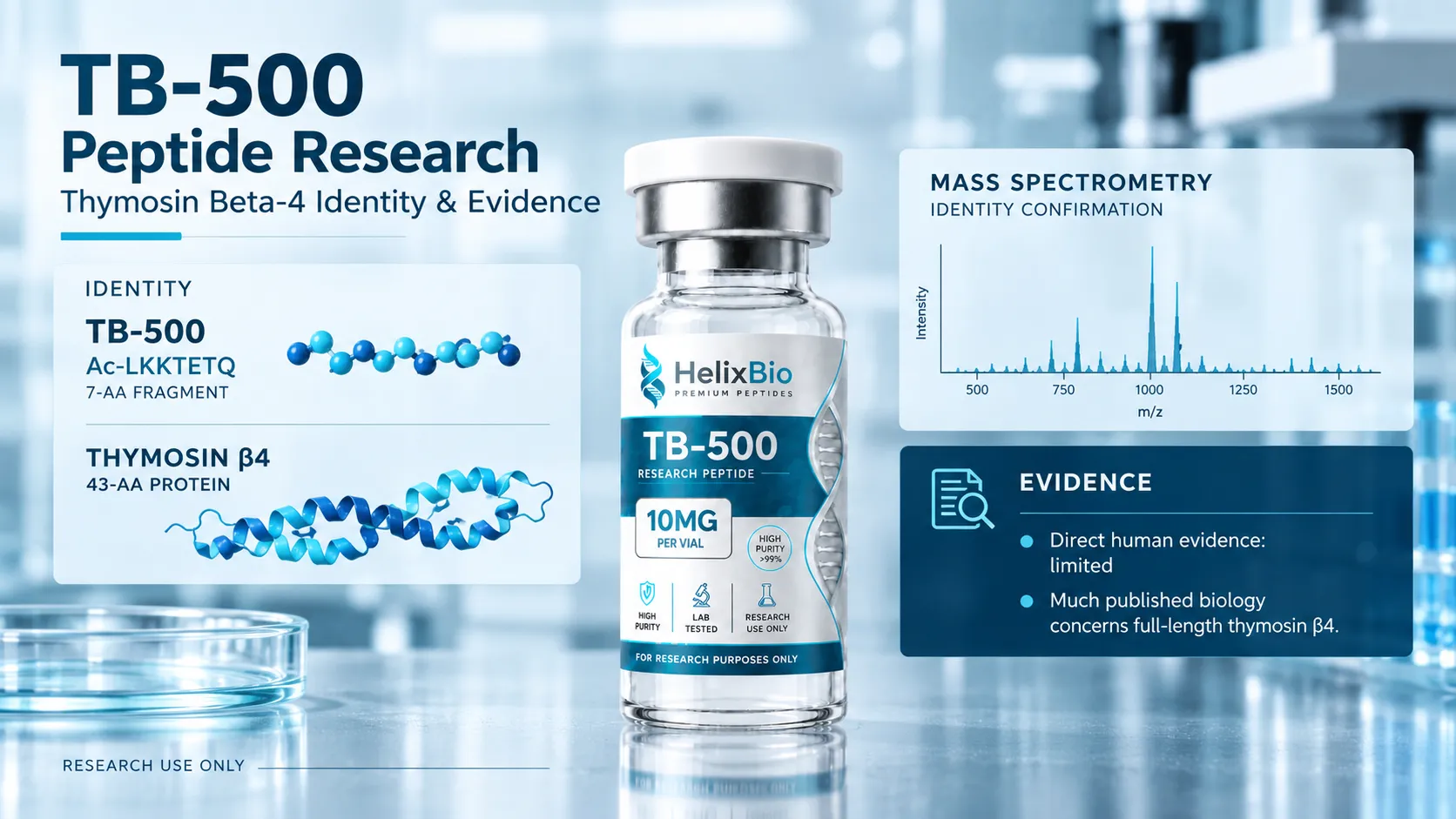
The molecular identity of TB-500 varies across sources between the full 43-residue thymosin beta-4, the acetylated LKKTETQ heptapeptide and the Ac-SDKP tetrapeptide, so the mass on the identity line identifies the molecule rather than the name.
Confirming the copper in GHK-Cu requires elemental analysis such as ICP-MS or atomic absorption, not chromatography.
A certificate of analysis establishes what is in one lot; it does not establish biological activity, and no published study has evaluated this four-component combination as a unit.
A certificate of analysis for a single peptide answers a short list of questions. Is this the right molecule, how much of the detected material is that molecule, and how much of it is in the vial. A KLOW COA has to answer those same questions once for every component in the container, and many of the certificates circulating for this blend do not. That gap is the subject of this article. It covers what a multi-component certificate has to establish, why a single aggregate purity figure cannot describe a four-component vial, which analytical properties of these specific compounds make them difficult to detect, and what publicly available KLOW certificates actually show when read closely.
Featured In This Article
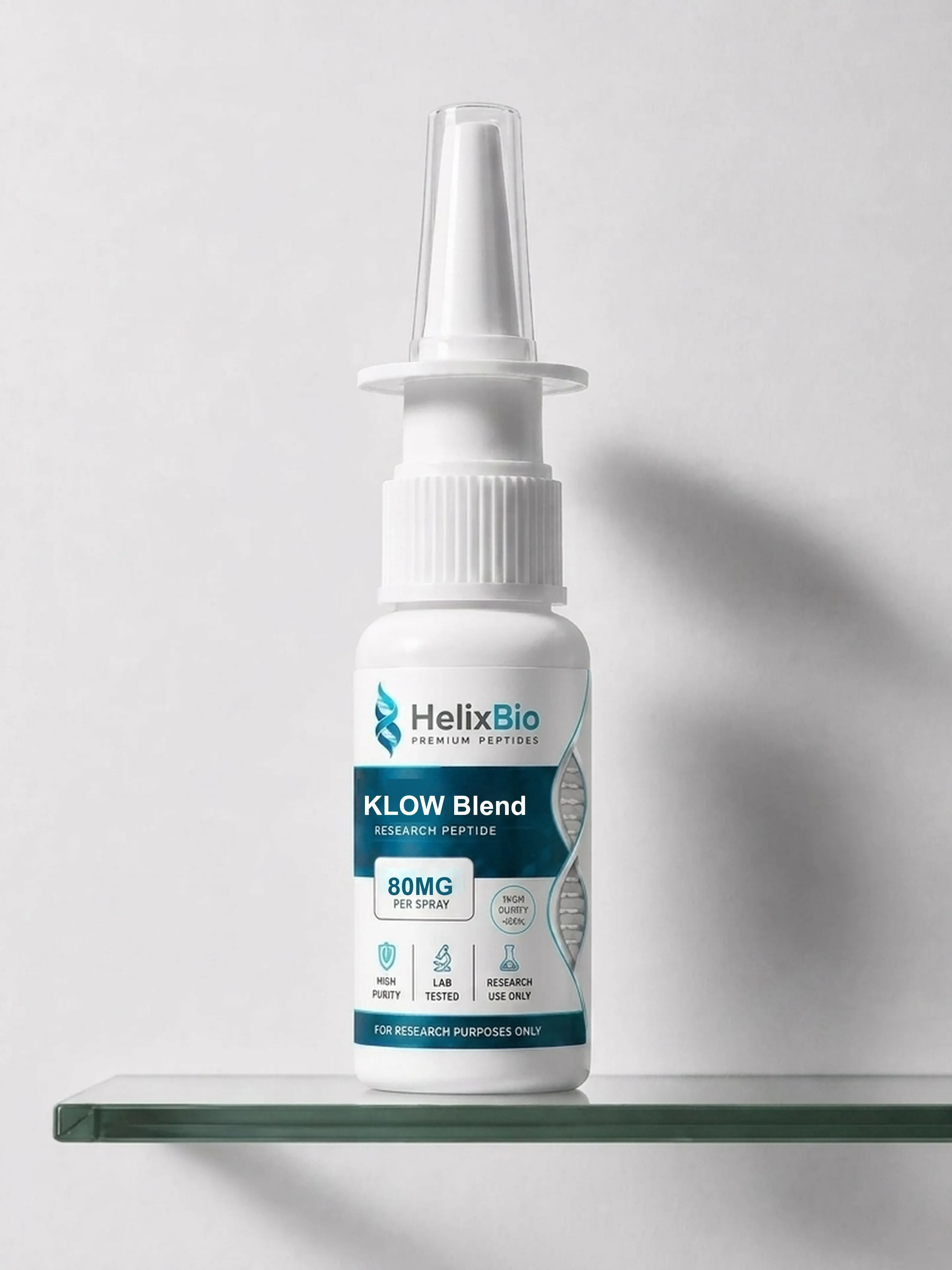
KLOW Blend Spray
RESEARCH PEPTIDE
Highly purified synthetic peptide prepared for rigorous laboratory research.
$149.99
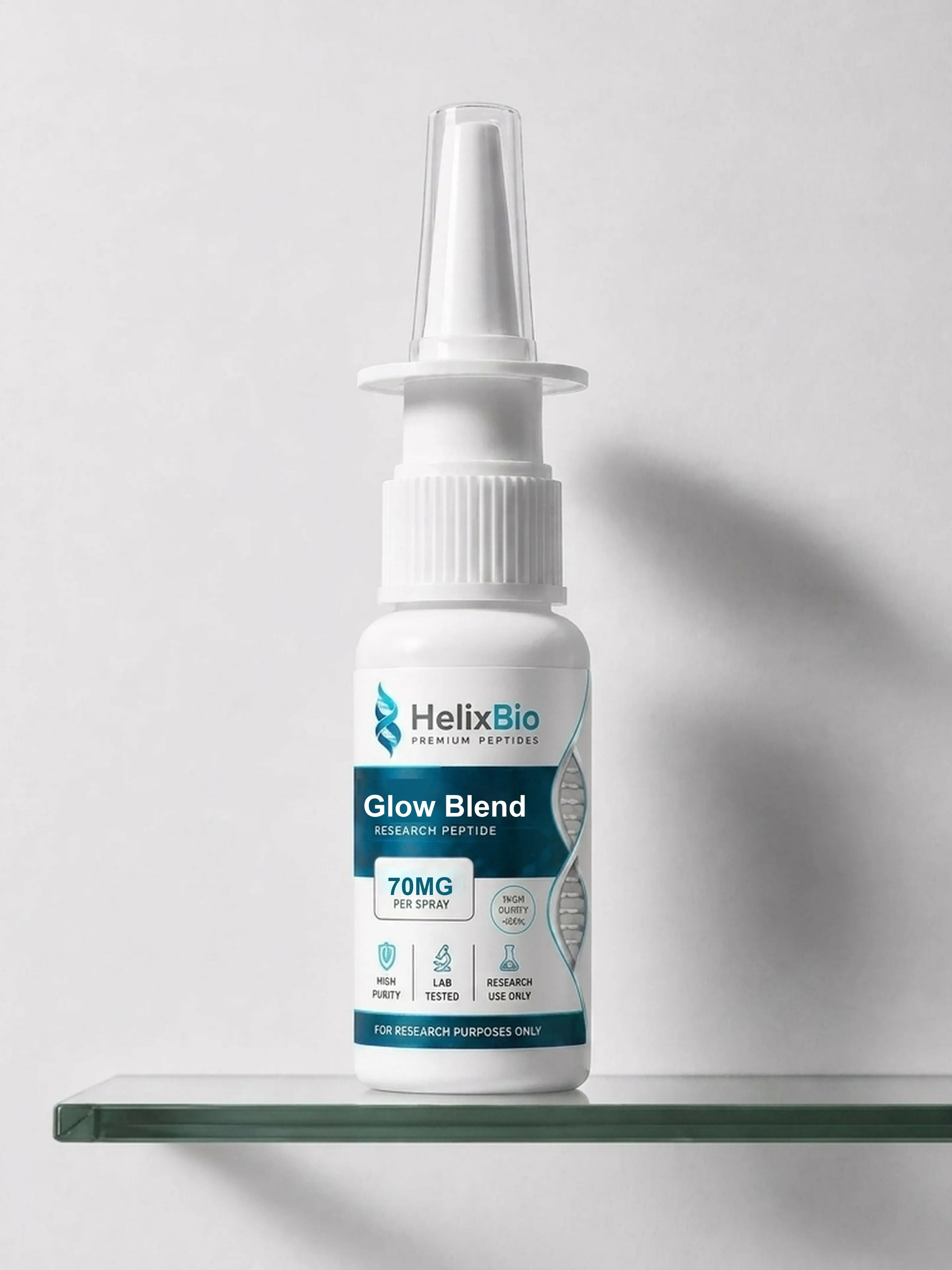
Glow Blend Spray
RESEARCH PEPTIDE
Highly purified synthetic peptide prepared for rigorous laboratory research.
$131.99
This is a documentation and verification article. Composition, component comparison and preparation are separate questions handled elsewhere.
What a KLOW COA Has to Establish
A certificate of analysis is batch evidence. It ties one specific lot of material to a specific set of measurements performed on that lot. It is not a description of a product line, not a statement about a compound in general, and not evidence of biological activity.
For a single-analyte vial that evidence is compact: one identity confirmation, one purity determination, one quantitative assay, one lot number. Our guide to reading a peptide certificate of analysis covers those fields individually.
A blend multiplies the work rather than the page count. Four components mean four identity confirmations, four purity determinations and four quantitative assays. It also introduces a fifth question that does not exist for single-compound vials at all: because the components were combined in intended proportions, are those proportions what the specification says they are?
A certificate reporting one identity line, one purity percentage and one total mass has addressed a fraction of what the material raises.
Question
Single-analyte vial
Four-component blend
What molecule is present?
One identity confirmation
Four separate identity confirmations
How clean is it?
One purity determination
Four per-component purity determinations
How much is present?
One quantitative assay
Four per-component quantitative assays
Are the proportions correct?
Not applicable
Requires per-component quantity, then arithmetic
Which document applies?
Lot-matched certificate
Lot-matched certificate covering every component
Identity, Purity, Quantity and Ratio Are Four Different Measurements
These terms are used interchangeably in product copy, and that is where most misreading begins. They are not synonyms, and they are not produced by the same analysis.
Measurement
What it establishes
What it does not prove
Analytical basis
Identity
Which molecule produced a given signal
How much is present, or how clean it is
Measured mass compared against the value calculated for the intended molecule
Purity
What fraction of detected material corresponds to the intended analyte
That the vial's total mass is that material, or that the label quantity is correct
Chromatographic area percentage under a stated method and detection wavelength
Quantity or assay
How many milligrams of a named component are present
Anything about the other components
Quantitative determination against a characterised reference standard
Component ratio
The proportion of each component relative to the others
The right-hand columns matter more than the left. Nearly every disappointment researchers report with blend documentation traces back to expecting one of these measurements to carry the weight of another.
Why One Purity Number Cannot Describe a Four-Component Vial
Chromatographic purity is a ratio. The main peak's area is divided by the total integrated peak area under a stated method, and the result is expressed as a percentage.
On a single-analyte sample that denominator is unambiguous. Anything that is not the target peak is an impurity, so the ratio carries meaning.
On a blend the logic breaks. If all four components are legitimate constituents of the product, then all four peaks belong in the numerator, in which case a figure such as 99% describes combined intended material against process impurities and says nothing about how the four are distributed. If instead only one component is treated as the target analyte, the other three are being counted as impurities, and the number is wrong in a different direction.
There is no third reading available. A composite purity figure on a multi-component certificate is either uninformative or incorrectly constructed, and the document rarely states which.
What answers the question is a per-component report: every peak assigned to a named compound, each with its own purity result and its own quantitative result. Some suppliers do publish this. The question for any given lot is whether the document in front of you does.
A purity percentage on a blend certificate should always be read with one question attached: percent of what, relative to what? Without the analytical method, the detection wavelength and the peak assignments, the figure cannot be interpreted, however high it is.
The Detection Problem Specific to These Four Components
This is where KLOW differs from most multi-component preparations, and it is the part almost no published material addresses.
None of the components has a useful 280 nm chromophore
Peptide chromatography commonly uses ultraviolet detection, and absorbance at 280 nm is convenient because tryptophan and tyrosine absorb strongly there. That makes many peptides easy to see and straightforward to quantify.
Now work through the components normally described for this blend.
BPC-157 has the sequence GEPPPGKPADDAGLV. It contains no tryptophan, no tyrosine and no phenylalanine, so no aromatic residue at all.
KPV is Lys-Pro-Val. Three residues, none aromatic.
GHK-Cu is the copper complex of glycyl-L-histidyl-L-lysine. Histidine is not a 280 nm chromophore in the sense that tryptophan and tyrosine are.
The TB-500 component derives from thymosin beta-4, whose 43-residue sequence is SDKPDMAEIEKFDKSKLKKTETQEKNPLPSKETIEQEKQAGES. That sequence contains a single phenylalanine and nothing else aromatic.
The consequence is practical rather than theoretical. Absorbance at 280 nm cannot determine content for this material, and a method running detection at that wavelength may under-represent or entirely miss components that are genuinely present. Peptide-bond absorbance in the low ultraviolet is what makes these compounds visible at all, which means the detection wavelength printed on a certificate is load-bearing information rather than a formatting detail.
A certificate that reports purity without stating the wavelength has withheld something a reader needs.
The mass range spans more than an order of magnitude
The components are not close in size. Publicly hosted KLOW certificates record BPC-157 with the formula C62H98N16O22 at 1419.5 g/mol and KPV as C16H30N4O4 at 342.43 g/mol, while a separate public KLOW certificate records its TB-500 component as C212H350N56O78S at 4963.0 g/mol.
That is roughly a fourteen-fold spread between the smallest and largest analyte in one container. Chromatographic and mass-spectrometric conditions optimised to resolve and quantify a species near 4,963 Da are not automatically appropriate for a 342 Da tripeptide, and the reverse holds equally.
There is an uncomfortable detail inside that observation. KPV, the component whose presence distinguishes this blend from the three-component preparation, is both the smallest analyte and the least conveniently detected. A method that comfortably characterises the two larger components can under-serve the one that defines the product.
Copper requires a different instrument
GHK-Cu is a coordination complex rather than a peptide alone. Confirming the tripeptide and confirming the copper are two different analyses. Chromatography and mass spectrometry address the peptide portion; metal content requires elemental analysis such as inductively coupled plasma mass spectrometry or atomic absorption spectroscopy.
A certificate reporting GHK-Cu with a peptide purity figure and no elemental data has characterised part of the molecule. Whether that limitation matters depends on the research question, but it should be visible rather than assumed away.
Component
Reported mass on public certificates
Aromatic residues
Detection consideration
BPC-157
1419.5 g/mol (C62H98N16O22)
None
Requires low-UV detection; invisible at 280 nm
KPV
342.43 g/mol (C16H30N4O4)
None
Smallest analyte; method range must extend low enough to resolve it
TB-500 component
4963.0 g/mol (C212H350N56O78S) on one public certificate
One phenylalanine
Largest analyte; mass definition varies by source, see below
GHK-Cu
Tripeptide plus coordinated copper
Histidine only, not a 280 nm chromophore
Peptide by chromatography, copper by elemental analysis
What Public KLOW Certificates Actually Show
Two publicly hosted KLOW certificates illustrate the gap between principle and practice more clearly than any general argument.
Quantity can miss the label and still be recorded as acceptable
One certificate records BPC-157 against a specification of 10 mg plus or minus 15%, with a measured result of 11.84 mg marked "Over-Conforming". The same document records KPV against the same 10 mg plus or minus 15% specification, with a measured result of 8.56 mg marked "Conforms".
Work through the arithmetic. A 10 mg window at plus or minus 15% runs from 8.5 mg to 11.5 mg. The KPV result sits just inside the lower bound. The BPC-157 result sits above the upper bound and is recorded with a qualifier rather than as a failure. On a single lot, two components nominally specified at the same 10 mg differ from one another by roughly 38%.
Both were reported at high purity on that document. Purity was not the issue. Quantity was, and the two are not the same measurement. This is the clearest available demonstration of why a purity figure cannot substitute for a quantitative assay, and why blend proportions have to be measured rather than inferred from a label.
The identity of the TB-500 component varies by source
A second public KLOW certificate identifies its TB-500 component as CAS 77591-33-4, PubChem CID 45382195, molecular weight 4963.0 g/mol, with the identity test recorded as thymosin beta-4. That is the full-length 43-residue parent protein.
That is not how the name is defined everywhere. Our TB-500 Spray product page records that the FDA bulk drug substances list defines TB-500 as thymosin beta-4, fragment (LKKTETQ), an acetylated heptapeptide corresponding to residues 17 through 23 of the parent sequence. Other published descriptions treat TB-500 as that seven-residue fragment near 889 Da, and a further definition in circulation describes it as the Ac-SDKP tetrapeptide, a different fragment again.
Three definitions attach to one product name, spanning more than a fivefold difference in mass. This is not a semantic dispute. It determines which mass the certificate should be confirming. A lot documented near 4,963 Da and a lot documented near 889 Da are materially different substances shipped under the same designation, and a certificate naming only "TB-500" without a molecular weight or formula does not allow a reader to tell them apart.
The verification step follows directly: read the mass, not the name. Whatever the label says, the value on the identity line is what identifies the molecule.
Suppliers Do Not Agree on the Composition Either
The identity question sits inside a broader one. Published specifications for preparations sold under the KLOW name do not match one another.
Several suppliers publish an 80 mg vial as 50 mg GHK-Cu with 10 mg each of BPC-157, TB-500 and KPV. Other published specifications place BPC-157 rather than GHK-Cu in the 50 mg position, inverting which component dominates the formulation. A prescription-channel source describes a different presentation entirely, with four components compounded into a 5 mL vial at per-millilitre concentrations rather than a lyophilised fill.
The KLOW Blend Spray product page takes the position that follows from this evidence: KLOW is a product designation rather than a characterised substance, and what a given container holds is settled by its lot documentation rather than by its label. That position is not a hedge. If the name does not fix the composition, the certificate is not a supplementary document. It is the only thing that establishes what the material is.
A recurring source of confusion is that microbiological release testing and chemical characterisation testing produce documents carrying the same name.
A sterility and bacterial endotoxin report establishes microbiological status. It reports nothing about identity, purity, quantity or component ratio. A chemical identity and purity report establishes the opposite set of facts and reports nothing about microbiological status.
Both are legitimate documents. Neither substitutes for the other. A researcher who requests "the COA" and receives a microbiological release report has received a genuine certificate that does not answer the question asked. The correction is to request identity and purity data per component explicitly, and to check what any document already in hand actually measured.
A Practical Verification Sequence
Working in this order tends to surface problems early rather than late.
Match the lot or batch number on the certificate to the number on the container. A document from a different production run is background information, not evidence about the material in hand.
Count the components. Every component claimed for the product should appear as a separately reported analyte.
Read each identity line by mass rather than by name. Each component should carry a molecular formula or molecular weight, and the TB-500 entry deserves particular attention.
Read purity per component. A single aggregate figure is not a per-component result; if only one number appears, treat the remaining components as uncharacterised.
Check the stated analytical method and detection wavelength. Given the absent 280 nm chromophores, this determines whether the reported figures can describe the material at all.
Read quantity separately from purity. Look for a measured mass per component against a stated specification, and note where the result falls within the window rather than relying on the pass marker.
Look for elemental data if a metal complex is present. Nothing else speaks to copper content.
Confirm the issuing laboratory is named and independently identifiable, and that the document type matches what is required.
Record what was not measured. Absences are part of the analytical record, and they are what a future reader will need when a result requires explanation.
For prepared-solution formats the documentation questions shift. Fill mass and diluent volume are not researcher-controlled variables, so per-component concentration and vehicle composition move to the front of what should be requested. General handling practice for laboratory materials is covered in the [reconstitution and storage guide](/peptide-reconstitution-guide-bacteriostatic-water-storage-stability).
What a Blend Certificate Can and Cannot Support
A well-constructed multi-component certificate can establish which molecules are present, how clean each one is under a stated method, how much of each is in the lot, and how those amounts relate to the intended formulation. That is a substantial body of information and it forms the basis of a reproducible experimental record.
It cannot establish biological activity. It cannot establish that combining these components produces an effect none of them would produce individually, and no published study has evaluated this four-component combination as a unit, so component-level literature does not transfer to the mixture. It also applies only to the lot for which it was issued.
Those limits are worth stating directly, because documentation quality and research conclusions are often discussed as if they were one conversation. Good documentation makes an experiment interpretable. It does not make an underlying hypothesis correct.
Materials supplied on a research-use-only basis are not evaluated by the FDA for human safety or efficacy, a point covered further in our overview of research peptide legality and RUO compliance.
Limitations and Open Questions
Several gaps are worth stating explicitly, because they define what current documentation can and cannot settle.
No pharmacopoeial monograph defines KLOW as a substance, so there is no reference standard specification against which a supplier's certificate can be benchmarked.
Published specifications disagree on which component occupies the dominant mass position, and that disagreement is not resolvable from public sources.
The molecular identity of the TB-500 component varies across regulatory records, supplier documentation and reference sources, with no single authority reconciling them.
Area-percentage purity assumes uniform detector response across analytes, which is not generally true for compounds differing this widely in size and structure, so peak-area ratios are a weak proxy for mass ratios without calibration.
Public certificates for these preparations vary in whether they report per-component quantity at all, which makes cross-supplier comparison of documentation quality difficult rather than straightforward.
What a careful reader can establish from a good certificate is what is in one container. What no certificate establishes is what the mixture does. Keeping those two questions apart is most of what reading blend documentation well amounts to.
Got Questions?
Frequently Asked Questions
A KLOW COA is a batch-specific analytical document reporting what one lot of the blend was tested for and what the results were. Because the preparation contains multiple components, a complete certificate reports identity, purity and quantity for each component separately rather than a single set of figures for the container as a whole.
Yes. Each component is a distinct analyte with its own molecular weight, its own chromatographic behaviour and its own purity. A certificate reporting one identity line and one purity figure has characterised the vial as a single substance, which it is not.
Not usefully. Purity is a ratio of detected material, and on a multi-analyte chromatogram the denominator is undefined unless every peak is resolved and assigned to a named compound. A lone aggregate figure should be treated as uninterpretable rather than reassuring.
A lot number, a named issuing laboratory, per-component identity with molecular formula or weight, per-component purity with the analytical method and detection wavelength stated, per-component quantitative results against a specification, and elemental data where a metal complex is present. Test dates and storage conditions should also appear.
Identity establishes which molecule produced a signal. Purity establishes what fraction of detected material that molecule represents. Quantity establishes how many milligrams are present. Ratio establishes the proportions between components. Each requires a different measurement, and a certificate can report one without the others.
Chromatography separates and quantifies compounds according to how they move through a column, and retention time is not proof of molecular identity. Compounds can co-elute, and a peak at an expected time is consistent with the expected compound rather than confirmation of it. Mass measurement is what closes that gap.
It supplies a measured mass that can be compared against the value calculated for the intended molecule. On a multi-component preparation that is particularly valuable, because it allows each peak to be assigned to a named component rather than inferred from elution order.
KPV. Public certificates record it near 342 g/mol in a container that may also hold a component near 4,963 g/mol, and it carries no aromatic residue. A method tuned for the larger components can under-serve it, which matters because KPV is the component that distinguishes this preparation from the three-component one.
Detection at 280 nm relies on tryptophan and tyrosine. BPC-157 contains no aromatic residue, KPV contains none, GHK contributes only histidine, and the thymosin beta-4 sequence contains a single phenylalanine. Content determination therefore requires low-ultraviolet detection or an orthogonal method, and the wavelength used should be stated on the certificate.
It is a genuine certificate, but it establishes microbiological status only and reports nothing about identity, purity, quantity or component ratio. Where chemical characterisation is required, it should be requested specifically rather than assumed to be covered.
Because KLOW is a product designation rather than a defined chemical entity. Published specifications differ on which component occupies the dominant mass position, on total fill, and on which molecule the TB-500 component is. The certificate issued for the lot in hand is the only document that settles those questions for that material.
It does not demonstrate biological activity, and it does not show that a combination produces effects the components would not produce separately, since no published study has evaluated this four-component combination as a unit. It also applies only to the lot for which it was issued.