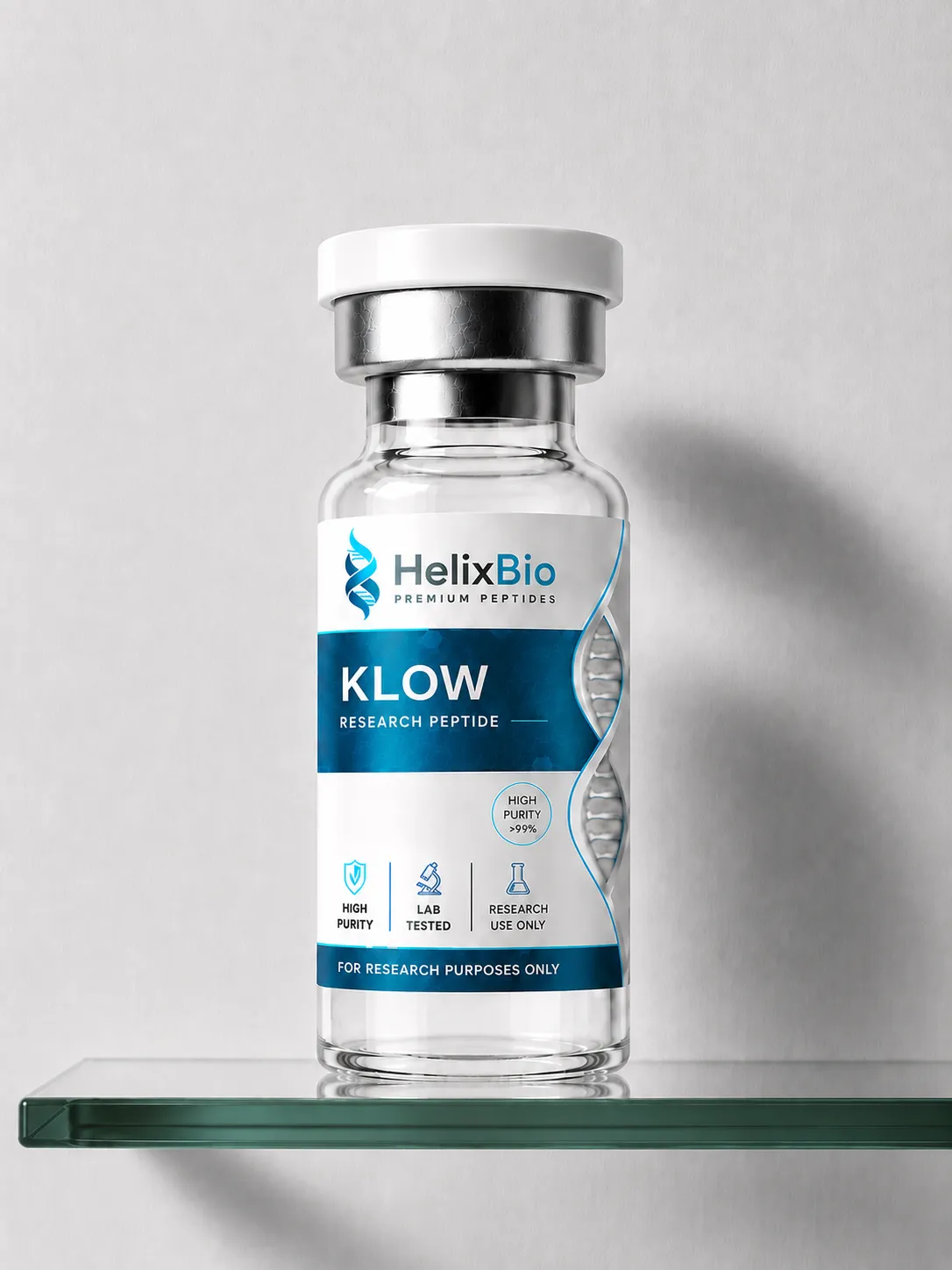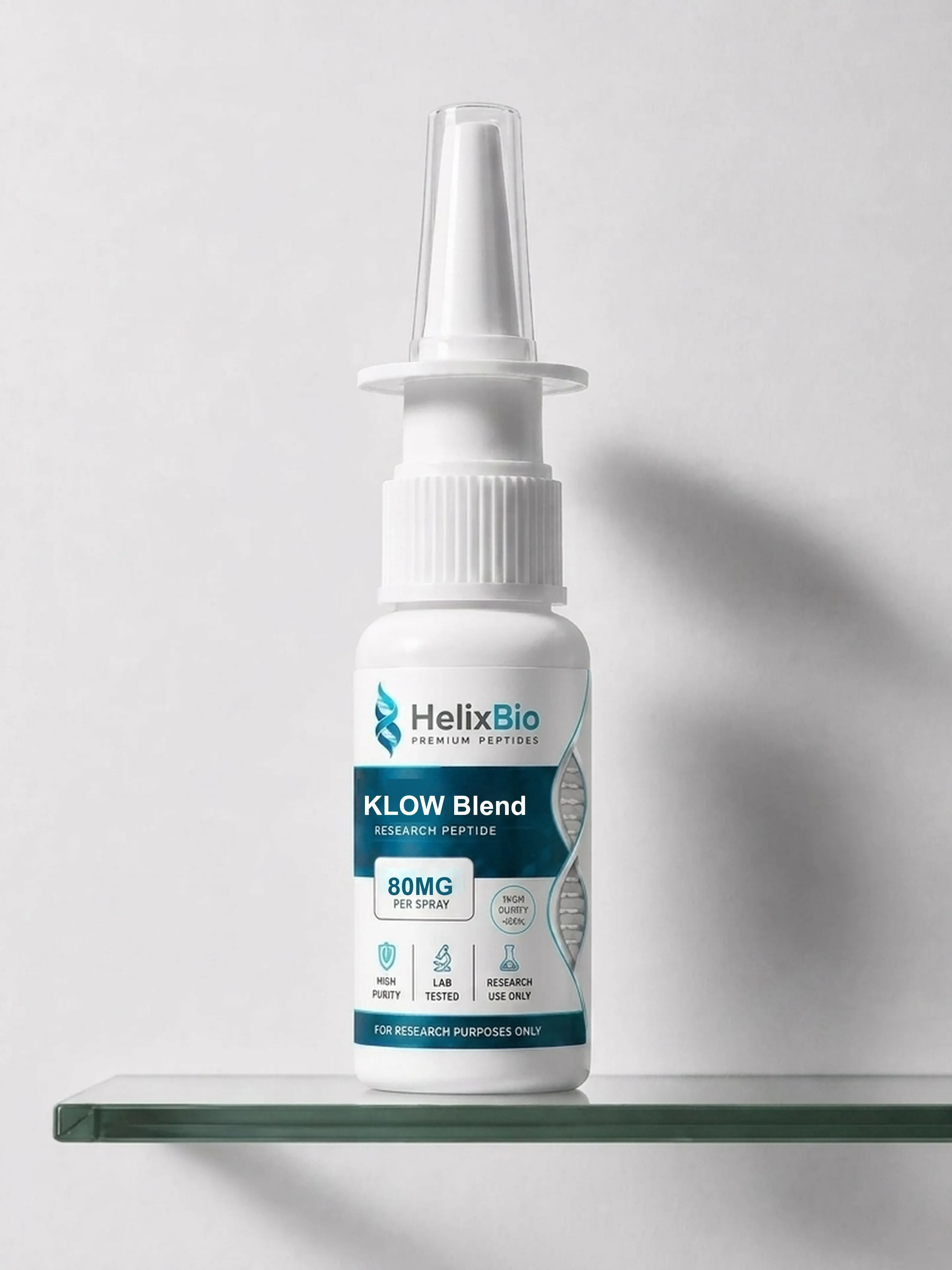
Four molecular entities share one container here, and the smallest of them is the reason the product has its own name. KLOW Blend Spray is Helix Bio's prepared-solution preparation of the KLOW combination — GHK-Cu, a copper(II) complex of the tripeptide glycyl-L-histidyl-L-lysine; BPC-157, a synthetic pentadecapeptide; TB-500, a thymosin β4-related material; and KPV, the three-residue C-terminal fragment of α-melanocyte-stimulating hormone. Those first three are the GLOW combination. KPV is the addition, and it is the only compositional difference between the two. Helix Bio supplies this material for qualified laboratory and scientific research. It is not intended for human or veterinary consumption, administration by any route, diagnosis, treatment, or prevention of disease. One thing is worth establishing before anything else on this page: KLOW is a product designation rather than a characterised substance, and published specifications for blends carrying the name do not agree with each other. What a given container holds is settled by its lot documentation, not by its label.
HPLC certified
Independent analysis
Highest standard
Full traceability
KLOW has no registry identity. There is no CAS number for it, no monograph, no PubChem entry and no entry in any clinical trial register — because KLOW is not a compound. It is four compounds combined at fixed masses and supplied together, and the name describes the combination as sold.
That matters more than it might sound. A name without a specification behind it means the market is free to apply it inconsistently, and it does. Blends sold as KLOW share the same four component identities across essentially every supplier, but they do not share the same quantities, and in one respect they disagree fundamentally. Researchers writing for publication would name the four peptides individually rather than use the trade designation, and that is the right instinct.
The name is generally read as GLOW with a letter added for the extra component. There is no documented acronym expansion, and this page does not supply one.
Spray describes the container. This material is a prepared solution in a metered-delivery bottle, and Helix Bio supplies it on that basis alone — no route of administration is implied, recommended or supported, and none should be inferred from the presentation.
What the format changes is chemistry rather than application, and with four components it changes more than it would with one. A lyophilised blend holds all four dry and comparatively inert until a researcher prepares the solution their protocol calls for. A prepared solution commits all four to a single aqueous environment, at a single pH, chosen once at manufacture and applied to everything in the bottle for the product's whole life.
Those four molecules do not share stability preferences. Two considerations follow specifically from this combination rather than from prepared solutions in general.
The first is the copper. GHK-Cu contributes a coordinated copper(II) centre, and copper(II) is redox-active. Thymosin β4 carries a methionine near its N-terminus. Metal-catalysed oxidation of methionine is ordinary, well-characterised solution chemistry, and a shared vehicle places those two things together in a way that four separate containers do not. That is a reasonable question to put to a supplier about any copper-containing solution-format blend, and it is a question about formulation design rather than about any particular lot.
The second is that the copper also makes appearance informative. Copper(II)–peptide complexes of this type are characteristically blue in aqueous solution, and the colour reflects the coordination state rather than an added colourant. On a single-peptide spray, appearance tells a researcher very little. Here it carries analytical meaning, and any appearance specification should be read against the current lot documentation rather than against general expectations.
KLOW contains four distinct molecular entities. The market commonly calls it a four-peptide blend; that description is not quite right, because GHK-Cu is a copper(II) coordination complex in which the metal is part of the molecular identity rather than an additive. Three peptides and one metallopeptide complex is the accurate reading, and it changes how the material has to be characterised.
| Component | Molecular class | Identity |
|---|---|---|
| BPC-157 | Synthetic pentadecapeptide | Gly-Glu-Pro-Pro-Pro-Gly-Lys-Pro-Ala-Asp-Asp-Ala-Gly-Leu-Val; commonly reported as C₆₂H₉₈N₁₆O₂₂, ~1,419.5 g/mol |
| GHK-Cu | Copper(II) complex of a tripeptide | Glycyl-L-histidyl-L-lysine copper(II); INCI copper tripeptide-1; CAS 89030-95-5; commonly reported as C₁₄H₂₄CuN₆O₄, ~403.9 g/mol |
| KPV | Synthetic tripeptide | Lys-Pro-Val, corresponding to α-MSH(11–13); C₁₆H₃₀N₄O₄, 342.44 g/mol; CAS 67727-97-3; PubChem CID 125672 |
| TB-500 | Thymosin β4-related peptide material | Molecular form must be confirmed per lot: full-length thymosin β4 (43 residues, ~4,963 Da) and the acetylated fragment Ac-LKKTETQ (~889 Da) are both supplied under this name |
Molecular values above describe the named compounds, drawn from published chemical references. They are not lot values. Lot values come from the Certificate of Analysis.
On quantities. Helix Bio's lyophilised KLOW material is published at 80 mg total, with BPC-157 at 50 mg and GHK-Cu, KPV and TB-500 at 10 mg each. Two things need saying about that figure rather than left implied.
First, 80 mg is the combined mass of four peptides. It is not the amount of any one of them, and entering it into a concentration calculation returns a blended figure that describes no individual component. Per-component concentrations have to be worked out four times, once per component mass, against the same volume.
Second, and more consequentially: published KLOW specifications disagree about which component carries the 50 mg. Helix Bio's own documented material places BPC-157 in that position. A majority of other suppliers publish specifications placing GHK-Cu there instead. These are not variations on a theme — they describe blends built around different primary components, in which two of the four concentrations differ five-fold. Results obtained with one specification should not be assumed to transfer to the other, and a market convention is not a substitute for a document. Confirm the per-component mass on the certificate of analysis for the lot in hand.
For the spray presentation specifically, per-component content, total strength, concentration and fill volume are given on the current product listing and the applicable lot documentation. Figures published for the lyophilised vial describe that vial and should not be carried across.
KLOW and GLOW. Both are supplied by Helix Bio and the relationship between them is straightforward.
| KLOW | GLOW | |
|---|---|---|
| Components | 4 | 3 |
| GHK-Cu | Yes | Yes |
| BPC-157 | Yes | Yes |
| TB-500 | Yes | Yes |
| KPV | Yes | No |
KPV is the only compositional difference. Everything else said about choosing between them follows from whether KPV's research context is relevant to the work in question. Component masses within each blend differ, so the two specifications should be checked separately rather than assumed to scale.
Evaluating a single-compound research material is a familiar exercise: confirm identity, confirm purity, match the lot. A four-component product does not reduce to that, and almost none of the extra difficulty is visible on the label. The questions a blend raises that a single compound never does are which molecular form of each component is present, how much of each is present and in what proportion, and what a purity figure can possibly mean on a chromatogram carrying four intended peaks. Helix Bio's position is that those questions belong on the product page rather than in a support email.
The honest answers point toward the lot documentation rather than away from it, and on this product one of them points somewhere uncomfortable. Published specifications for blends sold as KLOW genuinely conflict about which component is dominant. A page that quietly picked one and presented it as the standard would read more confidently and serve a researcher worse, because the researcher's actual problem is that the number they find online may not describe the vial in front of them. Stating the conflict, naming which side Helix Bio's own documentation falls on, and directing the reader to their lot certificate is the only version of this section that survives contact with a real experiment.
For KLOW Blend Spray specifically, the documentation to look for is per-component identity confirmation with the thymosin-related form named explicitly, per-component purity reported separately rather than as one blended figure, a quantitative determination of how much of each component is present, and a copper determination by an elemental method. A general catalogue statement about testing standards is not a substitute for any of those. Where a catalogue statement and a lot document disagree, the lot document governs.
KLOW Blend Spray is intended for qualified users working in legitimate laboratory or scientific research environments, including:
It is not intended for personal experimentation, self-administration, human consumption, veterinary use, cosmetic use, or medical treatment. No dosing information, administration protocol or preparation instruction is provided on this page or elsewhere on this site, and none should be inferred from the composition information above.
Product level
| Specification | Details |
|---|---|
| Product Name | KLOW Blend Spray |
| Research Category | Healing & Recovery / Research Peptide Blend |
| Product Type | Multi-component research preparation |
| Number of Components | Four |
| Composition | GHK-Cu, BPC-157, KPV, TB-500 |
| Format | Prepared spray solution |
| Component Proportion | Fixed at manufacture; not adjustable by the end user |
| Total Strength | Refer to current product listing and lot documentation |
| Concentration | Refer to current product listing and lot documentation |
| Concentration Basis | Refer to the applicable Certificate of Analysis |
| Fill Volume | Refer to current product listing |
| Vehicle / Excipients | Refer to current product documentation |
| Component Ratio | Stated per lot; see the applicable Certificate of Analysis |
| Appearance | Refer to current lot documentation |
| Purity | Reported per component; refer to the applicable Certificate of Analysis |
| Identity Testing | Refer to the applicable Certificate of Analysis |
| Lot / Test Date | Stated on the applicable Certificate of Analysis |
| Packaging | Refer to current product listing |
| Storage | Follow current product-specific documentation |
| Manufacturer | Helix Bio |
| Country of Origin | Verify current product documentation |
| Intended Use | Research and laboratory investigation only |
| Human Use | Not intended for human consumption or administration |
| Veterinary Use | Not intended for veterinary use |
Component level
| Component | Molecular class | Reported molecular identity |
|---|---|---|
| BPC-157 | Synthetic pentadecapeptide | GEPPPGKPADDAGLV; C₆₂H₉₈N₁₆O₂₂; ~1,419.5 g/mol |
| GHK-Cu | Copper(II) coordination complex of a tripeptide | Glycyl-L-histidyl-L-lysine copper(II); copper tripeptide-1; CAS 89030-95-5; C₁₄H₂₄CuN₆O₄; ~403.9 g/mol |
| KPV | Synthetic tripeptide | Lys-Pro-Val; α-MSH(11–13); C₁₆H₃₀N₄O₄; 342.44 g/mol; CAS 67727-97-3; PubChem CID 125672 |
| TB-500 | Thymosin β4-related peptide material | Form confirmed per lot: thymosin β4 (43 residues, ~4,963 Da) or Ac-LKKTETQ (~889 Da) |
Molecular values above are drawn from published chemical references for the named entities. They describe the compounds, not this lot.
Each component has its own literature, its own models and its own limitations. They are set out separately below because that is how the evidence exists.
Copper-peptide chemistry. GHK-Cu is studied as a defined copper(II)–peptide complex, which makes it a reference material in work on metal–peptide coordination, copper transport and copper-dependent enzymes. Lysyl oxidase, a copper-requiring enzyme involved in the cross-linking of collagen and elastin, recurs through this literature as a mechanistic anchor. The published record is overwhelmingly in vitro and in animal models.
Matrix and dermal cell biology. Fibroblast and keratinocyte culture systems, matrix protein synthesis endpoints and gene-expression profiling account for a large share of the GHK-Cu record. These are cell-level findings. They describe what has been measured in a dish.
Melanocortin-derived anti-inflammatory research. KPV is studied as the C-terminal fragment of α-MSH that retains anti-inflammatory activity in preclinical models while lacking the pigmentary activity of the parent hormone. Its mechanism is unusual and worth stating precisely: KPV lacks the sequence motif required to bind the known melanocortin receptors, and published work reports uptake into intestinal epithelial cells through the PepT1 transporter rather than through receptor engagement. Research contexts include NF-κB and MAP-kinase signalling, cytokine output in epithelial and intestinal models, and formulation work aimed at protecting a small unmodified peptide from peptidase degradation. FDA's 2026 review of KPV identified no human safety studies.
Soft-tissue and gastrointestinal models. BPC-157's published record is concentrated in rodent models across gastrointestinal and soft-tissue endpoints. Two limitations belong with any reading of it: the work is overwhelmingly preclinical, and a large proportion originates from a small number of closely associated research groups.
Cytoskeletal and actin research. Thymosin β4 is characterised as an actin-sequestering protein, and its interaction with monomeric actin underlies most of its research literature. Whether that literature describes a given research material depends entirely on whether the material is the full-length protein or the short N-terminal fragment. FDA's 2026 review of TB-500 identified no human safety studies.
Analytical method development. This product is a genuine test case for multi-analyte characterisation: four species spanning fourteen-fold in mass, one of them a metal complex requiring an orthogonal technique, one of them small and effectively invisible to the detection wavelength most peptide methods default to. That is a legitimate research application in its own right, and arguably the one this material is best suited to.
No published study of this four-component combination was identified. Searches of PubMed, ClinicalTrials.gov and the WHO International Clinical Trials Registry Platform return no results for KLOW as a compound, formulation or investigational product, and none for the four components investigated together as a combination.
The available literature concerns the components individually, in specific preparations, at specific concentrations, in specific models. Because there is no direct combination evidence, no synergistic, additive or complementary effect can be claimed for this blend, and no claim that the combination performs better than its components individually is supported. Anything described as an effect of KLOW is describing the components separately and inferring the combination. That inference may be reasonable. It is not evidence, and researchers designing work with a multi-component material should treat the combination as uncharacterised and consider whether component-level controls are required to interpret any result obtained with it.
Each publication should be evaluated on its own model, preparation, concentration and endpoints. Findings do not transfer across molecular forms, across preparations, or from components to combinations.
A single purity percentage is a well-defined quantity for a single-compound material. On a four-component product it is not, and the reason is worth stating plainly rather than working around.
Chromatographic purity is normally reported by area normalisation — the target peak as a proportion of total peak area. A chromatogram carrying four intended components has no single target peak, so an area-normalised figure has no unambiguous meaning on this material. Three separate things are needed instead:
There is a further constraint on this particular combination that does not apply to most materials in this catalogue. Ultraviolet detection at 280 nm relies on tryptophan and tyrosine. None of KLOW's components provides a useful chromophore at that wavelength. BPC-157's sequence contains no tryptophan, tyrosine or phenylalanine. KPV is lysine, proline and valine — no aromatic residue at all. Histidine in GHK-Cu is not a 280 nm chromophore, and thymosin β4 contains phenylalanine but neither tryptophan nor tyrosine. The practical consequences are concrete: absorbance at 280 nm cannot be used to determine peptide content for any component here, detection has to run in the low ultraviolet where the peptide bond absorbs, and response factors at that wavelength differ between components and are shared with substances that may be present in the vehicle. A method description that names only a wavelength is not sufficient information about this material.
Two component-specific points complete the picture.
The smallest component is the one that defines the product. KPV at 342 Da is what separates KLOW from GLOW. It is also the least visible analyte in the mixture — no aromatic residue, and a mass low enough to fall outside the acquisition range of a method configured around the 1,420 and 4,963 Da components. A run tuned for the larger species can be blind to the one that makes the material KLOW rather than GLOW. Confirming that KPV is present, and quantifying it, is a deliberate analytical decision rather than something that happens automatically.
Some things mass spectrometry cannot settle. Published structure-activity work on α-MSH(11–13) analogues reports that replacing L-proline with D-proline at the middle position abolishes activity. The two forms have identical mass. Chiral methods, not mass spectrometry, distinguish them. Separately, aspartyl isomerisation in BPC-157's Asp-Asp-Ala-Gly region is isobaric and therefore invisible to mass measurement alone.
What mass spectrometry does exceptionally well on this product is settle identity across the set. The four components span roughly fourteen-fold in mass — about 342, about 404, about 1,420, and either about 889 or about 4,963 depending on which thymosin-related form is supplied. A single run configured across that range confirms that four intended species are present and resolves the TB-500 form question that the product name leaves open.
Researchers evaluating a KLOW Blend Spray lot should look for:
One distinction is worth carrying into any document review. Microbiological release testing and identity testing are different documents that are often both called a certificate of analysis. A sterility result and an endotoxin result establish that a material passed those tests; they say nothing about what is in the container, how much of it, or how pure it is. If a document reports one purity figure and no ratio, it has not characterised a blend. If it reports sterility and endotoxin only, it has not characterised the material at all — it has released it.
No certification, regulatory approval or quality claim should be inferred unless it is explicitly documented by the manufacturer or the relevant regulatory authority. Where a general catalogue statement and a lot document disagree, the lot document governs.
Storage and handling requirements should be taken from the current KLOW Blend Spray product documentation and lot-specific instructions. Helix Bio's lot documentation for its KLOW material has specified refrigerated storage; confirm the condition stated for the lot and format in hand rather than assuming it carries across presentations.
General laboratory considerations:
Degradation in a multi-component solution is not necessarily uniform across the components, and the least stable component sets the practical limit for the whole container regardless of how the others behave. Storage guidance published for any one component in isolation should not be assumed to describe this material.
Helix Bio describes its research materials as supplied to laboratories and institutions in the United States, with tracked shipping and controlled packaging practices within its fulfilment process.
Because shipping conditions, packaging specifications, availability and delivery requirements change, researchers should review the current Helix Bio shipping information and the product listing before ordering.
Product packaging should remain appropriately labelled and handled as research material after delivery, with the lot number retained so it can be matched to the applicable Certificate of Analysis. Researchers are responsible for following applicable institutional, federal, state and local requirements governing research materials.
KLOW Blend Spray is supplied by Helix Bio for research and laboratory purposes only. It is not intended for human or veterinary consumption, self-administration, administration by any route, diagnosis, treatment, cure, mitigation or prevention of any disease or condition. It is not a cosmetic, a dietary supplement, a consumer wellness product or a medical treatment.
None of the four components is an FDA-approved drug in the United States, and their regulatory positions are not identical. As of September 2026, BPC-157, KPV and TB-500 were each considered by FDA's Pharmacy Compounding Advisory Committee at its meeting on 23 July 2026, and the committee recommended each of them for possible inclusion on the 503A Bulks List by a vote of eight to six with one abstention. GHK-Cu was not considered at that meeting; injectable GHK-Cu was removed from Category 2 of FDA's interim 503A bulk drug substances list on 15 April 2026, and FDA has indicated a separate review before the end of February 2027.
Four qualifications apply to all of the above, and each of them matters. The committee's recommendations were made against FDA staff's own written assessment, which had advised against including any of the substances under review. A Pharmacy Compounding Advisory Committee recommendation is advisory, is not binding on FDA, and is not FDA approval; placement on the list would require rulemaking. Removal from Category 2 did not place any substance on an authorised list. And Helix Bio is not a compounding pharmacy and does not operate as a compounding facility under Section 503A of the Federal Food, Drug, and Cosmetic Act, so none of this describes a route to human use.
Two further points belong here rather than being left to inference. FDA's review identified no human safety studies for KPV or TB-500. And research evidence for the individual components is not evidence for this combination, which has not been characterised in published research.
Regulatory status changes. Researchers should confirm current status directly with FDA. Researchers are responsible for determining whether a material is appropriate for their intended experimental application and for complying with applicable institutional and regulatory requirements.
Knowledge Base
Knowledge Base
Knowledge Base
Knowledge Base
Knowledge Base
Knowledge Base
Knowledge Base
Knowledge Base
Knowledge Base
Knowledge Base
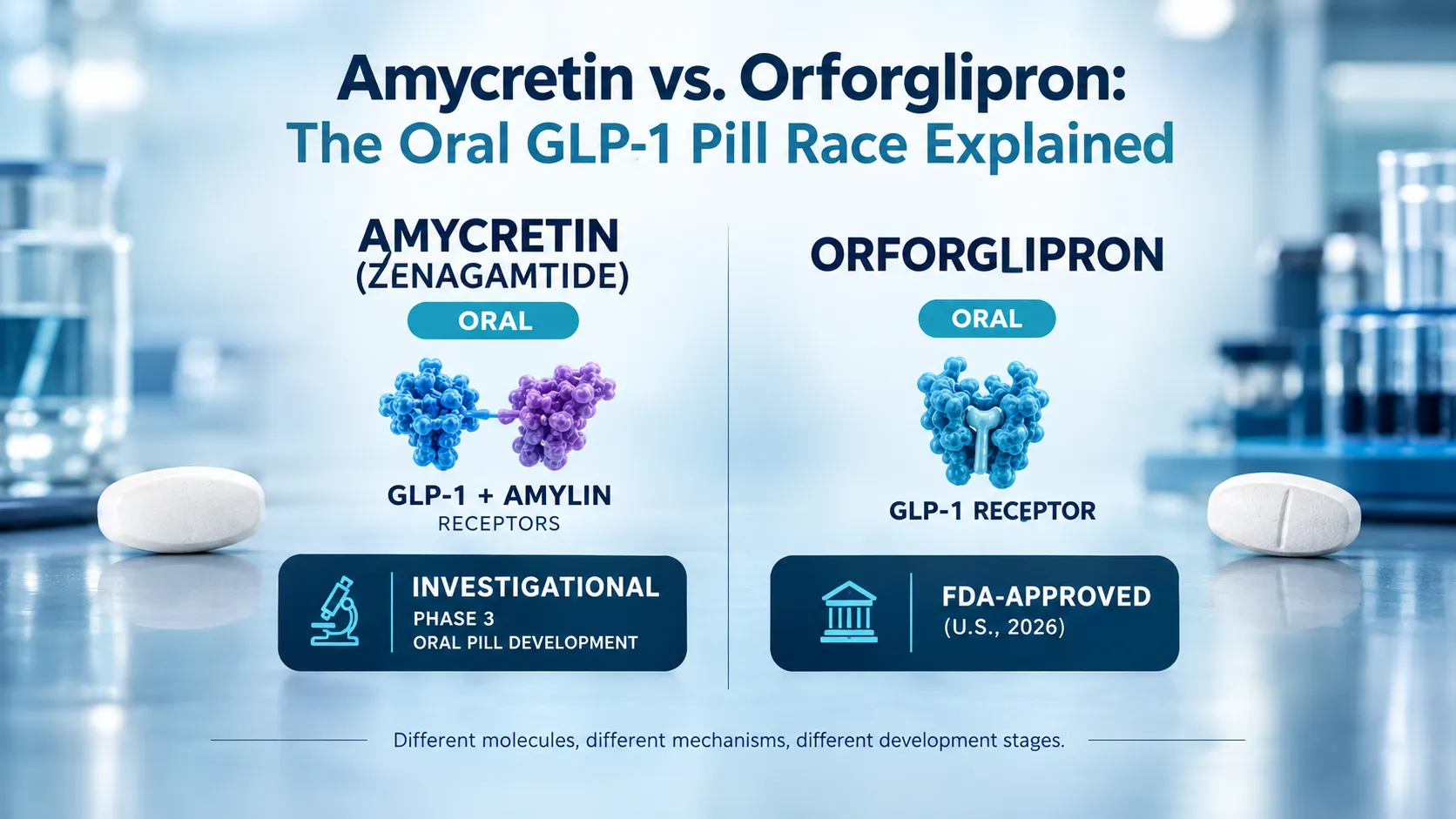
Amycretin is a peptide and orforglipron is not. How that chemistry explains the formulations, trial results, and approval status of both GLP-1 pills.
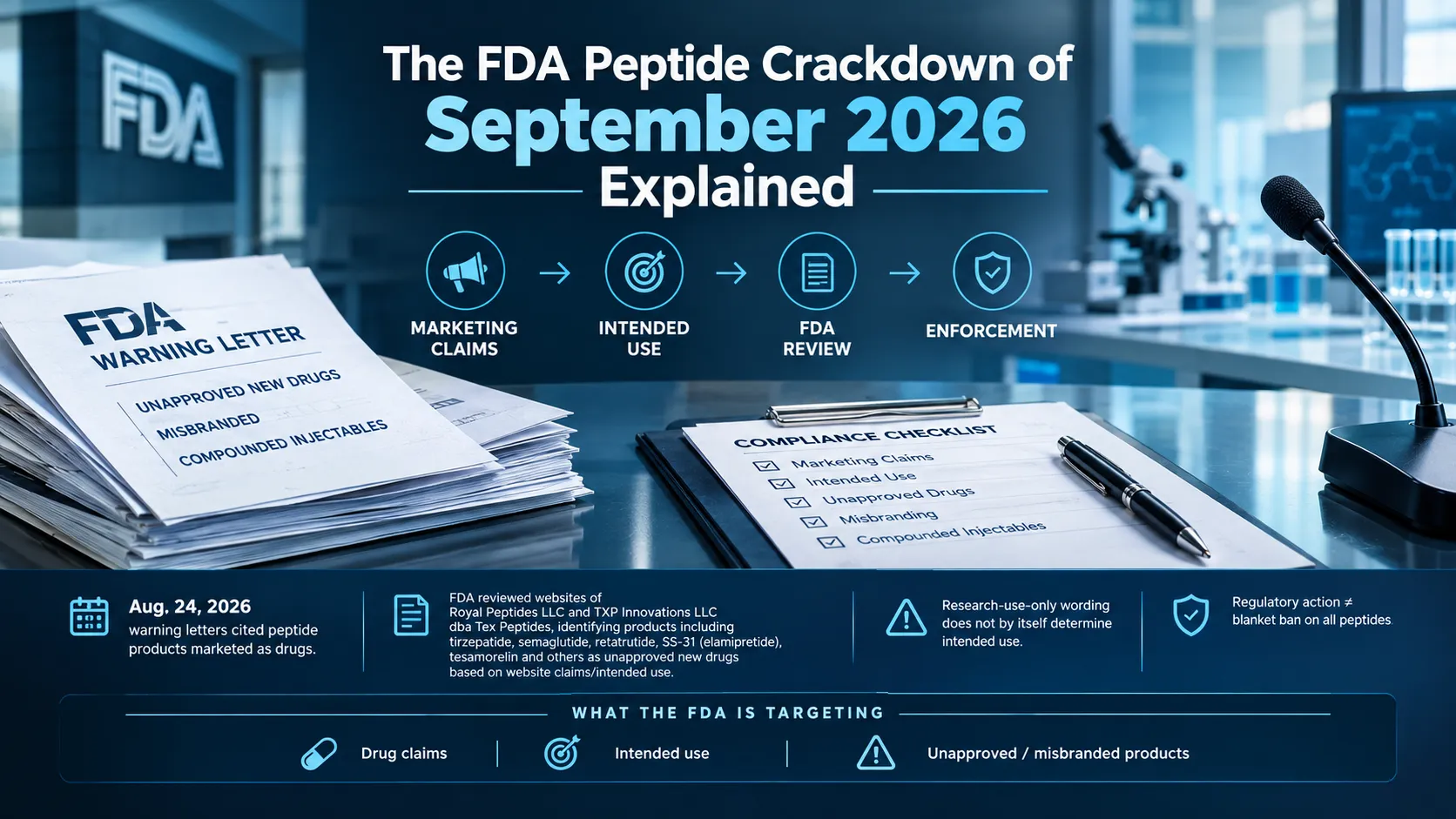
Five peptide sellers got FDA warning letters in September 2026. See who was named, why the research label failed, and the full 2026 enforcement timeline.
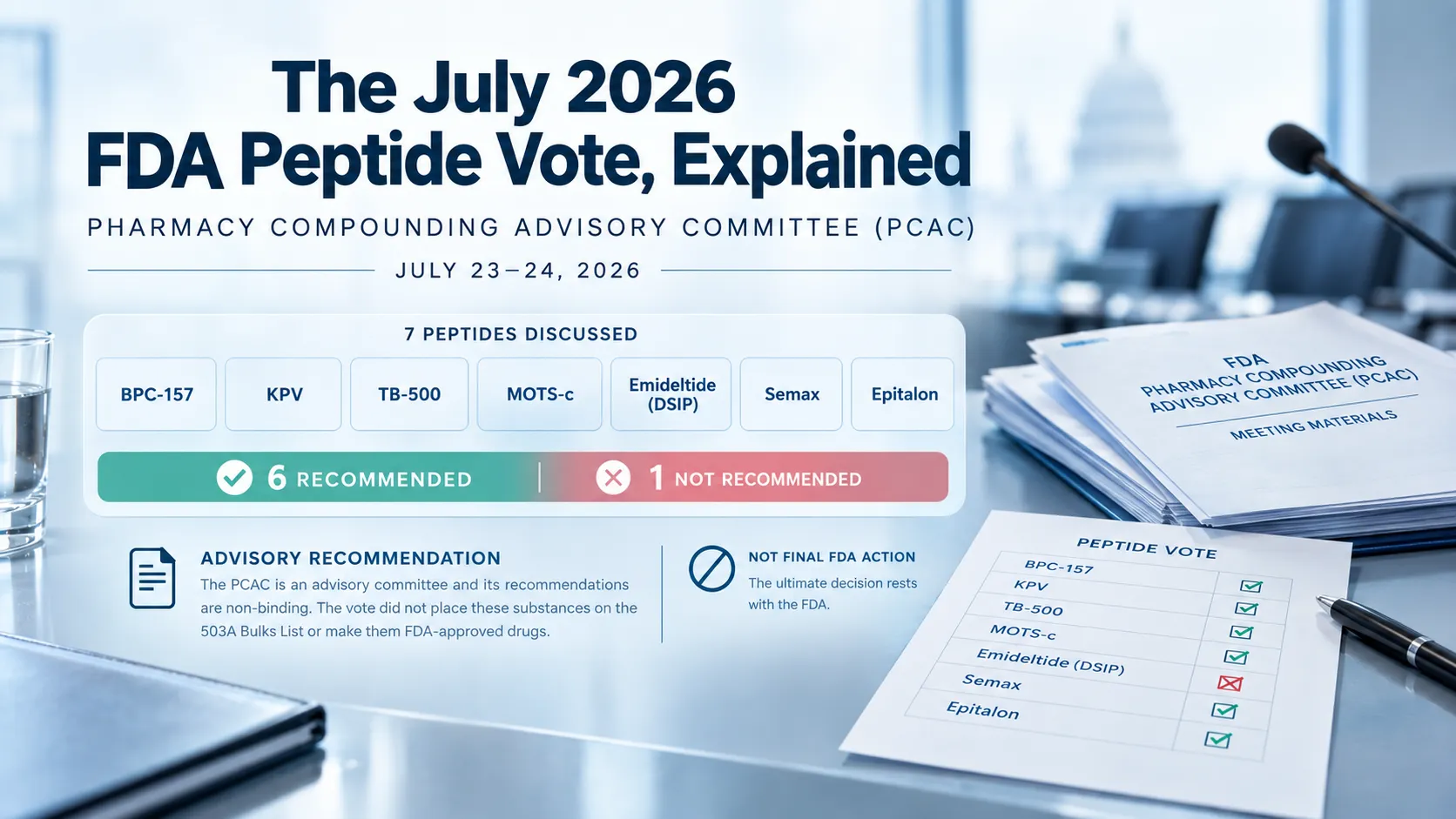
In July 2026, the FDA's advisory committee recommended 6 peptides for the 503A bulk list. None are on it yet. What the vote changed and what it didn't.