Amycretin vs. Orforglipron: The Oral GLP-1 Pill Race Explained
Metabolic researchSeptember 23, 20268 min read
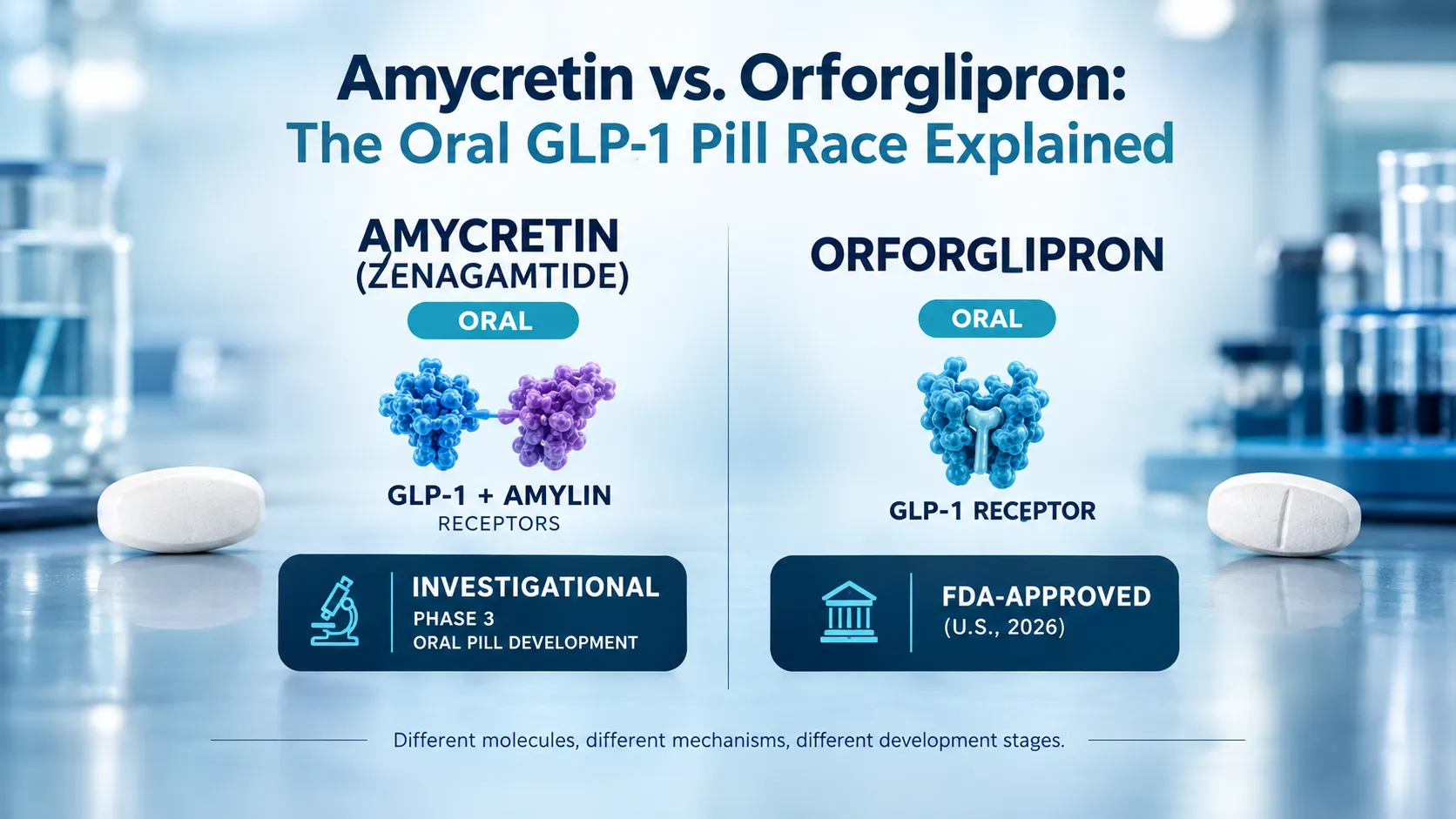
Amycretin is a peptide and orforglipron is not. That single chemical difference explains their formulations, label restrictions, and development timelines.
Amycretin, now named zenagamtide, is a single peptide molecule described in 2026 phase 2 papers as an agonist of GLP-1, amylin and calcitonin receptors.
Orforglipron, marketed as Foundayo, is a synthetic small molecule of roughly 883 daltons with no peptide backbone, about one-fifth the mass of semaglutide.
The FDA approved Foundayo on April 1, 2026 for chronic weight management, the fifth clearance under the Commissioner's National Priority Voucher pilot and the first new molecular entity approved under it.
Zenagamtide is investigational with no approval anywhere; the Phase 3 AMAZE program began February 2026 and lists completion in June 2029.
Oral peptides require permeation enhancers such as SNAC because gut proteases degrade them, and SNAC-based formulations carry fasting-type label restrictions.
Orforglipron requires no permeation enhancer and its approved label carries no food, water, or time-of-day restrictions.
The Wegovy pill, oral semaglutide, was approved December 22, 2025, making it the first oral GLP-1 for weight management; Foundayo is the first without food or water restrictions.
No head-to-head trial has tested zenagamtide against orforglipron, so cross-trial figures cannot rank the two on efficacy.
Two oral compounds dominate current GLP-1 research discussion, and one is a peptide while the other is not. Amycretin, now formally renamed zenagamtide, is a peptide. Orforglipron, sold as Foundayo, is a synthetic small molecule with no peptide backbone at all. That single chemical fact explains nearly every meaningful difference between them, from how each survives the gut to how each is manufactured and stored.
One of the two is already approved. The FDA cleared Foundayo on April 1, 2026 for chronic weight management. Zenagamtide remains investigational, with Phase 3 work underway and no approval anywhere. This article covers what each compound is and why the chemistry dictates the formulation. It also sets out what the trial record shows, along with one widely repeated date error worth correcting.
Is amycretin actually a peptide?
Yes, amycretin, now called zenagamtide, is a unimolecular peptide agonist. The 2025 phase 1b/2a paper describes it as a GLP-1 and amylin receptor agonist; the 2026 phase 2 papers describe it as an agonist of GLP-1, amylin and calcitonin receptors. It is a single peptide molecule acting at more than one receptor target. Orforglipron is the opposite case, a synthetic small molecule of roughly 883 daltons with no peptide backbone. Eli Lilly developed it under the code LY3502970.
That distinction is not a technicality. Whether a compound is built from amino acids determines how it behaves in the digestive tract. That behavior in turn determines how it can be formulated as a pill. Every downstream difference between these two follows from it.
What zenagamtide is and where it stands
Novo Nordisk developed the compound under the code NNC0487-0111 and the working name amycretin. Published literature now uses zenagamtide, and both names refer to the same molecule.
Its mechanism is described in the peer-reviewed record as a unimolecular agonist, meaning one molecule reaching several receptor targets. The 2025 phase 1b/2a paper describes GLP-1 and amylin receptor agonism; the 2026 phase 2 papers describe agonism at GLP-1, amylin and calcitonin receptors. This differs structurally from CagriSema, which combines two separate molecules, cagrilintide and semaglutide, in a fixed-dose pairing. The amylin receptor research behind CagriSema covers that mechanism in depth.
Novo is developing two routes in parallel. A once-weekly subcutaneous formulation and a once-daily oral formulation are both under investigation for weight management and type 2 diabetes. Industry reporting expects the injectable to reach market first.
It remains investigational, with no FDA approval and no approval in any other jurisdiction. The Phase 3 AMAZE program began in February 2026, with AMAZE 1 (NCT07339423) enrolling an estimated 1,150 participants, with primary completion listed for June 2029. Analyst expectations place the earliest realistic approval around 2029 to 2030, which is an industry projection and not a commitment from the sponsor.
What Foundayo is and where it stands
Orforglipron is a non-peptide small-molecule GLP-1 receptor agonist. It was discovered at Chugai Pharmaceutical and licensed to Eli Lilly in 2018.
The molecular contrast with peptide GLP-1 drugs is stark. Orforglipron has a molecular formula of C48H48F2N10O5 and a molecular weight near 883 daltons. Semaglutide, a 31-amino-acid peptide, sits around 4,100 daltons. Orforglipron is roughly one-fifth the mass. Structural work using cryo-electron microscopy places its binding site in a pocket within the receptor's upper helical bundle. Receptor pharmacology describes biased agonism favoring G-protein and cAMP signaling with low beta-arrestin recruitment.
Approval came on April 1, 2026, covering use alongside a reduced-calorie diet and increased physical activity. The indication applies to adults with obesity, or overweight with at least one weight-related comorbid condition. That clearance was the fifth under the FDA's Commissioner's National Priority Voucher pilot and the first new molecular entity approved under the program. FDA described it as the fastest approval of a new molecular entity since 2002, issued 50 days after filing.
A diabetes indication is not approved. Industry reporting has pointed to late 2026 for a possible decision, which remains pending and not granted.
Why the chemistry decides how each pill is formulated
This is where the peptide distinction stops being academic.
Peptides are chains of amino acids, and the digestive tract is built to break those chains apart. Gut proteases degrade peptide drugs before meaningful absorption occurs. An oral peptide therefore needs help crossing the gut wall intact, and the established solution is a permeation enhancer. Oral semaglutide uses salcaprozate sodium, known as SNAC, for exactly this purpose.
SNAC-based oral peptides carry consequences in the label. Oral semaglutide must be taken in the morning with a small amount of water, a fixed interval before any food or other drink. Those restrictions exist because the absorption mechanism demands specific gut conditions.
Orforglipron has no peptide backbone, so there is nothing for gut proteases to cleave. No permeation enhancer is required, and the approved label carries no food or water restrictions and no time-of-day requirement. Lilly's approval announcement made this the headline claim.
Oral zenagamtide uses SNAC as its permeation enhancer, which is documented. Whether its eventual label would carry fasting-type restrictions is an inference drawn from how comparable SNAC formulations behave. No label exists, because the compound is investigational.
This section describes formulation science, not administration guidance. Helix Bio Chem supplies research materials only and provides no dosing, administration, or usage instructions for any compound.
The manufacturing consequences run in the same direction. Small-molecule synthesis and peptide production are different industrial problems with different cost curves and different scale ceilings. Oral small molecules also avoid the cold-chain requirements that injectable peptide products typically carry.
What the trials showed, side by side
Compound
Trial
n
Duration
Weight change
HbA1c change
Notes
Orforglipron
ATTAIN-1
3,127
72 wk
−12.4% adhered / −11.2% treatment-policy
Not primary
Obesity population
Orforglipron
ATTAIN-2
1,613
72 wk
−10.5% topline / −9.6%
−1.8 pp
Type 2 diabetes
The ATTAIN-1 figures carry two numbers because they report two estimands. One result, 12.4%, describes participants who adhered to treatment. The 11.2% figure applies regardless of adherence. Both are valid, and they answer different questions.
ACHIEVE-3 is the only head-to-head trial in this table, and it compared orforglipron against oral semaglutide, not against zenagamtide.
No trial has ever tested zenagamtide directly against orforglipron. Cross-trial numbers cannot rank them, because different populations, durations, endpoints, and analysis methods make that comparison invalid. Any source presenting one as more effective than the other on this evidence is overreaching.
Several sources get this wrong, so the record is worth stating plainly.
The FDA approved Novo Nordisk's Wegovy pill, oral semaglutide 25 mg, on December 22, 2025. Novo launched it in the United States in early January 2026. That was the first oral GLP-1 receptor agonist approved for weight management.
Foundayo arrived on April 1, 2026, more than three months later. Its genuine distinction is narrower and more specific. Foundayo is the first oral GLP-1 for weight loss carrying no food or water restrictions and no time-of-day requirement. That claim is accurate, while the broader label of first GLP-1 pill is not.
The difference matters because the narrower claim is the one that follows from the chemistry.
What the safety data shows so far
Foundayo's label carries a boxed warning for thyroid C-cell tumors, including medullary thyroid carcinoma. The label states that orforglipron is not pharmacologically active in rats or mice and did not produce tumors in rodents, and that while it is pharmacologically active at the human GLP-1 receptor, the human relevance of GLP-1 receptor-dependent rodent thyroid C-cell tumors has not been determined. It is contraindicated in patients with a personal or family history of medullary thyroid carcinoma, in patients with multiple endocrine neoplasia syndrome type 2, and in patients with known serious hypersensitivity to orforglipron. Reported adverse effects are class-typical and gastrointestinal, including nausea, constipation, diarrhea, vomiting, indigestion, and abdominal pain. Headache, fatigue, and hair loss also appear in the label.
Zenagamtide's safety profile is not established, and its investigational status means no regulator has reviewed it. In the phase 2 subcutaneous dose-finding trial, most adverse events were gastrointestinal and mild to moderate, 21 of 261 exposed participants (8%) reported serious adverse events, and no deaths occurred. Those are trial observations from a dose-finding study, not label facts.
Why peptide researchers should care
The first oral GLP-1 to reach patients without fasting restrictions is not a peptide. For a field built on peptide engineering, that is a genuinely awkward result.
The protease problem has shaped oral peptide delivery for two decades. SNAC and comparable permeation enhancers made oral peptides possible, but they came with absorption conditions that translate into label restrictions. A small molecule sidesteps the problem entirely by not having the vulnerability in the first place.
Peptide chemistry's counter-move is not better absorption technology but different pharmacology. Amylin co-agonism, the mechanism behind both zenagamtide and the cagrilintide and CagriSema research, targets a receptor system that small molecules have not matched. Dual-receptor peptide engineering appears across tirzepatide's GIP and GLP-1 mechanism and the broader GLP-1 and GIP agonist literature. That is where peptides retain an advantage molecular size does not erase.
Whether the next decade of oral metabolic drugs belongs to better peptides or to fewer of them is still open. The chemistry has not settled it.
Where this leaves the comparison
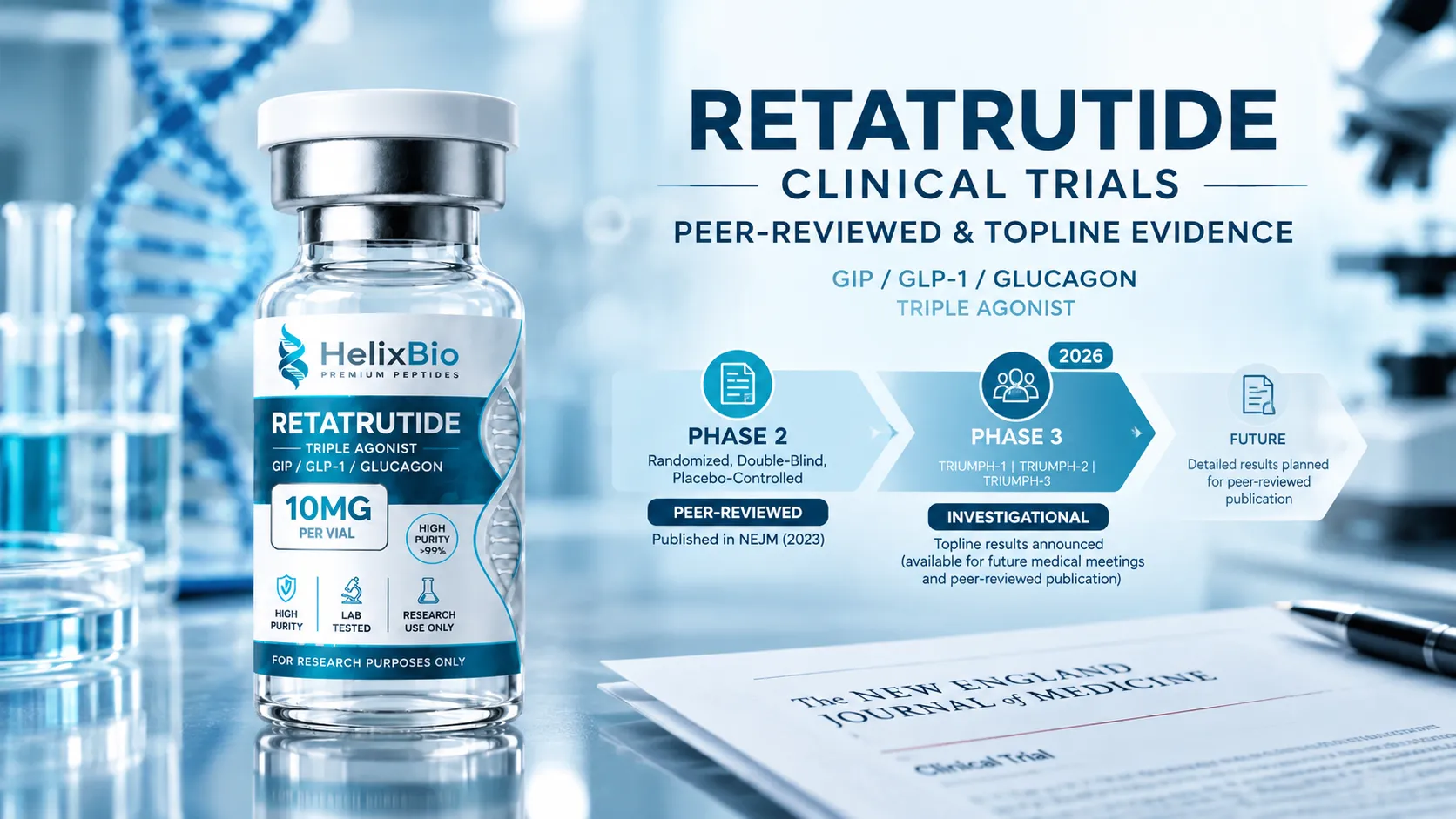
One compound is a peptide and the other is a small molecule, and that difference drives the formulation gap between them. Regulatory status splits them too: one is approved and the other is investigational, which puts their timelines years apart. The record for the first oral GLP-1 approved for weight management belongs to the Wegovy pill, not to Foundayo. Readers tracking this area may find the retatrutide trial evidence a useful next step.
Got Questions?
Frequently Asked Questions
Yes. Amycretin, now named zenagamtide, is a unimolecular peptide agonist. The 2025 phase 1b/2a paper describes it as a GLP-1 and amylin receptor agonist, and the 2026 phase 2 papers describe it as an agonist of GLP-1, amylin and calcitonin receptors.
No. Orforglipron is a synthetic small molecule with the formula C48H48F2N10O5 and a molecular weight near 883 daltons. It has no peptide backbone, which is why gut proteases do not degrade it the way they degrade peptide drugs.
Zenagamtide is the current name for the compound previously called amycretin, developed by Novo Nordisk under the code NNC0487-0111. Both names refer to the same investigational molecule, and published literature has moved to zenagamtide.
No. Zenagamtide, formerly amycretin, is investigational and holds no approval in the United States or elsewhere. Phase 3 trials under the AMAZE program began in February 2026.
The Phase 3 AMAZE 1 trial lists completion in June 2029, and industry analysts have pointed to roughly 2029 to 2030 as the earliest realistic approval window. Those are external projections, not commitments from the sponsor, and trial outcomes remain unknown.
Orforglipron has no peptide backbone, so it does not require a permeation enhancer to survive the digestive tract. Its approved label carries no food or water restrictions and no time-of-day requirement. This is a formulation fact from the label, not administration guidance.
Zenagamtide is a single molecule acting at more than one receptor. CagriSema is a fixed-dose combination of two separate molecules, cagrilintide and semaglutide. The receptor targets overlap but the molecular architecture differs.
No head-to-head trial comparing the two compounds exists. Their published trials used different populations, durations, and endpoints, so cross-trial percentages cannot establish which performs better.