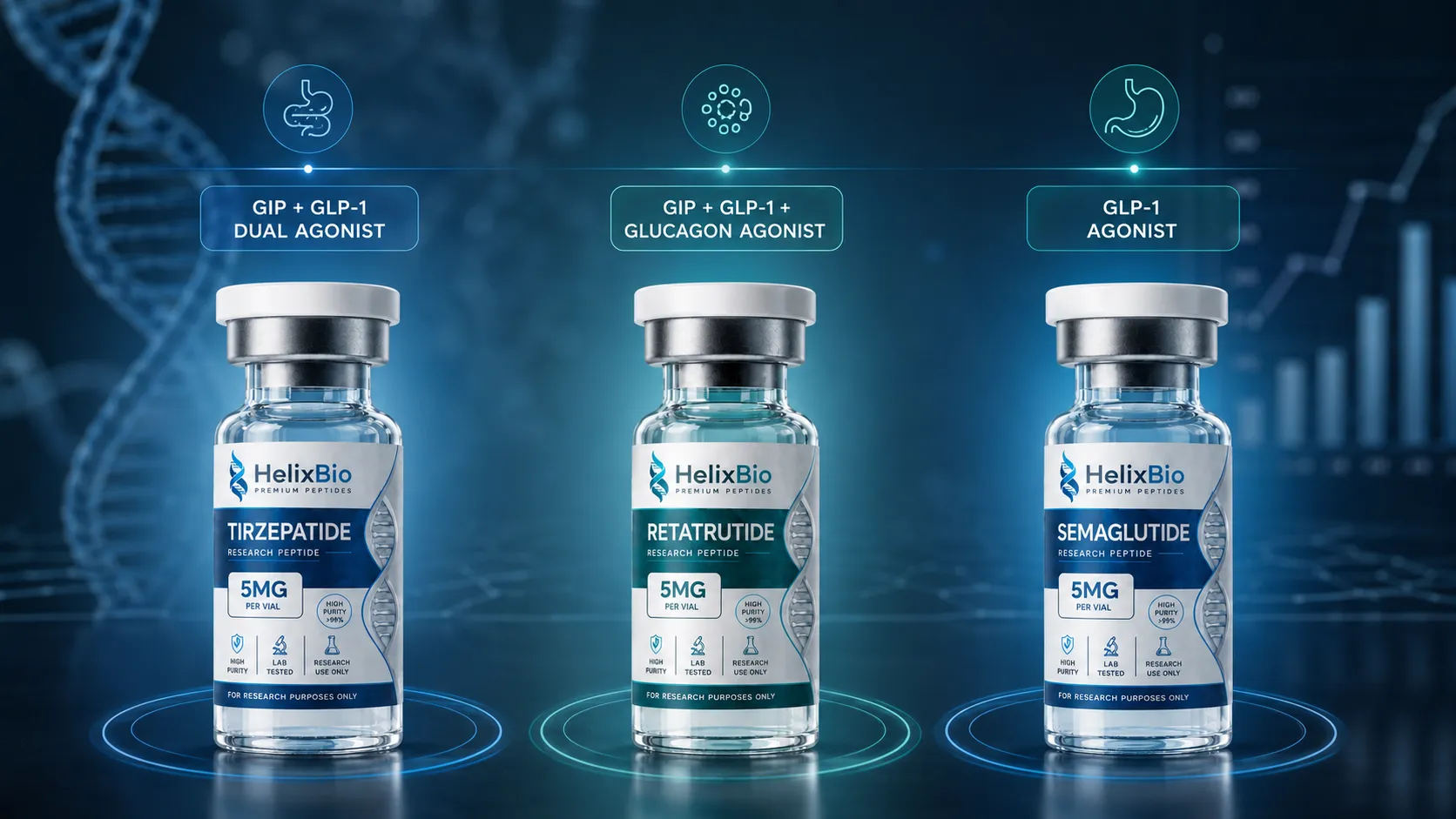
- Semaglutide is a single GLP-1 receptor agonist, Tirzepatide is a dual GIP and GLP-1 agonist, and Retatrutide is a triple GIP, GLP-1 and glucagon receptor agonist.
- The GLP-1 receptor binds an incretin hormone released from intestinal L-cells and has been associated in research with glucose-dependent insulin secretion and appetite signalling.
- The GIP receptor binds the second major incretin from intestinal K-cells, and its pharmacology has been investigated for both agonism and antagonism in metabolic research.
- Glucagon receptor agonism within a multi-agonist molecule extends the mechanism beyond incretin biology into hepatic glucose output and energy expenditure pathways.
- All three compounds use fatty acid acylation and albumin binding to extend circulating duration, supporting weekly dosing intervals in trial protocols.
- Semaglutide functions as the mechanistic control in comparative research because its single receptor target isolates one variable rather than two or three.
- Retatrutide remains investigational with no FDA-approved form, having been studied in Eli Lilly's Phase 3 programme including the TRIUMPH and TRANSCEND-T2D-1 trials.
- Research-grade Semaglutide and Tirzepatide are laboratory reagents distinct from the FDA-approved branded pharmaceutical products containing the same compounds.
- Increasing receptor targets produces a richer signalling profile but a harder attribution problem, since simultaneous receptor activities cannot be separated by observation alone.
- Lot-level purity verification is a prerequisite for valid three-compound comparison, since material variance can masquerade as between-compound difference.
The incretin research field has moved through three distinct generations of receptor agonist design in roughly a decade, and the compounds defining each generation differ in a single structural respect: how many receptor targets a single molecule engages. Semaglutide activates one. Tirzepatide activates two. Retatrutide activates three. That progression from single to dual to triple agonism is the organising principle behind current metabolic peptide research, and understanding it explains why the three compounds produce distinct signalling profiles in study models despite belonging to the same broad class. This comparison covers the receptor pharmacology of each, what published investigational data has reported, and how the three differ in handling and research application.
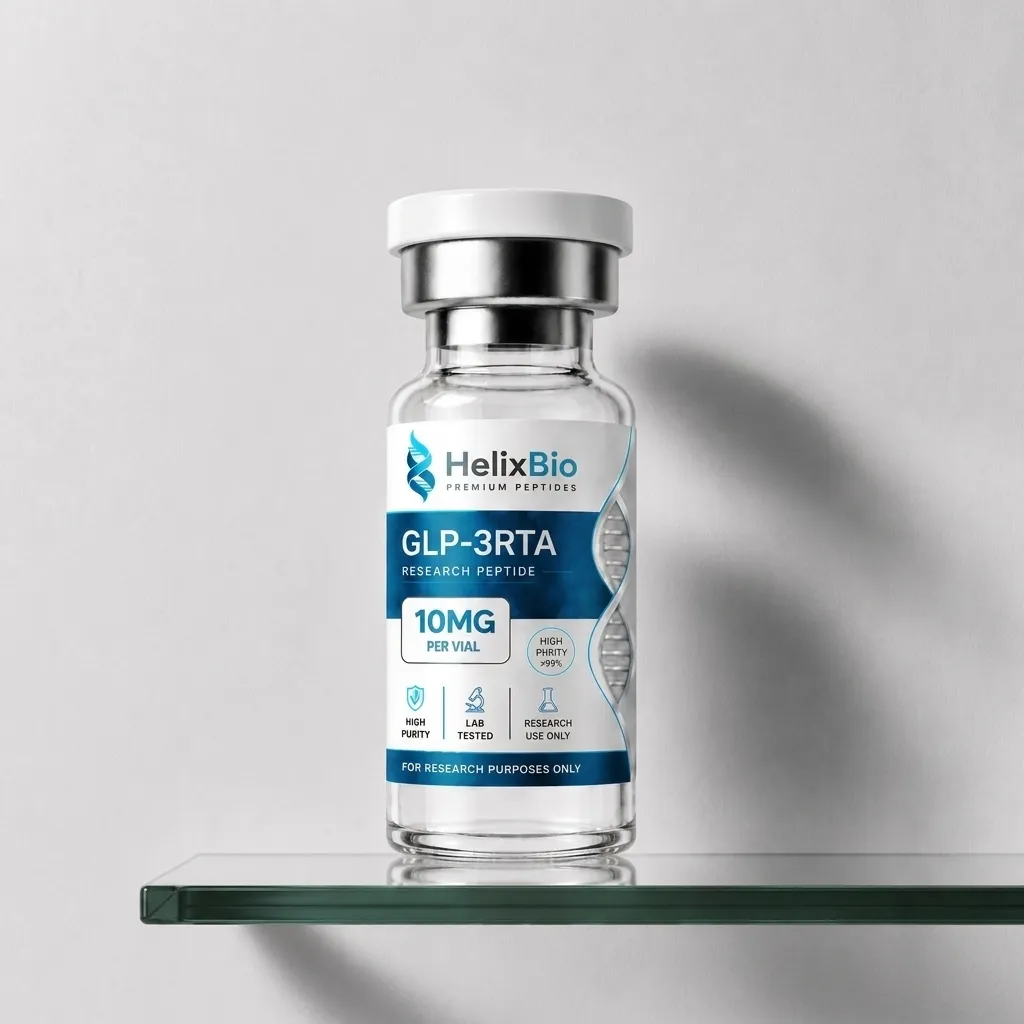
GLP-3RTA
RESEARCH PEPTIDE
GLP-3RTA is a synthetic research peptide studied for triple hormone receptor agonism — activity across the GLP-1, GIP, and glucagon receptors within a single molecule. That three-receptor mechanism has made it one of the most closely watched areas of metabolic and endocrine research, setting it apart from single- or dual-agonist peptides such as Semaglutide and GLP-1TRZ. Helix Bio supplies GLP-3RTA as a lyophilized powder intended strictly for laboratory and preclinical research, manufactured to a high-purity standard and backed by third-party verification. It is not intended for human consumption, diagnostic use, or any therapeutic application.
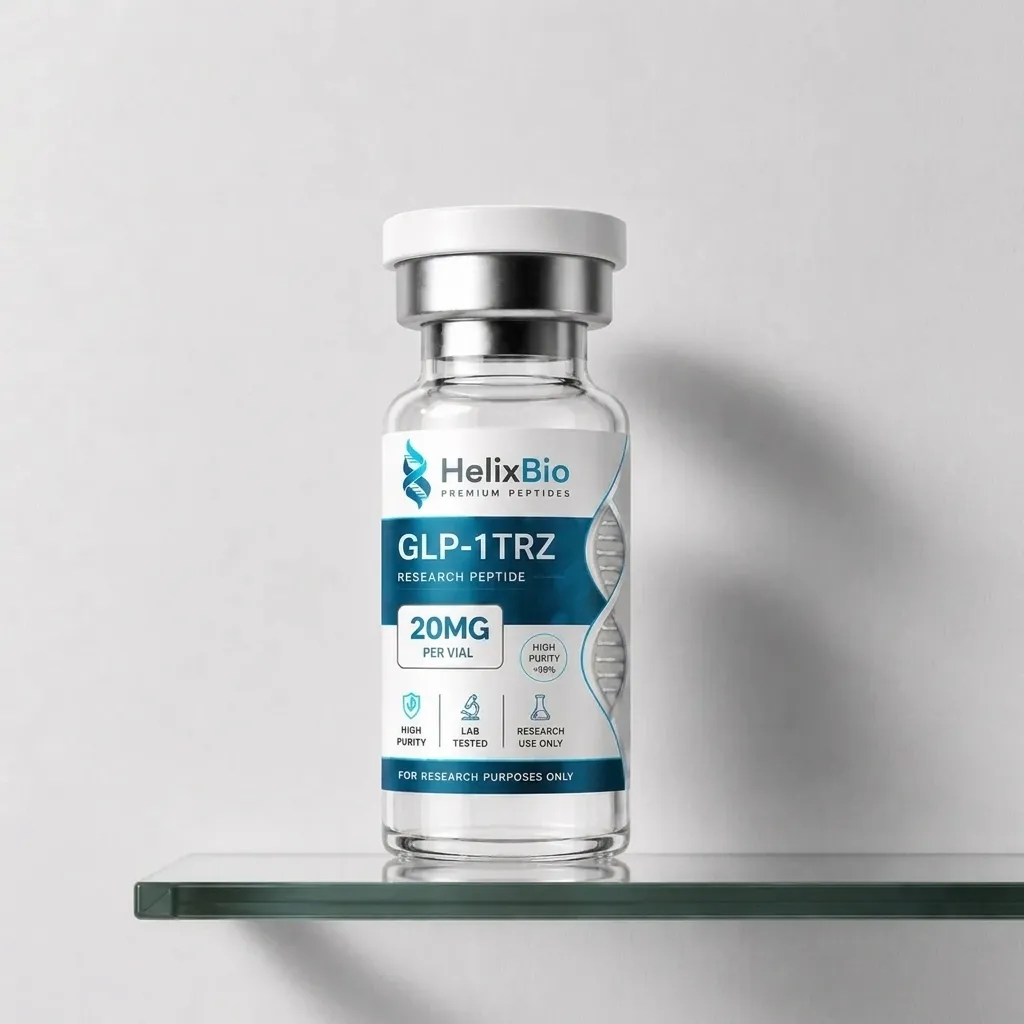
GLP-1TRZ
RESEARCH PEPTIDE
GLP-1TRZ is a synthetic research peptide studied for its activity as a dual GIP/GLP-1 receptor agonist — engaging two distinct incretin receptor pathways within a single molecule. It sits between single-receptor compounds like Semaglutide and the newer triple-agonist GLP-3RTA, making it a common middle point of comparison in incretin research. Helix Bio supplies GLP-1TRZ as a lyophilized powder intended strictly for laboratory and preclinical research, manufactured to a high-purity standard and backed by third-party verification. It is not intended for human consumption, diagnostic use, or any therapeutic application, and it is a separate product from FDA-approved branded medications.

Semaglutide
RESEARCH PEPTIDE
Semaglutide is a synthetic research peptide studied for its activity as a GLP-1 receptor agonist — one of the most extensively documented compounds in incretin pharmacology, with a clinical trial record (the STEP and SUSTAIN programs) that spans over a decade. Developed originally by Novo Nordisk, Semaglutide is the reference point most researchers use when evaluating newer dual- and triple-agonist peptides such as GLP-1TRZ and GLP-3RTA. Helix Bio supplies Semaglutide as a lyophilized powder intended strictly for laboratory and preclinical research, manufactured to a high-purity standard and backed by third-party verification. It is not intended for human consumption, diagnostic use, or any therapeutic application, and it is a separate product from FDA-approved branded medications.
The Receptor Systems Involved
Three receptors define this compound class, each with a distinct physiological role documented in metabolic research.
The GLP-1 receptor binds glucagon-like peptide-1, an incretin hormone released from intestinal L-cells following nutrient intake. In research models, GLP-1 receptor activation has been associated with glucose-dependent insulin secretion, suppression of glucagon release, delayed gastric emptying, and central signalling affecting appetite regulation.
The GIP receptor binds glucose-dependent insulinotropic polypeptide, the second major incretin, released from intestinal K-cells. GIP receptor pharmacology has proven considerably more complex in research than GLP-1, with investigators examining both agonism and antagonism at this receptor for metabolic effect. Research has associated GIP receptor signalling with insulin secretion and with adipose tissue metabolism.
The glucagon receptor binds glucagon, a hormone with actions that appear opposed to insulin in glucose regulation. Research interest in glucagon receptor agonism within a multi-agonist molecule centres on hepatic glucose output and on reported effects relating to energy expenditure, which is mechanistically distinct from the incretin arms of the same molecule.
The design logic behind multi-agonist peptides is that combining receptor activities within a single molecule produces signalling that differs from the sum of separate single-target compounds administered together. This is why comparative research examines multi-agonists as distinct entities rather than as combination therapy equivalents.
Compound Comparison Table
Attribute | Semaglutide | Tirzepatide | Retatrutide |
|---|---|---|---|
Receptor targets | GLP-1 | GIP and GLP-1 | GIP, GLP-1, and glucagon |
Agonist class | Single agonist | Dual agonist | Triple agonist |
Structural basis | GLP-1 analogue | GIP-based dual agonist | Multi-receptor synthetic peptide |
Reported half-life | Approximately one week | Approximately five days | Supports weekly dosing intervals in trials |
Half-life mechanism | Fatty acid acylation, albumin binding | Fatty acid moiety, albumin binding | Fatty acid acylation |
Development stage | Approved products exist in branded form | Approved products exist in branded form | Investigational, Phase 3 |
Branded approved forms | Ozempic, Wegovy, Rybelsus | Mounjaro, Zepbound | None |
Research framing | Established incretin comparator | Dual incretin mechanism | Multi-receptor mechanism under investigation |
Important distinction: research-grade Semaglutide, Tirzepatide, and Retatrutide supplied for laboratory use are not the branded FDA-approved pharmaceutical products listed above. They are research-use-only materials for in-vitro laboratory investigation and are not manufactured, labelled, or intended as substitutes for approved medicines.
Semaglutide: The Single-Agonist Baseline
Semaglutide is a GLP-1 receptor agonist and functions as the comparator against which later multi-agonist compounds are evaluated in the research literature.
Structural design
Semaglutide is an analogue of native GLP-1 modified to resist enzymatic degradation and extend circulating duration. Native GLP-1 is cleaved rapidly by dipeptidyl peptidase-4, giving it a half-life measured in minutes. Semaglutide incorporates amino acid substitutions that reduce DPP-4 susceptibility and a fatty acid chain that promotes albumin binding, together extending its reported half-life to approximately one week.
Research profile
Because Semaglutide engages a single well-characterised receptor, its signalling profile is the most isolated of the three compounds. In comparative research design this makes it valuable as a mechanistic control: observed differences between Semaglutide and a multi-agonist can be attributed to the additional receptor arms rather than to GLP-1 activity, which both compounds share.
Research applications include receptor binding and selectivity assays, incretin pathway signalling studies, and comparative work establishing baseline GLP-1 receptor response. Additional detail is available on the Semaglutide product page.
Tirzepatide: Dual GIP and GLP-1 Agonism
Tirzepatide engages both incretin receptors within a single molecule, making it the first widely studied dual agonist in this class.
Structural design
Tirzepatide is a synthetic peptide built on a GIP-based backbone engineered to also activate the GLP-1 receptor. It incorporates a fatty acid moiety supporting albumin binding, with a reported half-life of approximately five days consistent with weekly dosing intervals in trial protocols. Its receptor activity is not balanced between the two targets — research has described differing potency at each receptor, which is itself an active area of pharmacological investigation.
Research profile
Tirzepatide occupies the mechanistic middle position in this comparison and is therefore central to research examining what the GIP receptor arm contributes beyond GLP-1 activation alone. Comparative studies against Semaglutide have investigated whether dual incretin engagement produces signalling that single-receptor agonism does not.
Research applications include dual receptor binding characterisation, comparative incretin signalling studies, and adipose tissue metabolism research examining GIP receptor involvement. See the Tirzepatide product page for compound documentation.
Retatrutide: Triple GIP, GLP-1 and Glucagon Agonism
Retatrutide adds a third receptor arm and remains investigational, with no approved branded form.
Structural design
Retatrutide is a synthetic peptide engineered for agonist activity at the GIP, GLP-1, and glucagon receptors within a single molecule. Like the other two compounds it employs fatty acid acylation to extend circulating duration and support weekly dosing intervals in trial protocols.
The glucagon receptor arm is what distinguishes it mechanistically. Adding glucagon receptor agonism to an incretin-based molecule is a deliberate design choice reflecting research interest in hepatic glucose handling and energy expenditure pathways that the incretin receptors do not address.
Development status
Retatrutide has been studied in Eli Lilly's Phase 3 clinical programme, including the TRIUMPH trials and TRANSCEND-T2D-1. These are investigational studies, and Retatrutide has not received FDA approval for any indication. Published data from this programme should be read as investigational research findings rather than as established clinical conclusions.
Research applications include triple receptor binding characterisation, glucagon receptor pathway investigation in a multi-agonist context, and comparative studies against dual and single agonists. See the Retatrutide product page for compound documentation.
Mechanistic Comparison Across the Three Generations
Research question | Semaglutide | Tirzepatide | Retatrutide |
|---|---|---|---|
GLP-1 receptor engagement | Yes, sole target | Yes, one of two | Yes, one of three |
GIP receptor engagement | No | Yes | Yes |
Glucagon receptor engagement | No | No | Yes |
Value as mechanistic control | Highest, single variable | Moderate, two variables | Lowest, three variables |
Signalling complexity | Lowest | Intermediate | Highest |
Regulatory status of compound class | Approved forms exist | Approved forms exist | Investigational only |
The pattern running through this table is a trade-off between mechanistic complexity and interpretive clarity. A single agonist produces the cleanest attribution: an observed effect derives from one receptor. A triple agonist produces the richest signalling profile but the most difficult attribution problem, because three simultaneous receptor activities cannot be separated by observation alone. This is precisely why comparative study designs place all three compounds in the same protocol rather than examining any one in isolation.
Why the Field Moved from Single to Multi-Receptor Design
The progression from single to dual to triple agonism was not incremental refinement of the same idea. Each step addressed a limitation identified in the generation before it, and understanding that sequence explains why three compounds exist rather than one optimised molecule.
The stability problem that produced Semaglutide
Native GLP-1 is an effective signalling molecule with an impractical pharmacokinetic profile. Dipeptidyl peptidase-4 cleaves it within minutes of release, which means the endogenous hormone cannot serve as a research or therapeutic agent in its natural form. The first generation of engineering effort therefore targeted duration rather than mechanism.
Semaglutide's design solves that problem through two modifications working together: amino acid substitutions that reduce susceptibility to DPP-4 cleavage, and a fatty acid chain that promotes reversible albumin binding. Albumin binding creates a circulating reservoir that releases the compound gradually, extending the reported half-life from minutes to approximately one week. The mechanism was left unchanged; only its persistence was engineered.
The second incretin question that produced Tirzepatide
Once a durable GLP-1 agonist existed, a mechanistic question became answerable: what does the other incretin receptor contribute? GIP had been characterised for decades, but its pharmacology resisted simple interpretation. Research had reported conditions under which GIP receptor signalling appeared to support metabolic outcomes and conditions under which it appeared not to, and both agonist and antagonist approaches were investigated.
Tirzepatide represents the agonist answer to that question in molecular form. Building GLP-1 receptor activity onto a GIP-based backbone produced a molecule that engages both incretin pathways simultaneously, allowing researchers to examine dual engagement as a single pharmacological entity rather than as two compounds administered together.
The non-incretin question that produced Retatrutide
Both first- and second-generation compounds remain confined to incretin biology. The third generation asks what happens when a mechanistically distinct receptor is added to the same molecule.
Glucagon receptor agonism is the notable design choice here because glucagon has actions that appear opposed to insulin in glucose regulation. Combining glucagon receptor agonism with incretin receptor agonism inside a single molecule is not intuitive on the surface, and the research rationale rests on the proposition that the composite signalling profile differs from what either component produces alone. Whether that proposition holds is precisely what the investigational programme is examining.
Designing a Comparative Study Across the Three Compounds
Because the three compounds differ by a known number of receptor variables, they support a comparative design that few other peptide sets allow.
Controlling for the shared arm
All three engage the GLP-1 receptor. This shared arm functions as an internal control: any effect observed identically across all three compounds is unlikely to be attributable to the receptor arms that differ between them. Conversely, an effect present in Tirzepatide and Retatrutide but absent in Semaglutide points toward GIP receptor involvement, while an effect unique to Retatrutide points toward the glucagon arm.
This subtractive logic is the primary methodological value of studying the three together. It is not available when any one compound is examined alone.
Accounting for potency differences
A complication worth noting is that multi-agonists do not engage their targets with equal potency. Research has described differing potency at each receptor for dual agonists, meaning a compound labelled as engaging two receptors may engage them at substantially different strengths. This matters for interpretation: an apparent difference between compounds may reflect relative potency at a shared receptor rather than the presence or absence of an additional receptor arm.
Comparative protocols address this by characterising receptor binding for each compound independently before drawing conclusions from composite effects.
Material consistency as a design requirement
The subtractive logic above depends entirely on the assumption that the only differences between the three compounds are the intended pharmacological ones. Lot-level variation in purity, impurity profile, or peptide content undermines that assumption directly.
Source of variance | Effect on comparison | Control measure |
|---|---|---|
Purity difference between lots | Apparent potency difference | Match lots by HPLC purity figure |
Impurity profile difference | Off-target signal attributed to compound | Review full chromatogram, not headline figure |
Peptide content vs gross mass | Concentration error across compounds | Confirm net peptide content on COA |
Reconstitution inconsistency | Concentration variance between arms | Standardise diluent and volume, record both |
Storage history difference | Differential degradation | Store all three under identical conditions |
Each row in this table describes a mechanism by which a material difference can present as a pharmacological one. The controls are unremarkable individually; the point is that all of them must hold simultaneously for a three-compound comparison to mean what it appears to mean.
Research Handling Considerations
All three compounds are typically supplied as lyophilized powder, and handling requirements are broadly similar across the class.
Storage before reconstitution. Lyophilized peptides are generally stored frozen or refrigerated, protected from light and moisture. The dry state substantially limits the hydrolytic and deamidation pathways that drive peptide degradation in solution.
Reconstitution. Diluent is introduced gently down the vial wall rather than directly onto the peptide cake, and vials are swirled rather than shaken. Concentration is calculated from stated vial content and diluent volume, and recorded. The Helix Bio peptide calculator handles this arithmetic, and our reconstitution guide covers diluent selection and stability timelines.
Post-reconstitution. Reconstituted material is refrigerated and used within the window indicated on the product documentation. Repeated freeze-thaw cycling is avoided, as it is a recognised contributor to peptide degradation. Common handling errors are covered in our guide to storage mistakes that degrade research compounds.
Documentation. Each lot should be matched to its batch-specific certificate of analysis by lot number. For comparative research across three compounds, lot-level records are what allow a between-compound difference to be attributed to receptor pharmacology rather than to material variance.
Semaglutide, Tirzepatide, and Retatrutide supplied as research materials are for in-vitro laboratory investigation only. They are not for human or veterinary use, and are not intended for ingestion, injection, or any form of administration. Research-grade material is distinct from the FDA-approved branded pharmaceutical products containing these compounds, which are prescription medicines dispensed under medical supervision. Nothing in this article constitutes dosing, protocol, or medical guidance.
Compliance and Interpretation Notes
Three interpretive cautions apply when reading research literature on this compound class.
Approved products and research materials are separate categories. Semaglutide and Tirzepatide exist in FDA-approved branded formulations that are prescription medicines manufactured under pharmaceutical quality frameworks. Research-grade material carrying the same compound name is a laboratory reagent supplied for in-vitro investigation and is neither equivalent to nor a substitute for those products.
Retatrutide has no approved form. All available data derives from investigational clinical research. Describing findings from that programme as established outcomes overstates their regulatory and evidentiary status.
Clinical trial data does not transfer to laboratory research directly. Published trial results describe outcomes under specific protocols in specific populations. They inform mechanistic understanding but do not define laboratory research parameters.
Purity determines comparability. In a three-compound comparison, differences in purity or impurity profile between lots can produce apparent between-compound differences that are actually material differences. Verified purity and confirmed molecular identity for each compound are prerequisites for a valid comparison. Our guide to reading a certificate of analysis covers how to confirm both.
Summary
The three compounds represent successive generations of receptor agonist engineering rather than interchangeable alternatives. Semaglutide provides the single-receptor baseline with the cleanest mechanistic attribution. Tirzepatide adds GIP receptor engagement and enables research into what the second incretin arm contributes. Retatrutide adds glucagon receptor agonism and remains investigational, extending the mechanism beyond incretin biology entirely.
For comparative research, the value of the set lies in the fact that each compound isolates a different number of variables. Researchers can review the full GLP-1 and metabolic research category or the complete Helix Bio catalogue for compound documentation and batch certificates.
Frequently Asked Questions
The three compounds differ in how many receptors a single molecule engages. Semaglutide is a single agonist targeting the GLP-1 receptor, Tirzepatide is a dual agonist targeting both GIP and GLP-1 receptors, and Retatrutide is a triple agonist targeting GIP, GLP-1, and glucagon receptors. That progression in receptor targets is the organising principle of the compound class.
Glucagon receptor agonism extends the mechanism beyond incretin biology, which is what the GIP and GLP-1 arms address. Research interest in this third receptor centres on hepatic glucose output and reported effects relating to energy expenditure, pathways that incretin receptor activation alone does not engage.
Because Semaglutide engages a single well-characterised receptor, its signalling profile is the most isolated of the three. In comparative study design this makes differences between Semaglutide and a multi-agonist attributable to the additional receptor arms rather than to GLP-1 activity, which all three compounds share.
No. Ozempic, Wegovy, and Rybelsus are FDA-approved prescription medicines manufactured under pharmaceutical quality frameworks and dispensed under medical supervision. Research-grade Semaglutide is a research-use-only laboratory reagent supplied for in-vitro investigation and is neither equivalent to nor a substitute for those products.
No. Mounjaro and Zepbound are FDA-approved branded pharmaceutical products containing tirzepatide, supplied as prescription medicines. Research-grade Tirzepatide is a laboratory material supplied strictly for in-vitro research use and is not manufactured, labelled, or intended as a substitute for an approved medicine.
No. Retatrutide remains investigational with no approved branded form. It has been studied in Eli Lilly's Phase 3 clinical programme, including the TRIUMPH trials and TRANSCEND-T2D-1, and all available data derives from that investigational research rather than from established clinical conclusions.
Semaglutide has a reported half-life of approximately one week and Tirzepatide approximately five days, with Retatrutide supporting weekly dosing intervals in trial protocols. All three achieve extended circulating duration through fatty acid acylation promoting albumin binding, a shared design strategy across the class.
Both bind incretin hormones but from different intestinal cell populations: GLP-1 from L-cells and GIP from K-cells. GLP-1 receptor activation has been associated in research with glucose-dependent insulin secretion, glucagon suppression, and delayed gastric emptying, while GIP receptor research has examined insulin secretion alongside adipose tissue metabolism and has explored both agonism and antagonism.
The design logic behind multi-agonist peptides is that combining receptor activities within a single molecule produces signalling that differs from the sum of separate single-target compounds administered together. Comparative research therefore treats them as distinct entities rather than as combination therapy equivalents.
All three are typically supplied as lyophilized powder and are generally stored frozen or refrigerated, protected from light and moisture. The dry state substantially limits the hydrolytic cleavage and deamidation pathways that drive peptide degradation in solution.
Reconstituted material is refrigerated and used within the window indicated on the product documentation, with repeated freeze-thaw cycling avoided as a recognised contributor to degradation. Diluent should be introduced gently down the vial wall rather than directly onto the peptide cake, and vials swirled rather than shaken.
Differences in purity or impurity profile between lots can produce apparent between-compound differences that are actually material differences. Verified purity by HPLC and confirmed molecular identity by mass spectrometry for each compound are prerequisites for attributing an observed difference to receptor pharmacology rather than to material variance.
- 01Jastreboff AM, Kaplan LM, Frias JP, et al. Triple-Hormone-Receptor Agonist Retatrutide for Obesity - A Phase 2 Trial. New England Journal of Medicine. 2023;389(6):514-526.
- 02Jastreboff AM, Aronne LJ, Ahmad NN, et al. Tirzepatide Once Weekly for the Treatment of Obesity. New England Journal of Medicine. 2022;387(3):205-216.
- 03Wilding JPH, Batterham RL, Calanna S, et al. Once-Weekly Semaglutide in Adults with Overweight or Obesity. New England Journal of Medicine. 2021;384(11):989-1002.
- 04Coskun T, Sloop KW, Loghin C, et al. LY3298176, a novel dual GIP and GLP-1 receptor agonist for the treatment of type 2 diabetes mellitus. Molecular Metabolism. 2018;18:3-14.
- 05Drucker DJ. Mechanisms of Action and Therapeutic Application of Glucagon-like Peptide-1. Cell Metabolism. 2018;27(4):740-756.
- 06Lau J, Bloch P, Schaffer L, et al. Discovery of the Once-Weekly Glucagon-Like Peptide-1 Analog Semaglutide. Journal of Medicinal Chemistry. 2015;58(18):7370-7380.

Helix Bio Chem Team
Research & Product Team
Our in-house team tracks published peptide research and translates it into clear, source-cited summaries for the research community.
Reviewed by in-house research chemists
support@helixbiochem.com