- A certificate of analysis is a batch record describing one identified lot, not a general statement about a supplier's catalog.
- The lot number on the vial must match the lot number on the certificate, or the document describes different material.
- HPLC purity is a relative measure of detected peak area and does not account for water or counterion present in the vial.
- Mass spectrometry confirms molecular identity by comparing observed mass against the theoretical mass calculated from the sequence.
- Neither HPLC nor mass spectrometry is sufficient alone, because one measures proportion and the other measures identity.
- Net peptide content states how much of a vial's total mass is peptide, and it is the correct basis for reconstitution calculations.
- Residual water and trifluoroacetate counterion account for most of the gap between nominal vial weight and actual peptide mass.
- Identical purity figures across every lot in a catalog describe a uniformity that genuine analytical testing rarely produces.
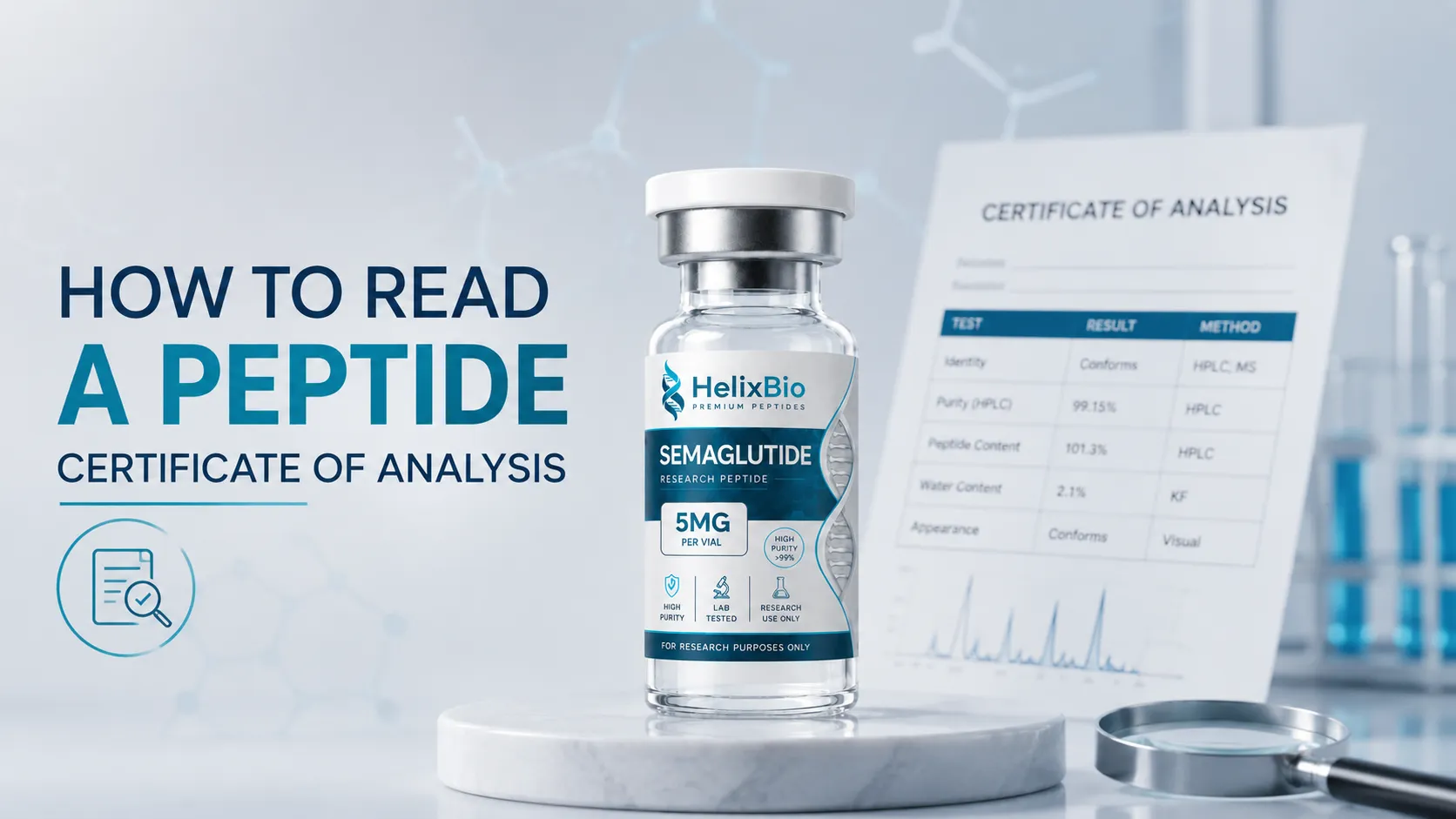
A certificate of analysis (COA) is the only document that connects a specific vial in a researcher's hand to a specific set of analytical measurements. Everything else a supplier publishes, including the purity claim on a product page, is a general statement about a catalog. A COA is a statement about one batch. Knowing how to read one — and knowing which fields distinguish a document that has actually been tested from one that has been templated — is the most practical quality-control skill in research peptide sourcing. This guide walks through every field on a peptide COA, explains what HPLC purity and mass spectrometry data actually measure, and identifies the specific red flags that separate a batch-specific analytical record from a marketing artifact.
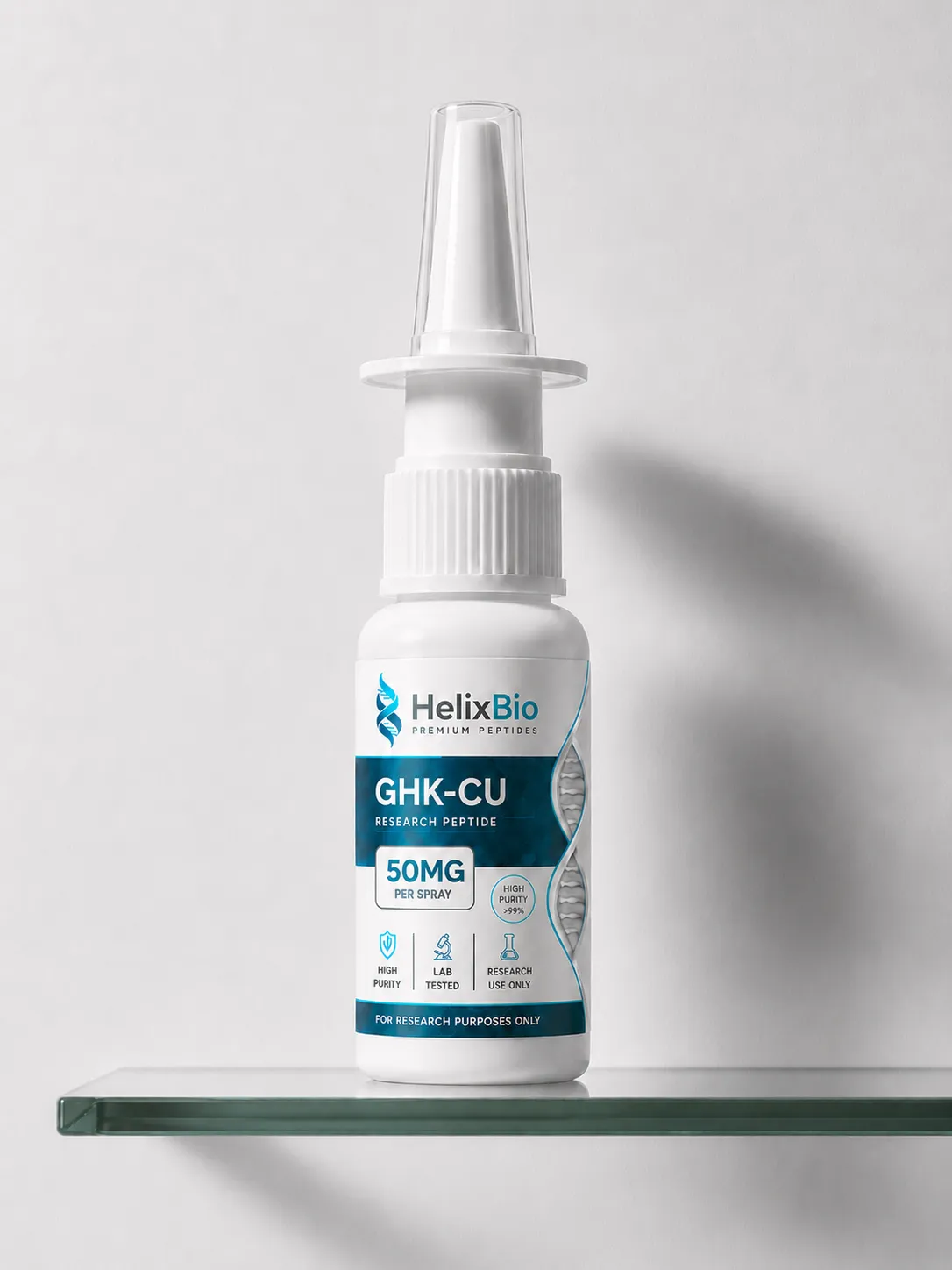
GHK-CU Spray
RESEARCH PEPTIDE
GHK-Cu Spray is a research-use formulation containing GHK-Cu, the copper complex of glycyl-L-histidyl-L-lysine (GHK). GHK is a naturally occurring tripeptide that has been investigated extensively for its copper-binding properties, cellular signaling, extracellular-matrix biology, and tissue-remodeling mechanisms. Helix Bio supplies GHK-Cu Spray strictly for laboratory and scientific research. It is intended for qualified researchers studying copper-peptide chemistry, cellular pathways, peptide biology, and related experimental models. It is not intended for human or veterinary administration.
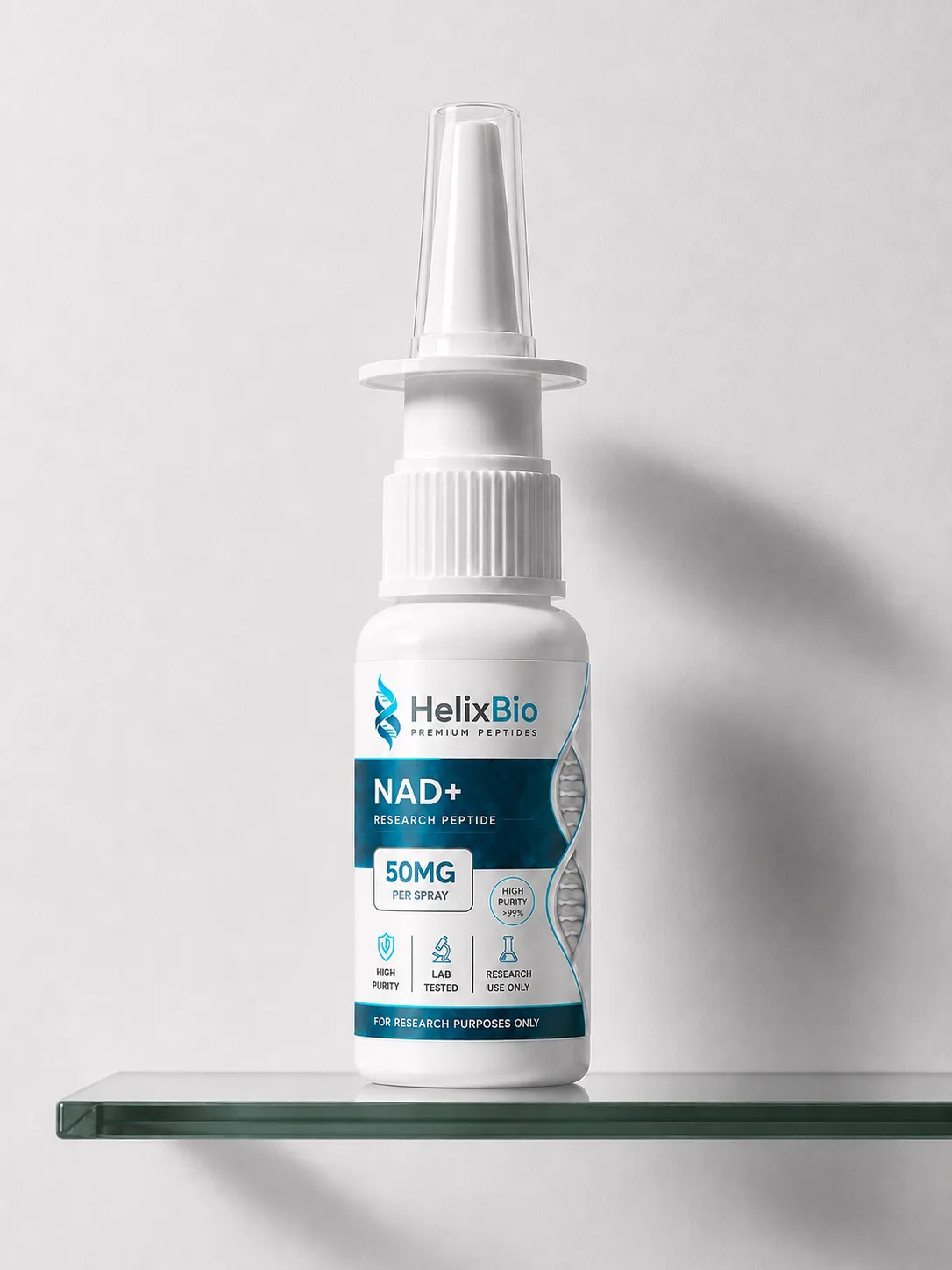
NAD+ Spray
RESEARCH PEPTIDE
NAD+ Spray is a research-use formulation containing nicotinamide adenine dinucleotide (NAD+), an essential cellular coenzyme involved in redox reactions and several biochemical signaling processes. NAD+ research spans cellular metabolism, mitochondrial biology, oxidative phosphorylation, DNA repair, and NAD-dependent enzyme activity. Helix Bio supplies NAD+ Spray strictly as a research and laboratory material. It is intended for qualified researchers investigating NAD+ biology and related biochemical pathways and is not intended for human or veterinary administration.
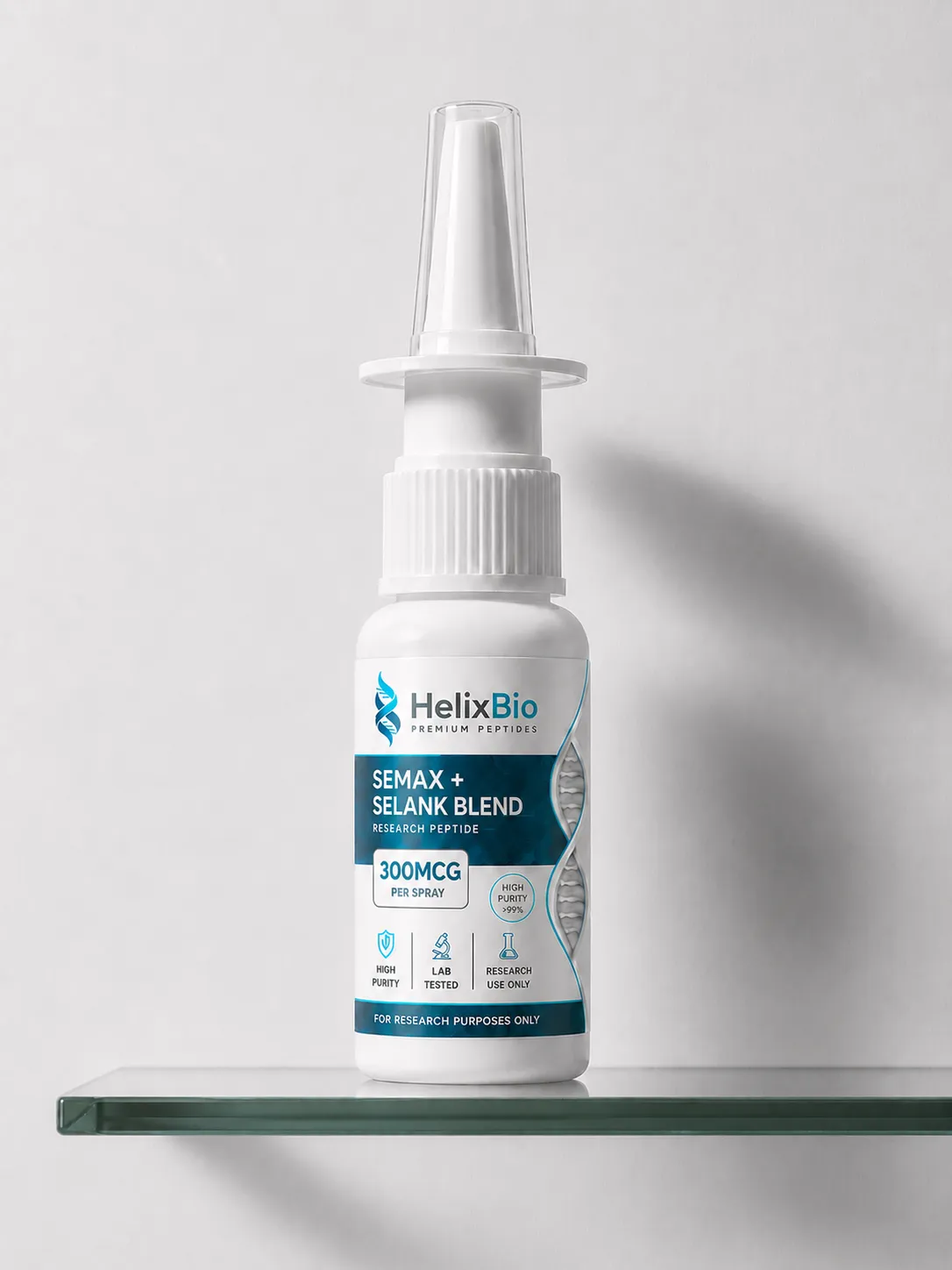
Semax + Selank Blend Spray
RESEARCH PEPTIDE
Semax + Selank Blend Spray is a research-use-only peptide preparation combining two synthetic heptapeptides, Semax and Selank, for controlled laboratory and scientific investigation. Semax is structurally related to the ACTH(4–10) peptide fragment, while Selank is a synthetic analogue of the endogenous peptide tuftsin. The combination is relevant to research involving peptide structure, molecular signaling, neurobiology, receptor interactions, enzymatic activity, and related biochemical pathways. Helix Bio supplies research materials for laboratory use only. This product is not intended for human or veterinary administration.
What a Certificate of Analysis Is, and What It Is Not
A COA is a batch record. It reports the results of analytical tests performed on material from one identified lot, on an identified date, using identified methods. It is evidence about that lot and nothing else.
A COA is not a safety assessment, a suitability determination for any application, or a regulatory approval. It does not certify that a compound is appropriate for any particular experimental model, and for research-use-only materials it carries no clinical meaning whatsoever. It answers two narrow questions well: is this the compound it claims to be, and how much of the material is that compound rather than something else.
That narrowness is the document's strength. A COA that appears to say more than this is usually saying less.
The Anatomy of a Peptide COA
A complete peptide certificate of analysis contains the fields below. The right-hand column is what the absence of that field should tell a researcher.
Field | What it reports | What its absence means |
|---|---|---|
Product name and sequence | Compound identity and amino acid sequence | Identity cannot be checked against published sequence data |
Lot or batch number | The specific production run tested | The document cannot be tied to the vial received |
Purity by HPLC | Percentage of total peak area attributable to the target compound | The central purity claim is unverifiable |
Molecular weight, theoretical and observed | Calculated mass versus mass measured by MS | Molecular identity is unconfirmed |
Analytical method details | Column, gradient, detection wavelength, run time | The purity figure cannot be evaluated or reproduced |
Net peptide content | Actual peptide mass excluding water and counterion | Reconstitution math will be systematically wrong |
Water content | Residual moisture, typically by Karl Fischer titration | One contributor to mass discrepancy is undocumented |
Counterion content | Residual acetate or trifluoroacetate from purification | A second contributor to mass discrepancy is undocumented |
Appearance | Physical description of the material | Visual verification on receipt has no reference point |
Date of analysis | When testing was performed | Age of the data relative to the lot is unknown |
Testing laboratory | Who performed the analysis | Independence of the result cannot be assessed |
Not every research supplier publishes all eleven fields. The first six should be treated as non-negotiable.
Lot Numbers: The Single Most Important Cross-Check
The first action on receiving any research peptide is to compare the lot number printed on the vial label against the lot number on the certificate of analysis. If they do not match, the document describes different material.
This check takes five seconds and catches the most common documentation failure in the sector: a supplier publishing one representative COA for a product and reusing it across every subsequent production run. The chromatogram may be entirely genuine. It simply describes a batch that shipped eighteen months ago.
A certificate of analysis with no lot number, or with a lot number that does not match the vial label, provides no verifiable information about the material received. Treat it as an undocumented batch regardless of how impressive the reported purity figure is. Purity claims are only meaningful when they are traceable to the specific production run in front of you.
Lot numbers also matter after the fact. Two lots of the same compound at the same nominal purity can differ in net peptide content, water content, and impurity profile. A study that records lot numbers alongside its results can resolve batch effects later. A study that does not cannot.
HPLC Purity: Reading the Chromatogram
High-performance liquid chromatography is the standard method for determining peptide purity. Reversed-phase HPLC separates a sample's components by hydrophobicity as they pass through a column, and a detector records each component as a peak. Purity is then calculated by area normalization: the area under the target peak divided by the total area of all detected peaks, expressed as a percentage.
What the percentage actually measures
This is the most frequently misunderstood figure on the document. HPLC purity is a relative measure, not an absolute one. A result of 99.1% means the target compound accounts for 99.1% of the detected peak area, not that the vial contains 99.1% peptide by mass. Water and counterion do not appear as chromatographic peaks and therefore do not reduce the purity figure at all. This is precisely why net peptide content exists as a separate field, and why a 99% pure peptide can still be well under 99% peptide by vial weight.
Detection wavelength matters for the same reason. Peptide bonds absorb strongly in the far ultraviolet, so peptide HPLC is typically run at 214 or 220 nm. A purity figure reported without its detection wavelength cannot be compared meaningfully against another laboratory's figure.
Common impurities in synthetic peptides
Solid-phase peptide synthesis is a cyclical process, and its characteristic impurities follow directly from how it works:
- Deletion sequences, where one amino acid failed to couple in a given cycle, producing a peptide one residue short.
- Truncated sequences, where chain assembly terminated early.
- Incompletely deprotected peptides, retaining a side-chain protecting group.
- Oxidized species, particularly at methionine, cysteine, and tryptophan residues.
- Residual solvents and scavengers carried over from cleavage and workup.
Deletion sequences are the most analytically interesting because they are structurally similar to the target compound. They elute close to it and can be difficult to resolve on a shallow gradient, which is one reason method details on a COA carry real information rather than being boilerplate.
Method details worth checking
A credible chromatography section states column chemistry and dimensions, mobile phase composition, gradient profile and run time, flow rate, and detection wavelength. These parameters determine resolution. A very short run on a steep gradient can compress closely eluting impurities into the main peak and inflate the apparent purity figure, which is why a purity number presented without method context should be read with caution.
Mass Spectrometry: Identity, Not Purity
Mass spectrometry answers a different question than HPLC. It measures the mass-to-charge ratio of ionized molecules in the sample, confirming molecular identity by comparing observed mass against the theoretical mass calculated from the amino acid sequence.
A COA should report both figures. Observed mass should agree closely with theoretical mass; acceptable tolerance depends on the instrument, with high-resolution methods reporting agreement to several decimal places and lower-resolution methods reporting to the nearest whole mass unit.
Question | Answered by HPLC | Answered by Mass Spectrometry |
|---|---|---|
Is this the right molecule? | No, only that one species dominates | Yes, by mass confirmation against the sequence |
How much of the sample is that molecule? | Yes, as a percentage of detected peak area | Not reliably; ionization response varies by species |
Are deletion sequences present? | Detectable as resolved adjacent peaks | Detectable as distinct mass species |
Is residual water present? | No, water is not detected | No |
Is counterion present? | No | No, not in standard peptide MS analysis |
Neither method alone is sufficient. Mass spectrometry can confirm the target compound is present while saying little about how much of the sample is something else. HPLC can show a single dominant peak without proving that peak is the intended molecule. Used together, the two cross-check each other, which is why a COA reporting only one of them is an incomplete document.
Net Peptide Content: The Most Consequential Line
Net peptide content, sometimes labelled peptide content or actual peptide content, states what proportion of the material in the vial is peptide rather than water, counterion, or salts. It is typically determined by amino acid analysis or nitrogen determination.
The figure has direct practical consequences. Consider a vial labelled 10 mg with a reported HPLC purity of 99% and a net peptide content of 82%. That vial contains roughly 8.2 mg of peptide, not 10 mg. A researcher reconstituting on the assumption of 10 mg introduces an 18% concentration error into every subsequent calculation in the protocol, and no amount of careful pipetting will recover it.
Purity and content answer different questions and are routinely confused. Purity asks: of the peptide in this vial, how much is the right peptide? Content asks: of the total mass in this vial, how much is peptide at all? A material can be 99% pure and 82% peptide content simultaneously, and both figures are needed before any concentration calculation is meaningful. Use the [peptide calculator](/peptide-calculator) with net peptide content, not nominal label weight.
Where net peptide content is not reported, researchers working from label weight should recognise that their stated concentration carries an undocumented margin of error. Our unit conversion guide covers how that error propagates through mg, mcg, mL, and IU calculations.
Water Content and Counterion: Where the Missing Mass Goes
Lyophilized peptides are hygroscopic and retain residual moisture after freeze-drying. Water content is usually measured by Karl Fischer titration and commonly falls in the low single-digit percentage range, though it rises with improper storage and repeated exposure to ambient air.
Counterion content is the second contributor. Reversed-phase purification is typically performed with trifluoroacetic acid in the mobile phase, and the resulting peptide carries trifluoroacetate as a counterion. For peptides with several basic residues, counterion can account for a substantial fraction of dry mass. Some manufacturers perform a counterion exchange to acetate, which should be documented on the COA where it has been done.
Together, water and counterion explain most of the gap between a vial's nominal weight and its actual peptide mass. Both are ordinary features of legitimate synthesis and purification rather than defects, and their disclosure is a marker of a thorough document. Storage conditions that allow moisture ingress shift water content upward over time, which is why our guide to storage mistakes that degrade research compounds bears on documentation accuracy as well as on stability.
Third-Party Versus In-House Testing
A COA generated by the manufacturer that produced the material and a COA generated by an independent analytical laboratory are not equivalent documents, even when the underlying methods are identical.
In-house testing is not inherently unreliable. Manufacturers run analytics as a routine part of quality control, and there is nothing improper about a producer testing its own output. The limitation is structural rather than ethical: the party reporting the result has a commercial interest in the result. Independent third-party testing removes that interest from the reporting chain.
The strongest signal is a supplier that publishes third-party results including unfavourable ones, such as a lot that tested below an advertised threshold. A catalog in which every published lot lands at exactly the same purity figure, across dozens of production runs, describes a statistical uniformity that genuine analytical testing rarely produces. Helix Bio publishes its batch testing standard on the about page, and every catalog item ships with a lot-specific certificate.
Seven Red Flags on a Peptide COA
- No lot number, or a lot number that does not match the vial label. The document cannot be tied to the material.
- A purity figure with no method details. Column, gradient, and detection wavelength determine what the number means.
- No chromatogram image, only a stated percentage. The trace is where shoulder peaks and unresolved impurities become visible.
- Identical purity figures across every lot in a catalog. Real analytical variation is not this uniform.
- No mass spectrometry data. Purity without identity confirmation is an incomplete claim.
- No net peptide content. Every downstream concentration figure inherits an unstated error.
- A testing date that predates the production run, or no date at all. The data may describe entirely different material.
How to Verify a COA Independently
- Match the lot number on the vial to the lot number on the certificate.
- Check that the stated amino acid sequence corresponds to the compound named, using published sequence data for that peptide.
- Confirm the theoretical molecular weight is consistent with that sequence.
- Confirm the observed mass on the mass spectrometry report agrees with the theoretical mass.
- Read the chromatogram rather than only the summary percentage, looking for shoulder peaks and unresolved features near the main peak.
- Confirm the detection wavelength is appropriate for peptide analysis before comparing purity figures across suppliers.
- Locate net peptide content and use that figure, not label weight, for reconstitution.
- Note the testing laboratory and whether the analysis was independent.
- Record the lot number in the experimental log alongside concentration and preparation date.
Compliance Context for Research-Use-Only Materials
Research-use-only labeling is a regulatory designation, not a marketing phrase. FDA guidance on RUO-labeled products addresses the distinction between materials distributed for laboratory research and materials distributed with clinical intent, and the labeling carries specific obligations for manufacturers and distributors alike. Materials supplied under this designation are not evaluated by the FDA for safety or efficacy in human or veterinary contexts.
A certificate of analysis does not change that status. It documents what a batch contains; it says nothing about suitability for any application outside laboratory research. All Helix Bio compounds are supplied strictly for in-vitro laboratory research and are not intended for human or veterinary use, ingestion, injection, or any form of administration.
Researchers who want to review lot documentation before ordering can request it through the contact page, and the FAQ knowledge base covers further documentation and compliance questions. Format-specific documentation differences between dry and pre-solubilized presentations are covered in our guide to nasal spray and lyophilized vial formats.
Frequently Asked Questions
A complete COA lists product name and amino acid sequence, lot or batch number, HPLC purity with its method parameters, theoretical and observed molecular weight from mass spectrometry, net peptide content, water content, counterion content, appearance, date of analysis, and testing laboratory. The first six should be treated as non-negotiable. Anything less makes the purity claim difficult to evaluate independently.
No. HPLC purity is calculated by area normalization and reports the proportion of detected peak area attributable to the target compound. Water and counterion are not detected chromatographically and therefore do not reduce the purity figure. A material can be 99% pure by HPLC while being substantially less than 99% peptide by vial mass, which is what net peptide content reports separately.
The lot number ties analytical data to the specific production run in a researcher's hand. Without a matching lot number, a COA may describe an entirely different batch produced months earlier. Recording lot numbers in the experimental log also makes batch effects resolvable after a study concludes, which is otherwise impossible.
Net peptide content states what proportion of the total material in a vial is peptide rather than residual water, counterion, or salts, typically determined by amino acid analysis. A vial labelled 10 mg with 82% net peptide content holds roughly 8.2 mg of peptide. Reconstituting on the assumption of the label figure introduces a systematic concentration error into every downstream calculation.
Solid-phase synthesis characteristically produces deletion sequences where one residue failed to couple, truncated sequences where chain assembly stopped early, incompletely deprotected species retaining a side-chain protecting group, oxidized forms at methionine, cysteine, or tryptophan, and residual solvents from cleavage and workup. Deletion sequences are the hardest to resolve because they elute close to the target compound.
Peptide bonds absorb strongly in the far ultraviolet, so peptide HPLC is typically run at 214 or 220 nm, and different wavelengths produce different relative responses across species in a sample. A purity figure reported without its detection wavelength cannot be compared meaningfully against a figure from another laboratory.
No. Mass spectrometry confirms that a molecule of the expected mass is present, which establishes identity rather than proportion. Ionization efficiency varies between species, so relative peak intensity in an MS spectrum is not a reliable purity measure. HPLC supplies the proportional measurement that MS cannot.
Reversed-phase peptide purification is commonly performed with trifluoroacetic acid in the mobile phase, and the purified peptide retains trifluoroacetate as a counterion. For peptides with multiple basic residues, counterion can account for a meaningful fraction of dry mass. Some manufacturers perform an exchange to acetate, which should be stated on the COA where it has been done.
Residual moisture is usually determined by Karl Fischer titration and reported as a percentage of total mass. Lyophilized peptides are hygroscopic, so water content rises with improper storage and repeated exposure to ambient air, which is one reason opening a cold vial before it reaches room temperature is discouraged.
In-house analytics are a routine and legitimate part of manufacturing quality control, and the methods used are often identical to those of an independent laboratory. The limitation is structural: the party reporting the result also produced the material. Independent third-party testing removes that commercial interest from the reporting chain, which is why it carries more evidentiary weight.
Genuine analytical results vary between production runs, because synthesis efficiency, purification recovery, and impurity profiles all differ batch to batch. A catalog in which dozens of lots report an identical purity figure describes a uniformity that real testing rarely produces, which suggests a templated document rather than a lot-specific measurement.
No. A COA documents what a batch contains and the analytical methods used to determine it. It makes no statement about suitability for any application, and for research-use-only materials it carries no clinical meaning. FDA guidance on RUO-labeled products addresses the distinction between distribution for laboratory research and distribution with clinical intent; such materials are not evaluated by the FDA for safety or efficacy outside a research setting.
- 01Mant CT, Chen Y, Yan Z, et al. HPLC analysis and purification of peptides. Methods in Molecular Biology. 2007;386:3-55.
- 02Aebersold R, Mann M. Mass spectrometry-based proteomics. Nature. 2003;422(6928):198-207.
- 03Wang W. Lyophilization and development of solid protein pharmaceuticals. International Journal of Pharmaceutics. 2000;203(1-2):1-60.
- 04International Council for Harmonisation. ICH Quality Guidelines, including Q2 Validation of Analytical Procedures and Q6B Specifications: Test Procedures and Acceptance Criteria for Biotechnological/Biological Products.
- 05U.S. Food and Drug Administration. Distribution of In Vitro Diagnostic Products Labeled for Research Use Only or Investigational Use Only. Guidance for Industry and FDA Staff, November 2013.
Helix Bio Chem Team
Research & Product Team
Our in-house team tracks published peptide research and translates it into clear, source-cited summaries for the research community.
Reviewed by in-house research chemists
support@helixbiochem.com