Reconstitution Configurator
Calculated Draw
For laboratory research use only. Not for human or veterinary use.
- 1 mg = 1,000 mcg is the fundamental conversion for peptide mass; treating mg and mcg as interchangeable produces a 1,000-fold dosing error.
- U-100 insulin syringes use the fixed relationship 100 units = 1 mL, meaning 1 unit = 0.01 mL regardless of peptide concentration or type.
- Concentration (mcg/mL) = Total Peptide Mass (mcg) ÷ Solvent Volume (mL); this formula is the foundation of all peptide dosage calculations.
- Volume (mL) = Target Dose (mcg) ÷ Concentration (mcg/mL); multiply by 100 to convert mL to U-100 syringe units.
- For HGH only, 1 mg = 3 IU (1 IU = 333 mcg); this conversion is compound-specific and does not apply to other peptides.
- Common calculation errors include mg/mcg confusion, decimal place miscounting, reusing unit counts from previous reconstitutions, and using vial volume instead of added solvent volume.
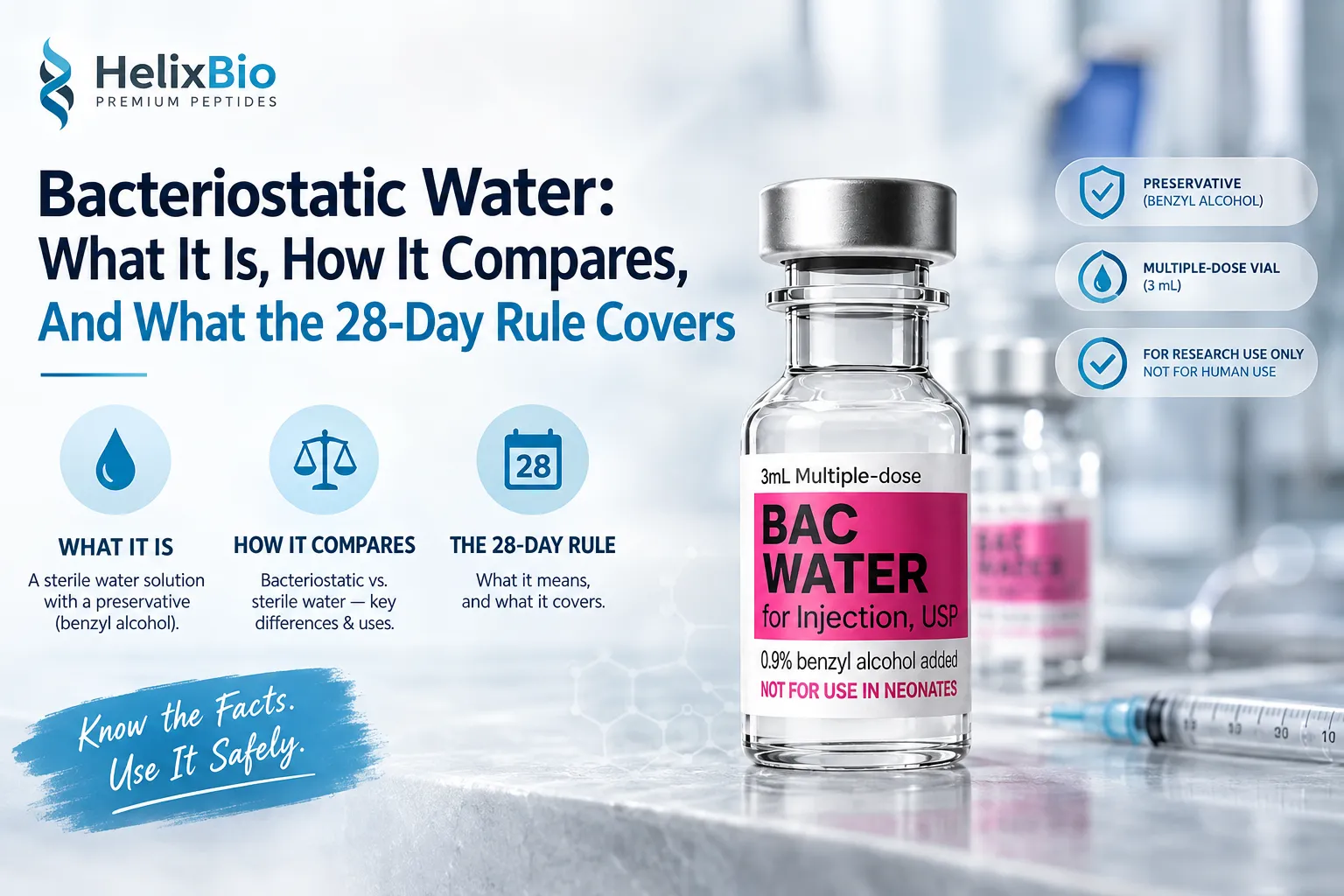
- Bacteriostatic water should be discarded 28 days after opening; preservative efficacy diminishes over time even if the solution appears clear.
- All peptides discussed are supplied exclusively for laboratory and investigative purposes, not approved for human consumption or therapeutic applications.
Accurate peptide dosage calculations are fundamental to reproducible laboratory research. Misunderstanding unit conversions between milligrams (mg), micrograms (mcg), milliliters (mL), and international units (IU) represents one of the most common sources of experimental error in peptide research protocols.
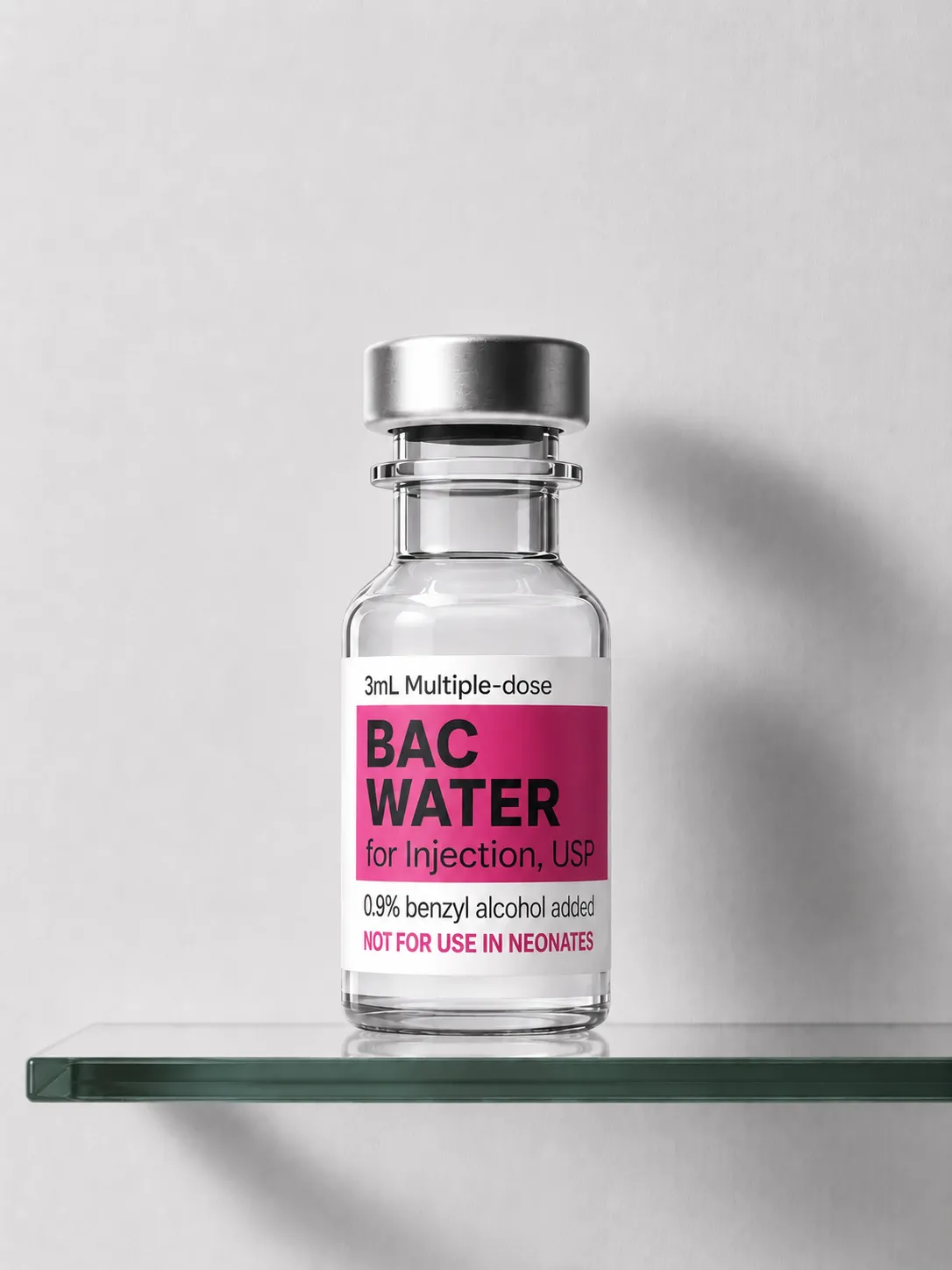
BAC Water
LABORATORY SOLVENT
BAC Water, also known as Bacteriostatic Water, is a sterile, non-pyrogenic solution commonly used in laboratory environments for the reconstitution and dilution of research peptides and other compatible research compounds. It contains Water for Injection with 0.9% benzyl alcohol as a preservative to help inhibit bacterial growth after the vial has been opened. Helix Bio supplies research-grade BAC Water exclusively for laboratory, analytical, and educational research applications. This product is intended for research use only and is not intended for human or veterinary use.
Peptide reconstitution involves dissolving lyophilized powder in a measured volume of bacteriostatic water or other appropriate solvent to create a working solution with known concentration. From this concentration, researchers calculate the volume required to deliver a specific mass of peptide for each experimental administration. The mathematical relationships are straightforward, but decimal errors, unit confusion, and syringe misreading can lead to 10-fold or 1,000-fold dosing mistakes that compromise experimental validity.
For precise laboratory calculations, researchers can utilize an interactive peptide dosage calculator to verify reconstitution math and unit conversions prior to experimental procedures.
This comprehensive guide explains peptide dosage calculations from first principles, covering concentration formulas, unit conversions, insulin syringe reading, and common calculation errors. The content is intended strictly for laboratory and research professionals working with peptide compounds in controlled experimental settings. For step-by-step reconstitution technique, see our peptide reconstitution guide, and for the handling errors that quietly degrade potency after reconstitution, see common peptide storage mistakes.
Understanding Mass Units: mg vs mcg in Peptide Research
The foundation of peptide dosage calculation is understanding the relationship between mass units. Peptide vials are typically labeled in milligrams (mg), while research protocols often specify doses in micrograms (mcg).
The mg to mcg Conversion
The conversion between milligrams and micrograms is fixed:
1 mg = 1,000 mcg
This means:
- 5 mg vial = 5,000 mcg total peptide
- 10 mg vial = 10,000 mcg total peptide
- 50 mg vial = 50,000 mcg total peptide
Conversely:
- 250 mcg = 0.25 mg
- 500 mcg = 0.5 mg
- 1,000 mcg = 1 mg
The mg/mcg conversion error is the single largest source of peptide dosing mistakes. Treating a mg figure as if it were mcg (or vice versa) produces a 1,000-fold error. Always convert all values to the same unit (preferably mcg) before performing calculations.
Why mcg is Preferred for Peptide Dosing
Most research peptides are administered in microgram quantities rather than milligram quantities. Typical research doses range from 50 mcg to 500 mcg per administration for many compounds. Expressing doses in mcg avoids small decimal values that are prone to misreading and calculation errors.
For example:
- 0.25 mg is more easily misread than 250 mcg
- 0.125 mg is more error-prone than 125 mcg
Converting all values to mcg before calculation is a best practice that reduces decimal errors.
Understanding Volume Units: mL and Insulin Syringe Units
Peptide solutions are measured in milliliters (mL), but insulin syringes use a "unit" scale that must be converted to mL for accurate dosing.
The U-100 Insulin Syringe Standard
The vast majority of peptide research uses U-100 insulin syringes, where:
100 units = 1 mL
Therefore:
1 unit = 0.01 mL (10 microliters)
This relationship is fixed regardless of peptide concentration or type.
Common U-100 Syringe Conversions
Syringe Units | Volume (mL) | Volume (μL) |
|---|---|---|
1 unit | 0.01 mL | 10 μL |
5 units | 0.05 mL | 50 μL |
10 units | 0.10 mL | 100 μL |
20 units | 0.20 mL | 200 μL |
25 units | 0.25 mL | 250 μL |
50 units | 0.50 mL | 500 μL |
100 units | 1.00 mL | 1,000 μL |
On a standard U-100 syringe, each numbered mark typically represents 5 units (0.05 mL), and each minor tick represents 1 unit (0.01 mL). Always verify the syringe scale before use, as some syringes may have different graduation patterns.
U-40 vs U-100 Syringes: Critical Distinction
While U-100 syringes are standard for peptide research, U-40 syringes exist (primarily for veterinary insulin).
U-40 syringes: 40 units = 1 mL, so 1 unit = 0.025 mL
U-100 syringes: 100 units = 1 mL, so 1 unit = 0.01 mL
Using a U-40 syringe with U-100 calculations (or vice versa) produces a 2.5-fold dosing error. Always verify the syringe is labeled "U-100" before use.
Peptide Reconstitution: Concentration Calculations
Reconstitution is the process of adding a measured volume of solvent (typically bacteriostatic water) to a lyophilized peptide vial to create a solution with known concentration.
The Concentration Formula
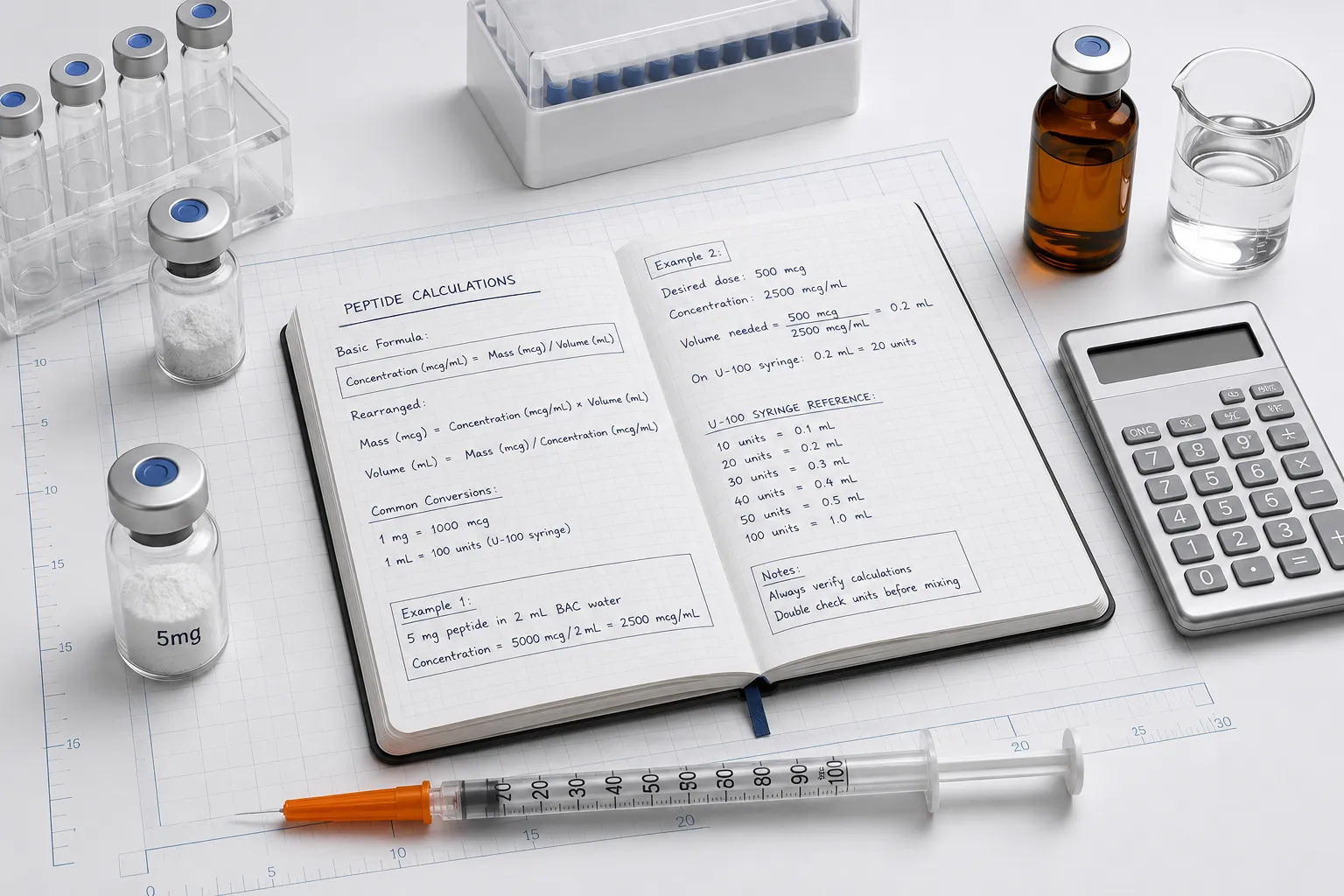
The fundamental concentration formula is:
Concentration (mg/mL) = Total Peptide Mass (mg) ÷ Solvent Volume (mL)
For practical peptide calculations, it's more useful to express concentration in mcg/mL:
Concentration (mcg/mL) = [Total Peptide Mass (mg) × 1,000] ÷ Solvent Volume (mL)
Or equivalently:
Concentration (mcg/mL) = Total Peptide Mass (mcg) ÷ Solvent Volume (mL)
Worked Example: 5 mg Vial Reconstituted with 2 mL
Step 1: Convert mg to mcg
5 mg × 1,000 = 5,000 mcg total peptide
Step 2: Divide by solvent volume
5,000 mcg ÷ 2 mL = 2,500 mcg/mL concentration
This means each 1 mL of solution contains 2,500 mcg of peptide.
Alternative Reconstitution Volumes
Using the same 5 mg vial with different solvent volumes:
Vial Size | Solvent Volume | Concentration (mg/mL) | Concentration (mcg/mL) |
|---|---|---|---|
5 mg | 1 mL | 5 mg/mL | 5,000 mcg/mL |
5 mg | 2 mL | 2.5 mg/mL | 2,500 mcg/mL |
5 mg | 2.5 mL | 2 mg/mL | 2,000 mcg/mL |
5 mg | 5 mL | 1 mg/mL | 1,000 mcg/mL |
Higher concentrations (less solvent) require smaller injection volumes but may be more difficult to measure accurately. Lower concentrations (more solvent) require larger volumes but allow more precise measurement of small doses.
A common strategy is to reconstitute to achieve concentrations that produce round-number syringe unit draws. For example, reconstituting a 5 mg vial with 2.5 mL yields 2,000 mcg/mL, making a 250 mcg dose equal to 12.5 units on a U-100 syringe.
Calculating Injection Volume from Target Dose
Once concentration is known, the injection volume for any target dose can be calculated.
The Volume Formula
Volume (mL) = Target Dose (mcg) ÷ Concentration (mcg/mL)
To convert to syringe units:
Units = Volume (mL) × 100 (for U-100 syringes)
Or combined into one formula:
Units = [Target Dose (mcg) ÷ Concentration (mcg/mL)] × 100
To streamline volume calculations across different solution concentrations, use a dedicated peptide reconstitution calculator during protocol preparation.
Worked Example: 250 mcg Dose from 2,500 mcg/mL Solution
Step 1: Calculate volume in mL
250 mcg ÷ 2,500 mcg/mL = 0.1 mL
Step 2: Convert to syringe units
0.1 mL × 100 = 10 units
Therefore, a 250 mcg dose from a 2,500 mcg/mL solution requires drawing to the 10-unit mark on a U-100 syringe.
Additional Worked Examples
Example 1: 10 mg vial reconstituted with 2 mL, targeting 500 mcg dose
- Concentration: 10,000 mcg ÷ 2 mL = 5,000 mcg/mL
- Volume: 500 mcg ÷ 5,000 mcg/mL = 0.1 mL
- Units: 0.1 mL × 100 = 10 units
Example 2: 5 mg vial reconstituted with 2.5 mL, targeting 125 mcg dose
- Concentration: 5,000 mcg ÷ 2.5 mL = 2,000 mcg/mL
- Volume: 125 mcg ÷ 2,000 mcg/mL = 0.0625 mL
- Units: 0.0625 mL × 100 = 6.25 units (round to 6 or 6.5 units depending on syringe precision)
Example 3: 50 mg vial reconstituted with 10 mL, targeting 1 mg (1,000 mcg) dose
- Concentration: 50,000 mcg ÷ 10 mL = 5,000 mcg/mL
- Volume: 1,000 mcg ÷ 5,000 mcg/mL = 0.2 mL
- Units: 0.2 mL × 100 = 20 units
Quick Reference: Units per Dose at Common Concentrations
Target Dose | 1,000 mcg/mL | 2,000 mcg/mL | 2,500 mcg/mL | 5,000 mcg/mL | 10,000 mcg/mL |
|---|---|---|---|---|---|
100 mcg | 10 units | 5 units | 4 units | 2 units | 1 unit |
250 mcg | 25 units | 12.5 units | 10 units | 5 units | 2.5 units |
500 mcg | 50 units | 25 units | 20 units | 10 units | 5 units |
1,000 mcg (1 mg) | 100 units | 50 units | 40 units | 20 units | 10 units |
Doses requiring less than 5 units on a U-100 syringe (0.05 mL) approach the limits of reliable measurement. Consider reconstituting to lower concentration if your protocol requires sub-5-unit doses for improved accuracy.
International Units (IU) vs mg: The HGH Conversion Challenge
International Units (IU) represent a measure of biological activity rather than mass, and the conversion between IU and mg varies by compound. This is particularly relevant for human growth hormone (HGH) research.
HGH IU to mcg Conversion
For somatropin (recombinant human growth hormone):
1 mg = 3 IU
Therefore:
1 IU = 0.333 mg = 333 mcg
This conversion is specific to HGH and does not apply to other peptides.
Worked Example: HGH Dose Conversion
A research protocol specifies 2 IU of HGH:
- 2 IU × 333 mcg/IU = 666 mcg (approximately 0.667 mg)
If the HGH vial contains 10 mg (30 IU) reconstituted with 1 mL:
- Concentration: 10,000 mcg ÷ 1 mL = 10,000 mcg/mL
- Volume for 666 mcg: 666 mcg ÷ 10,000 mcg/mL = 0.0666 mL
- Units: 0.0666 mL × 100 = 6.66 units (approximately 7 units)
The IU-to-mcg conversion is compound-specific. For most peptides (BPC-157, TB-500, GHK-Cu, etc.), dosing is expressed directly in mcg or mg without IU conversion. Only use IU units when the compound's specific conversion factor is known and documented.
Common Calculation Errors and How to Avoid Them
Peptide dosage calculations are prone to specific, predictable errors. Understanding these pitfalls allows researchers to implement safeguards.
Error 1: mg/mcg Confusion (1,000-Fold Error)
Mistake: Treating 5 mg as 5 mcg, or calculating a 250 mcg dose as 250 mg.
Consequence: 1,000-fold overdosing or underdosing.
Prevention:
- Convert all values to mcg before calculation
- Write out the conversion explicitly: "5 mg = 5,000 mcg"
- Double-check that your final dose is in the expected range (typically 50–1,000 mcg for most peptides)
Error 2: Decimal Place Miscounting
Mistake: Reading 0.1 mL as 1.0 mL, or 0.01 mL as 0.1 mL.
Consequence: 10-fold dosing error.
Prevention:
- Always write leading zeros: "0.1 mL" not ".1 mL"
- Use mcg units to avoid small decimals
- Verify syringe markings match your calculated volume
Error 3: Reusing Unit Counts from Previous Reconstitutions
Mistake: Using "10 units" from a prior vial without recalculating for the new reconstitution volume.
Consequence: Dosing error proportional to the concentration difference.
Prevention:
- Recalculate from scratch for every new vial or reconstitution
- Label vials with concentration (mcg/mL) and date
- Never assume unit counts transfer between different solvent volumes
Error 4: Using Vial Volume Instead of Added Solvent Volume
Mistake: Confusing the total vial capacity with the volume of bacteriostatic water added.
Consequence: Incorrect concentration calculation.
Prevention:
- Record the exact volume of solvent added, not the vial size
- Example: A 5 mg vial reconstituted with 2 mL has 2 mL solvent volume, regardless of vial capacity
Error 5: Assuming All Syringes are U-100
Mistake: Using U-40 or other syringe types with U-100 calculations.
Consequence: 2.5-fold dosing error (U-40 vs U-100).
Prevention:
- Verify syringe is labeled "U-100" before use
- Check barrel markings: U-100 syringes show 100 units = 1 mL
Error 6: Shaking Instead of Swirling
Mistake: Vigorously shaking the vial after adding bacteriostatic water.
Consequence: Potential peptide denaturation from mechanical stress.
Prevention:
- Gently swirl or roll the vial until fully dissolved
- Do not shake, vortex, or inject water at high pressure directly onto the powder
Implement a "two-person check" for critical calculations in shared laboratory settings. Have a colleague independently verify concentration and dose calculations before proceeding with reconstitution.
Step-by-Step Reconstitution Protocol with Calculations
A standardized reconstitution protocol minimizes errors and ensures reproducibility.
Pre-Reconstitution Preparation
- Confirm peptide identity: Match vial label, batch record, and intended concentration.
- Review handling notes: Some peptides have specific solvent or pH requirements.
- Gather materials: Bacteriostatic water, sterile syringes, alcohol swabs, labels.
- Prepare calculation worksheet: Write down vial mass, planned solvent volume, and target concentration before beginning.
Reconstitution Steps
Step 1: Bring both peptide vial and bacteriostatic water to room temperature.
Cold peptide powder or solvent can cause condensation and affect dissolution.
Step 2: Clean both vial stoppers with alcohol swabs and allow to dry.
This prevents contamination during solvent transfer.
Step 3: Calculate and record planned concentration.
Example: 5 mg vial + 2 mL bacteriostatic water = 2,500 mcg/mL
Step 4: Draw the calculated volume of bacteriostatic water into a sterile syringe.
Use a fresh syringe for each transfer to minimize contamination risk.
Step 5: Inject bacteriostatic water slowly down the inner wall of the peptide vial.
Do not inject directly onto the lyophilized cake, as this can cause foaming and mechanical stress.
Step 6: Gently swirl or roll the vial until fully dissolved.
Do not shake. The solution should become clear without visible particulates.
Step 7: Inspect the solution for clarity.
If turbid or cloudy, check for incomplete dissolution or aggregation. Some peptides may require additional time or gentle warming.
Step 8: Label the vial immediately.
Include: peptide name, concentration (mcg/mL), solvent used, reconstitution date, and researcher initials.
Step 9: Store according to peptide-specific stability requirements.
Most reconstituted peptides are stable for 14 to 30 days at 2 to 8°C when protected from light.
Post-Reconstitution Verification
Before using the reconstituted peptide:
- Re-verify concentration calculation
- Confirm storage conditions match peptide requirements
- Check solution clarity before each use
- Document each withdrawal from the vial for traceability
Bacteriostatic Water: Volume Selection and Best Practices
Bacteriostatic water (0.9% benzyl alcohol in sterile water) is the most common solvent for peptide reconstitution in laboratory research.
Selecting Appropriate Solvent Volume
The volume of bacteriostatic water added determines final concentration and should be selected based on:
Target dose range: Choose a volume that produces convenient syringe unit draws for your planned doses.
Example: For a 5 mg vial with planned 250 mcg doses:
- 2 mL solvent → 2,500 mcg/mL → 250 mcg = 10 units (convenient)
- 2.5 mL solvent → 2,000 mcg/mL → 250 mcg = 12.5 units (acceptable)
- 5 mL solvent → 1,000 mcg/mL → 250 mcg = 25 units (larger volume, may be preferable for very small doses)
Peptide solubility: Most peptides dissolve readily at concentrations up to 10 mg/mL (10,000 mcg/mL), but some may require lower concentrations for complete dissolution.
Syringe precision: Very small doses (<5 units) may benefit from lower concentrations to improve measurement accuracy.
Bacteriostatic Water Storage and Stability
Unopened bacteriostatic water:
- Store at controlled room temperature (20–25°C)
- Protect from light
- Check expiration date before use
Opened bacteriostatic water:
- Refrigerate after opening (2–8°C)
- Discard after 28 days
- Appearance alone is not sufficient to assess preservative efficacy
Do not use bacteriostatic water beyond 28 days after opening, even if it appears clear. Benzyl alcohol preservative efficacy diminishes over time, increasing contamination risk.
Aseptic Technique During Reconstitution
To minimize contamination risk:
- Use fresh sterile syringes and needles for each transfer
- Avoid touching vial stoppers with fingers or non-sterile surfaces
- Do not reuse needles between vials
- Minimize air exposure during mixing (consider nitrogen purging for oxidation-prone peptides)
Quality Control and Documentation
Proper documentation supports experimental reproducibility and regulatory compliance.
Essential Documentation Elements
For each reconstitution event, record:
- Peptide name and batch/lot number
- Vial mass (mg)
- Solvent type and volume added (mL)
- Calculated concentration (mcg/mL)
- Reconstitution date and time
- Researcher initials
- Storage location and conditions
- Planned expiration date (typically 21–30 days post-reconstitution)
Batch Traceability
Maintain records linking:
- Peptide batch number to Certificate of Analysis (CoA)
- Solvent batch number to purchase records
- Reconstitution records to specific experiments using the material
This enables investigation of any quality issues or experimental anomalies.
Periodic Verification
For long-term studies:
- Periodically verify solution clarity and absence of particulates
- Consider HPLC or mass spectrometry verification for critical experiments
- Document any deviations from planned protocols
Implement a standardized reconstitution log template for your laboratory. This ensures consistent documentation across different researchers and experiments, facilitating reproducibility and troubleshooting.
Conclusion
Accurate peptide dosage calculations are essential for reproducible laboratory research. Understanding the relationships between mg, mcg, mL, and IU, combined with proper reconstitution technique and systematic error prevention, allows researchers to prepare peptide solutions with confidence and precision.
Key principles include converting all values to consistent units (preferably mcg) before calculation, using U-100 insulin syringes correctly, documenting all reconstitution parameters, and implementing safeguards against common calculation errors. By following standardized protocols and maintaining rigorous documentation, researchers can minimize dosing variability and maximize experimental reliability in peptide research applications.
Frequently Asked Questions
Multiply mg by 1,000 to get mcg. For example, 5 mg = 5,000 mcg. Always convert all values to the same unit (preferably mcg) before performing calculations to avoid 1,000-fold errors.
U-100 means the syringe is calibrated so that 100 units equal 1 mL, making 1 unit = 0.01 mL (10 microliters). This relationship is fixed regardless of peptide concentration.
Concentration (mcg/mL) = Total Peptide Mass (mcg) ÷ Solvent Volume (mL). For a 5 mg vial reconstituted with 2 mL: 5,000 mcg ÷ 2 mL = 2,500 mcg/mL.
Volume = 250 mcg ÷ 2,500 mcg/mL = 0.1 mL. Units = 0.1 mL × 100 = 10 units on a U-100 syringe.
For somatropin (recombinant human growth hormone), 1 mg = 3 IU, so 1 IU = 333 mcg. This conversion is specific to HGH and does not apply to other peptides.
No, always recalculate for each new vial or reconstitution. Different solvent volumes produce different concentrations, making previous unit counts invalid.
Treating mg and mcg as interchangeable, producing a 1,000-fold dosing error. Always convert all values to mcg before calculating and verify the final dose is in the expected range.
Opened bacteriostatic water should be discarded after 28 days, even if it appears clear. Benzyl alcohol preservative efficacy diminishes over time, increasing contamination risk.
No, gently swirl or roll the vial until fully dissolved. Shaking can denature the peptide structure through mechanical stress.
Include peptide name, concentration (mcg/mL), solvent used, reconstitution date, researcher initials, and planned expiration date (typically 21–30 days post-reconstitution).
U-40 syringes (40 units = 1 mL) are primarily for veterinary insulin and will produce a 2.5-fold dosing error if used with U-100 calculations. Always verify the syringe is labeled U-100.
Check for incomplete dissolution or aggregation. Some peptides may require additional time, gentle warming, or different solvent conditions. Do not use turbid solutions without investigating the cause.
- 01Aero Peptides. Peptide Calculator: Reconstitution & Dosage Tool. 2026.
- 02Peptpedia. Peptide Reconstitution Calculator. 2026.
- 03Apex Laboratory. Peptide Reconstitution Calculator. 2026.
- 04Peptide Dosage. How to Read a U-100 Insulin Syringe: Units, mL Conversion and Dosing Math. 2026.
- 05Peptide Science. Syringe Unit Conversions: mcg, mg, mL and IU Reference. 2026.
- 06Milo Lab. Reconstituting Peptides: A Bacteriostatic Water Guide (Ratios, Technique, Storage). 2026.
- 07Peptide Prescriber. Peptide Reconstitution: Errors & Solutions. 2026.
- 08Peptides.nyc. Peptide Dosing Mistakes: mg vs mcg, Titration & Reconstitution. 2026.
Helix Bio Chem Team
Research & Product Team
Our in-house team tracks published peptide research and translates it into clear, source-cited summaries for the research community.
Reviewed by in-house research chemists
support@helixbiochem.com