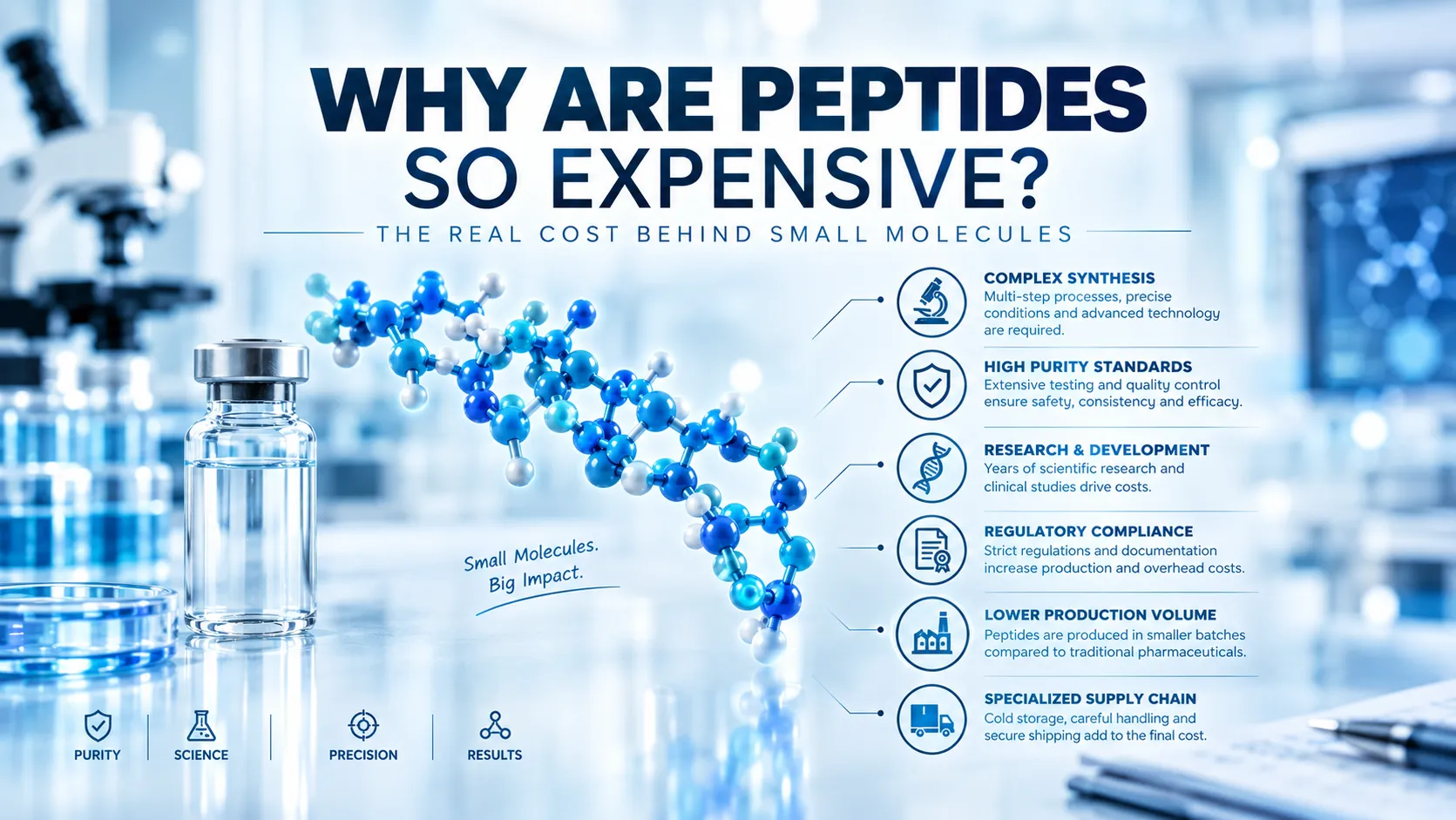
- The chemistry is unforgiving, the quality control costs more than the raw manufacturing, and the business around it runs on small batches under regulated handling.
- Raw amino acids are commodity chemicals and cost very little.
- A 99% line on a certificate represents metered hours of column time, solvent and discarded product.
- Separate assays answer separate questions, each runs on different equipment, and each carries a separate invoice.
- Price per milligram of peptide beats price per vial every time.
- Every dollar below the honest cost floor was saved somewhere specific.
- Three cost structures produce three price levels.
- Normalize to dollars per milligram, check which testing tier stands behind the number, and buy the evidence rather than the sticker price.
Why are peptides so expensive?
A 5 mg vial of BPC-157 lists near $25 on one site and near $80 on another. Same compound, same stated size, often the same 99% figure printed on the label.
That gap is not random, and it is not only markup. Peptides are expensive for three reasons. The chemistry is unforgiving, the quality control costs more than the raw manufacturing, and the business around it runs on small batches under regulated handling. Every residue added to a chain gives the batch another chance to fail. Purity above 95% gets bought by throwing material away. Each test on a certificate of analysis arrives with its own invoice.
So here is the 30 second version. Cheap starting materials go into the process. A modest fraction emerges as correct full length molecules, and most of the price pays for proving which is which.
What follows walks that in order. First the synthesis, then purification, then testing, then the three markets that sell related molecules at very different prices. After that you get 2026 price bands and the reasons two honest vendors differ. The last sections cover why the cheapest vial on the internet exists, and the arithmetic that shows which vial is actually cheaper.
Helix Bio Chem materials are supplied for laboratory research use only, and not for human use, veterinary use, or compounding. Everything here describes laboratory and research materials, and nothing on this page is medical, legal, or purchasing advice.
What does it cost to make a peptide vial?
Most research peptides are built by solid phase peptide synthesis, usually shortened to SPPS. The first amino acid sits anchored to a solid resin bead. Chemists then add the next residue, wash, deprotect, wash again, and repeat. A 15 residue peptide takes 14 of those coupling rounds, plus a deprotection step between each one.
No coupling round in that sequence finishes perfectly. Reported coupling efficiency generally sits somewhere between 95% and 99.9%, depending on the residue and where it lands in the sequence. Chains that miss a round do not vanish. They stay on the bead and keep growing, one residue short, and they end up in the same crude batch as the correct product. Chemists call these deletion sequences, and they are the reason length turns into money.
Compound the per step number across a whole chain and the pattern gets stark. The table below is straight arithmetic on coupling efficiency, not measured factory yield, and it ignores losses from cleavage and purification.
Crude yield by chain length, compounding a stated per-step coupling efficiency across n-1 couplings
Chain length | 99% per coupling | 98% per coupling | 95% per coupling |
|---|---|---|---|
15 residues, the length of BPC-157 | about 87% | about 75% | about 49% |
31 residues, the semaglutide backbone | about 74% | about 55% | about 21% |
39 residues, the retatrutide backbone | about 68% | about 46% | about 14% |
Read the bottom right cell again. At 95% per step, a 39 residue chain leaves roughly 14 correct molecules out of every 100 starting points. The other 86 are impurities that still have to be separated and discarded. Long sequences get so punishing that manufacturers often switch to recombinant or hybrid routes instead of building the whole backbone step by step.
Structural extras push the bill higher. Semaglutide carries a C18 fatty diacid attached to a lysine through a spacer, which is a separate acylation step. Retatrutide carries a C20 diacid on a linker, an amidated C terminus, and three non standard residues including aminoisobutyric acid. Cyclization, disulfide formation and unnatural amino acids each add chemistry, and each addition brings its own side products.
Those non standard residues cost more than commodity ones as well. Aminoisobutyric acid and alpha methyl leucine are not bulk amino acids, so protected building blocks for them get priced accordingly. Suppliers pay more per gram for the input, and methylated residues resist coupling, which means slower rounds or repeated ones.
Scale moves the arithmetic in the other direction. A synthesis run carries fixed costs that do not care about batch size. Reactor setup, solvent lines, operator hours and the analytical work that qualifies the run all fall in that bucket. Spread those across 10 grams and every milligram shoulders a real share of them. Across a kilogram, that same overhead nearly disappears into the unit cost.
Raw amino acids are commodity chemicals and cost very little. Correct, full length, verified molecules are what the buyer actually pays for, and most of the starting material never becomes one.
Why does purification cost more than synthesis?
What comes off the resin is not a product. It is a mixture of the target peptide, truncated chains, deletion sequences, side products from cleavage, and residual solvent. Separating that mixture is where a large share of the cost lands.
Here is the part that makes it hard. A deletion peptide missing one residue out of thirty is chemically almost the same molecule as the target. It carries nearly the same size, nearly the same charge, and nearly the same behavior on a reversed phase column. Separating two compounds that differ that little demands slow gradients, long runs and tight control.
Preparative HPLC is the tool that does that work. Crude material loads onto a large column, elutes over a gradient, and the operator collects only the fractions that fall inside a defined window. Everything outside the window gets discarded, including target peptide that eluted at the shoulders of the peak. Published preparative runs on difficult sequences have recovered only a fifth of the crude they started with.
Now the reason purity gets expensive fast. Pushing from 95% to 98% to 99% means narrowing that collection window, running larger column volumes, and extending run times. Each narrowing throws away more good material at the boundary. Chemists sometimes rerun pooled fractions entirely. The cost curve bends upward because the losses compound, not because the chemistry changes.
Solvent is a real line item on its own. Preparative runs push liters of water and acetonitrile through a column. Spent solvent then has to be collected and disposed of under chemical waste rules. Neither the buying nor the disposal comes free.
Analytics run alongside all of it. After each pass, a sample goes back to analytical HPLC to check whether the pooled fractions actually hit the target spec. Purification and testing work as a loop, so a supplier chasing a higher number pays for both sides of that loop repeatedly. Our breakdown of purity testing and contamination data covers what those measurements do and do not capture.
Translate all of that back to the label. A 99% line on a certificate represents metered hours of column time, solvent and discarded product. Skipping it is one of the clearest ways a cheap vial gets cheap.
What does peptide testing cost?
Buyers tend to read a certificate as one verdict. It is not. Separate assays answer separate questions, each runs on different equipment, and each carries a separate invoice.
- HPLC reports purity, usually as the area percentage of UV absorbing material that elutes as the target peak. It says nothing about which molecule that peak is.
- Mass spectrometry reports identity by matching observed mass against the expected mass. A peptide missing one residue can look clean on HPLC while being the wrong compound, and only mass data catches that.
- Endotoxin testing, by LAL or recombinant Factor C assay, measures bacterial endotoxin in endotoxin units. Endotoxin is invisible to both HPLC and mass spectrometry.
- Sterility and bioburden testing asks a microbiological question that no chromatography method answers.
- Net peptide content measures how much of the powder is peptide rather than water, counterion or residual salt. Material can read 99% pure by HPLC and still be well under 90% peptide by mass.
That last point matters more than most buyers realize, and it comes back in the pricing math below. Our guide on how to read a peptide certificate of analysis walks through each field in order.
Evidence arrives in tiers, and the tiers differ in strength and in price:
- Per lot third party testing. An independent laboratory tests the specific lot in your vial. Strongest linkage, highest cost, since every batch triggers fresh assays.
- Pooled or group buy testing. One test covers material shared across buyers or batches. Cheaper, but the link between the report and your particular vial gets looser.
- Supplier issued certificate only. The seller reports its own numbers. Cheapest to produce, and least independent.
Run the arithmetic across a catalog and a genuine testing program becomes the single most expensive recurring line a seller carries. Identity, purity, endotoxin and content testing, repeated per lot, across dozens of products, never stops costing money. Which is exactly why a suspiciously low price has usually dropped it quietly first.
Why does the same molecule sell at three different prices?
Related molecules reach buyers through three channels, and each channel carries a different cost structure before anyone adds margin.
Research use materials are supplied for laboratory work only. The cost base covers synthesis, purification, analytical testing, lyophilization, vialing and shipping. No clinical infrastructure sits behind it and no prescriber is involved, so the per vial number stays lowest of the three.
Compounded preparations come from licensed compounding pharmacies operating under pharmacy rules, with a prescriber in the loop. Facility standards, pharmacist labor, beyond use dating, documentation and clinical oversight all sit inside that price. Which preparations may be compounded is a regulatory question that shifts over time and varies by category. The mix available in any given year is not fixed.
Approved branded drugs carry the heaviest structure of all. Clinical trial programs, regulatory filings, GMP manufacturing, pharmacovigilance, distribution and commercial support all load onto the product. List prices for branded GLP-1 products have run past $1,000 a month before insurance or savings programs apply.
Three cost structures produce three price levels. Readers comparing a research vial against a monthly clinic figure are not comparing the same product with different markup. They are comparing different businesses that happen to involve a similar molecule. Helix Bio Chem supplies research use materials only, and nothing here is legal or medical guidance about any of those channels.
What do peptides cost in 2026?
The two tables below do different jobs. The first shows where peptide cost generally sits across publicly listed research use vials. The second shows how to normalize any price to cost per milligram.
Research use vial price bands, as of September 2026
Compound | Common vial size | Typical listed range |
|---|---|---|
BPC-157 | 5 mg | $20 to $80 |
TB-500 | 5 mg | $25 to $70 |
Ipamorelin | 5 mg | $15 to $60 |
CJC-1295 (no DAC) | 5 mg | $18 to $70 |
Semaglutide | 5 mg | $20 to $80 |
Tirzepatide | 5 mg | $20 to $90 |
Retatrutide | 5 mg | $24 to $100 |
GHK-Cu | 50 mg | $30 to $80 |
These bands summarize ranges reported across publicly available vendor guides in 2026. They are not Helix Bio Chem prices and they are not quotes from any named seller. Peptide prices move with synthesis scale, supply and demand, so treat the table as orientation and check current listings before you buy.
Two patterns inside that table deserve naming. Compounds made at scale for years, like ipamorelin and CJC-1295, cluster toward the low end because supply is mature and competition is thick. Newer or longer molecules carry a synthesis penalty and face fewer suppliers, which is why retatrutide tops the list.
Per milligram normalization, illustrative arithmetic only
Listed price | Vial size | Cost per mg |
|---|---|---|
$30 | 5 mg | $6.00 |
$55 | 5 mg | $11.00 |
$45 | 10 mg | $4.50 |
$70 | 10 mg | $7.00 |
$60 | 50 mg | $1.20 |
$140 | 100 mg | $1.40 |
Numbers in that second table are made up for the math. Nobody's real listing is being quoted.
Work one comparison through slowly to see it. Say a 5 mg vial lists at $45 and a 10 mg vial of the same compound lists at $70. Divide and the 5 mg vial costs $9.00 per milligram while the 10 mg vial costs $7.00 per milligram. The bigger sticker price buys the cheaper peptide, which is the ordinary result of spreading fixed vialing and testing costs across more material.
Then add net peptide content, and the ranking can flip. Suppose the $45 vial reports 95% net peptide content, giving 4.75 mg of actual peptide, or $9.47 per milligram. Suppose the $70 vial reports 70% net content, giving 7.0 mg, or $10.00 per milligram. On the sticker the second vial looked 22% cheaper per milligram. Measured against what is actually in the powder, it costs more.
Those figures are illustrations, not readings from any real certificate. The method behind them is the real point. Price per milligram of peptide beats price per vial every time.
Why do vendors charge different prices for the same peptide?
Two suppliers can both operate honestly and still land far apart on price. The inputs below explain most of the spread.
Batch size and synthesis scale. A kilogram scale run spreads setup, column time and operator hours across far more product than a 10 gram run. Larger sellers genuinely pay less per milligram.
Sourcing and traceability depth. Some vendors buy finished powder and repackage it. Others commission synthesis, hold documentation on the crude source, and can trace a vial back to a specific run. That paperwork costs money to maintain.
Testing tier. Per lot third party testing on every product is a permanent line item. Supplier issued numbers are close to free. The difference shows up in the price.
Fill accuracy and overfill. Filling to label with tight tolerances, and overfilling slightly so no vial falls short, means giving away material on every unit.
Storage and handling. Cold storage, protection from light and controlled shipping preserve material that would otherwise degrade in transit. Our notes on storage mistakes and potency loss cover what goes wrong when that step gets skipped.
Support, returns and payments. Staffed support, a real returns policy and higher risk payment processing all carry cost. Marketing and affiliate commissions sit on top.
None of that implies bad faith anywhere. Stack those inputs and a 2x spread between two legitimate sellers stops looking strange. It is also why asking "are peptides expensive" has no single answer: the price reflects which of these inputs a seller actually pays for.
Why is the cheapest vial on the internet so cheap?
Somewhere below the sum of synthesis, purification, testing, filling, storage and shipping sits a cost floor. Listings appear under that floor constantly, so it helps to understand structurally how they get there.
Testing is the usual first casualty. Dropping per lot third party assays removes a large recurring expense. So does moving to pooled testing and presenting it as lot specific, which leaves the certificate looking similar at a glance. Traceability often goes next, because keeping records that tie a vial to a documented synthesis run takes staff time.
Fill weight offers another lever to pull. A vial labeled 10 mg that holds 7 mg costs 30% less to produce and looks identical on a shelf. Purity specifications work the same way. Material purified to 95% and sold without stating the grade sells at the price of 99% material while costing considerably less to make.
Some low prices are ordinary commerce. Loss leaders, clearance on aging inventory and genuine scale advantages all produce real bargains from real sellers. At the far end sits substitution, where the powder is a cheaper compound entirely, or is not the labeled molecule at all.
Carry one mental model away from this section. Every dollar below the honest cost floor was saved somewhere specific. A seller who discloses where, by naming the purity grade, the testing tier and the fill, is doing real work. A seller who simply prints a lower number is not.
How do you compare peptide prices fairly?
Six checks, in the order that catches problems fastest.
- Normalize to dollars per milligram first. Divide price by vial size before comparing anything. Vial sizes are not standardized, and sticker prices hide the comparison.
- Adjust for net peptide content when it is reported. Purity and content are different measurements, and content tells you how much peptide the powder actually holds.
- Check the testing tier, not just the presence of a certificate. Ask whether the report covers your lot number or a different batch entirely.
- Confirm the laboratory is named and reachable. An independent lab that can be contacted is evidence. An unnamed lab is a claim.
- Compare purity specifications honestly. A 95% product and a 99% product are different goods at different costs. That gap is a real price difference rather than a rounding error.
- Total the landed cost. Shipping, cold packaging, payment surcharges and returns policy all belong in the comparison.
Our checklist for buying research peptides online in the USA expands each of these into what to ask before ordering.
The bottom line
Peptides cost what they cost because of chemistry, quality control and business reality. Molecules get built one residue at a time, with unavoidable failures along the way. Purification discards a large share of what synthesis produces, and every assay proving the result carries its own price. Small batches and regulated handling do the rest.
So when two vials look identical and the prices are not, the difference is usually documentation. Normalize to dollars per milligram, check which testing tier stands behind the number, and buy the evidence rather than the sticker price.
Frequently Asked Questions
Worth depends on what the price buys in evidence. For research use material, a fair price returns verified identity, a stated purity grade, lot linked testing and accurate fill. Paying less for a vial with none of that documentation buys an unknown, which is rarely good value in laboratory work.
Research use vials commonly list between roughly $15 and $100, depending on compound, vial size and supplier, as of September 2026. Larger vials of inexpensive compounds like GHK-Cu run lower per milligram. Newer or longer molecules such as retatrutide sit toward the top of the range.
Insurance is built around approved medications prescribed for approved indications, so coverage tracks the product rather than the molecule. Approved peptide drugs may be covered subject to plan rules and prior authorization. Compounded preparations generally sit off formulary, and research use materials are not medical products and are never reimbursed.
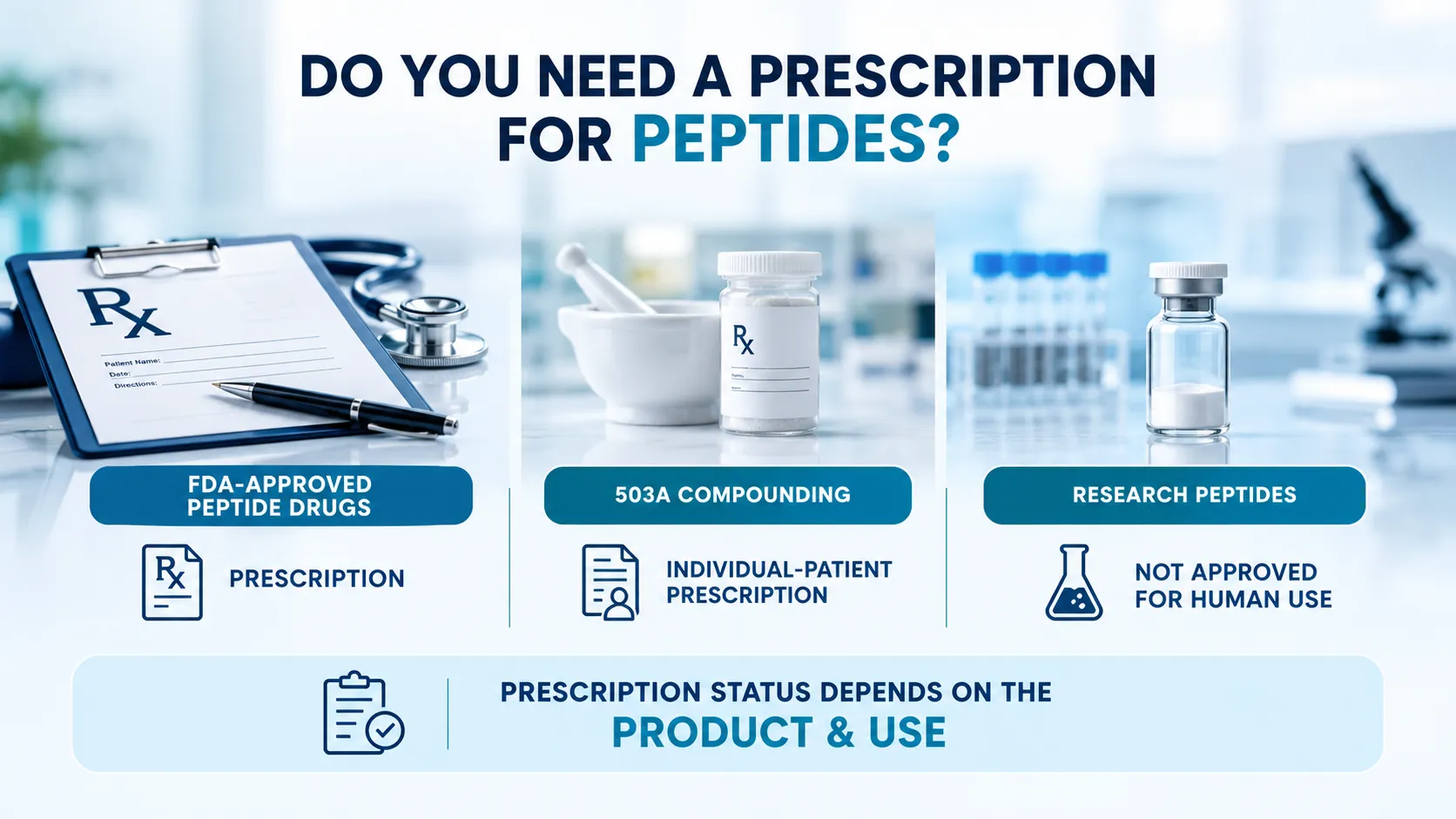
Approved peptide medications require a prescription, and compounded preparations require a prescriber as well. Research use materials are a different category entirely. They are supplied for laboratory work, not for human use, so the prescription question does not apply to them in the way buyers often assume.
Chain length, structural modifications and batch scale set the floor. A 15 residue peptide made at scale costs far less per milligram than a 39 residue chain. Fatty acid side chains and non standard residues add cost on top, and testing depth, fill accuracy and purity grade explain most of the rest.
Monthly figures circulating online come from clinical and compounded programs, where a prescriber sets a defined course. Research use material has no monthly figure. Consumption depends entirely on study design, assay volume and how long a reconstituted vial stays usable under proper storage.
Vial prices compare containers, not contents. Dividing by milligrams reveals that a larger vial is usually cheaper per unit, since fixed filling and testing costs spread further. Factoring in net peptide content goes one step deeper and sometimes reverses which vial genuinely costs less.
Helix Bio Chem Team
Research & Product Team
Our in-house team tracks published peptide research and translates it into clear, source-cited summaries for the research community.
Reviewed by in-house research chemists
support@helixbiochem.com