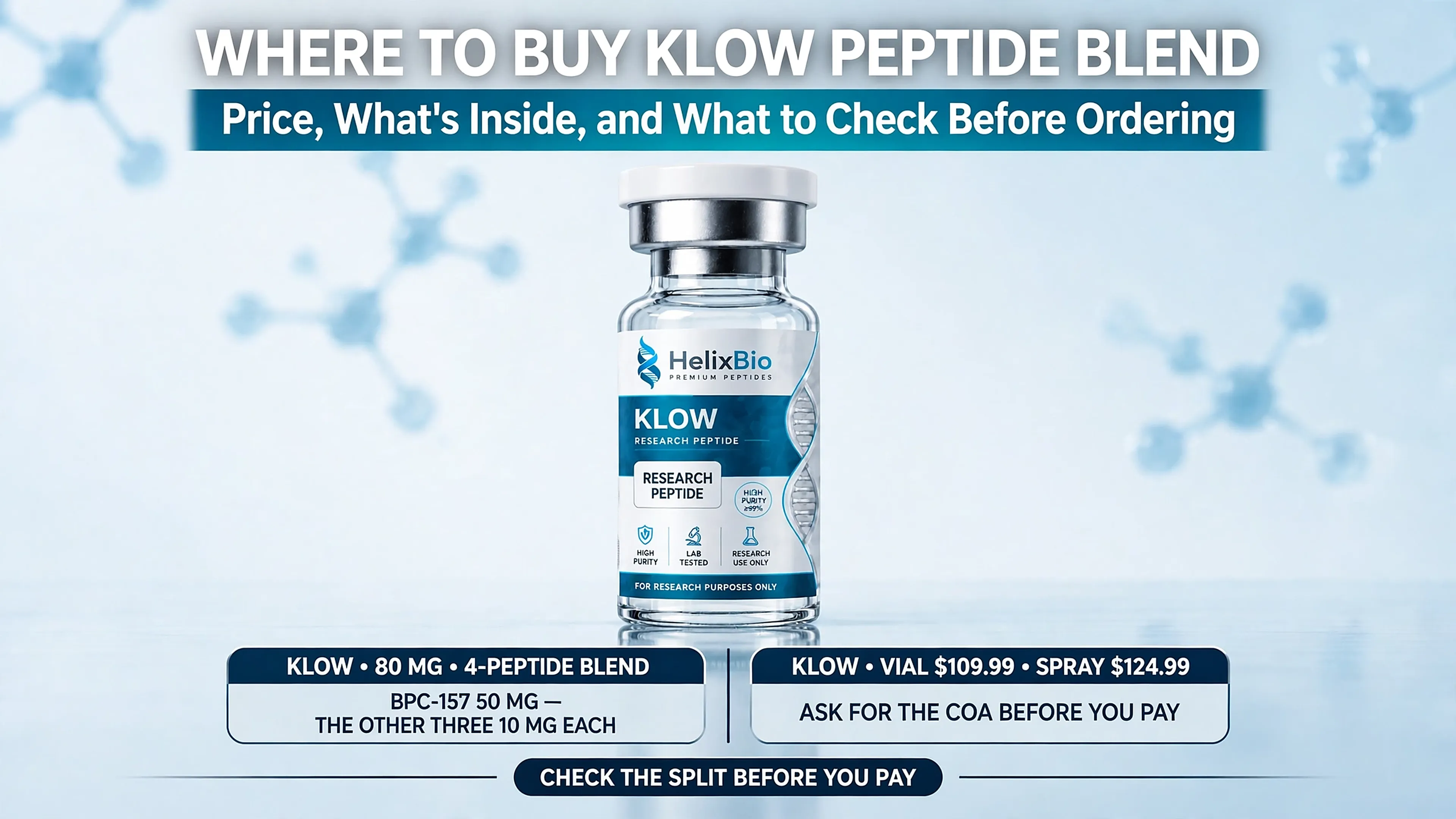
- Helix Bio Chem lists the KLOW vial at $109.99 and the KLOW Blend Spray at $124.99, both prices verified on the live product pages on 17 November 2026.
- Helix's published lyophilised split puts BPC-157 at 50 mg and GHK-Cu at 10 mg, while most other suppliers publish the reverse, a five-fold difference on two components within the same 80 mg total.
- The KLOW vial page does not name its four components and describes the product as a proprietary multi-peptide formulation, with the breakdown supplied in order documentation.
- The spray page names all four components but publishes no per-component quantity, total strength, concentration, fill volume or mass per actuation for the spray format.
- No publicly viewable KLOW lot certificate was found on either product page, and the site's certificates page showed a batch count of zero at the time of checking.
- On 23 July 2026 the FDA's Pharmacy Compounding Advisory Committee voted 8 to 6 with one abstention in favour of recommending BPC-157, KPV and TB-500 for the 503A Bulks List, against FDA reviewer conclusions, and the vote is advisory only.
- The HHS draft enforcement discretion policy published 30 October 2026 covers six peptides including BPC-157, KPV and TB-500, applies to section 503A prescription compounding rather than finished blends, and does not include GHK-Cu.
- BPC-157 falls under WADA class S0 and TB-500 under section S2 as a thymosin beta-4 derivative, both prohibited at all times under the 2026 list.
- A PubMed search for all four components together returned no results on 17 November 2026, so no published human study of the finished blend was identified.
Helix Bio Chem sells KLOW in two formats. The KLOW Blend Spray is $124.99 and the KLOW vial is $109.99, both prices checked on 17 November 2026. The spray page names four components, GHK-Cu, BPC-157, KPV and TB-500. What it does not publish is the per-component quantity, total strength, concentration or fill volume for the spray itself. That missing specification matters more than the price difference, and this guide shows you what to request before you pay. View KLOW Blend Spray. Both products are sold strictly for laboratory research use.
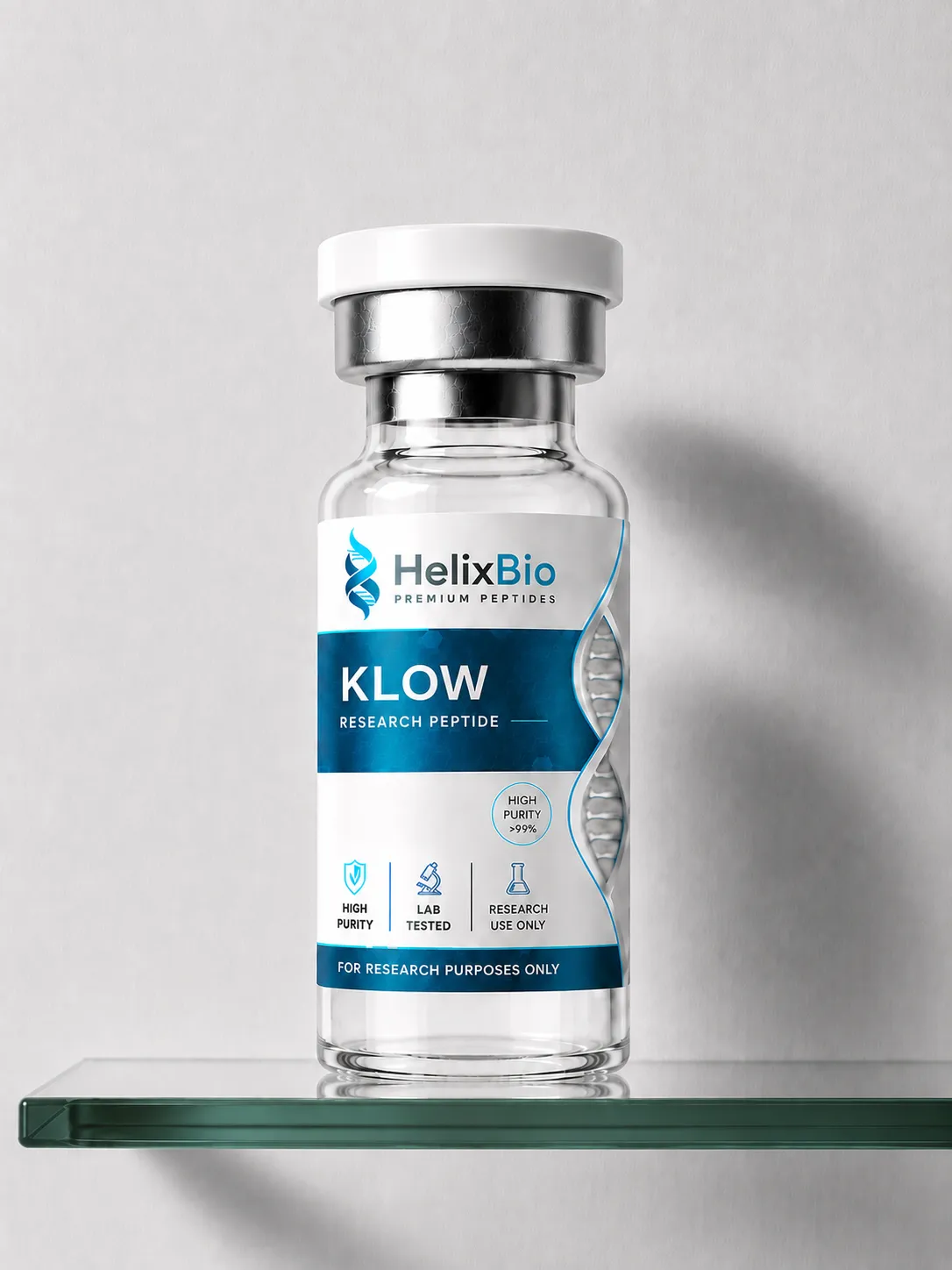
Klow
RESEARCH PEPTIDE
Klow is a multi-peptide research blend supplied by Helix Bio for laboratory use only. It combines several peptides commonly referenced in tissue-repair, recovery, and inflammation-model research literature into a single vial, rather than requiring researchers to source and combine individual compounds separately. Researchers studying cellular regeneration, inflammatory markers, soft-tissue research models, or recovery-related biomarkers use blended formulations like Klow because they let a study reflect combined effects between peptides, which is a different research question than testing one compound in isolation. Helix Bio's Klow blend ships as a lyophilized powder, is batch tested, and includes a certificate of analysis with every order. This page covers what the blend is, how it's tested, storage guidance, and how Klow relates to Helix Bio's other blend, Glow — background that's useful before placing a research order.
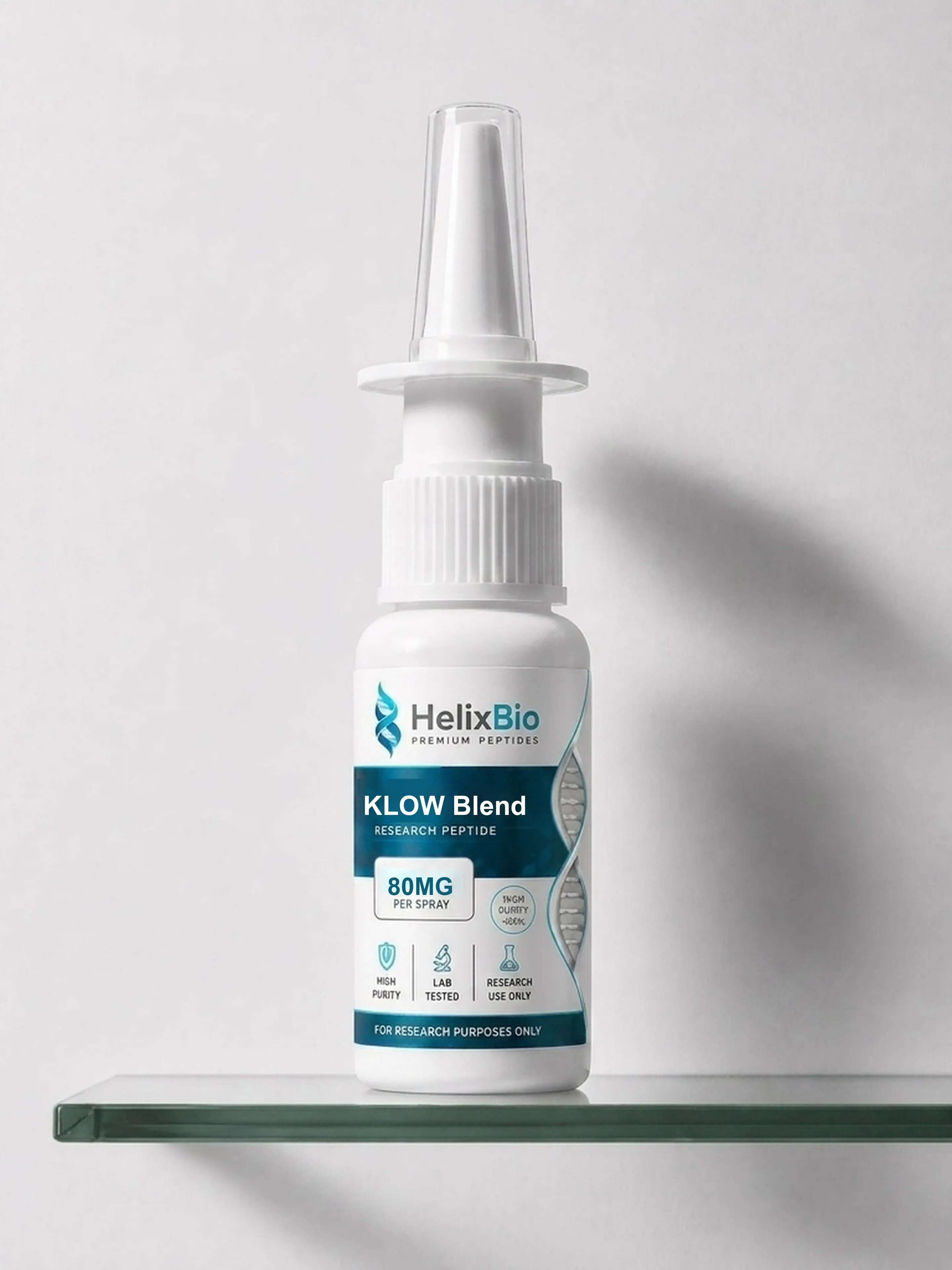
KLOW Blend Spray
RESEARCH PEPTIDE
Four molecular entities share one container here, and the smallest of them is the reason the product has its own name. KLOW Blend Spray is Helix Bio's prepared-solution preparation of the KLOW combination — GHK-Cu, a copper(II) complex of the tripeptide glycyl-L-histidyl-L-lysine; BPC-157, a synthetic pentadecapeptide; TB-500, a thymosin β4-related material; and KPV, the three-residue C-terminal fragment of α-melanocyte-stimulating hormone. Those first three are the GLOW combination. KPV is the addition, and it is the only compositional difference between the two. Helix Bio supplies this material for qualified laboratory and scientific research. It is not intended for human or veterinary consumption, administration by any route, diagnosis, treatment, or prevention of disease. One thing is worth establishing before anything else on this page: KLOW is a product designation rather than a characterised substance, and published specifications for blends carrying the name do not agree with each other. What a given container holds is settled by its lot documentation, not by its label.
KLOW is sold strictly for laboratory and research use only. It is not a drug, dietary supplement, cosmetic, or treatment product. It is not intended for human or veterinary use, injection, ingestion, or any form of self-administration. This guide covers prices, ordering steps, supplier checks and listed composition only. It does not provide dosing, administration, reconstitution, or any therapeutic claim for KLOW or any component.
What you are actually buying when a supplier says KLOW
KLOW is a commercial blend name, not a standardised formulation. Four research peptides sit behind the label. GHK-Cu is a copper-binding tripeptide, which Helix's GLOW spray page lists as INCI copper tripeptide-1, CAS 89030-95-5. BPC-157 is a synthetic pentadecapeptide. KPV is a tripeptide derived from alpha-MSH. TB-500 is a thymosin beta-4 related material, and its exact molecular form has to be confirmed per lot.
That last point is not a technicality. The name TB-500 is used for at least two different molecules in commerce, either full-length thymosin beta-4 or the acetylated fragment Ac-LKKTETQ. Helix's own GLOW spray page states this directly and says the form must be confirmed for the lot in hand. A listing that prints TB-500 and nothing else has not told you which molecule you are buying.
For the mechanism and research background on each component, our GLOW versus KLOW comparison covers that ground in detail. This page stays on the buying question.
Suppliers do not agree on what goes in the vial
Here is the part most buying guides skip. The four components are consistent across the market, but the quantities are not, and the disagreement is large.
Component | Helix published lyophilised split | Split published by most other suppliers |
|---|---|---|
GHK-Cu | 10 mg | 50 mg |
BPC-157 | 50 mg | 10 mg |
KPV | 10 mg | 10 mg |
TB-500 | 10 mg | 10 mg |
Stated total | 80 mg | 80 mg |
Both columns add to 80 mg. Two components swap places, and the swing on each is five-fold. A vial built to the left-hand column and one built to the right are materially different products. They share only a name and a total mass.
Neither column is the definitive KLOW formula, because no standard exists to be definitive about. The practical consequence is simple. Only the lot documentation for the container you are sent can tell you which formulation you actually received.
What KLOW costs right now
Helix prices were re-verified on the live product pages on 17 November 2026.
Helix product | Format | Price, checked 17 Nov 2026 |
|---|---|---|
Lyophilised powder | $109.99 | |
Prepared spray solution | $124.99 |
The spray carries a $15.00 premium over the vial. Neither page displayed a sale price or a customer review at the time of checking.
Wider market figures need a different label, and here is why. Third-party roundups quote US prices for an 80 mg KLOW vial in a band of roughly $99 to $200, with outliers below and above. Those figures came from comparison articles rather than from each supplier's own checkout, so they are dated observations and not verified current prices. Several of those roundups also run discount codes and affiliate links for the vendor they rank first. Worth knowing before you treat a ranking as neutral.
Two specific prices should be treated as unsettled. Ascension's KLOW price appears in circulation as $120, as $125 against a $199.99 list, and as $160. Which figure you see depends on the roundup, and a further 50 percent code is reported on top. Pure Health appears as both $199.99 and $139.00. Until a figure comes off the supplier's own live page, treat all of these as disputed rather than current.
Why price per milligram misleads on this blend
Comparison sites like to rank KLOW by price per milligram, which produces tidy numbers like $0.55 per mg. The arithmetic treats 80 mg of blend as 80 mg of one chemical. The two circulating formulations disagree five-fold on which component dominates. So a per-mg figure can compare two different products and present the result as a value verdict.
If you want to compare on cost, compare per disclosed component, and only when both suppliers actually publish their split. Where a supplier does not disclose the quantities, the comparison is incomplete and no amount of division fixes it.
KLOW vial or KLOW spray, and why the spec sheets differ
The two Helix formats are not the same product in different packaging. One ships as dry powder, the other as a prepared solution, and the published specifications differ in an important way.
Specification | KLOW vial | KLOW Blend Spray |
|---|---|---|
Price, 17 Nov 2026 | $109.99 | $124.99 |
Format | White to off-white lyophilised powder | Prepared solution in a metered-delivery bottle |
Components named on the page | No, described as a proprietary multi-peptide formulation | Yes, all four named |
Per-component quantities for this format | Not published, provided with order documentation | Not published, deferred to the current listing and lot documentation |
Total strength for this format | Not published on the page | Not published |
Concentration and fill volume | Not applicable | Not published |
Storage | Unreconstituted at -20°C protected from light and moisture, reconstituted at 2°C to 8°C | Follow current product-specific documentation, refrigerated per lot |
Lot COA | Request the current document | Request the current document |
The vial page does not name its four components at all. It calls KLOW a proprietary multi-peptide formulation and says the full breakdown comes with order documentation. The spray page does name all four, and it publishes the lyophilised 80 mg split shown earlier. It also states plainly that those masses should not be carried across to the spray.
Respect that boundary when you compare listings. The spray's variant naming includes an 80 mg reference. Helix has not published a verified total strength, concentration, fill volume or mass per actuation for it. Treat the spray's strength as unpublished rather than assuming it matches the powder.
One more gap worth noting. Neither rendered product page displayed a SKU at the time of checking, so any SKU you see quoted elsewhere should be confirmed with Helix directly.
What to ask for before you pay
This is the section that actually protects your money. A useful certificate of analysis for a four-component blend has to establish more than a single purity number.
Request these items and read the answers before ordering:
- The current composition sheet for the format you are buying, vial or spray, not the other one
- A lot-specific certificate of analysis for the batch you will be sent
- Identity confirmation for all four components, not three
- A quantity figure for each component, so you can see which formulation you are getting
- The molecular identity line for TB-500, including formula or molecular weight, so you can tell which molecule is present
- The name of the laboratory that performed the testing
- The analytical method used, and which test produced which result
- The testing date and the lot or batch number
- Confirmation that the lot number on the document matches the container you receive
A single combined purity percentage cannot establish four component identities and four quantities. HPLC purity speaks to how much of what was measured is the intended material. It does not say which four molecules are in the vial, or in what ratio. Our KLOW COA verification guide works through the analytical detail. It covers why copper and the small tripeptides create detection problems a generic certificate will not address.
Where a supplier claims laboratory accreditation, check the scope rather than the badge. ISO/IEC 17025 accreditation is granted for specific tests by specific methods. A laboratory accredited for HPLC purity may not be accredited for mass-spectrometry identity work. Ask which register entry covers the test on your certificate, and check its expiry date yourself.
What Helix currently publishes, stated plainly
Honesty here is worth more than trust language. Both Helix KLOW pages make a certificate-of-analysis commitment with the order. At the time of checking, no KLOW lot certificate was publicly viewable on either product page. The site's certificates page displayed a batch count of zero, with a note that COA documents are being added.
So you cannot inspect a Helix KLOW certificate before ordering, and you should not expect to. Request the current composition sheet and the relevant lot certificate as part of your pre-order questions. Check the lot number against the container when it arrives.
The purity figures displayed in the page furniture need the same care. Both KLOW pages show a site-wide verified purity badge of 99 percent or higher. The site's own footer says certain items may test below 99 percent purity. Those are catalogue-level statements. Neither is a measured KLOW lot result, and no verified KLOW lot purity figure was published on the site at the time of checking.
The listings that should slow you down
A low price is a reason to ask more questions, not proof that a product is fake. These patterns are worth a pause:
- No identifiable certificate, or a certificate with no lot number
- One combined purity figure and no component identities
- No quantity disclosure for any component
- Ingredient names that shift between the title, the description and the certificate
- TB-500 named with no formula or molecular weight anywhere
- Accreditation claimed without a named laboratory or a scope you can check
- A price far below the observed market band, with no documentation to explain it
- Marketplace listings where the actual supplier is unclear
Our peptide COA red flags cross-check goes further into how these documents fail. On where KLOW is not ordinarily sold, the short answer covers most questions. Research blends like this are not normally stocked by Amazon. They are not dispensed at a pharmacy counter either, because no finished KLOW blend is an approved drug. Supplier websites are the usual channel, which puts the documentation burden on you.
How KLOW and GLOW compare on price
GLOW and KLOW share three components, and KLOW adds KPV. That is the formulation difference, and it is covered properly in the GLOW versus KLOW comparison along with the GLOW component evidence review.
On price, the live Helix Bio Chem figures on 17 November 2026 were $109.99 for the KLOW vial against $94.99 for GLOW. In spray format it was $124.99 for KLOW against $109.99 for GLOW. Both dated figures put KLOW above GLOW in each format, a $15.00 gap in each case, which is what the extra component would suggest. Confirm both product pages yourself before relying on that gap, since it may reflect a recent pricing change.
Adding a fourth component does not make a blend better supported by research. No head-to-head study of GLOW against KLOW exists, so the comparison is one of composition and price, not of performance.
Buying the blend versus the four peptides separately
The reasoning behind blend pricing is straightforward. One vial of four co-formulated peptides usually costs less than four separate vials, which is why blends exist at all. Third-party guides put the separate-purchase route at roughly $200 to $320 as of 17 November 2026, against blend pricing in the $99 to $200 band.
Those totals depend entirely on assumptions, and the assumptions are where the comparison breaks. Running the arithmetic honestly requires three inputs. You need the current price of each single-component product, the vial size each is sold in, and the exact split in your blend. Change the split from GHK-Cu at 50 mg to BPC-157 at 50 mg, and the basket changes shape completely. You now need five 10 mg vials of one peptide instead of one 50 mg vial of another.
For that reason, no separate-purchase total is published here. The component prices needed to calculate it were not re-verified for this guide. A figure built on stale inputs would be worse than no figure. If you want the comparison, price each component on the live product pages against the split on your actual lot documentation.
A lower total also does not make the blend the better choice. Separate vials let you vary one component independently, and a blend does not.
How ordering works at Helix
The process is short, and the documentation step is the one worth not skipping.
- Choose your format on the KLOW vial or KLOW Blend Spray page
- Read the listed specifications and note what the page does not publish for that format
- Request the current composition sheet and the lot certificate if you need them before committing
- Add the product to your cart and review the order summary
- Confirm the available payment methods at checkout
- Confirm shipping details and any applicable charges at checkout
- Place the order once you are satisfied the product and documentation meet your research requirements
On account requirements, Helix's published terms set an age floor of 18 or the legal age where you live. Standard retail orders are not described as requiring proof of research status, institutional affiliation or government identification. Our research peptide account requirements guide covers what suppliers typically ask for.
Payment methods, shipping costs and delivery charges are listed at checkout rather than on the product pages, so confirm them there. One policy point deserves a direct question before you order. The refund policy and the shipping policy do not read consistently on damaged or lost shipments. Ask Helix to confirm in writing what applies to your order.
For a broader supplier-vetting framework that applies to any vendor, not just this one, use our research peptide buying checklist.
Where KLOW actually stands with regulators
No KLOW blend is approved by the FDA for any use, and none of the four components is an FDA-approved drug. A research-use-only label is a seller designation, not a regulatory clearance, and it does not create any approved route to human use.
The compounding picture changed during 2026, and the detail matters because it is widely misreported. On 23 July 2026, the FDA's Pharmacy Compounding Advisory Committee voted 8 to 6 with one abstention. The recommendation was to add BPC-157, KPV and TB-500 to the 503A Bulks List. The vote went in favour, against the conclusion FDA reviewers had reached, and it is advisory only. An advisory recommendation does not change a substance's legal status. A further PCAC meeting has been reported as expected before the end of February 2027.
Then on 30 October 2026, HHS published a draft enforcement discretion policy covering 503A compounding with six peptide bulk substances, including BPC-157, KPV and TB-500. The comment window closed on 13 November 2026. Read the scope carefully. The policy describes circumstances in which HHS does not intend to act against state-licensed pharmacies, federal facilities or licensed physicians compounding under section 503A. That holds while the bulks list is settled through rulemaking. It covers single-ingredient prescription compounding, not finished blends, and it does not apply to research-use sellers. GHK-Cu is not among the six.
GHK-Cu sits in a different place again. FDA's 503A categories list, updated 14 May 2026, carries GHK-Cu in Category 1, under evaluation, with injectable routes of administration excluded. Category placement is not inclusion on the Bulks List, which happens only through rulemaking.
For athletes the position is less ambiguous. BPC-157 is captured by the non-approved substances class, S0, and TB-500 is covered under section S2 as a thymosin beta-4 derivative. Both are prohibited at all times, in and out of competition, under the 2026 list. GHK-Cu and KPV are not individually named, which does not place them outside the list's catch-all wording. KLOW cannot be described as cleared for tested sport.
For the US legal position on research purchases, including how state rules vary, see our research peptide legality overview. None of this is legal advice.
What the research does and does not show
A PubMed search for all four components together returned no results on 17 November 2026. No published human study of the finished KLOW blend was identified, and the nearest combination work involves two of the four components in animals. Evidence for individual ingredients does not transfer to the finished blend, and preclinical findings are not human outcomes.
Making the call
Buying KLOW well comes down to three things. Know which formulation you are getting, because the two circulating splits differ five-fold on two components. Get the lot documentation in hand, because no public KLOW certificate was available to inspect at the time of writing. Treat every price as dated, including the ones on this page.
If Helix's published specifications and documentation process suit your requirements, the spray is the format with all four components named on the page. View KLOW Blend Spray for current pricing and specifications, or compare it against the KLOW vial if you prefer lyophilised powder. Ask for the composition sheet and the lot certificate either way.
Frequently Asked Questions
Supplier websites are the usual channel, and Helix Bio Chem sells both a KLOW vial at $109.99 and a KLOW Blend Spray at $124.99 as checked on 17 November 2026. Research blends like this are not ordinarily stocked by general marketplaces or dispensed at pharmacy counters. Whichever supplier you use, ask for the lot-specific certificate before ordering.
Helix lists the vial at $109.99 and the spray at $124.99, both checked 17 November 2026. Third-party roundups put the wider US market for an 80 mg vial at roughly $99 to $200, though those are dated observations rather than verified checkout prices. Because suppliers publish different component splits, two KLOW listings at the same price may not be the same product.
No, and this is the most important thing to know before buying. Most suppliers publish GHK-Cu at 50 mg with the other three at 10 mg each, while Helix's published lyophilised split puts BPC-157 at 50 mg and GHK-Cu at 10 mg. Both total 80 mg, but two components swap at a five-fold difference, so only your lot documentation tells you which formulation you received.
It should establish identity and quantity for all four components, tie them to one lot number, and name the laboratory, the method and the testing date. For TB-500 it should include a formula or molecular weight, since that name is used for more than one molecule. A single combined purity percentage does not establish four identities and four quantities, and our KLOW COA verification guide explains why.
Yes, Helix sells a KLOW Blend Spray at $124.99 as checked on 17 November 2026, supplied as a prepared solution in a metered-delivery bottle. The spray page names all four components, which the vial page does not. It does not publish per-component quantities, total strength, concentration, fill volume or mass per actuation for the spray, so request the current composition sheet.
No. No KLOW blend is FDA approved, and none of the four components is approved as a drug. A research-use-only designation comes from the seller and is not a regulatory clearance. The July 2026 advisory committee vote on BPC-157, KPV and TB-500 and the October 2026 HHS draft enforcement policy both concern prescription compounding, not research-use blends, and neither is an approval.
Research chemicals are generally sold for laboratory use under research-use-only terms, and Helix sells KLOW on that basis. That is not the same as a product approved for human use, and state rules vary, so no blanket claim of legality across every state holds up. Our research peptide legality overview covers the framework, and none of it is legal advice.
Judge the documentation rather than the badges. Ask for a lot-specific certificate naming the laboratory, the method, the date and a batch number you can match to the container, with identity and quantity for each of the four components. Be wary of one combined purity figure, accreditation claims with no checkable scope, and prices far below the market band with nothing to explain them.
GLOW is built on GHK-Cu, BPC-157 and TB-500, and KLOW adds KPV as a fourth component. On live Helix Bio Chem prices checked 17 November 2026, the KLOW vial was $109.99 against $94.99 for GLOW, and the KLOW spray was $124.99 against $109.99. No head-to-head study compares the two, so a fourth component does not mean better-supported research.
Storage differs by format, so follow the documentation for the one you buy. Helix lists the lyophilised vial as stored at -20°C unreconstituted, protected from light and moisture, and 2°C to 8°C once reconstituted. The spray defers to current product-specific documentation, with refrigerated storage noted per lot. Shipping costs and delivery details are confirmed at checkout.
No documented expansion of the name was found in the sources checked for this guide. Some vendor pages assert that the K refers to KPV, which is plausible given that KPV is the component separating KLOW from GLOW, but no authoritative source confirms it. Treat KLOW as a commercial blend name rather than an abbreviation with an established meaning.
There is no established human safety profile for the finished KLOW blend, because no published human study of the four components together was identified. That means no credible side-effect list or frequency data exists for it, and any page presenting one is not working from published evidence. KLOW is sold for laboratory research use only and is not for human use.
- 01Helix Bio Chem. KLOW product page. Price, format, storage and composition wording verified 17 November 2026.
- 02Helix Bio Chem. KLOW Blend Spray product page. Price, named components and published lyophilised split verified 17 November 2026.
- 03Helix Bio Chem. GLOW and GLOW Blend Spray product pages. Comparison prices verified 17 November 2026.
- 04Helix Bio Chem. Certificates of Analysis page. Batch count and certificate availability checked 17 November 2026.
- 05US Food and Drug Administration. 503A Category Lists of Bulk Drug Substances, updated 14 May 2026. GHK-Cu listed in Category 1 excluding injectable routes.
- 06Department of Health and Human Services. Enforcement Discretion Policy Regarding 503A Compounding Using Certain Peptide Bulk Drug Substances. 91 FR 68526, 30 October 2026, FR Doc 2026-22192.
- 07American Journal of Managed Care. FDA Panel Backs 6 Peptides for Compounding, 31 July 2026. Reports the 23 July 2026 PCAC vote of 8-6 with one abstention on BPC-157, KPV and TB-500.
- 08National Law Review. FDA Committee Supports Peptide Compounding, 2026. Confirms the PCAC vote was advisory and does not change legal status.
- 09World Anti-Doping Agency. 2026 Prohibited List, in force 1 January 2026. Class S0 non-approved substances and class S2 peptide hormones and growth factors.
- 10PubMed. Combined search for BPC-157, GHK-Cu, KPV and TB-500 returned no indexed results, run 17 November 2026.
Helix Bio Chem Team
Research & Product Team
Our in-house team tracks published peptide research and translates it into clear, source-cited summaries for the research community.
Reviewed by in-house research chemists
support@helixbiochem.com