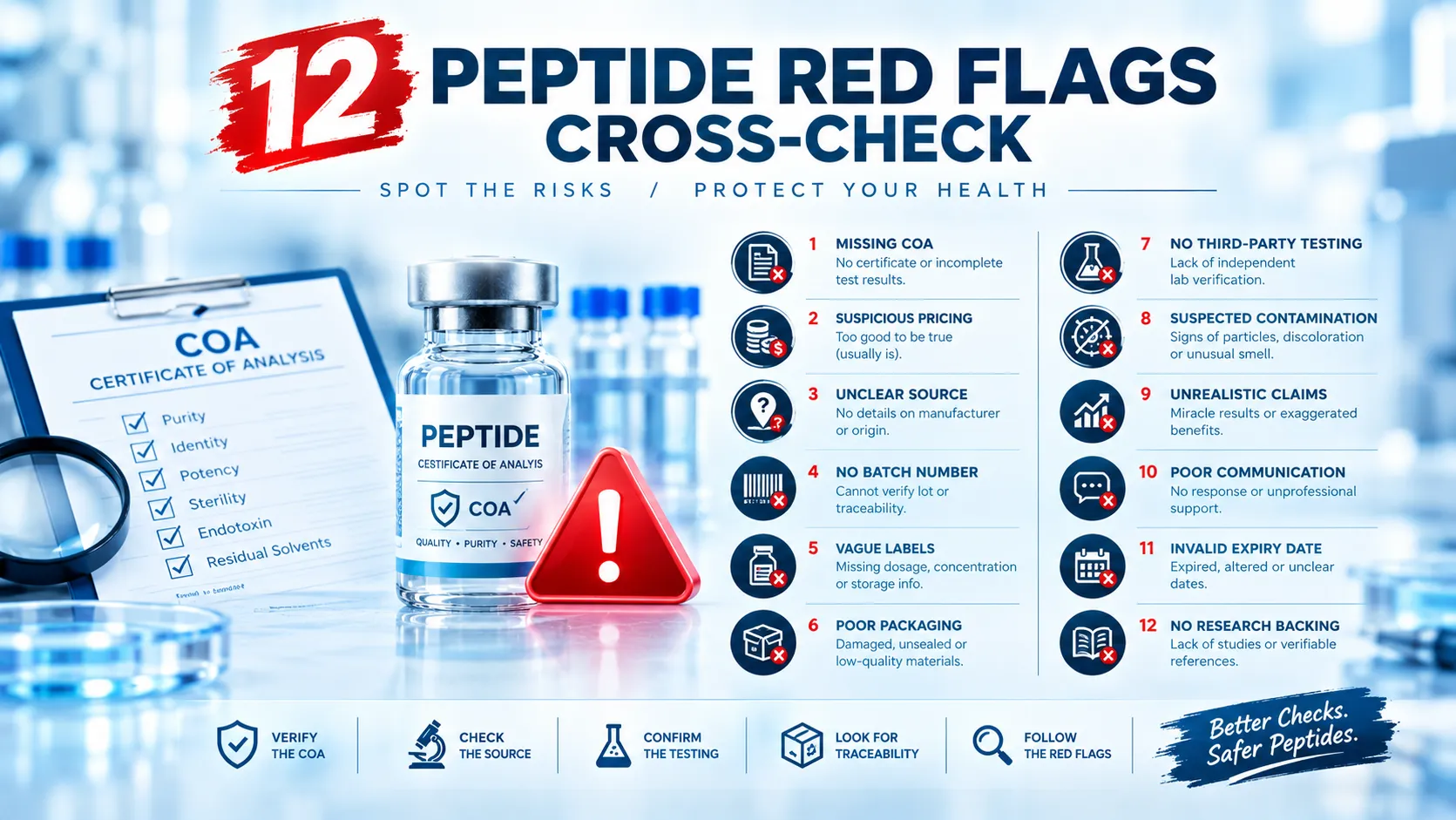
- A peptide COA red flag is a mismatch or gap between documents, not proof of fraud, contamination, or poor quality.
- The six-link chain runs from the vial label to the COA, the lab, the issuer's record, the test scope, and the supplier's claims.
- The lot number is the only link between a vial and a test report, so it is the first thing to check.
- ISO/IEC 17025 accreditation applies to a defined scope, which the accrediting body's directory and scope document show.
- A COA is strongest evidence when it matches the issuing laboratory's own record of the report.
- Claims such as sterile or endotoxin-tested each need their own matching test result on a report.
- Under 21 CFR 207.77, FDA registration or drug listing does not denote FDA approval.
- Even a clean document check describes a tested sample, not overall safety or suitability for human use.
A peptide COA red flag is a gap or mismatch between documents that should describe the same material: the vial label, the certificate of analysis, the lab's own record, and the supplier's claims. In other words, it is a reason to verify or ask for more. It is not proof that a peptide is fake, contaminated, or poorly made.
This guide checks those documents in order. For each red flag, it covers what the problem looks like, why it may matter, what to verify, what to request, and what remains uncertain.
This guide is the cross-check procedure. For a field-by-field walkthrough of a single certificate, see our guide to reading a peptide certificate of analysis.
What counts as a COA red flag, and what doesn't?
Not every COA problem carries the same weight. In practice, four situations look alike at first but mean different things:
- Missing information. A field, document, or record is absent. This limits what you can check, but it says nothing about the material itself.
- Inconsistency. Two sources that should match do not. This is the strongest reason to ask questions, because at least one source is wrong or incomplete.
- Unverifiable claim. Nobody can check the statement, such as "third-party tested" with no lab named.
- Confirmed finding. An independent test or an official record establishes a fact. A document review alone rarely gets this far.
Most flags below fall into the first three groups. That matters, because an honest supplier can have an incomplete file. Conversely, a polished file can still describe the wrong lot.
However, this article does not explain individual COA fields. For lot numbers, chromatograms, mass spectrometry, and net peptide content, see our field-by-field COA guide.
How do you verify a peptide COA?
Instead of asking whether one document looks professional, follow the material from the vial to the marketing:
- Product label and lot. Does the vial carry a lot that the paperwork also names?
- COA details. Does the report describe that lot and material, with dates that fit?
- Laboratory identity. Can you identify the lab, and does any accreditation cover the test?
- Verifiable report. Does the report match the issuer's own record?
- Testing scope. Did testing cover each claim, on the product actually sold?
- Supplier claims. Do marketing and regulatory statements stay within the evidence?
Each link compares at least two sources. As a result, a break early in the chain weakens everything after it.
Why go to this trouble? In one published study, researchers at Ghent University ordered 98 synthetic peptides at a requested purity of at least 95.0%. Every peptide arrived with a COA stating that purity. However, only 43 met it in the team's own analysis, and the authors linked part of the gap to the supplier's less selective method (Verbeke et al., 2015). That study is not a survey of today's market. Still, it shows that an authentic certificate and an accurate result are different things.
Link 1: The Vial Label and Lot
Red Flag 1: The Vial Has No Lot, or the Lot Appears on No Document
The first red flag is a vial with no lot number, or with a lot that no supplied COA mentions.
What it looks like. The label shows a product name and amount but no lot. Alternatively, its lot differs from every report on the product page.
Why it may matter. In practice, the lot number is the only link between a vial and a test result. Without it, a report describes some batch, but not necessarily yours.
What to verify. First, photograph the label on arrival. Then compare its lot number, character by character, with each available report.
What to request. Start by asking for the report that matches your lot. If none exists, ask whether anyone tested the lot, and who.
What remains uncertain. A matching lot shows only that the documents name the same batch. It does not prove your vial came from the sample the lab received.
Red Flag 2: The Label and the Report Describe Different Material
The second red flag is a label and a report that disagree about the material itself.
What it looks like. For example, the label names one salt form while the report names another. Similarly, the amounts may differ, or the report may describe a powder when the product is a spray.
Why it may matter. After all, each detail changes what the lab examined. Still, some differences have simple explanations, such as a label that rounds the amount.
What to verify. Compare the compound name, salt form, amount, physical form, and sample description. Then note each difference rather than judging it.
What to request. Ask the supplier to explain each difference in writing. In addition, ask whether a report exists for the exact form sold.
What remains uncertain. An explanation may settle a mismatch on paper. However, only testing the product itself confirms what the vial contains.
Link 2: The COA as a Document
Red Flag 3: One Report Appears to Cover Several Lots or Products
The third red flag is a single report offered as evidence for several lots or products.
What it looks like. The same report number, chromatogram, or figures appear on more than one product page. Likewise, a supplier may send the same file for orders months apart.
Why it may matter. A COA describes the sample the lab received. So if one report supports many lots, most of them may lack their own report.
What to verify. Collect reports for several products or orders. Then compare report numbers, dates, sample IDs, and results. Shared layouts are normal, since labs use templates; identical data, however, are not.
What to request. Next, ask which lots each report covers, and whether newer lots have their own.
What remains uncertain. Reuse does not prove that later lots are poor. Instead, it leaves them undocumented, so their quality stays unknown.
Red Flag 4: The Dates Do Not Fit Together
The fourth red flag is a set of dates that cannot all be true, or no dates at all.
What it looks like. A report has no analysis date. Alternatively, analysis predates manufacture, or the sample arrives after its own analysis date.
Why it may matter. Dates tie a result to a specific sample at a specific time. Therefore, a contradictory sequence suggests the report may belong to another sample, or simply contains a typing error.
What to verify. List every date on the label and report: manufacture, sample receipt, analysis, and issue. Then check that they run in order.
What to request. In addition, ask for the lot's manufacture date and the lab's sample-received date.
What remains uncertain. An older report is not invalid because of its age. Nevertheless, it describes the material as it was then, and storage since then is a separate question.
Link 3: The Laboratory Behind the Report
Red Flag 5: The Issuing Lab Cannot Be Identified Independently
The fifth red flag is a lab that you can find only through the supplier's own materials.
What it looks like. The report names a lab but gives no address, contact route, or website. Alternatively, a search for the lab returns only the supplier's pages.
Why it may matter. After all, independence is the point of third-party testing. If the lab exists only in the seller's materials, you cannot confirm that it is real or separate.
What to verify. Search for the lab by name, and check that its contact details match the report. Next, look for the lab's own instructions for verifying reports.
What to request. Then ask for the lab's full name, location, and report-verification process.
What remains uncertain. Small labs may have little public presence and still produce sound data. Equally, a known name on a report does not prove that lab issued it. For wider supplier checks, see our general sourcing checklist.
Red Flag 6: An Accreditation Claim Cannot Be Checked or Does Not Cover the Test
The sixth red flag is an accreditation claim you cannot check, or one that excludes the reported test.
What it looks like. A report says "ISO 17025" but names no certificate or accrediting body. Alternatively, the lab's scope lists no peptide method, or an ISO 9001 certificate stands in for lab accreditation.
Why it may matter. ISO/IEC 17025 lets testing labs demonstrate competence and valid results, according to ISO. However, accreditation bodies, not ISO, assess labs against it (ILAC). Moreover, accreditation covers a defined scope. Under NIST's NVLAP program, for instance, reports must flag any data that fall outside the accredited scope (NIST Handbook 150, Annex A).
What to verify. First, find the accrediting body and certificate number. Then search that body's public directory; ANAB, for example, publishes one. Finally, check whether the scope document lists the method on your report.
What to request. Ask for the certificate number and scope document, and whether the specific test fell within it.
What remains uncertain. Many labs that test research peptides lack accreditation, and that alone does not make their results wrong. Conversely, accreditation shows that assessors reviewed a lab's system. It does not prove any single result correct.
Link 4: The Report and the Issuer's Own Record
Red Flag 7: There Is No Way to Check the Report at Its Source
The seventh red flag is a report that exists only as the file you received.
What it looks like. The report has no report number, verification key, or link. Alternatively, its QR code leads to the supplier's website rather than the lab's.
Why it may matter. Anyone can edit a PDF after it leaves the lab. By contrast, a record the issuer holds is much harder to alter, so it is the stronger reference.
What to verify. Look for a report identifier and the lab's own verification route. Then check that any link opens a domain the lab controls. Use the lab's published procedure first, and contact the lab only where it invites verification requests.
What to request. Similarly, ask the supplier for the report identifier and any verification key.
What remains uncertain. Many labs offer no public lookup, so a missing portal is not proof of forgery. Even so, nobody can confirm the document independently.
Red Flag 8: The Issuer's Record and the PDF Disagree
The eighth red flag is a mismatch between the lab's record and the document the supplier shared.
What it looks like. The lab's record shows a different lot, date, client, sample description, or result. In other cases, the supplier shares only a cropped image that hides the identifier.
Why it may matter. In this comparison, the issuer's record is the reference version. Therefore, any difference means someone changed the shared document, attached the wrong sample, or made a copying error.
What to verify. Compare five items across both versions: identifier, lot or sample ID, dates, sample description, and each result.
What to request. Ask for the complete report as the lab issued it, together with an explanation of each difference.
What remains uncertain. From outside, a clerical error and a deliberate edit can look identical. For that reason, describe what differs rather than guessing why.
Link 5: What Was Actually Tested
Red Flag 9: A Claimed Test Appears on No Report
The ninth red flag is a testing claim that no report supports.
What it looks like. A product page says "sterile," "endotoxin-free," or "heavy-metal tested." Yet the only report lists purity and identity.
Why it may matter. Above all, each property needs its own test. Sterility testing asks whether viable microorganisms are present. By contrast, endotoxin testing measures bacterial endotoxin; FDA identifies USP chapter 85 as the Bacterial Endotoxins Test (FDA guidance on pyrogen and endotoxins testing). Even for regulated drugs, federal rules require appropriate laboratory testing of each batch that claims to be sterile or pyrogen-free (21 CFR 211.167). A purity figure answers neither question.
What to verify. List every quality claim on the product page. Then find the matching test, method, and result on a report.
What to request. Then ask for the report containing each claimed test, including its method and result.
What remains uncertain. A missing report does not prove nobody ran the test. Equally, a passing result describes only the tested sample.
Red Flag 10: The Report Covers an Input, Not the Finished Product
The tenth red flag is a raw-material report used to support claims about a different finished product.
What it looks like. A supplier sells a spray, blend, or other formulation. However, the only report describes the peptide powder used to make it.
Why it may matter. Formulation adds ingredients, steps, and handling. Consequently, a raw-material result does not establish the identity, amount, or purity of each finished component. Moreover, one purity figure cannot describe a blend's several compounds, as our page on what blend COAs need to show explains.
What to verify. Compare the report's sample description with the product sold: form, concentration, components, and lot.
What to request. Ask whether anyone tested the finished product, and request that report. For blends, ask for results for each component.
What remains uncertain. A strong raw-material report is still useful evidence about the input. Nonetheless, it leaves the finished product untested.
Link 6: Supplier Claims and the Evidence
Red Flag 11: Marketing Claims Go Beyond the Documents
The eleventh red flag is marketing language that promises more than the available records show.
What it looks like. A site says "every batch independently tested," but offers no lot-level reports. Similarly, "third-party verified" may appear with no lab named.
Why it may matter. A general claim about a process is not evidence about a specific lot. The testing may exist, but a reader cannot verify it.
What to verify. Match each claim on the product page to a specific document. Then note which claims lack one.
What to request. Next, ask for the reports behind each claim, for your lot.
What remains uncertain. An unsupported claim may still be true. In that case, the evidence exists but nobody has shown it.
Red Flag 12: Regulatory or Human-Use Claims Conflict With the Labeling
The twelfth red flag is a regulatory or human-use statement that conflicts with research-use labeling or federal rules.
What it looks like. A research-use-only product page also offers dosing guidance or health benefits. Alternatively, a seller presents "FDA registered" as a mark of quality.
Why it may matter. First, registration is not approval. Federal regulation states that registering an establishment or listing a drug does not denote FDA approval (21 CFR 207.77). Furthermore, labels do not settle intended use. In an August 2026 warning letter, FDA looked past research-use labels to website content, including bacteriostatic water sales. It concluded the products were drugs intended for human use (FDA warning letter to Peptide Partners LLC, August 24, 2026).
What to verify. Check approval status in FDA's own databases; our list of which peptides are FDA-approved summarizes it. Then read the whole product page, not only its disclaimer.
What to request. In that case, ask what "registered" or "approved" refers to, and request the registration or application number.
What remains uncertain. This section is not legal advice. Because rules differ by product and business type, a document review cannot settle legal status.
What can a COA not tell you?
Passing every check above is useful, but its reach is limited:
- Authentic is not accurate. A genuine report can still reflect a method that misses impurities, as the Ghent study showed.
- The sample is not necessarily your vial. A report describes what the lab received. Only the supplier's records connect that sample to your vial.
- Identity is not purity. Confirming the target's mass shows it is present, not what else is there.
- Purity is not content. A purity percentage does not state how much peptide the vial holds.
- Purity is not contamination. Metals, endotoxin, and microbes each need separate tests.
- Testing is not sterility. A sterility claim needs a sterility result.
- Lab evidence is not safety. No COA shows that a material is safe or suitable for human use.
Our review of what analytical testing can and cannot settle covers these limits in depth. For safety, see why purity is not safety. For change over time, see shelf-life versus half-life.
The Cross-Document Verification Checklist
Use this table with the label, the report, the lab's record, and the product page open together.
Check | What to compare | What consistency looks like | What to request if a discrepancy remains |
|---|---|---|---|
Lot match | Vial label vs. report | Same lot, character for character | The report for your lot |
Material match | Label vs. report sample description | Same compound, salt form, amount, and form | A written explanation of each difference |
One report per lot | Reports across lots and products | Distinct report IDs, dates, and data | Reports for the lots you hold |
Date sequence | Manufacture, receipt, analysis, and issue dates | Dates run in order | Manufacture and sample-received dates |
Lab identity | Report vs. independent sources | Lab found outside supplier materials; details match | Lab name, location, and verification process |
Accreditation scope | Claim vs. accrediting body's directory and scope | Current certificate; method listed in scope | Certificate number and scope document |
Source record | Report vs. issuer's own record | Matching ID, lot, dates, and results | The unedited report and verification key |
Test coverage | Product-page claims vs. reported tests | Every claim has a matching result | The report for each claimed test |
Product form | Report sample vs. product sold | Finished product tested; each component reported | A finished-product report |
Claim support | Marketing vs. documents | Every claim traceable to a document | The documents behind each claim |
Regulatory wording | Site claims vs. FDA records | No approval implied by registration; no human-use guidance | The registration or application number |
Completing every row does not certify a product as safe, sterile, or suitable for human use. Instead, it shows only that the documents agree.
What should you ask a peptide supplier?
If a gap remains, a short written request usually works best. Ask for:
- The complete report for your lot, as the lab issued it.
- The lab's name, location, report identifier, and any verification key.
- A list of the tests run on that lot, with methods.
- Whether testing covered the finished product, not only its raw material.
Then read the reply for specifics. A clear "we have not tested that" is useful, because it shows exactly what remains unknown. Likewise, a missing document limits the evidence; it does not prove misconduct.
Finally, keep requests factual and private. If questions stay unanswered, treat the material as undocumented rather than making public accusations.
Final Takeaway
A COA reports specific tests on a particular sample. Its meaning therefore depends on the report's authenticity, the sample's link to your lot, the tests run, and how the results are used.
On its own, a COA cannot establish product quality, sterility, stability, safety, regulatory approval, or suitability for human use. Our evidence-grading methodology explains how to weigh it alongside other evidence.
Frequently Asked Questions
A red flag is a gap or mismatch between documents that should describe the same material, such as the vial label, the COA, the issuing lab's record, and the supplier's claims. It signals that something needs checking or explaining, not that the peptide is fake, impure, or unsafe.
No. A red flag means the documents do not yet support a conclusion, and some gaps have ordinary causes such as a clerical error. Only independent testing or an official record can establish what a vial contains, so the material is best treated as undocumented until the gap is resolved.
Researchers locate the report identifier and the lab's own verification route, then compare the lab's record with the copy they received. Any link or QR code should open the lab's domain rather than the supplier's, and the lab's published procedure comes before direct contact.
The first step is to photograph the label and ask the supplier for the report that matches that lot. If no such report exists, the COA on hand describes another batch and says little about the vial in question.
A COA describes the sample a lab received, which normally comes from one lot. When one report is used for several lots, the other lots have no results of their own, which leaves them undocumented rather than proven poor.
Accreditation shows that an accreditation body assessed a lab's competence for a defined scope of tests. It does not cover methods outside that scope or prove any single result correct, and many labs testing research peptides are not accredited at all.
The report's list of tests, methods, and results is the evidence, not the product page. Each claim, such as purity, identity, sterility, or endotoxin status, needs its own matching result on a report.
Not on its own, because sprays, blends, and other formulations add ingredients and handling after the raw powder is tested. The finished product's identity, amount, and component purity remain untested unless the finished product itself was analyzed.
No. Under 21 CFR 207.77, registering an establishment or listing a drug does not denote FDA approval, and implying otherwise is misbranding. Approval status should be checked in FDA's own databases.
Not completely. Passing every check shows that the documents agree and point to the same lot, but a report still describes the sample the lab received and only the tests performed.
Useful requests cover whether the lot was tested, by which lab, with which methods, and whether the finished product was tested. An honest statement that a record does not exist is informative, and it is not proof of misconduct.
- 01Verbeke F, Wynendaele E, Braet S, D'Hondt M, De Spiegeleer B. Quality evaluation of synthetic quorum sensing peptides used in R&D. Journal of Pharmaceutical Analysis. 2015;5(3):169-181.
- 02Code of Federal Regulations. 21 CFR 207.77, What legal status is conferred by registration and listing? eCFR, current as of October 7, 2026.
- 03Code of Federal Regulations. 21 CFR 211.167, Special testing requirements. eCFR, current as of October 7, 2026.
- 04U.S. Food and Drug Administration. Guidance for Industry: Pyrogen and Endotoxins Testing, Questions and Answers.
- 05U.S. Food and Drug Administration. Warning Letter to Peptide Partners LLC, MARCS-CMS 735063, August 24, 2026.
- 06International Laboratory Accreditation Cooperation. ILAC Mutual Recognition Arrangement and signatories.
- 07National Institute of Standards and Technology. NIST Handbook 150 (2016), Annex A: Referencing NVLAP accreditation.
- 08ANSI National Accreditation Board (ANAB). ISO/IEC 17025 Testing Laboratory Accreditation.
Helix Bio Chem Team
Research & Product Team
Our in-house team tracks published peptide research and translates it into clear, source-cited summaries for the research community.
Reviewed by in-house research chemists
support@helixbiochem.com