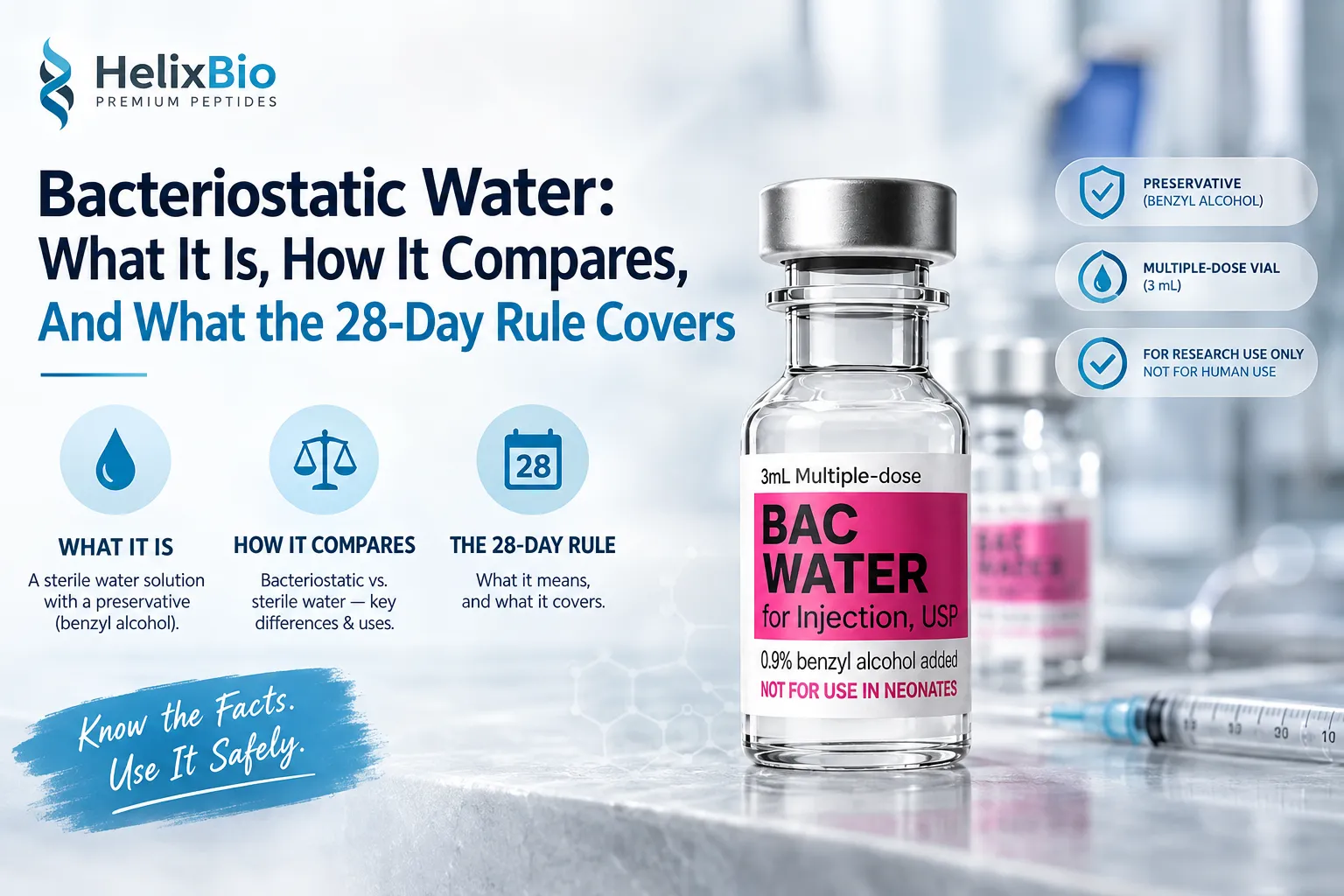
- Bacteriostatic water is sterile water containing 0.9% (or 1.1%) benzyl alcohol as a preservative — that single additive is the complete difference from plain sterile water.
- 'Bacteriostatic' means the preservative limits bacterial growth without necessarily killing bacteria. It does not mean the product is less sterile than sterile water.
- The product is sterile at the point of manufacture. The preservative's role begins only after the vial is first opened or punctured.
- The 28-day opened-vial limit comes from CDC, Joint Commission, and USP <797> guidance for multiple-dose vials in general — not from any specific property of benzyl alcohol itself.
- The 28-day figure is a default: the manufacturer's stated date takes precedence, and neither figure can ever exceed the product's original expiration date.
- Bacteriostatic water is not isotonic. The licensed label says it 'must be made approximately isotonic prior to use' and warns that IV administration without a solute may cause hemolysis.
- Benzyl alcohol limits microbial growth. It has no effect on the chemical stability of a dissolved substance — that depends on the dissolved material, not the diluent.
- The 'NOT FOR USE IN NEONATES' warning traces to 1982 CDC and NEJM reports linking benzyl alcohol-preserved intravascular solutions to deaths among premature infants.
- A useful COA is lot-specific and reports measured results — not just a conformance statement — for benzyl alcohol content, sterility, bacterial endotoxins, pH, and appearance.
- Sterile water and bacteriostatic water are not interchangeable: sterile water carries no preservative, is labeled for single use, and is specifically required for materials incompatible with benzyl alcohol.
Bacteriostatic Water at a Glance
The table below summarizes the licensed product, Bacteriostatic Water for Injection, USP, as described on the Pfizer (Hospira) label. Research-grade products may differ, so always check the supplier's own specifications.
Attribute | What the label says |
|---|---|
Base | Sterile, nonpyrogenic water for injection |
Preservative | Benzyl alcohol, 0.9% (9 mg/mL) or 1.1% (11 mg/mL) |
pH | 5.7 (range 4.5 to 7.0) |
Container | Multiple-dose vial |
Labeled storage | 20 to 25 °C (68 to 77 °F) |
Tonicity | Not isotonic; the label says it "must be made approximately isotonic prior to use" |
Key warning | "NOT FOR USE IN NEONATES" |
Status | Rx only |
Opened-vial guidance | 28 days after first entry unless the manufacturer specifies otherwise (CDC, Joint Commission and USP guidance for healthcare settings) |
What Is Bacteriostatic Water?
Bacteriostatic water is sterile, nonpyrogenic water for injection that contains benzyl alcohol as an antimicrobial preservative, usually at 0.9%. The preservative limits the growth of bacteria that may enter after the first puncture, which is why manufacturers supply it in multiple-dose containers.
One licensed version, from Pfizer (Hospira), is Bacteriostatic Water for Injection, USP. Its label describes it as "a sterile, nonpyrogenic preparation of water for injection containing 0.9% (9 mg/mL) or 1.1% (11 mg/mL) of benzyl alcohol added as a bacteriostatic preservative." According to that label, its sole indicated purpose is "diluting or dissolving drugs" that a drug's own manufacturer says may be prepared that way. In other words, it's a vehicle. It is never the active ingredient.
Two parts of that description deserve a closer look: what "bacteriostatic" means, and what benzyl alcohol is really doing.
What does "bacteriostatic" mean, and how is it different from "bactericidal"?
"Bacteriostatic" describes something that stops bacteria from multiplying without necessarily killing them. "Bactericidal" describes something that kills bacteria outright. The two words sit at different points on the same spectrum, and the difference matters for how a preserved solution should be understood.
Bacteriostatic water takes its name from the first property. Its preservative holds back growth. It doesn't sterilize the vial, and it can't undo contamination that has already happened. Sterility comes from manufacturing. The preservative only plays a supporting role once someone breaks the seal.
What benzyl alcohol does, and what it doesn't do
Benzyl alcohol is an antimicrobial preservative. In a multiple-dose vial, its job is to keep microorganisms that might enter on repeated withdrawals from multiplying in the remaining liquid.
USP defines a multiple-dose container as one that "permits withdrawal of successive portions of an article for parenteral administration without changing the safety, strength, quality, or purity of the remaining portion." A preservative is what makes that possible. By contrast, USP doesn't require single-dose containers to meet antimicrobial effectiveness criteria. That's why their labels call for single use.
There are clear limits, though. Benzyl alcohol doesn't make a solution sterile. Nor does it extend the life of an opened vial indefinitely. And it does nothing to stop a dissolved substance from breaking down chemically. The next section treats each of these as a separate question.
0.9% and 1.1%: the two labeled concentrations
Most references mention only 0.9% benzyl alcohol. The Pfizer label actually lists two presentations:
- 0.9% (9 mg/mL): 30 mL multiple-dose plastic Fliptop vials (NDC 0409-3977-03, tray of 25)
- 1.1% (11 mg/mL): a 20 mL fill in 30 mL multiple-dose glass Fliptop vials (NDC 0409-1093-04, tray of 25)
In both cases, the labeled pH is 5.7, within a range of 4.5 to 7.0. If a supplier's product doesn't state its benzyl alcohol concentration, that's a gap worth asking about.
Bac water, BWFI and "reconstitution solution": sorting out the names
First, "bac water" is simply shorthand for bacteriostatic water. "BWFI" is short for the licensed product name, Bacteriostatic Water for Injection. On its own, the abbreviation "bac" is ambiguous in search, so the full name is the safer term.
"Reconstitution solution," however, is broader. It describes any liquid used to dissolve a dry (often freeze-dried) material. Depending on the material, that could be sterile water, bacteriostatic water, saline or something else. So when someone asks how long a "reconstitution solution" lasts, the honest answer depends on which solution they mean.
Sterile, Preserved and Stable: Three Different Things
Much of the confusion around bacteriostatic water comes from treating three separate properties as one. They aren't, and keeping them apart makes almost every other question easier to answer.
Property | What it means | What establishes it | What it doesn't guarantee |
|---|---|---|---|
Sterility | No viable microorganisms in the sealed product | The validated manufacturing and sterilization process, supported by lot testing | That the contents stay sterile after the vial is entered |
Preservation | The ability to limit microbial growth after repeated entry | An antimicrobial preservative such as benzyl alcohol | Sterility, or unlimited use after opening |
Chemical stability | Whether a dissolved substance stays chemically intact over time | The properties of that substance, plus temperature, pH, light and time | Anything about microbial safety |
Why the distinction matters
Sterility is a property of the product at release. A label claim alone can't prove it, because it rests on how the manufacturer made the product. For example, the 2019 recall described later involved vials whose sterilization the manufacturer couldn't confirm. That shows how much depends on the process.
Preservation only matters once the vial is open. It buys time and lowers risk, but within limits. That's why published guidance still caps how long anyone should keep an opened multiple-dose vial.
Chemical stability is the property most often wrongly credited to bacteriostatic water. A preservative stops bacteria from growing. However, it has no effect on hydrolysis, oxidation or aggregation of whatever is dissolved in the water. How long a dissolved material stays intact is a question about that material, not about the diluent. Our article on why half-life and shelf life are two different clocks explores that distinction in more depth.
What Is the Difference Between Bacteriostatic Water and Sterile Water?
Bacteriostatic water contains benzyl alcohol as a preservative and is packaged in multiple-dose vials. Sterile water for injection contains no preservative and is labeled for single use, with any unused portion discarded. Both are sterile when sealed, and neither is isotonic on its own.
The Pfizer (Hospira) label for Sterile Water for Injection, USP, says it contains "no bacteriostat, antimicrobial agent or added buffer." It comes in single-dose containers, and the label is blunt about what that means: "Do not reuse single-dose containers. Discard unused portion."
Here is how the two licensed products compare, based on their labels:
Characteristic | Bacteriostatic water | Sterile water for injection |
|---|---|---|
Sterile when sealed | Yes ("sterile, nonpyrogenic") | Yes |
Antimicrobial preservative | Yes | No ("no bacteriostat, antimicrobial agent or added buffer") |
Benzyl alcohol | 0.9% or 1.1% | None |
Container type | Multiple-dose vial | Single-dose container |
Opened-vial considerations | Multiple-dose guidance applies: 28 days after first entry unless the manufacturer specifies otherwise | Single use; "Discard unused portion" |
Tonicity warning | IV administration without a solute "may result in hemolysis" | Same warning |
Neonatal limitation | "NOT FOR USE IN NEONATES" (benzyl alcohol) | No benzyl alcohol warning |
Labeled storage | 20 to 25 °C | 20 to 25 °C |
Labeled purpose | Diluting or dissolving drugs, per the drug manufacturer's instructions | Diluting or dissolving drugs |
What the table doesn't show
A few points need more than a table cell.
First, "bacteriostatic" does not mean "less sterile." Both products are sterile at release. The difference only appears after opening, when one contains a preservative and the other doesn't.
Second, sterile water is not a weaker version of bacteriostatic water. Some materials specifically require a preservative-free diluent, because benzyl alcohol can be incompatible with them. The bacteriostatic water label says so itself: "Some drugs for injection may be incompatible in a given vehicle, or when combined in the same vehicle or in a vehicle containing benzyl alcohol."
Can one be used in place of the other?
Not automatically. They are different products with different labels. The right diluent depends on the instructions for the material and on the laboratory's own procedures. Some materials call for a preserved diluent, while others need one without benzyl alcohol. Neither product is universally "better."
What Is Bacteriostatic Saline?
Bacteriostatic saline, labeled as Bacteriostatic 0.9% Sodium Chloride Injection, USP, is sterile water for injection containing 9 mg/mL of sodium chloride plus 0.9% benzyl alcohol as a preservative. Unlike bacteriostatic water, it is isotonic. It is also supplied in multiple-dose vials.
Its Pfizer (Hospira) label describes it as "a sterile, nonpyrogenic, isotonic solution of sodium chloride in water for injection." The labeled pH is 5.0 (4.5 to 7.0), and it carries the same "NOT FOR USE IN NEONATES" warning, again because of the benzyl alcohol. It comes in 10, 20 and 30 mL vials.
"Bacteriostatic sodium chloride" and "bacteriostatic saline" refer to the same thing. What separates it from bacteriostatic water is the salt, not the preservative:
Bacteriostatic water | Sterile water for injection | Bacteriostatic 0.9% sodium chloride | |
|---|---|---|---|
Sodium chloride | None | None | 9 mg/mL |
Benzyl alcohol | 0.9% or 1.1% | None | 0.9% |
Isotonic? | No | No | Yes ("isotonic") |
pH (label) | 5.7 (4.5 to 7.0) | Not stated in the label sections reviewed | 5.0 (4.5 to 7.0) |
Container | Multiple-dose | Single-dose | Multiple-dose |
Source: Pfizer (Hospira) labels for each product. Rows describe the licensed products only.
As with sterile water, the choice between saline and water as a diluent comes down to the instructions for the material involved. Salt can affect how some substances dissolve or behave, which is one reason the two aren't interchangeable.
Label Limitations: Tonicity, Newborns and Compatibility
Three warnings on the bacteriostatic water label explain most of its limitations. They're summarized here as background, not as clinical guidance.
Why bacteriostatic water isn't isotonic
An isotonic solution has roughly the same concentration of dissolved particles as body fluids. Water with nothing dissolved in it, or with only a small amount of benzyl alcohol, falls well short of that. When red blood cells sit in a solution like this, water moves into them, and they can swell and burst. Scientists call this hemolysis.
The licensed label addresses this directly. First, it states that Bacteriostatic Water for Injection, USP "must be made approximately isotonic prior to use." It then warns that "Intravenous administration of Bacteriostatic Water for Injection without a solute may result in hemolysis." Sterile water carries the same hemolysis warning.
That's a useful correction to a common claim. Some sources describe bacteriostatic water as "approximately isotonic." The label says the opposite: the water itself is not isotonic and needs a solute to approach isotonicity.
Why it's labeled "not for use in neonates"
The label states plainly: "NOT FOR USE IN NEONATES." It explains that benzyl alcohol "has been associated with toxicity in neonates."
The warning dates back to 1982. That year, the CDC reported deaths among premature infants associated with the benzyl alcohol preservative in some intravascular solutions. A paper in the New England Journal of Medicine later the same year described the clinical picture as "gasping syndrome." The warning on today's labels comes from that history.
Compatibility isn't universal
Benzyl alcohol isn't compatible with everything. As noted above, the label warns that some drugs "may be incompatible" in a vehicle containing benzyl alcohol. So whether bacteriostatic water is a suitable diluent for a given material depends on that material and its manufacturer's instructions, not on the diluent alone.
How Long Is Bacteriostatic Water Good For After Opening?
For multiple-dose vials, published guidance sets a limit of 28 days from the first time the vial is opened or punctured, unless the manufacturer specifies a different date. That date can never run past the product's original expiration date. The figure comes from CDC injection-safety guidance, the Joint Commission and USP chapter <797>, all written for healthcare settings.
The 28-day figure appears all over the internet, often without context. Some sites state it as a fixed property of bacteriostatic water. Others quote much shorter or much longer periods with no source at all. Here is what the guidance actually says, and what it doesn't.
Where the 28-day figure comes from
Three sources state the same limit, each with a manufacturer exception.
The CDC says: "Once a multi-dose vial is opened (e.g., needle-punctured) the vial should be dated and discarded within 28 days unless the manufacturer states another date for that opened vial."
The Joint Commission makes the exception explicit: the vial should be "discarded within 28 days unless the manufacturer specifies a different (shorter or longer) date for that opened vial."
USP chapter <797>, the standard for sterile compounding, states in section 15.2: "Upon initially entering or puncturing a conventionally manufactured MDC [multiple-dose container], the MDC is not used for more than 28 days unless otherwise specified by the manufacturer on the labeling."
Now notice what isn't on that list: the bacteriostatic water label itself. The 28-day limit comes from injection-safety and compounding standards that apply to multiple-dose vials in general. It isn't a special property of benzyl alcohol.
When does the 28-day period start?
The period starts at the first opening or puncture. It doesn't start on the manufacture, purchase or delivery date. Both the CDC and the Joint Commission describe dating the vial at first access, which turns the opening date into a visible record.
Why 28 days isn't a universal answer
Treating "28 days" as a law that applies to every bottle of bacteriostatic water would be a mistake, for four reasons.
- Manufacturer labeling comes first. Every one of the sources above defers to the manufacturer, and the Joint Commission notes that the manufacturer's date may be shorter or longer.
- The original expiration date is a hard ceiling. The CDC states that "the beyond-use-date should never exceed the manufacturer's original expiration date." A vial opened two weeks before it expires doesn't get 28 more days.
- The guidance was written for healthcare settings. It governs medications in clinical practice and compounding. Research-grade material is a different context, so laboratories follow the supplier's labeling and their own institutional procedures.
- It says nothing about what's dissolved in the water. The 28-day limit is about microbial risk in an opened multiple-dose container. It doesn't tell you how long a substance dissolved in that water stays chemically stable. That depends on the substance, not the diluent.
Shelf Life vs Opened-Vial Dating
These two dates answer different questions. In fact, mixing them up is one of the most common errors in online guides.
Date | What it covers | Who sets it | When it applies |
|---|---|---|---|
Expiration date (shelf life) | The sealed, unopened product | The manufacturer, printed on the label | Until the vial is first opened |
Beyond-use date (opened-vial dating) | The vial after first entry | Manufacturer labeling where given; otherwise guidance such as the 28-day limit | From first opening; never past the expiration date |
Stability of a dissolved material | A substance after it's been dissolved | The properties of that substance and how it's stored | Separate from both dates above |
Shelf life describes the unopened product. The CDC is clear on this: "An unopened multi-dose vial should be discarded according to the manufacturer's expiration date." There's no single shelf life for bacteriostatic water. Look at the expiration date printed on the specific vial and lot.
Opened-vial dating, also called the beyond-use date, takes over once the seal has been broken. It can never extend past the expiration date.
Consider two examples. A vial opened 40 days ago falls outside multiple-dose guidance even if its expiration date is a year away, unless its manufacturer specifies a longer period. Meanwhile, an unopened vial past its expiration date is out of date regardless.
How Should Bacteriostatic Water Be Stored?
The licensed product's label calls for storage at 20 to 25 °C (68 to 77 °F). The bacteriostatic saline and sterile water labels give the same range. For any research-grade product, the supplier's stated storage conditions take precedence.
Does bacteriostatic water need to be refrigerated?
Not according to its label. The licensed product is labeled for storage at controlled room temperature, 20 to 25 °C (68 to 77 °F), and the label doesn't call for refrigerating unopened vials. For opened vials, follow the manufacturer's labeling and your institution's procedures.
That said, be wary of precise "hours at room temperature" figures, which are common online. They tend to appear without any primary source. Refrigeration questions about a material dissolved in the water are a separate topic, because they depend on that material's stability, not on the diluent.
What if a vial has frozen, or looks cloudy or discolored?
The label offers a general principle for parenteral products: they "should be inspected visually for particulate matter and discoloration prior to administration, whenever solution and container permit."
Cloudiness, discoloration or visible particles are signs that a solution may no longer meet its specification. The same doubt applies to a vial stored outside its labeled conditions. The licensed label's storage range is 20 to 25 °C, and some supplier product pages, including ours, specifically say to protect the product from freezing. When a vial's condition is in doubt, the supplier's guidance and the laboratory's own procedures are the right references.
Licensed Pharmaceutical Product vs Research-Grade Material
Bacteriostatic water exists in two quite different regulatory contexts, and the same name can describe both.
Bacteriostatic Water for Injection, USP is a prescription pharmaceutical product. It comes with full prescribing information, is labeled "Rx only," and is distributed through pharmaceutical channels for clinical use.
Research-grade bacteriostatic water comes from laboratory suppliers for research use only. It isn't a drug product, and it isn't approved for human or veterinary use. Instead, the supplier's own specifications and documentation describe its quality.
For that reason, neither label tells you everything about the other. A research-grade product may share the same basic formula, but that doesn't make it equivalent to the licensed drug. In the same way, a licensed product's label doesn't describe any particular research supplier's material. That's why documentation matters so much.
What does "USP" mean on a label?
USP is the United States Pharmacopeia, which publishes the official standards (monographs) for drug substances and products in the USP–NF. When "USP" appears in a product's name, as in "Bacteriostatic Water for Injection, USP," it indicates that the product is represented as meeting the USP–NF monograph for that article.
In other words, "USP" isn't a general mark of quality that any supplier can attach to anything. If a research product claims USP compliance, it's fair to ask which monograph it refers to and what documentation supports the claim. If a product doesn't claim it, don't assume it.
The 2019 recall: why lot numbers matter
On 6 September 2019, the FDA published Hospira's voluntary nationwide recall of one lot of Bacteriostatic Water for Injection, USP. The lot, W20308, consisted of 30 mL multiple-dose vials, and the stated reason was "lack of confirmation of sterilization for some vials from this lot." Hospira reported that it had not received reports of adverse events linked to the issue.
Even so, the episode is worth knowing for a practical reason. Manufacturers issue recalls by lot. So without a lot number on the vial, and documentation tied to that lot, nobody can tell whether a particular vial is affected. Lot traceability isn't paperwork for its own sake. It's what links a vial to its testing history.
What Should a Bacteriostatic Water COA Show?
A useful certificate of analysis (COA) for bacteriostatic water belongs to one specific lot. It reports test results, not just claims, for at least the preservative content, sterility, bacterial endotoxins, pH and appearance or particulate matter, and it names the lab that issued it.
Here's a checklist you can apply to any supplier's documents:
What to look for | Why it matters |
|---|---|
Product name and lot number | Ties the document to the actual vial; recalls are issued by lot |
Manufacture and expiration dates | Shows the unopened shelf life |
Benzyl alcohol content (assay) | Confirms the preservative concentration, such as 0.9% |
Sterility test result (USP <71>) | Reports the lot's sterility test |
Bacterial endotoxins result (USP <85>) | Supports a "nonpyrogenic" claim |
pH (USP <791>) | Should fall within the stated range; the licensed product's label gives 4.5 to 7.0 |
Particulate matter (USP <788>) and visual appearance | Checks for sub-visible particles and visible defects |
Container type | Multiple-dose containers rely on an effective preservative (antimicrobial effectiveness, USP <51>) |
Testing laboratory, signature and issue date | Shows who is accountable for the results |
If you'd like a field-by-field walkthrough of reading analytical certificates in general, see how to read a certificate of analysis. Its examples come from a different product type, but the logic of checking lot numbers, methods and dates carries over.
COA vs certificate of conformance
The two documents sound alike, but they do different jobs. A certificate of analysis reports measured results for a specific lot against its specifications. A certificate of conformance states that a lot meets stated requirements, and it may not include any measured results at all.
A certificate of conformance can be legitimate. Still, it tells a reader less. If you're comparing suppliers and one provides actual results while another provides only a statement of conformance, that difference is worth weighing.
What a COA can't establish
A COA is valuable, but it has limits.
- It doesn't prove sterility on its own. A sterility test examines a sample from the lot. A passing result supports the claim, but sterility assurance ultimately depends on the validated manufacturing process behind it.
- It doesn't establish safety for human use. Analytical results describe the material. They don't make a research product suitable for use in people or animals.
- It doesn't confer regulatory status. A COA isn't FDA approval, and it doesn't turn a research-grade product into a licensed drug.
- It doesn't prove suitability for every application. Compatibility depends on what the water will be used with.
- It describes the lot at release, not the vial you opened weeks ago. A COA says nothing about storage after shipment, about an opened vial or about anything dissolved in it.
Common Misconceptions About Bacteriostatic Water
"Bacteriostatic means it isn't sterile." It doesn't. Bacteriostatic water is sterile when sealed. "Bacteriostatic" describes the preservative's ability to limit growth after the vial is opened.
"Bacteriostatic water lasts 28 days after opening, full stop." The 28-day figure is a default from healthcare guidance for multiple-dose vials. It yields to the manufacturer's date, it can't exceed the expiration date, and it says nothing about what's dissolved in the water.
"The preservative keeps whatever is dissolved in it stable." Benzyl alcohol limits microbial growth. It doesn't prevent chemical degradation of a dissolved substance.
"Bacteriostatic water is approximately isotonic." The licensed label says it "must be made approximately isotonic prior to use." In other words, the water on its own isn't.
"Sterile water and bacteriostatic water are interchangeable." One contains a preservative and comes in multiple-dose vials. The other contains none and carries a single-use label. Which one is appropriate depends on the instructions for the material involved.
"A COA proves a product is safe." A COA reports analytical results for a lot. It doesn't confer regulatory approval or establish suitability for human use.
Where to Buy Bacteriostatic Water, and What to Check First
The licensed product, Bacteriostatic Water for Injection, USP, carries an "Rx only" label and moves through pharmaceutical distribution. Laboratory suppliers, by contrast, sell research-grade bacteriostatic water for research use only. Whichever you're evaluating, the same handful of questions separates a well-documented product from a vague one:
- Is the composition stated, including the benzyl alcohol concentration?
- Is every vial marked with a lot number and an expiration date?
- Is a lot-specific COA available, with actual results rather than a conformance statement only?
- Are the storage conditions stated?
- Is the container type (multiple-dose) and any opened-vial dating from the manufacturer stated?
- Does the supplier describe the product's regulatory status accurately, without claiming approval or equivalence it can't support?
Choosing a vial size
Vial size matters too. The licensed product's 0.9% presentation comes in 30 mL vials. Some research suppliers offer smaller sizes. A size that matches how quickly a lab uses the material avoids keeping an opened vial near the end of its dating period.
Helix Bio Chem supplies research-grade bacteriostatic water in 3, 10 and 30 mL vials. The bacteriostatic water product page lists its stated composition (sterile water with 0.9% benzyl alcohol), storage conditions and research-use terms, so you can check it against the points above. As with every Helix Bio Chem product, we sell it strictly for laboratory and research use. It isn't intended for human or veterinary use.
Frequently Asked Questions
Bac water is shorthand for bacteriostatic water: sterile water for injection containing benzyl alcohol, usually 0.9%, as a preservative. The preservative limits bacterial growth after someone opens the vial, which is why bac water comes in multiple-dose vials. The licensed product's name is Bacteriostatic Water for Injection, USP.
No. Both are sterile when sealed, but bacteriostatic water contains benzyl alcohol as a preservative and is packaged in multiple-dose vials. Sterile water for injection contains no preservative, and its label calls for single use, with any unused portion discarded.
An added antimicrobial preservative makes water bacteriostatic. In bacteriostatic water, that preservative is benzyl alcohol, at 0.9% or 1.1% in the licensed product. It slows the multiplication of bacteria that may enter after the vial is opened, rather than killing them outright.
Yes. The licensed product's label describes it as "sterile, nonpyrogenic." Its sterility comes from the manufacturing process, not from the benzyl alcohol. The preservative's role starts after the vial is opened, when it limits the growth of any microorganisms that get in. It doesn't re-sterilize the contents.
Published guidance for multiple-dose vials sets a limit of 28 days from first opening or puncture, unless the manufacturer specifies a different date. That date can never pass the product's original expiration date. The figure comes from the CDC, the Joint Commission and USP <797>, all written for healthcare settings.
No. The 28-day figure is a default for opened multiple-dose vials in healthcare settings. A manufacturer can specify a shorter or longer opened-vial date, and the original expiration date always caps it. Research laboratories follow the supplier's labeling and their own procedures.
The period starts when the vial is first opened or punctured. It doesn't start on the manufacture, purchase or delivery date. Guidance from the CDC and the Joint Commission describes dating the vial at first access, so the vial itself records the opening date.
Not according to its label. The licensed product is labeled for storage at 20 to 25 °C (68 to 77 °F), and the label doesn't call for refrigerating unopened vials. For opened vials and for research-grade products, the manufacturer's labeling and the laboratory's procedures apply.
The shelf life is whatever the expiration date on the specific vial says. It varies by manufacturer and lot, so there's no single figure. Shelf life covers the unopened product only. Once the vial is opened, opened-vial dating applies instead, and it can never extend beyond the expiration date.
No. Bacteriostatic saline, or Bacteriostatic 0.9% Sodium Chloride Injection, USP, contains 9 mg/mL of sodium chloride in addition to 0.9% benzyl alcohol, and its label describes it as isotonic. Bacteriostatic water contains no salt and isn't isotonic.
No. The licensed label states that Bacteriostatic Water for Injection, USP "must be made approximately isotonic prior to use." It also warns that intravenous administration without a solute may cause hemolysis, the rupture of red blood cells in a solution with too few dissolved particles.
The warning exists because of benzyl alcohol. The label states that benzyl alcohol "has been associated with toxicity in neonates." The warning traces back to 1982 reports of deaths among premature infants associated with benzyl alcohol-preserved intravascular solutions.
A useful COA is tied to a specific lot number. It reports measured results for benzyl alcohol content, sterility, bacterial endotoxins, pH and appearance or particulate matter, along with manufacture and expiration dates. It should also identify the testing laboratory and the issue date.
No. A COA reports analytical results for a lot. A sterility result comes from testing a sample, so it supports the claim, but sterility assurance depends on the manufacturing process. A COA also doesn't establish suitability for human use, and it doesn't confer regulatory approval.
Pharmaceutical bacteriostatic water is a prescription drug product with full prescribing information, labeled "Rx only." Laboratory suppliers sell research-grade bacteriostatic water for research only, and it isn't approved for human or veterinary use. Instead, the supplier's specifications and documentation describe its quality.
The licensed product, Bacteriostatic Water for Injection, USP, is labeled "Rx only." Laboratory suppliers sell research-grade bacteriostatic water for research use only. This article describes labeling, not legal requirements. Check the rules that apply to your organization and jurisdiction.
The licensed 0.9% product comes in 30 mL multiple-dose vials. The 1.1% presentation is a 20 mL fill in a 30 mL glass vial. Bacteriostatic saline comes in 10, 20 and 30 mL vials. Some research suppliers offer smaller sizes; Helix Bio Chem's research-grade bacteriostatic water comes in 3, 10 and 30 mL vials.
- 01Pfizer (Hospira). Bacteriostatic Water for Injection, USP, prescribing information (revised 11/2019).
- 02Pfizer (Hospira). Bacteriostatic 0.9% Sodium Chloride Injection, USP, prescribing information (revised 02/2019).
- 03Pfizer (Hospira). Sterile Water for Injection, USP, prescribing information (revised 03/2026).
- 04Centers for Disease Control and Prevention. Preventing Unsafe Injection Practices (last reviewed 26 March 2024).
- 05The Joint Commission. Managing Multi-dose Vials of Injectable Medication, Standards FAQ (updated 22 July 2024).
- 06United States Pharmacopeia. General Chapter <797> Pharmaceutical Compounding—Sterile Preparations, section 15.2, as quoted in Florida Department of Health, USP <797> Sterile Compounding Inspection Form (August 2024).
- 07United States Pharmacopeia. General Chapter <659> Packaging and Storage Requirements (USP 38–NF 33, Second Supplement).
- 08U.S. Food and Drug Administration. Hospira, Inc., Issues a Voluntary Nationwide Recall for One Lot of Bacteriostatic Water for Injection, USP (6 September 2019).
- 09Centers for Disease Control and Prevention. Neonatal deaths associated with use of benzyl alcohol—United States. MMWR. 1982;31(22):290.
- 10Gershanik J, Boecler B, Ensley H, McCloskey S, George W. The gasping syndrome and benzyl alcohol poisoning. N Engl J Med. 1982;307(22):1384–1388.
Helix Bio Chem Team
Research & Product Team
Our in-house team tracks published peptide research and translates it into clear, source-cited summaries for the research community.
Reviewed by in-house research chemists
support@helixbiochem.com