- FDA-approved peptide drugs including semaglutide, tirzepatide, tesamorelin and bremelanotide (Vyleesi) are prescription-only in the United States.
- Compounded peptides always require a prescription from a licensed prescriber, and only substances the FDA deems eligible may be compounded at all.
- Research-use-only peptide vials carry no prescription step because the sale involves no prescriber, no patient and no drug product.
- The absence of a prescription requirement is normal for laboratory materials and a warning sign for any product marketed for human use.
- On April 15, 2026 the FDA removed twelve peptides from Category 2 of its 503A bulk drug substances list, effective around April 22, 2026.
- The Pharmacy Compounding Advisory Committee recommended six peptides for the 503A Bulks List on July 23 to 24, 2026, but that vote is advisory only.
- As of September 2026, published FDA materials did not show BPC-157, TB-500, KPV, MOTS-c, Semax or Epitalon as added to the 503A Bulks List.
- Age gates and research-use acknowledgments at checkout are supplier terms of sale, not prescriptions and not clinical clearance.
Two peptide websites can look almost identical. One asks for a prescription before it ships, the other never mentions one. Both can be following the rules, because the compound decides which rule applies.
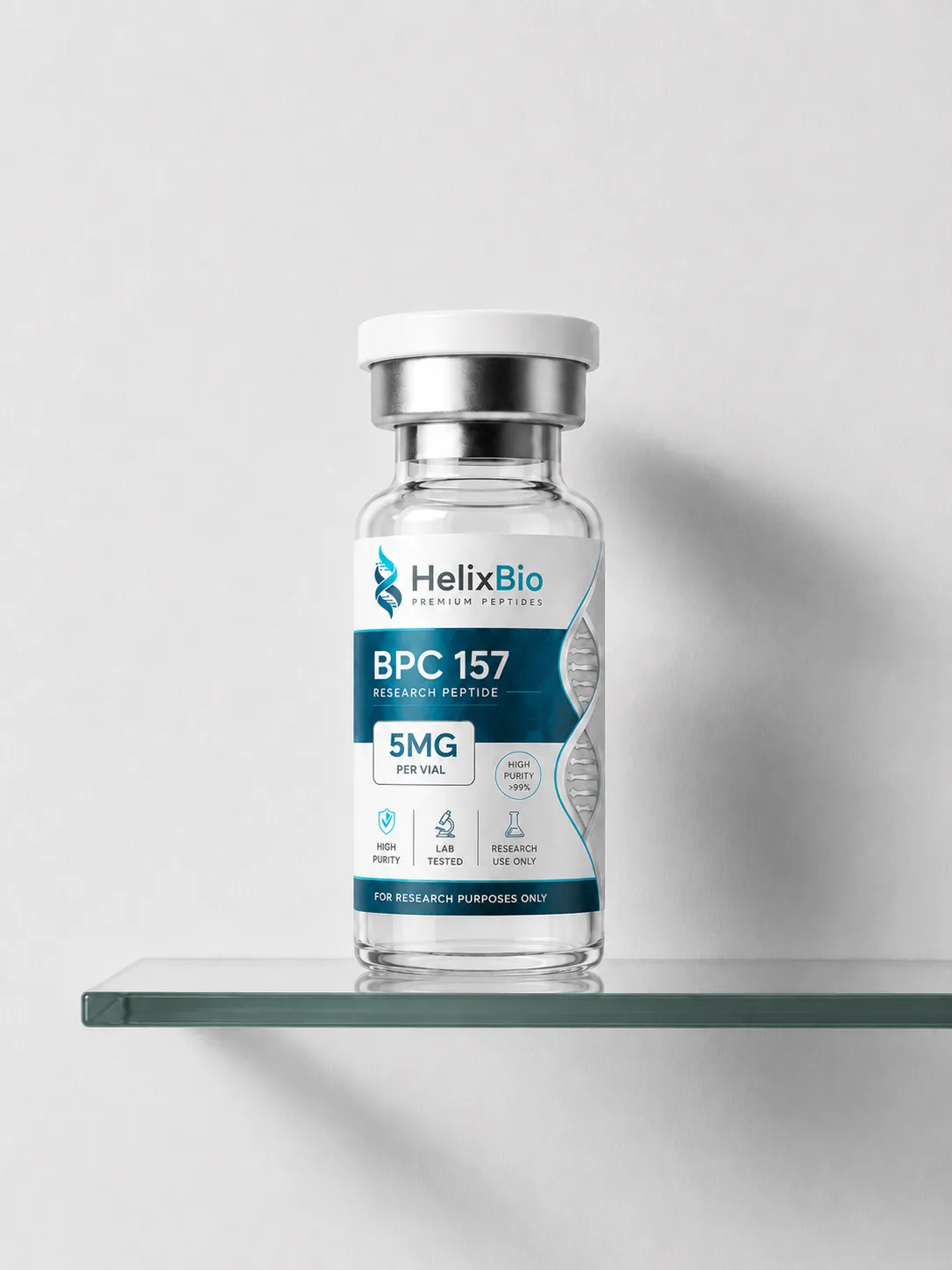
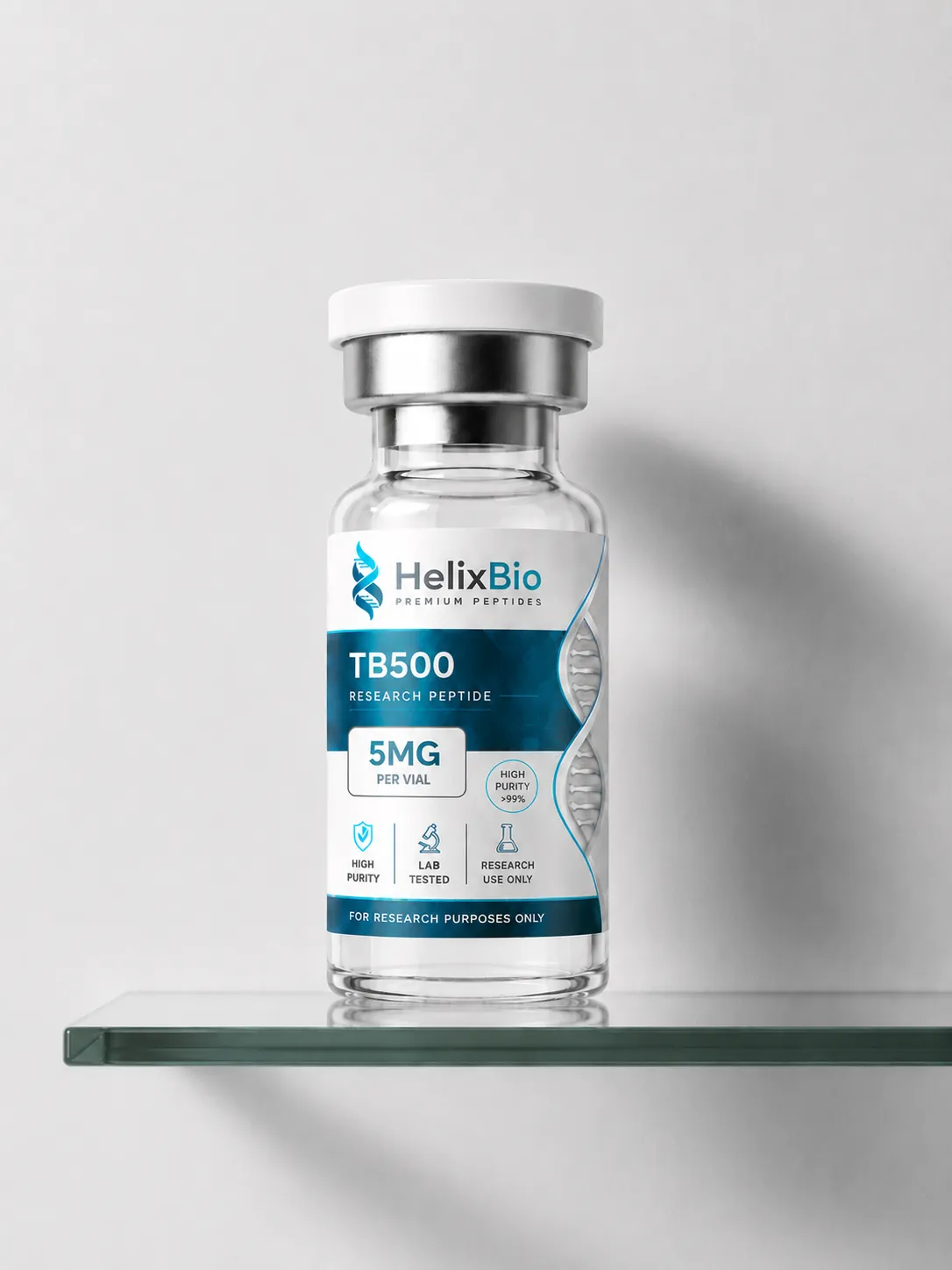
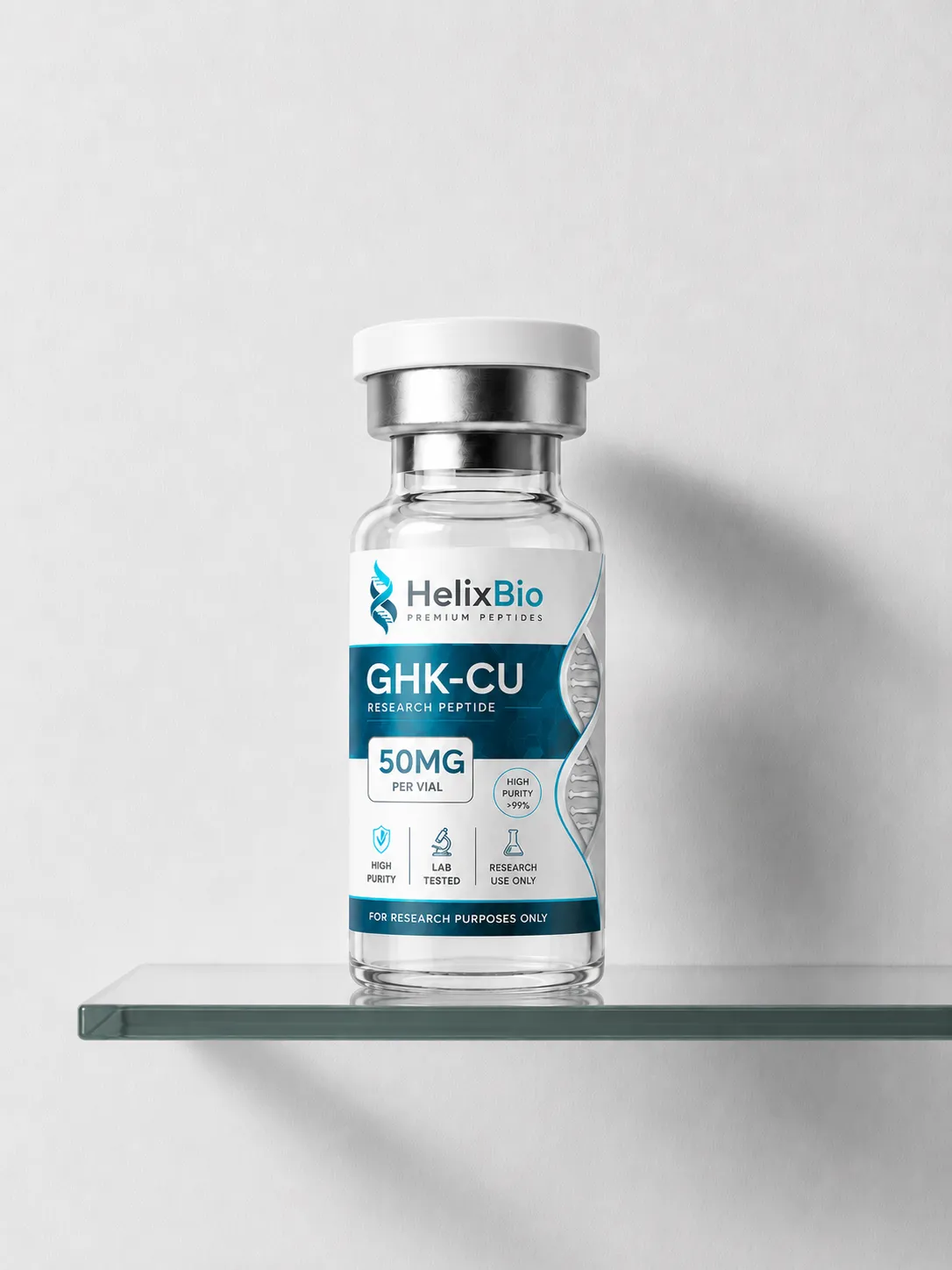
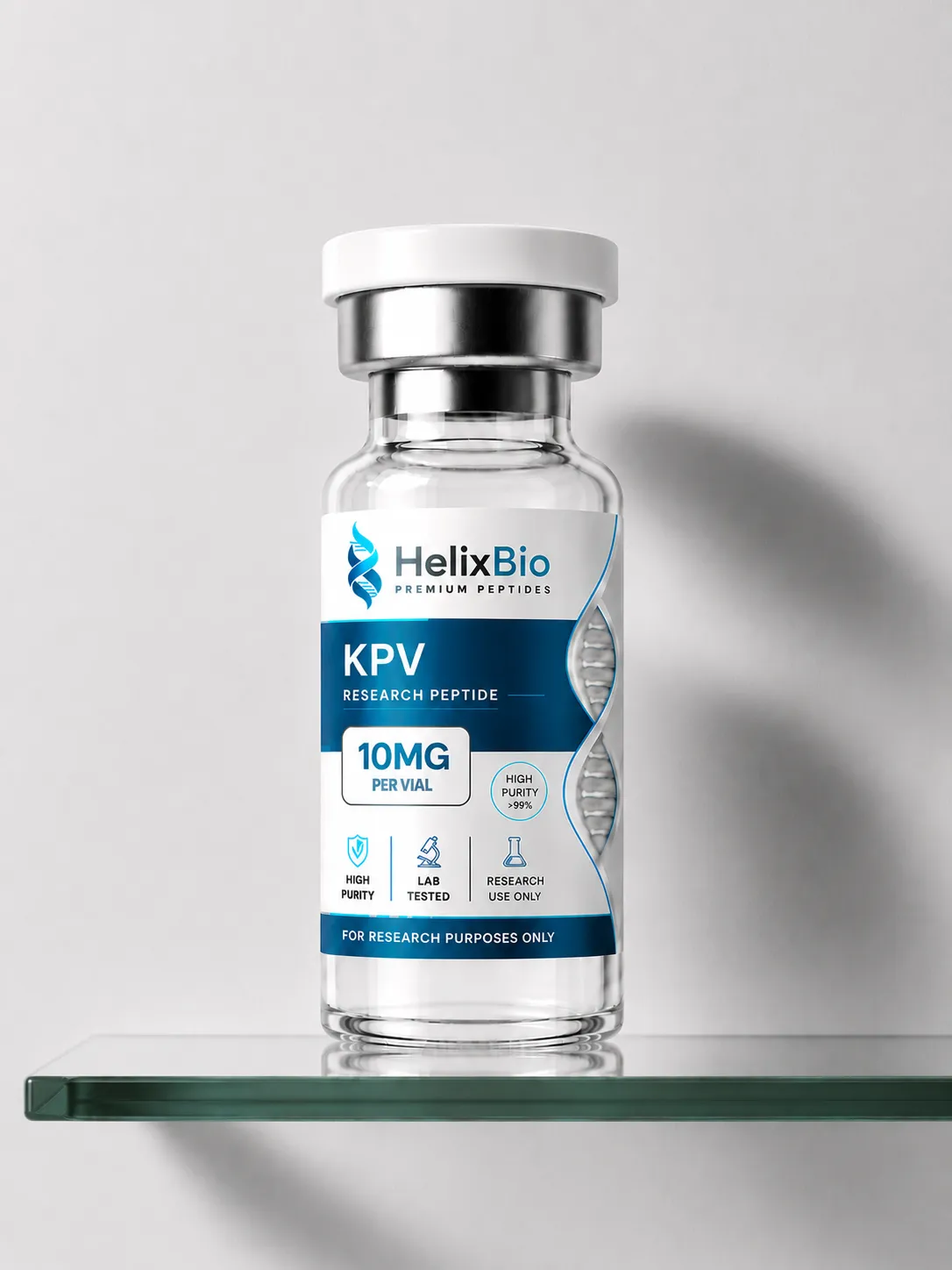
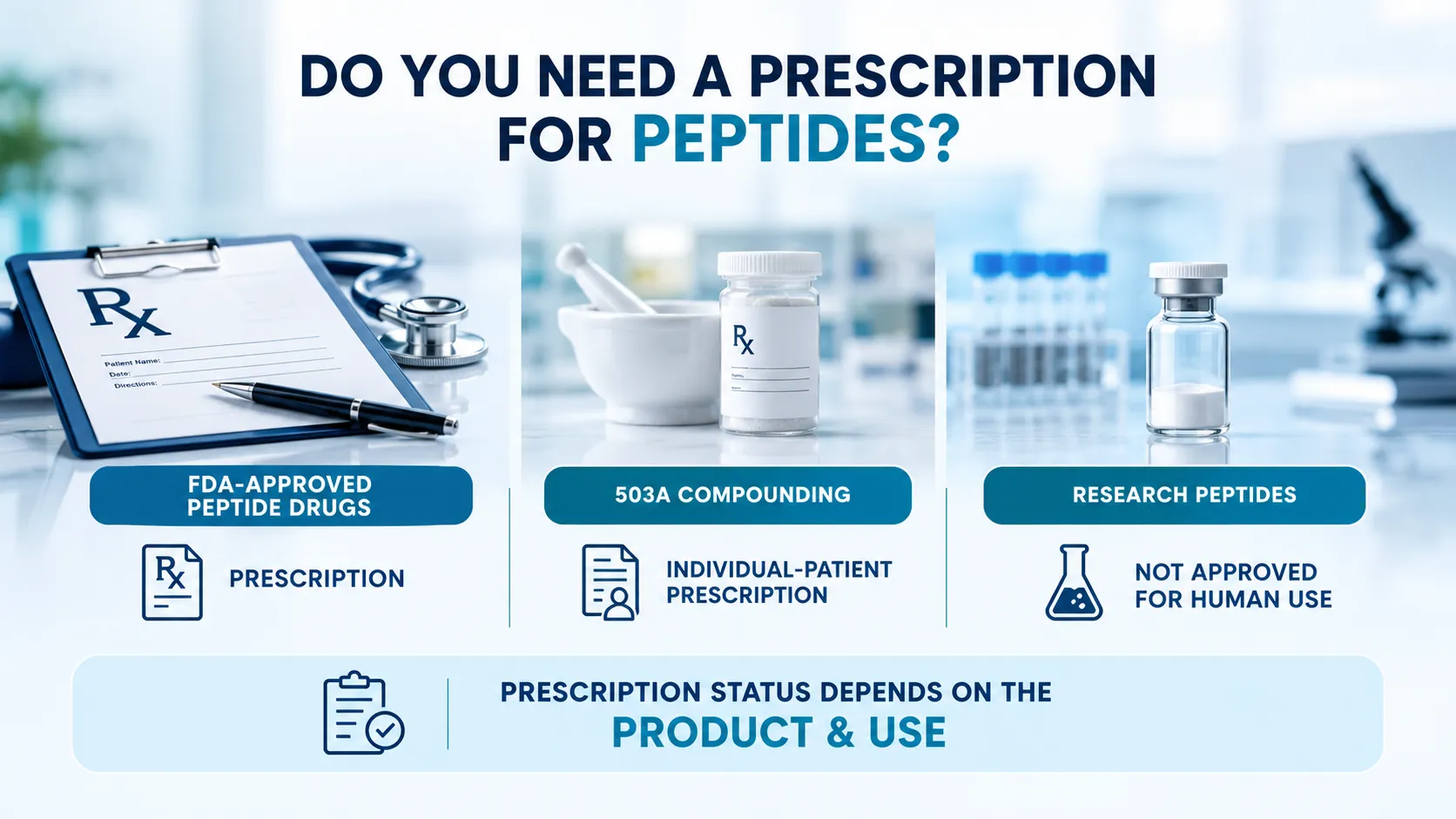
Peptides sit in one of three regulatory categories, and each carries its own answer. FDA-approved peptide drugs require a prescription. Compounded peptides require one from a licensed prescriber. Research-use-only compounds are sold without a prescription because they are not drug products at all. That describes their legal category, not whether they are safe for people.
Prescription rules depend on which of three categories a peptide falls into
Sorting the compound into its category comes first. Put the compound in the right bucket and the prescription answer follows on its own.
FDA-approved peptide drugs need a prescription. These are finished drug products the FDA has reviewed and approved for specific medical uses. Pharmacies dispense them against a prescriber's order, and the label carries federal prescription-only status.
Compounded peptides need a prescription too. A compounding pharmacy prepares these for one named patient after a licensed prescriber writes for them. No approved product sits behind a compounded preparation, so the prescription carries the entire clinical decision.
Research-use-only compounds have no prescription to require. Suppliers sell these as laboratory reagents for benchwork, not as medicines for people. Where the law sees no drug product and no patient, it asks for no prescriber.
Here is the through-line most articles skip. A prescription is an accountability instrument linking three things together: a licensed prescriber, an identified patient, and a drug product. Remove any one of those and the instrument has nothing to attach to. Research vials remove all three at once, which is why a research checkout has no prescription field to fill in.
That single idea explains why one site asks for a prescriber's details and the next asks only for a checkbox.
FDA-approved peptide drugs always need a prescription
Semaglutide, tirzepatide, tesamorelin and bremelanotide all sit in this bucket. Tesamorelin reached the US market as Egrifta in 2010 for HIV-associated lipodystrophy. Bremelanotide followed as Vyleesi in June 2019, and its listing carries federal legend status, meaning prescription only.
Approval under the Federal Food, Drug, and Cosmetic Act does the work here. Once the FDA has reviewed a drug's safety and effectiveness for a stated use, prescription status becomes the control on that use. A clinician decides whether the drug fits the patient, and the pharmacy fills against that decision.
Selling or dispensing an approved peptide drug for human use without a prescription is unlawful. The reference table below carries the specifics for each compound.
Compounded peptides still need a prescription, and not every peptide can be compounded
Compounding means a pharmacy makes a preparation for one patient because no approved product suits them. Two legal channels exist. Under Section 503A, a licensed pharmacist or physician compounds for an identified patient pursuant to a valid prescription. The prescriber-patient relationship is the trigger, and the preparation is made one order at a time. Under Section 503B, an outsourcing facility produces larger batches under tighter federal manufacturing oversight. Those batches often supply clinics and hospitals rather than one named person.
Compounded preparations are not FDA-approved manufactured products, so they travel through a separate legal channel with its own rules. Approval and compounding are two different doors.
Eligibility is the part most articles gloss over. A pharmacy cannot compound from just any bulk substance. The FDA maintains bulk drug substance lists, and a substance's category decides whether 503A pharmacies may use it at all. Category 1 covers substances usable under the agency's stated conditions. Category 2 flags significant safety concerns, and Category 3 covers nominations lacking evidence to evaluate.
Compounded GLP-1 products show how fast this can move. Broad shortage-based compounding of semaglutide and tirzepatide ended once the FDA declared those shortages resolved (how compounded semaglutide and tirzepatide legality changed in 2026). The 2026 specifics for research peptides come later in this article.
Why research-peptide checkouts don't ask for a prescription
Picture what a prescription authorizes. A licensed clinician assesses a patient, decides a drug product is appropriate, and writes an order a pharmacy can fill. Every part of that chain points at a person receiving treatment.
A vial sold as a laboratory reagent breaks that chain at the first link. No prescriber has assessed anyone, no patient exists in the transaction, and the material is not offered as a drug product. Nothing remains for a checkout to collect, so nothing is collected. Can you buy peptides without a prescription? For research-use-only material, yes, and that fact reflects the product's regulatory category rather than any grant of permission.
The gap is where people get hurt. Human use of research-use-only material is unapproved, and it can run straight into drug law. Regulators look at how a product is marketed, labeled, and actually used. A disclaimer in the footer does not settle the question. A supplier who writes "research use only" while selling on human-benefit claims has protected nobody. The buyer is the one left exposed (research-use-only peptide legality in the USA).
Age gates and research-use acknowledgments are terms-of-sale controls a supplier sets, recording what a buyer agreed to at purchase. They are not prescriptions, they are not clinical clearance, and they do not make anything safe to put in a human body (sourcing checklist).
State rules add a further layer on top of the federal picture, and they vary at checkout (state-by-state peptide law tracker).
What peptides can you get without a prescription?
Plenty of peptide products sit on ordinary shelves, and none are lab vials. Collagen peptide powders are sold as dietary supplements. Cosmetic and topical peptides, including GHK-Cu serums, are sold over the counter as cosmetics. Both categories clear a much lower regulatory bar than drugs. Their risk profile differs too, since they are not injected and make no drug claims.
GHK-Cu deserves its own note, since one molecule shows up in three legal places. A cosmetic copper-peptide serum is an over-the-counter product anyone can buy today. A research-use-only GHK-Cu vial is laboratory material sold without a prescription and not for human use. A compounded topical preparation, made by a pharmacy for a named patient, requires a prescription.
Injectable research vials such as BPC-157 and TB-500 also ship without a prescription, for the reason already given. They are sold as lab materials, so no prescription attaches to them. Nobody should read that as clearance to use them.
What a legitimate peptide prescription looks like
A real prescription pathway has moving parts anyone can see. Clinical evaluation comes first, usually with baseline labs, and a licensed prescriber of record owns the decision. Dispensing happens through a licensed pharmacy, either a regular pharmacy for approved drugs or a 503A compounding pharmacy for compounded preparations. Follow-up monitoring closes the loop.
Telehealth compresses that into a few screens without removing any of it. A patient completes an intake, a clinician reviews it, a prescription follows if they judge it appropriate, and a licensed pharmacy ships. Can an online doctor prescribe peptides? Yes, within the same rules that govern any other prescribing, including state licensure and the requirement that the clinician actually evaluate the patient.
Cost tracks the oversight behind every step. Prescription pathways run more expensive than gray-market vials because someone is paying the clinician, the pharmacy, and the compliance work behind both (peptide pricing).
Research-use-only peptides are laboratory materials, not medicines. Nothing on this page describes human use, and a certificate of analysis never makes a compound safe for people.
Where each peptide stands on prescriptions
Verdicts below are for the United States and reflect published status as of September 2026. Contested rows point forward to the 2026 section, where the dispute is laid out with dates.
Peptide | Prescription required? | Legal pathway | 2026 note |
|---|---|---|---|
Semaglutide | Yes | FDA-approved drug; compounding only in narrow patient-specific circumstances | Shortage declared resolved February 21, 2025; FDA proposed on April 30, 2026 to keep it off the 503B Bulks List |
Tirzepatide | Yes | Same as semaglutide | Shortage declared resolved December 19, 2024; same April 2026 proposal, comment period closed July 30, 2026 |
Tesamorelin | Yes | FDA-approved drug, prescription only | Marketed as Egrifta SV; first approved 2010 |
PT-141 (bremelanotide) | Yes | FDA-approved drug, prescription only | Marketed as Vyleesi; approved June 2019 |
Sermorelin | Yes | Compounded preparation, prescription required | Geref applications withdrawn effective 2009; no approved product on the US market |
BPC-157 | No lawful prescribing pathway as a drug; RUO vials sold without a prescription as lab materials | None currently authorized for compounding | Removed from Category 2 effective April 22, 2026; advisory committee recommended it for the 503A Bulks List on July 23, 2026; not yet added |
TB-500 | Same as BPC-157 | None currently authorized for compounding | Removed from Category 2 effective April 22, 2026; recommended at the July 23 to 24, 2026 meeting; not yet added |
CJC-1295 | Contested | Some 503A pharmacies dispense by prescription; eligibility disputed | Entered 503A Category 2 in September 2023; removed effective 27 September 2024 after nominators withdrew; FDA took five forms to PCAC on 4 December 2024 and proposed none be added, with no final rule published; federal litigation (Evexias Medical Centers v. FDA, N.D. Tex.) pending |
Ipamorelin | Contested | Some 503A pharmacies dispense by prescription; eligibility disputed | Removed from Category 2 effective 27 September 2024 after nominators withdrew; advisory committee voted against inclusion of both forms (acetate and free base) on 29 October 2024; no final rule published |
KPV | No prescription for RUO vials; compounding eligibility not granted | None currently authorized for compounding | Removed from Category 2 effective April 22, 2026; recommended in July 2026; not yet added |
GHK-Cu cosmetic serum | No | Over-the-counter cosmetic | Unaffected by the 503A bulks lists |
GHK-Cu RUO vial | No | Sold as laboratory material | Removed from Category 1 in April 2026 after its nomination was withdrawn; not added to the 503A Bulks List |
GHK-Cu compounded topical | Yes | Prescription, 503A or 503B pharmacy | Removed from Category 1 in April 2026; PCAC consultation planned before end of February 2027 |
Collagen peptides | No | Dietary supplement | Unaffected by the 503A bulks lists |
Retatrutide | Not prescribable | Investigational, clinical trials only | In late-stage trials as of 2026; no FDA approval |
Three rows carry live disputes rather than settled answers. CJC-1295, ipamorelin and GHK-Cu are described differently by different publishers right now, and the next section explains why.
When "no prescription needed" is actually a warning sign
Most articles blur a line worth drawing sharply. Missing prescription requirements are expected for research-use-only lab materials and alarming for anything marketed for human use. Category decides which reading applies.
Watch for these:
- An approved prescription drug such as semaglutide, tirzepatide or tesamorelin offered with no prescription step anywhere in the flow.
- A site selling research vials while writing about results, protocols or benefits for people, then hiding behind a disclaimer at the bottom.
- A claimed pharmacy license that no state board will confirm.
Good signs run the other way. Look for a pharmacy license that checks out and a prescription requirement wherever the law imposes one. Published third-party testing helps, as do research-use terms stated plainly with no human-use marketing around them.
What actually changed in peptide prescription rules in 2026
Two dated events matter, and neither did what the headlines suggested.
On April 15, 2026, the FDA published notice that it would remove twelve peptides from Category 2 of its 503A bulk drug substances list. Removal took effect around April 22, 2026. Those twelve included BPC-157, TB-500, KPV, MOTS-c, Semax, Epitalon, and others. GHK-Cu was handled separately from those twelve. It left Category 1 after its nomination was withdrawn, with PCAC consultation planned before the end of February 2027. The removals followed withdrawal of the original nominations. Losing the "significant safety risks" designation is not the same as gaining compounding access. The agency placed none of them on the 503A Bulks List at that time (FDA peptide reclassification in 2026).
Then came the Pharmacy Compounding Advisory Committee meeting of July 23 and 24, 2026. The committee reviewed seven peptides and voted to recommend six of them for the 503A Bulks List: BPC-157, TB-500, KPV, MOTS-c, Semax and Epitalon. Emideltide, also called DSIP, was the one rejected. FDA's own reviewers had recommended against all seven, and the votes were narrow. The committee's role is advisory, so a favorable vote is a recommendation rather than a rule. Adding a substance still requires notice-and-comment rulemaking and an amendment to 21 CFR 216.23. As of September 2026, published FDA materials did not show these peptides as added (July 2026 PCAC peptide vote explainer).
Three contested claims deserve direct handling, because publishers keep repeating them as settled.
A February 2026 reclassification restoring compounding access is the first. What happened in late February 2026 was an HHS policy announcement, not a regulatory action. The formal step came in April, and it removed a designation rather than granting access.
KPV moving to Category 1 is the second. KPV left Category 2 in April 2026 and won a favorable advisory recommendation in July 2026. No published FDA action had placed it on the 503A Bulks List as of September 2026.
CJC-1295 and ipamorelin compoundability is the third, and here the sources disagree. CJC-1295 entered 503A Category 2 in September 2023 but was removed effective 27 September 2024 after the nominators withdrew. It sits in no category today, which authorizes nothing. FDA still took five forms to the Pharmacy Compounding Advisory Committee on 4 December 2024 and proposed that none be added. No final rule has published since. Some clinic and pharmacy sites market both peptides as compoundable by prescription today. Federal litigation over their status (Evexias Medical Centers v. FDA, N.D. Tex.) is pending. Anyone relying on a compounding pathway for these two is relying on a contested reading.
GHK-Cu adds a fourth wrinkle to the picture. It left Category 1 in April 2026 after its nomination was withdrawn, without being added to the bulks list. FDA planned further advisory committee consultation before the end of February 2027. Claims that injectable GHK-Cu was "restored to Category 1" in February 2026 do not match the agency's own April list action.
The bottom line
Prescription questions about peptides are really category questions. Approved drugs and compounded preparations both require a prescription. Research-use-only vials carry none, because they are not drug products and not for human use. Work out which category a compound sits in first, then the prescription answer takes care of itself.
Frequently Asked Questions
No lawful route exists for buying them this way. Semaglutide, tirzepatide, tesamorelin and Vyleesi are prescription-only drug products, and selling them for human use without a prescription breaks federal drug law. Sites that skip that step for those compounds are operating outside the rules.
Regular pharmacies dispense FDA-approved manufactured drug products. Most therapeutic peptides have no approved product behind them. They can only reach a patient as a compounded preparation made for that person under Section 503A or 503B.
No, prescriptions do not work that way. Research-grade material is supplied as a laboratory reagent, not a drug product, and prescriptions attach to drug products dispensed by licensed pharmacies. A clinician can prescribe a compounded peptide where the substance is eligible for compounding, which is a different thing entirely.
There is no lawful prescribing pathway for BPC-157 as a drug in the United States as of September 2026. It has no FDA approval and it is not on the 503A Bulks List, despite a favorable advisory vote in July 2026. Research vials are supplied without a prescription as laboratory material.
The legal status is contested right now. Some pharmacies dispense both by prescription. CJC-1295 was removed from 503A Category 2 effective 27 September 2024 after its nominators withdrew. It sits in no category today, which authorizes nothing. Ipamorelin was removed from Category 2 on the same date. An advisory committee voted against adding either of its forms to the 503A Bulks List on 29 October 2024. Federal litigation over compounding status is pending. Research vials are supplied without a prescription as laboratory material.
It is not approved any more. Sermorelin was approved as Geref, and those applications were withdrawn effective 2009, so no approved sermorelin product is marketed in the United States today. Patients who receive sermorelin receive a compounded preparation, which requires a prescription.
The peptides discussed here are not scheduled by the DEA. Their prescription status comes from the drug provisions of the Federal Food, Drug, and Cosmetic Act, not from controlled substance scheduling. The two systems answer different questions.
Coverage generally follows FDA approval status. Insurers may cover an FDA-approved peptide drug for its approved indication, subject to plan rules. Compounded peptide preparations are usually paid out of pocket, since they are not approved products. Plan documents are the only reliable source.
Reputable research suppliers restrict sales to adults through their terms of sale. That restriction comes from supplier policy rather than a single federal age law for laboratory chemicals. Rising interest among younger buyers drew press attention through 2026, which makes adult-only enforcement more important, not less.
They sell different categories of product. Sites dispensing approved or compounded drugs must collect a prescription, because a prescriber and a patient are part of the transaction. Sites supplying research-use-only materials have no prescription to collect, since no drug product is involved.
- 01U.S. Food and Drug Administration. FDA clarifies policies for compounders as national GLP-1 supply begins to stabilize.
- 02U.S. Food and Drug Administration. Declaratory Order: Resolution of Shortages of Tirzepatide Injection Products, December 19, 2024.
- 03Orrick. FDA Announces Removal of 12 Peptides from Category 2 and Schedules PCAC Meetings to Consider Adding Peptides to the 503A Bulk Drug Substances List, April 2026.
- 04National Community Pharmacists Association. FDA advisory committee nominates six peptides for pharmacies to compound, July 31, 2026.
- 05American Journal of Managed Care. FDA Panel Backs 6 Peptides for Compounding, July 2026.
- 06Holland & Knight. FDA Advisory Committee Endorses Compounding of Certain Peptides, August 2026.
- 07Sheppard Mullin. What to Watch: Status Update on Peptide Regulation.
- 08Drugs.com. Vyleesi (bremelanotide) FDA Approval History.
Helix Bio Chem Team
Research & Product Team
Our in-house team tracks published peptide research and translates it into clear, source-cited summaries for the research community.
Reviewed by in-house research chemists
support@helixbiochem.com