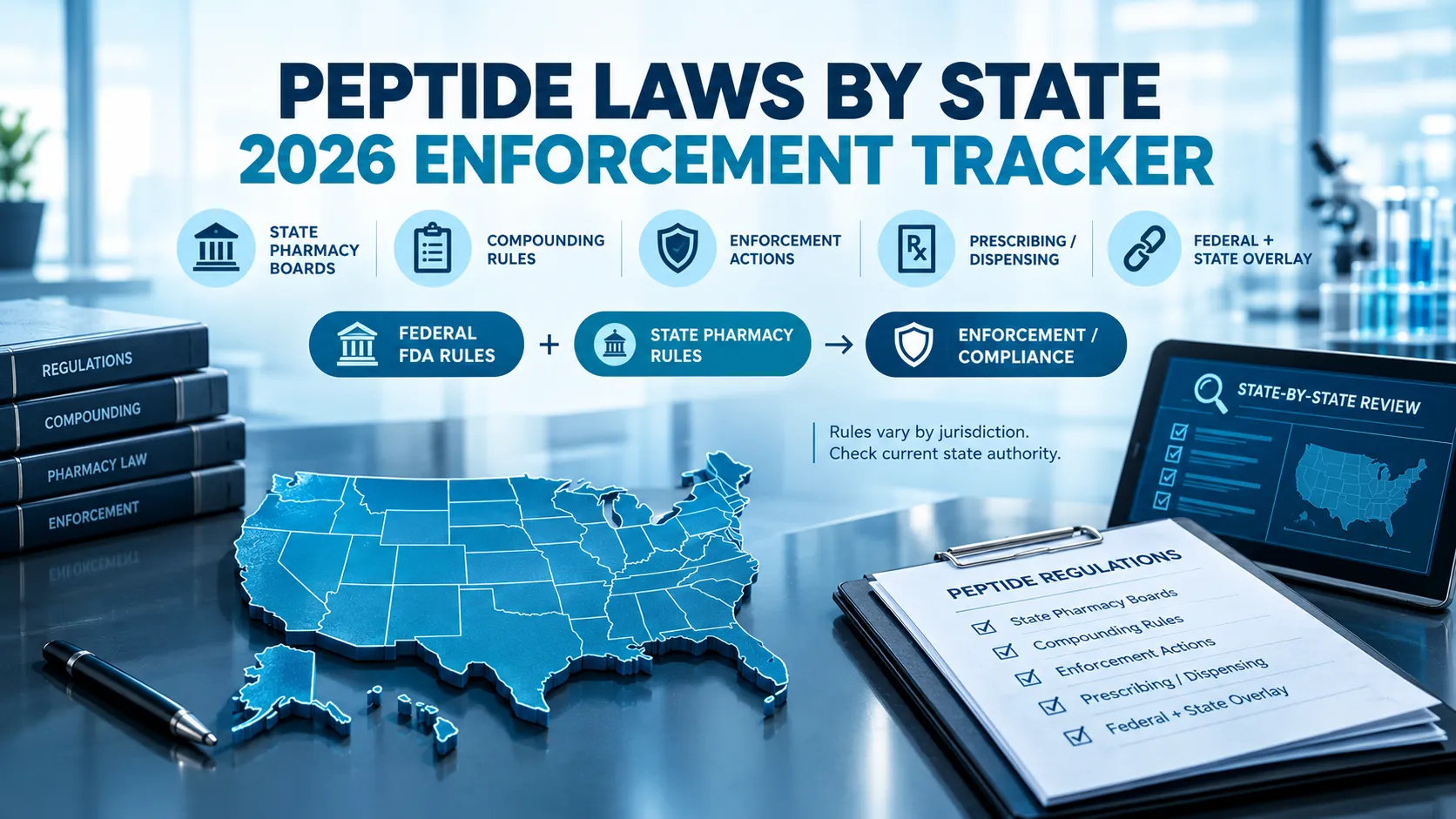
Two state boards moved against research-grade peptides in 2026. Alabama told physicians they may not compound, administer, or dispense them to patients. Mississippi said the same thing in a joint statement signed by three separate boards. Louisiana went the other way that same year. Its new law restricts licensing boards from blocking qualified providers who source peptides through compliant compounding pathways.
Three states have 2026 action confirmed against a primary source this page reviewed directly. Two more, South Carolina and Ohio, are credibly reported by law firms, but their underlying documents could not be opened and read during research for this page, so they are listed separately rather than counted as confirmed.
This page tracks what each state has actually done, with links to the board notices, signed statements, and enacted bills themselves. It is updated monthly, and it carries a changelog so you can see what changed. What follows is the federal floor, the three categories that determine which rules apply, then the state table.
Quick answer: which states restricted peptides in 2026?
No state banned peptides in 2026. Alabama and Mississippi published positions restricting what licensed providers may do with non-FDA-approved or research-grade peptides, and Louisiana enacted a law protecting providers who source through compliant compounding pathways. South Carolina and Ohio are reported to have acted, on secondary sources only. Every confirmed action governs professional conduct, and none of them reaches possession.
Key facts, as of 24 September 2026:
- Restrictive, primary source reviewed: Alabama (Board of Medical Examiners notice) and Mississippi (three-board joint statement, 19 August 2026).
- Permissive, enacted law: Louisiana Act 374, adding R.S. 37:23.5, signed 22 May 2026 and effective 1 August 2026.
- Reported, primary source not reviewed: South Carolina and Ohio.
- No 2026 action on record: 45 states.
- Scope: no state has scheduled peptides as controlled substances, and no confirmed action reaches possession by a researcher.
Who do peptide laws actually apply to?
No federal law bans peptides as a class. Legality turns on what a specific compound is, how it is labeled and marketed, and who is doing what with it.
People typing this question are usually asking one of three different things. Some want to know whether they can possess the material. Others are asking whether a licensed provider may give it to a patient. A third group wants to know about selling it. Those have different answers, and conflating them is where most confusion starts.
Here is the distinction that makes the rest of this page readable. Every confirmed 2026 state action restricts what licensed providers may do, and none of them reaches possession. When a medical board tells physicians they may not administer research-grade peptides to patients, that is a rule about medical practice. It is not a controlled-substance schedule and it is not a possession ban.
One limitation belongs up front, and it is easy to miss. A state having taken no action is not the same as a state affirmatively permitting something, and silence should be read as silence.
What federal rules do state peptide laws build on?
Three federal concepts get merged constantly, and separating them explains most state activity.
FDA approval status determines whether a compound can be marketed as a drug for human use. Compounding pathways under sections 503A and 503B govern whether a pharmacy or outsourcing facility may prepare a non-approved substance for a patient. Research-use-only labeling is a statement about intended use attached to a product sold for laboratory work.
That third concept does less work than people assume. RUO labeling describes what material is for, and it creates no legal exemption. It also does not override what a licensing board says a provider may do.
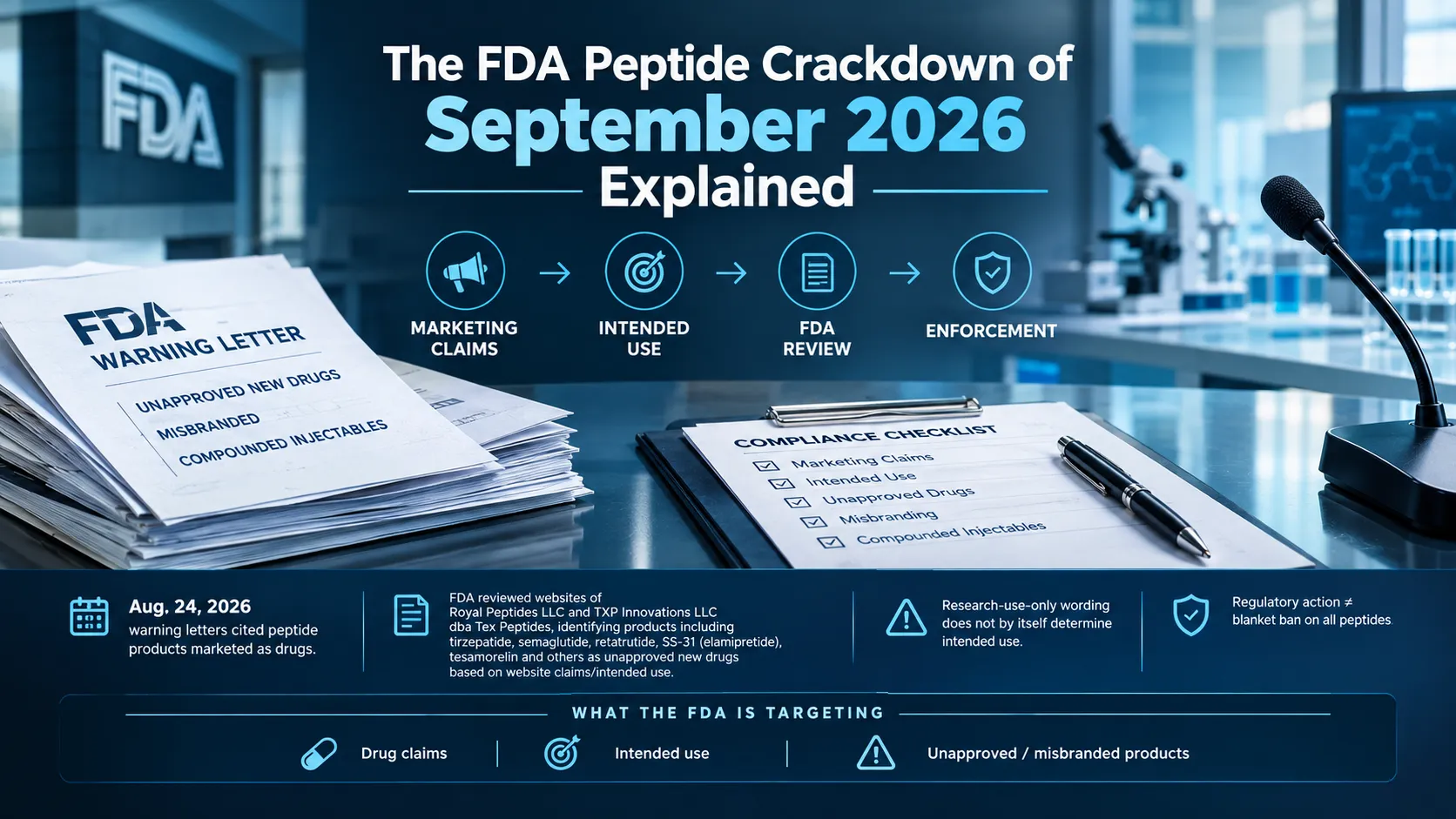
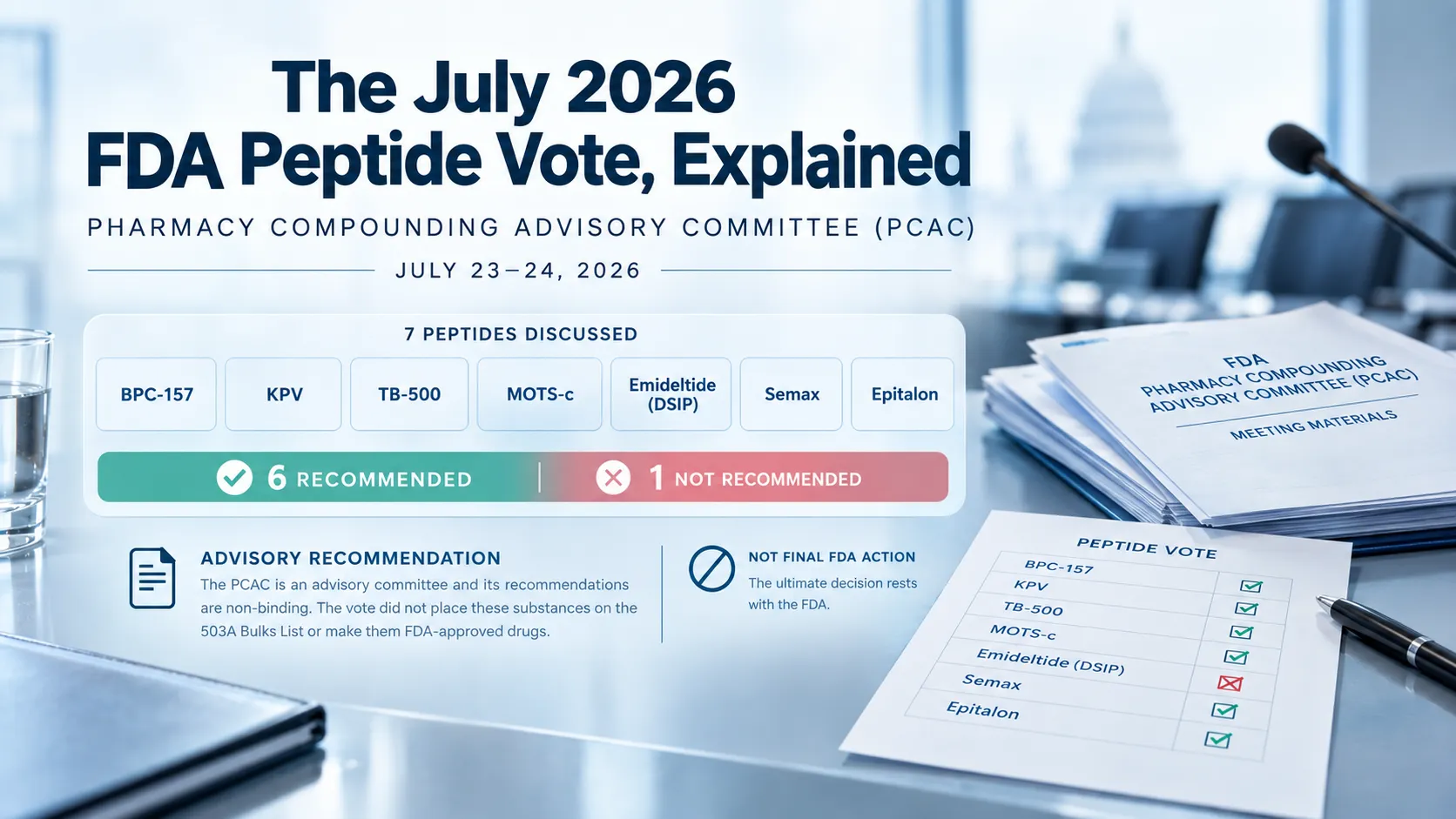
The federal layer moved in 2026. Warning letters went out to peptide sellers in September, and the Pharmacy Compounding Advisory Committee voted on seven peptide substances in July. Both are covered in depth elsewhere on this site, in the September 2026 FDA crackdown and the July 2026 PCAC vote.
One national development sits alongside those. The National Association of Boards of Pharmacy announced a national adverse-event reporting clearinghouse for compounded medications, reported July 29, 2026. It sets up coordinated referral pathways among pharmacy boards, medical boards, and state attorneys general, and the release references the PCAC review directly. Read it accurately though, because this is a general compounded-medication safety initiative and not a peptide-specific enforcement program.
Federal action sets a floor that states can build on. Two of them built higher in 2026.
What are the three legal categories of peptides?
Which rules apply to a given peptide depends on which of three buckets it falls into.
FDA-approved peptide drugs are approved for specific human indications, available by prescription, and regulated as drugs. Semaglutide and tirzepatide both sit in this category.
Compoundable peptides are substances a 503A pharmacy or 503B outsourcing facility may prepare for patients, subject to FDA's bulk substances lists. Whether a given peptide belongs on those lists is exactly what the PCAC reviews decide.
Research chemicals are sold and labeled for laboratory use. They have not been evaluated by FDA for human safety or efficacy, and they are not intended for patient administration.
State board actions target movement between these buckets. Alabama restricted physicians from administering research-grade peptides to patients, which addressed third-category material being used as though it belonged in the first.
Identity is part of why boards treat research-grade material differently. A product designation is not a chemical name, and the two can diverge. The TB-500 identity problem covers a case where analytical literature found internet-sourced material inconsistent with its own description.
Peptide laws by state 2026: the full 50-state table
Anyone researching peptide laws by state 2026 runs into the same problem, which is that most summaries assert positions no primary source supports. The table below does the opposite and shows only what can be documented.
How to read the status column. Restrictive action 2026 means a board or agency published a position limiting provider conduct. Permissive law 2026 means an enacted statute protects it. No 2026 action on record means no state action was found during research for this page. Reported, primary source not reviewed means a credible secondary source describes state action whose underlying document could not be opened and read for this page.
Empty rows mean no documented 2026 action was found, not that a state has endorsed anything. Existing pharmacy, medical practice, and consumer protection law still applies in all 45.
What did Alabama and Mississippi actually say?
The Alabama Board of Medical Examiners published an official notice with language that leaves little room. Under no circumstances, it says, is it permissible for a physician to compound, administer, or dispense a non-FDA-approved or research-grade peptide to a patient.
Scope runs wider than prescribing alone. The notice reaches advising, recommending, supplying, prescribing, and administering. It also closes a workaround directly, stating that research-grade consent forms do not remove a physician's liability.
The date deserves a caveat worth stating openly. That page carries no publication date of its own, and contemporaneous reporting places it at May 26, 2026. This page dates it that way while noting the notice itself does not print a day.
Mississippi went further in one respect. Its position arrived as a joint statement dated August 19, 2026, signed by three boards at once. The Board of Nursing, the Board of Pharmacy, and the State Board of Medical Licensure all put their names to it. Between them they cover providers across nursing, pharmacy, and medicine.
On substance the two states match closely. Providers may not compound, administer, or dispense non-FDA-approved or research-grade peptides to patients, with the same breadth covering advising through administering.
Both documents are agency guidance, not enacted statute. That distinction matters for how they can be challenged and how they bind.
Worth stating plainly, because competitor pages get this wrong: neither state banned peptides. Both actions restrict licensed providers in their professional capacity, and neither reaches possession.
What does Louisiana Act 374 do?
Louisiana moved the other direction, through statute instead of guidance.
Act 374, introduced as SB 253, adds R.S. 37:23.5 to Louisiana law. The governor signed it on May 22, 2026, and it took effect on August 1, 2026.
What it does is narrow and specific. The law restricts licensing boards from prohibiting qualified providers from supplying peptides obtained through compliant 503A or 503B sources. It constrains what boards may do, which is why it reads as a direct counterweight to the Alabama and Mississippi approach.
Classification matters here, because this is enacted law and not pending legislation or board guidance. It carries different weight than either.
The scope of Act 374 repays careful reading. It covers peptides obtained through compliant compounding sources, so it grants no permission for research-grade material. Nothing in it changes what research chemicals are.
How does research-use-only labelling interact with state rules?
Research-use-only labeling is a statement of intended use. It tells a buyer, a regulator, and a court what the material is sold for.
What the label does not do is function as a legal shield. Intended use can be inferred from conduct, marketing, and context, not from the label alone. A seller marketing research chemicals with human-use messaging has an intended-use problem regardless of what the vial says.
This is the hinge for both 2026 board actions. Alabama and Mississippi both reached provider conduct, and neither cared what the label said, because the question was what the provider did with the material.
For a researcher, the practical read is simpler. The designation describes what the material is for, and institutional rules, purchase agreements, and state professional-practice law all still apply on top of it.
Who actually gets prosecuted over peptides?
On the documented 2026 record, enforcement reached licensed providers through their own boards. Alabama and Mississippi both acted through professional licensure channels, aimed at physicians, nurses, and pharmacists.
No primary source found during research for this page shows an individual researcher facing action for possessing research-grade peptides. The limitation is equally important though. Absence of documented action guarantees nothing, and board actions are one channel among several that include state attorneys general and federal agencies.
One case deserves specific mention because it circulates without support. Law firm summaries describe Ohio Board of Pharmacy guidance and med-spa licence actions involving peptides, and a widely circulated slide deck references an Ohio med-spa penalty without naming a clinic, a date, or an order number. Ohio appears in the table as reported rather than confirmed, because the underlying board documents could not be opened and read for this page.
How do peptide rules apply to telemedicine?
Telehealth concentrates regulatory risk in a way in-person practice does not. A prescriber sits in one state, a patient sits in another, and two boards may hold opposite positions on the same substance.
The Interstate Medical Licensure Compact makes multi-state practice easier and multi-state exposure real at the same time. A physician practicing across several states answers to several boards.
One widely circulated claim needs addressing directly. Reports of a coordinated multi-state crackdown on peptide prescribing in May 2026 circulate online, naming several states and a federation-level initiative. Research for this page found no supporting announcement from the Federation of State Medical Boards and none from any named state board. This page does not repeat that claim as fact.
A clinician can verify something narrower and more useful. Check the published position of every board you hold a license under, because that is the document that binds you.
What happens to peptides at customs and between states?
Customs treats research chemicals according to declared intended use and product documentation. Material declared for laboratory research is assessed differently than material presenting as a drug for human use.
Interstate shipping raises a separate question. Rules in the receiving state apply on arrival, which matters more than the rules at origin. A legal shipment can land in a state whose board has published a restrictive position.
One honest limitation belongs at the end of this section. Customs outcomes are discretionary, inconsistently reported, and rarely documented publicly. No reliable pattern can be drawn from available sources.
The bottom line
Three states took action on peptides in 2026 that this page confirmed against a primary source. Alabama and Mississippi restricted licensed providers from administering research-grade material to patients. Louisiana enacted a law protecting providers who source through compliant compounding pathways. South Carolina and Ohio are reported to have acted, on secondary sources this page has not verified against the underlying documents.
Forty-five states have no 2026 action on record. That is the accurate status, and it means existing law applies without a new layer on top.
No confirmed 2026 state action reaches possession of research-grade peptides by researchers. Every documented action operates through professional licensure.
This page updates monthly, so check the changelog below to see whether anything moved since your last visit.
Changelog
- September 24, 2026 - South Carolina and Ohio added as reported, primary source not reviewed; state counts updated accordingly.
- August 19, 2026 - Mississippi joint statement issued by the Board of Nursing, Board of Pharmacy, and State Board of Medical Licensure.
- August 1, 2026 - Louisiana Act 374 took effect.
- July 29, 2026 - NABP national adverse-event reporting clearinghouse for compounded medications reported.
- May 26, 2026 - Alabama Board of Medical Examiners notice published, date per contemporaneous reporting.