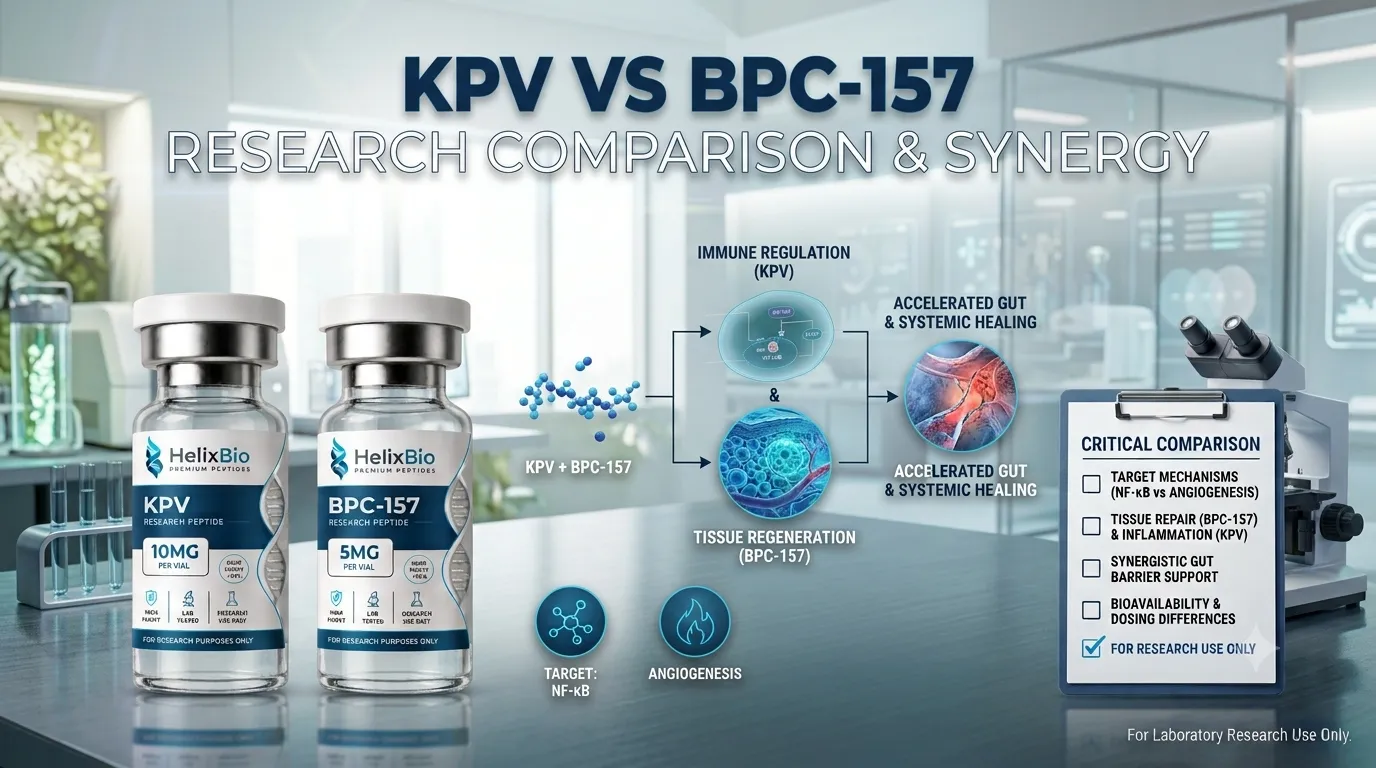
KPV and BPC-157 have never been compared in one published study, so any ranking of one above the other is inference across separate research programs.
No published study, in animals or humans, has tested KPV and BPC-157 co-administered.
FDA's 2026 review identified no human clinical data, no pharmacokinetic data, and no FAERS reports for KPV via any route of administration.
BPC-157 research includes a thirty-year rodent program and five small human studies totalling roughly one hundred subjects.
The only randomized, placebo-controlled trial of BPC-157 was reported as a 2005 meeting abstract and its full results were never published.
Neither peptide has an identified molecular target, and FDA states the mechanisms of both remain unknown.
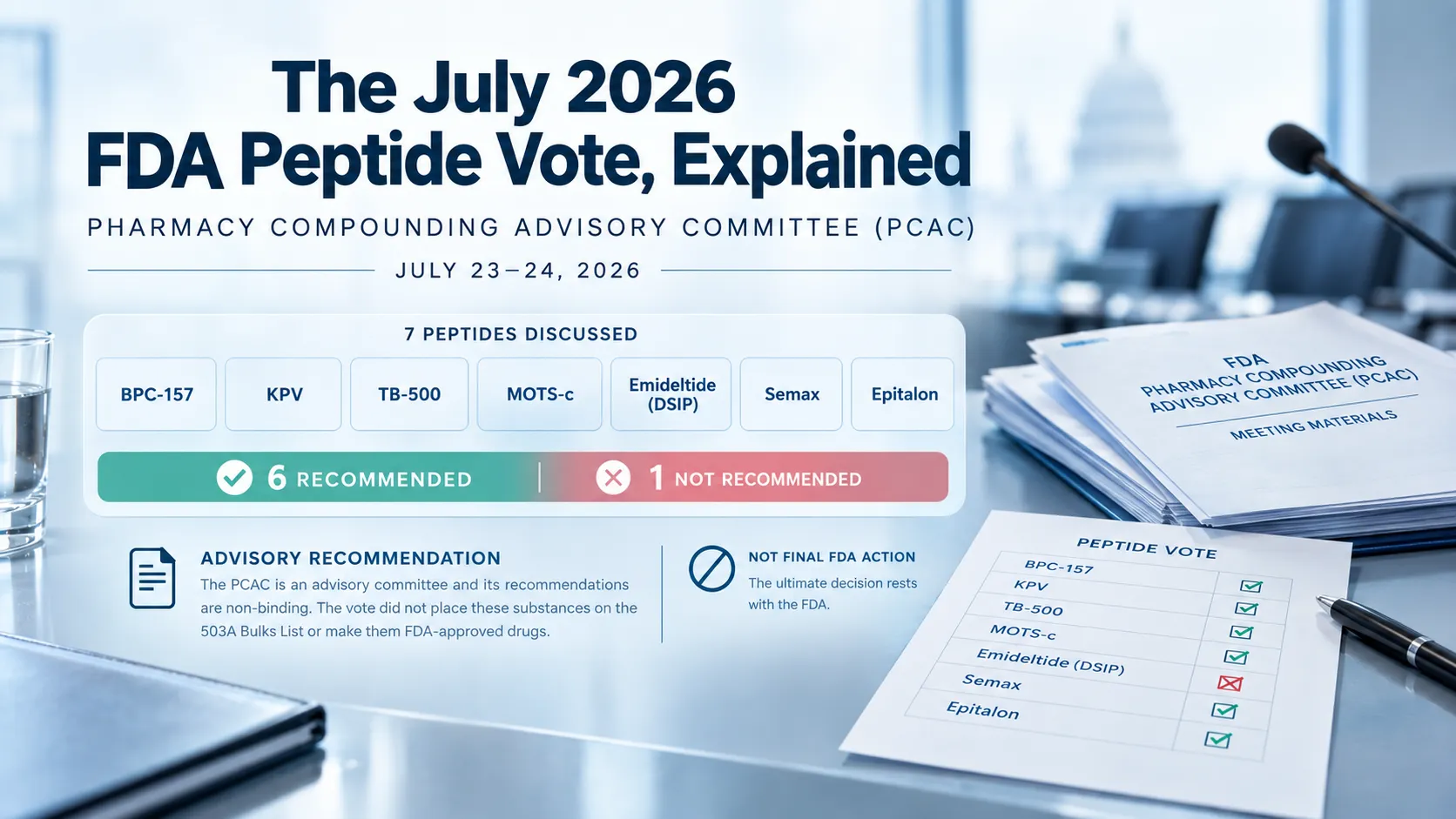
On July 23, 2026, FDA's Pharmacy Compounding Advisory Committee recommended both peptides for the 503A Bulks List, against the recommendation of FDA's own reviewers.
A committee recommendation is not a rule, and no proposed rule had been published as of September 2026.
Two peptides dominate the same search queries, and no study has ever put them side by side. KPV and BPC-157 are both promoted for gut inflammation and tissue repair, and an FDA advisory committee recommended both for compounding in July 2026. Neither is an FDA-approved drug. This article sets out what each compound's research literature actually contains and what it does not. It then compares the two on mechanism, evidence tier, and regulatory status. It contains no dosing, no administration guidance, and no protocols.
Featured In This Article
KPV
RESEARCH PEPTIDE
Highly purified synthetic peptide prepared for rigorous laboratory research.
$77.00
BPC-157
RESEARCH PEPTIDE
Highly purified synthetic peptide prepared for rigorous laboratory research.
$61.00
The honest frame matters more than any ranking. No published study has tested KPV against BPC-157, and no published study has tested the two together. Every comparison available, this one included, is assembled by reading two separate literatures side by side and noting where they diverge.
Quick answer: how do KPV and BPC-157 compare?
No study has compared KPV and BPC-157 directly. BPC-157 has the larger animal literature and a small number of human studies, while the FDA identified no human exposure data for KPV by any route. An FDA advisory committee recommended both for the 503A bulks list in July 2026. Neither is FDA-approved, and neither is on the codified list at 21 CFR 216.23.
KPV
BPC-157
Identity
Tripeptide, H-Lys-Pro-Val-OH
Pentadecapeptide, GEPPPGKPADDAGLV
Origin
C-terminal fragment of alpha-MSH
Sequence from human gastric juice protein BPC, Zagreb program, early 1990s
Proposed mechanism
PepT1-dependent uptake, NF-kB and MAPK suppression
Rat and dog models across gut, tendon, liver, and nerve
Regulatory status
No FDA approval; recommended for 503A list July 2026
No FDA approval; recommended for 503A list July 2026
Sports status
S0 catch-all for non-approved substances; not named individually
Named on WADA's prohibited list under S0
What does the research on KPV actually show?
KPV is a three-amino-acid peptide, H-Lys-Pro-Val-OH, corresponding to residues 11 to 13 of alpha-melanocyte-stimulating hormone. Its molecular weight is 342.43 g/mol and its CAS number is 67727-97-3. FDA records no UNII code and no USP monograph for either the free base or the acetate form.
The mechanism is unsettled, and the most informative finding is a negative one. KPV does not appear to act through the melanocortin receptors that carry alpha-MSH's own activity. It did not raise cyclic AMP in MC1 receptor-expressing murine macrophages (Mandrika 2001). Getting and colleagues found no involvement of MC2, MC3, or MC4 receptors in KPV's anti-inflammatory effect (Getting 2003). Kannengiesser and colleagues treated mice carrying a non-functional MC1 receptor and found KPV still protected the animals during colitis (Kannengiesser 2008).
The current working model replaces receptor binding with transport. Dalmasso and colleagues reported that the di/tripeptide transporter PepT1 carries KPV into intestinal epithelial cells and T cells. Inside the cell, KPV suppressed NF-kB activation and MAP kinase signaling (Dalmasso 2008). FDA describes this as a proposal and not a settled account. Its 2026 evaluation states that the molecular targets underlying KPV's reported effects remain unknown.
The animal record is real but narrow. KPV reduced inflammation in two murine colitis models, DSS colitis and CD45RB-high transfer colitis (Kannengiesser 2008), and in murine peritonitis (Getting 2003). Dalmasso's work spans human cell lines and mouse colitis. Earlier work on the alpha-MSH fragment traces back to Hiltz and Lipton (1989).
The human record is empty. FDA's review found no clinical study, no pharmacokinetic or pharmacodynamic data, and no human exposure data via any route. A FAERS search through December 3, 2025 returned no reports. The food and cosmetics complaint system returned none either.
What the evidence does not show
No human study of KPV exists, so effectiveness in people is untested and not merely unproven.
FDA identified no acute toxicity, repeat-dose toxicity, genotoxicity, reproductive toxicity, or carcinogenicity study of either KPV form.
The molecular target is unidentified, so the PepT1 and NF-kB account remains a hypothesis.
One in-vitro study found KPV permeates human cadaver skin poorly, which cuts both ways for topical formulations (Pawar 2017).
Nothing in the published literature addresses immunogenicity or peptide aggregation for KPV.
What does the research on BPC-157 actually show?
BPC-157 is a fifteen-amino-acid peptide, GEPPPGKPADDAGLV, with a sequence derived from a protein found in human gastric juice. It was first synthesized at the University of Zagreb and first described in the literature in 1993. Its development code is PL-14736. Its molecular weight is 1419.5 g/mol.
No receptor for BPC-157 has been identified. FDA states that the molecular targets have not been found and the mechanisms remain poorly understood. Researchers have proposed four overlapping pathways. They are upregulation of growth factors and their receptors, suppression of inflammatory signaling, induction of angiogenesis, and stimulation of nitric oxide synthesis. Most of these proposals originate with one research group. A gut-brain axis role is also proposed, and it too comes from a single program, so it reads as a hypothesis.
The animal literature is the substantive part. Rats treated with BPC-157 showed roughly 40% smaller surgically created colonic fistulas from post-surgical day 3 onward (Klicek 2008). Other rat work reports protection against NSAID-induced gastric lesions and against several models of liver injury. Tendon work appears in Staresinic (2003) and Chang (2011). FDA flags a recurring weakness across this body of work. Dose-response relationships were not established, because widely separated doses produced effects of the same size.
Toxicology exists, within limits. Intramuscular studies in rats and dogs reported no acute toxicity at the doses tested. The same program found no evidence of mutagenicity across Ames, chromosome aberration, and micronucleus assays (Xu 2020). Twenty-eight-day dosing produced clotting-time changes in both species and liver-associated laboratory signals. Pharmacokinetic work in rats and dogs found a half-life of roughly 5 to 15 minutes (He 2022). No carcinogenicity study of either form exists.
Human evidence is where the picture tightens. FDA's search of the published literature identified five clinical studies in total. One was a rectal enema study in 24 healthy subjects. One was a multicenter randomized, double-blind, placebo-controlled trial in 53 subjects with mild-to-moderate ulcerative colitis. The remaining three were an intra-articular knee-pain series, an intravesical pilot in 12 women with interstitial cystitis, and an intravenous safety study in 2 adults.
The randomized trial deserves its own paragraph. It was reported only as a 2005 meeting abstract, and the full results were never published in a journal (Ruenzi 2005). The reported mean change in disease activity index was -3.2 in the treated group and -1.6 on placebo. The estimated between-group difference was 1.6 points, with a confidence interval running from -4.84 to 1.62. That interval crosses zero. FDA concluded there is a lack of evidence to reach any conclusion about effectiveness in ulcerative colitis.
BPC-157 has no FDA approval for any indication. It appears on the World Anti-Doping Agency's prohibited list under S0, non-approved substances, which applies at all times. FDA's FAERS search through December 4, 2025 retrieved three reports, all involving injectable products. They describe an injection-site reaction, an episode of shortness of breath, and a case of diffuse hyperpigmentation with gingival darkening that recurred on rechallenge. FDA notes that two of the three involved a second peptide, which prevents attribution to BPC-157.
What the evidence does not show
No randomized trial results have been published in a peer-reviewed journal, so the single trial cannot be independently assessed.
Nearly all healing claims trace to one research group, and independent replication exists for mechanistic readouts more than for healing outcomes.
No carcinogenicity study exists. Because angiogenesis is one of the proposed mechanisms, tumor-related questions remain open and unanswered in both directions.
FDA found no human pharmacokinetic data for oral, subcutaneous, nasal, or transdermal routes.
The clotting and liver signals seen in 28-day animal dosing have no longer-duration study to confirm or resolve them.
How do KPV and BPC-157 differ in mechanism?
The mechanistic distance between these two compounds is larger than the search interest suggests. KPV's proposed action is intracellular and anti-inflammatory. It is carried into cells by a transporter and dampens a transcription factor. BPC-157's proposed action is tissue-level and reparative, centered on new blood vessel formation and nitric oxide signaling. One proposal is about turning inflammation down. The other is about building tissue back.
The evidence contrast is starker still. KPV has zero human data of any kind. BPC-157 has a thirty-year rodent program and a limited intramuscular toxicology package. Its human exposure totals roughly one hundred subjects across five small studies. One of those was randomized, and none produced published, peer-reviewed efficacy results. Neither compound has a confirmed molecular target.
Gut health drives most of the search interest here, and it deserves an honest answer. KPV's gut evidence comes from mouse colitis models scored on weight, histology, and myeloperoxidase activity. BPC-157's gut evidence comes from rat fistula and lesion models scored on macroscopic healing. It also includes one human ulcerative colitis trial that did not demonstrate a difference from placebo. Different species, different endpoints, different decades, and no shared comparator. Ranking them against each other requires assumptions the data do not supply.
How strong is the evidence for each peptide?
Claim
Evidence type
Key finding
Confidence
Limitation
KPV suppresses NF-kB signaling
In-vitro
Reduced NF-kB and MAPK activation in intestinal and immune cell lines
Low
Cell lines only; effect size in human tissue unknown
Proposed transporter route; FDA states targets remain unknown
KPV reduces intestinal inflammation
Animal
Improved recovery and histology in two murine colitis models
Low
Rodent models; no human confirmation
What did the July 2026 FDA vote mean for KPV and BPC-157?
On July 23, 2026, FDA's Pharmacy Compounding Advisory Committee considered both peptides for the 503A Bulks List. It evaluated BPC-157 for ulcerative colitis and KPV for wound healing and inflammatory conditions. It recommended adding both.
The vote went against FDA's own scientists. Agency reviewers had published evaluations proposing that none of the fourteen peptide forms under consideration be added. Trade and legal press reported the tally as 8 in favor and 6 against, with one abstention, for each of BPC-157, KPV, and TB-500. FDA has not published official tallies, so those numbers are as reported and not agency record. Separate votes were held for the free base and acetate forms of each substance, with the same outcome each time. MOTS-c was also recommended on July 23. On July 24, the committee recommended Semax and Epitalon and declined to recommend emideltide, also called DSIP.
One detail is easy to miss. Both BPC-157 nominations and the KPV nomination had been withdrawn before the meeting. FDA evaluated the substances on its own initiative.
A committee recommendation is not a rule, and a rule would not be an approval. Adding a substance to the 503A Bulks List requires FDA to complete notice-and-comment rulemaking. That means a proposed rule, a comment period, and a final rule amending the regulation. As of September 2026, no proposed rule has been published, neither peptide is on the list, and neither has FDA approval for any indication. Helix Bio Chem products are sold for laboratory research use only, not for compounding, human use or veterinary use.
Can KPV and BPC-157 be combined?
No published study, in animals or in humans, has tested KPV and BPC-157 co-administered. That is the complete answer, and it belongs before any discussion of why the two are paired.
Sources describing a synergy between them are reasoning from two separate single-compound literatures. The argument runs that one compound suppresses inflammatory signaling while the other supports tissue repair, so the two should complement each other. That is a mechanistic hypothesis. It has never been tested, so nothing is known about combined effect, combined safety, or interaction.
FDA's review of BPC-157 surfaced one relevant real-world data point. A FAERS report describes reactions following use of a combination product, and the presence of two peptides made attribution to either one impossible. Combination use makes evidence harder to interpret, not easier.
How do KPV, BPC-157 and TB-500 compare?
TB-500 enters this comparison because the three names are searched together. The advisory committee also recommended it on July 23, 2026. FDA's reviewers found no human clinical evidence for TB-500, the same finding they reached for KPV.
The BPC-157 and TB-500 pairing has been examined more closely than either pairing involving KPV. We cover it separately in our BPC-157 vs TB-500 comparison. The same caution applies there. No study has compared those two directly either.
Helix Bio Chem supplies both compounds discussed here for laboratory research use, KPV and BPC-157. Neither is offered for human use.
Got Questions?
Frequently Asked Questions
No published study supports ranking either above the other, because the two have never been compared in a single experiment. BPC-157 has a far larger research base, including animal toxicology and five small human studies, while KPV has no human data at all. A larger research base indicates more study, not a better outcome.
No published research has tested the two co-administered in any model, animal or human. Claims about combining them are inference drawn from two separate single-compound literatures, not experimental findings. FDA's 2026 review notes that a combination product made one adverse event report impossible to attribute to either peptide.
In research models, KPV has been studied as an anti-inflammatory agent. Published work covers murine colitis, murine peritonitis, rodent wound models, and cell-line studies of NF-kB suppression. FDA evaluated it for the proposed uses of wound healing and inflammatory conditions and found no evidence available to assess effectiveness.
The available research cannot answer this, because no study has compared the two. KPV's gut data come from two mouse colitis models scored on weight, histology, and myeloperoxidase activity. BPC-157's come from rat fistula models plus one randomized human trial whose reported confidence interval crossed zero.
Human safety is unknown, and that phrasing is precise. FDA's 2026 review found no clinical studies, no human exposure data via any route, and no acute, repeat-dose, genotoxicity, reproductive, or carcinogenicity study in animals. A FAERS search through December 2025 returned zero reports, which reflects an absence of documented use.
FDA's FAERS search through December 2025 retrieved three reports, all involving injectable products. They describe an injection-site reaction, shortness of breath, and hyperpigmentation with gingival darkening that recurred on rechallenge. Two of the three involved a second peptide, so attribution to BPC-157 is not possible.
No human timeline exists, because no human study of KPV has ever been conducted. In the murine colitis work, recovery was assessed through body weight, histology, and myeloperoxidase activity in colonic tissue over the disease course. Those are study durations in mice and not indications of onset in people.
No human onset data exists. As study facts, the ulcerative colitis trial dosed once daily for two weeks, and treated rats showed smaller colonic fistulas from post-surgical day 3 onward. Animal timelines do not transfer to humans, and FDA found no human pharmacokinetic data for most routes.
FDA itself decided nothing. Its Pharmacy Compounding Advisory Committee recommended adding both peptides to the 503A Bulks List on July 23, 2026, against the recommendation of FDA's own reviewers. Adding anything to the list requires notice-and-comment rulemaking, and no rule had been proposed as of September 2026.
Yes. BPC-157 is named on the World Anti-Doping Agency's prohibited list under S0, the non-approved substances category, and S0 applies at all times. Because that category covers substances with no regulatory approval for human therapeutic use, no recognized indication exists that would support an exemption.
Both are promoted for overlapping purposes, principally gut inflammation and tissue repair, and both are sold through the same channels. Both also reached a wider audience through the same July 2026 advisory committee meeting. No published study has examined them together, which is why the framing matters more than any ranking.