Quick answer: what did the July 2026 FDA PCAC peptide vote change?
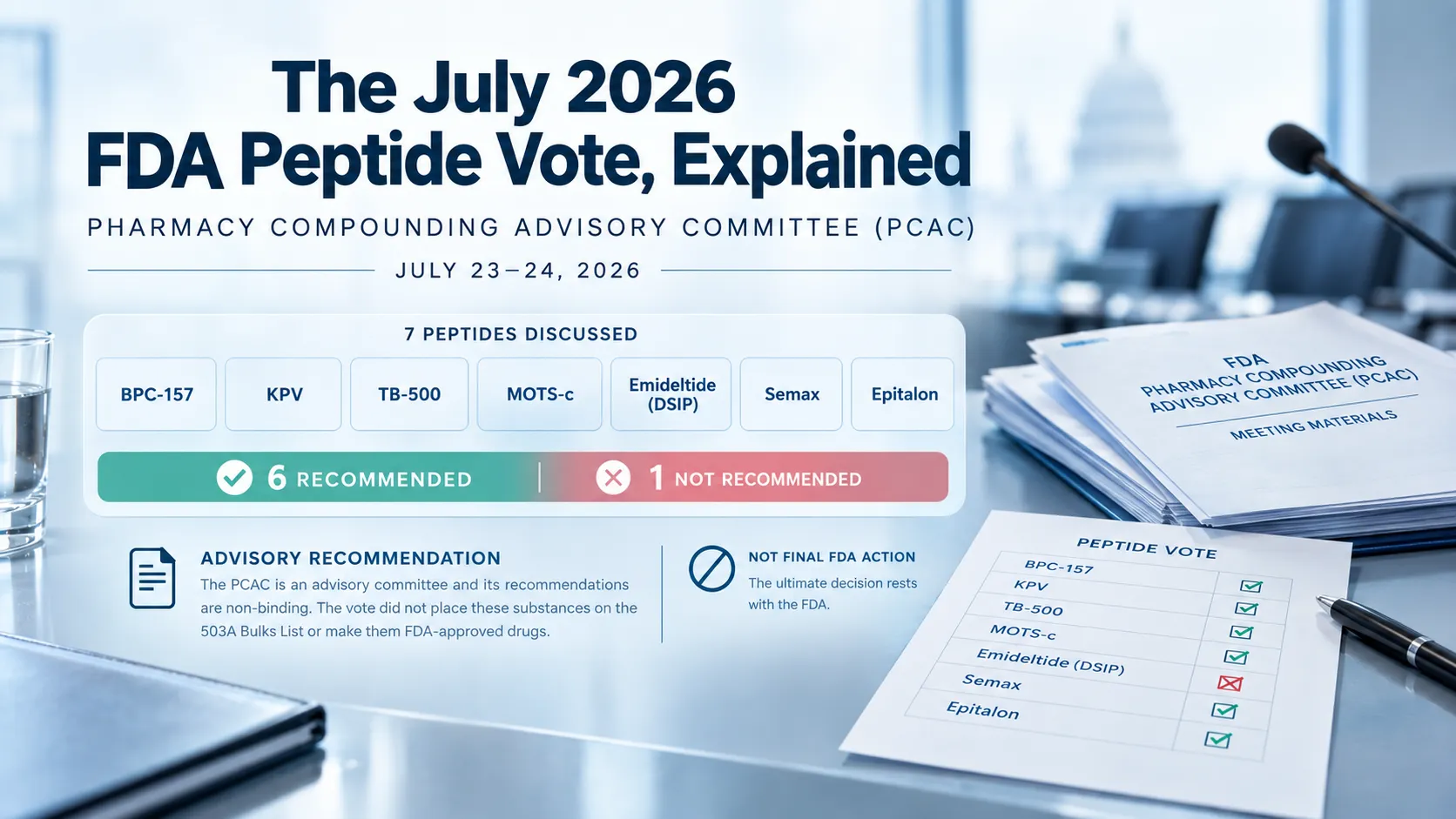
The FDA PCAC peptide vote of July 23–24, 2026 did not change any regulation. The FDA's Pharmacy Compounding Advisory Committee (PCAC) recommended six peptides for the 503A pharmacy-compounding bulks list: BPC-157, KPV, TB-500, MOTS-c, Semax and Epitalon. It did not recommend emideltide (DSIP). The recommendations are advisory. As of 22 September 2026, none of the six is on the codified list at 21 CFR 216.23, none is FDA-approved, and the FDA had not published a proposed rule to add any of them.
Key facts, as of 22 September 2026:
- Meeting: PCAC, July 23–24, 2026, seven peptides, free base and acetate forms.
- Result: six recommended; emideltide (DSIP) not recommended.
- Legal effect: advisory only; adding a peptide to 21 CFR 216.23 requires FDA rulemaking.
- Status: none of the seven is FDA-approved, on the codified 503A list, or in Category 1.
- Next: PCAC review of GHK-Cu, Melanotan II, LL-37, dihexa acetate and PEG-MGF planned before the end of February 2027.
Did the July 2026 vote make peptides legal to compound?
No, the vote did not make these peptides legal to compound. The committee's recommendations are advisory and do not bind the FDA. As of September 2026, none of the six recommended peptides appears on the codified 503A bulks list. A favorable vote is one input to a longer process, and the FDA has not said how it will proceed.
The committee in question is the Pharmacy Compounding Advisory Committee (PCAC). It is an outside expert panel that advises the FDA on drug-compounding questions. It does not make law and does not issue approvals.
The 503A bulks list is the federal list of bulk ingredients that traditional compounding pharmacies may use to prepare drugs for individual patients with a prescription. It is sometimes searched as the "503A bulk list."
The list is codified at 21 CFR 216.23, a section of the Code of Federal Regulations. A substance is formally on the list only when it appears in that regulation.
How did the PCAC vote on each peptide?
The PCAC voted on seven peptide families on July 23–24, 2026. It considered the free base and acetate forms of each. Six received favorable recommendations and one, emideltide (DSIP), did not. The official FDA minutes had not been published at the time of writing, so the tallies below come from outlets that covered the live webcast.
The Day-1 figures are reported consistently in the coverage we reviewed. McDermott Will & Schulte reported an 8–6 split with one abstention for each of BPC-157, KPV, and TB-500, and a 7–5 result with two abstentions for MOTS-c.
The Day-2 figures are less settled. Coverage splits on Epitalon, and the FDA transcript that would settle the Day-2 counts has not been posted. McDermott Will & Schulte and LumaLex Law reported 7–4 with one abstention, and STAT also reported 7–4, while RAPS reported 7–5 with one abstention. We will update this table when the FDA publishes its minutes.
For context, the nominations named specific uses. Those included ulcerative colitis for BPC-157, wound healing and inflammatory conditions for KPV, wound healing for TB-500, obesity and osteoporosis for MOTS-c, insomnia for Epitalon, and selected neurologic uses for Semax. These are uses the nominators proposed, not established uses. For MOTS-c, the FDA briefing states that the nomination lacked sufficient information for the agency to fully evaluate the proposed uses, and that it identified no clinical studies evaluating them. Helix Bio makes no claim that any peptide is safe or effective for any of these uses.
For the research behind each peptide, see our articles on BPC-157, TB-500, MOTS-c and Epitalon.
Why did the vote surprise observers?
The vote surprised observers because the FDA's own scientists had recommended against listing all seven substances. The committee went against staff on six of them and agreed with staff only on emideltide.
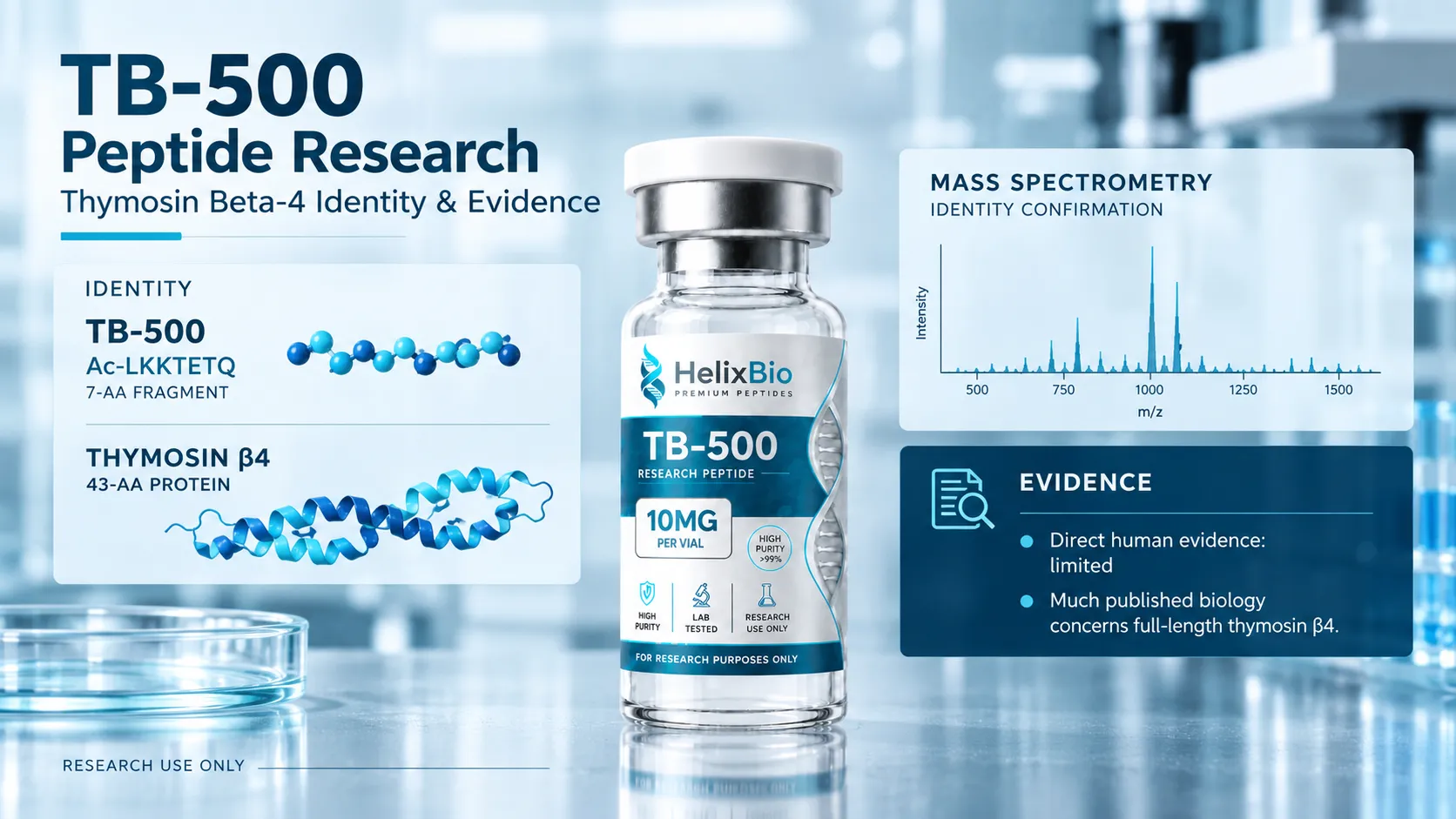
The FDA's position is documented in its briefing materials, which are primary sources posted on FDA.gov. According to those documents, the nominators submitted 25 nonclinical articles on BPC-157 and the FDA identified five clinical studies of it, the FDA found no studies in which TB-500 was administered to humans, and it identified no human exposure data for KPV.
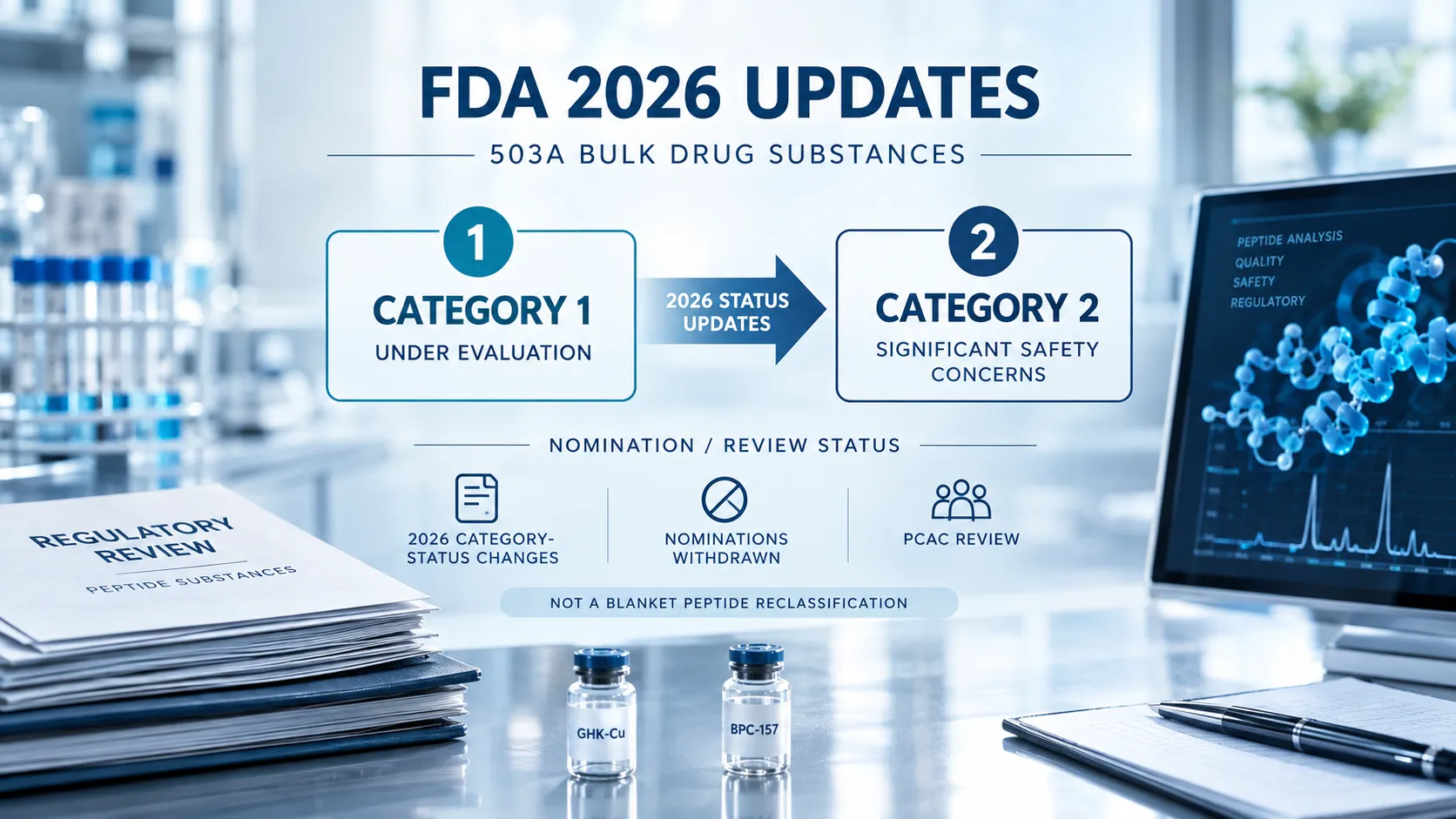
It also helps to know how these peptides got here. In September 2023, the FDA moved more than a dozen peptides into Category 2. Category 2 is the part of the FDA's interim bulks policy for substances flagged as raising significant safety concerns. Our explainer on the Category 2 to Category 1 reclassification covers that history in detail.
In April 2026 (announced April 15), the FDA moved a group of peptides, reported by law firms as 12, from Category 2 to its withdrawn-nominations table because their nominators withdrew them. FDA's current table lists 17 undated entries. All seven peptides on the July docket are among them. Removal from Category 2 does not automatically place a substance in Category 1. Category 1 is the interim group where the FDA exercises enforcement discretion. A substance in the withdrawn-nominations table is outside the Category 1 enforcement policy, so that policy does not cover it.
What does a PCAC recommendation mean legally?
A PCAC recommendation is advice. It does not bind the FDA and changes nothing in the regulation by itself. To add a peptide to 21 CFR 216.23, the FDA would have to go through notice-and-comment rulemaking. No timetable has been published.
The standard path runs from FDA review through a proposed rule, a public comment period and a final rule. Our 503A bulks list explainer walks through each step.
Estimates of how long this will take vary. Medscape reported that the required rulemaking could take a year or more, and McDermott said it could occur in 2027 or extend into a multi-year process.
Legal analysts have also described a possible faster interim route. McDermott noted that Secretary Kennedy could add the peptides to Category 1 on an interim basis or issue statements signaling enforcement discretion while final rulemaking is pending. As of September 2026, no such interim action has been published, and the FDA has not said it will take that route.
Are BPC-157, TB-500 and the other peptides FDA-approved or on the 503A list? Status by peptide
None of the seven peptides is an FDA-approved drug, and none is on the codified 503A bulks list. The table below summarizes where each one stands. Every entry reflects status as of September 2026.
Buchanan Ingersoll & Rooney, a law firm, made the same point about the votes. It cautioned that the favorable votes should not be treated as authorization to begin compounding any of the six peptides.
Why did the PCAC reject emideltide (DSIP)?
The committee narrowly declined emideltide (DSIP), in line with FDA staff. The FDA evaluated emideltide for opioid withdrawal, chronic insomnia, and narcolepsy. For those uses, the evidence did not clear the committee's bar.
According to the FDA briefing document and secondary summaries of the meeting, staff raised the following concerns:
- limited characterization of the free base and acetate forms
- no USP/NF monograph and no FDA-approved drug containing emideltide
- older human studies that were small and uneven, and that mostly used intravenous rather than the nominated subcutaneous route
- an uncertain mechanism of action
- possible risks from impurities, aggregation, and immune reactions
- existing established therapies for the proposed uses
A narrow rejection is not necessarily permanent. Negative votes generally end the current nomination, but a substance can be nominated again in a future cycle.
What is the difference between 503A and 503B?
503A and 503B are separate legal pathways, and each has its own bulks list. The July 2026 vote concerned only the 503A list. A favorable 503A recommendation says nothing about 503B eligibility.
The practical point for readers: a favorable recommendation for the 503A list should not be read as a statement about every compounding pathway. Our 503A bulks list explainer sets out how the two pathways differ.
What are states doing about research-grade peptides?
Several states have taken positions since 2025, independent of the federal process. Boards in at least four states have issued guidance or statements on non-FDA-approved or "research-grade" peptides, most of them restricting licensed providers' involvement.
Mississippi. On August 19, 2026, the state's medical licensure, nursing, and pharmacy boards issued a joint statement barring licensed providers from compounding, administering, or dispensing non-FDA-approved or research-grade peptides. The prohibition also covers advising, recommending, supplying, and prescribing. It is the only one of these notices issued jointly by three boards.
Alabama. On May 26, 2026, the Alabama Board of Medical Examiners and Medical Licensure Commission issued an official notice with substantially similar framing.
South Carolina. According to a law firm summary, the Board of Medical Examiners published a closely matching notice in mid-August 2026. Like Mississippi, it stated that patient consent forms and waivers do not cure the problem. We did not directly review the South Carolina board document.
Ohio. According to a law firm summary of Board of Pharmacy guidance (April 2026), med spas and clinics are told not to use peptides labeled "for research purposes only," and peptides such as BPC-157 cannot currently be compounded. The summary also says the board has revoked or suspended several med spas' terminal distributor (TDDD) licenses over peptide-related violations. We did not directly review the underlying Ohio board documents.
These state statements are board policy positions, not rules adopted through formal rulemaking. They were issued independently of the federal process and are not changed by the July vote. Law firm commentary (LumaLex Law) describes the Mississippi and South Carolina notices as nearly identical, and Alabama's earlier notice as using similar wording.
What happens next before the February 2027 meeting?
The FDA has said the PCAC will meet again before the end of February 2027 to review five more peptides. As of September 2026, the date, location, and Federal Register docket number for that meeting had not been published.
The five peptides are GHK-Cu, Melanotan II, cathelicidin (LL-37), dihexa acetate, and pegylated mechano growth factor (PEG-MGF).
GHK-Cu is on an unusual track. FDA's withdrawn table lists it only for injectable routes, because that nomination was withdrawn. The non-injectable form was removed from Category 1 on April 22, 2026, but after a nominator clarified on May 5 that it wanted to keep that nomination, the FDA said it would add GHK-Cu (except for injectable routes) back to Category 1, where it appears on the FDA list updated May 14, 2026.
GHK-Cu's place in the withdrawn-nominations table is covered in our reclassification explainer.
Status tracker
Last updated: 22 September 2026
Items still pending: official FDA minutes and transcript, any Federal Register notice of proposed rulemaking, any interim Category 1 or enforcement-discretion statement, and the Federal Register notice for the February 2027 meeting.
Sources and method: status statements come from FDA documents and the Federal Register, and vote tallies and state actions come from the law-firm, press and board sources listed in the references. Tallies are press-reported until the FDA publishes minutes. For how we keep regulatory status separate from scientific evidence, see how Helix Bio grades peptide research evidence.