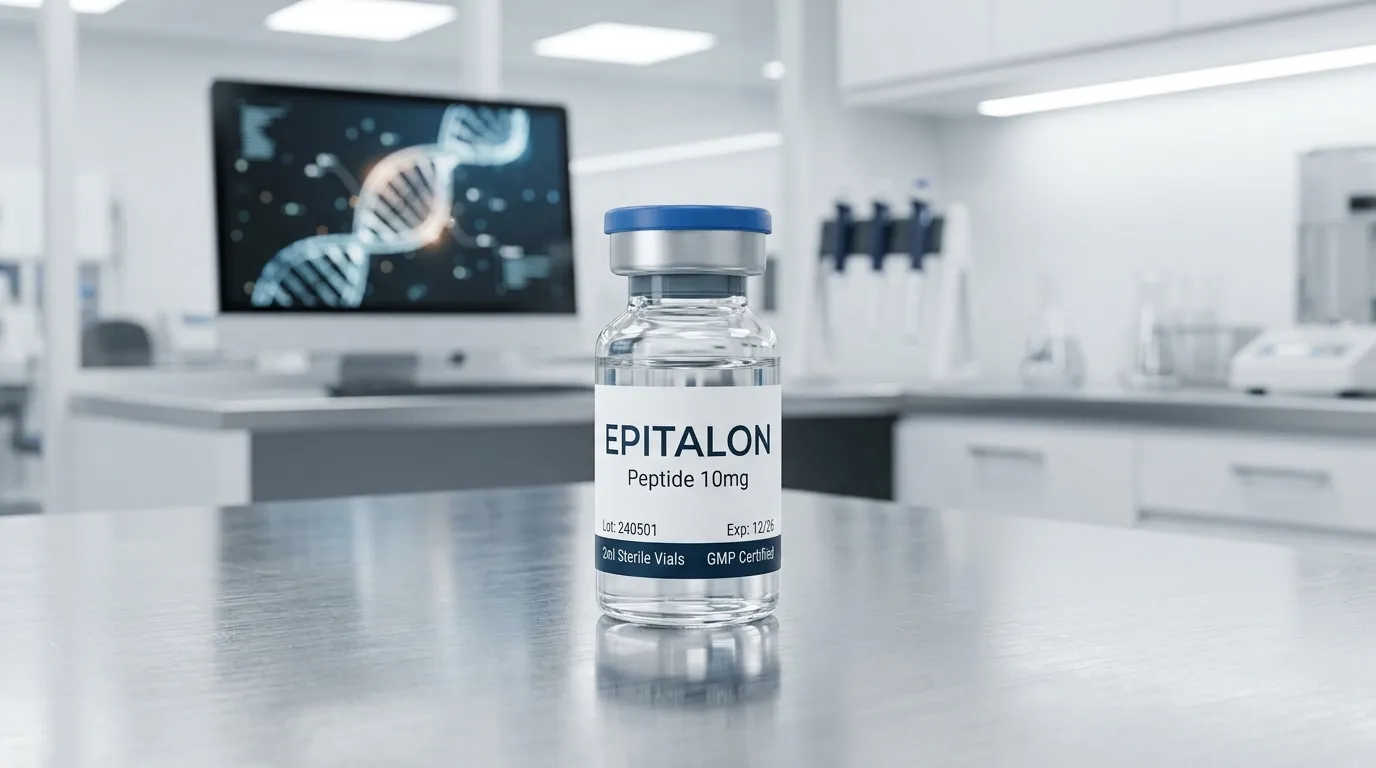
- Epithalon and Epitalon are two spellings of the same synthetic tetrapeptide, sequence Ala-Glu-Asp-Gly, abbreviated AEDG.
- Epitalon is chemically distinct from Epithalamin, a crude bovine pineal gland extract, and FDA treats them as different substances.
- Human outcome data frequently attributed to Epitalon, including mortality findings in older adults, come from trials that administered Epithalamin rather than the synthetic tetrapeptide.
- The foundational 2003 telomerase finding was produced in telomerase-negative human fetal fibroblast cultures, not in living subjects.
- A 2025 Biogerontology study from Brunel University London independently replicated dose-dependent telomere lengthening through hTERT and telomerase upregulation in normal human cells.
- The same 2025 study reported telomere extension via the ALT pathway in breast cancer cell lines, and FDA has noted that telomerase activation carries a theoretical carcinogenicity concern.
- FDA identified only three published studies in which epitalon was administered to humans, none of which measured a clinical endpoint.
- In July 2026 an FDA advisory committee recommended epitalon for the 503A Bulks List against agency staff advice, but the vote is advisory and does not confer approval or change its legal status.
Search interest in Epithalon runs well ahead of the evidence base, and the gap between the two is where most confusion starts. The compound is a four-amino-acid peptide with a genuinely interesting experimental record in telomere biology, and it is also routinely described online as a proven anti-aging intervention that no published human study supports. This article separates those two things. It covers what Epithalon is chemically, where it came from, what the telomerase and melatonin research actually measured, how strong that evidence is by study model, and what the July 2026 FDA advisory committee review revealed about its regulatory standing in the United States.
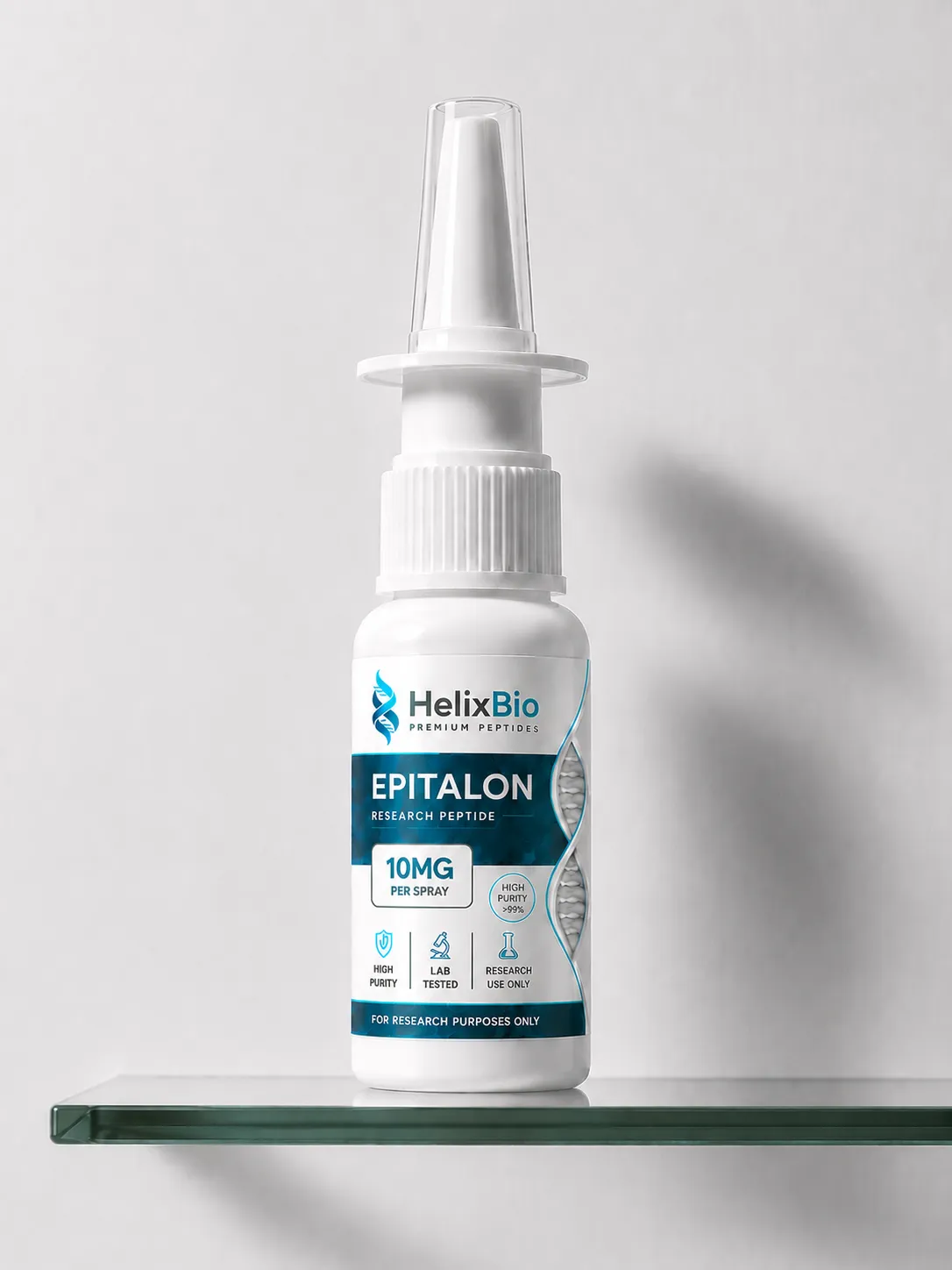
Epitalon Spray
RESEARCH PEPTIDE
Epitalon Spray is a research-use-only preparation featuring Epitalon, also known as AEDG (Ala-Glu-Asp-Gly), a synthetic tetrapeptide studied in cellular, molecular, neurobiology, and aging-related research. Published research has examined Epitalon in areas including gene expression, chromatin biology, neuronal activity, and pineal-related signaling. Helix Bio supplies research materials for laboratory and scientific applications. This product is intended exclusively for controlled research and laboratory work and is not intended for human or veterinary administration.
NAD+ Spray
RESEARCH PEPTIDE
NAD+ Spray is a research-use formulation containing nicotinamide adenine dinucleotide (NAD+), an essential cellular coenzyme involved in redox reactions and several biochemical signaling processes. NAD+ research spans cellular metabolism, mitochondrial biology, oxidative phosphorylation, DNA repair, and NAD-dependent enzyme activity. Helix Bio supplies NAD+ Spray strictly as a research and laboratory material. It is intended for qualified researchers investigating NAD+ biology and related biochemical pathways and is not intended for human or veterinary administration.
SS-31
RESEARCH PEPTIDE
SS-31, also known as elamipretide, MTP-131, or Bendavia, is a synthetic mitochondria-targeted tetrapeptide studied extensively in laboratory research involving mitochondrial membranes, cardiolipin interactions, cellular bioenergetics, oxidative stress models, and mitochondrial protein interactions. SS-31 is particularly relevant to researchers investigating how small cationic-aromatic peptides interact with mitochondrial membranes and influence molecular processes associated with mitochondrial structure and function. Research has identified interactions between SS-31 and cardiolipin-containing membranes, as well as several mitochondrial proteins associated with energy metabolism. Helix Bio supplies research peptides for laboratory and scientific applications. The company's website states that its products are research and laboratory materials rather than products intended for human or veterinary use.
What Is Epithalon (Epitalon)?
Epithalon is a synthetic tetrapeptide with the amino acid sequence alanine-glutamic acid-aspartic acid-glycine, abbreviated AEDG. It has been studied primarily in cell culture and animal models for effects on telomerase expression, telomere length, pineal melatonin output, and circadian gene expression. Human data exist but are extremely limited, and no clinical trial has established efficacy for any indication.
Epithalon and Epitalon are the same compound
The two spellings refer to one molecule. Epitalon is the more common form in regulatory documents; Epithalon appears more often in the older translated Russian literature and in commercial listings. The FDA's own evaluation states that epitalon is also known as epithalon and by its amino acid components, and uses the terms interchangeably. Neither spelling is a United States Adopted Name, which is part of why the naming is inconsistent across suppliers and papers.
For search and cataloguing purposes, treat epithalon, epitalon, AEDG peptide, and Ala-Glu-Asp-Gly as labels for a single research compound.
Epitalon is not Epithalamin
This distinction matters more than any other in the literature, and most consumer-facing pages get it wrong.
Epithalamin is a crude polypeptide complex extracted from bovine pineal glands. Epitalon is a defined synthetic tetrapeptide whose sequence was derived from studying the amino acid content of that extract. FDA explicitly considers them different substances, and epithalamin is not listed as a synonym for epitalon in the agency's substance registry.
The practical consequence is significant. A large share of the human outcome data circulating under the Epitalon name — including the frequently cited mortality findings in older adults — comes from trials that administered epithalamin, the bovine extract, not the synthetic tetrapeptide. Because epithalamin contains a mixture of polypeptides that likely varies between preparations, effects observed with the extract cannot be attributed to the tetrapeptide. Any article that cites epithalamin mortality data as evidence for Epitalon is making an unsupported substitution.
What Is the AEDG Peptide?
AEDG is the single-letter representation of the sequence: A for alanine, E for glutamic acid, D for aspartic acid, G for glycine. At four residues it sits at the very short end of the peptide range, which has consequences for how it is synthesised, purified, and verified.
Attribute | Detail |
|---|---|
Common names | Epithalon, Epitalon, AEDG peptide |
Sequence | H-Ala-Glu-Asp-Gly-OH |
Molecular formula (free base) | C14H22N4O9 |
Molecular weight (free base) | 390.35 g/mol |
CAS number (free base) | 307297-39-8 |
CAS number (acetate salt) | 307297-40-1 |
Compound class | Synthetic tetrapeptide; described as a peptide bioregulator |
Primary research areas | Telomerase and telomere biology, pineal and circadian regulation, gene expression, experimental gerontology |
Human evidence level | Very limited; three published studies administering epitalon to humans |
USP or NF monograph | None |
The free base and the acetate salt are distinct substances with different molecular weights, and FDA treats them as separate bulk drug substances. Vendors and papers frequently use "epitalon" without specifying which form, a point the agency singled out as a characterisation problem.
Where Epitalon Came From
The compound emerged from the Russian peptide bioregulator research program associated with Vladimir Khavinson and the St. Petersburg Institute of Bioregulation and Gerontology. The program's premise was that short peptides isolated from animal tissues act as tissue-specific regulators of gene expression, and that synthetic analogues of those peptides could reproduce the effects of the crude extracts.
Epithalamin, the bovine pineal extract, came first. Epitalon was developed as its synthetic counterpart, in part because calf pineal glands were a limited raw material. Dating the synthesis precisely is awkward: FDA's briefing document places the initial synthesis in the late 1980s in one section and cites literature dating it to 1999 in another. The safest statement is that the work originated with Khavinson's group in St. Petersburg over the late 1980s to 1990s.
One structural feature of this literature deserves flagging rather than romanticising. An independent review by neuroscientists at the Alzheimer's Drug Discovery Foundation noted that every preclinical and clinical study it assessed had been conducted by Khavinson's group, with no independent confirmation, and that roughly half of the approximately 110 published articles on the two compounds are available only in Russian. That is not an accusation of error. It is a description of an evidence base that had, for decades, no external replication.
How Does Epitalon Work? Proposed Mechanisms by Evidence Grade
Two mechanisms dominate the literature. Both are supported at the level of cell culture and animal experiments. Neither has been demonstrated to produce a clinical outcome in humans.
The telomerase hypothesis holds that AEDG upregulates expression of hTERT, the catalytic subunit of telomerase, which extends telomeres and delays replicative senescence. The pineal hypothesis holds that AEDG acts on the aging pineal gland to restore night-time melatonin output and normalise circadian signalling. A proposed link between them is that peptides of this size may interact directly with DNA or chromatin to influence gene expression, though the specific molecular target has not been established.
Neither mechanism has an identified receptor. FDA's evaluation states plainly that the mechanisms by which epitalon regulates melatonin levels in vivo remain unknown. A described effect is not the same as a characterised mechanism.
Epitalon and Telomere / Telomerase Research
Telomeres are repetitive DNA-protein caps at chromosome ends. They shorten with each round of somatic cell division, and when they reach a critical length the cell enters senescence. Telomerase, largely silent in most adult somatic cells, can add telomeric repeats back. Telomere attrition is one recognised hallmark of cellular aging, which is why a compound reported to activate telomerase attracts attention.
What the foundational study actually did
The 2003 study by Khavinson, Bondarev and Butyugov is the origin of nearly every telomerase claim made about this peptide. Researchers added Epithalon to cultures of telomerase-negative human fetal fibroblasts at 50 ng/mL for four days. They reported induced expression of the telomerase catalytic subunit, measurable telomerase enzyme activity, and elongation of telomeres.
Read the model carefully. These were fetal fibroblasts in a dish. "Human somatic cells" in the title means human-derived cells in culture, not people. The study demonstrates that the peptide can induce telomerase in a specific cell line under specific conditions. It does not show that the same thing happens in a living human, and it measures no health outcome of any kind.
The 2025 independent replication
This is the most consequential recent development, and it postdates most of the reviews that describe the field as unreplicated. In 2025, a group at Brunel University London published a quantitative study in Biogerontology treating breast cancer cell lines and normal human epithelial and fibroblast cells with epitalon. Using qPCR and immunofluorescence, they reported dose-dependent telomere lengthening in normal cells via hTERT and telomerase upregulation.
That constitutes independent confirmation of the core in vitro finding, which the field previously lacked. Two caveats belong alongside it: the paper required a published correction in November 2025 after incorrect figures appeared in the original, and it remains a cell-culture study. It strengthens the mechanistic claim. It says nothing about humans.
The finding that longevity pages omit
The same 2025 study reported that in the breast cancer cell lines, telomere extension also occurred through Alternative Lengthening of Telomeres, an ALT pathway response the authors found was specific to the cancer cells rather than the normal ones.
This connects to a concern FDA raised directly. Long telomeres are associated with increased risk of malignancy, and the agency concluded that because epitalon activates telomerase and lengthens telomeres, continuous lifelong exposure could in principle allow cells to evade senescence and become cancerous. FDA also noted that the existing rodent tumour studies, which reported reduced spontaneous tumour incidence, used a single fixed dose, tested only female mice, and exposed animals for roughly five and a half months in total — too limited in scope and duration to characterise carcinogenic potential either way.
The honest summary is that the same mechanism proposed as geroprotective is also the mechanism that raises an unresolved oncological question. Sources presenting only the tumour-suppression half of that literature are presenting half of it.
Epitalon, Melatonin and Pineal Research
Melatonin is produced by the pineal gland and entrains the sleep-wake cycle to light and darkness. Endogenous production declines with age, partly through pineal calcification. That decline is the premise for the melatonin arm of Epitalon research.
The preclinical evidence here is genuinely conflicting, and it is a better test of source quality than the telomerase material. In old rhesus monkeys, ten days of epitalon raised evening serum melatonin more than fourfold and partially restored the circadian cortisol rhythm, with no significant effect in young animals. But an in vitro study perfusing pineal glands from young and old rats with epitalon at 1, 10 and 100 micromolar found no increase in melatonin release at all. A reviewing body noted this discrepancy without being able to resolve it, suggesting it might reflect preparation impurities or species differences.
Epitalon also appears in broader sleep and circadian research alongside other compounds, which we cover in our overview of peptides under study for sleep and recovery. The pattern across studies is that effects appear where pineal function is already age-impaired and are absent in young or unimpaired subjects — which, if real, makes this a restoration effect rather than an enhancement effect.
Epitalon and melatonin supplements are not interchangeable. A melatonin supplement supplies the hormone directly. Epitalon is investigated for whether it alters the gland's own production. Comparing them as substitutes misrepresents both.
What the Research Actually Shows
Research area | Model | Reported finding | Evidence strength | Principal limitation |
|---|---|---|---|---|
Telomerase and hTERT | Human cell culture | Induced telomerase activity, telomere elongation | Moderate for the in vitro claim; independently replicated in 2025 | Cell culture only; no organism-level outcome |
Telomere lengthening in cancer lines | Human cancer cell lines | Extension via ALT pathway | Preliminary | Raises unresolved oncological questions |
Lifespan | Flies, mice, rats | Reported lifespan increases | Weak to moderate | Almost entirely one research group; fixed doses; female animals |
Melatonin restoration | Aged monkeys | Increased evening melatonin | Weak | Small, no sleep endpoints, contradicted by rat pineal data |
Circadian gene expression | Humans (night-shift workers) | Altered clock gene expression, increased melatonin metabolite | Very weak | Small, short, methodological gaps |
Insomnia or sleep outcomes | None | No studies | Absent | FDA found no trials in patients with insomnia |
Anti-aging in humans | None | No studies | Absent | No clinical endpoint has been tested |
Epitalon Clinical Research: What Human Data Exists
FDA's literature search identified three published studies in which epitalon was administered to humans. That number is worth sitting with, given how the compound is marketed.
- A randomised, placebo-controlled study by Ivko and colleagues in 2021 gave sublingual AEDG to women aged 40 to 50 working night shifts, over 20 days, at a study level of 0.5 mg per day. Among participants with low baseline melatonin metabolite excretion, levels rose roughly 1.7-fold, while the placebo group did not change.
- A related 2021 publication examined the effect of sublingual AEDG on expression of circadian clock genes in human immune cells.
- An earlier study administered epitalon by parabulbar injection to patients with congenital retinitis pigmentosa.
The Ivko study is the strongest human evidence available, and its limitations are substantial. FDA noted the publication did not specify blinding, the duration was short, the sample was small, no sleep outcomes were measured, and the reported improvements in general condition were described without explaining how they were assessed. It also used sublingual administration.
Note what none of these studies is: a trial with a clinical endpoint. A biomarker moving in a study of 40 people is not evidence of a treatment effect on aging, sleep, or anything else. FDA's conclusion was that the potential therapeutic significance of melatonin changes is unclear without any corresponding evaluation of clinical outcomes.
Regulatory and Research-Use Context
Epitalon has no USP or NF monograph, is not a component of any FDA-approved drug, and is not recognised in the European or Japanese Pharmacopoeia. There are no approved epitalon products in Canada, Australia, the United Kingdom, or across the surveyed EU member states. It received an FDA orphan drug designation for retinitis pigmentosa in September 2010; that designation was withdrawn in January 2016.
The July 2026 compounding review
On 23 and 24 July 2026, FDA's Pharmacy Compounding Advisory Committee evaluated seven peptides, including epitalon in both free base and acetate forms, for the 503A Bulks List. FDA's scientific staff recommended against listing all seven. For epitalon specifically, reviewers cited inadequate physicochemical characterisation, no clinical safety data in humans, unassessed immunogenicity risk for the proposed subcutaneous route, no evidence of effectiveness for the reviewed indication of insomnia, and the availability of approved alternatives.
The committee voted the other way. It recommended six of the seven, epitalon among them, by a narrow margin and against staff advice.
An advisory vote is not approval, and it is not a change in legal status. Adding a substance to the 503A Bulks List requires notice-and-comment rulemaking, which typically takes considerably longer than the vote itself. Nothing about the July 2026 recommendation makes epitalon an approved drug or alters the research-use-only framework under which it is supplied. For the wider context of that meeting, see our breakdown of the [2026 peptide compounding vote](/fda-503a-bulks-list-explained-2026-peptide-vote) and our overview of [research peptide legality in the USA](/are-research-peptides-legal-usa-ruo-compliance).
Identity, Purity and Why the Naming Problem Is a Laboratory Problem
FDA's characterisation critique translates directly into practical guidance for anyone using this material as a reagent.
The agency found that inconsistent naming that does not follow INN, USAN or IUPAC conventions is itself a risk, because there is no way to know which substance a given reference standard refers to. It also found that nomination materials contained certificates of analysis whose titles named one form while the molecular weight identified the other — free base and acetate confused within a single document.
For a research workflow, that means the following checks carry real weight:
- Confirm which form the lot is. A molecular weight near 390.35 indicates free base; near 450.40 indicates the acetate salt.
- Verify identity by mass spectrometry rather than inferring it from the product name.
- Check that the HPLC purity figure is accompanied by impurity limits. FDA specifically observed that epitalon certificates it reviewed reported purity but gave no information on the nature of individual impurities.
- Look for residual solvent and, for any aqueous work, microbial quality testing. These were absent from the documentation FDA examined.
- Record the lot number against every experiment, since short-peptide synthesis produces truncation and coupling-related impurities that vary between batches.
Our field guide to reading a peptide certificate of analysis walks through each of these fields. Handling and stability considerations for short peptides are covered in the reconstitution and storage guide.
Limitations and Open Questions
A credible summary of this compound has to state what is not known, and the list is long.
- No pharmacokinetic data exist for epitalon in humans. Absorption, distribution, half-life and clearance are uncharacterised.
- No acute toxicity, repeat-dose toxicity, or developmental and reproductive toxicity studies were identified by FDA.
- The molecular target is unidentified. How a tetrapeptide would reach and influence hTERT transcription is hypothesised, not demonstrated.
- The carcinogenicity question is open in both directions, with rodent data suggesting tumour suppression and mechanistic reasoning suggesting the opposite.
- The melatonin evidence is internally contradictory between primate and rat models.
- Most of the animal and human literature originates from a single research group, and much of it is untranslated. The 2025 Brunel replication addresses this for the in vitro telomerase finding only.
- No study has measured a clinical aging outcome in humans. Not one.
None of this makes Epitalon uninteresting. A short, well-defined peptide with a replicated in vitro effect on hTERT expression is a legitimate object of study. It makes the marketing claims unsupportable, which is a different statement.
Working With Epitalon as a Research Material
Researchers investigating AEDG peptide biology need material whose identity and purity are documented at the lot level, precisely because the published literature is inconsistent about which form of the compound was used. Helix Bio supplies Epitalon Spray as a research-use-only preparation, with batch-specific certificates of analysis and third-party HPLC and mass spectrometry testing. Specifications, concentration and storage should be confirmed against the documentation accompanying the lot received rather than assumed from a catalogue entry.
All Helix Bio products are supplied for laboratory research only. They are not intended for human or veterinary administration, and nothing in the research summarised above establishes safety or efficacy in humans.
Frequently Asked Questions
There is no chemical difference; both spellings refer to the same synthetic tetrapeptide, Ala-Glu-Asp-Gly. Epitalon is the spelling used in FDA regulatory documents, while Epithalon appears more often in translated Russian literature and commercial listings. Neither is a United States Adopted Name, which is one reason the naming remains inconsistent across suppliers and publications.
No, and this is the most consequential mix-up in the literature. Epithalamin is a crude polypeptide complex extracted from bovine pineal glands, while Epitalon is a defined synthetic tetrapeptide whose sequence was derived from analysing that extract. FDA considers them separate substances, so findings from studies using Epithalamin cannot be attributed to Epitalon.
No. The telomerase findings come from cultured human cells, where the peptide was applied directly to cells in a dish and telomere length was measured as a molecular endpoint. Inferring an anti-aging effect in an organism requires demonstrating that the same thing happens in vivo and that it produces a health outcome, and no study has done either in humans.
Yes, at the cell-culture level. A 2025 study in Biogerontology from a group at Brunel University London reported dose-dependent telomere lengthening in normal human cells through hTERT and telomerase upregulation. This is notable because earlier reviews had characterised the field as lacking any confirmation outside the original Russian research group, though the paper required a figure correction in November 2025.
AEDG is the single-letter abbreviation for the sequence alanine-glutamic acid-aspartic acid-glycine, which is the full composition of Epitalon. Some publications and product listings use AEDG peptide as the primary name rather than Epitalon. The two terms are interchangeable in this research context.
Ask what was measured and in what system. Telomere length and hTERT expression are molecular biomarkers observed in cultured cells; an anti-aging effect is a clinical outcome in a living organism over time. A study can legitimately report the first while providing no information about the second, and most Epitalon research falls into that category.
Epitalon is not an FDA-approved drug, has no USP or NF monograph, and is not a component of any approved product. It held an orphan drug designation for retinitis pigmentosa from 2010 until that designation was withdrawn in 2016. In July 2026 an FDA advisory committee recommended it for the 503A Bulks List against the agency's own staff recommendation, but that vote is advisory and requires rulemaking before it changes anything.
They operate at different points in the same pathway and are not substitutes. A melatonin supplement introduces the hormone exogenously, whereas Epitalon has been investigated for whether it influences the pineal gland's own melatonin production. Notably, effects in animal studies appeared where pineal function was already age-impaired and were absent in young subjects.
These sit at very different evidence levels and should not be treated as members of one category. Rapamycin and metformin have extensive human clinical literature in their approved indications and ongoing geroscience trials, and NAD precursors have multiple completed human trials, while Epitalon has three published human studies and no clinical endpoint data. Grouping them as comparable longevity interventions overstates the Epitalon evidence considerably.
They come from the same broader Russian peptide research tradition but target unrelated biology. Semax and Selank have been investigated in neurological and behavioural contexts, whereas Epitalon research centres on telomerase, pineal function and circadian regulation. Shared national research origins are not a shared mechanism.
Purity by HPLC of 98% or higher is the common benchmark for research peptides, but the percentage alone is insufficient for this compound. FDA observed that epitalon certificates of analysis it reviewed reported purity without characterising individual impurities, and separately found documents that named one chemical form in the title while the molecular weight matched the other, so verifying identity and form matters as much as the purity figure.
Because the free base and the acetate salt are distinct substances. Epitalon free base has a molecular weight of 390.35 g/mol and CAS number 307297-39-8, while epitalon acetate has a molecular weight of 450.40 g/mol and CAS number 307297-40-1. FDA treats them as separate bulk drug substances, so a lot's documentation should identify which form it contains.
- 01Khavinson VK, Bondarev IE, Butyugov AA. Epithalon peptide induces telomerase activity and telomere elongation in human somatic cells. Bulletin of Experimental Biology and Medicine. 2003;135(6):590-592.
- 02Al-dulaimi S, Thomas R, Matta S, Roberts T. Epitalon increases telomere length in human cell lines through telomerase upregulation or ALT activity. Biogerontology. 2025;26:178.
- 03Al-dulaimi S, Thomas R, Matta S, Roberts T. Correction: Epitalon increases telomere length in human cell lines through telomerase upregulation or ALT activity. Biogerontology. 2025.
- 04U.S. Food and Drug Administration. FDA Briefing Document: Pharmacy Compounding Advisory Committee Meeting, July 23-24, 2026 - Evaluation of Epitalon-Related Bulk Drug Substances (Epitalon Free Base and Epitalon Acetate).
- 05U.S. Food and Drug Administration. July 23-24, 2026: Meeting of the Pharmacy Compounding Advisory Committee.
- 06Alzheimer's Drug Discovery Foundation, Cognitive Vitality Reports. Epithalamin/Epithalon: Evidence Summary for Researchers.
- 07Korkushko OV, Lapin BA, Goncharova ND, Khavinson VK, et al. Normalizing effect of the pineal gland peptides on the daily melatonin rhythm in old monkeys and elderly people. Advances in Gerontology. 2007;20(1):74-85.
- 08McNally EJ, Luncsford PJ, Armanios M. Long telomeres and cancer risk: the price of cellular immortality. Journal of Clinical Investigation. 2019;129(9):3474-3481.
Helix Bio Chem Team
Research & Product Team
Our in-house team tracks published peptide research and translates it into clear, source-cited summaries for the research community.
Reviewed by in-house research chemists
support@helixbiochem.com