- The FDA publishes no official total. A peer-reviewed 2026 review counts 34 peptide approvals between 2016 and 2024, while this page's tables list 47 approved peptide drugs going back to 1960.
- The FDA's December 2023 draft guidance defines a peptide as a molecule of 40 or fewer amino acids regulated as a drug.
- No research peptide sold online is FDA-approved, including BPC-157, TB-500, KPV, GHK-Cu, ipamorelin, CJC-1295, Semax, MOTS-c and Epitalon, as of September 2026.
- Four peptide drugs were approved in 2024 and 2025, namely pegulicianine, palopegteriparatide, levacetylleucine and elamipretide.
- Elamipretide (Forzinity) received accelerated approval on September 19, 2025, which requires a confirmatory trial and can be withdrawn.
- Sermorelin held two FDA approvals as Geref, both withdrawn effective June 18, 2009, and no FDA-approved sermorelin product is marketed in the United States as of September 2026.
- The July 2026 Pharmacy Compounding Advisory Committee vote was advisory only, and none of the six recommended peptides appears on the codified 503A bulks list at 21 CFR 216.23.
- Retatrutide, CagriSema and survodutide are investigational as of September 2026, and Fast Track or Breakthrough Therapy designation is not an approval.
Last updated: September 30, 2026
Search for a list of FDA-approved peptides and the first page of results will tell you 14, then 34, then more than 80. All three numbers sit on sites that look authoritative. Most of those lists also mix approved prescription drugs with compounds sold in vials online, so the count falls apart before you finish reading it.
This page sets out to do three things. It lists every FDA-approved peptide drug, grouped by what the drug treats, with the year of first approval. A second section gives a plain verdict on the popular peptides that are not approved. The last one names compounds sitting in late-stage trials, because future approvals will come from there.
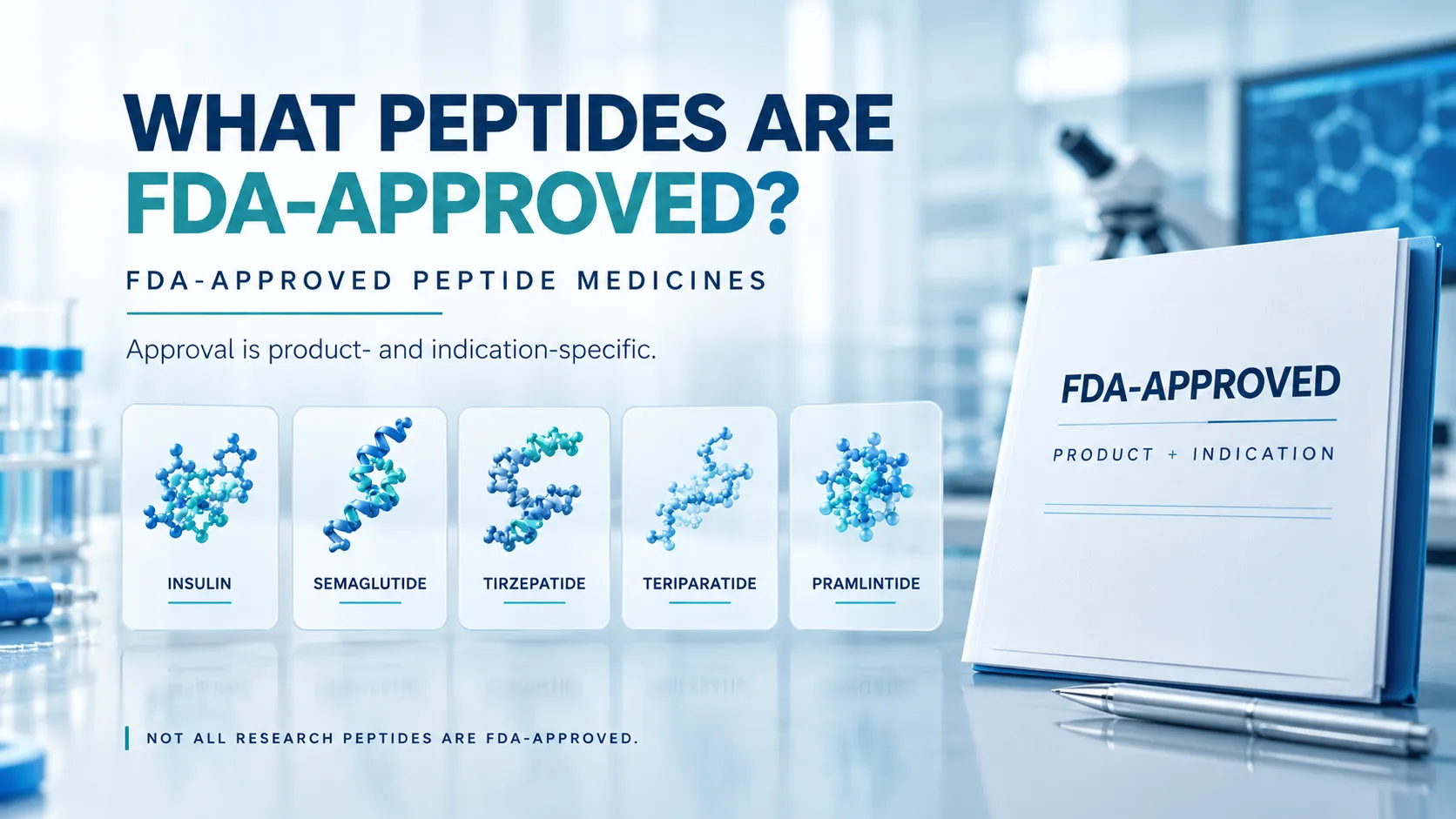
Approval is a narrow thing, and the narrowness is the whole point. When the FDA approves a peptide, it has reviewed safety and efficacy data for one product, from one manufacturer, for one labeled use. A chemical carrying the same name and sold for laboratory research has been through none of that. Two vials can hold the same molecule on paper and sit in completely different regulatory worlds. Hold on to that distinction and the rest of this page reads easily.
The short answer
As of September 2026, this page lists 47 FDA-approved peptide drugs, the earliest approved in 1960. The FDA publishes no official total, and the peer-reviewed counts in circulation each cover a different window. That number comes from a peer-reviewed harvest of FDA approvals published in 2026, not from the agency, because the FDA publishes no official total.
None of the peptides sold as research chemicals appear on that list. BPC-157, TB-500, KPV, GHK-Cu, ipamorelin, CJC-1295 and Semax are all unapproved as of September 2026.
Three investigational drugs sit near the line without crossing it. Retatrutide, CagriSema and survodutide are in phase 3 trials, and none of them is approved.
Full tables follow, grouped by therapeutic area. To check any single compound yourself, skip to the verification section near the end, which names the FDA databases that give a straight answer.
Why you'll see three different numbers (14, 34, 80)
The three figures are not competing claims about the same thing. Each one counts something different, and only one of them carries a source you can check.
Take the figure 14 first, which several competitor pages print as though the FDA published it. No agency document backs that number. It is a curated selection, usually the drugs the writer found interesting, presented as a total.
The 34 figure comes from the 2025 FDA TIDES Harvest, a review published in Pharmaceuticals in 2026. It cites 34 FDA peptide approvals between 2016 and 2024, and separately reports the total of approved oligonucleotide therapeutics at 24 since 1998. The 34 figure is quoted from an earlier source rather than counted by the authors. The window is stated, the method is stated, and the paper is indexed.
That leaves 80, a figure traced to a 2022 review in Signal Transduction and Targeted Therapy. The review counted more than 80 peptide drugs on the global market as of February 2022. Global is doing heavy lifting in that sentence. The figure includes products approved outside the United States and products no longer sold. It also counts 33 non-insulin peptide drugs approved worldwide since 2000.
No FDA-published aggregate exists to settle the argument. The agency's December 2023 draft guidance defines a peptide as a molecule of 40 or fewer amino acids regulated as a drug. That guidance states no total anywhere.
So when a site announces 14 FDA-approved peptides, it is showing you a selection. The 34 figure is sourced, dated and defined, but it counts approvals inside a nine-year window rather than everything on the market. It also stops at 2024, so it excludes elamipretide, which the same review reports as a 2025 approval.
Every FDA-approved peptide, grouped by what it treats
The tables below group drugs by therapeutic area. Years give the first US FDA approval of the ingredient, not of every brand that later carried it. A dagger (†) marks a product discontinued in the United States that remains historically approved. Accelerated approvals carry a double dagger (‡).
One thing to notice before you scroll. These tables carry 47 rows, because they count every approved peptide drug rather than approvals inside one window. Thirty-two of those rows fall outside the 2016 to 2024 window the 34 count covers, and fifteen fall inside it. The review also counts more approvals inside that window than this page lists in it. Its authors applied their own definition of a peptide therapeutic. What follows is a fuller historical record. The two measure different things, and neither one is wrong.
Diabetes, weight and metabolic
Peptide (generic) | Brand(s) | First FDA approval | Approved use | Status |
|---|---|---|---|---|
Exenatide | Byetta | 2005 | Adjunct to diet and exercise for glycemic control in adults with type 2 diabetes | Marketed |
Pramlintide | Symlin, SymlinPen | 2005 | Amylin analog, adjunctive treatment in type 1 or type 2 diabetes with mealtime insulin | Marketed |
Liraglutide | Victoza (2010), Saxenda (2014) | 2010 | Victoza, type 2 diabetes glycemic control including patients 10 and older, plus MACE risk reduction in established CVD. Saxenda, chronic weight management | Marketed |
Dulaglutide | Trulicity | 2014 | Type 2 diabetes glycemic control in adults and patients 10 and older, plus MACE risk reduction | Marketed |
Lixisenatide | Adlyxin | 2016 | GLP-1 receptor agonist adjunct for type 2 diabetes glycemic control | † Discontinued in the US as of January 1, 2023 |
Semaglutide | Ozempic (2017), Rybelsus (2019), Wegovy (2021) | 2017 | Ozempic, type 2 diabetes glycemic control, MACE reduction, kidney and CV outcomes in T2D with CKD. Rybelsus, oral, type 2 diabetes glycemic control. Wegovy, chronic weight management, MACE reduction in established CVD with overweight or obesity, and noncirrhotic MASH | Marketed |
Setmelanotide | Imcivree | 2020 | Chronic weight management in POMC, PCSK1 or LEPR deficiency, Bardet-Biedl syndrome, and acquired hypothalamic obesity | Marketed |
Tirzepatide | Mounjaro (2022), Zepbound (2023) | 2022 | Mounjaro, type 2 diabetes glycemic control and MACE reduction. Zepbound, chronic weight management and moderate-to-severe obstructive sleep apnea in adults with obesity | Marketed |
Bone, growth and hormone
Peptide (generic) | Brand(s) | First FDA approval | Approved use | Status |
|---|---|---|---|---|
Calcitonin-salmon | Miacalcin | 1975 | Paget's disease, hypercalcemia, postmenopausal osteoporosis when alternatives are unsuitable | Brand nasal sprays discontinued, injectable generics marketed |
Somatropin | Genotropin | 1995 | Pediatric growth failure (GHD, Prader-Willi, ISS, SGA, Turner) and adult GH deficiency replacement | Marketed |
Teriparatide | Forteo | 2002 | Postmenopausal osteoporosis at high fracture risk, bone mass in men with osteoporosis, glucocorticoid-induced osteoporosis | Marketed |
Mecasermin | Increlex | 2005 | Growth failure in children with severe primary IGF-1 deficiency | Marketed |
Tesamorelin | Egrifta, Egrifta SV, Egrifta WR | 2010 | Reduction of excess abdominal fat in HIV-infected adults with lipodystrophy, not indicated for weight-loss management | Marketed |
Abaloparatide | Tymlos | 2017 | Postmenopausal osteoporosis at high fracture risk, bone density in men with osteoporosis, glucocorticoid-induced osteoporosis | Marketed |
Palopegteriparatide | Yorvipath | August 9, 2024 | Hypoparathyroidism in adults | Marketed |
Cancer and neuroendocrine
Peptide (generic) | Brand(s) | First FDA approval | Approved use | Status |
|---|---|---|---|---|
Leuprolide | Lupron, Lupron Depot | 1985 | Advanced prostate cancer, endometriosis, uterine leiomyomata, central precocious puberty | Marketed |
Octreotide | Sandostatin, Sandostatin LAR | 1988 | Acromegaly, diarrhea and flushing in metastatic carcinoid tumors, VIPomas | Marketed |
Goserelin | Zoladex | 1989 | Prostate cancer, endometriosis, endometrial thinning before ablation, advanced breast cancer in pre and perimenopausal patients | Marketed |
Bortezomib | Velcade | 2003 | Relapsed and refractory multiple myeloma | Marketed |
Lanreotide | Somatuline Depot | 2007 | Acromegaly, unresectable or metastatic GEP-NETs, carcinoid syndrome | Marketed |
Degarelix | Firmagon | 2008 | Advanced prostate cancer | Marketed |
Carfilzomib | Kyprolis | 2012 ‡ | Relapsed or refractory multiple myeloma | Marketed, accelerated approval |
Lutetium Lu 177 dotatate | Lutathera | 2018 | SSTR-positive gastroenteropancreatic neuroendocrine tumors in adults | Marketed |
Pegulicianine | Lumisight | April 17, 2024 | Imaging drug to help detect cancerous tissue during breast lumpectomy | Marketed |
Heart, blood and clotting
Peptide (generic) | Brand(s) | First FDA approval | Approved use | Status |
|---|---|---|---|---|
Eptifibatide | Integrilin | 1998 | Preventing blood clots in acute coronary syndrome and percutaneous coronary intervention | Marketed |
Bivalirudin | Angiomax | 2000 | Anticoagulant during coronary angioplasty | Marketed |
Nesiritide | Natrecor | 2001 | Acutely decompensated congestive heart failure with dyspnea at rest | † Discontinued in the US |
Icatibant | Firazyr | 2011 | Acute attacks of hereditary angioedema in adults | Marketed |
Vasopressin | Vasostrict | 2014 | Raising blood pressure in vasodilatory shock refractory to fluids and catecholamines, the first FDA-approved vasopressin product | Marketed |
Terlipressin | Terlivaz | 2022 | Improving kidney function in hepatorenal syndrome with rapid decline | Marketed |
Reproductive and fertility
Peptide (generic) | Brand(s) | First FDA approval | Approved use | Status |
|---|---|---|---|---|
Desmopressin | DDAVP | 1978 | Central diabetes insipidus, hemophilia A and type I von Willebrand's disease with factor VIII above 5% | Marketed |
Oxytocin | Pitocin | 1980 | Labor induction and augmentation, postpartum uterine contraction and bleeding control | Marketed |
Ganirelix | Antagon | 1999 | Inhibiting premature LH surges in controlled ovarian hyperstimulation | Marketed |
Cetrorelix | Cetrotide | 2000 | Inhibiting premature LH surges in controlled ovarian hyperstimulation | Marketed |
Choriogonadotropin alfa | Ovidrel | 2000 | Final follicular maturation and early luteinization in assisted reproduction | Marketed |
Bremelanotide | Vyleesi | 2019 | Acquired, generalized hypoactive sexual desire disorder in premenopausal women | Marketed |
Gut
Peptide (generic) | Brand(s) | First FDA approval | Approved use | Status |
|---|---|---|---|---|
Linaclotide | Linzess | 2012 | IBS with constipation, chronic idiopathic constipation, functional constipation in patients 2 and older | Marketed |
Teduglutide | Gattex | 2012 | Short bowel syndrome | Marketed |
Plecanatide | Trulance | 2017 | Chronic idiopathic constipation and IBS with constipation in adults | Marketed |
Rare disease, infection and other
Peptide (generic) | Brand(s) | First FDA approval | Approved use | Status |
|---|---|---|---|---|
Glucagon | Rescue kits including Baqsimi (2019) and Gvoke (2019) | 1960 | Severe hypoglycemia rescue | Marketed |
Daptomycin | Cubicin | 2003 | Complicated skin and skin structure infections caused by Gram-positive organisms | Marketed |
Enfuvirtide | Fuzeon | 2003 | HIV fusion inhibitor for treatment-experienced HIV-1 | † Discontinued in the US |
Afamelanotide | Scenesse | 2019 | Increasing pain-free light exposure in erythropoietic protoporphyria | Marketed |
Dasiglucagon | Zegalogue | 2021 | Severe hypoglycemia in diabetes patients aged 6 and older | Marketed |
Difelikefalin | Korsuva | 2021 | Moderate-to-severe CKD-associated pruritus in adults on hemodialysis | Marketed |
Levacetylleucine | Aqneursa | September 24, 2024 | Neurological symptoms of Niemann-Pick disease type C | Marketed |
Elamipretide | Forzinity | September 19, 2025 ‡ | First treatment for Barth syndrome in patients 30 kg and above | Marketed, accelerated approval with a confirmatory trial required |
Read the years down the first table and a pattern shows itself. Metabolic peptides dominate the recent record, with semaglutide and tirzepatide each collecting new labeled uses after their first approval rather than staying put.
Older approvals cluster somewhere else entirely. Endocrinology, oncology and critical care account for most of what came before 2010. A page built only around weight-loss peptides therefore misses most of the field.
Three entries in those tables carry daggers. Fuzeon, Natrecor and Adlyxin were approved, sold, and then pulled from the US market by their manufacturers. They stay on this list because historical approval is a fact that does not expire. Their absence from pharmacy shelves also confuses people who find them on older lists.
The four newest approvals (2024-2025)
Four peptide drugs reached approval in the last two years, and most competing lists predate all four.
Pegulicianine (Lumisight) was approved on April 17, 2024. Surgeons use it as an imaging drug during breast lumpectomy, where it helps detect cancerous tissue.
Palopegteriparatide (Yorvipath) followed on August 9, 2024, for hypoparathyroidism in adults. Levacetylleucine (Aqneursa) arrived on September 24, 2024, for the neurological symptoms of Niemann-Pick disease type C.
Elamipretide (Forzinity) is the interesting one. On September 19, 2025, the FDA granted it accelerated approval as the first treatment for Barth syndrome. Accelerated approval is not the same as full approval. The agency granted it on knee-muscle strength data judged reasonably likely to predict clinical benefit, and a confirmatory trial is required. If that trial fails, the approval can be withdrawn.
Why single out a two-year window? Most FDA-approved peptide lists in this niche were written before these four existed. None of them will tell you that one of the four sits on a conditional footing.
Popular peptides that are not FDA-approved
A peptide being sold online, argued about on forums, or recommended by a committee is not the same as a peptide being FDA-approved. The compounds below are the ones people ask about most, and every one of them gets the same verdict.
BPC-157 is a synthetic peptide related to a sequence found in gastric juice. Not FDA-approved. TB-500, a fragment of the protein thymosin beta-4, is not FDA-approved either. KPV, a three-amino-acid fragment, is not FDA-approved.
Six of these compounds share a specific 2026 wrinkle. In July 2026, the FDA's Pharmacy Compounding Advisory Committee voted to recommend BPC-157, KPV, TB-500, MOTS-c, Semax and Epitalon for the 503A bulks list. A recommendation from that committee is advisory only. None of the six appears on the codified list at 21 CFR 216.23, and none is FDA-approved as of September 2026. Emideltide, also called DSIP, was reviewed and not recommended. Our breakdown of the July 2026 PCAC vote covers the tallies and what they do and do not change.
GHK-Cu, a copper-binding tripeptide complex, follows a different path and reaches the same destination. Its non-injectable form returned to Category 1 in May 2026, and the injectable nomination was withdrawn. Category 1 is a compounding category, not an approval.
Ipamorelin and CJC-1295 are both growth hormone secretagogue compounds, and neither is FDA-approved. Semax, MOTS-c and Epitalon are not approved either.
Research peptides are sold for laboratory research use only and are not for human use. A research-use label on a vial is not a drug approval. An approval held by a drug of the same name does not extend to it.
One closing point matters more than the list itself. Not approved does not mean proven dangerous, and it does not mean safe. It means the FDA has not reviewed the compound as a drug, so nobody has weighed its safety and efficacy data in that formal way. Enforcement activity has picked up around this gap, which our September 2026 peptide crackdown explainer walks through.
Sermorelin was approved once and has been gone since 2009
Sermorelin is the trickiest entry on any FDA-approved peptide list, which is why it gets a section instead of a table row.
The approval history here is entirely real. On December 28, 1990, the FDA approved NDA 19-863 for Geref at 0.05 mg per ampule. That product was a diagnostic for assessing pituitary growth hormone secretion. A second approval followed on September 26, 1997, when NDA 20-443 covered Geref at 0.5 and 1.0 mg per vial. Its labeled use was idiopathic growth hormone deficiency in children with growth failure. EMD Serono was the sponsor of both applications.
Then the company walked away from both. It discontinued the 0.05 mg product on July 11, 2008, and the vials on December 2, 2008. Withdrawal of both NDAs was requested that same December. The FDA's withdrawal of both approvals took effect on June 18, 2009.
A 2013 notice muddies things for people who find it out of context. On March 4, 2013, the Federal Register published a determination that Geref was not withdrawn for safety or effectiveness reasons. In plain terms, that ruling lets the FDA approve future generic copies referencing Geref. It did not put any sermorelin product back on the market, and no generic followed.
Current status as of September 2026 is unambiguous. Both NDAs show a marketing status of Discontinued in openFDA data, and DailyMed returns zero current labels for sermorelin. No FDA-approved sermorelin product is marketed in the United States.
Calling sermorelin FDA-approved without that qualification misleads the reader. The drug was genuinely approved once. It is not available, and it has not been for well over a decade.
Retatrutide, CagriSema and survodutide are still in trials
Three metabolic peptides get asked about as though approval already happened. None of the three is approved as of September 2026.
Retatrutide is Eli Lilly's once-weekly triple agonist, hitting GIP, GLP-1 and glucagon receptors. It is running through the phase 3 TRIUMPH program, and TRIUMPH-2 results were presented on September 29, 2026. No application has been filed with the FDA. Lilly plans a submission in the first quarter of 2027. The company describes retatrutide in its own materials as an investigational molecule that cannot be legally sold or marketed for human use.
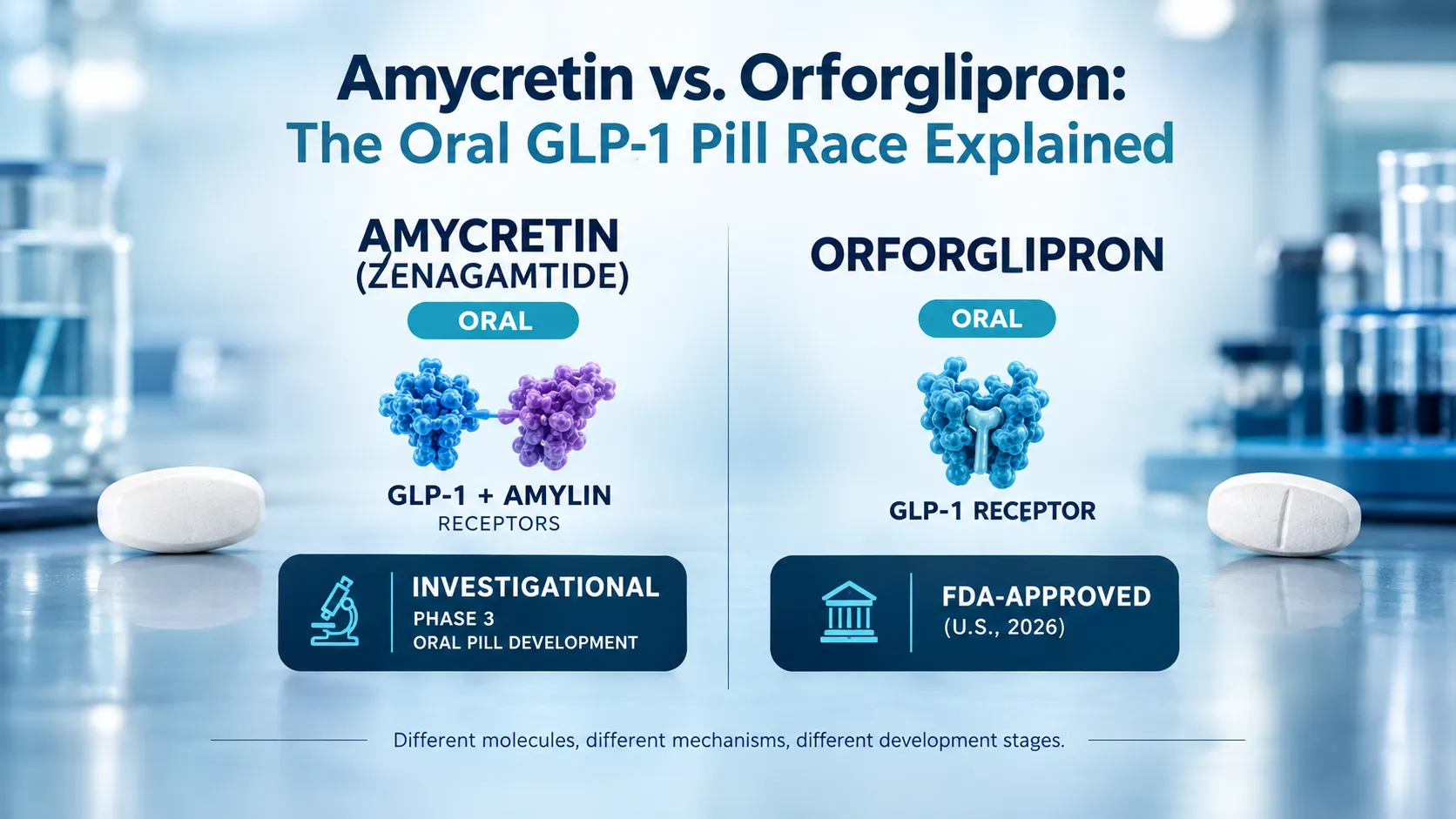
CagriSema pairs cagrilintide, an amylin agonist, with semaglutide in one once-weekly injection from Novo Nordisk. The phase 3 REDEFINE and REIMAGINE programs cover obesity and type 2 diabetes. Novo Nordisk calls the combination investigational. The company submitted an application for weight management in December 2025, and an FDA decision is expected in the fourth quarter of 2026. No decision had been announced as of September 30, 2026.
Survodutide is a once-weekly glucagon and GLP-1 dual agonist from Boehringer Ingelheim, licensed from Zealand Pharma, now in the phase 3 SYNCHRONIZE program. It holds FDA Fast Track designation from 2021 and Breakthrough Therapy designation from September 2024 for MASH. Neither of those designations is an approval. Designations speed up review and communication, and they permit no marketing at all.
Pipeline drugs are where the next approvals come from, and a CagriSema decision could land within months of this page going live. That is exactly why the date at the top matters.
What changed in 2026
Three developments this year tightened the line between approved drugs and everything else.
On July 23 and 24, 2026, the Pharmacy Compounding Advisory Committee voted to recommend six peptides for the 503A bulks list. Those six were BPC-157, KPV, TB-500, MOTS-c, Semax and Epitalon, while emideltide was not recommended. FDA staff had recommended against all seven before the vote. As of September 22, 2026, none had been added to the codified list at 21 CFR 216.23. None was FDA-approved, and no proposed rule had appeared.
April brought a quieter change with a confusing name. The FDA moved several nominated peptides out of the Category 2 table and into a withdrawn-nominations table after the nominators pulled their submissions. Sitting in a withdrawn-nominations table is not the same as sitting in Category 1, though the two get conflated constantly. Our Category 2 and Category 1 reclassification explainer sorts out which peptide moved where.
GLP-1 compounding changed on a separate track. The tirzepatide shortage was resolved on October 2, 2024, and the semaglutide shortage on February 21, 2025. Those resolutions removed the legal basis for compounding copies of either one. Deadlines for 503A and 503B facilities to stop passed during the first half of 2025.
Each of those developments pushed in the same direction. The gap between an approved drug and an unapproved compound got harder to blur in 2026. A list of only approved drugs becomes worth keeping at exactly that moment.
Approved, compounded, investigational and research-use are four different things
Most confusion about FDA-approved peptides comes from collapsing four categories into two. Here is what separates the four.
An approved drug has been through FDA review of safety and efficacy data for a specific product and a specific labeled use. Every drug in the tables above sits here.
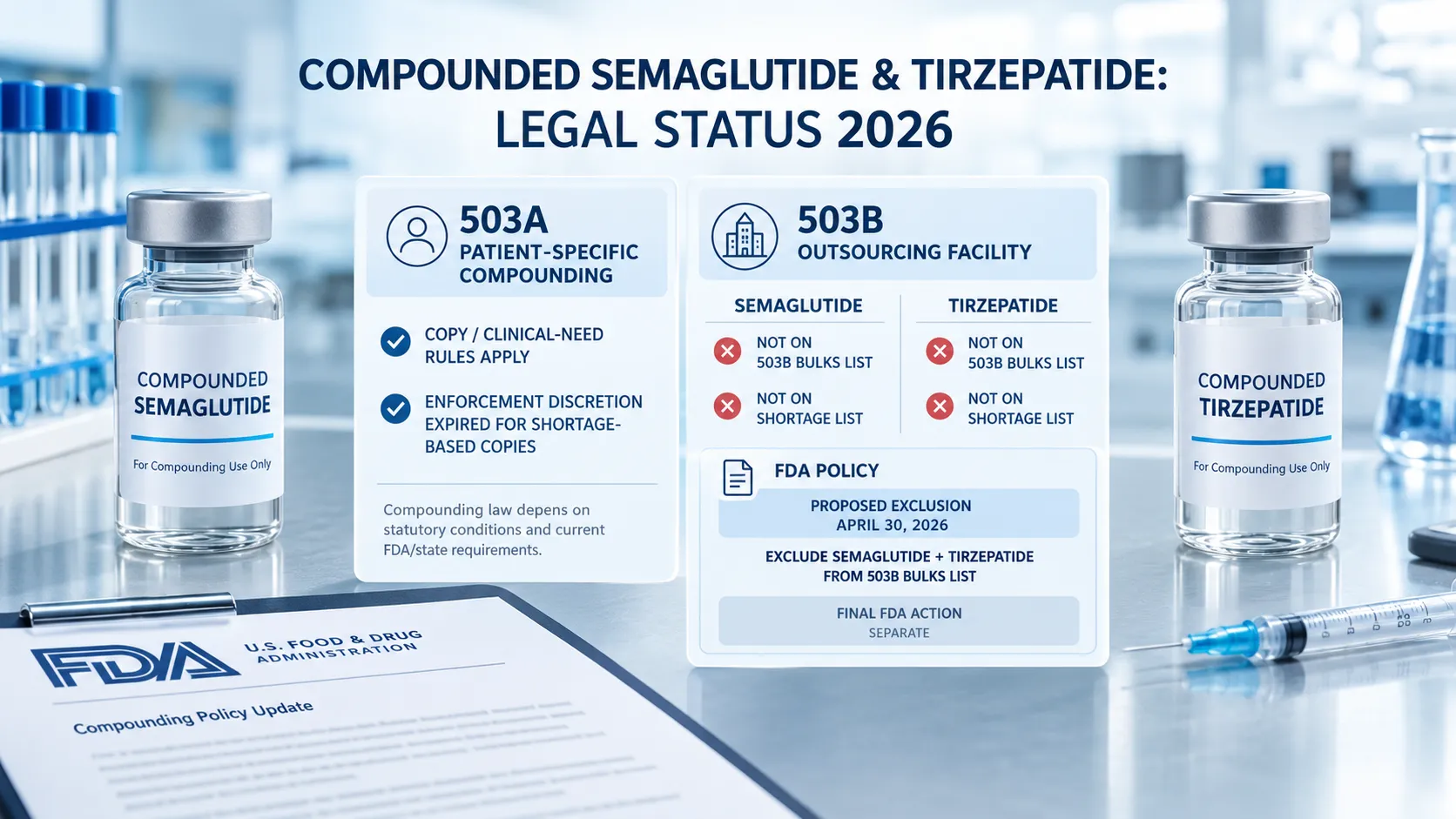
A compounded drug is prepared for an individual patient by a 503A pharmacy, or in batches by a 503B outsourcing facility. Those rules do not include premarket approval. Compounded drugs are not FDA-approved, even when they copy the active ingredient of a drug that is. Semaglutide and tirzepatide copies are the clearest recent case, and our guide to their current legal status explains what changed once the shortages ended.
An investigational drug is in clinical trials. Retatrutide, CagriSema and survodutide are the examples on this page, and none of them can be legally sold or marketed for human use.
A research-use-only chemical is sold for laboratory work and is not for human use. The RUO label does not make a compound a drug. An approval held by a drug with the same name never reaches across to it. Our overview of RUO compliance in the United States covers where that line sits.
The practical rule here is a short one. Match the claim to the bucket. A committee vote, a Category 1 listing, or a positive trial result never moves a peptide into the approved bucket.
How to verify any peptide's status yourself
Four public databases answer this question without any interpretation from a vendor or a blog.
Drugs@FDA holds the full approval history. Search the ingredient name, then read the approval dates and the marketing status attached to each application.
DailyMed holds the current product labels. A current label means a marketed product exists. Zero labels, which is what sermorelin returns today, means nothing is currently marketed under that ingredient.
The Orange Book's Discontinued Drug Product List captures the middle case, showing drugs that were approved and are no longer sold.
Withdrawal determinations and notices tied to advisory committee activity appear in the Federal Register, including the PCAC material discussed above.
One caution applies across all four. A discontinued listing proves historical approval and nothing about current availability. An active listing proves a marketed product exists, not that a given seller's version is that product.
The bottom line
Three numbers circulate for FDA-approved peptides, and only one of them carries a checkable definition. This page uses its own table as the list, and cites 34 only as a sourced count of approvals in one window. The tables use a wider standard and reach back to 1960.
None of the peptides sold as research chemicals appears on either list. BPC-157, TB-500, KPV, GHK-Cu, ipamorelin, CJC-1295, Semax, MOTS-c and Epitalon are all unapproved as of September 2026, whatever a committee recommended in July.
Check the date at the top before relying on any of this. A CagriSema decision is expected in the fourth quarter of 2026, and one approval would change both the tables and the pipeline section.
---
Frequently Asked Questions
The FDA publishes no official total, and this page lists 47 approved peptide drugs, the earliest from 1960. A peer-reviewed 2026 review counts 34 peptide approvals between 2016 and 2024. That nine-year window excludes older approvals such as desmopressin in 1978 and oxytocin in 1980.
No, only a small set of peptide drugs has been through FDA review of safety and efficacy data for a specific product and labeled use. The peptides sold as research chemicals are not approved, and neither are compounded preparations or drugs still in clinical trials. Approval attaches to a product, not to a molecule.
No, BPC-157 is not FDA-approved as of September 2026. The FDA's Pharmacy Compounding Advisory Committee recommended it for the 503A bulks list in July 2026, but that recommendation is advisory only. BPC-157 does not appear on the codified list at 21 CFR 216.23, and no proposed rule has been published.
No, TB-500, a fragment of thymosin beta-4, is not FDA-approved as of September 2026. It received the same advisory recommendation as BPC-157 at the July 2026 Pharmacy Compounding Advisory Committee meeting. That vote does not approve a drug, and TB-500 is absent from the codified 503A bulks list at 21 CFR 216.23.
No, KPV is not FDA-approved as of September 2026. The Pharmacy Compounding Advisory Committee recommended it for the 503A bulks list in July 2026, alongside BPC-157 and TB-500. A recommendation from that committee is advisory, and KPV does not appear on the codified list at 21 CFR 216.23.
No, GHK-Cu is not FDA-approved as of September 2026. Its non-injectable form returned to Category 1 in May 2026, and the injectable nomination was withdrawn. Category 1 is a compounding category describing which bulk substances a pharmacy may use, and it is not an approval of any product.
No, CJC-1295 is not FDA-approved as of September 2026, in any form. It was not among the peptides the Pharmacy Compounding Advisory Committee recommended in July 2026. No FDA review of safety and efficacy data has approved a CJC-1295 product for any labeled use in the United States.
No, ipamorelin is not FDA-approved as of September 2026. It appears on no FDA approval list, and it was not among the peptides recommended by the Pharmacy Compounding Advisory Committee in July 2026. Being widely sold and widely discussed carries no regulatory weight of any kind.
Sermorelin was approved once and is not approved now, which makes it the trickiest entry on any such list. The FDA approved it as Geref in December 1990 and again in September 1997, then withdrew both approvals effective June 18, 2009, after EMD Serono discontinued the products. As of September 2026, DailyMed lists zero current sermorelin labels.
Yes, tesamorelin was approved in 2010 and is marketed as Egrifta, Egrifta SV and Egrifta WR. Its labeled use is reduction of excess abdominal fat in HIV-infected adults with lipodystrophy. The label does not cover general weight-loss management, which is a common misreading of what this approval actually says.
No, retatrutide is an investigational Eli Lilly molecule in the phase 3 TRIUMPH program as of September 2026, and no application has been filed with the FDA. Lilly states that retatrutide cannot be legally sold or marketed for human use. Phase 3 results, including TRIUMPH-2, do not change that status.
No approval date exists, because no application has been submitted to the FDA. Eli Lilly has said it plans to file in the first quarter of 2027, which is a company plan rather than a filing. FDA review would follow submission and take additional time, so nothing about approval is certain as of September 2026.
- 01AlShaer D, et al. 2025 FDA TIDES Harvest. Pharmaceuticals. 2026;19(2):244. PMID 41754785.
- 02Wang L, et al. Therapeutic peptides, current applications and future directions. Signal Transduction and Targeted Therapy. 2022;7:48. PMID 35165272.
- 03FDA draft guidance, Clinical Pharmacology Considerations for Peptide Drug Products, December 2023.
- 04FDA Recently Approved Devices page, Lumicell Direct Visualization System (DVS), P230014. Approved April 17, 2024.
- 05FDA Drug Trials Snapshot, Yorvipath (palopegteriparatide). Approved August 9, 2024.
- 06FDA press release, FDA Approves New Drug to Treat Niemann-Pick Disease, Type C, September 24, 2024.
- 07Stealth BioTherapeutics press release, September 19, 2025. FDA accelerated approval of Forzinity (elamipretide HCl), the first therapy for Barth syndrome.
- 08Federal Register 78 FR 14095, March 4, 2013. Determination that Geref was not withdrawn for safety or effectiveness reasons.
- 09Federal Register 74 FR 23407, May 19, 2009. Withdrawal of approval of Geref NDAs, effective June 18, 2009.
- 10DailyMed, US National Library of Medicine. Current product labeling, accessed September 30, 2026.
- 11Drugs@FDA and the openFDA drug application dataset, updated September 29, 2026.
- 12Pharmacally, reporting Eli Lilly's September 29, 2026 TRIUMPH-2 announcement. Retatrutide remains investigational and cannot currently be legally sold or marketed for human use; Lilly plans a BLA submission in Q1 2027.
- 13PharmaShots, reporting Novo Nordisk's December 2025 press release. CagriSema NDA submitted to FDA for weight management; FDA decision expected Q4 2026.
- 14Reuters, April 28, 2026, reporting Boehringer Ingelheim's SYNCHRONIZE-1 Phase III results. Up to 16.6% weight loss at 76 weeks; Fast Track (2021) and Breakthrough (2024) designations are not approvals.
Helix Bio Chem Team
Research & Product Team
Our in-house team tracks published peptide research and translates it into clear, source-cited summaries for the research community.
Reviewed by in-house research chemists
support@helixbiochem.com