FDA Peptide Reclassification 2026: What Actually Changed
Recovery protocolsSeptember 17, 202612 min read
No FDA record shows peptides moving from Category 2 to Category 1 in 2026. Here is the verified sequence of events and what each step did and did not do.
No FDA document records any peptide moving from Category 2 into Category 1 during 2026.
On 27 February 2026, HHS Secretary Robert F. Kennedy Jr. stated that roughly 14 of 19 Category 2 peptides would return to Category 1, but no implementing FDA or HHS record was published.
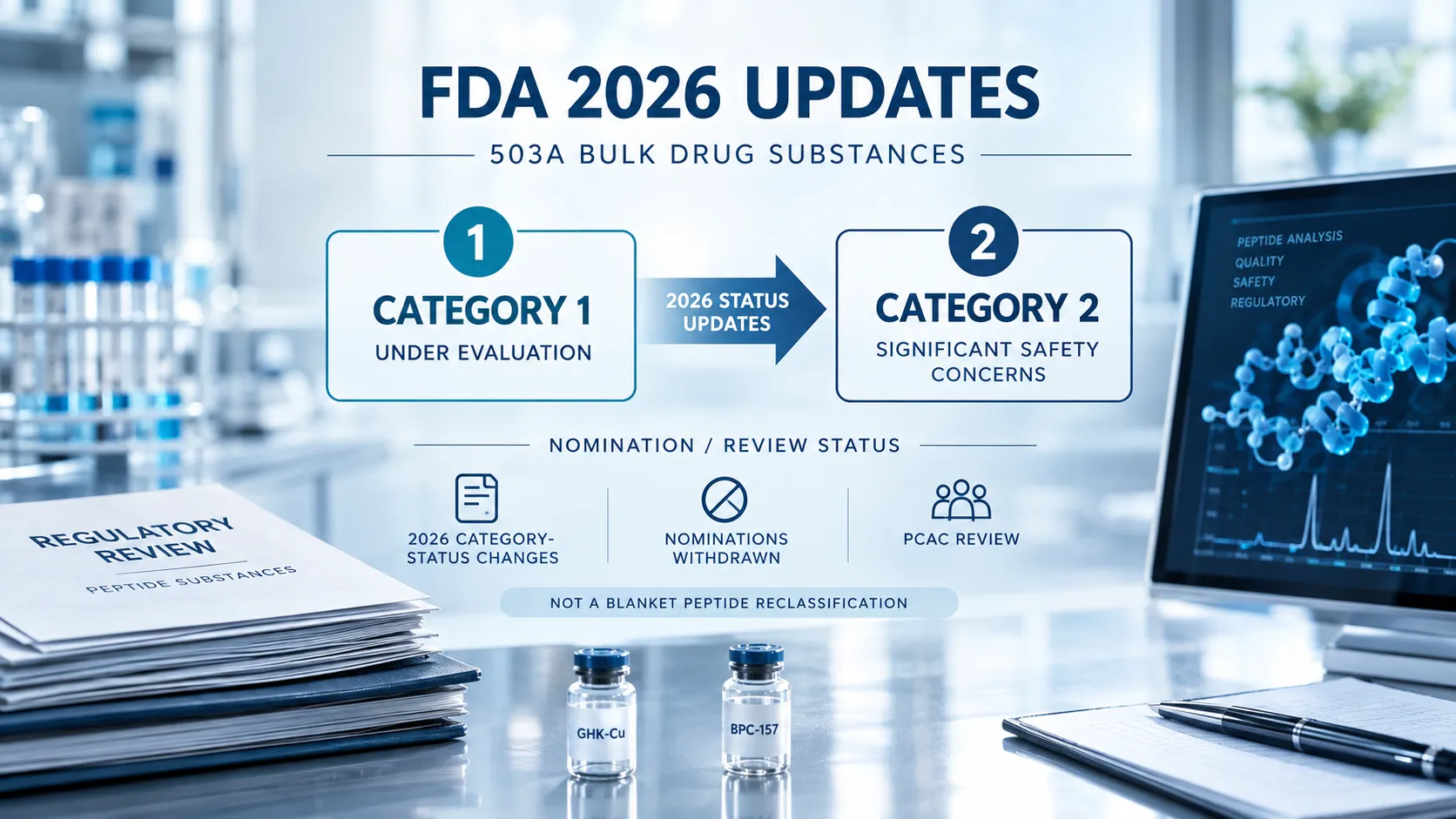
In April 2026, peptide nominations were withdrawn by their nominators and moved to a separate withdrawn-nominations table, which is outside the Category 1 enforcement policy rather than inside it.
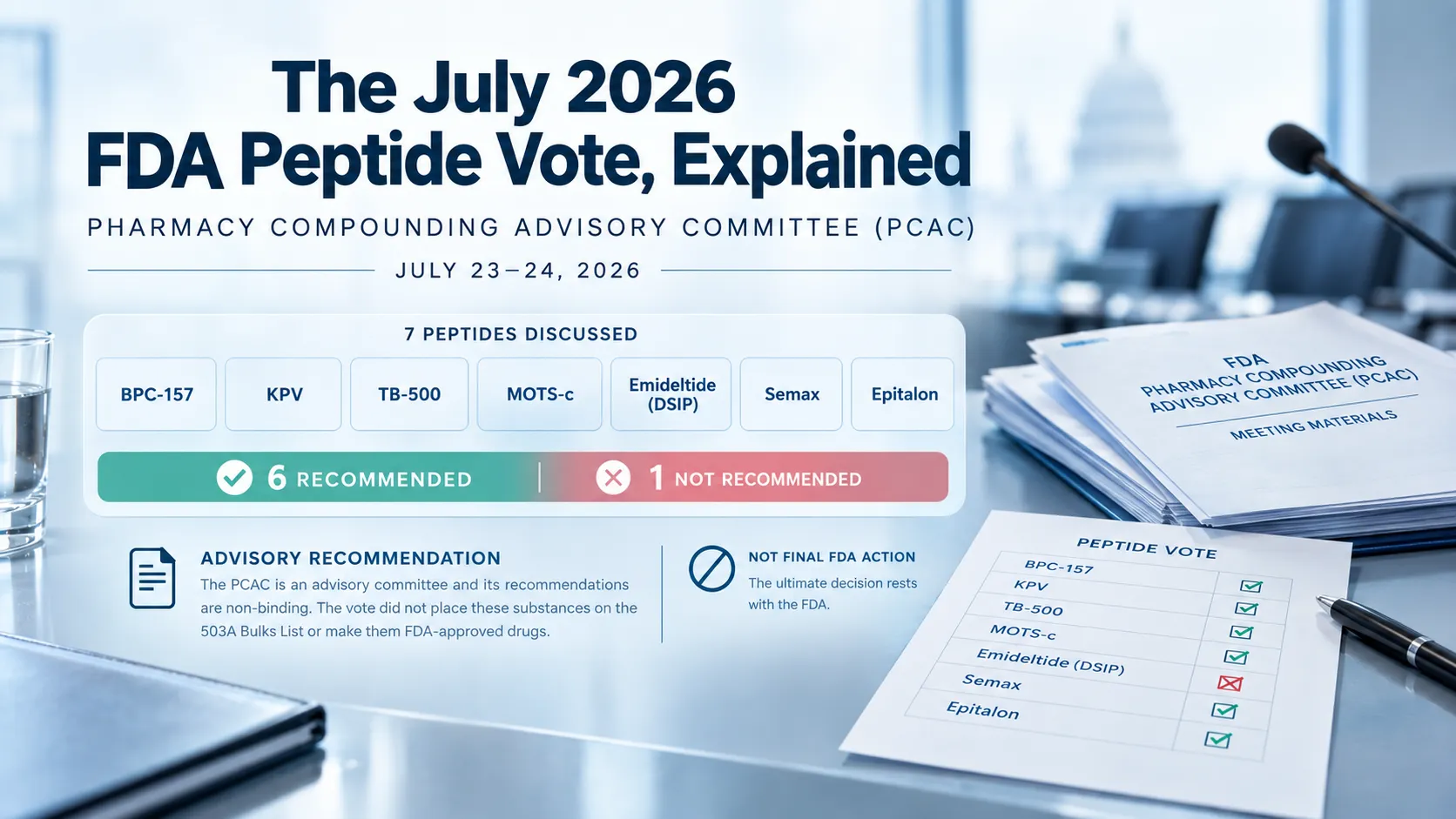
FDA's Pharmacy Compounding Advisory Committee met 23 and 24 July 2026 and recommended six of seven peptide groups for the 503A Bulks List, voting against emideltide.
FDA's own briefing materials had proposed that none of the fourteen reviewed free-base and acetate forms be added, so the committee reached the opposite conclusion from agency reviewers.
An advisory committee recommendation is not a rule; adding a substance to the 503A Bulks List requires notice-and-comment rulemaking, and no proposed rule had published as of 17 September 2026.
GHRP-2, GHRP-6 and ipamorelin acetate remain in 503B Category 2, kisspeptin-10 in 503A Category 2, and ibutamoren mesylate in both.
A substance's 503A position does not determine its 503B position, because the two sections apply different eligibility tests.
FDA has stated it does not intend to place substances nominated on or after 7 January 2025 into Categories 1, 2 or 3.
Category 3 reflects insufficient information to evaluate a nomination, not an identified safety risk, and is not a milder form of Category 2.
On 27 February 2026, HHS Secretary Robert F. Kennedy Jr. said in a podcast interview (The Joe Rogan Experience, episode 2461) that roughly 14 of 19 peptides on the FDA's Category 2 list would move back to Category 1. That statement is real and traceable to that interview and to contemporaneous reporting of it, rather than to any FDA document. What followed in the FDA's own records was something different, and the gap between the two explains almost every confused headline since.
This page tracks the regulatory sequence only. It does not cover what any of these compounds do, how they are made, or what the research shows. Those questions belong to the science pages linked throughout.
Where the record actually stands right now
Status: advisory recommendation issued, no rule proposed. Verified against FDA's own pages as published on 17 September 2026.
Three separate things happened in 2026, and the internet keeps compressing them into one. In April, a group of peptide nominations was withdrawn by the people who filed them, and FDA moved those substances off the Category 2 table into a separate list of withdrawn nominations. In July, an FDA advisory committee voted on whether seven of those peptide groups should go on the formal 503A Bulks List. And since July, nothing has been finalised.
No FDA document states that any peptide moved from Category 2 into Category 1 during 2026.
What each 2026 event did and did not do
2026 event
What the record shows
What it means
What it does NOT mean
April 2026 Category 2 removals
Nominations withdrawn by nominators; substances moved to a separate withdrawn-nominations table
The nomination is no longer active in the ordinary evaluation pathway
Not Category 1 placement, not a safety finding, not permission to compound
July 2026 PCAC votes
Committee recommended six of seven peptide groups for the 503A Bulks List
Formal advisory input is now on the record
Not FDA approval, not a rule, not a change to what pharmacies may prepare
FDA staff position
FDA proposed that none of the fourteen reviewed forms be added
The agency's reviewers reached the opposite conclusion from its own committee
Not a ban, and not a final agency determination either
Formal 503A Bulks List
No peptide from this review has been added
The list still stands as published in regulation
An advisory vote does not edit the list
FDA drug approval
No approval exists for any of these substances
These remain unapproved bulk substances
Bulks List eligibility is a separate question from approval entirely
The three categories, and what they are for
FDA's interim policy sorts nominated bulk drug substances into three buckets while it works through them. The categories are an enforcement posture, not a verdict.
Category 1 covers substances nominated with enough supporting information for FDA to evaluate, that do not appear on another relevant list. For these, FDA has said it does not intend to act against a compounder, provided the conditions in the guidance are met. That conditional phrasing is the whole point. Category 1 is a statement about what FDA intends to do, not a finding that a substance is safe or effective.
Category 2 covers substances FDA could evaluate but where it identified significant safety risks pending further work. FDA has said it would consider action against a compounder using these under its general enforcement policies. That is materially more restrictive than Category 1, and it is still not a statutory ban.
Category 3 is the one most readers skip. These substances were nominated with insufficient supporting information for FDA to evaluate them at all. Category 3 is a paperwork finding, not a safety finding, and a substance can be re-nominated with better support. Treating Category 3 as a milder Category 2 gets the meaning backwards.
One detail reshapes all of this. FDA's guidance states it does not intend to place substances nominated on or after 7 January 2025 into any of these categories. The three-category framework is a closing chapter, not a permanent classification system, which is why reading current peptide status through it produces odd answers.
Removal from Category 2 and placement into Category 1 are different events with different causes. A nomination can leave Category 2 simply because the nominator withdrew it. FDA's current page lists those substances under a heading that says exactly that: nominated but withdrawn.
Why "Category 2 to Category 1" is the wrong description
The February statement described an intended outcome. The April action produced a different one.
When a nominator withdraws a nomination, the substance stops moving through the evaluation pathway. It does not advance to the next stage of it. FDA's safety-risk page, current as of 22 April 2026, separates two tables: substances still in Category 2, and substances previously in Category 2 whose nominations were withdrawn. BPC-157, TB-500, KPV, MOTS-c, Semax, Epitalon, emideltide (DSIP), injectable GHK-Cu, AOD-9604, CJC-1295, cathelicidin LL-37, Melanotan II, PEG-MGF, selank acetate, thymosin alpha-1 and dihexa acetate appear in the withdrawn table.
The withdrawn table is not Category 1. It is not a category at all. A substance sitting there is outside the Category 1 enforcement policy rather than inside it, which is close to the opposite of what the popular framing claims.
What also did not happen: no primary FDA or HHS document has been published confirming that approximately 14 of 19 peptides were reclassified from Category 2 to Category 1 in February 2026. The statement was made. The implementing record was not.
Substances that stayed in Category 2
This is where the "14 of 19" framing breaks most visibly. Several peptides never left. FDA's current Category 2 table still lists them, and it lists them under specific pathways and routes.
Substance
Category 2 under
Added
Note on scope
GHRP-2
503B
29 Sep 2023
Listed for injectable and nasal routes specifically
GHRP-6
503B
29 Sep 2023
Route-qualified in FDA's stated concern
Ipamorelin acetate
503B
29 Sep 2023
Also appears in the withdrawn table for the 503A side
Kisspeptin-10
503A
29 Sep 2023
503A only
Ibutamoren mesylate
Read that table slowly. Ipamorelin acetate is in two places at once for two different reasons. Kisspeptin-10 is 503A. GHRP-2 and GHRP-6 are 503B. There is no single "FDA peptide status" to look up, which is why any article offering one is guessing.
Where the 2023 starting point came from
The number that anchors every version of this story is 19, but it comes from Secretary Kennedy's own characterisation rather than from any FDA publication: FDA's current withdrawn-nominations table lists seventeen substances and carries no dates at all. What FDA did publish was a set of actions in September 2023, when it identified potential significant safety risks for a group of nominated bulk substances and placed them in Category 2. The dates in FDA's current table bear that out: most of the peptide entries still listed carry 29 September 2023, with ibutamoren mesylate's 503B entry dated earlier, on 29 December 2022.
What FDA wrote at the time is worth reading precisely, because it is consistently paraphrased into something stronger. The recurring language is that compounded drugs containing a given substance may pose a risk for immunogenicity for certain routes of administration, and that FDA had identified no or only limited safety information for the proposed routes, so the agency lacked sufficient information to know whether the drug would cause harm. That is a statement about missing information. It is not a finding that a substance is dangerous, and the difference matters when the same sentence gets recycled as "FDA banned it."
The route qualifier appears throughout and is routinely dropped. FDA's GHRP-2 entry names injectable and nasal administration specifically. Its GHK-Cu entry is scoped to injectable routes. A status claim that omits the route is not reporting the record accurately.
State pharmacy law is a separate gate
Even a completed federal rulemaking would not settle the question on its own. Section 503A compounding is practised under state licensure, and state boards of pharmacy apply their own rules on what may be compounded and under what conditions. Federal eligibility is a necessary condition, not a sufficient one.
This is why blanket statements that a peptide is "legal" or "illegal" in the United States tend to be wrong in both directions. The accurate form of the question names the pathway, the exact chemical form, the route, the federal list or category, and the jurisdiction. Change any one of those and the answer can change with it.
503A and 503B answer different questions
Section 503A covers state-licensed pharmacies and physicians compounding for an identified patient. Section 503B covers FDA-registered outsourcing facilities, which operate under CGMP requirements and a separate bulks list.
Under 503A, a bulk substance qualifies if it complies with an applicable USP or NF monograph, or is a component of an FDA-approved drug, or appears on the 503A Bulks List. None of the seven peptides reviewed in July satisfies the first two routes, which is precisely why the third was the question on the table. Under 503B the test is different again, running through the 503B Bulks List or a drug-shortage connection.
Because the eligibility tests differ, a 503A answer tells you nothing reliable about the 503B position for the same molecule. The five substances in the table above demonstrate that directly.
What the July 2026 committee actually did
The Pharmacy Compounding Advisory Committee met on 23 and 24 July 2026 and voted on seven peptide groups, each considered as two distinct bulk drug substances: a free base and an acetate.
FDA's briefing materials proposed that none of the fourteen forms be added to the 503A Bulks List. The committee disagreed on six of seven. Reported vote outcomes were the same for the free base and the acetate of each substance. FDA has not published minutes or a transcript for this meeting, so the outcomes below come from contemporaneous reporting of the public sessions and the FDA meeting record will supersede them when it publishes.
Substance
FDA-evaluated use
Committee outcome
BPC-157
Ulcerative colitis
Recommended for inclusion
KPV
Wound healing, inflammatory conditions
Recommended for inclusion
TB-500
Wound healing
Recommended for inclusion
MOTS-c
Obesity, osteoporosis
Recommended for inclusion
Epitalon
Insomnia
Recommended for inclusion
Semax
Cerebral ischemia, migraine, trigeminal neuralgia
Recommended for inclusion
Two features of this record get lost in summaries. First, the committee reached a different conclusion from FDA's own reviewers on six consecutive substances, which is unusual and tells you the evidence base is contested rather than settled. Second, FDA evaluated named proposed uses, not the compounds in general. A recommendation tied to ulcerative colitis is not a recommendation for every purpose the market attaches to the same molecule.
The votes were close. Public reporting of the individual tallies varies in detail, so this page does not assert specific numbers. FDA had not published minutes or a transcript for this meeting at the time of writing; when it does, that record supersedes any secondhand tally.
What still has to happen
An advisory committee recommends. It does not legislate, and FDA is not bound by it.
To put a substance on the 503A Bulks List, FDA runs notice-and-comment rulemaking: a proposed rule, a public comment period, review of comments, then a final rule. As of 17 September 2026, no proposed rule covering these six peptides has published. There is no statutory deadline forcing one. The precedent worth knowing is that FDA published a proposed rule on ten other bulk substances in December 2016 and did not finalise until February 2019.
FDA has also indicated a further advisory consultation before the end of February 2027 covering cathelicidin LL-37, injectable GHK-Cu, dihexa acetate, Melanotan II and PEG-MGF.
Research-use-only supply is a separate commercial channel from pharmacy compounding. The 503A Bulks List governs what a licensed pharmacy may compound against a prescription. It does not confer regulatory standing on materials sold for laboratory use, and nothing in the July votes changed that. See our note on [research-use compliance in the United States](/are-research-peptides-legal-usa-ruo-compliance).
What none of this establishes
A Category 2 removal does not establish Category 1 placement, a safety determination, Bulks List inclusion, or authorisation to compound.
A committee recommendation does not establish FDA adoption, a rule, an approval, or lawful compounding in any state.
Published research on a molecule does not establish regulatory eligibility for it. The two run on separate tracks, and FDA's July review is a clear illustration: reviewers described the available human safety information for several of these substances as limited or absent while the scientific literature on them continues to grow. How we weigh those evidence types is set out in our evidence grading approach, and the analytical side of the same problem is covered in what contamination data shows about peptide purity testing.
Commercial availability establishes least of all. A substance can be widely sold, actively researched, and still sit outside every compounding pathway FDA operates.
How to check this yourself
Two FDA pages hold most of the answer, and both carry a visible "content current as of" date. The 503A bulk drug substances page defines the categories and states the January 2025 nomination cutoff. The safety-risks page holds the live Category 2 table and the separate withdrawn-nominations table.
One caution worth carrying. The 503A landing page describes the three categories but names no substances, so citing it for a claim about a specific peptide looks authoritative without actually supporting it. The substance-level content lives in the linked documents and tables, and that is where a status claim has to be checked.
Got Questions?
Frequently Asked Questions
No FDA record establishes that transition. Several peptide nominations were withdrawn by their nominators in April 2026 and moved to a separate withdrawn-nominations table, which is not Category 1 and is not a category at all.
On 27 February 2026, HHS Secretary Robert F. Kennedy Jr. stated in a podcast interview that approximately 14 of the 19 Category 2 peptides would return to Category 1. No primary FDA or HHS document implementing that specific transition has been published.
Category 1 reflects treatment under FDA's interim enforcement policy, subject to the conditions in the guidance and all other applicable legal requirements. It is not approval, not a safety determination, and not inclusion on the formal 503A Bulks List.
Category 2 covers nominated substances that FDA could evaluate but for which it identified significant safety risks pending further evaluation. FDA has said it would consider action against a compounder under its general enforcement policies, which is more restrictive than Category 1 without being a statutory ban.
Category 3 means a substance was nominated with insufficient supporting information for FDA to evaluate it, which is a documentation finding rather than a safety finding. Category 3 substances can be re-nominated with adequate support.
The committee recommended six of seven peptide groups for inclusion on the 503A Bulks List and voted against emideltide, also called DSIP. The recommendations are advisory and nonbinding.
No. The committee advises FDA, and FDA is not required to adopt its recommendations. Placing a substance on the 503A Bulks List requires notice-and-comment rulemaking that had not begun for these substances as of 17 September 2026.
FDA treated the free base and the acetate of each substance as distinct bulk drug substances, so fourteen forms were considered across the seven peptide groups. Reported vote outcomes were the same for both forms of each substance.
Category 1 is an interim enforcement-policy classification FDA applies administratively while evaluation continues. The 503A Bulks List is a formal list established through rulemaking. Neither one constitutes FDA approval of a finished drug product.
No. Category 1 concerns FDA's enforcement posture toward compounders using a bulk substance. Drug approval is an entirely separate pathway evaluating a specific finished product, indication, manufacturing process and label.
No. The two sections apply different eligibility tests and maintain separate bulks lists. Ipamorelin acetate illustrates this, appearing in 503B Category 2 while also appearing in the withdrawn-nominations table.
Neither was among the seven substances reviewed in July 2026. Both remain listed in 503B Category 2, added 29 September 2023, with FDA's stated concerns qualified by route of administration.
FDA would need to publish a proposed rule, take public comment, review those comments and issue a final rule. No statutory deadline governs that timeline, and a comparable earlier rulemaking took more than two years from proposal to final rule.
No. The 503A Bulks List governs what licensed pharmacies may compound against a patient-specific prescription. Research-use-only material sits in a separate commercial channel that the votes did not address.
FDA has indicated a further advisory consultation before the end of February 2027 covering cathelicidin LL-37, injectable GHK-Cu, dihexa acetate, Melanotan II and PEG-MGF.