Peptide research evidence levels explained: what analytical, cellular, animal and human studies each establish, and which inferences the evidence does not support.
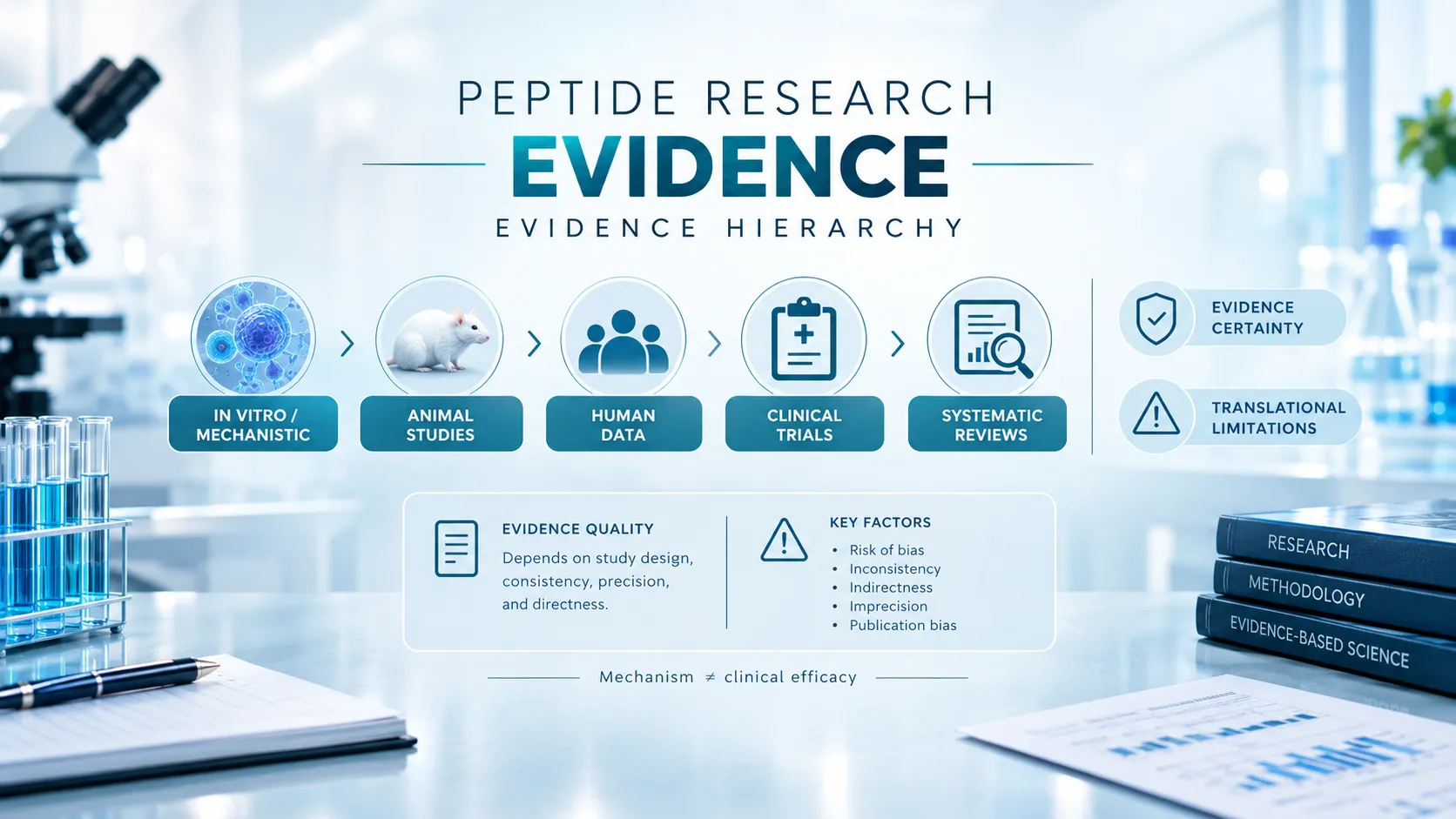
Evidence level describes where a finding came from; evidence quality describes how well the study was run; clinical relevance describes whether the result matters.
A single evidence pyramid does not fit peptide research because it assumes everyone agrees which molecule was tested.
Molecular identity is an upstream question: sequence, salt form, fragment versus parent and analog versus parent all change what a study is evidence for.
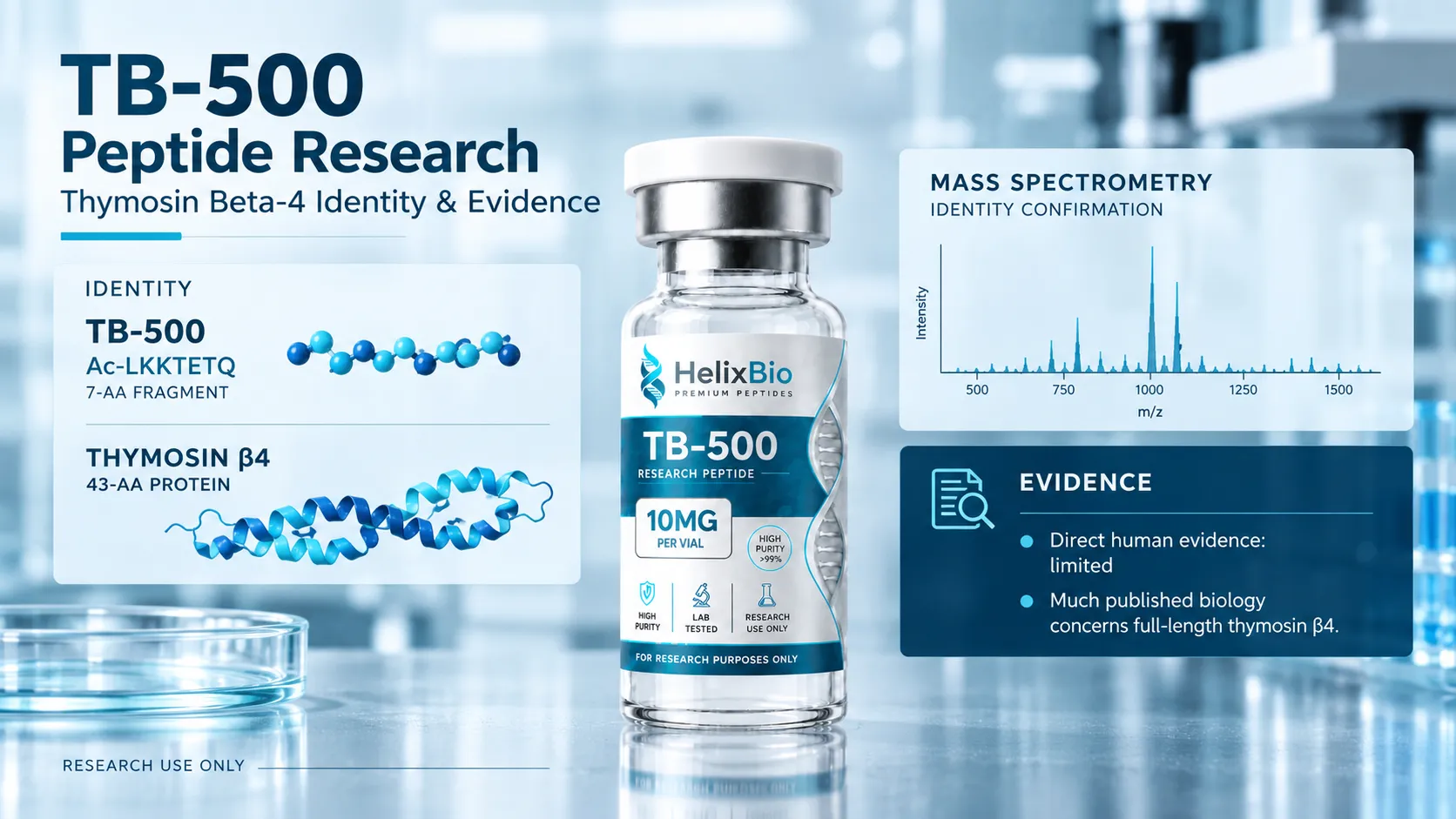
Mass spectrometry confirms a mass consistent with the target and is silent on stereochemistry, so a defining D-amino acid substitution can be invisible to it.
Chromatographic purity is an area-normalized figure under one method at one detection wavelength and is uninterpretable without those conditions.
Receptor binding is target engagement, not an outcome, and a moved biomarker is not a changed clinical condition.
A nonsignificant result does not prove absence of effect, but repeated null findings lower confidence in a claim.
Independent replication changes confidence more than repetition within the same laboratory.
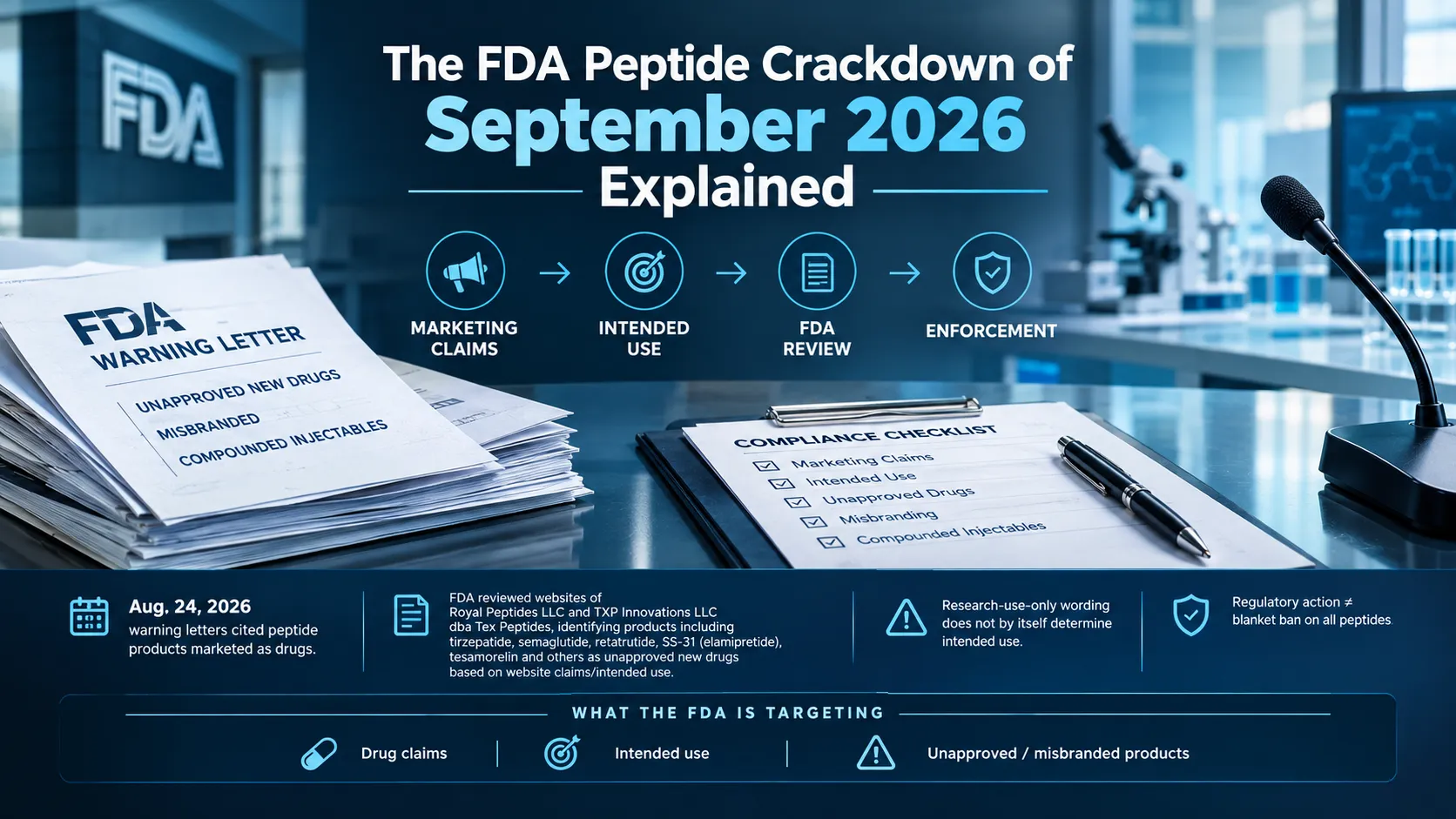
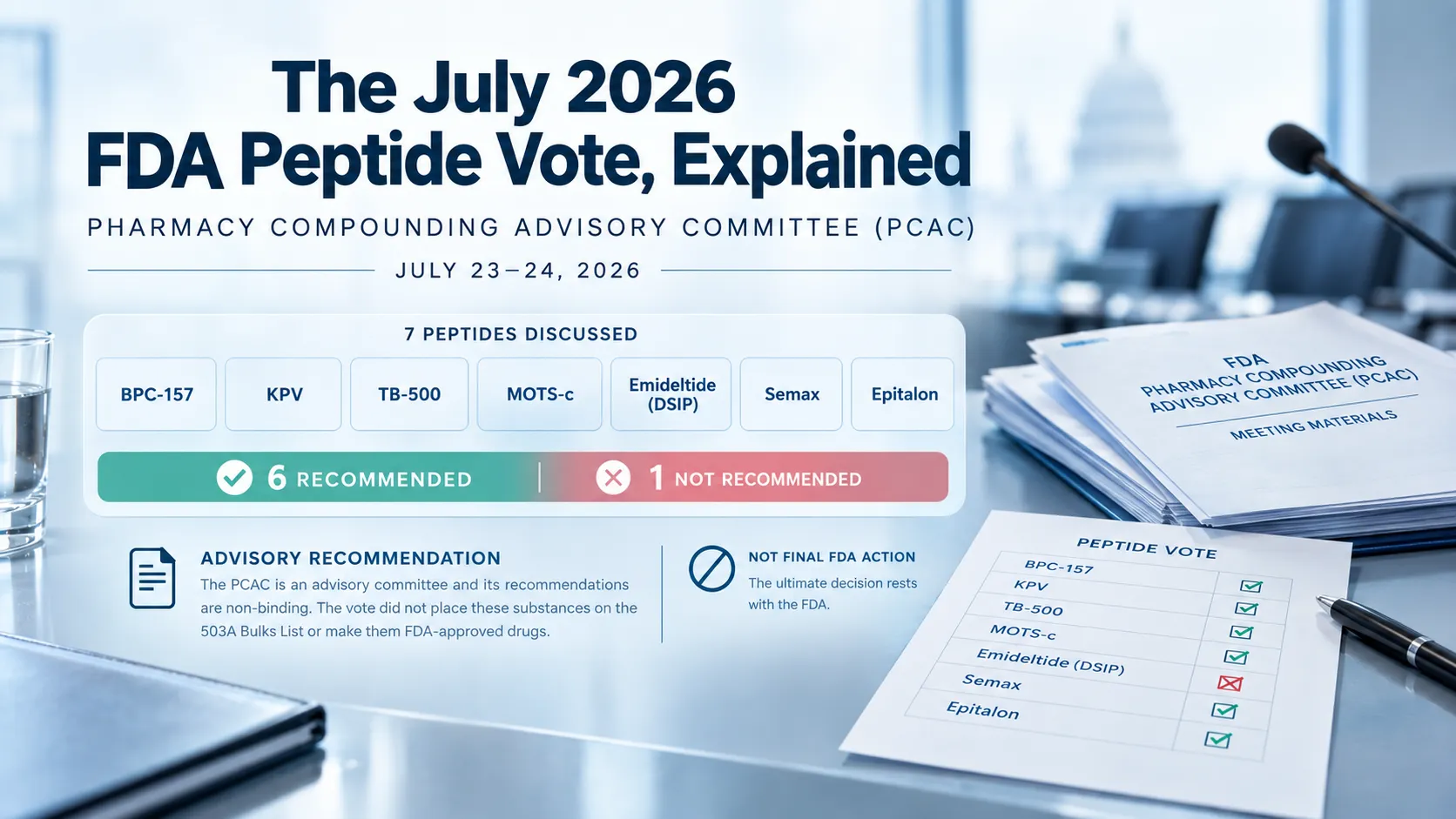
FDA approval, sports-authority prohibition and research-use-only labeling are regulatory facts, not scientific efficacy evidence.
Helix Bio applies an evidence-oriented editorial practice, not a validated institutional grading methodology, and makes no claim of peer review or in-house replication.
Most peptide pages on the open web use one phrase for every kind of finding: "research shows." That phrase covers a radioligand binding assay and a randomized human trial equally well, which is exactly the problem. This page sets out how Helix Bio reads peptide research evidence, what each kind of study can establish, and which inferences the evidence does not license. It is a methodology reference, not a claim about any compound.
What evidence levels mean in peptide research
Evidence level describes where a finding came from: an analytical instrument, a cell culture, an animal, a human pharmacology study, or a controlled clinical trial. It does not describe how well the study was run, and it does not describe whether the result matters.
Those are three separate questions, and collapsing them is the single most common error in peptide writing. A poorly controlled human trial can be weaker evidence than a well designed cell experiment for the question it actually answers. A perfectly executed receptor assay still says nothing about a clinical outcome.
So the useful question is never "is this strong evidence." It is "strong evidence for which claim."
Why a single evidence pyramid does not fit peptides
The classic pyramid ranks study designs from case report up to meta-analysis. It was built for clinical questions about approved interventions, and it assumes everyone already agrees on what molecule is being tested.
Peptides break that assumption. A study of full-length thymosin beta-4 is routinely cited as evidence for TB-500, a seven-residue acetylated fragment sold under a trade designation. A study of a pineal gland extract gets cited as evidence for a synthetic tetrapeptide. Under a pyramid, both look like the same tier. They are not evidence about the same substance at all.
That is why molecular identity sits upstream of study design in this framework, not beside it.
The three dimensions we apply
Rather than one ladder, three questions are asked of every claim.
Dimension 1, the question being answered. Chemical identity, mechanism, pharmacology, safety, efficacy, or regulatory status. Each has its own best source.
Dimension 2, the evidence context. Analytical, biochemical, cellular, tissue, animal, human observational, human pharmacology, human interventional, or systematic review.
Dimension 3, the confidence modifiers. Directness, study quality, reproducibility, consistency, sample size, endpoint relevance, species translation, molecule identity, formulation match, route match, and independent replication.
A finding can be high on context and low on confidence at the same time. A randomized trial that missed its primary endpoint and reports a positive post hoc subgroup is human interventional evidence with weak certainty attached.
Effect on the measured endpoint under the trial's conditions
Generalization beyond that population and endpoint
Did the endpoint move
Systematic review
Consistency across the included studies
More than the underlying studies contain
What does the body of work show
This table is the reference asset of the page. Evidence labels used elsewhere on this site are written to correspond to a row in it, and where a page uses a narrower label, such as organ culture or a grading taken from a cited review, it says so on that page.
Molecular identity comes first
Before any study counts as evidence for a compound, one question has to be settled: was the molecule tested the molecule under discussion.
Sequence, stereochemistry, terminal modifications, salt form, fragment versus parent, and analog versus parent all change the answer. Mass spectrometry confirms mass, and mass is silent on chirality, so a D-amino acid substitution can be the defining feature of a molecule and invisible to the instrument used to identify it.
Our AHK-Cu work shows how tight this can get. AHK and GHK differ by a single methylene group, about 14 Da, which one mass run separates cleanly. The copper in a copper tripeptide is a separate determination entirely, because chromatographic and mass methods characterize the peptide and say nothing about the metal. That is one entity, two analytical questions, and a copper tripeptide evidence walkthrough that keeps them apart.
A certificate of analysis answers whether a lot matches its specification. It does not establish that the compound works, is safe, or is suitable for any application. Analytical identity and biological effect are different claims supported by different evidence.
Evidence transfer: the inferences that do not carry
Most overstatement in peptide content is not fabrication. It is a real finding moved one step further than it reaches.
Animal to human. A rodent result establishes a rodent result.
In vitro to human. Culture concentrations are often orders of magnitude above anything reachable in an organism.
Receptor activation to benefit. Target engagement is an input, not an outcome.
Biomarker to clinical outcome. A moved marker is not a changed condition.
Extract to synthetic peptide. Trials of a tissue extract are not trials of a synthetic sequence, which is the distinction our Epitalon evidence review keeps explicit.
Formulation to formulation, and route to route. Different exposure, different biology.
Acute to chronic. A single-exposure response does not establish a sustained one.
Association to causation.
Tolerability to efficacy. Being tolerated is not working.
Human pharmacology to approval. Kinetics are not a regulatory decision.
Source authority depends on the question
There is no source that outranks every other source for every question. For chemical identity, primary analytical literature, curated chemical registries and lot-specific documentation beat any clinical trial. For mechanism, primary receptor and cellular pharmacology carries the weight. For clinical efficacy, controlled human studies and systematic reviews do. For regulatory status, only the current official record counts: agency documents, dockets, prohibited lists read at the source rather than summarized.
Two rules follow from this. Reviews orient, primary studies verify. And a supplier page, including this one, is not independent evidence for a scientific claim.
Citation traceability
A citation is useful only if it supports the specific claim attached to it. The chain we apply runs: claim, original source, exact molecule, model or population, intervention and exposure, endpoint, result, limitation, appropriate conclusion.
Breaks in that chain are common and quiet. A frequently repeated potency figure turns out to describe a different compound in the comparison. A reported half-life traces to a study that measured no pharmacokinetics. A mechanism is cited from a paper that was later corrected or withdrawn, which is what happened across the Dihexa literature and why source validity has to be rechecked rather than assumed.
How to read a peptide study
What exact molecule, sequence, salt form and formulation was tested.
What species or population, and what route.
What exposure, duration and comparator.
What endpoint, and was it prespecified.
Randomized, blinded, controlled, and adequately powered.
Was the result statistically significant, and separately, was it meaningful.
Has it been replicated, and by whom.
What funding and conflicts are declared.
What limitations did the authors themselves state.
Can this study actually answer the question being asked of it.
Null, conflicting and replicated findings
A nonsignificant result does not prove no effect, particularly in an underpowered study. Repeated null findings do lower confidence. Conflicting studies are compared on population, intervention, endpoint, method and risk of bias before either is discarded.
Do not cherry-pick positive studies while ignoring null or contradictory evidence. Publication bias and selective outcome reporting both push the visible literature toward positive results, so the absence of published negatives is not evidence that none exist.
Replication is graded too. Same-lab repetition is weaker than independent replication, and replication across models and populations is stronger again. A single positive study is hypothesis-generating.
Regulatory status answers a different question
FDA approval is a regulatory decision about a specific product, formulation and indication. Absence of approval does not establish absence of biological activity. Prohibition by a sports authority is a rules decision, not an efficacy finding. Research-use-only labeling is a product classification. None of these substitute for scientific evidence, and none are contradicted by it, because they answer different questions. Our RUO compliance explainer and 503A bulks list article cover the regulatory layer separately for that reason.
What HPLC, MS and a COA actually support
Chromatographic purity is an area-normalized figure under one method at one detection wavelength, and it is uninterpretable without those conditions. It does not confirm sequence, stereochemistry, or the absence of species the method cannot resolve.
Mass spectrometry supports a mass consistent with the target. Mass is not sequence, not handedness, and not content.
A certificate of analysis documents lot-specific results, and its evidentiary value depends on the method, the issuing laboratory, the reported result, and whether the document is tied to the lot in hand. Published testing of falsified peptide products has found wide purity variation and elemental impurities, which is covered in our contamination data review; the field-by-field reading is in our COA guide.
How evidence should change the wording
Evidence available
Wording that fits
Controlled clinical trials
Randomized controlled trials found
Human pharmacology
Human studies observed
Animal studies
Animal studies reported
Cellular work
In vitro studies found
Mechanistic reasoning
Mechanistic studies suggest
Proposal only
One proposed mechanism is
Nothing adequate
Current evidence does not establish
Every sentence on this site is meant to sit in the row its evidence supports. Where a finding does not reach a row, the honest output is the last one.
What this framework is not
Helix Bio applies an evidence-oriented editorial approach to its research content. It is a documented editorial practice, not a validated institutional methodology, and it should not be read as one. We do not operate an external certification, a formal peer-review process, an in-house replication program, or a proprietary numerical evidence score, and we do not claim any of those. Our analytical work, described on our standards page, characterizes material. It does not evaluate published literature, and it is not evidence of efficacy.
This page is also not medical advice, and nothing in it is a statement about the safety or effectiveness of any compound.
Got Questions?
Frequently Asked Questions
Evidence levels describe the context a finding came from, such as analytical, cellular, animal, human pharmacology or human interventional research. The level tells you what kind of question the study was able to answer, not how well it was conducted.
There is no single strongest type, because the best evidence depends on the question. Controlled human trials are the most relevant source for clinical efficacy, while a lot-specific analytical report is the better source for chemical identity.
No. An animal study establishes a result in that species, model, route and exposure. Translating it to humans requires human data, and many compounds that respond in animal models have not reproduced those effects in people.
In vitro research shows whether a defined cell system responds at a stated concentration. Culture concentrations are often far above anything achievable in an organism, so cellular activity does not establish a physiological effect.
Mechanistic evidence describes how a compound interacts with a target or pathway. Clinical evidence describes whether a measured outcome changed in people. A plausible mechanism is a reason to test a claim, not a substitute for testing it.
Human pharmacology establishes exposure, kinetics, target engagement and biomarker responses in people. It does not establish that a clinically meaningful outcome improved, which requires interventional evidence with a relevant endpoint.
Compare the studies on population, exact molecule, exposure, endpoint, method and risk of bias before discarding either. Conflicting results often reflect studies asking different questions rather than one study being wrong.
Identify the exact molecule tested, the model or population, the route and exposure, the comparator, and whether the endpoint was prespecified. Then separate statistical significance from whether the size of the effect is meaningful for the question.
A study is only evidence for the substance that was actually tested. Sequence, stereochemistry, terminal modifications, salt form and fragment length all define different molecules, even when the market uses one trade name for several of them.
Not automatically. An analog is a different molecule, and modifications are usually made precisely because they change binding, stability or exposure. Evidence transfers between them only when a study directly compares the two.
No. A certificate of analysis documents whether a lot met identity and purity specifications under stated methods. Analytical conformity and biological activity are separate claims supported by different types of evidence.
HPLC supports a chromatographic purity assessment under one method at one detection wavelength. It does not confirm sequence or stereochemistry, and it cannot report on species that the method does not resolve.
Mass spectrometry supports a molecular mass consistent with the intended compound. Mass is not sequence, not stereochemistry and not content, so a mass match narrows the possibilities rather than settling identity outright.
No. Approval is a regulatory decision about a specific product, formulation and indication. Lack of approval does not establish that a compound is biologically inactive, and approval does not transfer to a different formulation or route.
Our research content classifies findings by evidence type, states the model and population a result came from, keeps regulatory status separate from scientific findings, and names limitations. This is a documented editorial practice rather than a formally validated grading system.