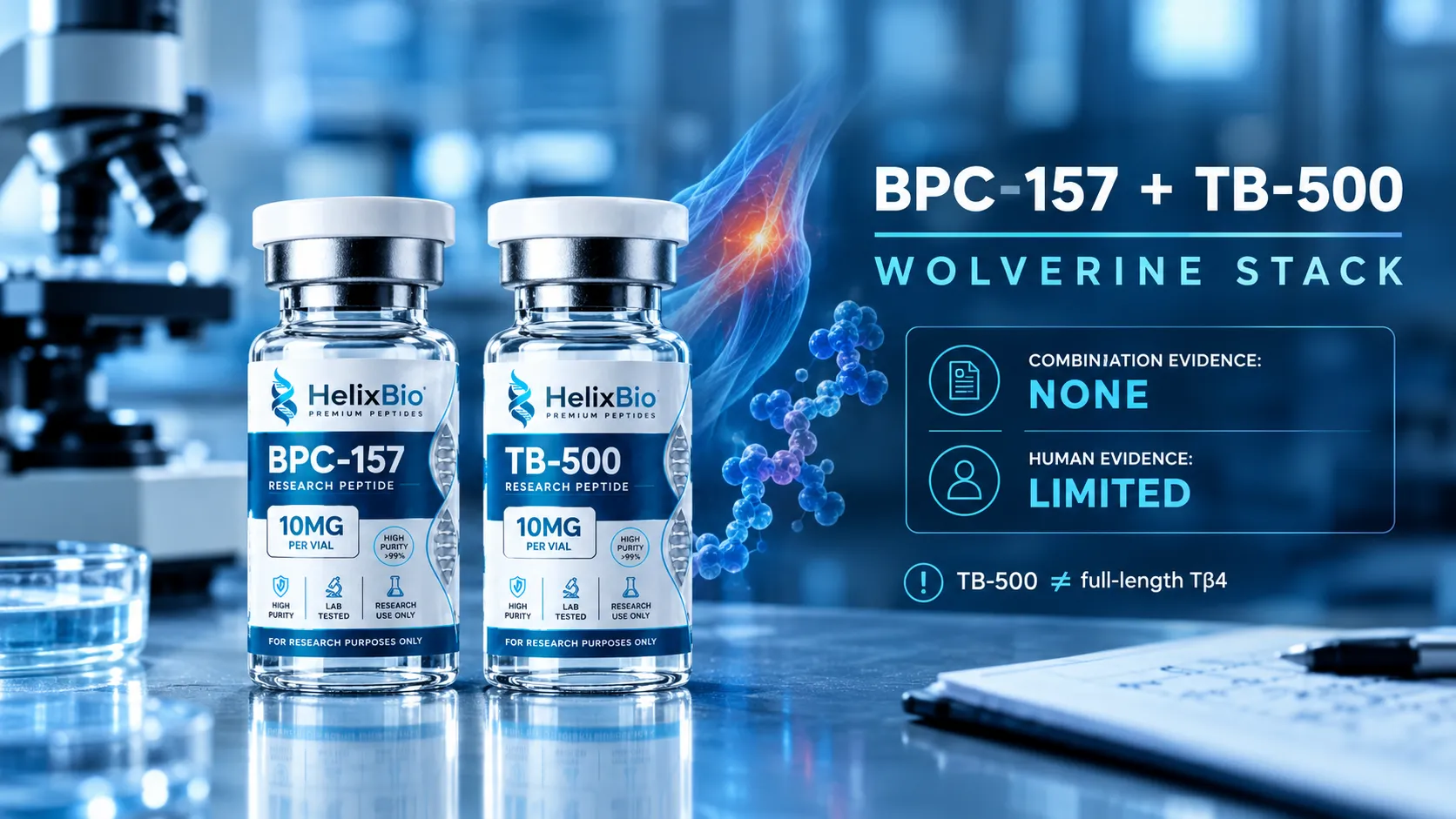
"Wolverine Stack" is a community and vendor nickname for BPC-157 combined with TB-500, with no CAS number, INN, monograph or defined composition behind it.
One controlled study has compared BPC-157, TB-500 and the combination in the same model, and the combination did not outperform either compound alone on any reported endpoint.
That study split eight animals per group between two endpoint types, so every reported comparison rests on four specimens per arm.
The study analysed four groups pairwise rather than testing an interaction term, so it shows no synergy demonstrated rather than synergy ruled out.
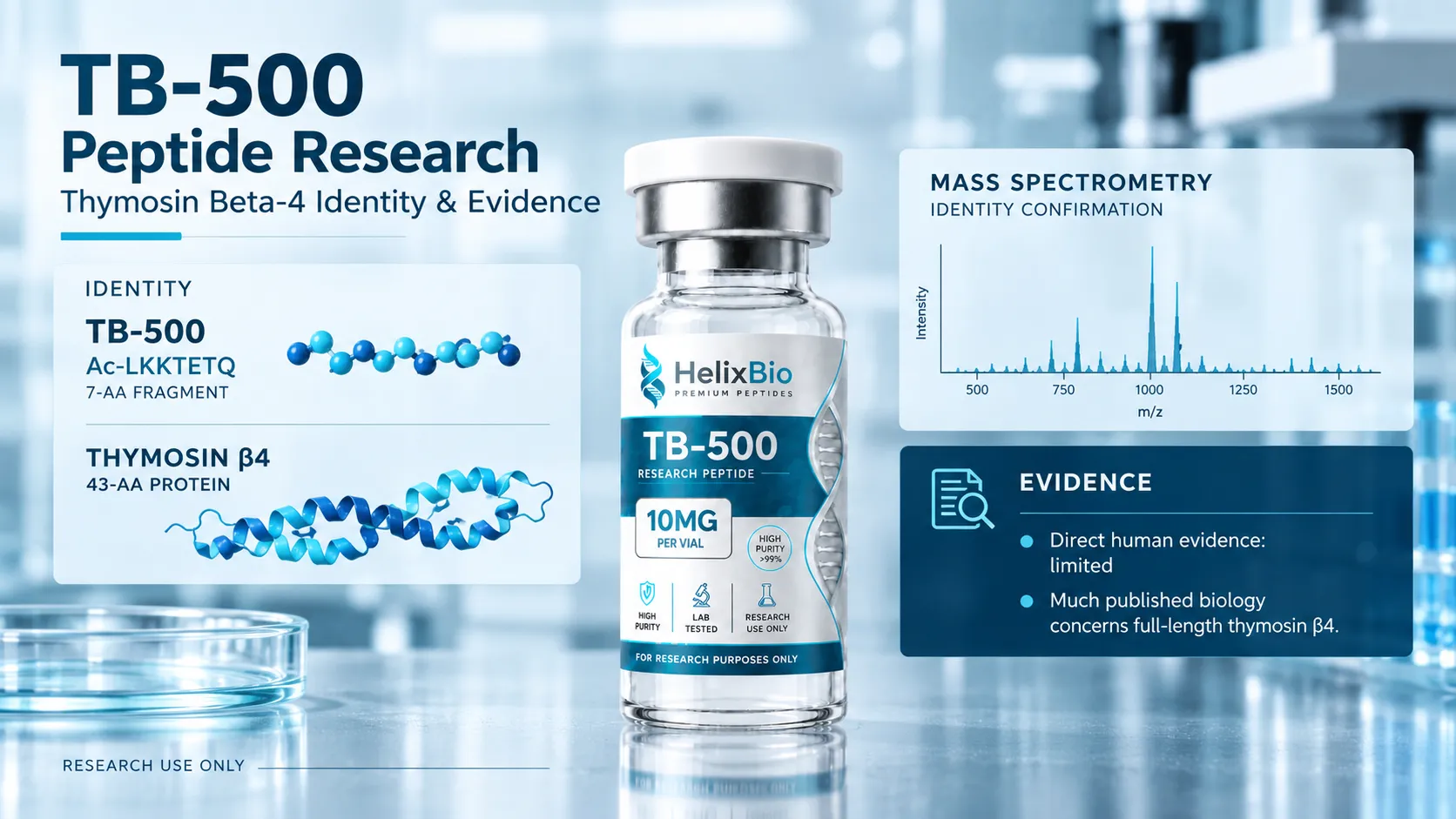
TB-500 identified in commercial material is Ac-LKKTETQ, a seven-residue acetylated fragment of thymosin beta-4, not the full 43-residue protein.
Human trial data cited for TB-500 generally belongs to full-length thymosin beta-4 in a topical ophthalmic programme, a different molecule, route and tissue.
A 2025 systematic review of BPC-157 in orthopaedic sports medicine found 35 of 36 included studies were preclinical and reported that no clinical safety data were found.
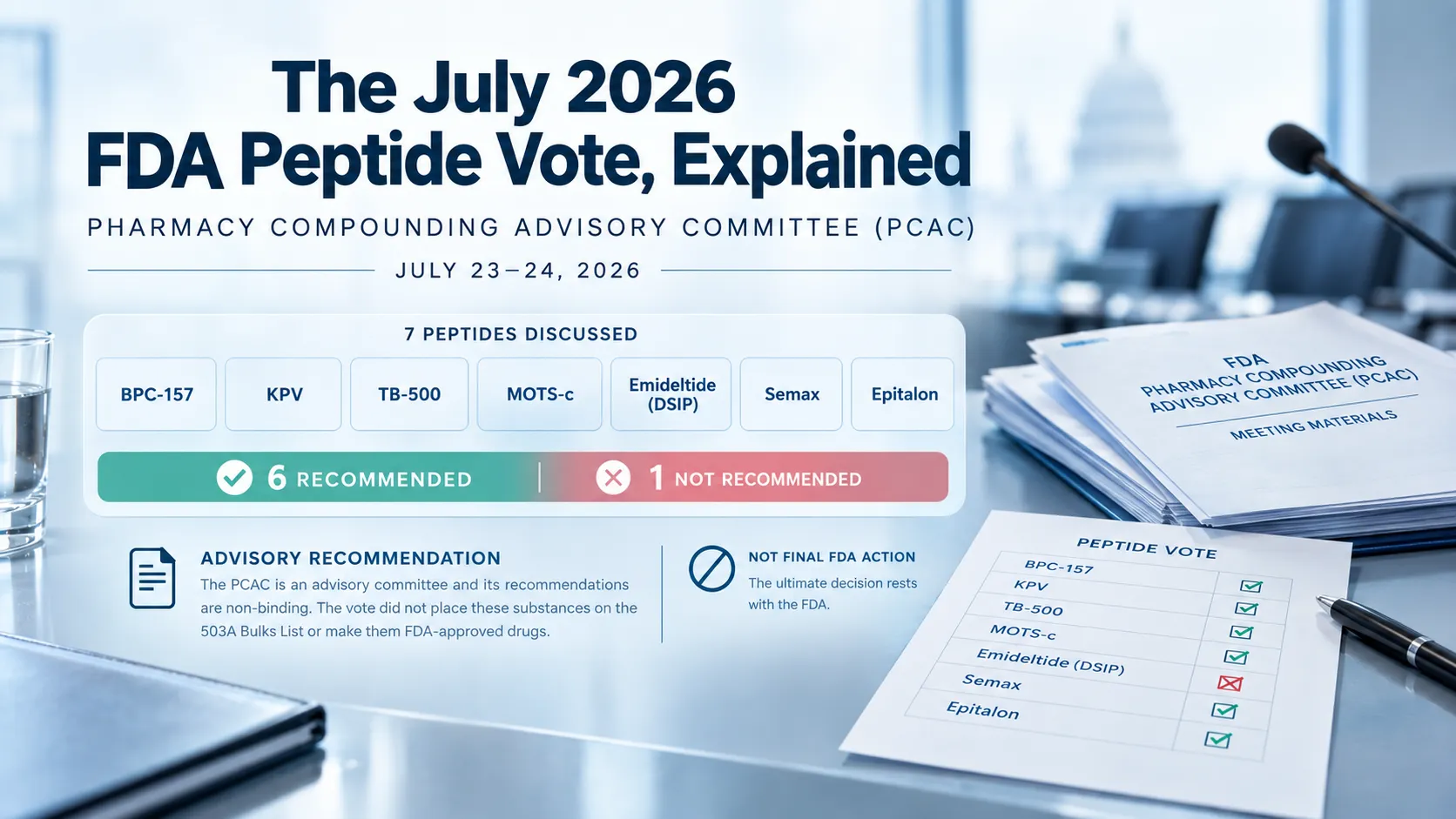
FDA's advisory committee recommended BPC-157 and TB-500 for the 503A Bulks List in July 2026 against FDA staff's own position; the vote is non-binding and changes nothing without rulemaking.
"Wolverine Stack" is a nickname, not a specification. In peptide forums and vendor catalogues it almost always means BPC-157 paired with TB-500, sometimes with a third compound added. No journal, pharmacopoeia or regulatory body uses the term, and nothing defines what a product sold under it must contain.
Featured In This Article
BPC-157
RESEARCH PEPTIDE
Highly purified synthetic peptide prepared for rigorous laboratory research.
$61.00
TB-500
RESEARCH PEPTIDE
Highly purified synthetic peptide prepared for rigorous laboratory research.
$72.00
The evidence question underneath the label is narrower and more answerable than the marketing suggests. One published study has tested the pairing head-to-head against each compound alone: a 2026 rat Achilles tendon model in which the combination did not outperform either peptide by itself on any endpoint measured. Separately, much of the human clinical data circulated as "TB-500 evidence" was generated with a different molecule — the full-length 43-residue thymosin beta-4 protein, not the short synthetic fragment sold under the TB-500 name.
This page covers what the term means, what each compound's evidence supports on its own, what the combination record shows, and where it stops.
What the Wolverine Stack Refers To
The Wolverine Stack is a community and vendor label for the combination of BPC-157 and TB-500, used mainly in tissue-repair and recovery discussion. It is not scientific nomenclature. It has no defined composition, no ratio convention, and no registry identity — no CAS number, no INN, no monograph. Two products sold under the name may contain different amounts of each component, or different molecules entirely.
That last point is not hypothetical. "TB-500" is a trade designation rather than a chemical name, and published analytical work on material sold under it has found contents that do not consistently match the description on the label. A named stack therefore tells a researcher what a supplier intends to sell, not what is in the vial. Identity has to come from lot documentation, which is a separate exercise covered in how to read a peptide certificate of analysis.
Where the Name Comes From
The name borrows the regenerative reputation of the Marvel character. It spread through forums and short-form video before vendors adopted it for blended products, which is the usual route for peptide nicknames.
A nickname carries no evidentiary weight. "Wolverine Stack" describes how a pairing is marketed, not what it does, and the analogy it invokes — rapid, near-complete tissue regeneration — is not a finding anyone has reported for either compound in any species.
A stack name is not a formulation standard. Before comparing any published result to material on hand, confirm which molecule the study administered and which molecule the certificate of analysis describes. For TB-500 in particular, those are frequently not the same thing.
The Two Compounds in Brief
BPC-157 is a synthetic 15-residue peptide (sequence GEPPPGKPADDAGLV) derived from a sequence reported in human gastric juice. Its preclinical literature is large and unusually consistent across injury models, with mechanistic work centred on VEGFR2-linked angiogenic signalling, nitric oxide pathways and collagen organisation.
TB-500 is a synthetic fragment marketed as a stand-in for thymosin beta-4. When an anti-doping laboratory characterised a commercial TB-500 formulation by high-resolution mass spectrometry, the peptide it identified was Ac-LKKTETQ — the N-terminally acetylated fragment corresponding to residues 17 to 23 of thymosin beta-4. That is seven amino acids.
Compound-level mechanism and pharmacology for each are covered separately in the BPC-157 vs TB-500 comparison; this page does not repeat them.
TB-500 Is Not Thymosin Beta-4
This is the single most consequential distinction on the page, and the one most often collapsed.
Thymosin beta-4 (Tβ4) is an endogenous 43-amino-acid actin-sequestering protein found in most human cell types. TB-500, as identified in commercial material, is a seven-residue acetylated fragment of it. A fragment is not a smaller dose of the parent protein — it is a different molecule with different binding surfaces, different pharmacokinetics and a separate evidence base.
BPC-157
TB-500 (as characterised)
Thymosin beta-4
What it is
Synthetic 15-residue peptide
Synthetic acetylated fragment, Ac-LKKTETQ
Endogenous 43-residue protein
Name type
Research designation
Commercial/market label
Standard scientific name
Human clinical programme
None identified
None identified
Topical ophthalmic (RGN-259)
Appears in peer-reviewed titles as
BPC-157 / BPC 157
Rarely; usually as a product
Thymosin β4 / Tβ4
Two errors follow from the conflation, and both are common in ranking pages.
The first is arithmetic. TB-500 is repeatedly described as a "17-amino-acid" peptide. That figure is a misreading of "residues 17–23", the position of the fragment within the parent sequence. The fragment identified in commercial TB-500 is seven residues long.
The second is evidentiary. The human trial data cited in support of TB-500 almost always belongs to full-length Tβ4, and specifically to a topical ophthalmic programme in dry eye and neurotrophic keratopathy — a different molecule, a different route and a different tissue from tendon repair. That programme's own record is also thinner than the citations imply: its published Phase III trial in neurotrophic keratopathy randomised 18 subjects and reported complete healing at four weeks in 6 of 10 treated versus 1 of 8 placebo, a difference the authors reported as a trend rather than a statistically significant primary result. A subsequent European Phase III trial in the same indication missed its primary endpoint in 2026.
There is a further complication specific to the fragment. Work quantifying TB-500 and its metabolites in rats and in vitro found that in fibroblast wound-healing assays, a shorter metabolite showed significant activity while the parent TB-500 did not — leading the authors to suggest that wound-healing activity attributed to TB-500 may belong to a breakdown product rather than the administered peptide. That is a live question about the fragment itself, not about Tβ4.
Thymosin beta-4 should also not be confused with thymosin alpha-1, an unrelated peptide with its own separate literature, covered in the thymosin alpha-1 research overview.
Why the Two Are Paired
The stated rationale is mechanistic complementarity. BPC-157 has been studied largely through vascular and angiogenic signalling; thymosin beta-4 biology centres on actin dynamics and cell migration. Two compounds acting on non-identical arms of the repair process are assumed to add up.
The assumption is reasonable as a hypothesis and is exactly how the combination is justified across vendor pages and blend products, including the multi-component preparations compared in the GLOW vs KLOW breakdown. It is not a result. Complementary mechanisms can also converge on shared downstream pathways, in which case adding the second compound buys nothing — and pathways proposed from separate literatures have not been shown to operate independently when the compounds are given together. The general principles and their limits are set out in the peptide stacking guide.
Distinguishing the two claims is the whole point of the next section.
What the Combination Study Found
Direct answer: one controlled study has compared BPC-157, TB-500 and the combination in the same model, and the combination did not outperform either compound alone on any reported endpoint. The authors state this explicitly as a finding.
The study (Biçer et al., Joint Diseases and Related Surgery, July 2026) used 32 male Sprague-Dawley rats undergoing standardised Achilles tendon transection and Kessler repair, randomised to four groups: vehicle control, BPC-157, TB-500, and both together, given daily by intraperitoneal injection for 30 days. Outcomes at four weeks were maximum load to failure, Bonar and Movin histopathological scores, Sirius red birefringence and immunohistochemical collagen typing.
Group
Biomechanics (max load to failure)
Total Movin score
Total Bonar score
BPC-157 alone
Not significantly different from control
Not significant
Not significant
TB-500 alone
Significantly higher than control
Significantly lower than control
Significantly lower than control
BPC-157 + TB-500
Not significantly different from any group
Significantly lower than control
Not significant
Read carefully, the result is more interesting than "the stack failed". TB-500 alone was the only group to reach significance biomechanically. The combination beat control on one composite histological score where BPC-157 alone did not. And no comparison between treatment groups reached significance in either direction.
Three limitations decide how much weight the study can carry, and none of them appear on the pages currently citing it.
First, the effective sample size is four, not eight. Eight animals per group were randomised, but tendons were split within each group — four to biomechanical testing, four to histology. Every number above rests on four specimens per arm. The authors state this, report no a priori power calculation for the histological work, and give post hoc power only.
Second, the design was never analysed for interaction. A study with control, drug A, drug B and A+B is structurally a two-by-two factorial, and additivity or synergy is a statement about the interaction term. This study used Kruskal-Wallis with Dunn's pairwise post hoc tests, which compare groups to each other and cannot estimate an interaction. So "no synergy demonstrated" is accurate; "synergy ruled out" is not, and the study does not claim it.
Third, the test articles were purchased from a research-chemical supplier and no identity or purity data for them is reported. Given what analytical work has found in commercial TB-500 material, what was actually administered in the TB-500 and combination arms is not established by the paper. The TB-500 dose was also selected from the full-length Tβ4 literature, because tendon-specific dose-finding for the fragment does not exist — the same conflation this article describes, appearing inside the study that tests the stack.
When a page cites this study, check whether it reports the split-sample design. A four-per-group exploratory study at a single four-week timepoint in healthy young rats is hypothesis-generating. The authors describe it that way; secondary coverage generally does not.
Evidence by Tier
Applying the same ladder to each entity separately, rather than to "the stack" as a unit, is what the label obscures.
Entity
Mechanistic / in vitro
Animal
Human observational
Randomised human
BPC-157
Extensive
Extensive, multi-tissue
One retrospective series identified
None identified
TB-500 (fragment)
Limited; metabolite question open
Sparse, tendon-specific data scarce
None identified
None identified
Thymosin beta-4
Extensive
Extensive
Yes
Yes — topical ocular only
Human Evidence, Stated Precisely
"No human evidence" is too blunt for BPC-157 and too generous for the combination.
A 2025 systematic review in HSS Journal searched the BPC-157 literature for orthopaedic sports-medicine applications through June 2024. Of 544 articles screened, 36 met inclusion criteria — 35 preclinical and one clinical. That single clinical study was a retrospective series of intra-articular BPC-157 for unspecified chronic knee pain in which 7 of 12 patients reported relief beyond six months. The review reported that no clinical safety data were found and graded the body of evidence as level IV and level V.
For the TB-500 fragment, no completed human efficacy trial has been identified for any musculoskeletal indication. For full-length thymosin beta-4, human trials exist but are topical and ophthalmic, as described above. For the two compounds administered together, no human study of any design has been identified.
Regulatory Position
Neither BPC-157 nor TB-500 is an FDA-approved drug for any indication, and neither is approved for human use in any form.
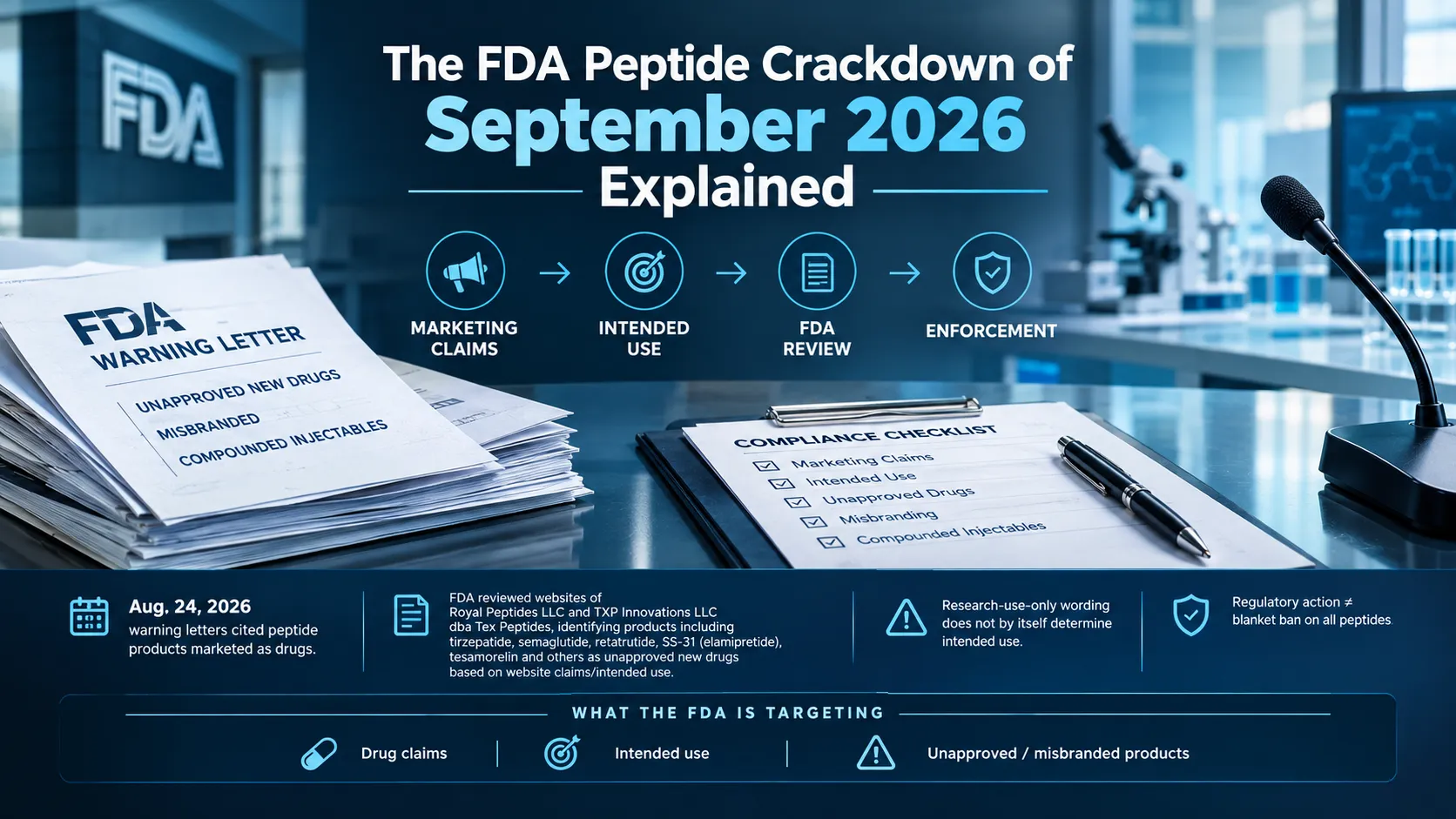
On 23–24 July 2026, FDA's Pharmacy Compounding Advisory Committee voted 8–6 with one abstention to recommend both BPC-157 and TB-500 — free base and acetate forms — for the Section 503A Bulks List, alongside four other peptides. Three points about that vote are routinely misreported. It went against FDA staff, who had recommended in their briefing materials that none of the fourteen peptide forms under review be included. It is advisory and non-binding. And it changes nothing until FDA completes notice-and-comment rulemaking, which has not happened. Fuller context is in the 503A bulks list explainer.
Both compounds had been removed from Category 2 in April 2026 after their nominators withdrew the nominations; FDA proceeded to review them regardless. Neither is a controlled substance. Both are prohibited in sport under anti-doping rules. Material sold for laboratory work is research-use-only, which is a statement about permitted use and not a legal exemption — the distinction is set out in the RUO compliance overview.
What This Evidence Does Not Establish
Specific to this pairing, the current record does not support any of the following.
Claim in circulation
Evidence status
What actually supports it
What it does not establish
The combination is synergistic
Not demonstrated
Mechanistic reasoning from separate literatures
The one controlled test found no additive benefit and did not test interaction
The combination is additive
Untested
Nothing
Additivity requires a factorial analysis nobody has published
TB-500 has human trial support
Misattributed
Trials of full-length Tβ4, topical and ocular
Anything about the seven-residue fragment, systemically, in tendon
Animal tendon results predict human outcomes
Not established
Rodent transection models in healthy young animals
Two further gaps are worth naming. Long-term data do not exist for either compound in any species at the timepoints that matter for tendon remodelling. And because the only combination study measured a single timepoint, a combination effect that emerges later — or an early effect that disappears — would be invisible to it.
What Would Settle the Question
The useful next experiments are specific, and naming them is more honest than calling for "more research".
A factorial design powered for the interaction term, not four groups compared pairwise. Multiple sacrifice timepoints across the remodelling window rather than one. Characterised test article, with the identity of the TB-500 arm confirmed analytically and reported, so the result attaches to a known molecule. Dose-response for the fragment in the tissue being studied, rather than doses borrowed from the full-length protein. And a model of impaired healing, since healthy young rodents are the population least likely to show a benefit ceiling.
Until at least the first three exist, the accurate statement about the Wolverine Stack is narrow: two compounds with non-identical preclinical mechanisms, tested together once, with no added benefit observed and no interaction analysis performed.
Got Questions?
Frequently Asked Questions
The Wolverine Stack is an informal community and vendor label for the combination of BPC-157 and TB-500, discussed mainly in tissue-repair research contexts. It is a marketing and forum term rather than a scientific one, and it does not define a fixed composition.
In almost all usage the label refers to BPC-157 and TB-500. Some suppliers add further components under the same or a similar name, so the label alone does not establish what a given preparation contains.
The name borrows the regenerative reputation of the Marvel character and spread through forums and short-form video before vendors adopted it. The analogy describes how the pairing is marketed and carries no evidentiary weight.
No. It does not appear in peer-reviewed literature, pharmacopoeial monographs or regulatory documents as a defined substance. There is no CAS number, INN or standard composition attached to it.
No. Thymosin beta-4 is an endogenous 43-amino-acid protein. When an anti-doping laboratory characterised commercial TB-500 material by high-resolution mass spectrometry, the peptide identified was Ac-LKKTETQ, the acetylated fragment corresponding to residues 17 to 23. They are different molecules with separate evidence bases.
That figure is a misreading of "residues 17–23", which describes the fragment's position within the parent thymosin beta-4 sequence rather than its length. The fragment identified in commercial TB-500 is seven residues long.
Yes, once in a controlled design. A 2026 rat Achilles tendon transection-and-repair study compared vehicle control, BPC-157 alone, TB-500 alone and both together across biomechanical and histopathological endpoints at four weeks.
No. In the only controlled test, the combination did not outperform either compound alone on any endpoint, and no comparison between treatment groups reached significance. The design also used pairwise group comparisons rather than a factorial interaction analysis, so synergy was never formally tested in either direction.
No human study of any design has been identified for BPC-157 and TB-500 administered together, including observational reports. No combination safety data exist.
Very little. A 2025 systematic review in HSS Journal screened 544 articles and included 36, of which 35 were preclinical. The single clinical study was a retrospective series of intra-articular BPC-157 for chronic knee pain in which 7 of 12 patients reported relief beyond six months, and the review reported that no clinical safety data were found.
On 23–24 July 2026 the Pharmacy Compounding Advisory Committee voted 8–6 with one abstention to recommend BPC-157 and TB-500 for the Section 503A Bulks List, against FDA staff's own recommendation against inclusion. The vote is advisory, non-binding, and has no legal effect until FDA completes notice-and-comment rulemaking.
Through lot-specific analytical documentation rather than the product name. Mass spectrometry distinguishes a seven-residue acetylated fragment from the 43-residue protein unambiguously, and published analysis has found that material sold as TB-500 does not consistently match its stated description.