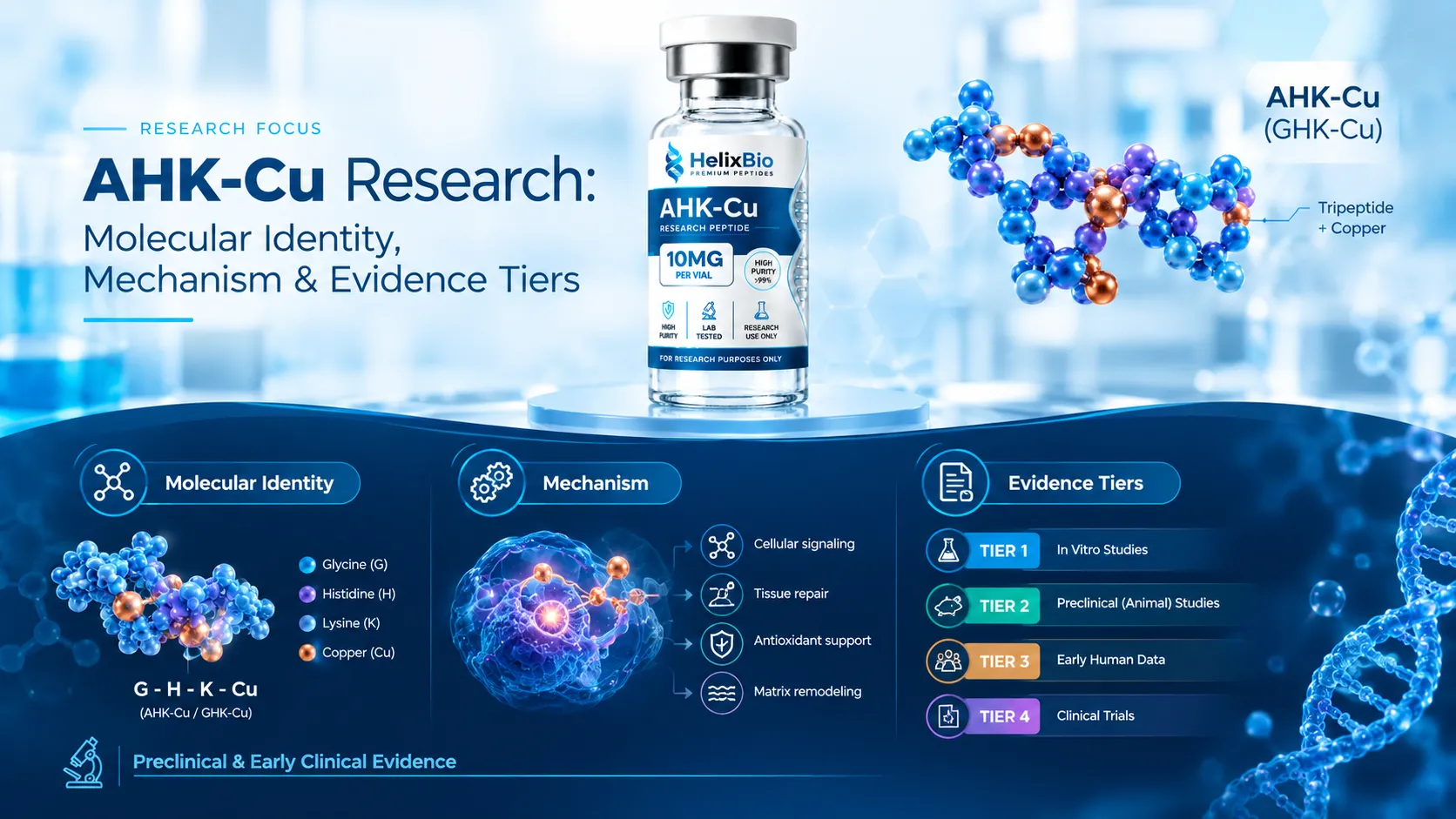
AHK-Cu is a synthetic copper(II) complex of the tripeptide Ala-His-Lys, listed in cosmetic nomenclature as Copper Tripeptide-3.
AHK and GHK differ by a single methylene group, 14.03 daltons, so one mass spectrometry run separates the two free peptides.
The principal AHK-Cu evidence is a 2007 study on isolated human hair follicles and cultured dermal papilla cells, not a human trial.
In that study, 240 follicles were cultured for 12 days across concentrations from 10 to the minus thirteenth to 10 to the minus seventh molar.
AHK-Cu was reported to increase dermal papilla cell proliferation and shift apoptosis markers toward cell survival in cell culture.
No published human trial of AHK-Cu was identified, and no human safety dataset exists for it as a distinct substance.
HPLC and LC-MS characterise the peptide component only; copper content requires an elemental method such as ICP-MS or atomic absorption.
GHK-Cu is named in the FDA 503A bulk drug substances record while AHK-Cu is not, and neither is FDA-approved for therapeutic use.
Two copper tripeptides sit one methylene group apart. One of them, GHK-Cu, was isolated from human plasma in the 1970s and has accumulated half a century of literature. The other, AHK-Cu, is a synthetic analogue whose published record is essentially a single 2007 paper. Almost everything written about AHK-Cu online borrows from the first molecule and attaches it to the second. This article separates the two: what AHK-Cu is at the molecular level, what its own studies actually measured, where the evidence stops, and what a laboratory has to do to confirm that the material in a vial is what the label says.
Featured In This Article
AHK-CU
RESEARCH PEPTIDE
Highly purified synthetic peptide prepared for rigorous laboratory research.
$66.00
GHK-CU
RESEARCH PEPTIDE
Highly purified synthetic peptide prepared for rigorous laboratory research.
$66.00
The Short Answer
AHK-Cu is a synthetic copper(II) complex of the tripeptide alanyl-histidyl-lysine (Ala-His-Lys), listed in cosmetic ingredient nomenclature as Copper Tripeptide-3. Its primary published evidence is one 2007 study on isolated human hair follicles and cultured human dermal papilla cells, in which AHK-Cu at picomolar-to-nanomolar concentrations lengthened follicles in organ culture and increased dermal papilla cell proliferation. No published human trial of AHK-Cu was identified in preparing this article. It is not approved by the FDA for any therapeutic use, and its structural cousin GHK-Cu — which does have a far larger literature — is a different molecule whose findings do not automatically describe it.
What AHK-Cu Actually Is
AHK-Cu belongs to a small family of histidine-containing tripeptides that bind divalent copper with high affinity. The binding site is a recurring motif: a free N-terminal amine, the deprotonated backbone amide nitrogen of the second residue, and the imidazole nitrogen of that residue's histidine side chain. Those three donor atoms plus a fourth coordinating group hold Cu(II) in a stable square-planar arrangement. The chemistry is the reason this family exists at all, and it is shared across the group rather than unique to AHK.
What distinguishes AHK from its relatives is position one. Where GHK carries glycine, AHK carries alanine — a methyl group in place of a hydrogen. That is the entire structural difference between the two parent peptides, and it is the reason the two names are so frequently interchanged in vendor copy, ingredient lists and aggregator databases.
The important consequence for research is that AHK-Cu is a coordination complex, not simply a peptide. A vial labelled AHK-Cu contains a peptide component and a metal component, and confirming one does not confirm the other. That distinction runs through the analytical section below and is the single most consequential practical point in this article.
AHK-Cu Sequence and Molecular Identity
The free tripeptide is well defined and consistently reported across chemical databases and reference-standard suppliers. The copper complex is not.
Property
AHK (free tripeptide)
GHK (free tripeptide)
Sequence
Ala-His-Lys
Gly-His-Lys
Molecular formula
C15H26N6O4
C14H24N6O4
Molecular weight
354.41
340.38
CAS (free peptide)
126828-32-8
49557-75-7
Cosmetic name of the Cu complex
Copper Tripeptide-3
Copper Tripeptide-1
Origin
Synthetic analogue
Occurs naturally in human plasma
The arithmetic is worth stating explicitly, because it is the most useful bench-level fact about this pair. AHK and GHK differ by exactly one CH2 unit: 14.03 daltons, 354.41 against 340.38. A single mass spectrometry run separates the two free peptides unambiguously.
A 14 Da gap between the AHK and GHK backbones means one mass run distinguishes them. It does not distinguish a copper-loaded complex from copper-free peptide, and it says nothing about how much copper is present.
Published identifiers for the copper complex itself are inconsistent, and researchers should treat any single figure with caution. Suppliers and ingredient pages variously report a formula of C15H25CuN6O4 with a molecular weight near 417, and — elsewhere — a formula containing fourteen carbons and seven nitrogens, which cannot describe an AHK backbone at all: alanine, histidine and lysine together contribute six nitrogens, and fifteen carbons, not fourteen. CAS 682809-81-0 appears in some catalogues attached to the hydrochloride salt and in others to the unqualified complex, while a second registry number circulates alongside it. Because these records disagree with one another, no single molecular weight for the complex is asserted here. The mass basis of a given lot — free base, hydrochloride, acetate, with or without a defined copper stoichiometry — is a question for the manufacturer's documentation rather than for a reference table.
How AHK-Cu Is Proposed to Work
The mechanism discussion around AHK-Cu tends to run ahead of the data, so it helps to sort the claims by how firmly each is attached to AHK-Cu specifically.
Established for the chemistry, not for the outcome. Copper is an obligatory cofactor for lysyl oxidase, superoxide dismutase and several other enzymes central to connective tissue biology. A histidine-containing tripeptide that binds Cu(II) can, in principle, act as a copper carrier and exchange that copper with cellular ligands. This is well-supported coordination chemistry for the peptide class. It is not, by itself, evidence that AHK-Cu produces any particular biological result.
Reported in the AHK-Cu study. In cultured human dermal papilla cells, AHK-Cu was reported to increase proliferation, shift the Bcl-2 to Bax ratio toward cell survival, and reduce the cleaved forms of caspase-3 and PARP. Those observations come from one experimental programme and are the strongest AHK-Cu-specific mechanistic data in the literature. The same paper's introduction also mentions increased vascular endothelial growth factor and reduced transforming growth factor-beta1, but as background on copper tripeptide complexes in dermal fibroblasts, not as results measured for AHK-Cu in this study.
Extrapolated. Wnt/beta-catenin signalling, HIF-1alpha activation, collagen cross-linking through lysyl oxidase, broader extracellular matrix remodelling and gene-expression modulation are routinely listed on AHK-Cu pages. These pathways are drawn from the copper peptide literature generally, and in most cases from GHK-Cu specifically. They are plausible for a copper-binding tripeptide and they are not demonstrated for AHK-Cu.
There is a further detail that rarely survives into secondary sources. The picomolar-to-nanomolar range comes from the 2007 follicle study, which reported effects at 10⁻¹² to 10⁻⁹ M. Supplier material for Copper Tripeptide-3 additionally cites fibroblast growth and collagen observations at 10 to 100 micromolar, a figure for which no peer-reviewed AHK-Cu source could be identified. Those regimes are separated by four to eight orders of magnitude, and the second is attributed to a company-authored publication concerning a finished cosmetic product rather than to an independent mechanistic study. Treating the two as one continuous body of evidence for a single mechanism is not defensible.
The Hair Follicle Study, in Detail
The 2007 paper by Pyo and colleagues in Archives of Pharmacal Research is the anchor of the AHK-Cu literature, and it is more informative when read at the level of method rather than conclusion.
Isolated human scalp hair follicles were maintained in organ culture for twelve days in Williams' E medium supplemented with L-glutamine, insulin, hydrocortisone and antibiotics. AHK-Cu was added to the medium across concentrations from 10 to the minus thirteenth up to 10 to the minus seventh molar. A total of 240 follicles were analysed, thirty follicles per condition, with elongation compared against vehicle-treated controls; the figure legend reports significance thresholds of p less than 0.01 and p less than 0.001. A parallel arm assessed dermal papilla cell viability by MTT assay after twenty-four hours of exposure across a similar concentration range.
Two features of that design matter for interpretation. Follicle organ culture is a system in which a piece of tissue survives, without vasculature, immune input or systemic hormones, for a period shorter than a single hair cycle. And the apoptosis result, often cited as though it were the study's headline, is a modest one: a reduction of roughly 3.5 percent in the proportion of apoptotic dermal papilla cells at 1 nanomolar (10⁻⁹ M) over 72 hours, which the authors report was not statistically significant. That is a smaller and less robust finding than the elongation data it usually accompanies.
One point of vocabulary is worth correcting, since it affects how the evidence is graded. The paper's title describes the work as in vitro, while its abstract describes the follicle arm as ex vivo. Both descriptions are defensible for explanted human tissue in culture, but they read differently, and secondary sources tend to repeat the stronger-sounding term: "ex vivo human" reads as closer to a human study than "in vitro" does, and no human was treated in either reading.
AHK-Cu vs GHK-Cu: What Is Actually Different
This is where most published AHK-Cu content fails, and the failure is usually one of attribution rather than of fact. The individual claims about GHK-Cu are often accurate; they are simply printed under the wrong molecule.
Feature
AHK-Cu
GHK-Cu
Parent tripeptide
Ala-His-Lys
Gly-His-Lys
Cosmetic nomenclature
Copper Tripeptide-3
Copper Tripeptide-1
Origin
Synthetic
Endogenous, isolated from human plasma
Size of published literature
Very small; one principal study
Large, spanning decades
Principal research context
Hair follicle and dermal papilla
Skin, wound repair, matrix remodelling
Human evidence
None identified
Topical human studies published
The nomenclature row is a live hazard rather than a theoretical one. Because the two names differ by a single digit, transposition is easy, and pages titled "Copper Tripeptide-1" that describe AHK-Cu in the body are findable today. Anyone verifying a raw material against an ingredient name should confirm the sequence, not the number.
The absence of human evidence for AHK-Cu is not filled by the presence of human evidence for GHK-Cu. They are different molecules with different registry identities, different regulatory treatment, and separate literatures. A finding demonstrated for one is, for the other, a hypothesis.
Stating an evidence level is more useful than stating a conclusion.
Evidence level
What exists for AHK-Cu
Interpretation
Cell culture
Dermal papilla proliferation, Bcl-2/Bax, reduced cleaved caspase-3 and PARP
Reported; single research programme
Tissue organ culture
Follicle elongation, 240 follicles, 12 days
Reported; organ culture without vasculature or systemic input
Animal
None identified
Absent
Human
None identified
Absent
Regulatory
No approval for therapeutic use; not named in the 503A bulks record
Absent
The honest summary is that AHK-Cu sits at the earliest tier of biological evidence, with a mechanistically specific and internally coherent set of observations from one laboratory, and nothing above that tier to corroborate it. That is a normal position for a compound of this age and commercial profile. It is only a problem when it is described as something else.
Human Evidence: Saying the Absence Precisely
Four statements are routinely treated as interchangeable, and they are not:
No human trials have been identified.
No human trials have been published.
No clinical efficacy evidence exists.
No human safety dataset exists.
The defensible claim is the first; the third and fourth hold only in the weaker form that no such evidence is available to cite. Searches of the published literature and of trial registries conducted for this article did not surface an interventional human study of AHK-Cu. That is an absence found, not a proof of absence: an unregistered cosmetic evaluation, an unindexed regional publication or an unpublished manufacturer study would not necessarily appear. What follows from it is straightforward — there is no human efficacy evidence to cite, and no human safety dataset for AHK-Cu as a distinct substance has been identified. Safety statements that do circulate are extrapolated from copper peptides generally, and most often from GHK-Cu.
Analytical Characterization: A Two-Part Identity Problem
For most research peptides, identity confirmation is a single question answered by two techniques: does the mass match, and how much of the chromatogram is the target. A copper complex asks a third question that neither technique answers.
Peptide identity and purity. Reversed-phase HPLC with low-wavelength UV detection establishes chromatographic purity, and LC-MS confirms the backbone mass. Note that AHK contains no tryptophan and no tyrosine, so absorbance at 280 nanometres is not a usable handle for this molecule; detection has to run near 214 nanometres, where the peptide bond absorbs.
Copper content and stoichiometry. Neither HPLC nor standard LC-MS tells a researcher how much copper is present or whether it is coordinated to the peptide rather than sitting as a separate salt. Elemental methods — ICP-MS, ICP-OES or atomic absorption — measure copper. A certificate showing a peptide purity figure and a matching backbone mass, with no elemental data, has characterised half the material.
A certificate of analysis that reports HPLC purity and MS identity for the peptide, but no copper determination, does not establish that a copper complex was supplied. For AHK-Cu specifically, ask what the copper number is and by which method it was obtained.
Two further points belong on a lot-level checklist. First, a purity percentage and a peptide content figure are different measurements, and area-normalised chromatographic purity does not describe how much of the vial mass is the target substance — a distinction covered in detail in our guide to reading a peptide certificate of analysis. Second, where several analytes share a vial, a single aggregate purity figure has no defined meaning at all; the same reasoning that applies to multi-component blends applies to a peptide-plus-metal system, for the same reason. Copper is also redox-active, which makes storage conditions and any co-formulated oxidation-sensitive components a real handling consideration rather than a formality.
Regulatory and Research-Use Context
AHK-Cu is not approved by the FDA for the treatment, prevention or diagnosis of any condition. It is supplied and handled as a research-use-only material.
The regulatory record contains a distinction that reinforces the scientific one. GHK-Cu is named in the FDA's Section 503A bulk drug substances framework, where it sits in Category 1 for non-injectable routes; injectable GHK-Cu was removed from Category 2 in April 2026 and is scheduled for review by the Pharmacy Compounding Advisory Committee before the end of February 2027. Committee review is an evaluation step and not an authorisation; removal from Category 2 does not confer Category 1 status, and a favourable recommendation is advisory to the agency rather than binding.
AHK-Cu appears nowhere in that record. It has not been nominated, categorised or scheduled for review. Agencies have, in other words, treated these two molecules as separate substances — which is the same conclusion the chemistry and the literature support.
What Remains Unknown
The gaps are large and worth naming.
Reproducibility. The central AHK-Cu findings have not, on the available record, been independently replicated by a second laboratory.
Translation. Follicle organ culture is a twelve-day system without blood supply or systemic hormones. What it predicts about a functioning scalp is untested for this compound.
Dose-response in any intact system. Effective culture concentrations describe a dish. They do not translate into a formulation concentration, and no study establishes what fraction of applied material would reach a follicle.
Copper handling. Whether the observed effects depend on delivered copper, on the peptide backbone, or on the complex as a unit has not been separated experimentally for AHK-Cu.
Safety. No human safety dataset has been identified. Copper is redox-active and has its own toxicology; that toxicology is a property of the metal, not a clean read-across from a peptide.
Generalisation from GHK-Cu. The most important open question in this field is the one no study has addressed: whether a single methylene substitution at position one leaves the biology intact. Until something tests it, transferring GHK-Cu findings to AHK-Cu is an assumption, not an inference.
Got Questions?
Frequently Asked Questions
AHK-Cu is a synthetic copper(II) complex of the tripeptide alanyl-histidyl-lysine, listed in cosmetic ingredient nomenclature as Copper Tripeptide-3. It is studied in laboratory models of hair follicle and dermal biology and is supplied as a research-use-only material.
AHK-Cu is more precisely a peptide-metal coordination complex than a peptide alone. The AHK portion is a three-residue peptide, and the material also contains copper bound to it, which is why identity confirmation requires both peptide analysis and an elemental copper measurement.
The peptide sequence is Ala-His-Lys, written H-Ala-His-Lys-OH. The free tripeptide has the molecular formula C15H26N6O4 and a molecular weight of 354.41, with CAS 126828-32-8 for the uncomplexed peptide.
The parent peptides differ at position one: alanine in AHK, glycine in GHK, a difference of one methylene group and 14.03 daltons. GHK occurs naturally in human plasma and has a large literature, while AHK is synthetic with one principal published study, and the two carry different cosmetic names, Copper Tripeptide-3 and Copper Tripeptide-1.
No. Findings demonstrated for GHK-Cu describe GHK-Cu, and no study has tested whether the alanine substitution leaves the relevant biology intact. Applying one molecule's evidence to the other is an assumption rather than an inference.
Histidine-containing tripeptides of this family coordinate Cu(II) through the N-terminal amine, the deprotonated backbone amide nitrogen and the histidine imidazole nitrogen, forming a stable square-planar complex. This coordination chemistry is well characterised for the peptide class rather than unique to AHK.
The anchor study is Pyo and colleagues, published in Archives of Pharmacal Research in 2007. Isolated human scalp follicles were cultured for 12 days and dermal papilla cells assessed by MTT assay, with AHK-Cu reported to lengthen follicles and increase papilla cell proliferation at picomolar-to-nanomolar concentrations.
No published human trial of AHK-Cu was identified in searches of the literature and trial registries for this article. That is an absence found rather than proof that none exists, but it means there is no human efficacy evidence and no human safety dataset to cite.
AHK-Cu-specific dermal data is thin. Fibroblast growth and collagen observations that appear on supplier data sheets are reported at 10 to 100 micromolar, far above the concentrations used in the follicle work, and trace to a company-authored publication about a finished cosmetic product rather than an independent study.
No. AHK-Cu is not approved by the FDA for the treatment, prevention or diagnosis of any condition, and it is not named in the Section 503A bulk drug substances record. It is handled as a research-use-only material.
Two layers are needed: HPLC purity with low-wavelength UV detection plus LC-MS backbone identity for the peptide, and an elemental method such as ICP-MS, ICP-OES or atomic absorption for copper content. A certificate reporting only peptide purity and mass has characterised half the material.
The free tripeptide is consistently reported at 354.41, but figures for the copper complex disagree across catalogues, and at least one widely copied formula contains an atom count that cannot describe an AHK backbone. Mass basis also varies by salt form, so the manufacturer's lot documentation is the reliable source rather than a reference table.