Peptide Purity Testing: What Contamination Data Shows
Recovery protocolsSeptember 15, 202614 min read
Published testing of falsified peptide products found wide purity variation and elemental impurities. What that evidence establishes, and where it stops.
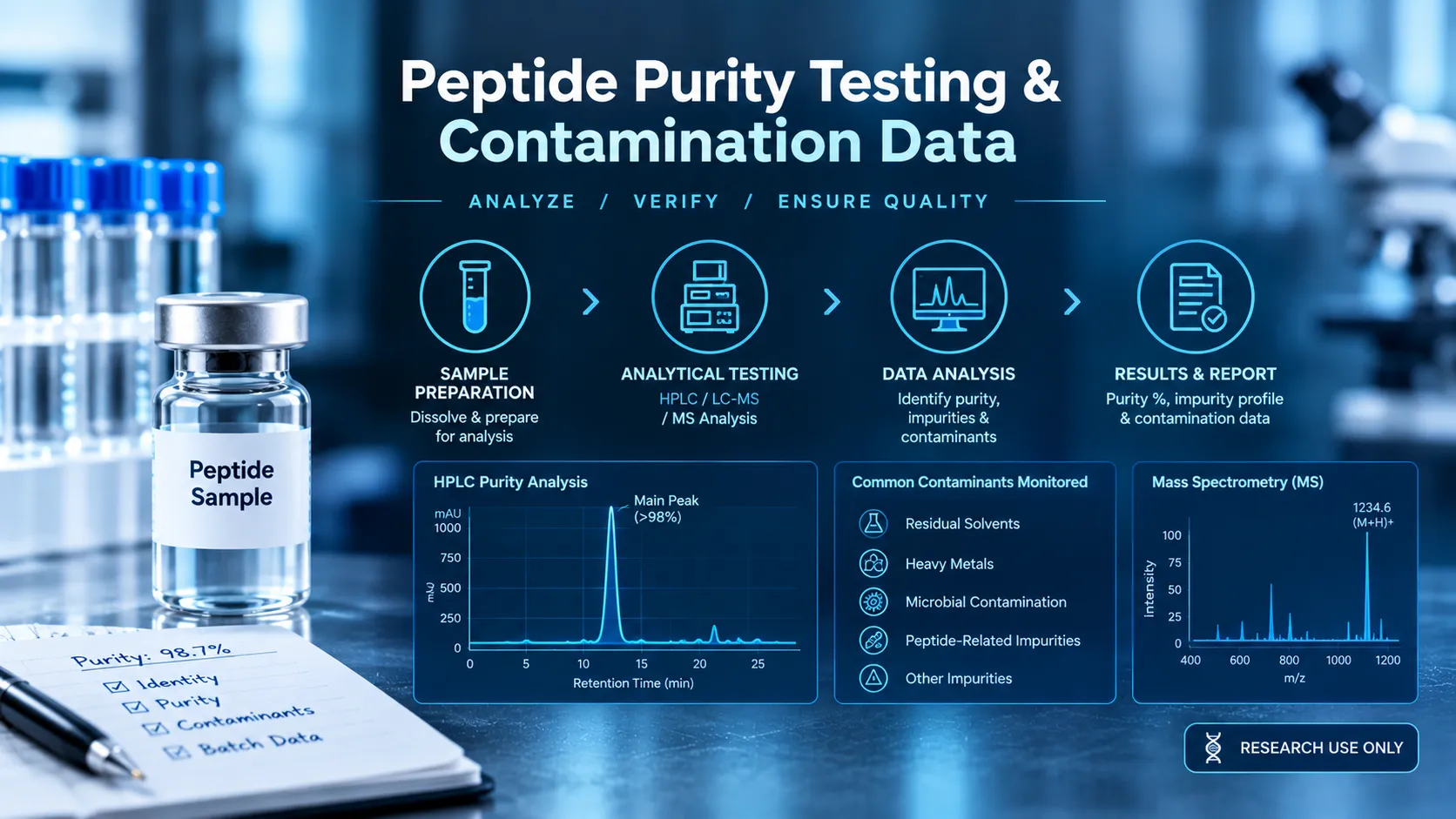
Peptide purity testing measures the proportion of detected material attributable to the target compound under one stated analytical method, most often reversed-phase HPLC.
A 2018 study by Janvier and colleagues screened the ten most frequently encountered falsified peptide drugs on the Belgian market, bought from three suspected illegal internet pharmacies.
That study reported purity between 5% and 75% for the cysteine-containing peptides tested, arsenic above the relevant parenteral limit in six samples, and lead above it in one.
The 5-75% figure describes those tested falsified products and does not establish a purity range for research-use-only materials, for suppliers generally, or for the market as a whole.
HPLC reports relative chromatographic purity and does not confirm molecular identity; mass spectrometry confirms mass and does not establish purity or quantity.
Mass spectrometry cannot distinguish a D-amino acid from its L-form, because the two have identical molecular mass.
A certificate of analysis is a lot-linked record of selected results on a stated date; it does not establish sterility, endotoxin status, potency or stability.
Purity does not mean safety, because sterility, endotoxin level, absolute content, elemental impurities and biological activity each require separate testing.
The 2026 ECRI and ISMP white paper on compounded peptide products is a policy and evidence review; no independent analytical testing by either organisation was identified.
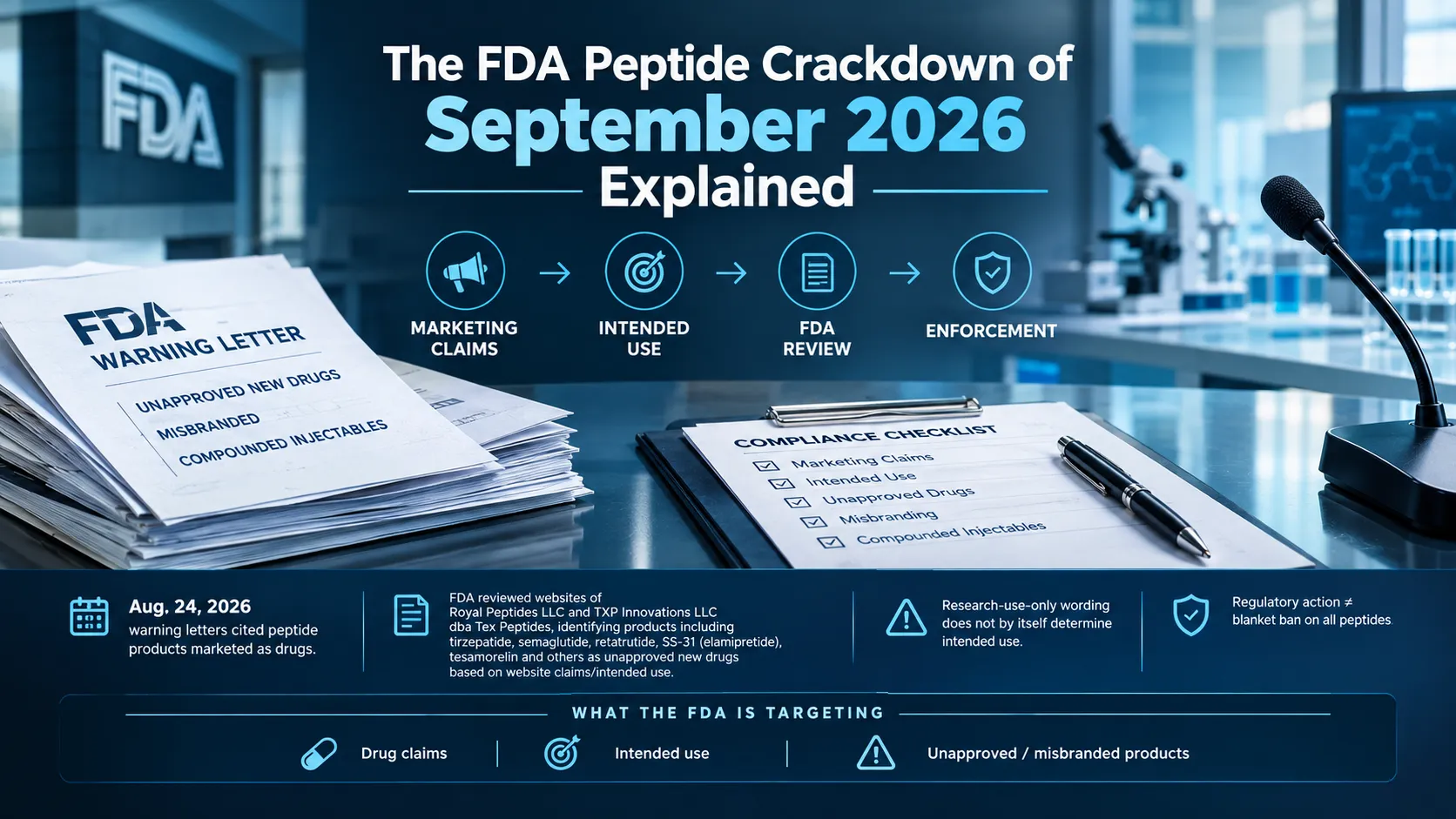
FDA warning letters to peptide sellers concern unapproved new drug status and intended use, not analytical findings about purity or contamination.
Published testing of falsified peptide products has found real quality failures, and almost every figure circulating on this subject traces back to one study with a narrow, specific sample. In a study published in 2018, Janvier and colleagues bought 27 preparations of the ten most frequently encountered falsified peptide drugs on the Belgian market from three suspected illegal internet pharmacies and screened them for active ingredient, related impurities, small-molecule contaminants, elemental impurities and residual solvents. They reported wide variation in how much material each vial held, purity between 5% and 75% for the cysteine-containing peptides, arsenic above the relevant parenteral limit in six samples, and lead above it in one. The samples were sold as "research chemicals", but the work did not estimate how common those failures are, describe suppliers outside its sample, or connect any measurement to a clinical outcome. This article separates what the testing established from what gets attributed to it, and sets out what HPLC, mass spectrometry and a certificate of analysis can each actually settle about a vial.
The evidence base in one table
Source
Year
What it is
Sample scope
Central finding
What it cannot support
Janvier et al., Talanta 188:795–807
2018
Analytical study
27 preparations of 10 falsified peptide drugs, 3 suspected illegal online pharmacies, Belgian market
Purity 5–75% in cysteine-containing peptides; As above the parenteral limit in six samples, Pb in one
A prevalence rate, a market-wide estimate, or any conclusion about suppliers outside the sample
Janvier et al., J Pharm Biomed Anal 161:175–191
2018
Review by the same group
Literature survey of falsified biotherapeutics
Case reports of absent, wrong or under-dosed API; one report of Bacillus cereus in falsified peptide samples
That any of these findings are typical of a defined product category
ECRI and ISMP white paper
2026
Policy and evidence review
Compounded peptide products marketed as wellness therapies
Clinical-evidence gaps, quality concerns, and a proposed minimum evidence standard
New analytical results — no independent testing by ECRI or ISMP was identified
FDA warning letters to peptide sellers
2026
Regulatory correspondence
Named firms, website review
Products alleged to be unapproved new drugs based on marketing and intended use
Any statement about the purity, identity or contamination of those products
DOJ, N.D. Ind., United States v. Kawa
2026
Criminal enforcement record
One vendor
Guilty pleas to introducing unapproved new drugs with intent to defraud and mislead
Evidence of a general contamination trend across the market
What the 2018 study actually tested
The design matters more than the headline number. The authors selected the ten falsified peptide drugs their laboratory encountered most often, sourced them from three suspected illegal internet pharmacies, and ran five separate screening categories against them rather than a single purity assay.
Their reported findings, in the authors' own framing: the overall amount of material present in the vials varied significantly between samples; different peptides carried different sequence-dependent impurities; the lowest purities were measured in cysteine-containing peptides; arsenic exceeded the ICH limit in six samples and lead in one; and speciation analysis showed the arsenic was present in its inorganic form.
The cysteine result has a chemical explanation the authors give directly. In peptides carrying a cystine bridge, they detected reduction of that bridge and the formation of aggregates through disulfide exchange. For some preparations of one cysteine-containing peptide, the total quantity of related impurities reached 95.5%. These are impurities structurally related to the intended molecule, which is exactly the population a reversed-phase chromatogram is designed to resolve — and exactly the population a molecular-mass measurement alone will not.
One detail is routinely dropped when this study is summarised. Of the contaminant screens (residual solvents, small-molecule contaminants and elemental impurities), the authors' own later review states that only the elemental impurities were found at concentrations exceeding the relevant thresholds. Two further findings are often quoted without their context: arsenic reached up to roughly ten times the ICH parenteral limit, and trace residual solvents were detected in every sample, although all solvent levels were well below ICH limits.
The 5–75% figure describes the cysteine-containing peptides among 27 preparations of ten falsified peptide drugs, sold as research chemicals by three suspected illegal online pharmacies in one country. It is not a purity range for research peptides generally, for gray-market products generally, or for any supplier not in that sample.
What the 2026 ECRI and ISMP white paper adds
ECRI and the Institute for Safe Medication Practices published a joint white paper on 5 May 2026 titled "Compounded Peptide Products Marketed as Wellness Therapies". It examines clinical-evidence gaps, quality concerns and emerging safety signals in products marketed for wellness use, and reviews recent FDA policy changes.
It is a policy and evidence document, not a new testing study. No independently commissioned analytical work by either organisation was identified in the publicly available material. Figures attributed in secondary coverage to "the 2026 report" trace back to the earlier analytical literature.
Its most useful contribution to anyone reading analytical documentation is a written evidence bar. For a peptide nominated to the 503A bulks list, the paper proposes: identity confirmed by mass spectrometry with purity of at least 98% under ICH Q3A and Q3B and FDA's May 2021 synthetic peptide impurity guidance; quantification and biological characterisation of impurities present at 0.10% or above; ICH Q1A stability data; bacterial endotoxin and sterility testing under USP chapters 85 and 71; at least one published Phase 1 study in 30 or more participants; and at least one controlled clinical study in a defined indication. The paper also notes that the April 2026 change in the safety classification of several wellness peptides was a policy decision rather than the result of new scientific evidence — a distinction covered separately in the 2026 FDA 503A bulks list vote.
Read as a checklist, that bar is a description of the gap between what a typical purity claim reports and what a full quality picture would require.
What these findings do not establish
Six statements the published record does not support, each of which appears regularly in secondary coverage:
That all gray-market or research-use-only peptides fall within a 5–75% purity range. The sample was 27 preparations of the ten falsified peptide drugs most often seized in Belgium, selected by seizure frequency rather than drawn at random.
That every tested sample contained arsenic or lead. Arsenic exceeded the limit in six samples and lead in one, out of 27 preparations.
That the results establish a national or global prevalence rate. No denominator of the wider market was defined.
That falsified medicines and research-use-only materials are the same category. Falsification is defined by deliberate misrepresentation of identity, composition or source. That is a different question from whether a legitimately supplied research material meets its stated specification. The samples in this study were themselves sold as "research chemicals", so a research-use-only label does not by itself settle which category a product belongs to.
That contamination caused clinical injury in the tested population. No health outcomes were collected in that study.
That a single 2018 snapshot describes the market as it stands in 2026. It describes what was purchased and measured then.
None of this makes the findings unimportant. It makes them evidence about tested products, which is the only kind of evidence an analytical study can produce.
Purity is not one measurement
Most disagreement about peptide quality is really a disagreement about which question is being answered. These are separate properties, established by separate methods, and a result for one says nothing about the others.
Property
What it addresses
What it does not establish
Purity
The proportion of detected material attributable to the target, under a stated method
Whether the material is consistent with the intended molecule
How much is present, or what else is in the vial
Content
Absolute mass or concentration of peptide per unit
Purity, identity, or biological activity
Elemental impurities
Metals present, typically by ICP-MS
Anything about the peptide itself
Sterility
Absence of viable microorganisms under a validated test
Absence of endotoxin, metals or chemical impurities
Three of those rows are almost never on a research-peptide certificate at all. The absence of a result is not a passing result.
What HPLC, mass spectrometry and a COA each establish
Method
Question it answers
Principal limitations
Reversed-phase HPLC
What proportion of detected peak area belongs to the main component
Relative, not absolute; depends on wavelength, gradient, column, integration and reporting threshold; co-eluting or non-absorbing species are invisible; says nothing about identity
Mass spectrometry
Whether an observed mass matches the intended molecule, with sequence information available from MS/MS
Silent on chirality and on quantity; a correct molecular ion can be present alongside substantial unrelated material
Certificate of analysis
What a named laboratory reported for one lot, by stated methods, on a stated date
Describes the sample submitted, not necessarily the vial received; scope is limited to what was tested
Three consequences follow, and they are the practical core of peptide purity analysis.
HPLC does not prove identity. Two different compounds can sit at the same retention time under one method, and a chromatogram carries no molecular information.
Mass spectrometry does not prove purity. It confirms that a mass consistent with the target is present. It does not establish what proportion of the vial that mass represents, and it is blind to a D-amino acid substituted for an L-amino acid, because the two have identical mass.
A certificate proves neither safety nor sterility. It is a lot-linked record of selected results. For the field-by-field mechanics of reading one, the peptide certificate of analysis guide covers lot numbers, net peptide content and document interpretation in detail, and a multi-component blend raises the additional problem that one area-percent figure cannot describe several analytes at once.
An area-percent purity figure becomes interpretable only alongside four things: the detection wavelength, the gradient and column, the integration and reporting threshold, and whether the method was shown to resolve the impurities of interest. Without them, the number is a percentage of something unstated.
How quality problems arise
The 2018 findings describe results, not causes. The mechanisms below are documented in synthetic peptide chemistry generally; attributing any of them to a specific reported result requires evidence the study did not produce.
Mechanism
Status in peptide chemistry
Attribution to the 2018 findings
Incomplete coupling, truncated and deletion sequences
Known consequence of solid-phase synthesis
Not established as the cause of any reported purity figure
Incomplete removal of protecting groups
Known process impurity
Reported as largely absent in the samples examined
Disulfide reduction and aggregation in cysteine-containing peptides
Known chemistry
Reported by the authors in the tested cysteine-containing peptides
Deamidation, aspartimide formation, methionine and tryptophan oxidation
Known modification routes
Reported among detected impurities
Elemental impurities from reagents, catalysts, equipment or containers
Known possible source
Present in multiple samples; the source was not investigated
That last row is the one that separates this literature from ordinary batch-quality failure. A vial containing a different molecule than the label states is not a purity problem; it is an identity problem, and only an identity method will find it. Storage-related change is a different clock again, covered in half-life versus shelf-life.
What regulatory actions show, and what they do not
FDA warning letters to peptide sellers have become frequent, and they are widely cited as proof of contamination. They are not. They concern legal status and intended use.
In the letter to Gram Peptides dated 31 March 2026, FDA stated it had reviewed the firm's website between January and March 2026 and concluded that the products offered were unapproved new drugs under section 505(a) of the Federal Food, Drug, and Cosmetic Act. In the letter to Peptide Partners LLC dated 24 August 2026, FDA stated that despite labelling marketing the products for research use only and not for human or veterinary use, evidence from the website established that the products were intended to be drugs for human use, noting that bacteriostatic water was marketed alongside them as a means of preparing an injectable product. Neither letter reports an analytical result. The legal framework itself is covered in the RUO compliance guide.
The criminal record is more directly relevant to documentation, for a reason that has nothing to do with contamination. In July 2026, the US Attorney's Office for the Northern District of Indiana reported that Matthew Kawa, who operated Paradigm Peptides, and Jennifer Stechkober were sentenced to 70 months and 16 months respectively after pleading guilty to introducing unapproved new drugs into interstate commerce with intent to defraud and mislead, with $78,317.52 in restitution and a $5 million money judgment against Kawa. DOJ reported that the business had told customers it was registered with FDA, manufactured products in its own US laboratories and tested them for quality, while in reality importing product from Asia and not testing it before sale.
That is an enforcement case, not a contamination survey, and it should not be cited as evidence about the market as a whole. What it does demonstrate is narrower and more useful: a certificate is only as good as the laboratory that issued it and the chain that connects it to the vial. A document nobody can trace back to a named laboratory and a real test date is not evidence of anything.
Does purity mean safety?
No. Purity is one dimension of product quality, and a high purity figure is compatible with a product that is unsterile, pyrogenic, degraded, wrongly quantified, or the wrong molecule entirely. Purity establishes proportion under one method. Sterility, endotoxin status, elemental impurities, absolute content and biological activity each require their own test, and none of them can be inferred from a chromatogram.
For research-use-only materials the point extends further. A compound can be analytically excellent and still have no human safety data whatsoever, because no such data has ever been generated. Analytical quality is a statement about the material. It is not a statement about what the material does.
Does source matter for research quality?
Source matters because it determines what can be verified, not because it guarantees an outcome. A supplier's documentation, lot traceability, choice of laboratory and willingness to release lot-specific records set the ceiling on how much of a quality claim an outside reviewer can actually check. The practical evaluation steps sit in the research peptide sourcing checklist.
Nine questions make a purity claim checkable:
Does the lot number on the certificate match the lot number on the vial?
Is the issuing laboratory named, and is it independent of the seller?
What is the test date, and how does it relate to the manufacturing date of that lot?
Which method produced the purity figure, at which detection wavelength?
Does "purity" here mean chromatographic area percent, or net peptide content? They are different quantities.
Which method confirmed identity, and what mass was observed against the expected mass?
Was absolute content or concentration determined, and by what method?
Were elemental impurities, endotoxin or sterility within the scope of testing at all?
Is the certificate specific to one lot, or a generic document reused across the catalogue?
On Helix Bio's own certificates page, the company states that every batch is verified through independent third-party US laboratories using HPLC and mass spectrometry. At the time of writing, the public testing library on that page displays a batch count of zero and states that COA documents are being added, directing researchers to request the certificate for a specific batch. The distinction worth holding onto is between a stated testing process and publicly visible lot-level evidence — and it is a fair question to put to any supplier making a purity claim, including this one. The nine questions above are the form that question should take.
Got Questions?
Frequently Asked Questions
Peptide purity testing is analytical measurement of how much of a sample is attributable to the intended peptide rather than to related impurities, process residues or contaminants. In practice it usually means reversed-phase HPLC reporting an area-percent figure, often paired with mass spectrometry for identity. It is a method-dependent measurement, not a single fixed property of the material.
Most commonly by reversed-phase HPLC with UV detection, where the sample is separated on a column and the main peak is expressed as a percentage of total integrated peak area. The figure depends on the detection wavelength, the gradient, the column, the integration parameters and the reporting threshold. Two laboratories using different methods can report different purities for the same material.
HPLC shows how many distinct components the method can separate and what proportion of detected signal each represents. It is well suited to resolving sequence-related impurities such as truncated or deletion sequences and oxidised forms. It reveals nothing about molecular identity, absolute content, sterility or elemental impurities.
No. A chromatographic peak carries retention-time information, not molecular information, and two different compounds can elute at the same time under a single method. Identity confirmation requires an orthogonal method, most commonly mass spectrometry with fragmentation data.
Mass spectrometry shows whether a measured molecular mass is consistent with the intended peptide, and MS/MS fragmentation can support sequence assignment. It is the standard method for confirming that the molecule in the vial is the molecule on the label. It does not quantify how much of the vial that molecule represents.
No. A sample can produce the correct molecular ion while still containing substantial unrelated material, because the measurement confirms presence rather than proportion. Mass spectrometry is also blind to stereochemistry, so a D-amino acid substituted for an L-amino acid produces an identical mass.
A certificate of analysis reports what a named laboratory measured for one identified lot, by stated methods, on a stated date. It is evidence of a reported result rather than proof of a property, and its value depends on whether the lot number matches the vial and whether the issuing laboratory is identified and independent.
By reading the scope of the certificate rather than its headline figure. Elemental impurities require ICP-MS, endotoxin requires an LAL or equivalent assay, and sterility requires a validated microbiological test, so none of the three appear on a document that lists only HPLC and mass spectrometry. An absent result is not a passing result.
No. Purity describes proportion under one analytical method and says nothing about sterility, endotoxin level, absolute content, stability or biological activity. A research-use-only material can also be analytically excellent while having no human safety data of any kind, because none has been generated.
Janvier and colleagues reported in 2018 that 27 preparations of ten falsified peptide drugs, acquired as research chemicals from three suspected illegal internet pharmacies, varied widely in the amount of material per vial, that purity ranged between 5% and 75% for the cysteine-containing peptides, and that arsenic exceeded the relevant ICH parenteral limit in six samples and lead in one. Speciation analysis showed the arsenic was present in its inorganic form.
The study most often cited for that range does not say so. The figure applies to the cysteine-containing peptides among 27 preparations of ten falsified peptide drugs, sold as research chemicals by three suspected illegal internet pharmacies in one country. It describes those samples, not research peptides in general or any supplier outside the sample.
Source matters because it sets the limit on what can be verified. Lot traceability, a named independent laboratory, a matching lot number and release of lot-specific documentation determine how much of a quality claim an outside reviewer can check. Source alone does not establish quality; it establishes whether quality is checkable.