- Research use only compounds are not evaluated by the FDA, so purity verification is the purchasing researcher's responsibility rather than a regulator's.
- A batch-specific certificate of analysis available before purchase is the single strongest indicator of a documented research peptide supplier.
- Third-party analytical testing removes the conflict of interest present when a supplier grades its own product through in-house-only testing.
- HPLC and mass spectrometry answer different questions: HPLC quantifies purity while mass spectrometry confirms molecular identity, and neither substitutes for the other.
- Lot-level traceability requires that the lot number printed on a vial label matches the lot number on the certificate of analysis supplied with it.
- A supplier returning the same generic certificate for every order of a compound is publishing a marketing document rather than a batch record.
- Visible research-use-only labelling across product pages and packaging indicates compliance, whereas a footer disclaimer beneath consumer-facing copy does not.
- Discrepancies between advertised purity claims and certificate of analysis figures are the highest-signal warning available to a purchaser and require no equipment to detect.
- Compounding pharmacies operating under Sections 503A and 503B are governed by regulatory frameworks that do not apply to research-use-only chemical suppliers.
- Retaining the certificate of analysis, product label, storage notes, and reconstitution records for each lot is what makes an experimental result reconstructible later.
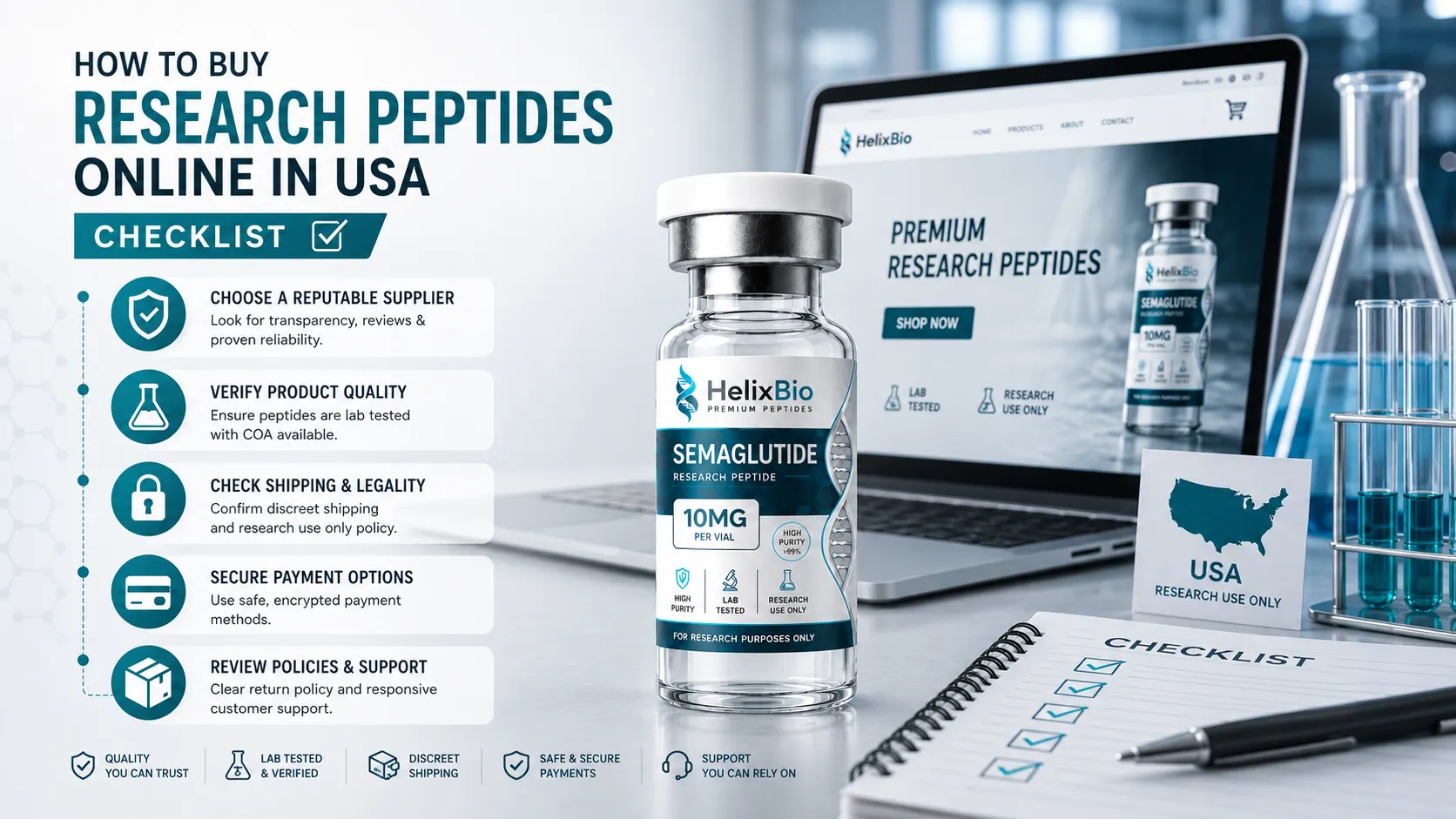
Sourcing research peptides in the United States is a due-diligence exercise, not a shopping decision. Because research-use-only (RUO) compounds sit outside the FDA approval framework that governs prescription drugs, no regulatory body verifies purity claims, batch documentation, or supplier representations before a product reaches a laboratory bench. That verification burden falls entirely on the purchasing researcher. This checklist covers the ten evaluation criteria that separate a documented supplier from a storefront, what each criterion looks like when it is done properly, and the specific questions worth asking before a first order is placed.
Why Supplier Evaluation Is the Researcher's Responsibility
A research use only designation means a compound is supplied strictly for in-vitro laboratory and analytical work. It is not evaluated by the FDA for safety or efficacy in humans, is not manufactured under the pharmaceutical current Good Manufacturing Practice requirements that govern approved drug products, and is not intended for human or veterinary administration in any form.
The practical consequence of that status is that no external authority audits the purity figure printed on a product page. A supplier claiming 99% purity and a supplier claiming 99% purity with a batch-specific HPLC chromatogram attached are making the same claim with entirely different evidentiary weight behind it. Only one of those claims can be checked.
This matters because compound purity directly determines experimental validity. A synthetic peptide containing truncated sequences, residual synthesis solvents, or counterion mass that was not accounted for will produce data — the data will simply be attributable to something other than the compound under study. Impurity-driven results are indistinguishable from real results at the point of measurement.
The single most useful screening question for any US research peptide supplier is whether a batch-specific certificate of analysis is available for review before purchase rather than after delivery. A supplier that can produce the document pre-sale is documenting inventory that already exists. A supplier that cannot is asking for trust in place of evidence.
The Ten-Point Sourcing Checklist
1. Third-party testing rather than in-house-only claims
Independent laboratory analysis means the testing entity has no commercial interest in the result. In-house testing is not inherently invalid — many legitimate manufacturers run internal quality control as a first-pass screen — but in-house-only testing places the supplier in the position of grading its own work.
The distinction to look for is explicit. A supplier performing third-party analysis will name the testing arrangement and publish the resulting analytical data. A supplier using vague language such as "lab tested" or "quality assured" without specifying who performed the testing has not actually made a verifiable claim.
2. Certificate of analysis available before purchase
A batch-specific certificate of analysis (COA) is the primary evidentiary document in peptide sourcing. Reviewing one before ordering, rather than accepting whatever arrives in the box, is the difference between verification and hope.
A complete COA identifies the specific lot, states purity as measured by HPLC, confirms molecular identity by mass spectrometry, and carries a test date. Generic marketing documents that display a purity figure without a lot number are not certificates of analysis regardless of what they are labelled. Our complete guide to reading a peptide certificate of analysis covers each field in detail and explains how to identify a fabricated or mismatched document.
3. Lot-level traceability from document to vial
Traceability is what connects a COA to the physical material in hand. The lot number printed on the vial label must match the lot number on the certificate. Without that match, the document describes some batch — just not necessarily the one on the bench.
Suppliers operating proper lot control can produce the correct COA for any vial on request, because their documentation is indexed by lot rather than by product. Suppliers that return the same PDF for every order of a given compound are publishing a marketing asset, not a batch record.
4. Both HPLC and mass spectrometry, not one alone
High-performance liquid chromatography and mass spectrometry answer different questions and neither substitutes for the other.
HPLC separates the components of a sample and quantifies the target peak as a percentage of total detected material. It establishes how much of the sample is the intended compound. Mass spectrometry measures molecular mass and confirms that the compound present is the one the label names. A sample can be highly pure and be the wrong molecule; a sample can be the right molecule at low purity. Only the two methods together rule out both failure modes.
5. A stated purity threshold rather than a marketing number
There is a meaningful difference between a supplier that publishes a documented purity floor and one that advertises a headline figure. The former commits to a standard applied across a catalogue. The latter quotes a best case.
Look for whether the stated threshold appears alongside disclosure that purity varies by product and lot. That disclosure is a marker of accuracy, not weakness — real analytical results distribute around a threshold rather than landing on a single round number every time.
6. Cold-chain handling and packaging integrity
Peptide stability is temperature-dependent, and transit is often the least controlled leg of a compound's life. Suppliers that take stability seriously ship with insulated packaging and coolant appropriate to the transit window, and they state what that packaging is.
Lyophilized material tolerates transit conditions considerably better than solution-phase material, which is one reason dry format is the default for shipped research compounds. Our comparison of nasal spray versus lyophilized vial formats covers how format choice interacts with shipping and storage stability.
7. Visible RUO labelling rather than buried disclaimers
Compliant suppliers keep research-use-only status visible on product pages, packaging, and documentation. Non-compliant suppliers place a disclaimer in a footer while the surrounding copy discusses human outcomes, protocols, or benefits.
The tell is language consistency. A supplier writing genuinely for a research audience describes compounds in terms of mechanism, receptor activity, and study models. A supplier writing for a consumer audience describes results, dosing, and personal outcomes while relying on a legal disclaimer to cover the gap. The disclaimer does not neutralise the surrounding content.
8. Identifiable company information
Verifiable business identity is a baseline requirement. That means a physical business address, a working telephone number, a company-domain email address, and named support hours.
Anonymous storefronts operating only through a contact form present a specific practical risk: there is no recourse path when a lot arrives mis-labelled, and no entity to hold to a documented standard. Named suppliers can be evaluated on record over time. Anonymous ones cannot.
9. Clear refund, shipping, and dispute terms
Published policies indicate an operating business with defined processes. What matters is not generosity but specificity — a policy stating exactly what happens when a shipment is damaged, delayed, or documented incorrectly is more useful than a broad satisfaction guarantee with no mechanism attached.
Read the refund policy specifically for how documentation disputes are handled. That clause reveals whether a supplier treats a COA mismatch as a serious quality event or a customer service inconvenience.
10. Consistency between advertising and documentation
The final check is a cross-reference rather than a new criterion. Compare the purity claim on the product page against the figure on the COA. Compare the compound name on the label against the molecular weight on the mass spectrometry report. Compare the storage guidance in the FAQ against the guidance on the packaging.
Discrepancies between marketing claims and analytical documents are the highest-signal warning available in this category, because they require no laboratory equipment to detect. A supplier whose documents contradict its own marketing has told a researcher everything necessary.
Scoring a Supplier Against the Checklist
Criterion | Documented supplier | Storefront | How to verify |
|---|---|---|---|
Testing arrangement | Independent third-party analysis | "Lab tested," unspecified | Ask who performs testing |
COA availability | Provided before purchase | Provided after, or not at all | Request one pre-order |
Lot traceability | Vial lot matches COA lot | Same generic PDF for all orders | Compare label to document |
Analytical methods | HPLC and MS together | One method, or unspecified | Check COA for both reports |
Purity standard | Published threshold with lot variance noted | Single headline number | Compare page claim to COA |
Cold-chain | Stated packaging and coolant | Unspecified | Ask before ordering |
RUO labelling | Visible across site and packaging | Footer disclaimer only | Read surrounding copy |
Company identity | Address, phone, named hours | Contact form only | Attempt direct contact |
Policies | Specific dispute mechanisms | Generic or absent | Read refund clause |
Claim consistency | Marketing matches documents | Figures diverge | Cross-reference both |
Questions Worth Asking Before a First Order
Direct questions produce more information than a website review, largely because the quality of an answer is itself data. Four questions are particularly efficient:
- Is every batch independently tested, and by what analytical methods?
- Can a batch-specific certificate of analysis be reviewed before purchase?
- What purity threshold applies across the catalogue, and how is lot-level variance disclosed?
- How are compounds packaged and handled in transit?
A supplier that answers all four in specific terms has documented processes. A supplier that answers in general reassurances has marketing copy. The response time and precision of the answers are frequently more informative than the answers themselves.
Compliance Considerations for US Purchasers
Several compliance points are worth understanding before ordering research peptides in the United States, because they shape what a legitimate supplier can and cannot say.
RUO compounds are not approved drugs. They have not been evaluated by the FDA for safety or efficacy in humans and are not intended to diagnose, treat, cure, or prevent any condition. A supplier making therapeutic claims about an RUO compound is making a claim it is not permitted to make.
Research-grade material is not compounded pharmaceutical material. Compounding pharmacies operating under Sections 503A and 503B of the Federal Food, Drug, and Cosmetic Act are subject to regulatory frameworks that do not apply to RUO research chemical suppliers. The two categories are frequently conflated in marketing copy and should not be.
Purchaser eligibility is a supplier policy. Most US research peptide suppliers restrict ordering to adults and require acknowledgement of research-use terms at checkout. These are supplier-imposed conditions rather than uniform federal requirements, which is why they vary between vendors.
Some compounds carry additional restrictions. Certain research compounds are subject to state-level rules or shipping limitations independent of their RUO status. Suppliers operating compliantly disclose these restrictions at checkout rather than after an order is placed. The Helix Bio FAQ addresses compliance and ordering questions in detail.
Research compounds supplied under RUO terms are intended exclusively for laboratory and scientific investigation. They are not for human or veterinary use and are not intended for ingestion, injection, or any form of administration. Any supplier presenting RUO compounds alongside human dosing guidance is operating outside the terms of that designation.
Documentation to Retain After Ordering
Sourcing does not end at delivery. Four records should be retained for every lot entering a laboratory:
- The batch-specific certificate of analysis, matched by lot number to the vial received
- The product label or a photograph of it, capturing lot number and stated content
- Receipt and storage-condition notes, including the state of the shipment on arrival
- Reconstitution records where applicable, noting diluent, volume, resulting concentration, and date
This record set is what makes a result reconstructible months later. When an experiment produces an anomalous outcome, the ability to trace back to a specific analysed lot is what distinguishes a debuggable protocol from an unexplainable one. Our peptide calculator supports the reconstitution arithmetic in that final record.
Applying the Checklist
The ten criteria above collapse into a single underlying question: can each claim be checked against a document? Third-party testing is checkable. A batch-specific COA is checkable. Lot traceability is checkable. Company identity is checkable. Claim consistency is checkable by anyone with two browser tabs open.
Marketing language is not checkable, which is precisely why it is the default output of suppliers with nothing to publish. Evaluating a supplier is largely a matter of separating the two categories and weighting accordingly. Researchers comparing suppliers can review the Helix Bio catalogue and the company documentation standards against every criterion on this list.
Frequently Asked Questions
Research peptides are sold in the United States as research-use-only laboratory materials, which places them outside the FDA approval framework governing prescription drugs. They are supplied strictly for in-vitro laboratory and analytical research and are not approved for, or intended for, human or veterinary administration. Individual compounds may carry additional state-level or shipping restrictions that a compliant supplier discloses at checkout.
The most reliable indicators are third-party batch testing rather than in-house-only claims, a batch-specific certificate of analysis available for review before purchase, lot numbers that match between vial and document, and identifiable company information including a physical address and working telephone number. Consistency between what a supplier advertises and what its analytical documents actually show is the strongest single signal.
Yes. Requesting a batch-specific certificate of analysis before purchase is the most efficient screening step available, because it tests whether documented inventory actually exists. A supplier able to produce a lot-specific document pre-sale is operating lot control; one that offers a certificate only after delivery, or not at all, is asking for trust in place of evidence.
In-house testing is performed by the supplier or its manufacturer, meaning the entity making the purity claim is also the entity verifying it. Third-party testing is performed by an independent laboratory with no commercial interest in the result. In-house quality control is not inherently invalid as a first-pass screen, but it cannot resolve the conflict of interest that independent analysis is designed to eliminate.
Peptide synthesis produces batch-to-batch variation in purity and impurity profile, so a purity figure is only meaningful in reference to the specific lot it was measured from. A certificate without a lot number, or one that does not match the number on the vial label, describes some batch that may not be the material actually in hand.
Research-grade peptides are typically synthesised and tested to a documented threshold of 98% or higher as measured by HPLC. More important than the specific figure is whether the supplier publishes the threshold as a catalogue-wide standard and discloses that results vary by product and lot, since real analytical data distributes around a threshold rather than landing on a single round number.
Peptide stability is temperature-dependent, so suppliers taking stability seriously ship with insulated packaging and coolant appropriate to the transit window and state what that packaging consists of. Lyophilized material tolerates transit conditions considerably better than solution-phase material, which is why dry format is the default for shipped research compounds.
Four records should be kept for every lot: the batch-specific certificate of analysis matched by lot number, the product label or a photograph capturing lot and stated content, receipt and storage-condition notes describing the state of the shipment on arrival, and reconstitution records noting diluent, volume, resulting concentration, and date. This set is what makes an anomalous result traceable months later.
No. Compounding pharmacies operate under Sections 503A and 503B of the Federal Food, Drug, and Cosmetic Act and are subject to regulatory frameworks that do not apply to research-use-only chemical suppliers. The two categories are frequently conflated in marketing copy but involve entirely different oversight, permitted claims, and intended use.
Check that the lot number on the document matches the vial label, that a test date is present, that both an HPLC purity figure and a mass spectrometry molecular weight confirmation appear, and that the analytical figures are consistent with the purity claimed on the product page. A certificate displaying a purity percentage without an identifiable lot or test date is a marketing asset rather than a batch record.
Age restrictions on research peptide ordering are typically supplier-imposed policies rather than uniform federal requirements, which is why the specific threshold and verification process vary between vendors. Most US suppliers restrict purchasing to adults and require acknowledgement of research-use-only terms at checkout as a condition of sale.
Research use only means the compound is supplied strictly for in-vitro laboratory and scientific investigation and has not been evaluated by the FDA for safety or efficacy in humans. It is not intended to diagnose, treat, cure, or prevent any condition, and is not for human or veterinary use, ingestion, injection, or any form of administration.
- 01U.S. Food and Drug Administration. Compounding and the FDA: Questions and Answers.
- 02U.S. Food and Drug Administration. Research Use Only and Investigational Use Only In Vitro Diagnostic Devices: Guidance for Industry and FDA Staff.
- 03U.S. Food and Drug Administration. Section 503A of the Federal Food, Drug, and Cosmetic Act.
- 04Sanz-Nebot V, et al. Characterization of synthetic peptides by liquid chromatography and mass spectrometry. Journal of Chromatography A.
- 05Manning MC, Chou DK, Murphy BM, Payne RW, Katayama DS. Stability of protein pharmaceuticals: an update. Pharmaceutical Research. 2010;27(4):544-575.
Helix Bio Chem Team
Research & Product Team
Our in-house team tracks published peptide research and translates it into clear, source-cited summaries for the research community.
Reviewed by in-house research chemists
support@helixbiochem.com