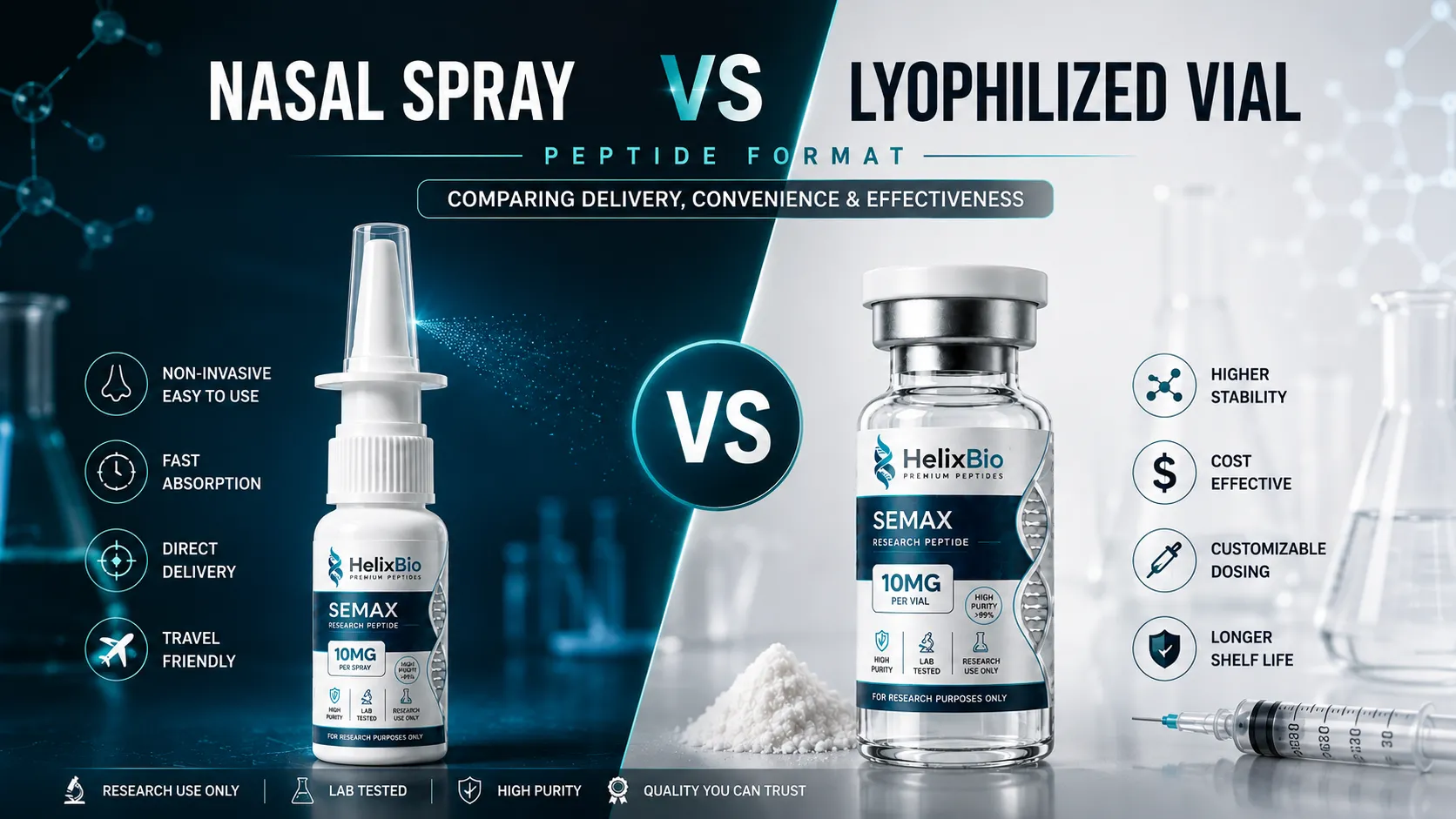
- Lyophilized peptides are freeze-dried solids requiring reconstitution, while spray formats arrive pre-dissolved at a fixed manufacturer-set concentration.
- Removing water through lyophilization removes the medium for hydrolysis and deamidation, which is why dry-state peptides store far longer than solutions.
- Concentration is set by the researcher at reconstitution in vial format, and set at manufacture in spray format.
- Spray-format research materials are refrigerated and never frozen, because freezing risks both compound degradation and mechanical failure of the pump.
- Metered pumps must be primed before first recorded use, since unprimed actuations dispense less than the rated volume.
- Net peptide content on the certificate of analysis, not the nominal label weight, is the correct basis for reconstitution math.
- Reconstituted material inherits the freeze-thaw vulnerability of any aqueous peptide preparation, which is why single-use aliquoting is standard practice.
- Lot numbers should be logged alongside concentration and preparation date in both formats, because batch effects cannot be resolved retrospectively without them.
Research peptides arrive at the bench in two fundamentally different physical states, and that difference changes almost every downstream handling decision a laboratory makes. A lyophilized vial contains a dry, freeze-dried powder that must be reconstituted before use. A spray-format preparation arrives pre-solubilized in a metered-dose container, already in aqueous solution. The compound inside may be chemically identical, but the two formats behave differently in storage, differ in how concentration is established, and are documented differently on a certificate of analysis. This guide explains what separates the two formats at the chemistry level, where each appears in laboratory research, and how handling protocols should change depending on which format is on the shelf.
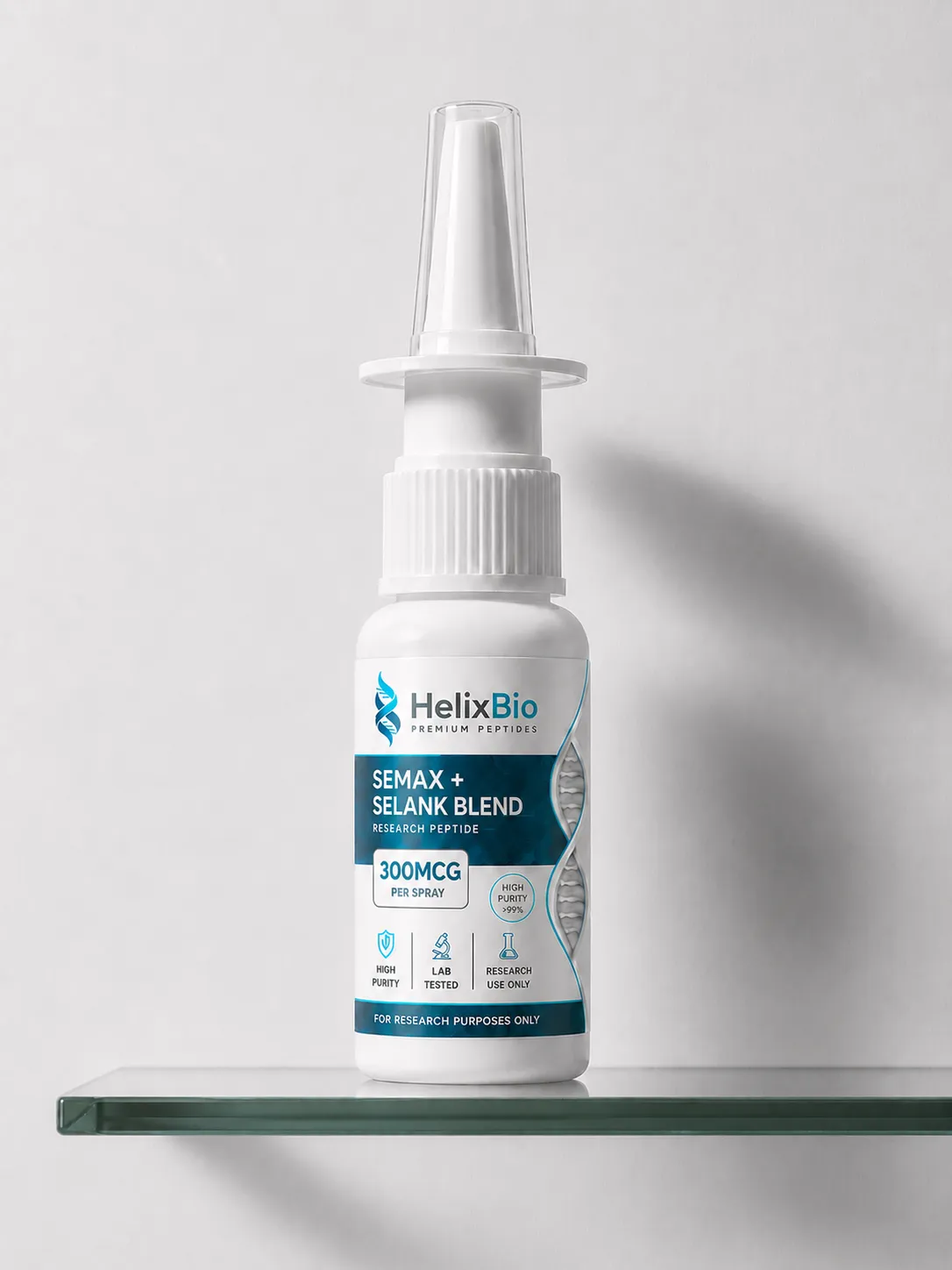
Semax + Selank Blend Spray
RESEARCH PEPTIDE
Semax + Selank Blend Spray is a research-use-only peptide preparation combining two synthetic heptapeptides, Semax and Selank, for controlled laboratory and scientific investigation. Semax is structurally related to the ACTH(4–10) peptide fragment, while Selank is a synthetic analogue of the endogenous peptide tuftsin. The combination is relevant to research involving peptide structure, molecular signaling, neurobiology, receptor interactions, enzymatic activity, and related biochemical pathways. Helix Bio supplies research materials for laboratory use only. This product is not intended for human or veterinary administration.
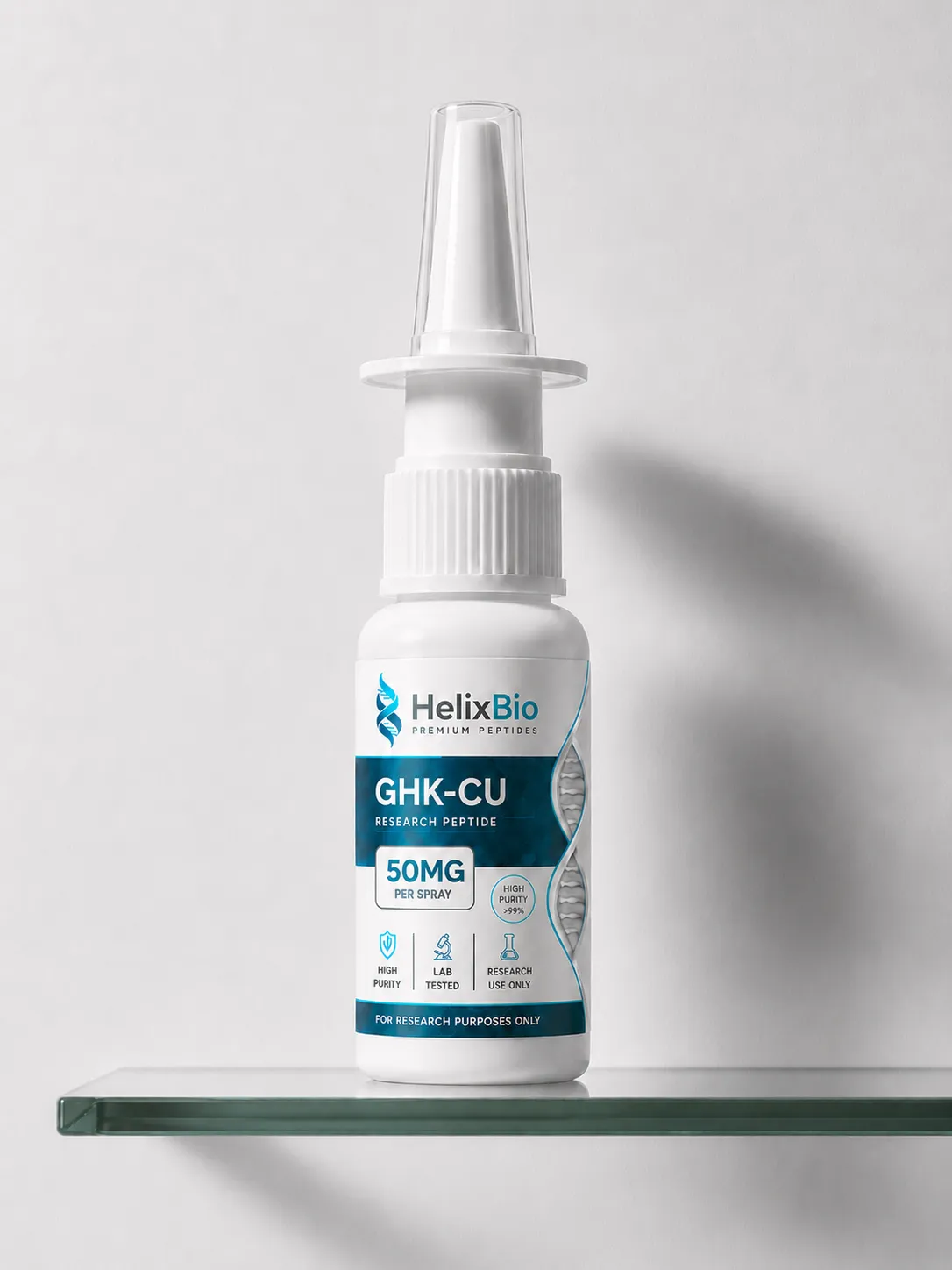
GHK-CU Spray
RESEARCH PEPTIDE
GHK-Cu Spray is a research-use formulation containing GHK-Cu, the copper complex of glycyl-L-histidyl-L-lysine (GHK). GHK is a naturally occurring tripeptide that has been investigated extensively for its copper-binding properties, cellular signaling, extracellular-matrix biology, and tissue-remodeling mechanisms. Helix Bio supplies GHK-Cu Spray strictly for laboratory and scientific research. It is intended for qualified researchers studying copper-peptide chemistry, cellular pathways, peptide biology, and related experimental models. It is not intended for human or veterinary administration.
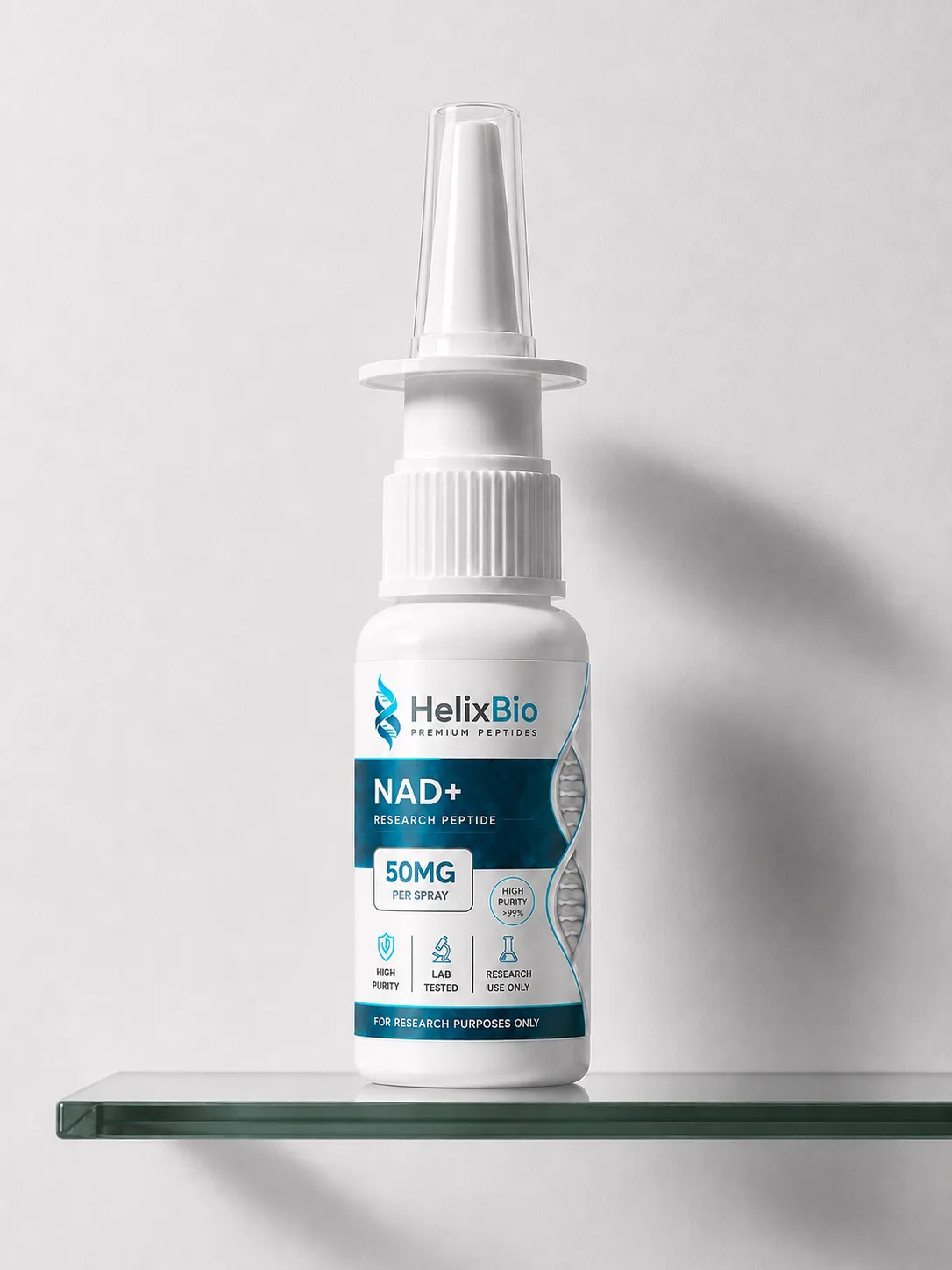
NAD+ Spray
RESEARCH PEPTIDE
NAD+ Spray is a research-use formulation containing nicotinamide adenine dinucleotide (NAD+), an essential cellular coenzyme involved in redox reactions and several biochemical signaling processes. NAD+ research spans cellular metabolism, mitochondrial biology, oxidative phosphorylation, DNA repair, and NAD-dependent enzyme activity. Helix Bio supplies NAD+ Spray strictly as a research and laboratory material. It is intended for qualified researchers investigating NAD+ biology and related biochemical pathways and is not intended for human or veterinary administration.
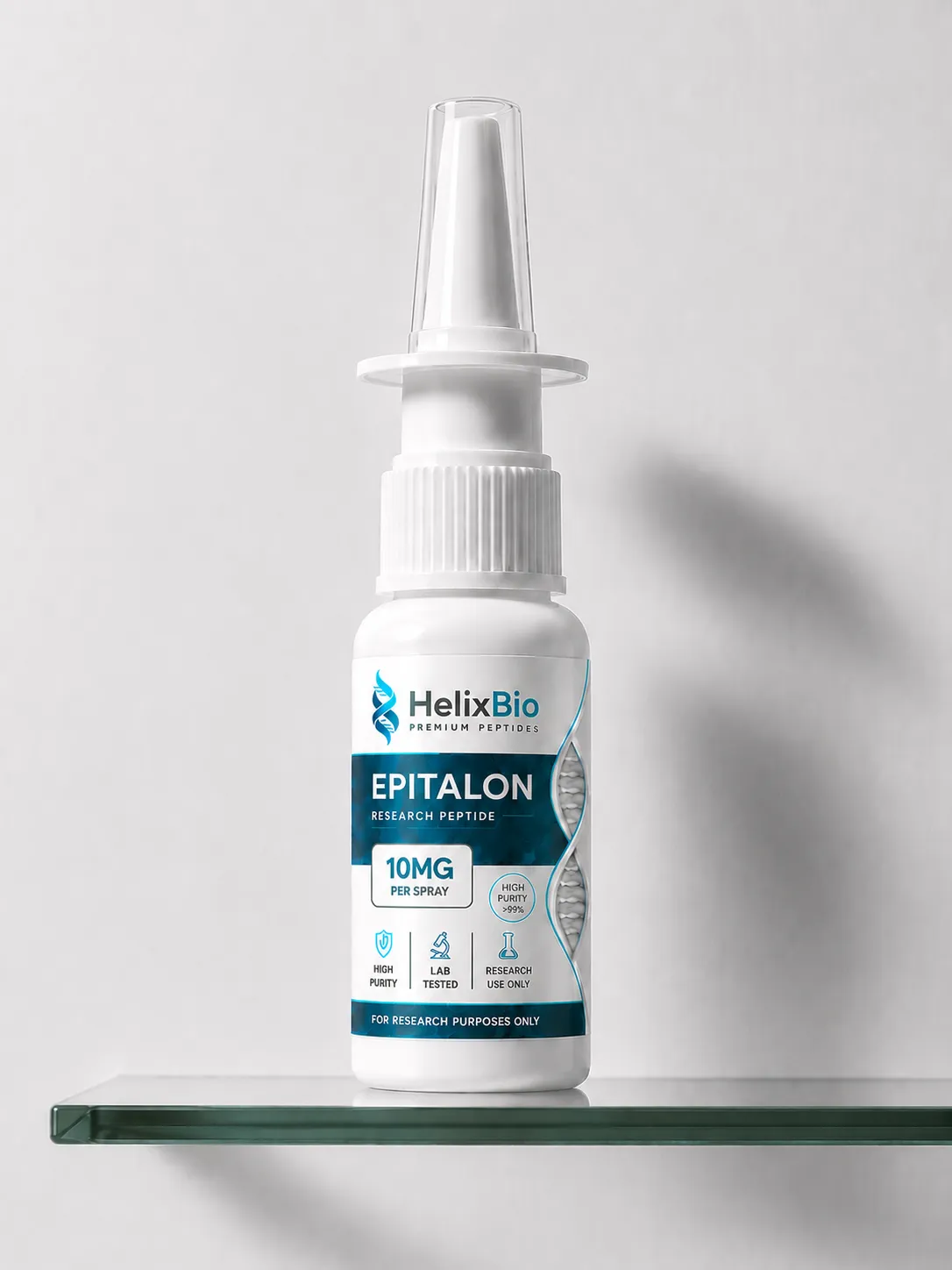
Epitalon Spray
RESEARCH PEPTIDE
Epitalon Spray is a research-use-only preparation featuring Epitalon, also known as AEDG (Ala-Glu-Asp-Gly), a synthetic tetrapeptide studied in cellular, molecular, neurobiology, and aging-related research. Published research has examined Epitalon in areas including gene expression, chromatin biology, neuronal activity, and pineal-related signaling. Helix Bio supplies research materials for laboratory and scientific applications. This product is intended exclusively for controlled research and laboratory work and is not intended for human or veterinary administration.
Two Formats, Two Different Physical States
The distinction is not a packaging preference. It is a difference in the physical chemistry of how the peptide is being held, and it is best understood as the difference between a stable intermediate and a finished preparation.
What lyophilization actually does
Lyophilization, also called freeze-drying, removes water from a frozen peptide solution by sublimation under vacuum rather than by evaporative heating. The material is frozen, pressure is dropped below the triple point of water, and ice converts directly to vapor. What remains is a porous solid cake containing the peptide, any bulking agents or cryoprotectants used in the formulation, and a small quantity of residual moisture.
The purpose of this process is chemical rather than logistical. Water is the medium for the two most common peptide degradation pathways: hydrolytic cleavage of the amide backbone and deamidation of asparagine and glutamine residues. Removing bulk water removes the reaction medium. The lyophilization process itself imposes freezing and drying stresses on a peptide, which is why formulation excipients and cycle design are treated as determinants of final product integrity rather than incidental details.
A lyophilized vial is best described as a research compound in storage form. It carries no working concentration at all until a researcher introduces a measured volume of diluent and calculates one.
What a pre-solubilized spray format is
A spray-format preparation contains the compound already dissolved in an aqueous carrier, sealed in a container fitted with a metered pump. The concentration is fixed by the manufacturer, and each actuation dispenses a defined volume of that solution.
Two consequences follow directly. First, concentration is not a researcher variable — total peptide mass and fill volume are both defined on the label and the certificate of analysis. Second, the stability clock started when the solution was prepared, not when the container was opened. A solution-phase preparation is chemically active from day one in a way a dry cake is not.
What the format gives up in flexibility it returns in reduced preparation error. No reconstitution, no diluent selection, no transfer step, and no dissolution judgement call.
Spray-format research preparations are laboratory materials only. The metered pump is a container mechanism for controlled volumetric dispensing in a research setting. It is not an indication that the material is intended for nasal, oral, or any other form of administration. Products are supplied for in-vitro laboratory research and are not for human or veterinary use.
Side-by-Side Format Comparison
Attribute | Lyophilized Vial | Spray Format (Pre-Solubilized) |
|---|---|---|
Physical state on arrival | Dry porous solid or powder | Aqueous solution |
Concentration on arrival | Undefined until reconstituted | Fixed at manufacture |
Preparation required | Reconstitution with a suitable diluent | None |
Unopened storage stability | Longest of the two; typically frozen or refrigerated | Shorter; refrigerated, solution-phase |
Stability clock starts | At reconstitution | At manufacture |
Primary degradation risks | Moisture ingress, freeze-thaw after reconstitution | Hydrolysis, deamidation, oxidation, adsorption |
Measurement variable | Volume drawn from a calculated concentration | Number of metered actuations |
Main sources of error | Diluent volume, transfer loss, incomplete dissolution | Priming state, actuator blockage, temperature at use |
Best suited to | Protocols requiring specific or varied concentrations | Protocols requiring format consistency across sessions |
Stability and Shelf Life: Where the Formats Diverge
Stability is the largest practical difference between the two formats, and it reduces to one variable.
Water is the limiting variable
Peptide bonds are susceptible to hydrolytic cleavage, and several amino acid residues are vulnerable to chemical modification in aqueous environments. Asparagine and glutamine residues undergo deamidation in solution. Methionine, cysteine, and tryptophan residues are prone to oxidation. Each of these pathways requires water as a medium or participant, which is why removing water is the standard approach to extending peptide shelf life. A lyophilized peptide stored cold and dry is chemically quiet; the same peptide in solution is chemically active, and its degradation rate scales with temperature.
This is why an unopened lyophilized vial and a spray preparation of the same compound cannot be assigned the same shelf life, even when both sit in the same refrigerator.
Freeze-thaw and temperature cycling
Repeated freeze-thaw cycling damages peptides in solution because ice crystal formation concentrates solutes at the freezing front and generates interfacial stress. Lyophilized material avoids this entirely while it remains dry, which is the format's core advantage for long-term inventory. Once a vial is reconstituted, it inherits the same freeze-thaw vulnerability as any other solution, which is why aliquoting into single-use volumes at the point of reconstitution is standard laboratory practice.
Spray-format materials should not be frozen at all. Freezing an aqueous formulation inside a pump container risks both compound degradation and mechanical failure of the actuator and dip tube.
Never assume the two formats share a storage protocol. Lyophilized vials are typically stored frozen or refrigerated and protected from light and moisture until reconstitution. Pre-solubilized formats are refrigerated, never frozen, and carry a shorter documented stability window because the compound has been in solution since manufacture. Applying a lyophilized storage rule to a spray product is one of the most common inventory errors in a mixed-format catalog.
For a fuller treatment of temperature, light, and moisture failure modes across both formats, see our guide to storage mistakes that degrade research compounds.
Concentration Accuracy: Two Different Problems
Both formats can produce accurate, reproducible concentrations. They simply move the accuracy burden to different points in the workflow.
The vial problem: researcher-controlled concentration
With a lyophilized vial, concentration is a calculation. The researcher divides the net peptide content stated on the certificate of analysis by the volume of diluent added. Accuracy therefore depends on three things: knowing the true net peptide mass rather than the gross vial weight, measuring diluent volume precisely, and achieving complete dissolution before any volume is drawn.
Incomplete dissolution is the underrated failure here. A peptide that has not fully entered solution produces a concentration gradient in the vial, so the first volume drawn will not match the last. Directing the diluent stream down the interior wall rather than onto the cake, then swirling gently, is standard practice for this reason. Our peptide reconstitution guide covers diluent selection and dissolution technique in full, and the unit conversion guide covers the mg, mcg, mL, and IU arithmetic that follows.
The spray problem: fixed concentration, variable actuation
With a spray format, the concentration is already established and cannot be adjusted. Accuracy instead depends on the container performing consistently. Metered pumps require priming before first use, and an unprimed or partially primed pump dispenses less than its rated volume. Actuation volume can also vary with temperature, with the angle of the container, and with how much solution remains in the reservoir, since dip tubes draw poorly at very low fill levels.
Variable | Vial Workflow | Spray Workflow |
|---|---|---|
Who sets concentration | Researcher, at reconstitution | Manufacturer, at fill |
Main accuracy risk | Reconstitution math and incomplete dissolution | Priming state and actuation consistency |
Adjustable mid-study | Yes, by reconstituting at a different volume | No |
Records required | Net peptide content, diluent volume, date of reconstitution | Concentration per actuation, actuation volume, lot number |
Reproducibility strength | High, if reconstitution is logged precisely | High, if the container is primed and handled uniformly |
Why Solution-Phase Formats Appear in the Research Literature
Solution-phase and intranasal preparations occupy a specific place in delivery research, and understanding why explains the format's presence in a research catalog at all.
The nasal cavity contains olfactory and trigeminal nerve pathways that connect to the central nervous system without crossing the blood-brain barrier. Published reviews of intranasal biologic delivery describe both the anatomical basis for this transport and the experimental considerations that govern it in animal models. That literature also notes that physicochemical properties — molecular weight, lipophilicity, formulation pH — strongly influence how much material transfers across the nasal epithelium in study models.
This body of work is why compounds such as Semax, Selank, Oxytocin, and GHK-Cu appear in solution-phase research preparations rather than exclusively as lyophilized powders. Compounds studied in neurobiology, receptor pharmacology, and central signaling research are frequently formulated this way in published models because the delivery route is a variable under investigation.
It is worth being precise about what this literature does and does not establish. Nose-to-brain transport is an active area of investigation with results that vary substantially by compound, species, and formulation. Research materials in spray format are supplied for laboratory investigation of these questions, not as evidence that any particular transport outcome occurs, and not as a route of administration for any organism.
Handling Protocols by Format
Lyophilized vial protocol
- Inspect the vial for an intact seal, a visible cake, and a legible lot number before anything else.
- Confirm net peptide content on the batch-specific certificate of analysis rather than assuming the label's nominal milligram figure.
- Allow the vial to reach room temperature before opening, so atmospheric moisture does not condense onto cold, hygroscopic powder.
- Add diluent slowly down the interior wall of the vial rather than directly onto the cake.
- Swirl gently until fully dissolved; do not shake, since agitation promotes aggregation at the air-liquid interface.
- Record diluent volume, resulting concentration, date, and lot number in a single log entry.
- Aliquot into single-use volumes if the material will be used across multiple sessions, then refrigerate.
Spray format protocol
- Verify the lot number and stated concentration per actuation against the certificate of analysis on receipt.
- Store refrigerated and upright; do not freeze.
- Prime the pump according to product documentation before first recorded use, and exclude priming actuations from any measurement record.
- Allow the container to reach a consistent handling temperature before each session, since actuation volume varies with viscosity.
- Keep the actuator clean and capped between sessions to reduce contamination risk at the orifice.
- Log the number of actuations used per session rather than estimating remaining volume by sight or weight.
- Discontinue use at the documented stability window rather than when the reservoir empties.
Whichever format a protocol uses, the lot number is the anchor for reproducibility. Log it in the same record as the concentration and the preparation date. Two lots of the same compound at the same nominal purity may still differ in net peptide content, and a study that does not record lot numbers cannot resolve batch effects after the fact.
Choosing a Format for a Research Protocol
The right format is determined by the protocol, not by convenience.
If the protocol requires... | Preferred format | Reason |
|---|---|---|
A specific molar concentration | Lyophilized vial | Concentration is set at reconstitution |
Several concentrations from one compound | Lyophilized vial | One vial can yield any concentration within range |
Long-term inventory before use | Lyophilized vial | Dry-state stability is substantially longer |
Minimal preparation steps between sessions | Spray format | No reconstitution, no transfer |
Consistency across many short sessions | Spray format | Fixed concentration removes preparation drift |
Investigation of solution-phase delivery itself | Spray format | The format is the variable under study |
Handling without reliable cold-chain at the bench | Lyophilized vial | Dry material tolerates handling conditions better |
Helix Bio supplies both formats. The nasal spray category includes the Semax + Selank Blend Spray, GHK-Cu Spray, NAD+ Spray, and Epitalon Spray, alongside lyophilized vials across the wider catalog. Every item in either format ships with a batch-specific certificate of analysis.
Documentation Differences on the Certificate of Analysis
The two formats generate different documentation, and knowing which figures to look for prevents misreading a batch record.
A lyophilized vial's certificate reports purity measured by HPLC, molecular identity confirmed by mass spectrometry, and, on a complete document, net peptide content. Net peptide content is the figure that matters for reconstitution, because gross vial mass includes residual moisture and counterion — typically trifluoroacetate carried over from reversed-phase purification. A vial labelled 10 mg does not necessarily contain 10 mg of peptide.
A spray-format certificate reports the same purity and identity data for the peptide used, plus the concentration of the finished solution and the volume dispensed per actuation. The operative figure for a researcher is concentration per actuation, not total milligram content of the reservoir.
Both formats are only as verifiable as the batch document behind them, and the fields worth checking are covered field by field in our guide on how to read a peptide certificate of analysis.
Common Handling Errors Across Both Formats
- Treating nominal label weight as net peptide content. The certificate of analysis governs, not the label.
- Freezing a spray container. This risks compound degradation and mechanical failure of the pump.
- Opening a cold lyophilized vial. Condensation onto hygroscopic powder introduces moisture into material formulated specifically to exclude it.
- Failing to prime a metered pump. Early actuations then under-dispense relative to the rated volume.
- Shaking rather than swirling during reconstitution. Agitation at the air-liquid interface promotes aggregation.
- Keeping reconstituted solution in the original vial across many sessions. Repeated septum punctures and temperature cycling both degrade the material.
- Not logging lot numbers. Batch effects become unresolvable in retrospect.
Compliance Framing
All research peptides supplied by Helix Bio, in either format, are offered strictly for laboratory and in-vitro research. They are not intended for human or veterinary use, ingestion, injection, or any form of administration. A spray format is a laboratory presentation of a research material; it is not a therapeutic product, and the presence of a dispensing container does not imply an approved route of administration in any context. Research-use-only labeling is a regulatory designation with specific meaning, and materials carrying it are not evaluated by the FDA for safety or efficacy outside a research setting.
Researchers evaluating either format should confirm purity, identity, and lot documentation before use. Our FAQ knowledge base covers compliance and documentation questions in more depth, and the peptide calculator supports concentration work for lyophilized material.
Frequently Asked Questions
An unopened lyophilized vial has the longer documented stability window, because removing bulk water removes the medium in which hydrolysis and deamidation proceed. A pre-solubilized spray has been in aqueous solution since manufacture, so its stability clock started earlier and runs faster. Researchers should follow the lot-specific window stated on each product's documentation rather than applying one storage rule across both formats.
Freezing is not recommended for spray-format research materials. Ice formation in an aqueous formulation concentrates solutes at the freezing front and creates interfacial stress that degrades peptides, and freezing can also damage the pump mechanism and dip tube. Spray formats are stored refrigerated and upright.
Gross vial mass includes residual moisture and counterion, most commonly trifluoroacetate carried over from reversed-phase purification, in addition to the peptide itself. Net peptide content is the figure that reports actual peptide mass, and it appears on a complete certificate of analysis. Reconstitution calculations should use net peptide content rather than the nominal label figure.
Concentration in a spray format is fixed at manufacture and stated on the certificate of analysis, usually as mass per actuation alongside the actuation volume. Researchers do not adjust it; they record the number of actuations used. This makes priming state and handling consistency the main accuracy variables rather than reconstitution arithmetic.
The most common causes are an unprimed or partially primed pump, use at a temperature different from previous sessions, a very low reservoir level where the dip tube draws poorly, and partial blockage at the actuator orifice. Priming according to product documentation and allowing the container to reach a consistent handling temperature before each session addresses most of this variance.
No. Cold glass and cold hygroscopic powder cause atmospheric moisture to condense inside the vial the moment the seal is broken, introducing water into material specifically formulated to exclude it. Allowing the vial to equilibrate to room temperature before opening avoids this.
Agitation generates air-liquid interfaces where peptides can unfold and aggregate, reducing the amount of intact compound in solution. Gentle swirling, with diluent directed down the interior wall of the vial rather than onto the cake, achieves dissolution with less interfacial stress.
The peptide molecule is the same, but the formulation is not. Spray formats contain an aqueous carrier with a defined pH and excipient profile chosen at manufacture, whereas a reconstituted vial contains whatever diluent the researcher selected. Formulation pH and composition influence solubility and stability, so the two preparations are not interchangeable in a protocol without documenting the difference.
The nasal cavity contains olfactory and trigeminal pathways that connect to the central nervous system without crossing the blood-brain barrier, and reviews of intranasal biologic delivery describe this route as an object of study in its own right. Compounds investigated in neurobiology and central signaling research are therefore frequently formulated this way in study models, where the delivery route is itself the variable being examined.
Once reconstituted, the material carries the same solution-phase vulnerabilities as any aqueous peptide preparation, including freeze-thaw sensitivity. Standard laboratory practice is to aliquot into single-use volumes at the point of reconstitution and refrigerate, rather than repeatedly puncturing and temperature-cycling the original vial across many sessions.
Lyophilized vials are the appropriate choice when a protocol requires multiple or specific concentrations, because concentration is determined by the diluent volume chosen at reconstitution. A spray format delivers one fixed concentration and cannot be adjusted mid-study without changing product.
Both formats should ship with a batch-specific certificate of analysis reporting HPLC purity, mass spectrometry identity confirmation, and the testing date, tied to a lot number that matches the label. Lyophilized vials should additionally state net peptide content, and spray formats should state solution concentration and volume per actuation. Documentation that cannot be matched to the specific lot received is not usable for reproducibility purposes.
- 01Lochhead JJ, Thorne RG. Intranasal delivery of biologics to the central nervous system. Advanced Drug Delivery Reviews. 2012;64(7):614-628.
- 02Dhuria SV, Hanson LR, Frey WH 2nd. Intranasal delivery to the central nervous system: mechanisms and experimental considerations. Journal of Pharmaceutical Sciences. 2010;99(4):1654-1673.
- 03Costantino HR, Illum L, Brandt G, Johnson PH, Quay SC. Intranasal delivery: physicochemical and therapeutic aspects. International Journal of Pharmaceutics. 2007;337(1-2):1-24.
- 04Wang W. Lyophilization and development of solid protein pharmaceuticals. International Journal of Pharmaceutics. 2000;203(1-2):1-60.
- 05Mant CT, Chen Y, Yan Z, et al. HPLC analysis and purification of peptides. Methods in Molecular Biology. 2007;386:3-55.
- 06U.S. Food and Drug Administration. Distribution of In Vitro Diagnostic Products Labeled for Research Use Only or Investigational Use Only. Guidance for Industry and FDA Staff, November 2013.
Helix Bio Chem Team
Research & Product Team
Our in-house team tracks published peptide research and translates it into clear, source-cited summaries for the research community.
Reviewed by in-house research chemists
support@helixbiochem.com