- Temperature fluctuations from frost-free freezers accelerate peptide degradation 2-3x compared to manual-defrost units
- Light exposure causes 15-30% potency loss within 2-4 weeks for peptides in clear vials versus amber vials in darkness
- Moisture content above 5% in lyophilized peptides exponentially increases hydrolysis rates
- Five or more freeze-thaw cycles reduce peptide biological activity by 40-60% through aggregation and oxidation
- Polystyrene containers can cause 20-50% apparent peptide loss within 24 hours due to surface adsorption
- Methionine, cysteine, and tryptophan residues are particularly susceptible to oxidative degradation
- Lyophilized peptides stored at -20C maintain stability for 12-24 months, reconstituted peptides only 1-3 months at -20C
- Integrated storage protocols addressing all seven factors preserve peptide integrity and experimental reproducibility
Peptide degradation represents one of the most significant yet preventable sources of research variability and wasted resources. Studies indicate that improper storage conditions account for approximately 30% of research setbacks involving peptide compounds, often before experiments even begin.
Understanding the mechanisms behind peptide potency loss enables researchers to implement preventive measures that preserve compound integrity and ensure experimental reproducibility. This analysis examines seven critical storage mistakes that compromise peptide stability, with evidence-based solutions for each. If you're reconstituting compounds for the first time, pair this with our peptide reconstitution guide for the correct starting protocol.
The Economic and Scientific Impact of Peptide Degradation
Peptide degradation carries substantial consequences for research programs. Beyond the direct financial cost of replacing compromised materials, degraded peptides introduce uncontrolled variables that undermine data quality and reproducibility.
Financial Implications
Research peptide costs vary widely based on sequence length, modifications, and purity grades. Typical investments include:
- Standard peptides (10-20 amino acids): $200-800 per 10mg
- Long peptides (20-40 amino acids): $500-2,000 per 10mg
- Modified peptides: $800-5,000+ per 10mg
- Custom synthesis: $1,000-10,000+ depending on complexity
When storage errors degrade these materials, the loss extends beyond replacement costs to include:
- Delayed research timelines
- Wasted reagents and consumables
- Personnel time invested in compromised experiments
- Potential publication retractions from irreproducible results
Scientific Consequences
Degraded peptides introduce systematic errors that compromise research integrity:
- Reduced biological activity in assay systems
- Inconsistent dose-response relationships across experiments
- False negative results from inactive compounds
- Increased variability between replicate measurements
- Confounded data interpretation from degradation byproducts
Recognizing and preventing storage-related degradation is therefore both an economic and scientific imperative.
Mistake #1: Temperature Fluctuations and Inconsistent Storage
Temperature represents the single most critical factor influencing peptide stability. Fluctuations between storage temperatures accelerate degradation through multiple mechanisms.
The Problem with Temperature Cycling
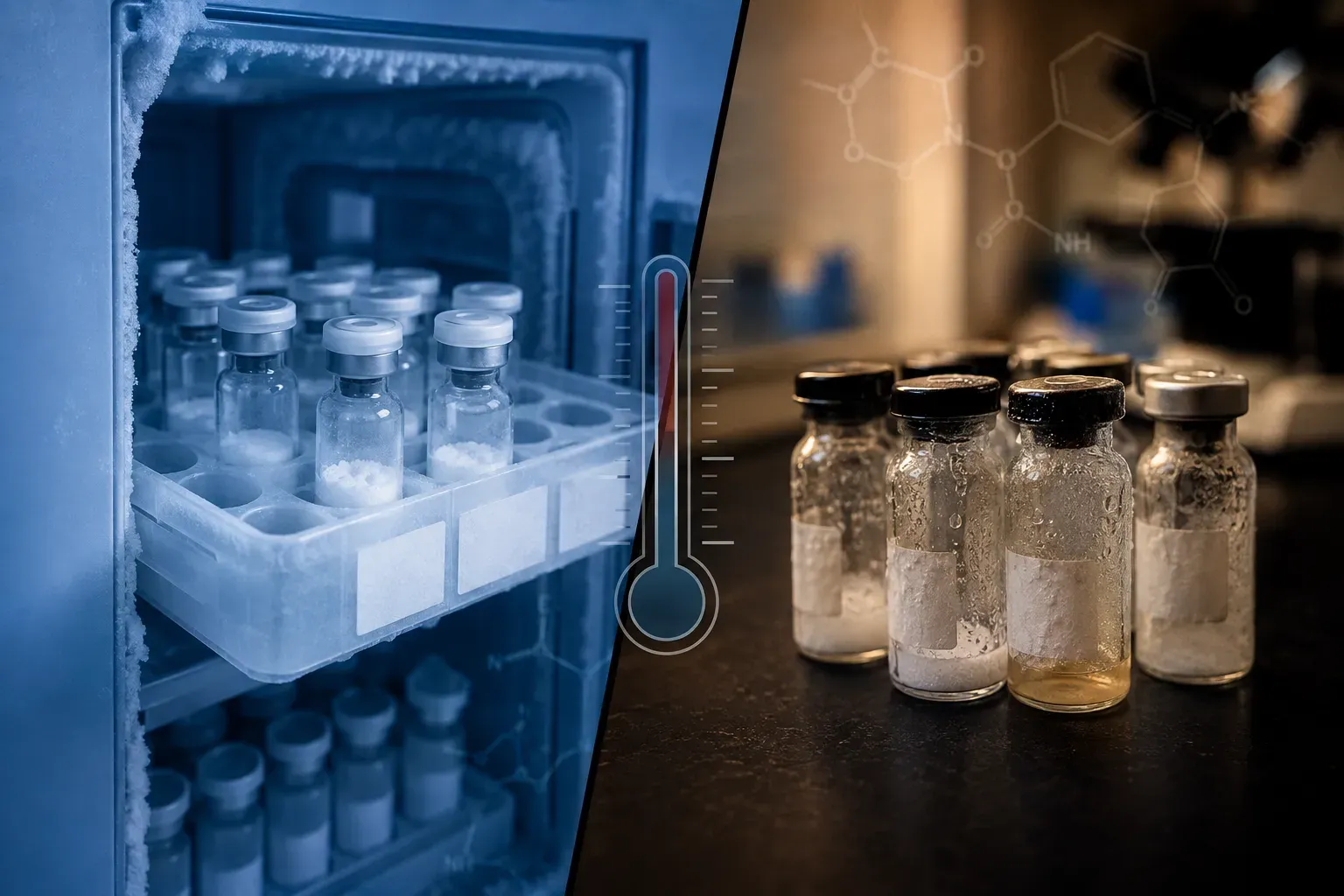
Many researchers store peptides in standard laboratory freezers that undergo regular defrost cycles. These cycles cause temperature fluctuations from -20C to as high as -5C over 2-4 hour periods, occurring weekly or monthly depending on freezer type.
Impact on peptides:
- Accelerated hydrolysis during warm phases
- Repeated partial thawing promoting aggregation
- Condensation formation introducing moisture
- Crystallization and recrystallization damaging molecular structure
Research demonstrates that peptides stored in frost-free freezers show 2-3x faster degradation rates compared to manual-defrost units maintaining constant -20C.
Solution: Dedicated Peptide Storage
Best practices for temperature management include:
- Manual-defrost freezers for long-term peptide storage
- Temperature monitoring with data loggers (alarms for excursions)
- Backup storage for critical materials during power outages
- Avoid door storage (warmest, most variable zone)
- Ultra-low freezers (-80C) for valuable or long-term materials
Place temperature data loggers in peptide storage freezers with alerts for excursions beyond -15C to -25C range. Early detection prevents widespread degradation.
Recognizing Temperature Damage
Signs of temperature-related degradation include:
- Visible ice crystals in lyophilized vials
- Peptide cake collapse or melting
- Solution turbidity after reconstitution
- Reduced activity in biological assays
- New peaks on HPLC chromatograms
Mistake #2: Light Exposure and Photo-Degradation
Many researchers underestimate the impact of light exposure on peptide stability. Ultraviolet and visible light catalyze photochemical reactions that degrade sensitive amino acid residues.
Photosensitive Amino Acids
Certain amino acids exhibit particular light sensitivity:
- Tryptophan: Absorbs UV light (280nm), forms oxidation products
- Tyrosine: Undergoes photo-oxidation and dimerization
- Phenylalanine: UV absorption leads to ring modifications
- Methionine: Light-catalyzed oxidation to methionine sulfoxide
- Cysteine: Photo-induced disulfide bond formation and cleavage
These reactions occur even under standard laboratory lighting, with UV sources (sunlight, fluorescent bulbs) accelerating degradation.
Real-World Impact
Studies show that peptides stored in clear glass vials on laboratory benches lose 15-30% potency within 2-4 weeks compared to amber vials stored in darkness. The degradation rate increases dramatically with direct sunlight exposure.
Solution: Light Protection Protocols
Effective light protection strategies include:
- Amber glass vials for all peptide storage
- Aluminum foil wrapping for clear vials
- Opaque storage containers in freezers and refrigerators
- Minimized light exposure during handling
- Dedicated dark storage areas for light-sensitive compounds
Even brief light exposure during weighing or reconstitution can initiate degradation cascades. Work under minimal lighting when handling photosensitive peptides.
Identifying Photo-Degradation
Photo-degraded peptides often display:
- Yellow to brown discoloration (tryptophan oxidation)
- Increased UV absorbance at 280nm
- New HPLC peaks corresponding to oxidation products
- Mass spectrometry evidence of +16 Da modifications (oxygen addition)
- Reduced biological activity disproportionate to storage time
Mistake #3: Moisture Intrusion and Hydrolytic Degradation
Water is the primary driver of peptide hydrolysis, the cleavage of peptide bonds through reaction with water molecules. Even small amounts of moisture dramatically accelerate degradation.
Sources of Moisture Contamination
Common moisture intrusion pathways include:
- Inadequate vial sealing (loose caps, damaged septa)
- Condensation during temperature transitions
- Humid laboratory environments (>60% relative humidity)
- Repeated vial opening in non-controlled atmospheres
- Desiccant exhaustion in long-term storage containers
Lyophilized peptides are hygroscopic, actively absorbing moisture from the environment. Once moisture content exceeds 5%, hydrolysis rates increase exponentially.
Hydrolysis Mechanisms
Peptide bond hydrolysis occurs through nucleophilic attack by water molecules:
- Acidic conditions (pH <4) catalyze hydrolysis at aspartic acid residues
- Basic conditions (pH >9) promote hydrolysis at multiple sites
- Neutral pH slows but does not prevent hydrolysis
- Elevated temperature accelerates all hydrolytic pathways
Particularly susceptible sequences include:
- Aspartyl-proline bonds (extremely rapid hydrolysis)
- Asparagine and glutamine residues (deamidation)
- C-terminal residues (increased accessibility)
Solution: Moisture Exclusion
Effective moisture prevention requires:
- Tight-sealing vials with intact septa
- Desiccant packets in storage containers (replace when saturated)
- Desiccators for high-value materials
- Controlled humidity environments (<40% RH ideal)
- Minimized vial opening frequency and duration
- Inert atmosphere storage (nitrogen or argon) for critical materials
Detecting Moisture Damage
Moisture-compromised peptides show:
- Lyophilized cake collapse or liquefaction
- Visible water droplets in vials
- Clumping or caking of powder
- Increased solution pH (from deamidation)
- HPLC evidence of hydrolysis fragments
- Mass shifts corresponding to water addition (+18 Da)
Mistake #4: Repeated Freeze-Thaw Cycles
Freeze-thaw cycling represents one of the most common and damaging storage errors. Each cycle subjects peptides to mechanical and chemical stress that cumulatively degrades material.
Mechanisms of Freeze-Thaw Damage
Multiple degradation pathways operate during freeze-thaw cycles:
Physical stress:
- Ice crystal formation disrupts molecular structure
- Concentration effects as water freezes (increased ionic strength)
- pH shifts during freezing (buffer component crystallization)
- Interfacial stress at ice-water boundaries
Chemical stress:
- Aggregation promoted by repeated concentration/dilution
- Oxidation accelerated during thawing phases
- Deamidation enhanced by pH fluctuations
- Disulfide bond scrambling in cysteine-containing peptides
Quantifying the Impact
Research demonstrates that peptides subjected to 5+ freeze-thaw cycles show:
- 40-60% reduction in biological activity
- 2-3x increase in aggregate formation
- New HPLC peaks corresponding to degradation products
- Visible precipitation in previously clear solutions
- Mass spectrometry evidence of oxidation and fragmentation
A single freeze-thaw cycle may cause minimal damage, but cumulative effects become severe with repeated cycling.
Solution: Aliquoting Strategy
The definitive solution is pre-aliquoting before initial freezing:
- Reconstitute peptide to desired concentration
- Divide into single-use aliquots (50-200 microliters)
- Flash-freeze aliquots in liquid nitrogen or -80C freezer
- Store at -20C or -80C until needed
- Thaw only required aliquots for each experiment
This approach ensures each aliquot experiences only one freeze-thaw cycle, preserving integrity for the majority of material.
Aliquoting Best Practices
Optimal aliquoting protocols include:
- Low-binding tubes to minimize adsorption losses
- Appropriate volumes for experimental needs (avoid waste)
- Clear labeling with date, concentration, and cycle number
- Rapid freezing to minimize ice crystal formation
- Consistent thawing (room temperature or 37C water bath)
Add 5-10% extra volume to account for tube adsorption losses. For a 100 microliter working aliquot, prepare 110 microliters.
Mistake #5: Inappropriate Container Materials
Peptide adsorption to container surfaces represents a significant but often overlooked source of apparent potency loss. The peptide isn't degrading chemically, but it's becoming unavailable for research applications.
Adsorption Mechanisms
Peptides bind to container surfaces through:
- Hydrophobic interactions with plastic surfaces
- Electrostatic attraction to charged surfaces
- Hydrogen bonding with surface functional groups
- Van der Waals forces (especially for small peptides)
Adsorption is particularly problematic for:
- Hydrophobic peptides (strong plastic binding)
- Low concentration solutions (<0.1 mg/mL)
- Small peptides (<10 amino acids)
- Basic peptides (electrostatic binding to negatively charged surfaces)
Material-Specific Binding
Different container materials exhibit varying adsorption characteristics:
Material | Adsorption Level | Suitable For |
|---|---|---|
Glass (siliconized) | Minimal | Long-term storage, low concentrations |
Glass (untreated) | Low-Moderate | Standard applications |
Polypropylene | Moderate | Short-term storage |
Polystyrene | High | Avoid for peptide storage |
Low-binding tubes | Very Low | Critical applications |
Polyethylene | Moderate-High | Not recommended |
Studies show that peptides stored in polystyrene tubes can lose 20-50% of apparent concentration within 24 hours due to surface adsorption alone.
Solution: Appropriate Container Selection
Container selection should match peptide properties:
- Glass vials (siliconized): Gold standard for storage
- Polypropylene: Acceptable for short-term, higher concentrations
- Low-binding tubes: Essential for precious or low-concentration materials
- Avoid polystyrene: High binding makes unsuitable for storage
- Consider surface treatment: Siliconization reduces binding 5-10x
Recognizing Adsorption Losses
Adsorption-related losses manifest as:
- Lower-than-expected concentration by UV or assay
- Inconsistent results between fresh and stored samples
- Recovery of peptide after aggressive tube washing
- Concentration-dependent losses (worse at low concentrations)
- No HPLC evidence of chemical degradation
Mistake #6: Oxidation and Inadequate Atmosphere Control
Oxidation represents a major degradation pathway for peptides containing oxidation-prone residues. Without proper atmosphere control, dissolved oxygen and air exposure drive oxidative damage.
Oxidation-Susceptible Residues
Particularly vulnerable amino acids include:
- Methionine: Oxidizes to methionine sulfoxide (+16 Da)
- Cysteine: Forms disulfide bonds or oxidizes to cysteic acid
- Tryptophan: Multiple oxidation products (hydroxy, nitro, formyl derivatives)
- Tyrosine: Forms dityrosine and other oxidation products
- Histidine: Oxidation to 2-oxo-histidine
- Phenylalanine: Hydroxylation to tyrosine
Oxidation Catalysts
Multiple factors accelerate oxidative degradation:
- Dissolved oxygen in reconstitution solvent
- Light exposure (photo-oxidation)
- Metal ions (copper, iron catalyze oxidation)
- Elevated temperature (increases reaction rates)
- Alkaline pH (promotes oxidation kinetics)
- Peroxide impurities in solvents or containers
Solution: Atmosphere Control
Effective oxidation prevention strategies:
- Inert gas overlay (nitrogen or argon) in storage vials
- Degassed solvents for reconstitution
- Metal-free containers and reagents
- Antioxidant additives (ascorbic acid, methionine) when compatible
- Dark, cold storage to minimize catalytic factors
- Single-use aliquots to minimize headspace exposure
Never store reconstituted peptides under ambient air for extended periods. Even refrigerator storage at 4C allows progressive oxidation over weeks.
Detecting Oxidative Damage
Oxidation indicators include:
- Mass spectrometry +16 Da, +32 Da shifts (oxygen addition)
- New HPLC peaks with earlier retention times
- Yellow to brown discoloration
- Reduced biological activity
- Increased UV absorbance at 280nm
- Free sulfhydryl group loss (for cysteine-containing peptides)
Mistake #7: Extended Storage Beyond Stability Timelines
Perhaps the most common mistake is simply storing peptides beyond their validated stability windows. Even under optimal conditions, peptides degrade over time.
Understanding Stability Timelines
Peptide stability varies dramatically based on form and storage conditions:
Lyophilized peptides:
- -20C or lower: 12-24 months (optimal)
- 2-8C: 6-12 months (acceptable)
- Room temperature: 2-4 weeks maximum
Reconstituted peptides:
- -80C: 6-12 months
- -20C: 1-3 months
- 2-8C: 2-4 weeks
- Room temperature: 1-7 days
These timelines assume proper storage conditions. Deviations (temperature fluctuations, light exposure, moisture) reduce stability proportionally.
The False Economy of Extended Storage
Researchers sometimes extend peptide use beyond recommended timelines to avoid replacement costs. This false economy creates greater expenses through:
- Failed experiments from degraded materials
- Wasted downstream reagents
- Personnel time on compromised studies
- Irreproducible results requiring repetition
- Potential publication issues from poor data quality
Solution: Inventory Management
Effective inventory practices prevent timeline violations:
- First-in-first-out (FIFO) usage protocols
- Clear labeling with reconstitution and expiration dates
- Regular inventory audits (quarterly minimum)
- Automated alerts for approaching expiration
- Strategic purchasing aligned with project timelines
- Disposal protocols for expired materials
Implement a color-coded labeling system: green (<3 months to expiry), yellow (1-3 months), red (expired). Visual management prevents accidental use.
Recognizing Time-Related Degradation
Age-related degradation shows:
- Progressive activity loss over storage time
- Increasing HPLC impurity peaks
- Cumulative oxidation and hydrolysis products
- Discoloration intensifying with time
- Precipitation in previously clear solutions
Integrated Storage Protocol: Best Practices Summary
Preventing peptide degradation requires systematic attention to all seven factors. An integrated protocol includes:
Pre-Storage Preparation
- Verify peptide identity and purity from the certificate of analysis
- Inspect lyophilized material for quality indicators
- Plan aliquot volumes based on experimental needs
- Prepare appropriate containers (glass, low-binding)
- Ensure storage equipment is functioning properly
Reconstitution and Aliquoting
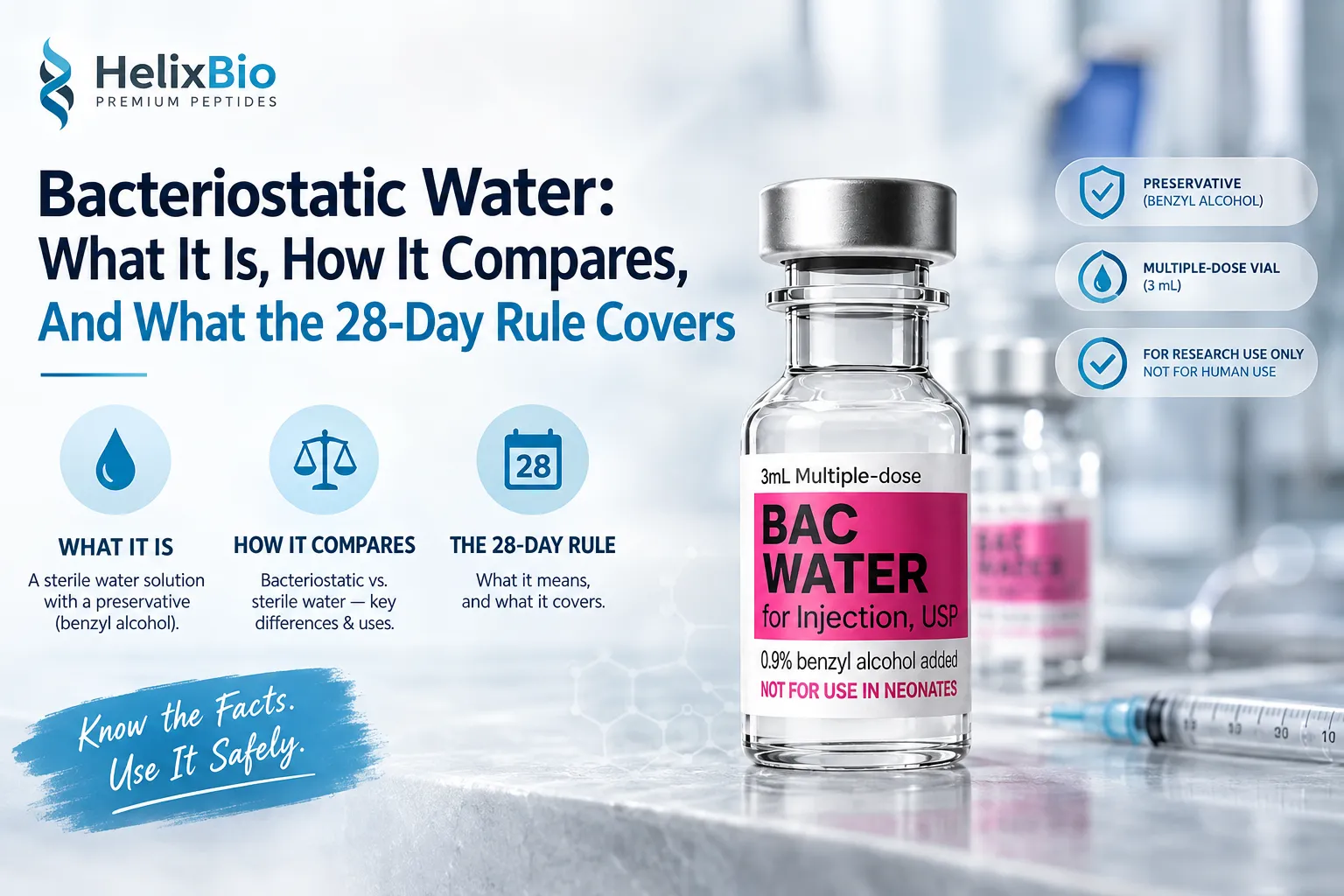
- Use appropriate solvent (bacteriostatic water, sterile water, or buffer)
- Calculate optimal concentration for stability and use
- Gentle mixing (swirling, not vortexing)
- Filter if necessary (0.22 micron for particulate removal)
- Aliquot immediately into single-use volumes
- Flash-freeze aliquots before long-term storage
Storage Conditions
- Temperature: -20C or lower for long-term
- Light: Complete darkness (amber vials, opaque containers)
- Atmosphere: Inert gas overlay when possible
- Moisture: Desiccant in storage containers
- Monitoring: Temperature data loggers with alarms
Ongoing Management
- Label clearly with dates, concentrations, and cycle numbers
- Track inventory with digital or physical systems
- Monitor stability through periodic testing
- Dispose properly when expired or degraded
- Document everything for reproducibility and compliance
Conclusion
Peptide degradation from improper storage represents a preventable source of research variability, financial loss, and scientific frustration. The seven mistakes examined here—temperature fluctuations, light exposure, moisture intrusion, freeze-thaw cycling, inappropriate containers, oxidation, and extended storage—account for the majority of storage-related peptide failures.
Implementing systematic storage protocols addressing each factor preserves peptide integrity, ensures experimental reproducibility, and maximizes research investment returns. The upfront effort required for proper storage pays dividends in data quality, resource efficiency, and scientific credibility.
Researchers should view peptide storage not as a passive holding state but as an active component of experimental design requiring the same rigor as any other protocol element. For compound-specific storage notes, see our guide on BPC-157, TB-500, and GHK-Cu.
Frequently Asked Questions
Lyophilized peptides remain stable at room temperature for 2-4 weeks maximum. Reconstituted peptides degrade within 1-7 days at room temperature. Degradation accelerates with light exposure, humidity, and temperature fluctuations. For research integrity, refrigerated or frozen storage is essential.
Frost-free freezers undergo defrost cycles causing temperature fluctuations from -20C to -5C, accelerating peptide degradation 2-3x. Manual-defrost freezers or dedicated peptide freezers with constant temperature are recommended for long-term storage. Temperature data loggers help monitor excursions.
Research shows peptides subjected to 5+ freeze-thaw cycles lose 40-60% biological activity with 2-3x increased aggregation. Best practice is aliquoting into single-use volumes before freezing, limiting each aliquot to one freeze-thaw cycle maximum.
Amber vials are recommended for all peptides, especially those containing tryptophan, tyrosine, methionine, or cysteine. Clear vials on laboratory benches show 15-30% potency loss within 2-4 weeks compared to amber vials in darkness. Light protection is a simple preventive measure.
Discoloration indicates oxidation, particularly of tryptophan, tyrosine, and methionine residues. Light exposure, dissolved oxygen, metal ions, and elevated temperature catalyze oxidation. Yellow to brown color progression correlates with potency loss. Discolored peptides should be analytically verified before use.
Store lyophilized peptides in tightly sealed vials with desiccant packets in storage containers. Maintain humidity below 40% RH. Use desiccators for high-value materials. Avoid repeated vial opening in humid environments. Lyophilized peptides are hygroscopic and absorb moisture readily, accelerating hydrolysis.
Siliconized glass vials provide minimal adsorption and are the gold standard. Polypropylene is acceptable for short-term storage at higher concentrations. Avoid polystyrene (20-50% loss within 24 hours). Low-binding tubes are essential for precious or low-concentration peptide solutions.
Degradation indicators include visible precipitation, discoloration (yellow/brown), reduced biological activity, new HPLC peaks, mass spectrometry evidence of modifications, and inconsistent assay results. Analytical verification (HPLC, mass spec) provides definitive assessment. Degraded peptides should not be used.
Antioxidants like ascorbic acid or methionine can reduce oxidation in some research applications but may interfere with downstream assays. Inert atmosphere storage (nitrogen/argon overlay) and degassed solvents are preferred. Test antioxidant compatibility with your specific research protocol before implementation.
Reconstituted peptides stored at 2-8C remain stable for 2-4 weeks. At -20C, stability extends to 1-3 months. At -80C, peptides remain stable for 6-12 months. Lyophilized peptides at -20C maintain integrity for 12-24 months. Aliquoting prevents freeze-thaw degradation.
Implement first-in-first-out (FIFO) protocols with clear labeling including reconstitution date, concentration, and expiration. Use color-coded labels for expiry tracking. Conduct quarterly inventory audits. Digital tracking systems with automated alerts prevent accidental use of expired materials.
No. Chemical degradation (hydrolysis, oxidation, deamidation) is irreversible. Physical aggregation may sometimes be reversed through denaturation and refolding, but this is impractical for most research applications. Prevention through proper storage is the only effective strategy. Discard degraded materials.
- 01Bachem. Handling and Storage Guidelines for Peptides. 2026.
- 02JPT. How to Store Peptides | Best Practices for Researchers. 2026.
- 03Pure Tested Peptides. Peptide Reconstitution, Storage, and Stability: A Complete Research Protocol Guide. 2026.
- 04Precursor Bio. Peptide storage: a practical guide to reconstitution and drift. 2026.
- 05American Peptides. Peptide Storage and Handling Guide for Research Labs. 2026.
- 06Healius Peptides. Peptide Reconstitution & Storage Guide | Full Lab Protocol. 2026.
Helix Bio Chem Team
Research & Product Team
Our in-house team tracks published peptide research and translates it into clear, source-cited summaries for the research community.
Reviewed by in-house research chemists
support@helixbiochem.com