Peptide Half-Life vs. Shelf-Life: Two Different Clocks
Recovery protocolsSeptember 8, 202613 min read
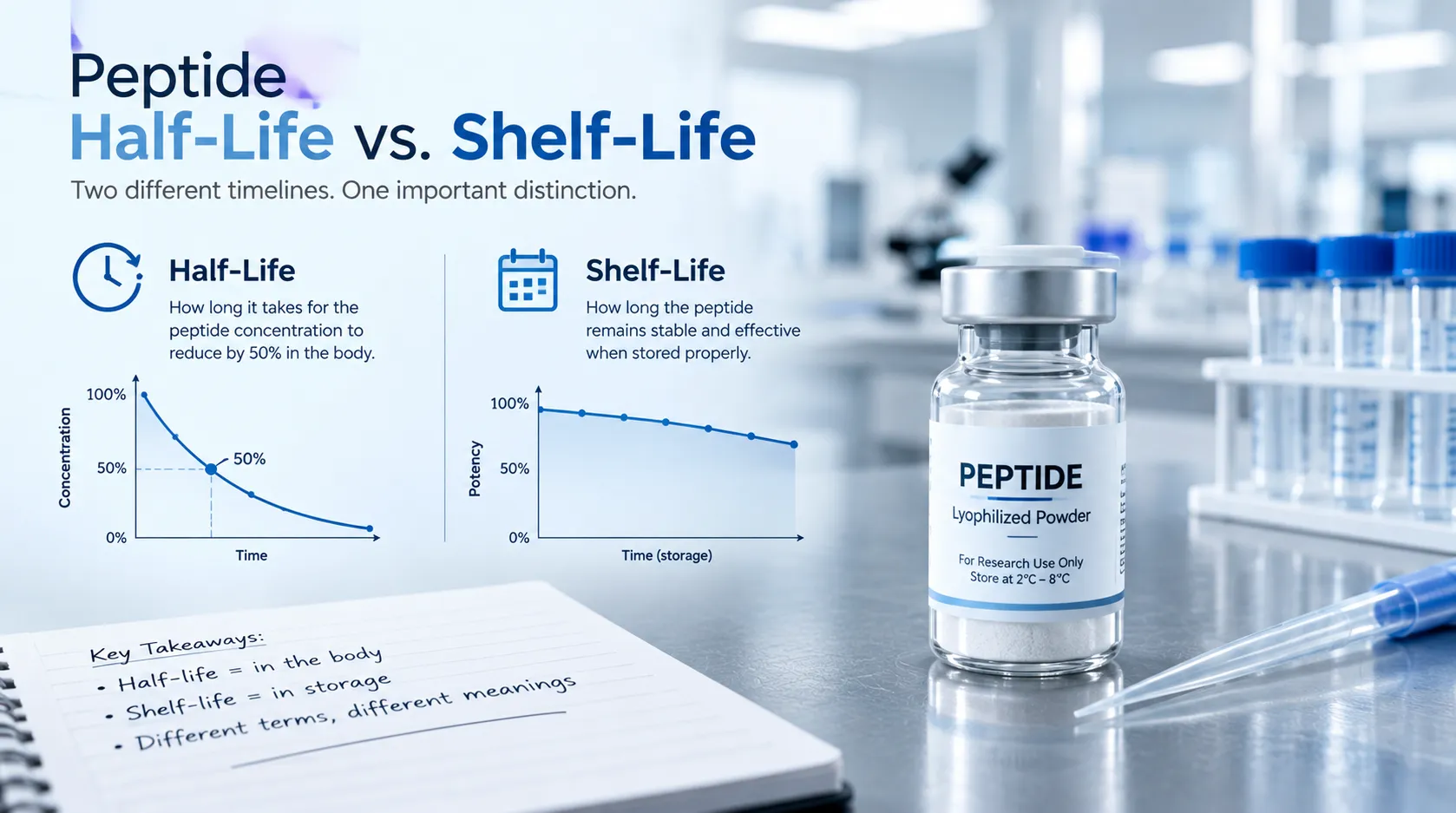
Peptide half-life measures decline in a biological system; shelf-life measures how long stored material stays within specification under defined conditions.
Peptide half-life describes how quickly a concentration declines in a biological system; peptide shelf-life describes how long stored material remains within defined specifications.
Half-life is a derived parameter related to clearance and volume of distribution, so it can lengthen because a substance distributes more widely rather than because it degrades more slowly.
Half-life is set mainly by enzymatic proteolysis and renal filtration, while storage stability is set by hydrolysis, oxidation, deamidation, isomerisation and aggregation in the container.
Semaglutide's approximately one-week elimination half-life derives from albumin binding and DPP-4 resistance, mechanisms that exist only in a biological system and confer no storage benefit.
Shelf-life is a specification claim tied to defined acceptance criteria and defined storage conditions, not the point at which half the material has degraded.
The legacy ICH stability guidelines Q1A(R2) through Q1E and Q5C remain operative; the consolidated ICH Q1 revision reached Step 2b consultation in April 2025 and has not reached Step 4 adoption.
An HPLC purity figure is only stability-relevant if the method has been demonstrated to be stability-indicating by separating relevant degradation products.
A Certificate of Analysis is batch-specific documentation from a single point in time and cannot establish a shelf-life, which requires time-series stability data.
Two of the most frequently confused numbers in peptide research describe different things: one describes what happens to a peptide inside a biological system, the other what happens to a peptide sitting in a vial. They are governed by different mechanisms and used for different decisions, and a long value for one says almost nothing about the other. This article separates them and explains what determines each.
The Short Answer: Half-Life and Shelf-Life Are Not the Same
Peptide half-life is a pharmacokinetic parameter describing how quickly a measured concentration declines in a biological system. Peptide shelf-life is a quality parameter describing how long stored material is expected to remain within defined specifications under defined storage conditions. They are not two versions of the same measurement, and neither can be converted into the other.
The distinction is easiest to hold onto as two clocks that start at different moments and run on different machinery.
Clock 1 starts when the peptide enters a biological system. It is driven mainly by enzymatic proteolysis and renal filtration, measured in plasma, and used to reason about exposure over time.
Clock 2 starts when the material is manufactured and packaged. It is driven by non-enzymatic chemistry — hydrolysis, oxidation, deamidation, aggregation — acting on a solid or a solution inside a container under specified temperature and humidity. It is established by stability studies and expressed as a period, not a rate.
A molecule can be excellent on one clock and unremarkable on the other. That is not a paradox. It is the expected result of two independent processes.
What Is Peptide Half-Life?
Half-life is the time required for the concentration or amount of a substance in a biological system to fall by half. In pharmacology the term normally means the elimination half-life, and it applies most cleanly to substances following first-order kinetics, where the rate of elimination is proportional to the concentration present.
Two properties of half-life are routinely misunderstood.
First, half-life is a derived parameter, not a property the molecule carries around. It is conventionally related to two more fundamental quantities — clearance and volume of distribution — by the relationship t½ = 0.693 × Vd / CL. Half-life therefore rises if clearance falls, and it also rises if the volume of distribution grows. A substance can show a longer half-life because it distributes more widely into tissue, not because it is being destroyed more slowly.
Second, half-life is context-dependent. The same peptide can yield different values depending on species, route, assay, sampling window, and whether the analysis is fitting an initial distribution phase or a terminal elimination phase. A half-life quoted without its context is an incomplete statement.
A related but separate concept is **in vitro stability** — for example, how long a peptide survives incubation in plasma or serum in a laboratory assay. This is a bench measurement of proteolytic susceptibility, not a pharmacokinetic half-life, and the two should not be quoted interchangeably.
What Determines Peptide Half-Life?
Half-life is determined by how fast a biological system removes the peptide, which for most peptides means enzymatic breakdown and kidney filtration.
Peptides generally clear quickly. They are substrates for a wide range of peptidases in plasma and tissue, and because most are small, they are readily filtered by the kidney and poorly reabsorbed. Reviews of therapeutic peptide pharmacokinetics describe endogenous and unmodified peptides as typically having short elimination half-lives for exactly these two reasons, with values often in the range of minutes to a few hours.
The main determinants are:
Proteolytic susceptibility. Whether the sequence presents cleavage sites for abundant peptidases. A single residue change at a recognised cleavage position can materially change clearance.
Molecular size and renal handling. Small peptides filter readily; strategies that increase effective hydrodynamic size reduce filtration.
Plasma protein binding. Binding to serum albumin shields a peptide from both enzymatic attack and glomerular filtration, and albumin's own long circulating life is borrowed by whatever binds it.
Structural modifications. Fatty-acid acylation, non-natural residues at protease-recognition sites, cyclisation, PEGylation and fusion to carrier proteins are established approaches to extending half-life.
A worked example — and what it does not establish
Semaglutide is a useful case because its pharmacokinetics are documented in an approved product label rather than in vendor copy. The FDA-approved labelling for Ozempic reports an elimination half-life of approximately one week, states that semaglutide is more than 99% bound to plasma albumin, and identifies albumin binding as the principal protraction mechanism — reducing renal clearance and protecting the molecule from metabolic degradation. The label also notes stabilisation against DPP-4, and that circulating material persists for roughly five weeks after a final dose.
Every one of those mechanisms has something in common. Albumin binding, protease resistance, renal shielding — none of them exists inside a sealed vial. There is no albumin in a vial. There are no peptidases. There are no kidneys. The engineering that produced a one-week half-life operates exclusively in a biological system and confers no storage benefit whatsoever.
This is the clearest available demonstration that the two clocks are independent. A half-life figure, however impressive, is not evidence about storage.
What Is Peptide Shelf-Life?
Shelf-life is the period during which stored material is expected to remain within its defined quality specifications when kept under stated storage conditions. It is not defined as the time until half the material has degraded, and it cannot be inferred from a molecule's structure alone.
Three features follow from that definition.
It is tied to a specification. A shelf-life claim is only meaningful alongside the acceptance criteria it refers to — assay content, related substances, appearance, pH, and whatever other attributes are relevant. "Stable for X months" is an incomplete sentence without "within these limits."
It is tied to conditions. The same material has different shelf-lives in different containers, at different temperatures, at different humidity, and in solution versus lyophilised form. A shelf-life detached from its storage condition is not transferable.
It is established by evidence. Under the ICH stability framework, the purpose of stability testing is to show how quality varies over time under the influence of temperature, humidity and light, and thereby to establish a retest period for a drug substance or a shelf life for a drug product, together with recommended storage conditions.
**Retest period and shelf life are not synonyms.** In ICH terminology a retest period applies to a drug substance — after it elapses, the material may be re-examined against specification rather than automatically discarded. A shelf life applies to a drug product. Research-grade materials are generally neither in the regulatory sense, which is precisely why the evidence behind any stated period matters more, not less.
This framework is currently in transition. The legacy ICH stability series — Q1A(R2) through Q1E, together with Q5C for biotechnological products — remains the operative reference. A consolidated revision, ICH Q1, reached Step 2b public consultation on 11 April 2025 with the consultation period closing on 30 July 2025, and has not yet reached Step 4 adoption.
What Determines Peptide Stability During Storage?
Storage stability is determined by chemical and physical degradation acting on the material in its container — reactions almost entirely different from the enzymatic processes that set half-life. The recognised routes include:
Deamidation. Asparagine, and more slowly glutamine, convert to acidic residues. In the standard review literature, deamidation is described as the most common chemical degradation pathway for this class of molecule. Its mechanism is pH-dependent: direct hydrolysis dominates at low pH, while a cyclic imide route dominates from around neutral pH upward.
Isomerisation. The same cyclic imide intermediate can yield isoaspartate, changing the backbone without changing the molecular formula.
Oxidation. Methionine, cysteine and tryptophan are the usual targets, promoted by dissolved oxygen, trace metals and light.
Hydrolysis. Cleavage of the peptide backbone, with certain adjacent-residue combinations markedly more labile than others.
Aggregation and precipitation. Physical rather than covalent, and often the failure mode that presents first as a visible or turbidity change.
Beta-elimination and disulfide exchange. Relevant where the sequence contains cysteine or a disulfide bond.
Four external variables modulate all of them: temperature, water, pH, and oxygen or light exposure. Water is the reason lyophilised solids are the default storage form — removing the solvent removes the medium in which hydrolysis and deamidation proceed. Temperature is the reason cold storage is standard, since reaction rates fall as temperature falls.
What none of this justifies is a universal number. How long a specific peptide stays within specification, lyophilised or reconstituted, at a given temperature, depends on that peptide's sequence, salt form, formulation, concentration, container closure, handling and — critically — on whether anyone actually measured it. Blanket figures of the form "all reconstituted peptides last N days" are not supported by the evidence base, because the evidence base is material-specific. Related handling considerations are covered in the peptide storage mistakes and reconstitution guides.
Peptide Half-Life vs. Shelf-Life: Side-by-Side
Factor
Half-Life
Shelf-Life
What it describes
Time for concentration in a biological system to fall by half
Period stored material remains within defined specifications
Where the clock runs
In vivo — plasma, tissue, whole organism
In the container, under defined storage conditions
Primary mechanisms
Enzymatic proteolysis, renal filtration, distribution
Time-series stability data against acceptance criteria
How it is measured
Concentration-time sampling and PK modelling
Stability study using stability-indicating methods
Half-Life, Shelf-Life and Duration of Action Are Three Things
Duration of action is a third concept and does not reliably follow from half-life either. How long an observable effect persists depends on receptor binding kinetics, downstream signalling, target turnover and the concentration-response relationship — not solely on how quickly the molecule leaves the circulation.
A substance can be largely cleared while an effect persists, because the biological consequence outlasts the exposure — and it can also circulate at concentrations below those producing any measurable effect.
Three concepts, three questions:
Half-life answers: how fast does concentration fall in the system?
Shelf-life answers: is the stored material still within specification?
Duration of action answers: how long does the measured effect persist?
How Researchers Evaluate Peptide Stability
Stability is evaluated by storing defined batches under defined conditions and testing them at intervals against pre-set acceptance criteria, using analytical methods capable of detecting the relevant degradation products.
A recognisable stability study has a specific shape: defined batches; a defined container closure system; defined storage conditions; a defined pull schedule; and pre-set acceptance criteria. Under the ICH framework, testing should cover the attributes susceptible to change during storage that could influence quality.
Forced degradation — deliberately stressing material with heat, light, acid, base and oxidants — sits alongside this. Its purpose is not to predict shelf-life. It is to generate degradation products so that the analytical method can be shown to separate them.
What HPLC and Mass Spectrometry Can and Cannot Establish
These methods characterise identity, purity and degradation products at the moment of testing. None of them establishes a shelf-life.
Reversed-phase HPLC separates the main component from related substances and yields a purity figure, usually as a percentage of total peak area. LC-MS adds mass information, which is what allows a peak to be assigned rather than merely counted. Mass spectrometry supports identity confirmation and the characterisation of degradation products by their mass changes.
Three limits deserve to be stated explicitly.
A purity number is only stability-relevant if the method is stability-indicating. Under ICH Q2(R2), a quantitative procedure earns that description by being shown to detect changes in relevant quality attributes during storage, with specificity demonstrated against samples containing relevant degradation products. A method never challenged with degraded material has not been shown to resolve degradants.
Some degradation is nearly invisible to a nominal-mass check. Deamidation changes mass by roughly 1 Da. Aspartate isomerisation changes the backbone but not the molecular formula, so it is isobaric and produces no mass shift at all. Detecting either generally requires chromatographic separation, high-resolution measurement, or peptide mapping.
Purity is not content. An area-percent purity figure describes the proportion of detected material that is the main peak. It does not establish how much peptide is in the vial — that requires a quantitative content determination.
No single analytical result — not an HPLC purity figure, not a mass confirmation — demonstrates that material will remain within specification over time. Time-series data under defined conditions is the only thing that does.
Certificates of Analysis and Stability Data Answer Different Questions
A Certificate of Analysis is batch-specific analytical documentation: it records what was measured on a particular lot, by particular methods, at a particular time. It is a snapshot. A stability study is a time series: the same material, in the same container, under stated conditions, tested repeatedly against acceptance criteria. Only the second can support a storage period.
Questions worth asking of any stability claim: what specification does it refer to; what storage condition and physical form; what container closure; were the analytical methods shown to be stability-indicating; and does the claim rest on measured data or on an assumption carried over from another material. Reading practice for batch documents is covered in the certificate of analysis guide.
Common Misconceptions
"Refrigeration extends a peptide's half-life." It does not. Half-life is measured in a biological system at physiological temperature. Refrigeration acts on stored material, slowing chemical degradation in the vial. It changes Clock 2 and leaves Clock 1 untouched.
"A long half-life means a long shelf-life." No relationship. The semaglutide case above makes the point: a one-week half-life derives from mechanisms that require a biological system to operate at all.
"Shelf-life is when 50% has degraded." Shelf-life refers to remaining within specification. Most specifications would be breached long before half the material was gone.
"The COA proves the shelf-life." A COA is a batch record at a point in time. Shelf-life needs a time series.
"HPLC purity proves stability." Only if the method was shown to separate degradation products, and only for the moment the sample was run.
"Half-life tells how long the effect lasts." Duration of action depends on receptor and downstream biology, not solely on clearance.
Almost every confusion here resolves once the environment is identified first and the number chosen second. All compounds referenced are discussed strictly in a research-use-only context.
Got Questions?
Frequently Asked Questions
Peptide half-life is the time required for the concentration of a peptide in a biological system to decline by half. In pharmacology it usually refers to elimination half-life and applies most cleanly to first-order kinetics. It is a derived parameter, conventionally related to clearance and volume of distribution rather than being an intrinsic property of the molecule.
Peptide shelf-life is the period during which stored material is expected to remain within defined quality specifications under stated storage conditions. It is not defined as the time until half the material degrades. A shelf-life statement is only interpretable alongside the specification it refers to, the storage conditions it assumes, and the stability data supporting it.
No. Half-life describes decline in a biological system driven mainly by enzymatic breakdown and renal filtration. Shelf-life describes how long stored material stays within specification, governed by chemical reactions such as hydrolysis, oxidation and deamidation inside a container. Neither can be calculated from the other.
Principally how quickly a biological system removes it. The main determinants are susceptibility to peptidase cleavage, molecular size and renal filtration, plasma protein binding, and structural modifications intended to resist those processes, such as acylation, non-natural residues, cyclisation or fusion to a carrier protein.
Chemical and physical degradation in the container. The dominant routes are deamidation, isomerisation, oxidation of methionine, cysteine and tryptophan, backbone hydrolysis, and aggregation. Temperature, water content, pH and exposure to oxygen and light modulate the rates, while sequence, salt form, formulation and container closure determine which route dominates.
No. The mechanisms that extend half-life generally operate only inside a biological system. Semaglutide's approximately one-week elimination half-life, as reported in its FDA-approved labelling, derives largely from binding to plasma albumin and resistance to DPP-4, neither of which exists in a sealed vial. A half-life value is not evidence about storage behaviour.
No. Refrigeration acts on stored material, slowing the chemical reactions that degrade it in the vial. Half-life is measured in a biological system at physiological temperature, where storage temperature is irrelevant. Cold storage affects the storage clock only, and conflating the two is one of the most common errors in this topic area.
Chemical degradation rates generally increase with temperature, which is why cold storage is standard and why lyophilized solids, lacking the water needed for hydrolysis and deamidation, are the usual storage form. How much stability a given temperature buys for a given peptide is material-specific and must be measured rather than assumed.
By comparing analytical results against the material's specification using methods shown to detect the relevant degradation products. Chromatographic separation is central, since degradation products may be resolvable chromatographically while being difficult to distinguish by mass alone. Visible changes such as discolouration or cloudiness can indicate a problem, but their absence does not indicate integrity.
In vivo stability concerns survival within a living system, dominated by enzymatic degradation and clearance, and is what half-life describes. In vitro stability covers measurements outside a whole organism, including plasma stability assays measuring proteolytic susceptibility and storage stability studies measuring chemical degradation in a container. All three are distinct measurements.
No. A Certificate of Analysis is batch-specific documentation recording what was measured on a particular lot at a particular time. Shelf-life requires a time series: the same material, in the same container closure, under stated conditions, tested repeatedly against acceptance criteria using stability-indicating methods. Neither document substitutes for the other.
HPLC separates the main component from related substances and yields a purity figure as a proportion of total peak area, while mass spectrometry supports identity confirmation and characterisation of degradation products. Neither establishes shelf-life, and purity is a separate question from how much peptide the vial actually contains.