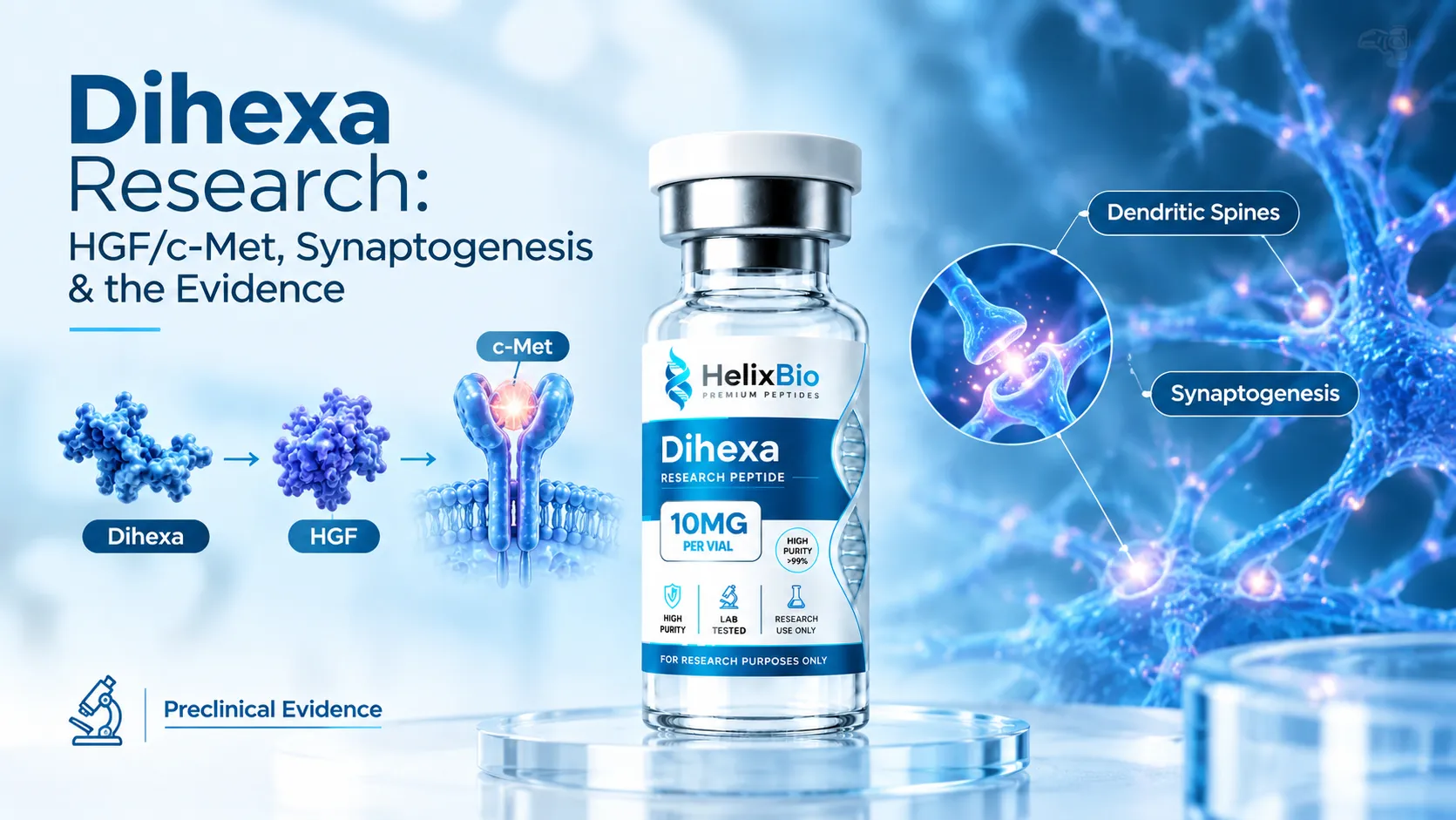
Dihexa Research: HGF/c-Met, Synaptogenesis & the Evidence
Growth researchSeptember 10, 202614 min read
Dihexa's foundational mechanism papers were retracted or flagged. What the surviving evidence shows about HGF/c-Met, synaptogenesis and the BDNF claim.
Dihexa is a peptidomimetic small molecule derived from angiotensin IV, not a peptide, and its identity is confirmed by small-molecule analytics rather than sequence verification.
Four papers underpinning Dihexa's mechanism received expressions of concern in September 2021, and two of the four were formally retracted in April 2025 following an institutional finding of falsified data.
The frequently quoted 65 pM HGF binding affinity comes from a paper that was retracted in April 2025 and is currently unsupported by any other source.
The claim that Dihexa is seven orders of magnitude more potent than BDNF is a ratio derived from cell-culture concentrations, not a measurement reported as such in the primary literature.
The proposed mechanism is that Dihexa binds hepatocyte growth factor and potentiates its activity at c-Met, not that it activates the c-Met receptor directly.
Independent stem-cell laboratories have used Dihexa since 2015 as a functional replacement for recombinant HGF in hepatocyte differentiation protocols, which supports pathway engagement in a liver-lineage context but says nothing about the brain.
A 2021 study in APP/PS1 mice by an independent group attributed Dihexa's cognitive effect to PI3K/AKT signalling and an angiotensin IV axis rather than to HGF binding.
Dihexa has never entered a human clinical trial, and the FDA has stated it had not identified human exposure data for drug products containing dihexa acetate.
Fosgonimeton is a different molecule whose Phase 2/3 LIFT-AD trial missed its primary endpoint in September 2024, and that result is pathway context rather than evidence about Dihexa.
Dihexa acetate was removed from 503A Category 2 in April 2026 as a procedural step and is scheduled for a Pharmacy Compounding Advisory Committee meeting before the end of February 2027; removal from a category is not approval.
Dihexa sits in an unusual position in the research-compound literature. Most of the facts repeated about it — the picomolar HGF binding affinity, the comparison against BDNF, the mechanism itself — trace back to four papers from a single laboratory, and two of those four were retracted in April 2025 after an institutional investigation found falsified data. Two more have carried expressions of concern since 2021. That does not make the compound uninteresting. It makes reading the literature a different exercise from reading most compound literature, because the citation you find in a vendor description may point at a paper that no longer stands.
Featured In This Article
Dihexa
RESEARCH PEPTIDE
Highly purified synthetic peptide prepared for rigorous laboratory research.
$65.99
This article maps that record paper by paper: what was withdrawn, what survives it, where the widely quoted potency figure actually comes from, what the strongest independent evidence is (it is not neurological), and where the U.S. regulatory position stood as of September 2026. Molecular identity, formula, CAS number and handling specifications sit on the Dihexa research material page and are not repeated here.
The Short Answer
Dihexa is a peptidomimetic small molecule derived from angiotensin IV, proposed to bind hepatocyte growth factor and potentiate its signalling at the c-Met receptor. Its published record is entirely preclinical — rodent and cell culture — and no human trial of Dihexa has ever been registered or run. The foundational mechanism papers from the originating laboratory have been retracted or flagged, so the HGF-binding mechanism is best described as proposed rather than established. Independent work published since supports pathway-level activity and one rodent cognitive result, but routes around the retracted data rather than confirming it.
Why "Peptide" Is the Wrong Word, and Why It Changes the Analytics
Dihexa is catalogued almost everywhere as a peptide. The structure does not support that. Only two residues in the molecule are proteinogenic — a tyrosine and an isoleucine — and both ends of that pair are synthetic caps rather than further residues. Every nitrogen in the molecule is an amide nitrogen. At roughly 505 g/mol, with three defined stereocentres and no ionisable backbone, it behaves as a small molecule in every respect that a laboratory cares about.
The distinction is not pedantry, and it has three practical consequences.
There is no sequence to verify. Peptide identity confirmation leans on sequence coverage and predictable fragmentation. Neither applies here, so identity rests on chromatographic behaviour against a reference standard, an accurate mass, and structural confirmation such as NMR where a manufacturer supplies it.
A purity number means something different. Area-percent from a peptide-style assay is not a small-molecule purity determination, and the two are not interchangeable on a certificate.
And it does not dissolve like a peptide. The caps were added specifically to raise lipophilicity and remove protease-cleavable bonds. The compound is described as insoluble in water, with DMSO as the practical solvent — the same design decision that made it orally absorbable in rodents is why it will not go into an aqueous buffer.
Helix Bio has covered this classification problem once before with a different compound, in why 5-Amino-1MQ is not a peptide. The pattern is the same: a small molecule filed in a peptide catalogue inherits the wrong verification logic along with the wrong label.
The search phrase "dihexa peptide" reflects how the compound is actually catalogued and searched for, not how it is correctly classified. Both facts can be true at once, and a certificate of analysis should reflect the second one.
From Angiotensin IV: What Actually Carried Over
Angiotensin IV is a hexapeptide fragment of the renin-angiotensin system with documented procognitive activity in rodents, limited by a serum half-life measured in single-digit minutes. The Washington State University programme that produced Dihexa worked backwards from that molecule: first establishing that the activity resided in the three N-terminal residues, then modifying that core for stability and membrane permeability.
The relationship is one of provenance, not equivalence. Two residues carry over and everything around them is new. Angiotensin IV's own pharmacology — including its interaction with insulin-regulated aminopeptidase — should not be attributed to Dihexa without direct evidence, and neither should anything from angiotensin II or III.
The Proposed HGF/c-Met Mechanism, and Which Paper Said What
Binding HGF Is Not Activating c-Met
The proposal is that Dihexa binds hepatocyte growth factor and potentiates HGF's activity at its receptor, c-Met. It is not a proposal that Dihexa binds or activates c-Met directly. A large number of secondary descriptions say "Dihexa activates c-Met," and that misstates the mechanism even as its own authors described it.
The specific evidence for that binding — including the frequently quoted 65 pM dissociation constant — came from the 2014 paper in the Journal of Pharmacology and Experimental Therapeutics that was retracted in April 2025. When a figure is cited from a retracted source, the figure does not become false by default, but it does become unsupported until something else establishes it. Nothing else currently does.
PI3K/AKT and the One Independent Rodent Study
The clearest surviving in-vivo result comes from a group unconnected to the originating laboratory. Sun and colleagues, publishing in Brain Sciences in 2021, gave Dihexa intragastrically to APP/PS1 transgenic mice over three months and reported improved spatial learning, preserved neuronal density, increased synaptophysin expression and reduced glial activation.
The detail worth noticing is in the title: the paper attributes the effect to the PI3K/AKT signalling pathway and frames it through an angiotensin IV axis, not through HGF. It does not replicate the HGF binding data. The most-cited surviving rodent study for this compound describes a mechanism that routes around the part of the literature that was withdrawn.
The Publication Record, Paper by Paper
Four papers from the Harding and Wright laboratories, published between 2011 and 2014 and all in the Journal of Pharmacology and Experimental Therapeutics, received expressions of concern in September 2021 over possible image manipulation. A Washington State University investigation subsequently found that a co-author had altered images in a doctoral dissertation and at least four co-authored papers. Two of the four were formally retracted in April 2025.
Publication
What it contributed
Current status
Benoist et al. 2011, JPET 339(1):35-44
Located the active core of Nle1-AngIV in three N-terminal residues; dendritic spine assay with BDNF as positive control
Not among the four flagged papers
Mimics of the HGF dimerization domain, 2011
Anti-Met and anticancer activity of the compound class
Expression of concern, Sept 2021; corrected 2014
Kawas et al. 2012
Development of AngIV analogues as HGF/Met modifiers
Retracted April 2025
McCoy et al. 2013, JPET 344(1):141-154
Named dihexa; reported oral procognitive activity and spinogenesis at picomolar concentrations
Expression of concern, Sept 2021; not retracted
Benoist et al. 2014, JPET
Primary evidence that the procognitive effect depends on HGF/c-Met; source of the 65 pM figure
Two conclusions follow, and both matter. Retraction of individual papers does not invalidate an entire field, so the compound's activity is not disproven. But the specific mechanistic claim that made Dihexa interesting rests disproportionately on the two papers that were withdrawn.
The "Seven Orders of Magnitude More Potent Than BDNF" Claim
Where the Number Comes From
This is the single most-repeated sentence written about Dihexa, and tracing it is instructive. It appears in near-identical wording across vendor catalogues, aggregator monographs and the compound's encyclopaedia entry. What it does not appear in, as a verbatim statement, is the abstract of either underlying paper.
What the primary literature does contain is narrower. The 2013 paper describes Dihexa as capable of inducing spinogenesis and synaptogenesis at picomolar concentrations, and its figures show hippocampal neurons treated at 10⁻¹² M. The 2011 companion paper used BDNF as a positive control in the same class of dendritic-spine assay. The famous figure is a ratio derived by comparing those two numbers — not a measurement either paper reported as such.
What the Assay Actually Measured
The endpoint was dendritic spine count per unit length of dendrite in dissociated rat hippocampal neurons in culture, after five days of treatment. That is a morphological readout in a dish. It is a legitimate and widely used assay. It is not a measure of cognitive effect, therapeutic effect, or effect in an intact animal.
Why an In-Vitro Molar Ratio Is Not a Potency Statement
Comparing a 505 g/mol small molecule against a roughly 27 kDa protein dimer on a molar basis compares two things that reach the assay by completely different routes. A recombinant protein applied to culture medium faces stability, aggregation and receptor-density constraints that a lipophilic small molecule does not. A molar ratio in one culture assay describes the concentration at which each produced an effect in that assay. It says nothing about maximum effect, nothing about duration, and nothing about what happens in an organism.
Assay-specific molar potency, general biological effectiveness and clinical effectiveness are three different claims. The published record supports a version of the first, in one cell-culture endpoint, from a paper that carries an expression of concern. It supports neither of the other two.
The Strongest Surviving Evidence Is in Liver, Not Brain
Here is the part of the Dihexa record that almost no secondary source mentions, and it is the most robust evidence the compound has.
Independent stem-cell laboratories use Dihexa as a functional substitute for recombinant hepatocyte growth factor. Siller and colleagues at the University of Oslo published a small-molecule-driven hepatocyte differentiation protocol in Stem Cell Reports in 2015 that replaces recombinant HGF with Dihexa in the hepatoblast-to-hepatocyte maturation step. The same group published it as a standard Current Protocols in Stem Cell Biology unit in 2016. It remains in use: a 2025 comparative study across fifteen human iPSC lines describes Dihexa as an HGF receptor agonist promoting terminal differentiation of hepatoblasts.
This matters for three reasons, and it is worth being precise about each.
It is independent. These groups have no connection to the Washington State University programme and no commercial interest in the compound as a nootropic.
It is functional and reproducible. A differentiation protocol either produces hepatocyte-like cells or it does not, and this one has been repeated across laboratories and cell lines for a decade.
And it is bounded. It establishes that Dihexa engages the HGF/c-Met axis productively in a liver-lineage context. It does not validate the 65 pM binding constant, it does not establish anything about the brain, and it does not speak to cognition. A compound can be a reliable reagent in a dish and still have an unproven story about what it does in a head.
Where the Human Evidence Stops
There are no human clinical trials of Dihexa. None registered, none published, no human pharmacokinetic data, no human safety data. In its regulatory materials the FDA has stated that it had not identified human exposure data for drug products containing dihexa acetate.
Fosgonimeton is the compound most often introduced at this point, and the relationship needs stating carefully. Athira Pharma — founded to commercialise this research programme — did not develop Dihexa. It set Dihexa aside over solubility and pharmacokinetic problems, screened a large compound series, and selected ATH-1017 (fosgonimeton), a prodrug converted in plasma to an active metabolite. That compound reached a Phase 2/3 Alzheimer's trial, LIFT-AD (NCT04488419), enrolling 315 patients on once-daily subcutaneous dosing.
Topline results announced on 3 September 2024 showed the trial missed its primary endpoint, a Global Statistical Test combining cognition and function measures, with a change of −0.08 favouring active treatment at 26 weeks (P = 0.70). Key secondary endpoints also failed to reach significance.
That result is context for the HGF pathway. It is not evidence about Dihexa in either direction — a different molecule, a different formulation, a different route, and a trial Dihexa itself was judged unsuitable to enter. Reading it as a verdict on Dihexa would repeat the same error as reading it as a vindication.
Dihexa's FDA and 503A Position as of September 2026
Dihexa is not an FDA-approved drug and has no approved indication anywhere.
Under the compounding framework, dihexa-related bulk drug substance entered Category 2 of the interim 503A list in September 2023. On 15 April 2026 the FDA announced the removal of twelve peptide bulk drug substances from Category 2, effective seven calendar days later, on the basis that the original nominations had been withdrawn by their nominators. Dihexa acetate was among them.
The removal is procedural and is routinely misread. It does not authorise compounding, and it does not move the substance into Category 1, where the FDA exercises enforcement discretion. The practical effect is that dihexa acetate currently sits in no category at all.
The FDA simultaneously scheduled two Pharmacy Compounding Advisory Committee meetings. Seven substances were reviewed on 23–24 July 2026; dihexa acetate was not among them. Dihexa acetate is instead slated for a second PCAC meeting before the end of February 2027, alongside injectable GHK-Cu, Melanotan II, cathelicidin LL-37 and PEG-MGF. As of this writing the exact date had not been published.
Step
What it does
What it does not do
Category 2 removal, April 2026
Lifts the "significant safety risks" designation
Authorise compounding; grant Category 1 status
PCAC review, before Feb 2027
Advisory committee votes on a recommendation
Bind the FDA to any outcome
FDA rulemaking, if it follows
Formal addition to the 503A bulks list
Constitute drug approval
A useful precedent from the July 2026 meeting: FDA scientific staff recommended against inclusion for all seven substances reviewed, citing insufficient safety and efficacy data and difficulties characterising the moieties, and the committee voted to recommend six of the seven anyway. Staff position and committee vote are not the same thing, and neither is a final agency decision. Our 503A bulks list explainer covers that process in more detail. None of this alters the research-use-only channel, which sits on a separate legal track, and none of it should be read as legal advice — compounding questions belong with qualified counsel.
What a Dihexa Certificate of Analysis Has to Answer
Two questions carry more weight for this compound than for a typical catalogue entry.
The first is identity, and it is a small-molecule exercise. That means chromatographic purity with the method stated, an accurate mass consistent with the molecular formula, structural confirmation where the manufacturer provides it, and attention to which reference standard the comparison was made against. Published molecular data for Dihexa is inconsistent across commercial sources — at least one widely syndicated monograph describes it as a three-amino-acid polypeptide with a different mass entirely — so the reference figures matter as much as the result. The general framework in our guide to reading a certificate of analysis applies, with the sequence-verification steps removed.
The second is mass basis, and it connects directly to the regulatory naming. The FDA's agenda item is "dihexa acetate," but the molecule has no basic nitrogen — all four nitrogens are amide nitrogens and the neutral species carries no formal charge. An acetate is therefore more plausibly a residual purification counterion than a stoichiometric salt. On a solid sold by weight, residual counterion and degree of hydration both change what fraction of the weighed material is Dihexa, and therefore the solvent volume needed to reach a target concentration. That belongs on the certificate, not in the product name.
What Is Established and What Remains Open
Claim
Evidence level
Peptidomimetic small molecule derived from angiotensin IV
Established — structural
Engages the HGF/c-Met axis functionally in a liver-lineage context
Supported — independent, reproducible, in vitro
Orally absorbed and brain-penetrant in rodents
Preclinical — reported, partly from flagged sources
Increases dendritic spine density in cultured hippocampal neurons
Preclinical — affected by publication-integrity concerns
Improves cognition in a transgenic mouse model via PI3K/AKT
Preclinical — one independent study, small group sizes
Binds HGF with 65 pM affinity
Unsupported — sole source retracted
"Seven orders of magnitude more potent than BDNF"
Derived ratio, not a reported measurement; assay-specific
Any effect in humans
The honest summary is that Dihexa is a compound with a real and reproducible biochemical footprint, an unproven neurological mechanism, one independent rodent result, no human evidence, and a literature that requires checking each citation's current status before relying on it. For anyone evaluating research material, the relevant discipline is the same one that applies to the compound's route into the central nervous system: separate what has been shown from what has been asserted, and keep the model and species attached to every finding.
Got Questions?
Frequently Asked Questions
Dihexa is a peptidomimetic small molecule, not a peptide. Only two residues in the molecule are proteinogenic, both termini are synthetic caps rather than additional residues, and every nitrogen in the structure is an amide nitrogen. At roughly 505 g/mol with no ionisable backbone, it behaves as a small molecule, which means there is no sequence to verify and small-molecule analytical logic applies to its certificate of analysis.
Dihexa was developed from angiotensin IV, a hexapeptide fragment of the renin-angiotensin system studied for procognitive activity in rodent models. A Washington State University programme first established that the activity resided in three N-terminal residues, then modified that core for metabolic stability and membrane permeability. The relationship is provenance rather than equivalence, and angiotensin IV's own pharmacology should not be attributed to Dihexa without direct evidence.
The proposed mechanism is that Dihexa binds hepatocyte growth factor and potentiates HGF's activity at its receptor, c-Met, with downstream signalling through PI3K/AKT. It is a proposal about binding HGF, not about binding or activating c-Met directly. Descriptions stating that Dihexa activates c-Met misstate the mechanism as its own authors described it.
The published proposal is HGF binding with potentiation at c-Met, not direct receptor agonism. The specific binding-affinity evidence for that proposal, including the widely quoted 65 pM dissociation constant, came from a 2014 paper that was retracted in April 2025. The mechanism should therefore be treated as proposed rather than established until independent data supports the binding figure.
Yes. Four papers from the originating Washington State University laboratories, published between 2011 and 2014 in the Journal of Pharmacology and Experimental Therapeutics, received expressions of concern in September 2021 over possible image manipulation. Two of those four were formally retracted in April 2025 after an institutional investigation found falsified or fabricated data. The remaining two still carry expressions of concern and have not been retracted.
That phrasing is a derived ratio rather than a measurement any primary paper reported as such. The underlying record is narrower: a 2013 paper described spinogenesis at picomolar concentrations in dissociated rat hippocampal neurons, and a companion 2011 paper used BDNF as a positive control in the same class of assay. The comparison describes concentrations in one cell-culture morphology assay and says nothing about maximum effect, duration, or activity in an intact organism.
The synaptogenesis findings are cell-culture results measuring dendritic spine count per unit length of dendrite in dissociated rat hippocampal neurons after five days of treatment. The paper reporting picomolar activity in that assay carries a 2021 expression of concern. A separate 2021 study in APP/PS1 mice from an independent group reported increased synaptophysin expression and preserved neuronal density after three months of oral administration.
No. Dihexa itself has never entered a human clinical trial, and none are registered. There is no human pharmacokinetic data, no human safety data and no human efficacy data. In its regulatory materials the FDA has stated that it had not identified human exposure data for drug products containing dihexa acetate.
Fosgonimeton (ATH-1017) is a different molecule developed by Athira Pharma, a company founded to commercialise the same research programme. Athira set Dihexa itself aside over solubility and pharmacokinetic problems and selected a prodrug instead. Fosgonimeton's Phase 2/3 LIFT-AD trial in Alzheimer's disease missed its primary endpoint in September 2024. That outcome is context for the HGF pathway, not evidence about Dihexa in either direction.
No. Dihexa is not an FDA-approved drug and has no approved indication. It has never been evaluated in a human trial, so no approval pathway has been opened for it. Research material supplied under research-use-only terms is a separate legal track from drug approval or pharmacy compounding.
Dihexa-related bulk drug substance entered Category 2 of the interim 503A list in September 2023 and was removed from that category in April 2026 because the original nomination had been withdrawn. Removal is procedural: it does not authorise compounding and does not confer Category 1 status, so the substance currently sits in no category. Dihexa acetate is scheduled for a Pharmacy Compounding Advisory Committee meeting before the end of February 2027, and a committee recommendation would still be advisory rather than an approval.
Small-molecule analytics rather than peptide analytics: chromatographic purity with the method stated, an accurate mass consistent with the molecular formula, structural confirmation such as NMR where provided, and the reference standard used for comparison. The molecular form and stated mass basis matter as much, because residual counterion content and degree of hydration both change what fraction of a weighed solid is Dihexa and therefore the solvent volume needed for a target concentration.