What CJC-1295 (With DAC) Research Actually Shows About Covalent Albumin Binding
Growth researchSeptember 19, 202612 min read
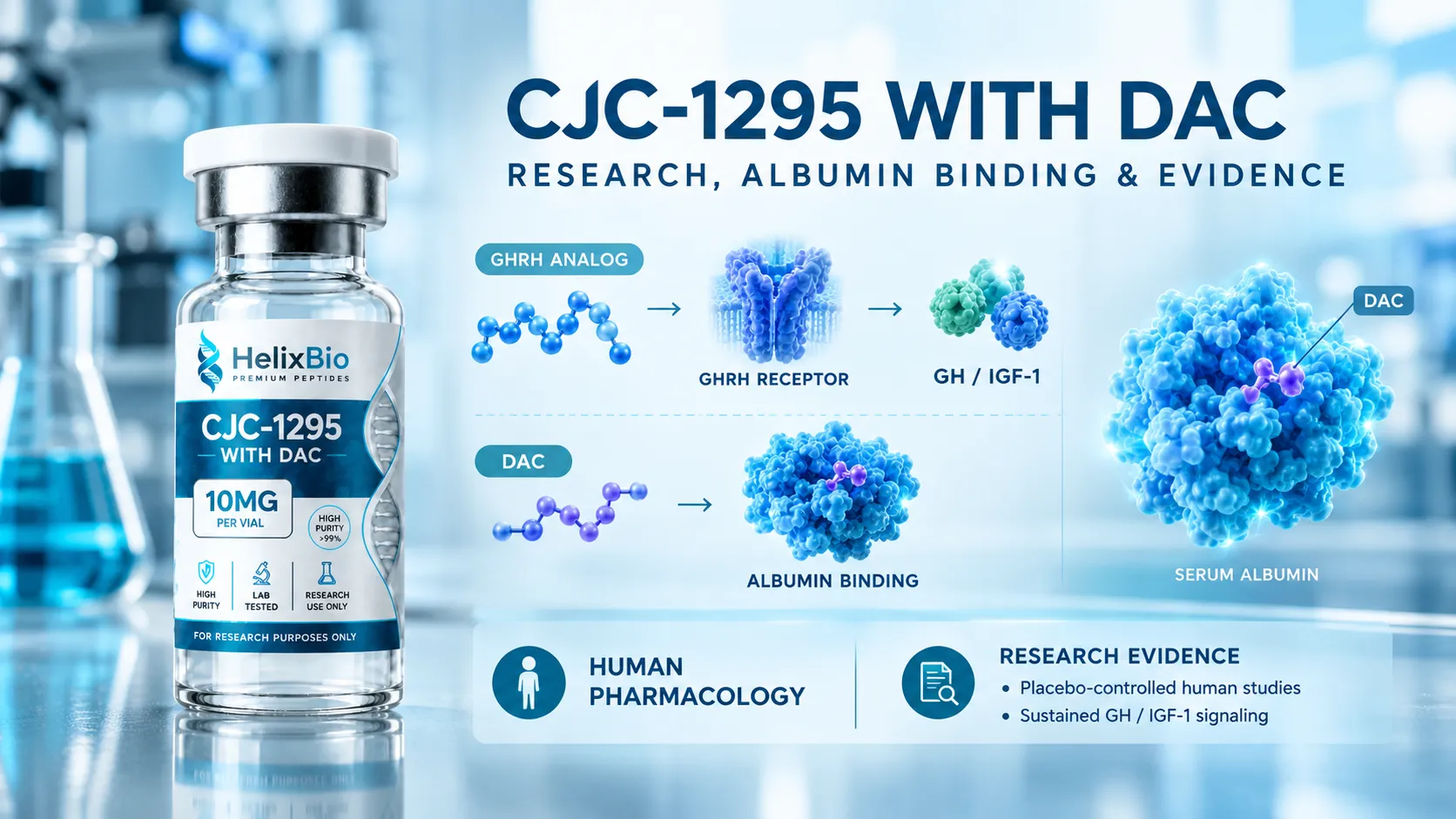
CJC-1295 with DAC is a GHRH analogue whose DAC construct forms a covalent albumin conjugate. An early-phase human study reported a 5.8 to 8.1 day half-life.
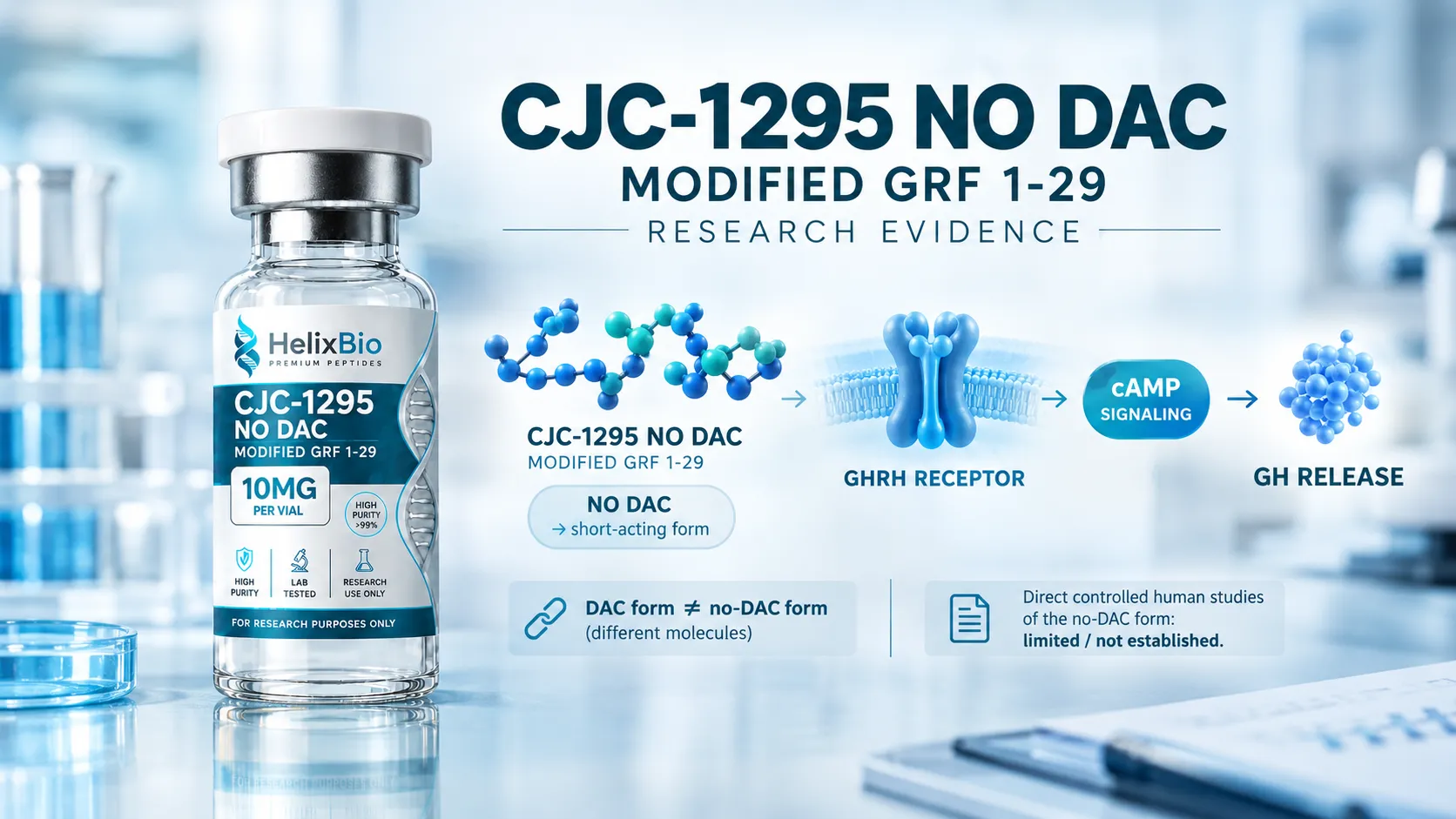
FDA treats CJC-1295 and CJC-1295 DAC as two distinct active moieties covering five separate bulk drug substances.
FDA lists CJC-1295 DAC free base as C165H269N47O46 with a molecular weight of 3,647.95 g/mol and CAS number 446262-90-4.
The DAC construct is a maleimidopropionamide-lysine unit whose maleimide group forms a covalent thioether adduct with the free thiol of albumin cysteine 34.
Teichman and colleagues reported an estimated half-life of 5.8 to 8.1 days after subcutaneous administration in healthy adults aged 21 to 61.
Growth hormone rose 2- to 10-fold for six days or more and IGF-1 rose 1.5- to 3-fold for nine to eleven days in that study, which measured biomarkers rather than clinical outcomes.
FDA states that direct evidence is lacking to confirm how much of the extended half-life the DAC modification itself accounts for, because no head-to-head comparison with the unconjugated form has been published.
No form of CJC-1295 is FDA approved, and the WADA Prohibited List names CJC-1295 under S2.2.4 without separating the DAC and no-DAC forms.
FDA's 2024 evaluation of CJC-1295 materials makes a point that most product pages skip. CJC-1295 and CJC-1295 with DAC are two different active moieties, not two grades of the same product. That distinction decides which studies count as evidence for which substance. This page covers the DAC form only. It sets out what the DAC construct is, how it attaches to albumin, what the published human data actually measured, and which widely repeated claims the record does not support.
What CJC-1295 with DAC actually is
CJC-1295 with DAC is a synthetic analogue of growth hormone releasing hormone, or GHRH, carrying an added chemical construct known as a Drug Affinity Complex.
The peptide part is a 29 amino acid sequence based on GHRH(1-29), with four substitutions at positions 2, 8, 15 and 27. FDA reports that backbone as Tyr-D-Ala-Asp-Ala-Ile-Phe-Thr-Gln-Ser-Tyr-Arg-Lys-Val-Leu-Ala-Gln-Leu-Ser-Ala-Arg-Lys-Leu-Leu-Gln-Asp-Ile-Leu-Ser-Arg-NH2. Attached to that backbone is the DAC itself, which FDA describes as a maleimidopropionamide-lysine unit, commonly written MPA-Lys. ConjuChem Biotechnologies developed it.
The two forms are not interchangeable on paper or in the laboratory. FDA evaluated five separate bulk substances under the CJC-1295 name, grouped under two distinct active moieties.
Property
CJC-1295 DAC (free base)
CJC-1295 (free base, no DAC)
Molecular formula
C165H269N47O46
C152H252N44O42
Molecular weight
3,647.95 g/mol
3,367.95 g/mol
CAS number
446262-90-4
446036-97-1
UNII
62RC32V9N7, record flagged as inconsistent
Not available
Salt forms FDA evaluated
Acetate and trifluoroacetate
Acetate
Active moiety
CJC-1295 DAC (free base)
CJC-1295 (free base)
Two identifier problems are worth knowing before anyone treats a number as settled. FDA notes that the UNII record in its Global Substance Registration System pairs the CJC-1295 free base name with a structure that is actually the DAC form. One withdrawn nomination also carried CAS 863288-34-0, which FDA describes as a deleted CAS number. Vendor pages still repeat both values.
Why the CJC-1295 name keeps causing mix-ups
At least nine different names have been used over time for those five substances, according to FDA's count. The agency treats that as a safety problem rather than a labelling quirk, because a person can end up dosed with a substance different from the one ordered.
History explains part of it. The DAC compound was described first, in 2005. A version without the DAC appears in the literature only in 2010, when Norwegian authorities analysed a seized preparation and found the peptide sequence with no DAC attached. So papers, registries and product labels reading simply "CJC-1295" can mean either molecule, and older ones usually mean the DAC form.
The practical rule follows from that. A source that says only "CJC-1295" is not automatically DAC evidence, and it is not automatically no-DAC evidence either. Someone has to check the structure, the manufacturer or the molecular weight before citing it. Evidence specific to the unconjugated form is handled separately in our CJC-1295 no-DAC research page.
What the DAC part of the molecule does
A Drug Affinity Complex has three conceptual parts. There is the active peptide, a short linker, and a reactive chemical group at the end of it.
In this molecule the reactive group is a maleimide, carried on 3-maleimidopropionic acid and joined to a lysine residue. Maleimides react readily with free thiol groups. That reaction, a Michael addition, forms a thioether bond, which does not simply come apart again once made.
One detail FDA's own document reports two ways
FDA's characterization section states twice that the MPA-Lys unit sits at the C terminus, and describes a synthesis route in which the MPA is attached after orthogonal deprotection on Ramage resin. The pharmacology section of the same document, summarising Jetté and colleagues, instead places the MPA-bound lysine residue at the N-terminal domain. Both statements appear in the same 2024 package. The published structure and the chemistry section agree on the C terminus, so that is the better supported position, but anyone quoting a location should say which source and which section it came from.
How covalent albumin conjugation works
Human serum albumin carries one free thiol in circulation, on the cysteine at position 34. That residue, albumin Cys34, is the target the DAC was designed around.
The maleimide reacts with the Cys34 thiol to form a stable adduct. Jetté and colleagues demonstrated this in rats, detecting albumin bound to CJC-1295 DAC in plasma by Western blot after subcutaneous administration. In the same work, albumin-conjugated CJC-1295 DAC was far more resistant to dipeptidyl peptidase-IV than GHRH(1-29). About 90 percent of the conjugate remained after incubation with the enzyme, while intact GHRH(1-29) could no longer be detected.
The conjugate also stayed active. Albumin-bound CJC-1295 DAC triggered growth hormone secretion from cultured rat pituitary cells, though it needed far higher concentrations than GHRH(1-29) to do so. Release from the carrier was not required for that activity, which is why describing the DAC as reversible albumin binding misstates the chemistry.
One consequence is less often mentioned. FDA points out that a reactive group of this kind may also attach to cysteine thiols on proteins other than albumin, and that off-target binding has not been ruled out.
Documentation matters more than the product name here. A purity figure on a certificate of analysis does not confirm which CJC-1295 form is in the vial, and it says nothing about safety or biological activity. Readers evaluating supplier paperwork can use our guide on [reading a peptide certificate of analysis](/how-to-read-peptide-certificate-of-analysis).
What the human pharmacokinetic study actually found
The central human evidence is Teichman and colleagues, published in 2006. It reports two randomized, placebo-controlled, double-blind ascending-dose trials lasting 28 and 49 days, in healthy adults aged 21 to 61, using subcutaneous administration.
After a single injection, mean plasma growth hormone rose 2- to 10-fold for six days or more. Mean IGF-1 rose 1.5- to 3-fold for nine to eleven days. The estimated half-life was 5.8 to 8.1 days. After repeated doses, mean IGF-1 stayed above baseline for up to 28 days, and the authors reported no serious adverse reactions.
FDA notes that the paper refers to its compound both as CJC-1295 and as DAC-GRF, prints the DAC structure, and names ConjuChem as the manufacturer, but does not identify the salt form used.
Where the 5.8 to 8.1 day figure comes from
That range is an estimate from a small early-phase programme, not a fixed property of the molecule. FDA's summary of the multiple-dose study reports mean estimated half-life values spanning 5.4 to 9.2 days among subjects sampled for up to 14 days, with clearance between 1.1 and 3.3 litres per hour. Measurable drug was present for 10 to 13 days after single or multiple doses.
Sixty-odd healthy volunteers produced those numbers, most of them after one injection. Half-life in that sense describes how long a substance persists in plasma, which is a different clock from how long a vial of material stays intact in storage, a distinction we cover in half-life versus shelf life.
Adverse events were common even in that short window. Injection site reactions affected roughly 70 percent of treated subjects in the first study. Headache was reported by 63 percent of treated subjects against 14 percent on placebo, and flushing, warmth or transient hypotension by about 30 percent.
What the GH and IGF-1 numbers do and do not establish
Four things get collapsed together in most coverage of this compound. Persistence in plasma, a growth hormone change, an IGF-1 change and a clinical outcome are separate findings, and only the first three were measured.
Finding
Evidence type
What it supports
What it does not establish
Estimated half-life of 5.8 to 8.1 days
Early-phase human pharmacokinetics
Prolonged plasma presence after subcutaneous dosing in healthy adults
A validated regimen, or the same behaviour in any other population
GH up 2- to 10-fold for six days or more
Human biomarker measurement
Sustained pituitary GH release over days
Muscle, fat, strength or recovery outcomes
IGF-1 up 1.5- to 3-fold for nine to eleven days
Human biomarker measurement
Downstream activation of the GH axis
Clinical benefit, body composition change or safety
Albumin conjugate detected in rat plasma, DPP-IV resistance in vitro
Animal and in-vitro evidence
Sorting claims by the kind of study behind them is the whole exercise, and our evidence grading methodology sets out how we apply it across compounds.
How the DAC form differs from the form without DAC
The two forms share a backbone and differ by roughly 280 g/mol of added construct. FDA states the position plainly, that the pharmacological profile of CJC-1295 DAC cannot be extrapolated to CJC-1295 without the DAC modification. The agency also reports that it identified no studies establishing whether the free base or acetate without DAC are pharmacologically active at all.
There is a subtler point about causation. Albumin conjugation is the designed mechanism and the best supported explanation for the long exposure, but FDA notes that direct evidence is lacking, and that showing the DAC form has a longer half-life than the same peptide without it would require a head-to-head comparison that has not been published. The four backbone substitutions may themselves contribute, since D-alanine at position 2 confers resistance to the same enzyme the DAC is credited with evading.
What happened to the clinical development programme
CJC-1295 DAC first appears in the literature in 2005, in the Jetté rat work. Human studies followed in 2006.
FDA states that ConjuChem withdrew CJC-1295 DAC from clinical trials in 2006 after the death of a subject in a Phase 2 trial. That trial, registered as NCT00267527, was a placebo-controlled study in adults with HIV-associated visceral obesity. FDA, drawing on anecdotal reports rather than published data, records that the subject had a heart attack two hours after an eleventh weekly dose and died about an hour later, and that the attending physician's most likely explanation was asymptomatic coronary artery disease with plaque rupture and occlusion. The death was not attributed to the compound. It was terminated, and its results were never published. The registry names the intervention only as CJC 1295, though FDA notes the European cross-registration lists the active substance as a CJC-1295 TFA salt.
No completed efficacy trial exists for either form. Nothing in the development record establishes that the compound works for any condition.
Where U.S. regulation and anti-doping stand
No form of CJC-1295 is FDA approved. None is a component of an approved drug, and none has a USP or NF monograph.
FDA's December 2024 advisory committee package concluded that the evaluation criteria weigh against adding any of the five CJC-1295 substances to the 503A Bulks List. The two original nominations had already been withdrawn, and FDA carried out the evaluation on its own initiative. On FDA's current category 2 page, updated in April 2026, CJC-1295 appears in the table of withdrawn nominations, with the agency's stated concerns about immunogenicity, characterization and limited clinical data still recorded. Removal from a category table is not approval, and an advisory package is not a final rule. Compounding status is a separate question again, which we track in our explainer on the 503A bulks list.
WADA takes a different angle. The Prohibited List names CJC-1295 under S2.2.4, growth hormone releasing factors, alongside CJC-1293, sermorelin and tesamorelin. S2 substances are prohibited at all times, in and out of competition. The listing names CJC-1295 without separating the DAC and no-DAC forms, so athletes should not assume one form sits outside it.
Helix Bio supplies this material for laboratory research use only. It is not a medicine, and nothing above describes a use in people.
What the evidence still does not establish
The gaps are as informative as the findings. Nothing in the published record establishes clinical efficacy for body composition, muscle, recovery, longevity or athletic performance. No validated regimen exists. Long-term safety is untested, and no carcinogenicity study has been conducted, which FDA flags as relevant because transgenic mice overexpressing GHRH develop pituitary hyperplasia and tumours.
Two further signals sit unresolved. FDA summarises a 2020 report of genotoxic signals in mouse pituitary cells exposed to CJC-1295 DAC, in vitro and in vivo. And the possibility of the reactive group binding thiols on proteins other than albumin has not been tested.
What to take from the DAC record
The chemistry is well described and the human pharmacology is thin. A DAC construct attaches covalently to albumin Cys34, the resulting conjugate persists for days in healthy adults, and growth hormone and IGF-1 move in response. That is the extent of it. Every claim beyond biomarker movement, in either direction, currently rests on inference rather than published evidence for this exact molecule.
Got Questions?
Frequently Asked Questions
CJC-1295 with DAC is a synthetic growth hormone releasing hormone analogue built on a 29 amino acid GHRH(1-29) backbone with a maleimidopropionamide-lysine construct attached. FDA lists its free base with the molecular formula C165H269N47O46 and a molecular weight of 3,647.95 g/mol.
DAC stands for Drug Affinity Complex, a construct made of a linker and a reactive maleimide group carried on the peptide. It was developed by ConjuChem Biotechnologies to extend how long a peptide persists in circulation.
The attachment is covalent. The maleimide group reacts with a free thiol to form a thioether adduct, and the conjugate was shown to remain biologically active without releasing the peptide from the carrier.
The reaction targets cysteine 34 of serum albumin, the one free thiol on circulating human serum albumin. Jetté and colleagues detected albumin-bound CJC-1295 DAC in rat plasma after subcutaneous administration.
MPA-Lys is the maleimidopropionamide-lysine construct FDA describes as the DAC-specific addition to the CJC-1295 backbone. MPA refers to 3-maleimidopropionic acid, which carries the reactive maleimide ring.
No. It is an estimate reported in a small early-phase study in healthy adults. FDA's summary of the multiple-dose arm reports mean estimated half-life values ranging from 5.4 to 9.2 days among subjects sampled for up to 14 days.
Teichman and colleagues published two randomized, placebo-controlled, double-blind ascending-dose trials in 2006, lasting 28 and 49 days in healthy adults aged 21 to 61. FDA notes the paper does not specify which salt form was used.
No. Its endpoints were pharmacokinetics plus growth hormone and IGF-1 concentrations, along with safety observations. Biomarker changes in healthy volunteers do not establish a clinical outcome.
No. FDA treats them as two distinct active moieties with different molecular formulas and weights, and states that the pharmacological profile of the DAC form cannot be extrapolated to the form without it.
Not in the published record. FDA notes that direct evidence is lacking and that a head-to-head comparison would be needed to confirm how much of the extended half-life the DAC modification accounts for.
No. No form of CJC-1295 is FDA approved, none is a component of an approved drug, and none has a USP or NF monograph. FDA's 2024 advisory package concluded the criteria weigh against adding any of the five CJC-1295 substances to the 503A Bulks List.
The WADA Prohibited List names CJC-1295 under S2.2.4, growth hormone releasing factors, and S2 substances are prohibited at all times. The listing does not separate the DAC and no-DAC forms.
Not on its own. FDA reported that most certificates it found for the DAC free base contained only a purity result with no impurity or aggregate controls, and that inconsistent naming makes reference standards hard to match to a specific substance.