What CJC-1295 (No DAC) Research Actually Shows About Modified GRF(1-29)
Growth researchSeptember 19, 202611 min read
CJC-1295 no DAC and CJC-1295 with DAC are two different substances. Which studies belong to each, and what the unconjugated form has never been tested for.
FDA treats CJC-1295 and CJC-1295 DAC as two different active moieties that are not interchangeable, across at least five bulk drug substances and nine names.
Modified GRF (1-29) is a 29-residue GHRH analog with substitutions at positions 2, 8, 15 and 27, not a fragment of GHRH.
The free base is C152H252N44O42 at 3367.95 g/mol, CAS 446036-97-1; FDA records the widely printed CAS 863288-34-0 as deleted.
The acetate salt has a variable acetate count, so FDA records no molecular weight for it.
Neither unconjugated form has a UNII, and the UNII in circulation belongs to the DAC compound.
Jetté 2005, Teichman 2006, Ionescu and Frohman 2006, Alba 2006 and Sackmann-Sala 2009 all studied the DAC compound.
FDA identified no pharmacology, pharmacokinetic or toxicology study of the unconjugated compound in any species.
The widely quoted 30-minute half-life has no primary source, and no study has compared the two forms' half-lives directly.
In 2009, Norwegian police and customs seized an unidentified pharmaceutical preparation. Mass spectrometry found a 29-residue peptide weighing 3365.9 daltons, with no albumin-binding group attached. Henninge and colleagues published the finding in 2010. FDA's own review names that report as the first reference to CJC-1295 without DAC anywhere in the scientific literature.
So the compound entered the record through a seizure, not a development program. That origin explains a great deal. Most of what the market says about this peptide was measured on a different molecule.
The short answer
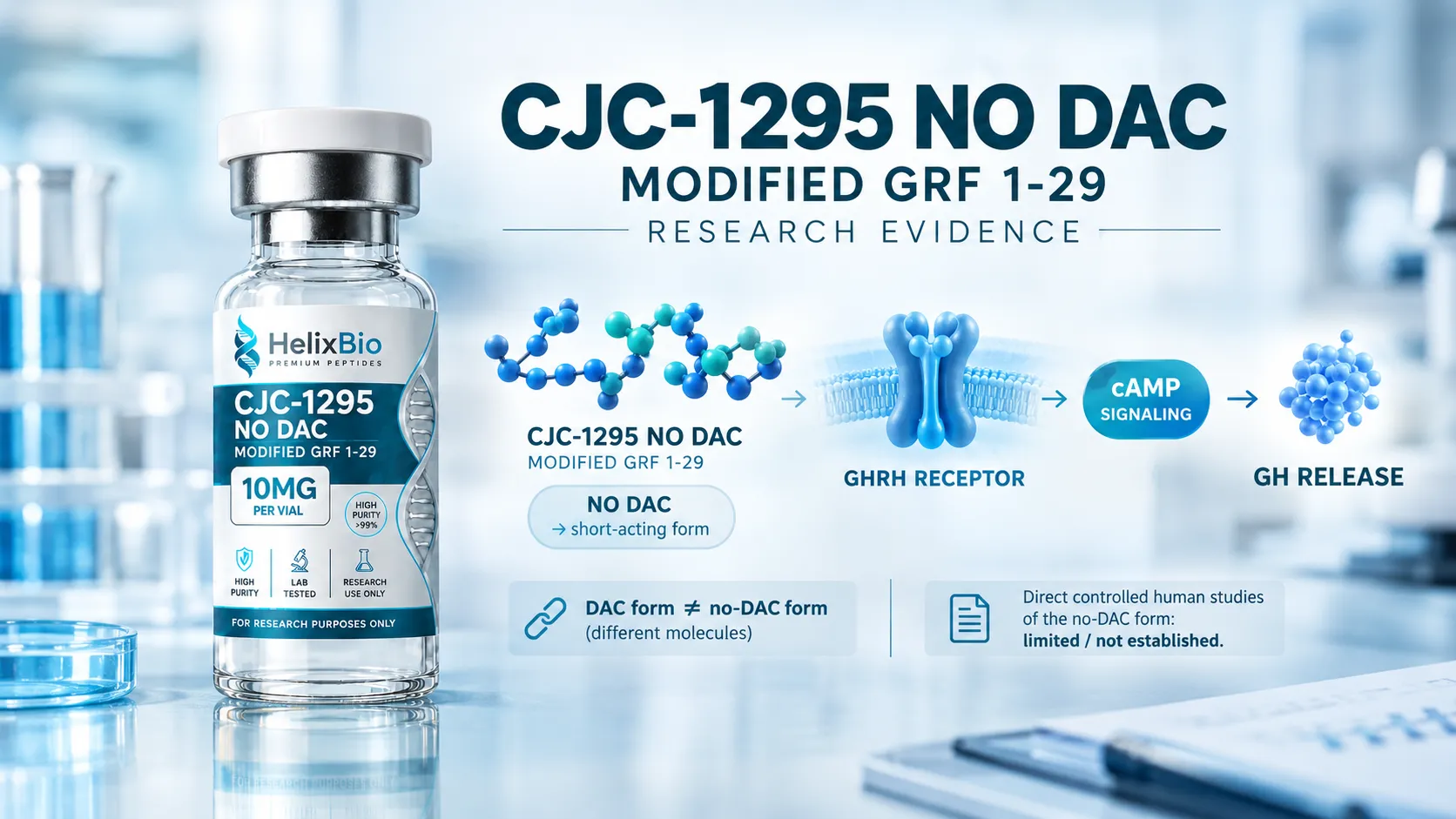
CJC-1295 no DAC, also sold as Modified GRF (1-29), is a synthetic 29-residue GHRH analog with four amino acid substitutions. It is a different substance from CJC-1295 with DAC, and FDA evaluates the two separately. Every published human and animal study under the CJC-1295 name examined the DAC form. FDA's 2024 review found no published pharmacology, pharmacokinetic or toxicology study of the unconjugated compound in any species.
The identity of this peptide is well documented. Its biology, as a standalone compound, is not.
Two compounds share one name
Regulators at the US Food and Drug Administration treat the two forms as two different active moieties. An active moiety is the part of a molecule that produces its pharmacological action, ignoring salts and counterions. FDA states plainly that these two are not interchangeable.
Counting the salt forms, the agency lists at least five distinct bulk drug substances in this family. It also counts at least nine different names used for them over time.
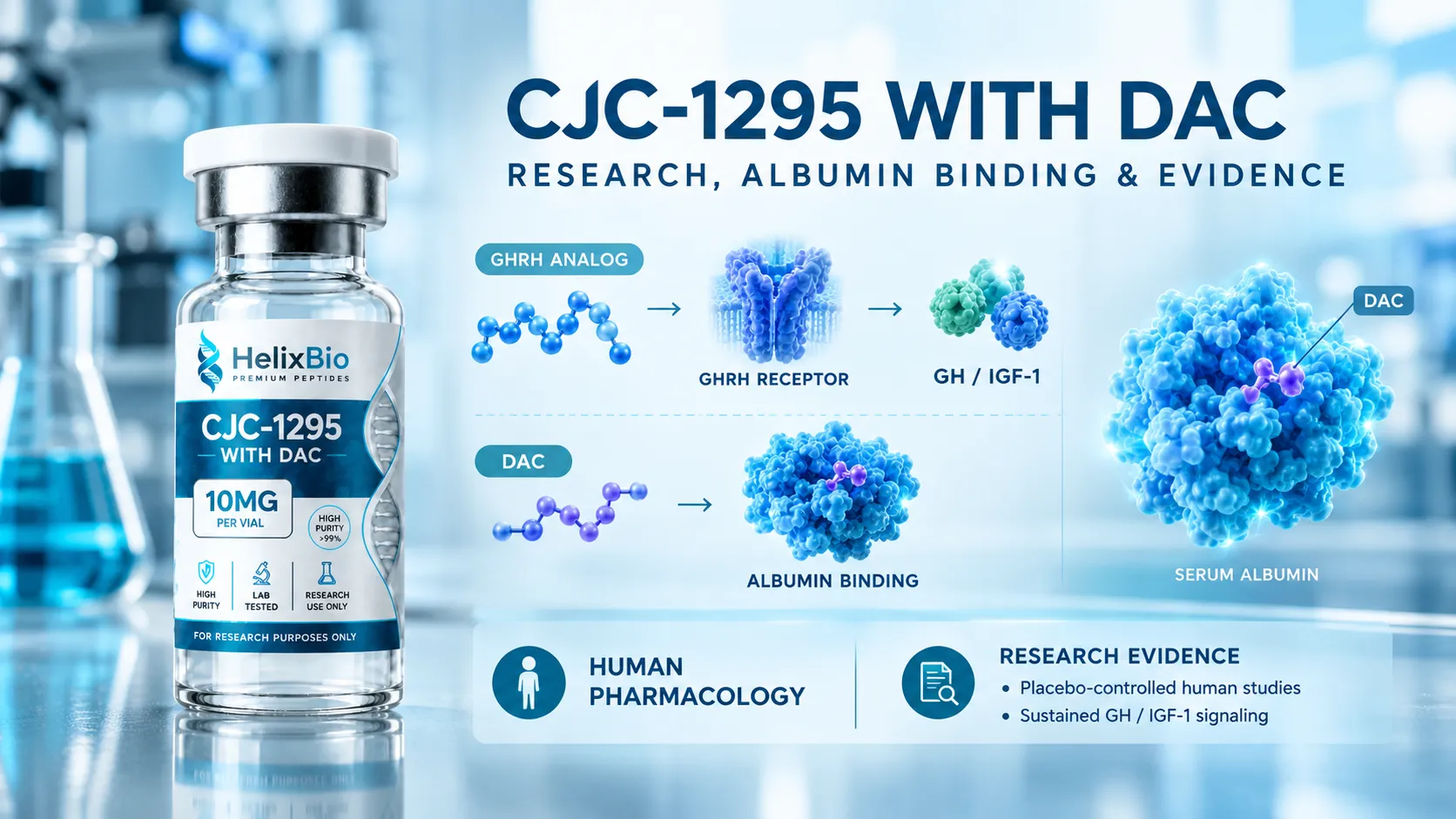
One substance is the 29-residue peptide. The other is the same core with a maleimidopropionamide-lysine group added at the C-terminus. That extra group is the Drug Affinity Complex, or DAC.
The naming does not even run in one direction. Wikipedia and much vendor copy treat bare "CJC-1295" as the DAC compound. FDA's regulatory record does the reverse, using "CJC-1295" for the unconjugated peptide and adding "DAC" for the conjugate. The Norwegian laboratory's 2010 paper also titled the non-DAC substance simply "CJC-1295".
Human findings reported under the name CJC-1295 describe the DAC-conjugated molecule. They do not describe the peptide sold as CJC-1295 No DAC or Modified GRF (1-29).
The chain has 29 residues and ends in an amide. Compared with the first 29 residues of human growth hormone-releasing hormone, four positions differ.
Position
Native GHRH(1-29)
This compound
Rationale on record
2
L-Ala
D-Ala
D-alanine at this position resists cleavage by DPP-IV
8
Asn
Gln
Avoids asparagine rearrangement or hydrolysis to aspartic acid
15
Gly
Ala
Not stated in FDA's review
27
Met
Leu
Removes the oxidation-prone methionine
Two corrections are worth carrying, because both circulate widely. Position 8 replaces asparagine with glutamine, not glycine. Position 15 replaces glycine with alanine.
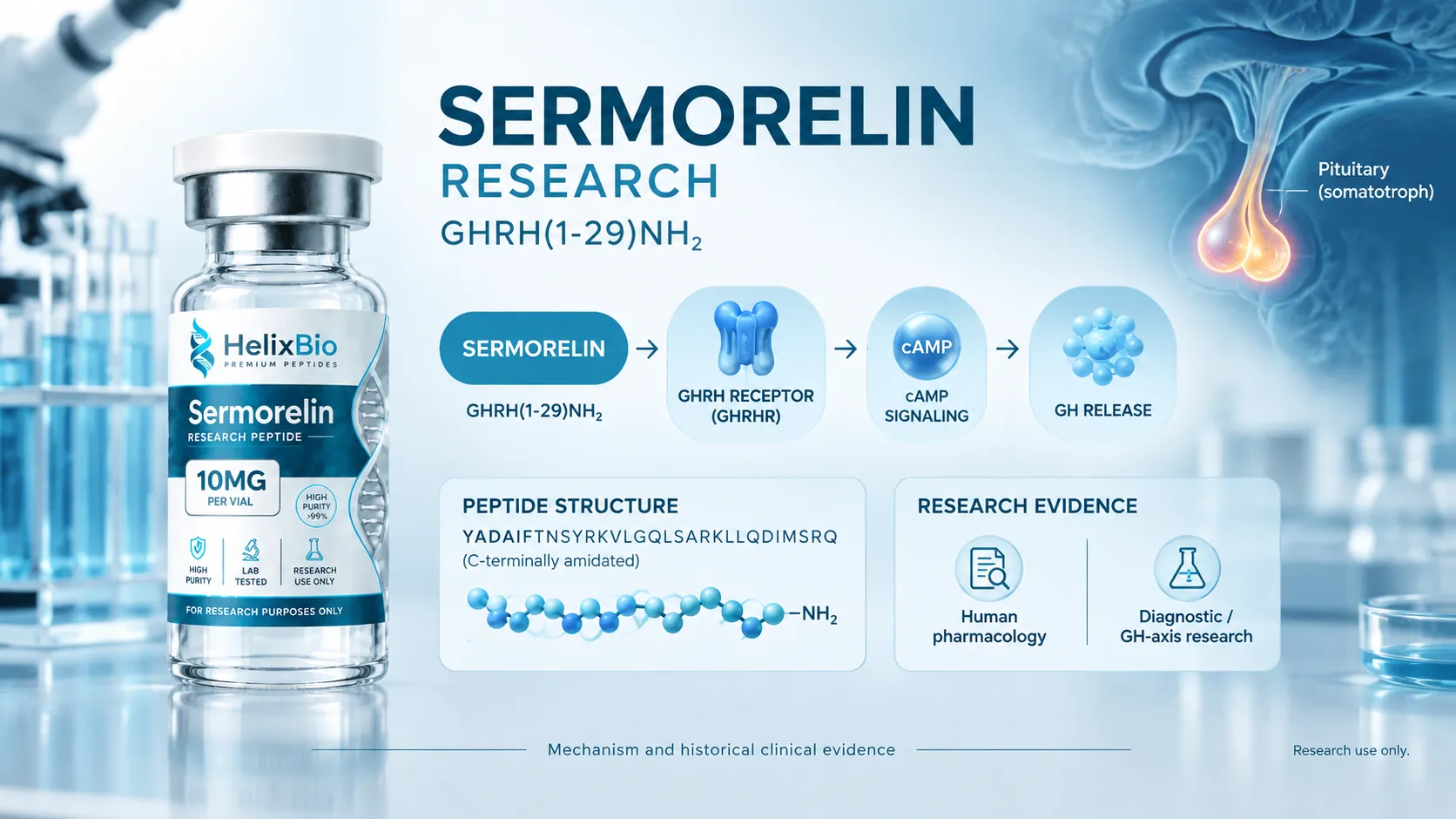
This compound is also an analog, not a fragment. The true fragment is sermorelin, the unmodified GRF(1-29) amide with no substitutions at all. Calling Modified GRF (1-29) a fragment erases the four changes that define it.
By design, the peptide should act at the GHRH receptor, as native GHRH does. Our comparison of GHRH analogs and GHRPs covers that receptor class. For this exact molecule, though, receptor activity is a design expectation. FDA found no published pharmacology study confirming it.
The identity record, and where it breaks
These are the fields a certificate of analysis should match. They come from FDA's registry table, not from supplier catalogs.
Field
Free base
Acetate salt
Molecular formula
C152H252N44O42
C152H252N44O42 plus a variable number of acetate units
Molecular weight
3367.95 g/mol
FDA records none
CAS number
446036-97-1
None available
UNII code
None available
None available
Four details in that table matter.
The acetate has no fixed molecular weight. FDA writes the number of acetate units as a variable, so no single mass exists. A certificate reading "CJC-1295 acetate, MW 3367.95" prints the free-base mass against a salt name. Those two describe different substances by weight.
Most vendors print a dead CAS number. Many product pages list CAS 863288-34-0. One withdrawn nomination submitted that number, and FDA's evaluation records it as a deleted CAS. The registry number FDA lists for the free base is 446036-97-1.
Neither unconjugated form has a UNII. The code in circulation, 62RC32V9N7, belongs to the DAC compound. FDA adds a sharper point about it. That registry entry pairs the non-DAC name with the DAC structure, so the record contradicts itself.
No monograph exists. No form of CJC-1295 has a United States Pharmacopeia or National Formulary monograph. None has an International Nonproprietary Name, and neither the European nor the Japanese pharmacopoeia recognizes it. "Modified GRF (1-29)", "Mod GRF 1-29" and "CJC-1295 no DAC" are naming conventions, not registry identities. Our guide to reading a certificate of analysis covers the fields that actually settle identity.
The two forms differ by 279.3 g/mol: 3647.25 for the DAC free base against 3367.95 here. One mass spectrometry run separates them cleanly. Mass cannot confirm stereochemistry, though, because D-alanine and L-alanine weigh exactly the same.
Both weights reproduce exactly from their formulas. The free base's monoisotopic mass calculates to 3365.89 daltons, matching the Norwegian measurement. One discrepancy in FDA's own table is worth flagging. The agency prints the DAC weight as 3647.95, which does not reproduce from the DAC formula, while 3647.25 does.
Which studies belong to which molecule
Five papers carry the CJC-1295 literature. Here is what each one studied.
Study
Molecule
Model
What was measured
Jetté 2005
DAC, trifluoroacetate salt
Rats, rat pituitary cells
Albumin conjugation, DPP-IV resistance, GH release
Teichman 2006
DAC, salt unspecified
Healthy adults
Pharmacokinetics, GH, IGF-1
Ionescu and Frohman 2006
DAC, salt unspecified
12 healthy men
GH pulsatility, IGF-1
Alba 2006
DAC, form unspecified
GHRH knockout mice
Growth, lean mass, pituitary GH cells
Jetté and colleagues titled their 2005 paper around hGRF(1-29)-albumin bioconjugates. They showed the DAC compound conjugated to albumin in rat circulation and resisted DPP-IV far better than native GHRH(1-29).
Teichman and colleagues gave healthy adults single and repeated subcutaneous injections of the DAC compound, made by ConjuChem. In the repeated-dose study, the mean estimated half-life ranged from 5.4 to 9.2 days. The paper prints the DAC structure.
Then comes the finding that matters most.
FDA identified **no pharmacological studies** of CJC-1295 free base or CJC-1295 acetate. It also found no nonclinical pharmacokinetic, acute toxicity, repeat-dose toxicity, genotoxicity, reproductive toxicity or carcinogenicity study of either form. Every study in the agency's file examined the DAC compound.
FDA spells out the consequence in plain terms. In the agency's words, the DAC compound's profile "cannot be extrapolated to CJC-1295 without the DAC modification." A regulator has written the evidence boundary in its own words. Our evidence grading framework explains why that distinction decides how each finding is labeled.
The half-life figure nobody has measured
Many pages selling this peptide quote a half-life of about 30 minutes. They usually set it beside 6 to 8 days for the DAC form, as if both were measured.
Only one of those two figures was measured. The week-scale figure traces to Teichman 2006, in humans, for the DAC compound. The 30-minute figure has no primary human pharmacokinetic source. FDA searched for pharmacokinetic data on the unconjugated form and found none, in humans or animals.
There is a subtler problem too, and FDA raised it against Jetté's work. The Jetté team concluded that albumin conjugation explains the DAC compound's stability. FDA's reviewers counter that direct evidence for this is lacking. Proving it would require comparing the half-lives of the DAC and non-DAC forms. FDA's review identified no such comparison.
The four backbone substitutions may themselves add stability. D-alanine at position 2 resists DPP-IV, while the position 8 and 27 changes remove a rearrangement site and an oxidation site.
So "the DAC stretches the half-life from 30 minutes to a week" holds one measured number and one unmeasured number. It also carries a causal claim no study has isolated. Half-life in the body is a separate idea from shelf-life in the vial, a distinction we unpack in half-life versus shelf-life.
From growth hormone to IGF-1 and beyond
Three levels sit in sequence here. A GHRH receptor agonist can raise pituitary growth hormone secretion. Growth hormone can then raise hepatic IGF-1 production. IGF-1 takes part in downstream tissue effects. Movement at one level does not prove movement at the next.
For the DAC compound, the human data reach the first two levels only. Ionescu and Frohman reported mean overnight growth hormone 46% above baseline. IGF-1 rose 44% one week after injection and stayed within the normal range in every subject.
Those are surrogate markers, measured in people whose pituitary axis already worked. FDA notes that growth hormone-deficient subjects may not respond the same way, since secretagogues need a pituitary that can answer.
What no study has shown for this compound
For the unconjugated peptide, the published record contains none of the following:
A human measurement of growth hormone or IGF-1
A body composition, muscle, strength or recovery endpoint in any species
A sleep, metabolic or longevity endpoint
A pharmacokinetic study, human or animal
A toxicology study of any kind
Long-term endocrine follow-up
That list reflects what FDA's review and this article's source checks could locate. An absence of reported harm where no study exists is not a safety finding.
What the DAC safety record contains
The DAC compound's clinical history includes an event marketing rarely mentions. ConjuChem ran a Phase 2 trial in HIV-associated lipodystrophy, with 192 subjects randomized to weekly injections or placebo.
Two hours after an eleventh weekly dose, one participant reported chest discomfort. An electrocardiogram confirmed an acute myocardial infarction, and the participant died about an hour later. The attending physician's stated explanation was undiagnosed coronary artery disease with plaque rupture. ConjuChem ended the trial in 2006, and its data were never published.
Causality was never established, and one death cannot prove a drug effect. It belongs in the record because development stopped there, with no public data to assess it.
In the healthy-volunteer studies, injection site reactions were the most common adverse event. Headache, diarrhea and transient flushing were also frequent. In animals, the DAC compound produced genotoxic signals in mouse pituitary cells and injection site inflammation in rats and dogs.
None of this is safety data for the unconjugated compound, in either direction.
Where FDA and anti-doping rules stand today
Compounding. FDA sorts nominated substances into three interim-policy categories. No form of CJC-1295 appears in any category of the 503A list, current as of 14 May 2026. None appears on the 503B list, current as of 21 March 2025.
CJC-1295 entered 503A Category 2 in September 2023. It was removed effective 27 September 2024, after the nominators withdrew. FDA then took five forms to its Pharmacy Compounding Advisory Committee on 4 December 2024 anyway. It proposed that none be added, with a separate vote on each. Committee votes are advisory, and no final rule has published. Our explainer on the 503A bulks list covers how that process works.
Sitting in no category does not mean approval. It means the substance falls outside the framework entirely.
Approval. No form of CJC-1295 is approved anywhere FDA checked. The agency found no approved product in twelve countries, including Australia, Canada, Japan and the United Kingdom, and no European Medicines Agency authorisation for use in the European Union. Neither the European nor the Japanese pharmacopoeia recognises any form.
Anti-doping. The 2026 WADA Prohibited List names CJC-1295 at section S2.2.4, among growth hormone releasing factors. The clause covers "growth hormone-releasing hormone (GHRH) and its analogues" and is explicitly non-exhaustive. Coverage therefore reaches both forms, whichever molecule the named example is read to mean. The prohibition applies at all times.
Research suppliers, including Helix Bio, sell this material strictly for laboratory research. It is not intended for human or veterinary use.
Four questions that sort out any claim
Most disputed statements about this peptide resolve under four questions.
Which molecule? If a source does not say DAC or non-DAC, treat the claim as unassigned.
Which salt? FDA notes that even the human studies leave the salt unspecified.
Which endpoint? Growth hormone, IGF-1, or something further downstream.
Which population? Healthy volunteers, animals, cultured cells, or nobody at all.
Take "CJC-1295 keeps IGF-1 raised for days." The answers are the DAC compound, salt unspecified, IGF-1 as a surrogate, and healthy adults in Teichman 2006. In that study, IGF-1 stayed above baseline for 9 to 11 days after one injection.
Now take "CJC-1295 no DAC has a 30-minute half-life." No published study answers any of the four.
What the evidence adds up to
Modified GRF (1-29) is a well-defined molecule with a thin evidence base. Its sequence, formula and mass are documented and checkable. What is missing is any published study of the compound itself.
That conclusion is narrower than either side of the usual argument. The CJC-1295 literature does not validate this peptide, because it examined a different molecule. It does not refute it either. The accurate word is untested.
When identity can be checked and evidence cannot, the certificate of analysis carries more weight than the literature. Our review of peptide purity testing explains what analytical results can and cannot establish.
Got Questions?
Frequently Asked Questions
CJC-1295 no DAC, also called Modified GRF (1-29), is a synthetic 29-residue GHRH analog with substitutions at positions 2, 8, 15 and 27. It lacks the Drug Affinity Complex, a maleimidopropionamide-lysine group attached to the C-terminus of the conjugated form. FDA treats the two as separate active moieties.
In market and research usage, the two names refer to the same molecule, as do Mod GRF 1-29 and tetrasubstituted GRF (1-29). None of these names is an official registry identity, since no form of CJC-1295 has a USP monograph or an International Nonproprietary Name.
The DAC form carries a maleimidopropionamide-lysine group at the C-terminus that the unconjugated form lacks. Their formulas are C165H269N47O46 and C152H252N44O42, and their free-base weights differ by 279.3 g/mol. FDA identifies them as two different active moieties, so evidence on one does not describe the other.
FDA's evaluation gives Tyr-D-Ala-Asp-Ala-Ile-Phe-Thr-Gln-Ser-Tyr-Arg-Lys-Val-Leu-Ala-Gln-Leu-Ser-Ala-Arg-Lys-Leu-Leu-Gln-Asp-Ile-Leu-Ser-Arg-NH2. Relative to native GHRH(1-29), position 2 becomes D-alanine and position 8 changes from asparagine to glutamine. Position 15 changes from glycine to alanine, and position 27 from methionine to leucine.
FDA lists CAS 446036-97-1 for the free base. The number 863288-34-0, which appears on many vendor pages, is recorded by FDA as a deleted CAS.
FDA records no molecular weight for the acetate, because the number of acetate units is variable rather than fixed. The 3367.95 g/mol figure belongs to the free base, so a certificate pairing it with an acetate name describes two different substances by weight.
That figure is widely quoted but has no identified primary source. FDA searched for pharmacokinetic data on the unconjugated compound and found none in humans or animals. The 6 to 8 day figure often printed beside it comes from Teichman 2006 and describes the DAC compound.
No published human study of the unconjugated compound has been identified. FDA's 2024 review found no pharmacology study of CJC-1295 free base or acetate in any species. The human studies published under the CJC-1295 name examined the DAC-conjugated molecule.
No. Teichman and colleagues studied the DAC compound, manufactured by ConjuChem, and the paper prints the DAC structure. FDA states that the DAC compound's pharmacological profile cannot be extrapolated to the form without the DAC modification.
No. The maleimide group forms a covalent bond with the thiol of cysteine 34 on albumin, which FDA describes as generating stable adducts. FDA also notes the group could react with cysteine thiols on proteins other than albumin.
It is the proposed explanation, not a demonstrated one. FDA's reviewers note that proving it would require comparing the half-lives of the DAC and non-DAC forms directly, and no such comparison has been published.
Yes. The free-base masses differ by 279.3 g/mol, so one mass spectrometry run separates them. Mass alone cannot confirm the D-alanine at position 2, because D- and L-alanine have identical mass.
No form of CJC-1295 appears in any category of FDA's 503A list, current 14 May 2026, or the 503B list, current 21 March 2025. At an advisory committee meeting on 4 December 2024, FDA proposed that none of five forms be added, and no final rule has published.
Yes. The 2026 WADA Prohibited List names CJC-1295 at S2.2.4 within a non-exhaustive clause covering GHRH and its analogues, so both forms are covered. The prohibition applies at all times, in and out of competition.