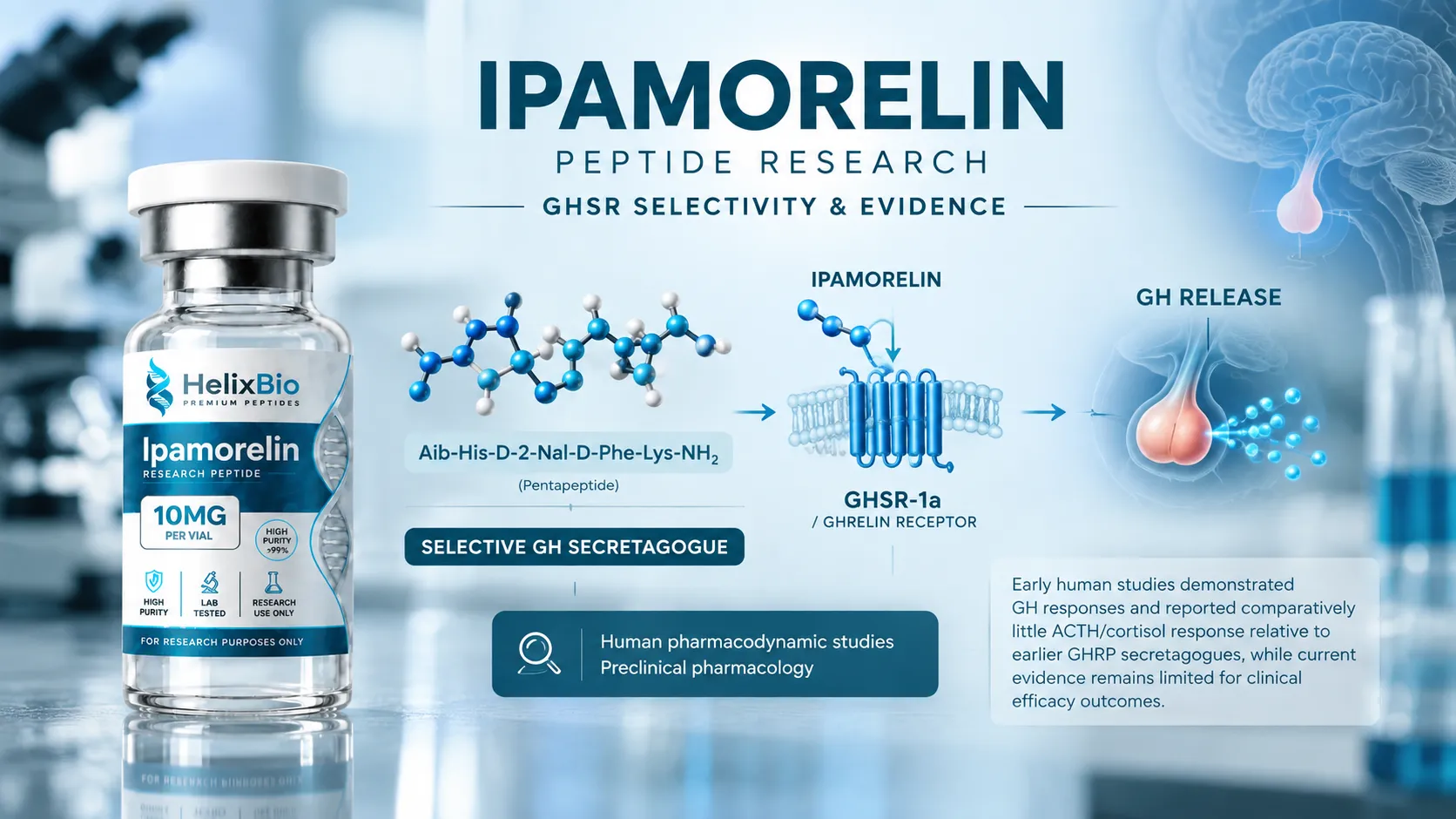
Ipamorelin is a synthetic pentapeptide, Aib-His-D-2-Nal-D-Phe-Lys-NH2, acting at the growth hormone secretagogue receptor rather than the GHRH receptor.
The 1998 selectivity finding describes a separation between growth hormone release and ACTH or cortisol release, measured in swine against a GHRH comparator.
The foundational study reported no effect on FSH, LH, prolactin or TSH for any secretagogue tested, so reduced prolactin release is not a point of difference from GHRP-2 or GHRP-6.
One published human pharmacokinetic study exists, using intravenous infusion, reporting a terminal half-life of about two hours and a growth hormone peak near 0.67 hours.
FDA identified no pharmacokinetic, pharmacodynamic or safety data for subcutaneous administration of ipamorelin in humans.
The single phase 2 efficacy trial in postoperative ileus did not meet its primary endpoint, at 25.3 against 32.6 hours, and development was discontinued.
FDA found that both ipamorelin nomination packages supplied a certificate of analysis for the acetate while every identity field matched the free base.
FDA records no defined molecular weight for ipamorelin acetate because the acetate stoichiometry is not fixed, so a salt name printed above 711.9 g/mol describes the free base.
Ipamorelin free base dissolves at 0.0032 mg/mL and the acetate at 5 mg/mL, so which form is supplied determines whether a working concentration is achievable.
An FDA advisory committee voted 0 to 12 with one abstention against including each ipamorelin form on the 503A bulks list on 29 October 2024.
Ipamorelin is a synthetic pentapeptide, Aib-His-D-2-Nal-D-Phe-Lys-NH2, that releases growth hormone by acting at the growth hormone secretagogue receptor rather than the GHRH receptor. It is routinely described as the first selective growth hormone secretagogue. That description comes from one 1998 paper, and it means something narrower and more specific than most pages selling the compound suggest.
Featured In This Article
Ipamorelin
RESEARCH PEPTIDE
Highly purified synthetic peptide prepared for rigorous laboratory research.
$72.00
This article covers what the foundational pharmacology measured, what the single published human pharmacokinetic study reported, what the one clinical efficacy trial found, and what the regulatory record says about identity. It is written for researchers evaluating the compound and its documentation. It does not cover the combination question, which our tesamorelin and ipamorelin combination evidence review already owns, and it does not restate the receptor-class biology set out in our GHRH analogues versus GHRPs comparison.
What the Word Selective Actually Referred To
Selectivity, in the paper that introduced the term for this molecule, described the separation between growth hormone release and adrenal axis activation. It was not a receptor-binding claim, and it was not a safety claim.
Raun and colleagues reported in 1998 that ipamorelin released growth hormone from primary rat pituitary cells with potency and efficacy similar to GHRP-6, at an EC50 of 1.3 plus or minus 0.4 nmol/l against 2.2 plus or minus 0.3 nmol/l for GHRP-6. In conscious swine the ED50 was 2.3 nmol/kg, again close to GHRP-6 at 3.9 nmol/kg. GHRP-2 was more potent but less efficacious, with an ED50 of 0.6 nmol/kg.
The selectivity finding sits in the swine experiments. Both GHRP-6 and GHRP-2 raised plasma ACTH and cortisol. Ipamorelin did not produce ACTH or cortisol levels significantly different from those seen after GHRH stimulation, and that held at doses more than 200-fold above the ED50 for growth hormone release.
Read the comparator carefully. The null result is against GHRH, not against an untreated baseline. The authors' own conclusion was that ipamorelin showed a selectivity for growth hormone release similar to that displayed by GHRH. That is a comparison between two stimuli, both of which raise growth hormone.
The Prolactin Claim Does Not Survive the Source
Vendor pages, including product listings on this site, commonly state that ipamorelin produces less prolactin release than older GHRPs. The 1998 paper reports something different.
None of the growth hormone secretagogues tested affected FSH, LH, prolactin or TSH plasma levels in the swine experiments. Not ipamorelin, not GHRP-2, not GHRP-6. A finding shared by all three compounds cannot be a point of difference between them. The documented separation is confined to ACTH and cortisol.
The Six Claim Levels, and Which Ones Have Evidence
Most confusion about this compound comes from sliding between levels of evidence that are not equivalent. Each step below requires its own demonstration.
Level
What would establish it
Status for ipamorelin
Receptor interaction
Antagonist profiling, binding data
Demonstrated, via GHRP-receptor antagonist blockade
Cellular signalling
Pathway-specific assays
Class-level; Gq/11 phospholipase activation described for ghrelin receptors
Growth hormone release
Measured hormone output
Demonstrated in rat cells, rats, swine and humans
Endocrine separation
Multi-hormone panel with comparators
Demonstrated for ACTH and cortisol, in swine, acutely
Physiological outcome
Body composition, bone, tissue endpoints
Not established in humans
Clinical efficacy
Controlled trial meeting an endpoint
Tested once, endpoint not met
Evidence at one level does not carry to the next. A measured growth hormone pulse is a pharmacodynamic observation, not a body-composition result.
What the Single Human Pharmacokinetic Study Reported
One published human pharmacokinetic study exists. Gobburu and colleagues ran a randomised, placebo-controlled dose-escalation trial using five 15-minute intravenous infusion rates, from 4.21 to 140.45 nmol/kg. FDA's own review of the trial records 48 subjects enrolled, with six healthy male subjects receiving ipamorelin and two receiving placebo at each dose level.
That detail matters, because the widely repeated figure of eight subjects per dose level counts the placebo recipients as though they received the compound. Six did.
The reported parameters were dose-proportional kinetics, a terminal half-life of about two hours, clearance of 0.078 L/h/kg and a steady-state volume of distribution of 0.22 L/kg. Growth hormone rose to a single sharp peak at roughly 0.67 hours and declined to very low concentrations by six hours at all doses.
Two qualifications belong with those numbers.
FDA's review records that the lowest dose group and the placebo group were excluded from the pharmacokinetic and pharmacodynamic analysis because growth hormone levels were negligible. The dose-proportionality conclusion therefore rests on four dose levels, and the lowest tested exposure did not produce a measurable response.
Every published human pharmacokinetic figure for this compound comes from intravenous infusion. FDA states plainly that it identified no pharmacokinetic or pharmacodynamic information for subcutaneous administration, and none for any other route. A two-hour half-life measured after an intravenous infusion does not describe the behaviour of the same compound given another way.
The One Clinical Efficacy Trial and Its Result
Ipamorelin was taken into a phase 2 trial for postoperative ileus. As summarised in FDA's evaluation, Beck and colleagues in 2014 ran a prospective, multicentre, randomised, double-blind, placebo-controlled study in adults undergoing small and large bowel resection. Of 117 hospitalised subjects, 114 received allocated study drug, 56 on intravenous ipamorelin and 58 on placebo, twice daily from the first postoperative day.
The primary endpoint was median time from first dose to tolerating a standardised solid meal. That was 25.3 hours with ipamorelin against 32.6 hours with placebo. The difference was not statistically significant. No differences were reported between groups on the secondary endpoints characterising upper and lower gastrointestinal function, including the composite GI-2 measure and length of stay. Development for this indication was discontinued.
The safety record from that trial should be reported alongside the efficacy result rather than separately. FDA records hypokalaemia in 12.5 percent of ipamorelin subjects against 3.4 percent on placebo, insomnia in 10.7 against 5.2 percent, and hyperglycaemia at discharge in 14.3 against 8.6 percent. Two subjects in the ipamorelin group experienced fatal serious adverse events following anastomotic leak after bowel resection for colon cancer. FDA states it is unclear whether those deaths were related to ipamorelin, and records them as contributing to its safety concern.
This is the complete published human efficacy and safety record for the compound.
The Identity Problem That FDA Found in the Nomination Files
The most useful document for anyone reading a certificate of analysis for this material is FDA's 2024 evaluation of ipamorelin as a candidate bulk drug substance, because it examines the paperwork rather than the pharmacology.
Two parties nominated ipamorelin for the section 503A bulks list. Because neither package made clear which substance was being nominated, and because of its safety concerns about peptides in compounded drug products, FDA elected to evaluate both forms on its own initiative. Reviewing what they had filed, FDA found that neither package made clear which substance was being nominated.
One nominator named ipamorelin acetate. The other named ipamorelin. In both packages the certificate of analysis supplied was for the acetate, while the UNII code, CAS number, molecular formula, molecular weight and chemical name all matched the free base. FDA's summary of the defect is worth stating exactly: the certificate of analysis submitted with each package refers to one substance by name in the title and a different substance by the molecular weight and formula.
This is the same failure mode FDA documented in a withdrawn TB-500 nomination, which suggests it is a characteristic of this paperwork rather than an isolated error.
Why Free Base and Acetate Are Not Interchangeable Here
Field
Ipamorelin (free base)
Ipamorelin acetate
UNII
Y9M3S784Z6
Not available
CAS
170851-70-4
1258196-85-8
Formula
C38H49N9O5
C38H49N9O5 · xCH3COOH
Molecular weight
About 711.9 g/mol
Not defined
Water solubility
0.0032 mg/mL
5 mg/mL
The molecular weight row is the one to sit with. FDA records no molecular weight for the acetate, because the acetate stoichiometry is written as x and is not fixed. A certificate that prints the name ipamorelin acetate above a molecular weight of 711.9 is printing the free-base mass against the salt name. That is not a rounding question; the two rows describe different materials.
The solubility row has a practical consequence. FDA calculated that because the free base is slightly soluble in water at 0.0032 mg/mL, it is impossible to formulate the proposed 2 mg/mL injectable preparation from it. The acetate, at 5 mg/mL, dissolves. Which form is in a vial therefore determines whether it can be brought into solution at a working concentration at all.
A five-field check settles it. Form, CAS, UNII, molecular formula and molecular weight must all describe one substance. If the title says acetate and any field matches the free base, the document describes two materials and identifies neither. Our [guide to reading a certificate of analysis](/how-to-read-peptide-certificate-of-analysis) covers the underlying methods.
What a Purity Figure Leaves Out
FDA also examined the purity data on the certificates it could find. The nominator's document carried a purity limit of 95 percent or greater with a reported result of 99.72 percent, and no impurity attribute control at all. A second certificate located in the literature reported a single impurity limit below 2 percent, with no information on what those impurities were.
A purity percentage with no impurity profile behind it does not describe what the remaining fraction consists of. FDA's stated concern is specific: without impurity and aggregation data it could not rule out immunogenicity, and it noted that injectable routes present particular risk on that front. The broader analytical picture is covered in our review of peptide purity testing data.
Distinguishing Ipamorelin From Its Neighbours
Three separate entities get merged under this compound's name.
Ipamorelin against the older GHRPs. It emerged from a chemistry programme exploring compounds lacking the central Ala-Trp dipeptide of GHRP-1, and was first synthesised at Novo Nordisk in the mid-1990s. It is a pentapeptide where GHRP-2 and GHRP-6 are hexapeptides. The residue-level differences within that older pair are set out in our GHRP-2 versus GHRP-6 comparison, and GHRP-2 itself is a common comparator in this literature.
Ipamorelin against the GHRH analogues. Sermorelin, tesamorelin and CJC-1295 act at the GHRH receptor. Ipamorelin acts at the growth hormone secretagogue receptor. These are different receptors with different signalling, not variants of one mechanism.
Standalone ipamorelin against the blends. Combination and stacking questions belong to our CJC-1295 and ipamorelin research guide and the tesamorelin combination review. Nothing in the single-compound record transfers to a preparation containing two compounds, and no trial has tested either pairing.
Regulatory Position, Stated in Separate Boxes
Four distinct statuses are routinely collapsed into one sentence. They are not the same question.
Approval. Ipamorelin has no approved indication. There is no USP or NF monograph for either form, and neither is a component of an approved drug. Among growth hormone secretagogues, macimorelin is approved, and only for diagnosing adult growth hormone deficiency rather than treating it.
Compounding. Neither form is on the list. FDA evaluated both on its own initiative and proposed against inclusion. At the advisory committee meeting of 29 October 2024, members voted 0 to 12 with one abstention against placing ipamorelin free base on the 503A bulks list, and 0 to 12 with one abstention against ipamorelin acetate. The recorded reason was a lack of information supporting safety and efficacy. Our 503A bulks list explainer covers how that process works.
Anti-doping. Ipamorelin is named on the WADA Prohibited List at S2.2.4, among growth hormone secretagogues and their mimetics. It is named rather than captured by a catch-all clause. Note that macimorelin appears in the same enumerated list despite being an approved drug, which shows that listing tracks pharmacological class rather than regulatory status.
Research supply. Material sold for laboratory use sits outside all three positions above. Not approved does not mean prohibited everywhere, and research-use labelling does not convert a substance into an approved medicine.
What the Evidence Does Not Establish
Receptor agonism does not establish therapeutic benefit. Demonstrating that a compound engages a receptor says nothing about outcomes.
Growth hormone release does not establish a physiological or clinical result. No published human trial has measured body composition, lean mass or bone endpoints for this compound.
The ACTH and cortisol finding does not establish general safety. It was an acute measurement, in swine, against a GHRH comparator, on two hormones.
Animal findings do not establish human outcomes. FDA identified no acute toxicity, repeat-dose toxicity, genotoxicity, reproductive toxicity or carcinogenicity studies for either form.
A single trial that missed its endpoint does not establish efficacy for a different indication. It establishes nothing for the indication it tested.
Intravenous pharmacokinetics do not describe other routes. No subcutaneous pharmacokinetic or safety data exist for this compound in any species.
Absence of a signal is not evidence of absence. FDA flagged two unresolved class-level questions from ghrelin receptor biology, on reward pathway activation and on effects on fertilisation and embryofetal development, and stated that available studies were insufficient to determine whether they apply here.
Historical research material is not the current commercial article. The compound characterised in 1998 was isolated as a trifluoroacetate salt, and FDA notes it is unclear which form the original experiments used.
Got Questions?
Frequently Asked Questions
Ipamorelin is a synthetic pentapeptide with the sequence Aib-His-D-2-Nal-D-Phe-Lys-NH2. It stimulates growth hormone release by acting at the growth hormone secretagogue receptor, and was first synthesised at Novo Nordisk in the mid-1990s.
In the 1998 paper that introduced the description, it referred to growth hormone release occurring without ACTH or cortisol levels rising significantly above those seen after GHRH stimulation. It is a comparison of endocrine output between stimuli, not a receptor-binding or safety claim.
In the reported swine experiments it did not raise ACTH or cortisol to levels significantly different from GHRH, and that held at doses more than 200-fold above the growth hormone releasing dose. GHRP-2 and GHRP-6 did raise both hormones in the same experiments.
The foundational study reports that none of the secretagogues tested, including GHRP-2 and GHRP-6, affected prolactin, FSH, LH or TSH levels in the swine experiments. A result shared by all three compounds does not distinguish between them.
Pharmacological profiling with GHRP and GHRH antagonists demonstrated that ipamorelin stimulates growth hormone release through a GHRP-like receptor system rather than the GHRH receptor. This receptor is commonly called the ghrelin receptor because ghrelin is its endogenous agonist.
Yes, in two published contexts. One pharmacokinetic and pharmacodynamic study in healthy male volunteers, and one phase 2 efficacy trial in patients recovering from bowel resection.
It reported dose-proportional kinetics with a terminal half-life of about two hours, clearance of 0.078 L/h/kg and a steady-state volume of distribution of 0.22 L/kg. Growth hormone rose to a single peak near 0.67 hours and fell to very low concentrations by six hours.
FDA's review records six subjects receiving ipamorelin and two receiving placebo at each of five dose levels. The commonly repeated figure of eight per dose level counts placebo recipients among those who received the compound.
No. Every published human pharmacokinetic figure derives from intravenous infusion, and FDA states it identified no pharmacokinetic or pharmacodynamic data for subcutaneous or any other route of administration.
No. The phase 2 trial in postoperative ileus reported a median time to first tolerated meal of 25.3 hours against 32.6 hours for placebo, a difference that was not statistically significant, with no differences on secondary endpoints. Development for that indication was discontinued.
It is a pentapeptide where both are hexapeptides, and it emerged from a series lacking the central Ala-Trp dipeptide of GHRP-1. In the reported swine comparison its growth hormone potency was close to GHRP-6, GHRP-2 was more potent but less efficacious, and only ipamorelin left ACTH and cortisol unchanged relative to GHRH.
They are separate substances with separate registry entries. The free base carries UNII Y9M3S784Z6 and CAS 170851-70-4 with a molecular weight near 711.9 g/mol, while the acetate has CAS 1258196-85-8, no UNII available, and no defined molecular weight because the acetate stoichiometry is variable.
Water solubility differs by more than three orders of magnitude, at 0.0032 mg/mL for the free base against 5 mg/mL for the acetate. FDA concluded on that basis that the proposed 2 mg/mL injectable preparation could not be formulated from the free base.
No. It has no approved indication, there is no USP or NF monograph for either form, and neither form is a component of an approved drug. On 29 October 2024 an FDA advisory committee voted against including either form on the 503A bulks list.
Yes. It is named on the WADA Prohibited List at S2.2.4, among growth hormone secretagogues and their mimetics, rather than being captured only by a catch-all provision.