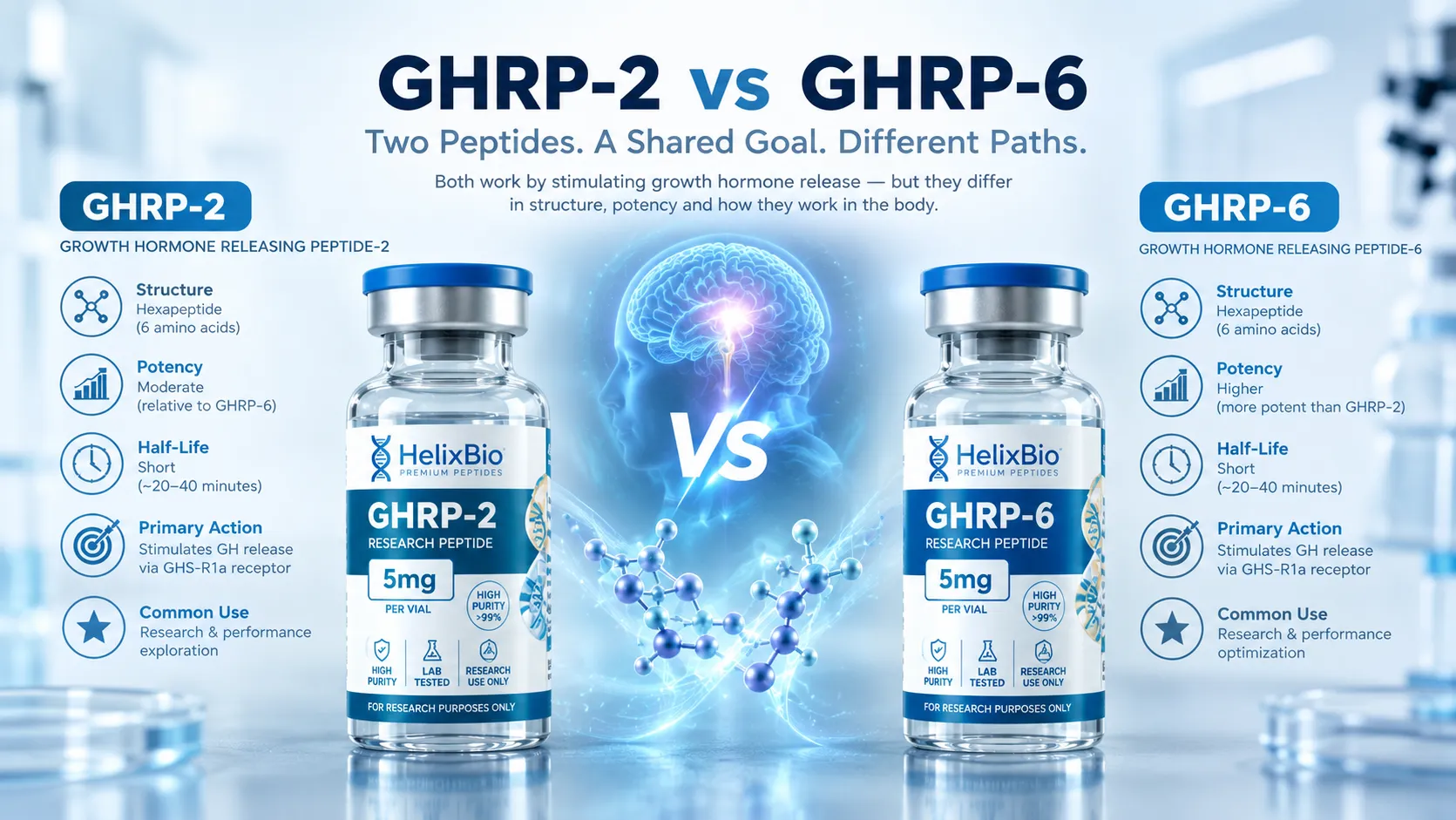
GHRP-2 is D-Ala-D-2-Nal-Ala-Trp-D-Phe-Lys-NH2 and GHRP-6 is His-D-Trp-Ala-Trp-D-Phe-Lys-NH2, so the two hexapeptides differ at positions 1 and 2 only and share the identical C-terminal core Ala-Trp-D-Phe-Lys-NH2.
Position 1 replaces L-histidine with D-alanine, which removes an aromatic imidazole side chain, removes the only ionizable side chain besides lysine, and inverts stereochemistry at that centre.
Position 2 replaces D-tryptophan with D-2-naphthylalanine, exchanging an indole bearing a hydrogen-bond-donating N-H for an all-carbon naphthalene ring of comparable bulk.
The two substitutions account for a molecular weight difference of about 55 daltons: 817.97 for GHRP-2 against 873.03 for GHRP-6 on a free-base basis.
GHRP-6 contains two tryptophan residues and GHRP-2 contains one, so ultraviolet quantitation and tryptophan oxidation liability are not equivalent between them.
Both compounds are agonists at the growth hormone secretagogue receptor GHS-R1a, and no receptor-bound structure of either peptide at that receptor has been determined.
The study most often cited as the head-to-head comparison of GHRP-2 and GHRP-6, Arvat and colleagues in Peptides 1997, compared GHRP-2 with hexarelin and did not include GHRP-6.
Mass spectrometry separates the two compounds cleanly but cannot confirm stereochemistry, because every D-to-L inversion in these sequences is mass-silent.
GHRP-2 and GHRP-6 are both six-residue growth hormone secretagogues, and four of those six residues are identical. Everything that distinguishes them sits at the first two positions of the chain. This article works through those two N-terminal substitutions residue by residue — what changes chemically, what that plausibly does to receptor interaction, and which of the differences reported between the two compounds the published literature actually establishes. It also corrects the most widely repeated sourcing error in this comparison: the study nearly always cited as the head-to-head between GHRP-2 and GHRP-6 did not include GHRP-6.
Featured In This Article
GHRP-2
RESEARCH PEPTIDE
Highly purified synthetic peptide prepared for rigorous laboratory research.
$72.00
GHRP-6
RESEARCH PEPTIDE
Highly purified synthetic peptide prepared for rigorous laboratory research.
$72.00
GHRP-2 vs GHRP-6: the short answer
GHRP-2 is D-Ala-D-2-Nal-Ala-Trp-D-Phe-Lys-NH2. GHRP-6 is His-D-Trp-Ala-Trp-D-Phe-Lys-NH2. They differ at position 1, where GHRP-6 carries L-histidine and GHRP-2 carries D-alanine, and at position 2, where GHRP-6 carries D-tryptophan and GHRP-2 carries D-2-naphthylalanine. Positions 3 through 6 are the same tetrapeptide amide in both molecules: Ala-Trp-D-Phe-Lys-NH2.
Those two substitutions produce a molecular weight difference of roughly 55 daltons, remove an ionizable side chain, invert the stereochemistry at position 1, and swap a hydrogen-bond-donating indole for a purely hydrocarbon naphthalene ring. Both compounds are agonists at the growth hormone secretagogue receptor GHS-R1a, and both belong to the same pharmacological class — the distinction between that class and the GHRH analogues is a separate subject.
What are GHRP-2 and GHRP-6?
GHRP-6 was the first member of the class to be characterised in detail. It emerged from work by Bowers, Momany and colleagues on enkephalin-derived peptides, published in 1984, at a point when neither the receptor these compounds acted on nor its endogenous ligand had been identified. The original paper does not call it GHRP-6 at all; it names the compound [His1,Lys6]GHRP after the two positions that had been varied, and reports that it released growth hormone without a concomitant release of LH, FSH, TSH or prolactin. The GHRP-6 label came later, once the numbered series existed. The receptor was cloned in 1996 and ghrelin was reported as its natural ligand in 1999, which means GHRP-6 was a well-characterised pharmacological tool for fifteen years before anyone knew what it bound.
GHRP-2 came later, from the same programme, as one of a set of analogues designed on the GHRP-6 scaffold. It is the only member of the pair with an International Nonproprietary Name — pralmorelin — and it carries the development codes KP-102 and GPA-748. It is marketed in Japan by Kaken Pharmaceutical in a single-dose formulation used to assess growth hormone deficiency. GHRP-6 has no INN and no equivalent regulatory identity anywhere.
That asymmetry matters when reading source material. Literature on GHRP-2 is often filed under pralmorelin and will not surface in a search for the GHRP name, while literature on GHRP-6 is almost always filed under the sequence or the GHRP-6 label.
GHRP-2 vs GHRP-6: amino acid sequences compared
Property
GHRP-2
GHRP-6
Sequence
D-Ala-D-2-Nal-Ala-Trp-D-Phe-Lys-NH2
His-D-Trp-Ala-Trp-D-Phe-Lys-NH2
Other names
Pralmorelin, KP-102, GPA-748
GHRP-6 only; no INN
Molecular formula
C45H55N9O6
C46H56N12O6
Average molecular weight
817.97 (free base)
873.03 (free base)
CAS number
158861-67-7
87616-84-0
Length and terminus
6 residues, C-terminal amide
6 residues, C-terminal amide
D-configured residues
Three (positions 1, 2, 5)
Two (positions 2, 5)
Tryptophan residues
One (position 4)
Two (positions 2 and 4)
Ionizable side chains
Lysine ε-amine only
Lysine ε-amine and histidine imidazole
Shared C-terminal core
Ala-Trp-D-Phe-Lys-NH2
Ala-Trp-D-Phe-Lys-NH2
The position-by-position view is where the comparison becomes useful rather than decorative.
Position
GHRP-2
GHRP-6
Same?
Chemical distinction
Why it matters
1
D-alanine
L-histidine
Differs
Methyl side chain in the D configuration versus an imidazole side chain in the L configuration
Removes the only ionizable side chain other than lysine and inverts backbone stereochemistry at the N-terminus
2
D-2-naphthylalanine
D-tryptophan
Differs
Naphthalen-2-yl, a bicyclic hydrocarbon, versus indol-3-yl, a bicyclic heteroaromatic bearing an N-H
Comparable bulk and aromaticity, but the indole N-H hydrogen-bond donor is absent in GHRP-2
The mass difference is arithmetic and checkable. Replacing a histidine residue (137.14) with an alanine residue (71.08) subtracts 66.06; replacing a tryptophan residue (186.21) with a 2-naphthylalanine residue (197.23) adds 11.02. The net is −55.04, which reconciles the published averages of 873.03 and 817.97 within rounding.
The two N-terminal positions that differ
Position 1: L-histidine versus D-alanine
This is the larger chemical change of the two, and it is the one most comparisons pass over.
Histidine contributes an imidazole ring with a side-chain pKa near 6, which means it is partially protonated in the pH range most aqueous work is done in. Alanine contributes a methyl group. The substitution therefore does three separate things at once: it removes an aromatic ring, it removes the peptide's only ionizable side chain besides the lysine ε-amine, and it inverts the configuration at that centre from L to D.
Because three variables move together, no single one of them can be assigned the credit for any difference observed between the two compounds. Anything written as "the histidine is responsible for X" is an inference, not a result, unless it comes from an analogue series in which the variables were separated.
The charge consequence is real and easy to overlook. At neutral pH GHRP-6 carries two groups capable of holding a positive charge and GHRP-2 carries one. That difference shows up in ion-exchange behaviour, in charge-state distribution under electrospray ionisation, and in the pH dependence of solubility.
Position 2: D-tryptophan versus D-2-naphthylalanine
Position 2 is the substitution that gets named in almost every description of GHRP-2, usually as the change that made it a "super-analogue" of GHRP-6. The chemistry is more specific than that framing suggests.
D-2-naphthylalanine is not a proteinogenic amino acid. Its side chain is a naphthalene ring system — two fused benzene rings, all carbon. D-tryptophan's side chain is indole — a benzene ring fused to a pyrrole, containing a nitrogen that bears a hydrogen. The two side chains are similar in size and both are flat, rigid and strongly hydrophobic. The substantive difference is that indole has a hydrogen-bond donor at that nitrogen and naphthalene has none, and that the all-carbon ring is the more hydrophobic of the two.
Both compounds retain the D configuration at position 2, so this substitution changes the side chain without changing backbone stereochemistry — the opposite pattern from position 1.
Both peptides retain an L-tryptophan at position 4. GHRP-6 therefore contains two indole rings and GHRP-2 contains one. An A280-based concentration estimate calibrated on one of these compounds will not transfer to the other, and GHRP-6 presents two tryptophan residues available for oxidation rather than one.
How the N-terminal substitutions change structural properties
Four properties change in ways that follow directly from the chemistry above, without requiring any assumption about biological outcome.
Net ionizable groups. Two in GHRP-6, one in GHRP-2, because the imidazole is gone.
Hydrophobicity. GHRP-2 exchanges an indole for a naphthalene and a histidine for an alanine, which raises the hydrophobic character of the N-terminal half.
Backbone stereochemistry. GHRP-2 carries three D-residues to GHRP-6's two, and the additional one sits at the N-terminus.
Hydrogen-bonding capacity at position 2. Present in GHRP-6 through the indole N-H, absent in GHRP-2.
What these changes do to the solution conformation of either hexapeptide is a harder question, and it is worth being explicit that a short, flexible peptide of this length does not have a single fixed structure in solution. Conformational modelling was part of the original design work — Momany and Bowers used conformational energy calculations in the early 1980s to guide which substitutions to make — but a computed preferred conformation is a model, not a measurement, and no experimentally determined receptor-bound structure of either compound at GHS-R1a is available to settle the question.
Experimental work on the free peptides does exist and is recent. Králík and colleagues examined eight growth hormone-releasing peptides by electronic circular dichroism in 2026, comparing spectral similarities and differences against the compounds' structural similarities and differences, and also assessed thermal stability and behaviour in a model membrane system of SDS micelles. The most pronounced membrane-associated spectral change in that set was reported for GHRP-5 rather than for either compound discussed here. It is the appropriate kind of evidence to reach for on conformation, and it is essentially absent from the popular comparisons of these two peptides.
How structure relates to GHS-R1a receptor interaction
Both compounds are agonists at GHS-R1a, the growth hormone secretagogue receptor type 1a, which is also the receptor for ghrelin. That much is not in dispute, and it is the reason the two are grouped together at all.
What the structure-activity literature establishes about the class is narrower than it is usually reported to be. Ferro and colleagues examined a set of GHRPs and truncated analogues in a radio-competitive assay against GHS-R1a, working from the general structure aa-aa-aa-Ala-Trp-(D-Phe)-Lys, and reported which chemical modifications at positions 1, 2, 3 and 7 influenced binding. The consistent finding across that work is the one the sequence table already shows: Ala-Trp-D-Phe-Lys is the conserved core, and the variable N-terminal positions modulate rather than create receptor affinity.
That framing is the accurate one. The two N-terminal positions are where the class is tuned; they are not where the class binds.
The most direct experimental comparison of these two specific compounds is older and less cited than it deserves to be. Wu, Chen, Zhang, Bowers and Clarke compared them in ovine and rat pituitary cells and reported that in partially purified sheep somatotrophs GHRP-2 raised intracellular cAMP in a dose-dependent manner while GHRP-6 did not, and that a GHRH-receptor antagonist reduced the cAMP and GH responses to GHRP-2 but did not affect GH release induced by GHRP-6.
Several boundaries belong on that result. It is a single in vitro study in two species, published in 1996 — before the secretagogue receptor was cloned and three years before ghrelin was identified. The antagonist result suggests the cAMP component seen with GHRP-2 in that preparation depended on the GHRH receptor rather than on GHS-R1a. It is a genuine reported difference between the two compounds in a defined model; it is not a demonstration that GHRP-2 and GHRP-6 use different signalling pathways in general.
Structure-activity relationship: why small sequence changes matter
The GHRP series is a useful case study in how little sequence change is needed to alter a peptide's profile. Hexarelin, a third member of the family, is GHRP-6 with a single methyl group added to the indole ring at position 2 — one carbon and two hydrogens. GHRP-1 is a heptapeptide built by extending the same core. Ipamorelin, frequently and wrongly described as a modified GHRP-2 or GHRP-6, comes from a different structural lineage: it lacks the central Ala-Trp dipeptide entirely and contains no tryptophan.
The shared core has a practical consequence that is easy to miss. Because positions 3 to 6 are identical, any degradation or synthesis-related fragment generated from the C-terminal side of either peptide is chemically the same species in both. A truncated Ala-Trp-D-Phe-Lys-NH2 impurity carries no information about which parent it came from. Impurity peaks that distinguish the two compounds have to involve the N-terminal half, which is the half that differs.
The general principle holds across short peptide agonists. When most of the binding determinant is concentrated in a conserved core, changes elsewhere shift affinity, selectivity and metabolic stability without abolishing activity — which is precisely what makes such positions attractive targets for medicinal chemistry, and precisely what makes claims about them hard to verify from a sequence alone.
GHRP-2 vs GHRP-6: research properties compared
Property
GHRP-2
GHRP-6
Evidence status
Receptor
GHS-R1a agonist
GHS-R1a agonist
Established for the class
Historical role
Later analogue built on the GHRP-6 scaffold
Prototype hexapeptide; reference ligand in the 1996 receptor cloning
Established
Regulatory identity
INN pralmorelin; Japanese diagnostic formulation
No INN
Established
cAMP response in sheep somatotrophs
Raised cAMP
Did not raise cAMP
Single in vitro study (Wu 1996); not generalised
Two rows on that table are the ones worth dwelling on.
No direct human comparison of GHRP-2 against GHRP-6 was identified. The study almost universally cited as the head-to-head — Arvat and colleagues, Peptides 1997 — compared GHRP-2 with hexarelin, alongside GHRH, TRH and hCRH, in six healthy young adults. GHRP-6 was not an arm of that study. Any page presenting it as GHRP-2-versus-GHRP-6 evidence has misread the citation.
The commonly repeated potency ratio could not be traced. A specific multiple describing how much more potent GHRP-2 is than GHRP-6 circulates widely and is variously attributed. A well-documented sixfold figure does exist in the classic literature, but it describes the non-peptide secretagogue L-692,429 relative to GHRP-6 — a different comparison entirely. Until a primary source is located, the ratio should be treated as unverified rather than repeated.
Common misconceptions
"They differ by one amino acid." They differ at two positions, 1 and 2.
"GHRP-2 is GHRP-6 with a naphthylalanine swap." That describes position 2 only and omits the histidine-to-D-alanine change, which is the larger chemical alteration of the two.
"Mass spectrometry confirms the sequence." It confirms mass, and the ~55 Da gap does cleanly separate these two compounds in one run. It does not confirm stereochemistry — D-alanine and L-alanine are identical in mass, so a lot synthesised with the wrong configuration at position 1 is invisible to MS alone.
"The PubChem CID identifies the compound." More than one PubChem record circulates for each of these molecules. A CAS number, a molecular formula and an observed mass are stronger anchors than a CID copied from a vendor page.
"Published abstracts can be trusted for sequences." The PubMed abstract of the 1997 Arvat paper renders GHRP-2 as a five-residue sequence with the alanine at position 3 omitted. Sequences belong in a structure record, not an abstract.
Verifying a sequence claim on a real lot
For anyone comparing documentation rather than literature, the useful checks follow from the same two positions.
Confirm identity by mass. The two compounds sit about 55 Da apart on the free-base basis. One run resolves them. Confirm which mass basis the certificate reports, since salt forms shift the number.
Confirm the tryptophan count matches the compound named. GHRP-6 has two indoles, GHRP-2 one. UV behaviour and oxidation liability differ accordingly, and a method transferred between the two without recalibration will misreport.
Recognise what mass cannot tell you. Both compounds contain D-residues, and every D-to-L inversion is mass-silent. Configuration requires a chiral method — typically hydrolysis followed by chiral derivatisation and separation — not MS.
GHRP-2 and GHRP-6 are described here strictly as subjects of laboratory research. Nothing above constitutes administration guidance, a protocol, or a therapeutic claim, and no comparison of the two is offered as a basis for selecting one for any use in humans or animals.
Got Questions?
Frequently Asked Questions
GHRP-2 is a synthetic hexapeptide growth hormone secretagogue with the sequence D-Ala-D-2-Nal-Ala-Trp-D-Phe-Lys-NH2, molecular formula C45H55N9O6 and an average molecular weight of 817.97 on a free-base basis. It carries the International Nonproprietary Name pralmorelin and the development codes KP-102 and GPA-748, and it acts as an agonist at the growth hormone secretagogue receptor GHS-R1a. It is supplied as a research reference material and is described here strictly as a subject of laboratory study.
GHRP-6 is a synthetic hexapeptide growth hormone secretagogue with the sequence His-D-Trp-Ala-Trp-D-Phe-Lys-NH2, molecular formula C46H56N12O6 and an average molecular weight of 873.03. It was described by Bowers, Momany and colleagues in 1984 as [His1,Lys6]GHRP, before the receptor it acts on had been cloned, and it became the reference compound for the whole growth hormone secretagogue class. Like GHRP-2, it is an agonist at GHS-R1a.
They differ at two positions. At position 1, GHRP-6 carries L-histidine and GHRP-2 carries D-alanine. At position 2, GHRP-6 carries D-tryptophan and GHRP-2 carries D-2-naphthylalanine. Positions 3 through 6 are identical in both. The result is a molecular weight difference of about 55 daltons, one fewer ionizable side chain in GHRP-2, an additional D-configured residue in GHRP-2, and the loss of the indole hydrogen-bond donor at position 2.
No. They are distinct compounds with different CAS numbers, 158861-67-7 for GHRP-2 and 87616-84-0 for GHRP-6, different molecular formulas and different masses. They are closely related, sharing four of six residues and the same receptor target, which is why they are frequently discussed together, but they are not interchangeable and a certificate of analysis for one does not describe the other.
Written in full, GHRP-2 is D-Ala-D-2-Nal-Ala-Trp-D-Phe-Lys-NH2 and GHRP-6 is His-D-Trp-Ala-Trp-D-Phe-Lys-NH2. Aligning them position by position shows two substitutions, both at the N-terminus, and four identical residues forming a shared C-terminal core of Ala-Trp-D-Phe-Lys with a primary carboxamide. Both peptides are six residues long and both terminate in a lysine amide.
The first is at position 1, where an L-histidine in GHRP-6 becomes a D-alanine in GHRP-2. The second is at position 2, where a D-tryptophan in GHRP-6 becomes a D-2-naphthylalanine in GHRP-2. Position 1 changes both the side chain and the stereochemistry; position 2 changes only the side chain, since both residues are D-configured.
Four structural properties change. GHRP-2 has one ionizable side chain to GHRP-6's two, because the histidine imidazole is absent. GHRP-2 is the more hydrophobic of the two across the N-terminal half. GHRP-2 carries three D-residues to GHRP-6's two. And GHRP-2 lacks the hydrogen-bond-donating indole N-H at position 2 that GHRP-6 has. These follow directly from the two substitutions and require no assumption about biological outcome.
Structure-activity work on the GHRP series, including the radio-competitive receptor study by Ferro and colleagues, identifies Ala-Trp-D-Phe-Lys as the conserved core and treats the variable N-terminal positions as modulating rather than creating affinity at GHS-R1a. That framing is well supported. Assigning a specific quantitative affinity consequence to either individual substitution would go beyond what the published series establishes.
One direct comparison exists and its scope is narrow. Wu, Bowers, Clarke and colleagues reported in 1996 that in partially purified sheep somatotrophs GHRP-2 raised intracellular cAMP while GHRP-6 did not, and that a GHRH-receptor antagonist reduced the response to GHRP-2 but not to GHRP-6. That is a single in vitro study in two species, published before the secretagogue receptor was cloned, and it does not establish a general signalling difference between the compounds.
In short peptide agonists, most of the binding determinant is concentrated in a small conserved region, so substitutions elsewhere shift affinity, selectivity and metabolic stability without abolishing activity. The GHRP series demonstrates this repeatedly: hexarelin differs from GHRP-6 by a single methyl group on the position 2 indole ring, and the whole numbered series was generated by varying a handful of positions around one core.
Start with identity rather than claims. Confirm the sequence against a structure record, confirm the observed mass against the stated mass basis, and check which salt form the figure describes. Note that the two compounds sit about 55 daltons apart, so a single mass spectrometry run separates them. Then read purity and identity as separate questions, since one figure rarely answers both.
Verify against structure records and primary literature, not abstracts or vendor pages. The PubMed abstract of the 1997 Arvat paper renders GHRP-2 as a five-residue sequence with the position 3 alanine omitted, and more than one PubChem record circulates for each compound, so a CAS number, molecular formula and observed mass are stronger anchors than a copied identifier. Remember also that mass cannot confirm configuration, and both sequences contain D-residues.