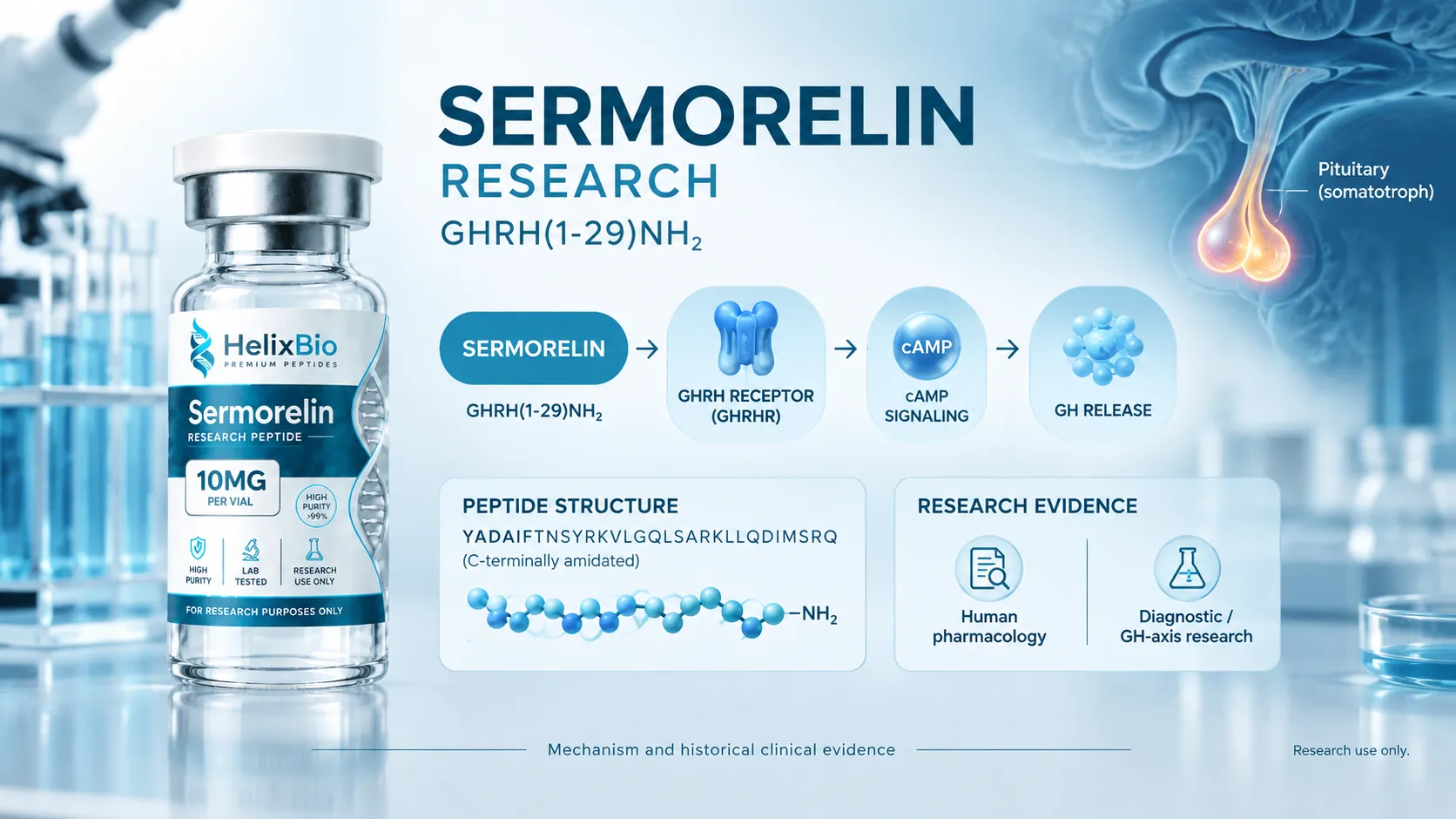
Sermorelin is synthetic GHRH(1-29)-NH2, the first 29 residues of human GHRH with a C-terminal amide.
Only studies naming unmodified GHRH(1-29)-NH2 or Geref count as direct sermorelin evidence.
The widely cited 1997 older-adult trial used [Nle27]GHRH(1-29)-NH2, a different molecule.
Two randomized 1993 pediatric trials disagreed on whether sermorelin could match recombinant GH.
Sermorelin tests pituitary GH reserve but cannot rule out deficiency that starts in the hypothalamus.
FDA approved Geref in 1990 and 1997; both approvals were withdrawn effective June 18, 2009.
In 2013, FDA found Geref was not withdrawn for reasons of safety or effectiveness.
No located controlled trial establishes adult fat loss, muscle gain, sleep or anti-aging effects for sermorelin.
The FDA approved sermorelin acetate twice, as Geref Diagnostic in 1990 and as Geref in 1997, then withdrew both approvals in 2009. Sermorelin is a synthetic copy of the first 29 amino acids of human growth hormone-releasing hormone (GHRH), ending in a C-terminal amide. Human studies show it releases growth hormone (GH) from the pituitary and was used to test pituitary GH reserve. In some children with GH deficiency, it also sped up growth. Those studies do not show adult benefits such as fat loss, muscle gain or slower aging. This review of sermorelin research peptide literature includes only studies that tested the exact molecule. Findings for modified analogues, tesamorelin and CJC-1295 stay separate.
Featured In This Article
Sermorelin
RESEARCH PEPTIDE
Highly purified synthetic peptide prepared for rigorous laboratory research.
$88.00
What sermorelin is, and how it differs from native GHRH
Native human GHRH is a 44-amino-acid hormone released by the hypothalamus. Sermorelin reproduces residues 1 to 29 of that chain. Its final arginine carries an amide group instead of a free acid, so chemists write it as GHRH(1-29)-NH2. Older papers call the same molecule GRF(1-29)-NH2.
Shorter did not mean weaker when researchers compared the two directly. In 1984, Grossman and colleagues found GHRH(1-29)NH2 equipotent to the longer GHRH(1-40) in normal subjects. That supports equal GH release in that test. It does not prove the fragment matches the full hormone in every property.
Field
Sermorelin (free peptide)
Sermorelin acetate
Sequence
YADAIFTNSYRKVLGQLSARKLLQDIMSR-NH2
Same peptide chain
Formula
C149H246N44O42S
Peptide plus acetate and water
Molecular weight
3357.93 g/mol
Higher, set by acetate and water content
CAS number
86168-78-7
114466-38-5
FDA UNII
89243S03TE
00IBG87IQW
PubChem lists the free peptide as CID 16132413. FDA's substance registry describes the acetate as a salt hydrate, which is why its mass differs. A certificate of analysis for sermorelin acetate should therefore say which form its mass refers to. Our COA guide explains how to check that field.
How sermorelin triggers growth hormone release
Sermorelin binds the GHRH receptor on somatotrophs, the pituitary cells that make growth hormone. That receptor couples to a protein called Gs, which switches on the enzyme adenylyl cyclase. The cell then makes more cAMP, a signaling molecule that activates protein kinase A and drives GH secretion. This chain is established GHRH-receptor biology. Individual sermorelin trials measured GH in blood, not each step inside the cell.
Wilton and colleagues measured the output end directly in 30 healthy men aged 19 to 43. An intravenous dose of 0.25 micrograms per kilogram already released GH. The largest response came at 1 to 2 micrograms per kilogram. GH stayed elevated for about three hours, even though the peptide was cleared quickly.
Because sermorelin acts through the pituitary, the GH it releases is the body's own hormone. Recombinant GH works differently, since it supplies the hormone directly. Receptor activation explains how GH rises, but it does not show that any later health outcome changes. Our GHRH analogues and GHRPs explainer covers how this receptor class differs from ghrelin-receptor peptides.
Which human studies actually tested sermorelin
A study counts as sermorelin evidence here only if it names unmodified GHRH(1-29)-NH2 or the Geref product. Changing a single residue creates a different molecule. The most common mix-up involves [Nle27]GHRH(1-29)-NH2, where norleucine replaces the methionine at position 27. That analogue appears in widely cited aging research, but it is not sermorelin.
Before trusting any citation labeled as a sermorelin study, open the methods and check the exact peptide name. A substituted residue, a free-acid end or a longer GHRH chain means the result belongs to a different molecule.
What the pediatric trials found, including the one where GH did better
The largest trial came from the Geref International Study Group, published by Thorner and colleagues in 1996. It enrolled 110 prepubertal children with GH deficiency who had never been treated. Every child received sermorelin once daily at bedtime for up to a year, in an open-label design. Of the 110, 86 were eligible for the efficacy analysis. Mean height velocity rose from 4.1 cm per year to 8.0 cm at six months and 7.2 cm at twelve months. At six months, 74% of the children were classed as good responders. Bone age advanced in step with height, and fasting glucose did not change.
Two randomized trials from 1993 compared sermorelin with recombinant GH directly, and they disagreed. Chen and colleagues studied 60 children whose deficiency began in the hypothalamus. Sermorelin was given as a continuous infusion, and the authors concluded it was unlikely to match GH for growth. Neyzi and colleagues studied 43 prepubertal children using three separate daily injections. In that trial, the higher sermorelin dose and GH produced similar growth over six months.
Delivery is the clearest difference between these two trials. Continuous exposure versus separate daily doses may explain the split, but neither trial tested that question directly.
Both trials also found antibodies against GHRH. In Chen's trial, 39 of 40 treated children developed them, and levels had almost disappeared nine months after treatment stopped. Neyzi's team found antibodies in 54% and 58% of the two sermorelin groups, with no link to growth. The abstracts do not say whether these antibodies blocked the peptide's action.
These trials lasted six to twelve months and report no final adult height. They describe historical pharmaceutical preparations given under medical supervision.
Why sermorelin was used to test pituitary growth hormone reserve
Geref Diagnostic carried a narrow FDA indication, evaluating whether the pituitary can secrete GH. The logic behind it is simple. Injected sermorelin acts on the pituitary directly and skips the hypothalamus above it. A normal GH response shows the pituitary can release hormone when it gets the signal.
That design has a known blind spot. Many children with GH deficiency have a working pituitary and a faulty hypothalamic signal. Grossman's 1984 study found normal or near-normal responses in 8 of 20 young patients already classed as GH deficient. A 1993 intranasal pilot described children who failed arginine and insulin tests yet reached 24 to 90 µg/l of GH after intravenous GHRH(1-29)-NH2.
For that reason, a normal response to sermorelin cannot rule out GH deficiency that starts in the hypothalamus. The test measures pituitary reserve and nothing beyond it.
What adult studies measured, and what they didn't
Two small adult studies used a peptide described as GHRH(1-29), though neither abstract states the amide form. Both are probably sermorelin, and they are reported here with that caveat.
Corpas and colleagues gave 10 healthy older men a low and a high dose twice daily. Each dose ran for 14 days in random order, with a treatment-free gap between them. Only the high dose significantly raised 24-hour GH and IGF-I, a growth factor made mainly in response to GH. The study had no placebo group at all.
Vittone and colleagues treated 11 men aged 64 to 76 with one nightly injection for six weeks. Nighttime GH rose, but IGF-I did not change. DEXA scans showed no change in muscle or fat. Two of six strength measures improved, and the authors judged single nightly dosing less effective than multiple daily doses.
The best-known adult trial is missing on purpose. Khorram's 1997 study of 19 older adults tested the Nle27 analogue, so its lean-mass findings in men do not describe sermorelin. No controlled adult trial located for this review reports body composition, physical function, sleep or longevity as a verified sermorelin outcome.
How long sermorelin lasts, and why the GH response outlasts it
Sermorelin clears from the blood quickly after injection. After intravenous injection, Wilton's team saw rapid elimination of the peptide but elevated GH for about three hours. Those are two different measurements. Plasma half-life tracks the peptide itself, while the GH curve tracks the pituitary's response to a brief signal.
One cause of that short life is an enzyme called dipeptidyl peptidase IV (DPP-IV). In lab tests, Bongers and colleagues found it cuts GRF(1-29)-NH2 between Ala2 and Asp3, at a rate similar to the full hormone. Frohman's 1989 plasma study of native GHRH described trypsin-like cleavage as well. DPP-IV is best described as one known route, not the only one.
Nasal delivery absorbed poorly in Wilton's study, with bioavailability of only 3 to 5%. In solution, the peptide also degrades at Asp3 and Asn8, and a 1992 stability study found it most stable at pH 4 to 5.
What the safety data covers
Safety reporting in these trials was brief and short-term. The 1996 pediatric trial found no adverse changes in routine blood chemistry or hormones over 12 months. It also found no excess IGF-I production. Chen's trial reported no serious side effects, with mild injection-site irritation in three children. Vittone's six-week adult study observed no significant adverse effects.
Antibodies were the most consistent finding in children, as described above. None of these studies was designed to establish long-term safety, and none tested current research-grade material.
Geref's FDA history, from 1990 approval to 2013 determination
Date
Event
December 28, 1990
NDA 19-863 approved, Geref Diagnostic, for testing pituitary GH secretion
September 26, 1997
NDA 20-443 approved, Geref, for idiopathic GH deficiency in children with growth failure
July 11, 2008
EMD Serono notifies FDA the diagnostic product is being discontinued
December 2, 2008
EMD Serono discontinues the treatment product and requests withdrawal of NDA 20-443
December 12, 2008
EMD Serono requests withdrawal of NDA 19-863
June 18, 2009
Withdrawal of both approvals takes effect (74 FR 23407)
March 4, 2013
FDA finds neither product was withdrawn for safety or effectiveness (78 FR 14095)
The 2013 notice answered a citizen petition. FDA reviewed its records and postmarketing adverse event data before reaching its finding. The stated purpose was to allow generic applications that reference Geref. FDA gave no commercial explanation for the withdrawal, and the notice approved no new product.
Helix Bio markets sermorelin as research-use-only (RUO) material. Research-use material should not be presented as equivalent to an FDA-approved finished drug product. The historical Geref approvals do not carry over to current research material. A certificate of analysis documents a lot's identity and purity, not approval, safety or clinical effect.
Product specifications and research-use terms are listed on the Sermorelin product page; lot-specific certificate of analysis documentation is confirmed per order.
Where sermorelin sits in FDA's compounding lists today
FDA's 503B category list for outsourcing facilities, updated March 21, 2025, places sermorelin acetate in Category 1. Its two asterisks mark it as a component of an FDA-approved drug. Category 1 describes substances under evaluation that FDA does not currently intend to act against when stated conditions are met. It is an interim enforcement position, not approval of any compounded product.
On FDA's 503A category list for pharmacies, updated May 14, 2026, sermorelin appears in no category. Whether it reaches 503A compounding another way, as a component of a once-approved drug, is a legal question these lists do not settle. Our RUO compliance guide explains how research-use labeling fits alongside these rules.
Why tesamorelin and CJC-1295 findings don't transfer
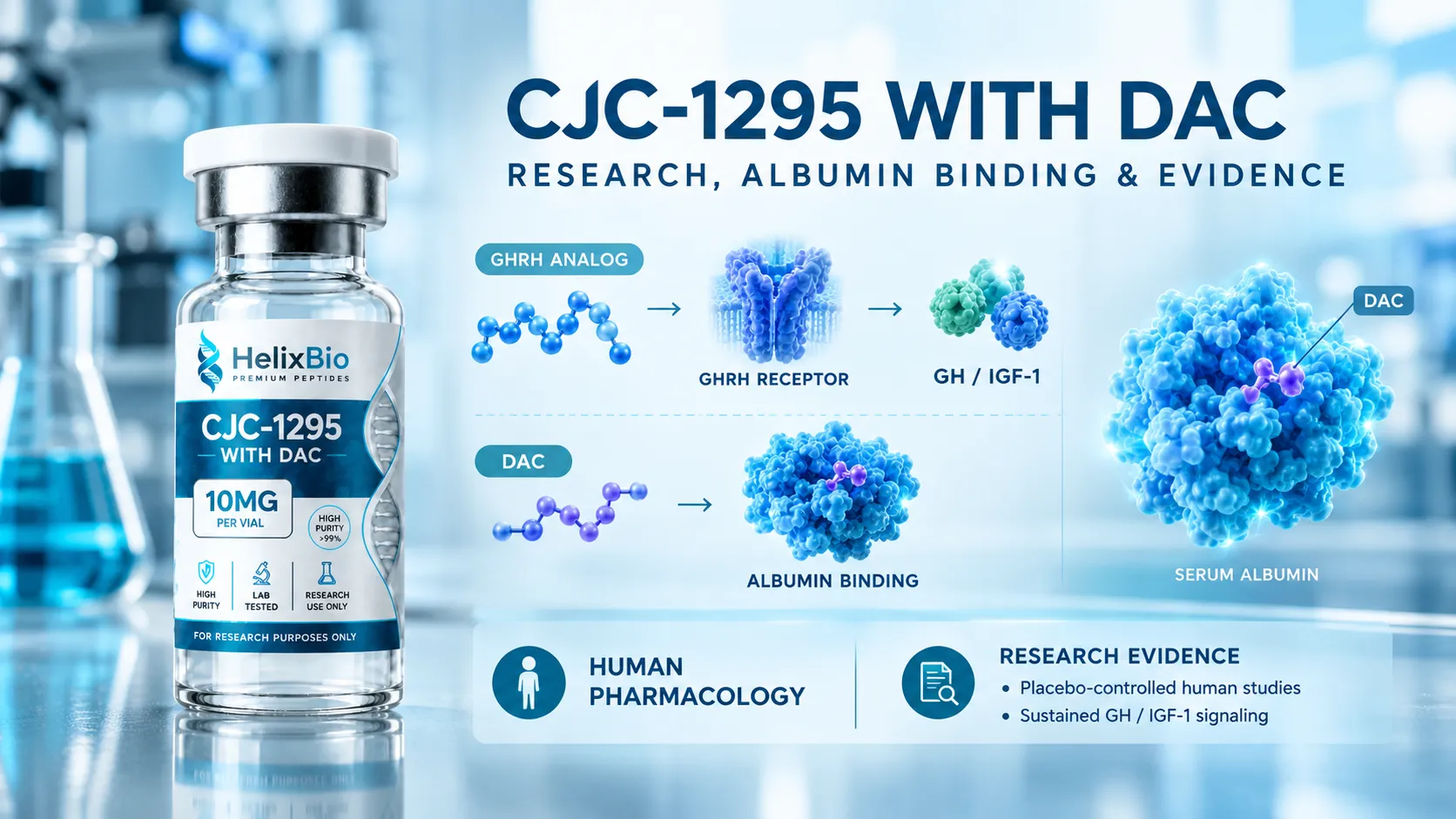
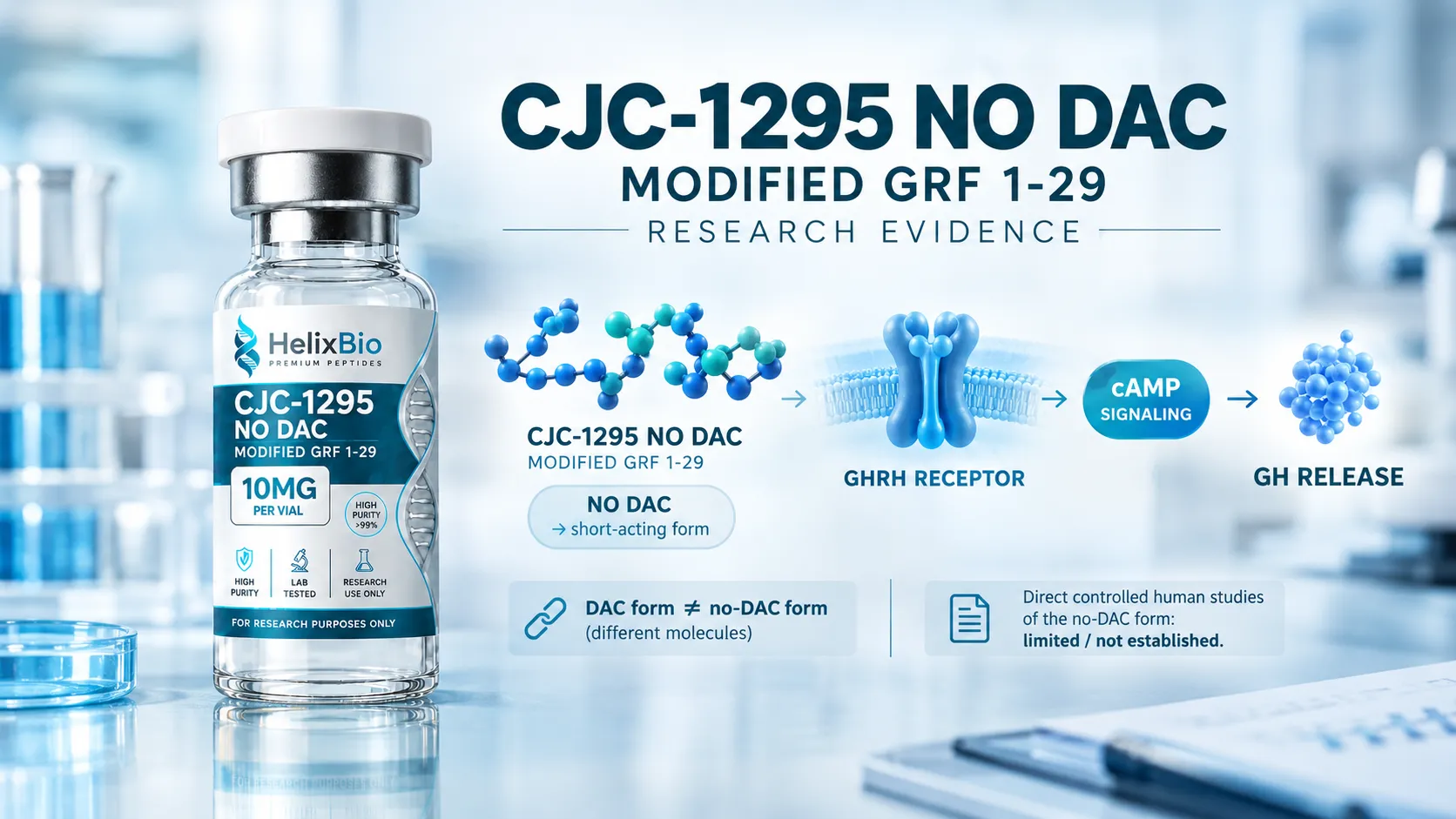
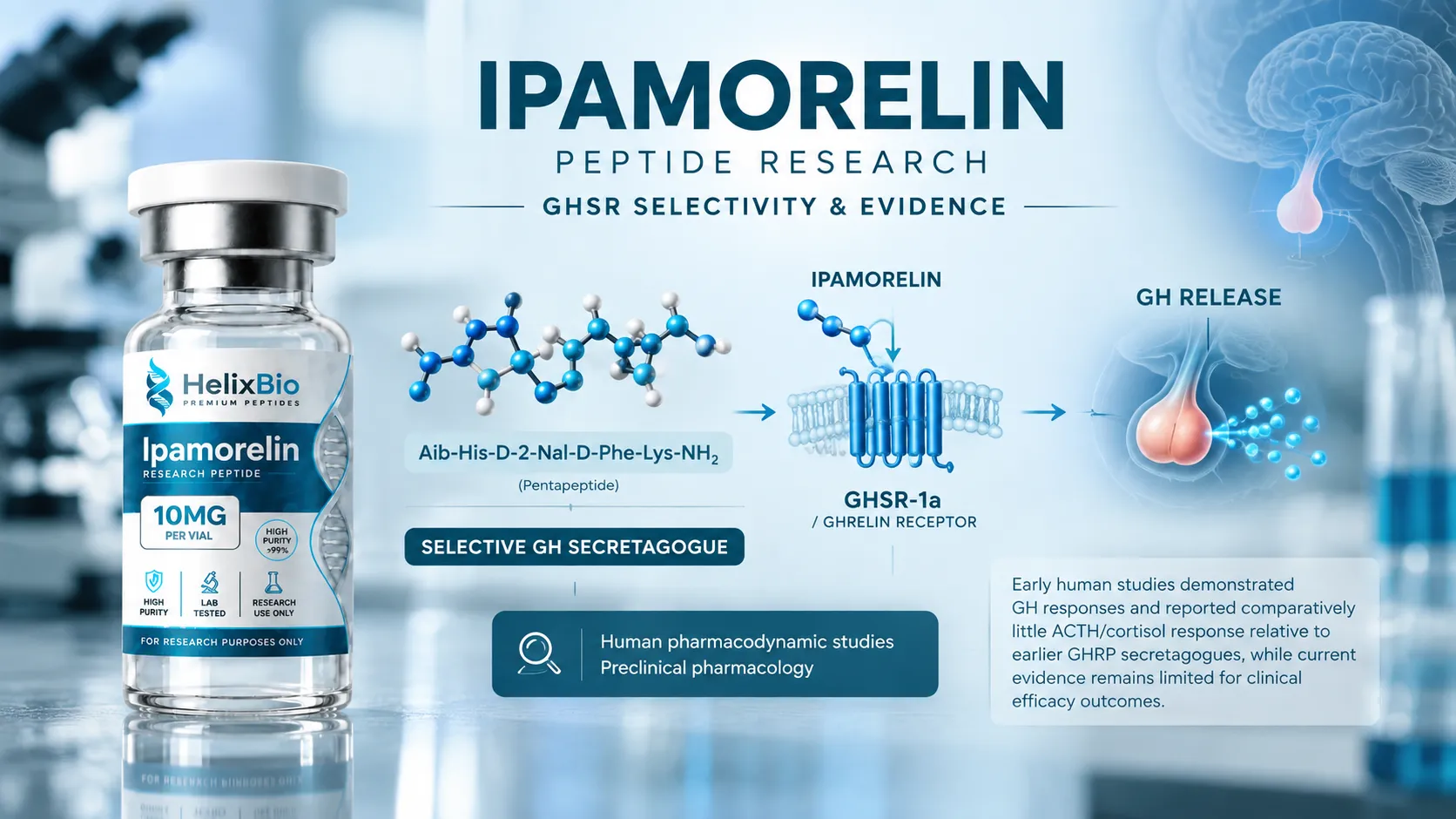
Each GHRH analogue is a separate molecule with its own record. Tesamorelin is the full 44-residue hormone with an added group at its N-terminus, and its trials and approval belong to it alone. CJC-1295 without DAC changes several sermorelin residues, including the methionine, which shifts its mass by about 10 Da. Ipamorelin acts on a different receptor entirely. The head-to-head details are in our sermorelin vs tesamorelin comparison.
What sermorelin research does not establish
Claim
What was actually measured
Status
Slows aging or extends life
No study measured aging or survival
Not established
Reduces body fat
Vittone found no change in DEXA fat
Not established
Builds muscle
No DEXA muscle change; 2 of 6 strength tests improved
Not established
Improves sleep
No sermorelin sleep outcome located
Not established
Geref approval covers sermorelin today
Both approvals withdrawn in 2009
False
Research material equals an approved drug
Different regulatory status entirely
What the sermorelin evidence adds up to
Sermorelin has a real human record, but a narrow one. It reliably releases GH and tests pituitary reserve, and it helped some children with GH deficiency grow faster. Adult outcomes remain unproven, and much of what circulates online belongs to other molecules. Researchers weighing GHRH analogues side by side can continue with our tesamorelin comparison.
Got Questions?
Frequently Asked Questions
Sermorelin is a synthetic peptide matching the first 29 amino acids of human growth hormone-releasing hormone, with an amide at its C-terminus. Its acetate salt was sold in the United States as Geref.
Sermorelin is specifically GHRH(1-29)-NH2, the amidated form. A free-acid version or a version with a substituted residue, such as [Nle27]GHRH(1-29)-NH2, is a different molecule.
Sermorelin binds the GHRH receptor on pituitary somatotrophs, which raises cAMP inside the cell and triggers growth hormone release. Human studies measured the growth hormone response in blood rather than each signaling step.
Studies that name the exact molecule include Wilton 1993 in healthy men, two randomized pediatric trials from 1993, and the 1996 Geref International Study Group trial. Two small adult studies from 1992 and 1997 probably used sermorelin, but their abstracts do not confirm the amide form.
Yes. FDA approved Geref Diagnostic under NDA 19-863 on December 28, 1990, and Geref under NDA 20-443 on September 26, 1997.
No FDA-approved sermorelin product is currently marketed. Both Geref approvals were withdrawn effective June 18, 2009, and FDA lists the products as discontinued.
EMD Serono discontinued both Geref products in 2008 and asked FDA to withdraw the approvals. In 2013, FDA determined they were not withdrawn for reasons of safety or effectiveness, without giving a commercial explanation.
Sermorelin acetate is in Category 1 of FDA's 503B list updated March 21, 2025, marked as a component of an FDA-approved drug. It does not appear in any category of the 503A list updated May 14, 2026, and neither placement is an approval.
Human studies found sermorelin is eliminated from blood rapidly, while the growth hormone it releases stays elevated for about three hours after intravenous injection. Plasma half-life and duration of the GH response are separate measurements.
Yes. In one 1993 trial, 39 of 40 treated children developed GHRH antibodies, and in another, 54% and 58% of the two dose groups did, with no link to growth response.
No. The one probable-sermorelin adult study with DEXA scans found no change in muscle or fat, and the trial most often cited for lean-mass gains used a different analogue.
No. Tesamorelin and CJC-1295 are structurally different molecules with their own trial records, so their findings describe only those compounds.
No. A certificate of analysis documents the identity and purity of one lot, and it does not establish FDA approval, safety, clinical effect or equivalence to the historical Geref product.