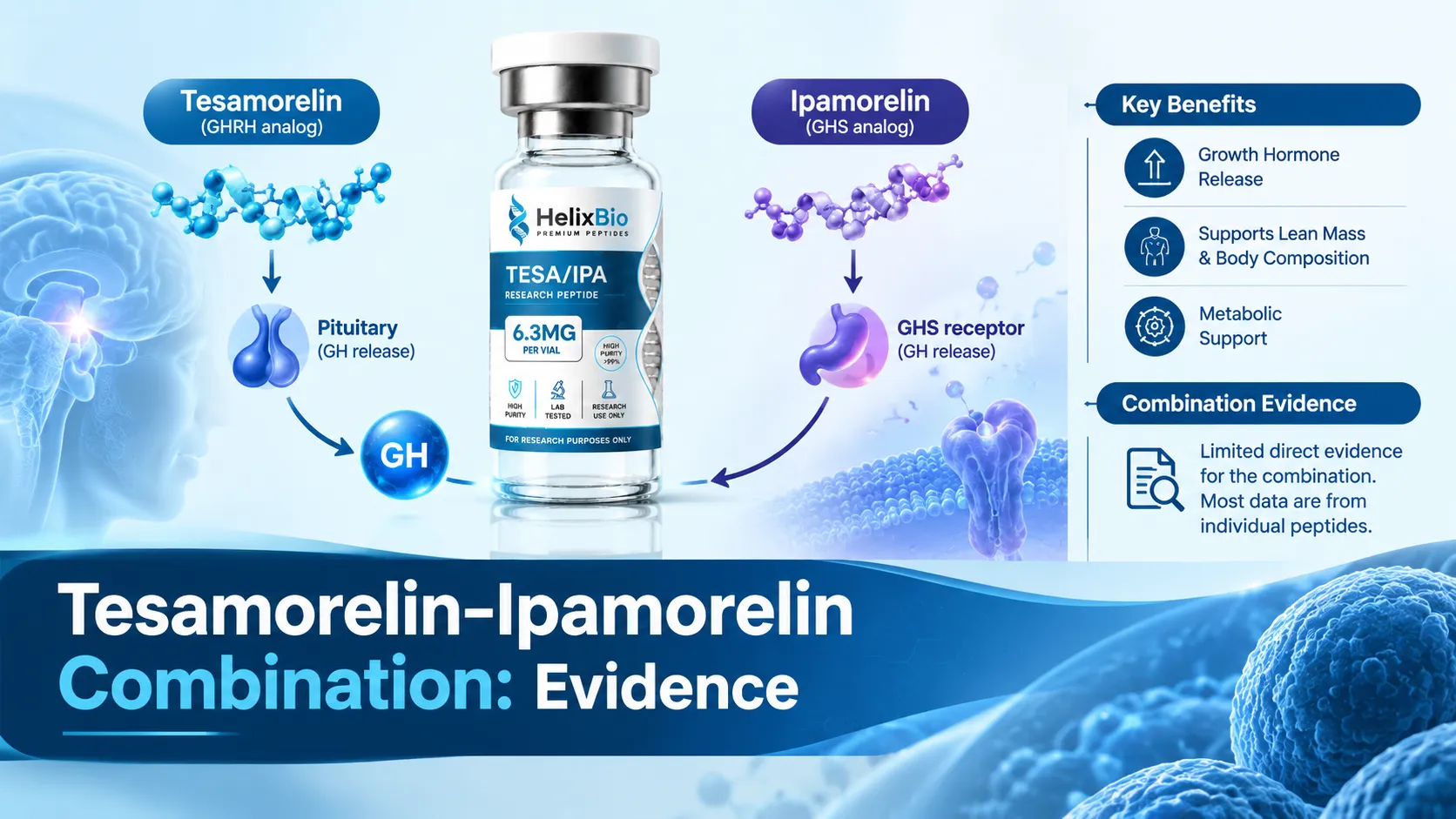
Tesamorelin is a 44-residue GHRH analogue acting at the GHRH receptor; ipamorelin is a pentapeptide acting at GHS-R1a, the ghrelin receptor.
No published controlled study of tesamorelin administered together with ipamorelin was identified in humans, animals or in vitro.
Tesamorelin is the only medication approved in the United States for reducing excess abdominal fat in adults with HIV and lipodystrophy.
Ipamorelin has no approval in any jurisdiction, and its one published clinical efficacy programme did not meet its primary endpoint.
Documented synergy between GHRH and a secretagogue was demonstrated with GHRP-6 and GHRP-2, not with ipamorelin, and on acute growth hormone endpoints.
That synergistic effect was absent in patients with hypothalamo-pituitary disconnection, indicating it is not simply a two-receptor pituitary phenomenon.
Tesamorelin has been regulated as a section 351 biologic since March 2020, placing it outside the 503A and 503B compounding framework that ipamorelin sits within.
A single area-percent purity figure is undefined for a two-component preparation; per-component identity, purity and quantity are three separate results.
The roughly 4,424-dalton mass difference between the two compounds allows one mass spectrometry run to resolve both, though mass cannot confirm stereochemistry.
Tesamorelin and ipamorelin are routinely discussed as though they were one thing. They are not. They are two molecules that engage two different receptors, sit in two different regulatory categories, and carry two evidence records that are not remotely comparable in size. Tesamorelin has a licensed product and a randomised human trial programme behind it. Ipamorelin has neither. The combination itself has something different again: a coherent pharmacological rationale and no direct study. This piece separates those layers, because the most common error in writing about this pair is quietly adding the evidence for one molecule to the evidence for the other and presenting the total as evidence for the blend.
Featured In This Article
Tesamorelin
RESEARCH PEPTIDE
Highly purified synthetic peptide prepared for rigorous laboratory research.
$105.00
Ipamorelin
RESEARCH PEPTIDE
Highly purified synthetic peptide prepared for rigorous laboratory research.
$72.00
Tesamorelin / Ipamorelin Blend Spray
RESEARCH PEPTIDE
Highly purified synthetic peptide prepared for rigorous laboratory research.
$125.99
What Tesamorelin and Ipamorelin Actually Are
Tesamorelin is the complete 44-residue human growth hormone-releasing hormone sequence, carried as a C-terminal amide, with a single trans-3-hexenoyl group attached to the N-terminal tyrosine. That acyl cap is the entire modification. It adds C6H8O, or 96.13 daltons, taking the molecule from 5039.73 for native GHRH(1-44) to 5135.86, and it slows the enzymatic clipping that shortens the native hormone's working life. It is worth flagging one persistent error here: tesamorelin has no D-alanine at position two. That substitution belongs to the CJC-1295 family, and describing tesamorelin with it — as several supplier listings still do — describes a different molecule.
Ipamorelin is a pentapeptide, Aib-His-D-2-Nal-D-Phe-Lys-NH2, at 711.87 daltons. It was identified at Novo Nordisk within a series of compounds that lacked the central Ala-Trp dipeptide of GHRP-1, which means it is not a shortened GHRP-6 and contains no tryptophan at all. The two molecules sit roughly 4,424 daltons apart, a gap wide enough that a single mass spectrometry run resolves both without ambiguity.
Two Receptors, Two Signalling Routes
Tesamorelin and ipamorelin act through entirely separate receptor systems. Tesamorelin is a GHRH analogue and binds the GHRH receptor; ipamorelin is a growth hormone secretagogue and binds GHS-R1a, the receptor for ghrelin. Their signalling is complementary in principle. That fact alone does not establish that the pair produces a larger or better result than either compound studied on its own.
Tesamorelin and the GHRH receptor
The GHRH receptor is a class B G protein-coupled receptor expressed on pituitary somatotrophs. Activation couples through Gs to adenylate cyclase, raising intracellular cyclic AMP and activating protein kinase A, which drives both the release of stored growth hormone and its transcription. Tesamorelin does not do anything the native hormone does not do; it does the same thing with a longer working window.
Ipamorelin and GHS-R1a
GHS-R1a is a class A receptor that couples through Gq/11 to phospholipase C, generating IP3 and diacylglycerol and mobilising intracellular calcium. The discovery order here is worth remembering, because it explains the naming confusion that follows this class around: the synthetic secretagogues came first in the 1980s, the receptor was cloned in 1996 using their pharmacology as the probe, and ghrelin — the endogenous ligand — was only identified in 1999.
Ipamorelin's defining property is selectivity rather than raw potency. In the 1998 characterisation study, it released growth hormone in conscious swine with an ED50 of 2.3 nmol/kg against 3.9 for GHRP-6, at broadly similar maximum concentrations, while producing no rise in ACTH or cortisol beyond what GHRH stimulation itself produced — at doses more than 200-fold above the GH-releasing dose. The comparison in that paper is quietly important: GHRH was the benchmark against which ipamorelin's clean profile was measured.
Where the two pathways meet
Both converge on the somatotroph, which is what makes the pairing interesting. But the interaction is not confined to the pituitary. In healthy men, a specific GHRH antagonist eliminated most of the growth hormone response to GHRP-6, cutting the mean peak from 33.8 to 6.2 micrograms per litre. A secretagogue's effect, in other words, depends substantially on endogenous GHRH signalling. That single finding complicates the tidy "two independent levers on one cell" story that most descriptions of this combination rely on.
Tesamorelin vs Ipamorelin: Mechanism and Evidence Side by Side
Attribute
Tesamorelin
Ipamorelin
Class
GHRH analogue
Growth hormone secretagogue
Size
44 residues, 5135.86 Da
5 residues, 711.87 Da
Receptor
GHRH receptor (GHRHR)
GHS-R1a (ghrelin receptor)
Signalling
Gs, cyclic AMP, PKA
Gq/11, PLC, intracellular calcium
Relationship to a native ligand
Native human GHRH sequence plus one acyl cap
No sequence relationship to ghrelin
Strongest human evidence
Randomised phase 3 trials in HIV-associated lipodystrophy
The table is a comparison of two research compounds, not a ranking. Neither column is "better"; they answer different questions and carry different evidence weights.
Why Researchers Consider the Combination at All
The rationale is straightforward and, taken on its own terms, reasonable. Two receptors, two second messengers, no competition for the same binding site, and a class-level literature showing that GHRH and secretagogue signals interact rather than simply stacking. If you were designing a stimulus intended to work with the axis rather than override it, engaging both inputs is a defensible starting hypothesis.
A starting hypothesis is what it remains.
Evidence for tesamorelin plus evidence for ipamorelin does not equal evidence for tesamorelin with ipamorelin. Each compound's trial record was generated with that compound administered alone. Combining two evidence bases is a rhetorical move, not an experimental result.
What Research Exists on Tesamorelin and Ipamorelin Together?
No published controlled study of tesamorelin administered with ipamorelin was identified. Not in humans, not in animals, not in vitro. Searches of the indexed literature and of trial registries return studies of one compound or the other, and reference lists of the individual-compound papers lead back to the same separated bodies of work.
That is a narrower claim than "there is no evidence," and the difference matters. Four distinct evidence categories exist, and only one of them is empty.
Evidence category
What exists
Model
Principal limitation
Tesamorelin alone
Randomised phase 3 trials with imaging endpoints
Humans, HIV-associated lipodystrophy
Population-specific; one compound, administered alone
Ipamorelin alone
Receptor and GH-release characterisation; one phase 2 efficacy trial
Rat and swine models; humans, postoperative ileus
Primary endpoint not met; no human body-composition data
Other GHRH plus secretagogue pairs
Acute co-administration studies with GH readouts
Humans, intravenous bolus
Different molecules, acute hormone endpoint
Tesamorelin with ipamorelin
None identified
—
What the GHRH-Plus-Secretagogue Literature Can and Cannot Tell Us
The combination literature that does exist is real, and it is genuinely interesting. When GHRH and GHRP-6 were given together to healthy subjects, the growth hormone response exceeded the arithmetic sum of the two given separately — an area under the curve of roughly 3,772 against 484 for GHRH alone and 1,435 for GHRP-6 alone. In patients with obesity, the same pairing produced a marked discharge that neither compound achieved alone. This is the source of the word "synergy" as it circulates around this topic, and in that specific setting the word was earned.
The same body of work contains its own limiting condition. In patients with hypothalamo-pituitary disconnection, the GHRP-6 response was blocked and the synergistic effect was absent, while the GHRH response was preserved. The interaction therefore is not a simple consequence of two receptors sitting on one cell. It requires intact hypothalamic input — which is exactly the variable that a description of the pituitary as a two-switch panel leaves out.
Three things stop that literature transferring cleanly to this pair:
The molecules are different. GHRP-6 raises ACTH and cortisol at GH-releasing doses; ipamorelin does not. Compounds within a receptor class are not interchangeable, and a result generated with one is not automatically a property of the class.
The design is different. Those were acute intravenous bolus experiments measuring hormone concentrations over roughly two hours, not repeated subcutaneous administration over weeks.
The endpoint is different. A larger growth hormone excursion is a pharmacodynamic observation. It is not a body-composition result, a metabolic result, or a clinical one.
Synergy, Additivity, or Simply Complementary Signalling?
These terms are used interchangeably in marketing copy and mean quite different things in pharmacology. Sorting them out is most of the analytical work on this topic.
Complementary signalling means two pathways plausibly interact. It is a structural claim about receptors and requires no combination data.
Additive effect means the combined response equals the sum of the individual responses. Demonstrating it requires all three arms measured.
Potentiation or synergy means the combined response significantly exceeds that sum. This is a statistical finding, not a description.
Demonstrated benefit means a combination changed an outcome that matters. This requires a controlled trial with that outcome as an endpoint.
For GHRH with GHRP-6 in healthy humans, the third bar was cleared on an acute growth hormone endpoint. For tesamorelin with ipamorelin, none of the four has been tested. The honest description of this pair is complementary signalling, which is the first rung, and it is reached by reasoning about receptors rather than by measurement.
What the Human Evidence Actually Shows
Tesamorelin's human record is substantial and specific. It is the only medication approved in the United States for the reduction of excess abdominal fat in adults with HIV and lipodystrophy, supported by two phase 3 randomised trials with imaging endpoints. The current formulation, EGRIFTA WR, was approved in March 2025 and requires weekly rather than daily reconstitution. What that record establishes is bounded by its population and its endpoint, a point covered in detail in our tesamorelin visceral fat research overview.
Ipamorelin's human record is thin by comparison. There is no approval in any jurisdiction. Its published clinical development consisted of a phase 2 programme in postoperative ileus that did not meet its primary endpoint, after which development was discontinued. There is no published human trial of ipamorelin with body-composition, lean-mass or bone endpoints. This is not an argument that ipamorelin does nothing; the receptor pharmacology is well characterised. It is an argument about what a human trial has and has not shown.
Regulatory Status: Three Separate Positions
One of the sharpest distinctions between these two compounds is not biological at all.
Tesamorelin transitioned to regulation as a biologic under section 351 of the Public Health Service Act in March 2020, under the Biologics Price Competition and Innovation Act. A transitioning biologic is not eligible for the compounding exemptions in sections 503A and 503B, which places tesamorelin outside that framework entirely — a different position from every other compound in the GH-axis group.
Ipamorelin sits inside that framework and has been through it. It was removed from Category 2 of the interim 503A list effective 27 September 2024 after its nominators withdrew, and FDA evaluated both the acetate and the free base on its own initiative anyway. At the advisory committee meeting of 29 October 2024, the committee voted against inclusion of both forms. FDA's briefing document for that meeting also records something useful to anyone reading a certificate of analysis: neither nomination package made clear whether it described ipamorelin acetate or ipamorelin free base, and the agency noted these are different substances. Our 503A bulks list explainer covers how that process works.
The combination has no regulatory status of its own. An approval held by one component transfers nothing to a preparation containing both.
Verifying a Two-Component Preparation
A blend raises an analytical problem that a single compound does not, and it is a problem researchers can check for themselves.
A single area-percent purity figure is undefined on a two-analyte chromatogram. If a certificate reports one number for a preparation containing both compounds, that number does not describe either component. What a two-component preparation actually requires is per-component identity, per-component purity, and a quantitative determination of how much of each is present — three results, not one.
The roughly 4,424-dalton gap between the two components is the useful property here: one mass spectrometry run separates 5135.86 from 711.87 with room to spare. Mass is silent on stereochemistry, though. Ipamorelin carries D-configured residues at positions three and four and an achiral Aib at position one, so a correct mass confirms which compound is present, not that it was assembled correctly.
There is a second consequence worth knowing. Tesamorelin carries a methionine at position 27, which oxidises with a 16-dalton shift, plus several amide side chains vulnerable to deamidation. Ipamorelin has neither liability. In solution, the two components therefore degrade at different rates, which means the ratio in a reconstituted preparation is a function of elapsed time as well as of what was originally filled. Our guide to reading a certificate of analysis covers the underlying methods.
Research Limitations and Open Questions
No direct data exist at any evidence level for this specific pair — not in vitro, not in animals, not in humans.
Component ratios differ substantially across available preparations, so even if a study existed, generalising from it would require the ratio to be stated.
Whether the interaction seen with other GHRH and secretagogue pairs holds when the secretagogue is a selective one has not been tested.
Somatostatin tone, receptor desensitisation over repeated administration and feedback through IGF-1 are all unexamined for this combination.
The gap between a hormone-concentration endpoint and an outcome endpoint remains the largest one in this literature.
What Is Established and What Is Not
Established: the two molecules, their sequences and masses, the receptors they engage, the second messengers involved, tesamorelin's approved indication and its trial record, ipamorelin's selectivity profile in preclinical models, and the failure of its one clinical efficacy programme.
Proposed but not demonstrated for this pair: that combining them produces an additive response, a synergistic one, or any outcome that either compound alone does not. The class-level literature supports the rationale. It does not substitute for the study, and no amount of restating the mechanism will close that gap. For the closely related question of a GHRH analogue paired with the same secretagogue, see our CJC-1295 and ipamorelin research guide; for the class distinction itself, our GHRH analogues versus GHRPs comparison sets out the receptor-level differences in full.
Got Questions?
Frequently Asked Questions
No published controlled study of the two administered together was identified. Searches of the indexed literature and trial registries return studies of one compound or the other. Every citation commonly presented in support of the combination describes a single compound studied alone, or a different pair of molecules entirely.
They differ in size, receptor and evidence base. Tesamorelin is a 44-residue GHRH analogue acting at the GHRH receptor through cyclic AMP. Ipamorelin is a five-residue secretagogue acting at GHS-R1a through intracellular calcium. Tesamorelin has an approved indication and phase 3 trial data; ipamorelin has neither.
No direct evidence supports that statement for this specific pair. Synergy has been demonstrated in humans for GHRH combined with GHRP-6, where the combined growth hormone response exceeded the arithmetic sum of the separate responses. Those are different molecules on an acute endpoint, so the finding describes that experiment rather than this combination.
The GHRH receptor is a class B receptor coupling through Gs to adenylate cyclase, raising cyclic AMP and activating protein kinase A. GHS-R1a is a class A receptor coupling through Gq/11 to phospholipase C, generating IP3 and diacylglycerol and mobilising intracellular calcium. Both are expressed on pituitary somatotrophs.
Yes, for a specific indication. Tesamorelin for injection is approved in the United States for reducing excess abdominal fat in adults with HIV who have lipodystrophy. The current formulation, EGRIFTA WR, was approved in March 2025. That approval covers a licensed pharmaceutical product and does not extend to research-grade material or to any combination.
No. Ipamorelin has no approved indication in any jurisdiction. In October 2024 an FDA advisory committee voted against including ipamorelin acetate and ipamorelin free base on the section 503A bulk drug substances list, following removal of both from the interim list's Category 2 the previous month after the nominators withdrew.
In its 1998 characterisation, ipamorelin released growth hormone in swine with potency comparable to GHRP-6 but produced no rise in ACTH or cortisol beyond levels seen after GHRH stimulation, even at doses more than 200-fold above the GH-releasing dose. That separation from adrenal axis activation, rather than greater potency, is what selectivity refers to here.
Only as context. Those studies used different molecules, acute intravenous administration, and growth hormone concentration as the endpoint. Compounds within a receptor class are not interchangeable, and an acute hormone excursion is not a body-composition or clinical outcome. The literature supports the rationale without testing this pair.
Not by itself. Human work with GHRH and GHRP-6 found that the synergistic effect disappeared in patients with hypothalamo-pituitary disconnection, while the GHRH response was preserved. The interaction depends on intact hypothalamic signalling rather than on two receptors being present on the same cell, which is a meaningfully different claim.
None. Tesamorelin has been regulated as a section 351 biologic since March 2020, placing it outside the compounding framework, while ipamorelin sits inside that framework and has been reviewed and voted against. A preparation containing both inherits neither position, and one component's approval confers nothing on the pair.
No. An area-percent figure derived from one chromatogram of a two-analyte material does not describe either component. Proper characterisation requires identity and purity determined for each compound separately, plus a quantitative determination of how much of each is present and in what ratio.
By mass. Tesamorelin at 5135.86 daltons and ipamorelin at 711.87 sit roughly 4,424 daltons apart, so a single mass spectrometry run resolves both. Mass is silent on stereochemistry, however, so a correct result confirms which compound is present rather than that its D-configured residues were assembled correctly.