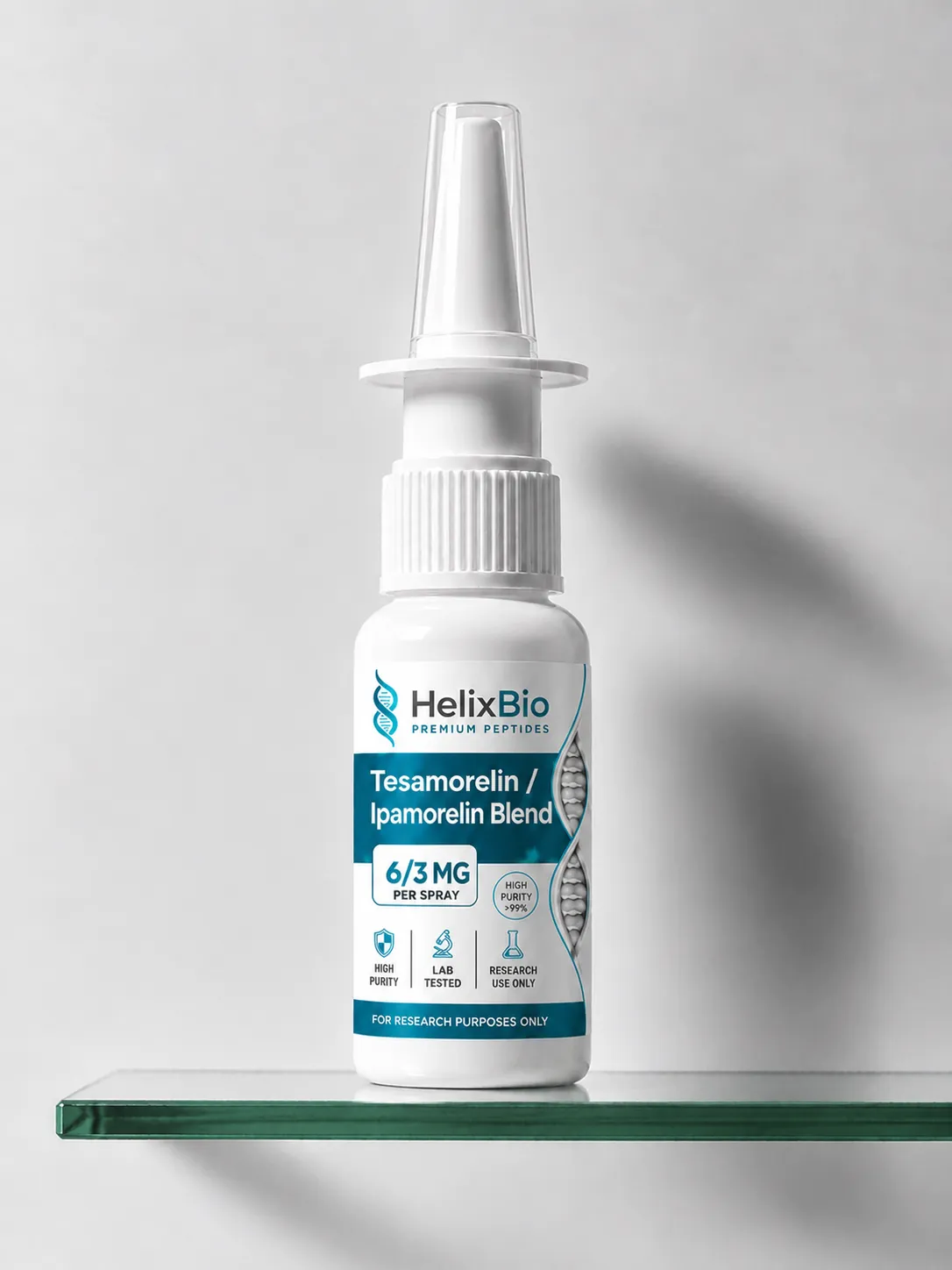
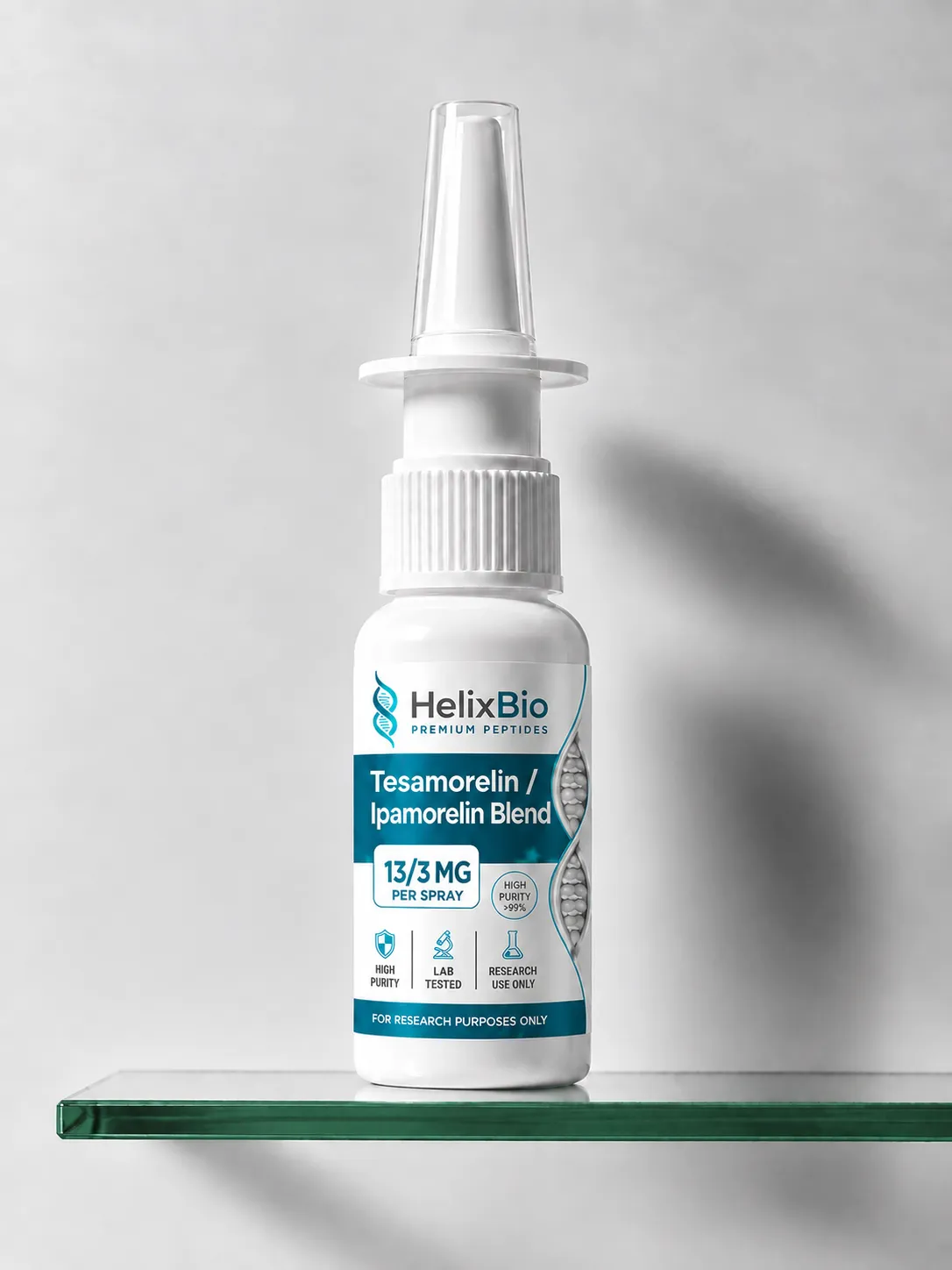
Two peptides, two receptor systems, one research material. Tesamorelin + Ipamorelin Blend Spray pairs tesamorelin — a 44-residue analogue of human growth hormone-releasing hormone carrying a trans-3-hexenoyl modification at its N-terminus — with ipamorelin, a five-residue growth hormone secretagogue that acts at the ghrelin receptor GHSR-1a. The two compounds are chemically unrelated and reach the growth hormone axis through separate receptors. Helix Bio supplies the pair as a prepared spray-format research material for qualified laboratory use only; it is not intended for human or veterinary consumption, diagnosis, treatment, or prevention of disease.
HPLC certified
Independent analysis
Highest standard
Full traceability
The blend is a defined mixture of two separately characterised synthetic peptides. It is not a single molecule, it has no combined amino-acid sequence, and it has no single molecular weight. Each component keeps its own identity, its own analytical profile, and its own literature.
Tesamorelin
Tesamorelin is a synthetic 44-residue peptide amide corresponding to human growth hormone-releasing hormone, GHRH(1-44), with a trans-3-hexenoyl group attached to the alpha-amino nitrogen of the N-terminal tyrosine. Nothing else in the sequence departs from the native peptide. Its molecular formula is C221H366N72O67S and its average molecular weight is 5,135.86 g/mol, indexed under CAS 218949-48-5 and PubChem CID 16137828. Scientific literature associates it with the GHRH receptor, GHRHR, expressed on somatotroph cells of the anterior pituitary.
The N-terminal modification is worth stating precisely, because it is frequently described incorrectly. Tesamorelin is defined by the hexenoyl cap alone. It does not carry a D-alanine substitution at position 2; that modification belongs to a different family of GHRH analogues, and material describing tesamorelin that way is describing another compound.
Ipamorelin
Ipamorelin is a synthetic pentapeptide with the sequence Aib-His-D-2-Nal-D-Phe-Lys-NH2, molecular formula C38H49N9O5, average molecular weight 711.87 g/mol, CAS 170851-70-4, PubChem CID 9831659. Three of its five residues are non-standard: the N-terminal alpha-aminoisobutyric acid has no stereocentre, and positions three and four are D-configured. The C-terminus is amidated. Published pharmacology, originating with Raun and colleagues in 1998, describes it as an agonist at the growth hormone secretagogue receptor GHSR-1a — the receptor for ghrelin — with a selectivity profile distinguishing it from earlier GHRP-family compounds in the models studied.
Two receptors, not one
This is the distinction that defines the material. Tesamorelin is associated with GHRHR; ipamorelin with GHSR-1a. These are separate receptors with separate endogenous ligands and separate downstream signalling. Evidence generated for one does not transfer to the other, and neither peptide is a substitute for the other in an experimental design. A blend gives an investigator both inputs in one material — it does not make them equivalent.
What has not been studied
A search of the published literature for controlled studies evaluating tesamorelin and ipamorelin together did not identify any. The human trial record for tesamorelin studied tesamorelin alone; the clinical record for ipamorelin studied ipamorelin alone. Published work describing enhanced growth hormone release from combining GHRH-pathway and secretagogue-pathway stimulation was generally performed with GHRH alongside GHRP-6 or GHRP-2 — different compounds from either component here. That work is mechanistic context for why the two pathways are of joint interest. It is not evidence about this pair, and no combined effect should be inferred from it.
Research material, not a pharmaceutical
Tesamorelin is the active substance in FDA-approved prescription products indicated for a specific HIV-associated condition. Those products are separate regulated articles with their own approved labelling, manufacturing controls and route of administration. A research-use-only blend containing tesamorelin is not equivalent to them and is not an FDA-approved product. Ipamorelin has never been approved in any indication; its clinical development, in postoperative gastrointestinal recovery, did not meet its primary endpoint and was discontinued.
“Spray” on this listing describes the physical presentation of the material — a prepared solution in a spray-fitted container — and nothing more. It does not designate an administration route, and no route-specific property should be inferred from it. Helix Bio supplies no product intended for administration by any route.
What the format does change is chemistry, and for this particular pair it changes it asymmetrically. In a prepared solution the two components are not equally durable. Tesamorelin carries a methionine at position 27, the single sulfur-containing residue in the molecule and a site at which oxidation adds sixteen mass units; it also carries asparagine and glutamine residues at which deamidation adds one. Ipamorelin has no methionine, no asparagine, no cysteine, and its two D-configured residues make it comparatively resistant to proteolytic and chemical attack for a peptide of its size.
The practical consequence is specific to a blend, and it is the reason a solution-format blend deserves its own documentation rather than inheriting a lyophilised product’s: the component ratio in a prepared solution is a function of time as well as of fill. If one component degrades faster than the other in a shared vehicle, a ratio that was accurate at manufacture will not stay accurate, and the rate depends on the vehicle, the pH, the container and the storage temperature. A ratio determined at fill is a fact about the fill, not a permanent property of the material.
Researchers evaluating this material should therefore treat vehicle composition, pH and lot-specific stability data as first-order questions rather than housekeeping — and should not transfer storage or stability guidance from a lyophilised presentation of the same two peptides, where the relevant chemistry is different.
The two components sit within the broader study of growth hormone regulation but occupy different positions in it.
The existence of published research on either component does not establish that this blend is safe or effective for any use in humans. Neither component is an approved drug in the research-use form supplied here, and the regulatory status of a compound is a separate question from the volume of scientific interest in it.
A two-component material asks more of its documentation than a single peptide does, and the questions a researcher should ask are correspondingly more specific.
Helix Bio states that its research peptide catalogue uses independent HPLC testing for purity assessment and mass spectrometry for molecular identity confirmation, and that batch-specific Certificates of Analysis are available for its products. For a blend, the useful question is not whether those methods were used but how their outputs were reported: whether identity was confirmed for each component separately, whether purity is reported per component, and whether the ratio between the two was quantified rather than assumed from the fill.
Researchers should verify the applicable product documentation and current lot information for this specific material rather than relying on a general catalogue statement or on documentation issued for a different presentation of the same two peptides.
Tesamorelin + Ipamorelin Blend Spray is intended for qualified users working in legitimate laboratory or scientific research environments, including:
The product is not intended for personal experimentation, self-administration, human consumption, veterinary use, or medical treatment. It is not intended for consumers seeking health, cosmetic, performance, weight-management or therapeutic applications.
Component 1 — Tesamorelin
| Specification | Details |
|---|---|
| Scientific name | Tesamorelin |
| Synonyms | TH9507 |
| Compound type | Synthetic 44-residue peptide amide; GHRH analogue |
| Sequence | trans-3-hexenoyl-Tyr-Ala-Asp-Ala-Ile-Phe-Thr-Asn-Ser-Tyr-Arg-Lys-Val-Leu-Gly-Gln-Leu-Ser-Ala-Arg-Lys-Leu-Leu-Gln-Asp-Ile-Met-Ser-Arg-Gln-Gln-Gly-Glu-Ser-Asn-Gln-Glu-Arg-Gly-Ala-Arg-Ala-Arg-Leu-NH₂ |
| Peptide length | 44 residues |
| Molecular formula | C₂₂₁H₃₆₆N₇₂O₆₇S |
| Molecular weight | 5,135.86 g/mol |
| CAS | 218949-48-5 (free base); 901758-09-6 (salt form) |
| PubChem CID | 16137828 |
| Structural feature | trans-3-hexenoyl group on the N-terminal tyrosine; C-terminal amide |
| Associated receptor | GHRH receptor (GHRHR) |
Component 2 — Ipamorelin
| Specification | Details |
|---|---|
| Scientific name | Ipamorelin |
| Synonyms | NNC 26-0161 |
| Compound type | Synthetic pentapeptide; growth hormone secretagogue |
| Sequence | Aib-His-D-2-Nal-D-Phe-Lys-NH₂ |
| Peptide length | 5 residues |
| Molecular formula | C₃₈H₄₉N₉O₅ |
| Molecular weight | 711.87 g/mol |
| CAS | 170851-70-4 |
| PubChem CID | 9831659 |
| Structural features | Achiral Aib at position 1; D-configuration at positions 3 and 4; C-terminal amide |
| Associated receptor | Growth hormone secretagogue receptor 1a (GHSR-1a) |
Blend / product layer
| Specification | Details |
|---|---|
| Product name | Tesamorelin + Ipamorelin Blend Spray |
| Product type | Two-component peptide blend, prepared solution |
| Components | Tesamorelin; Ipamorelin |
| Research category | Growth Hormone Secretagogue / Peptide Blend |
| Format | Spray-format research solution |
| Component ratio | Refer to current product documentation |
| Component amounts | Refer to current product documentation |
| Concentration | Refer to current product documentation |
| Fill volume | Refer to current product listing |
| Vehicle | Refer to current product documentation |
| Purity | Refer to current lot-specific documentation; reported per component |
| Identity testing | Refer to applicable Certificate of Analysis |
| Packaging | Refer to current product listing |
| Storage | Follow current product-specific documentation |
| Intended use | Research and laboratory investigation only |
| Human use | Not intended for human consumption |
| Veterinary use | Not intended for veterinary use |
| Manufacturer | Helix Bio |
| Country of origin | Not specified; verify current product documentation |
Note. A blend has no combined molecular weight and no combined sequence. The two component masses are properties of two separate molecules and must not be summed or averaged into a single figure. Product-specific quantity, ratio, concentration and analytical results should be taken from the current lot’s documentation rather than inferred from the catalogue or from a different presentation of the same components.
GHRH receptor research. Tesamorelin is studied in connection with GHRHR, the receptor for native growth hormone-releasing hormone on pituitary somatotrophs. Its structural relationship to the native peptide — full-length GHRH(1-44) with a single N-terminal acylation — makes it useful in work examining how acylation affects the behaviour of a GHRH-family ligand.
GHSR-1a research. Ipamorelin is studied in connection with the growth hormone secretagogue receptor, the receptor for ghrelin. Its published characterisation concerns agonist selectivity: releasing growth hormone in the models studied without the accompanying ACTH and cortisol responses reported for earlier GHRP-family compounds.
Two-pathway comparative research. Because the components engage different receptors, the material is relevant to experimental designs comparing two ligand classes that converge on the same physiological axis. Such designs typically require the individual compounds as well as the combination, since a combined material alone cannot separate the contributions.
Analytical and stability research. A two-analyte solution with a 7:1 mass ratio between its components is a non-trivial analytical object: method development has to resolve and quantify both, and stability work has to track them independently. This makes the material relevant to method-development and forced-degradation work in its own right.
An evidence boundary. Published research on each component was generated with that component alone. No published controlled study evaluating the two together was identified. Findings from the individual literatures describe the individual compounds and should not be presented, combined, or read as describing what the blend does.
Analytical documentation matters for any research peptide, because identity, purity and concentration all feed directly into how an experiment is interpreted. For a two-component material it matters in a way that has a specific technical consequence, and it is worth being precise about it.
A purity figure produced by area normalisation on a chromatogram answers the question “what fraction of the detected material is the target compound?” That question has a definite answer when there is one target compound. On a chromatogram containing two intended analytes it does not. Tesamorelin and ipamorelin are both intended constituents; neither is an impurity of the other; and a single percentage cannot describe both without deciding, silently, which one it refers to. A meaningful purity statement for this material therefore needs two things a single-peptide COA does not: a purity value for each component, assessed against its own impurity profile, and a separate quantitative determination of how much of each component is present.
Mass spectrometry is well suited to the identity half of this. The two components are separated by roughly 4,424 mass units — 5,135.86 against 711.87 — so a single analysis can confirm both without ambiguity, and the presence or absence of each is unmistakable. One limitation is worth noting: ipamorelin’s D-configured residues at positions three and four are mass-silent, so mass confirmation alone cannot distinguish correctly-configured material from an all-L impurity of identical formula. Configuration is a chiral-method question.
A second question specific to blends concerns mass basis. Both peptides are commonly supplied as acetate salts, and both have distinct free-base and salt registrations — tesamorelin under two CAS numbers, ipamorelin under nominations that FDA itself recorded as ambiguous between the acetate and the free base. A stated milligram figure means different peptide content depending on which basis it is reported against, and in a blend that ambiguity applies twice, independently. The basis should be stated on the documentation rather than assumed.
Researchers should assess, where applicable:
No certification, regulatory approval, or quality claim should be inferred unless it is explicitly documented by the manufacturer or a relevant regulatory authority.
Storage and handling requirements should be taken from the current product documentation and lot-specific instructions for this material.
Follow the storage conditions supplied with the product.
Protect the material from inappropriate temperature, light and environmental exposure.
Keep the container properly closed when not in use in an approved research workflow.
Avoid unnecessary temperature cycling.
Maintain appropriate laboratory labelling and inventory records.
Follow institutional procedures for handling research peptides.
Do not use material beyond the stated storage period or applicable retest date without appropriate laboratory qualification.
Consult the current COA and product documentation for product-specific requirements.
Storage guidance should not be carried over from a lyophilised presentation of the same two peptides. A dry solid and a prepared solution are different materials with different degradation pathways, and for this pair the two components do not age at the same rate in solution. Nor should stability be inferred from data generated for either peptide on its own; components can behave differently in a shared vehicle than they do separately.
Helix Bio’s website describes research materials as being supplied to laboratories and institutions in the United States, and describes tracked shipping and cold-chain handling within its fulfilment process.
Because shipping conditions, packaging specifications, availability and delivery requirements may change, researchers should review the current Helix Bio shipping information and product listing before ordering. Product packaging should remain appropriately labelled and handled as research material after delivery. Researchers are responsible for following applicable institutional, federal, state and local requirements governing research materials.
Tesamorelin + Ipamorelin Blend Spray is sold by Helix Bio for research and laboratory purposes only. It is not intended for human or veterinary consumption, self-administration, diagnosis, treatment, cure, mitigation, or prevention of any disease or medical condition.
Neither component is an FDA-approved drug in this research-use form. Tesamorelin is the active substance in approved prescription products; that approval attaches to those specific regulated products and does not extend to a research-use blend, to a different formulation, or to a different route. Ipamorelin has never been approved for any human indication. The regulatory positions of the two components also differ from one another: approved products containing tesamorelin transitioned to regulation as biologics licensed under section 351 of the Public Health Service Act in March 2020, while ipamorelin has been evaluated within the separate bulk drug substances framework applying to pharmacy compounding. Neither status says anything about this research material.
This product is not a dietary supplement, consumer wellness product, or medical treatment. Researchers are responsible for determining whether a material is appropriate for their intended experimental application and for complying with applicable institutional and regulatory requirements.
Knowledge Base
Knowledge Base
Knowledge Base
Knowledge Base
Knowledge Base
Knowledge Base
Knowledge Base
Knowledge Base
Knowledge Base
Knowledge Base
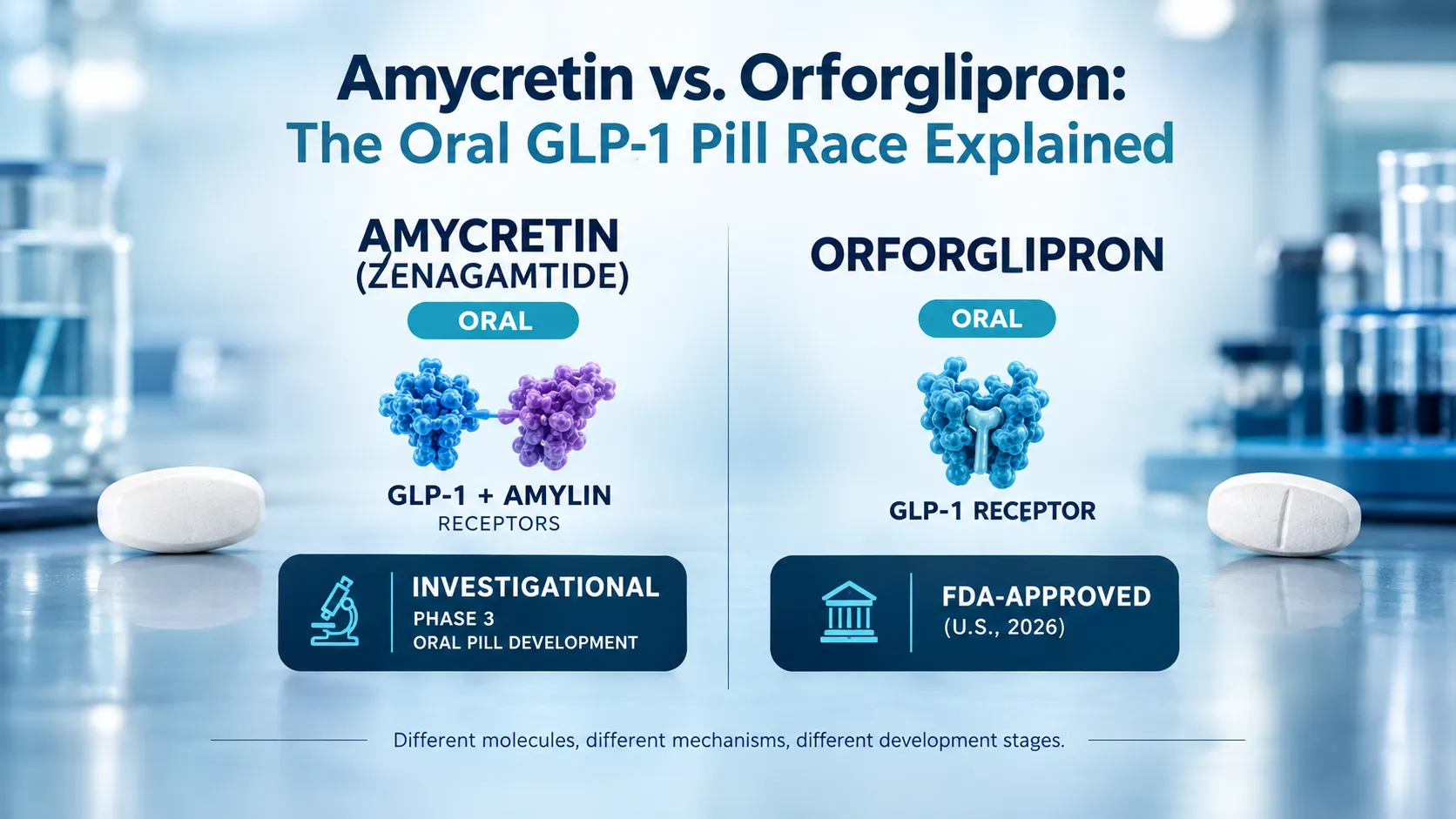
Amycretin is a peptide and orforglipron is not. How that chemistry explains the formulations, trial results, and approval status of both GLP-1 pills.
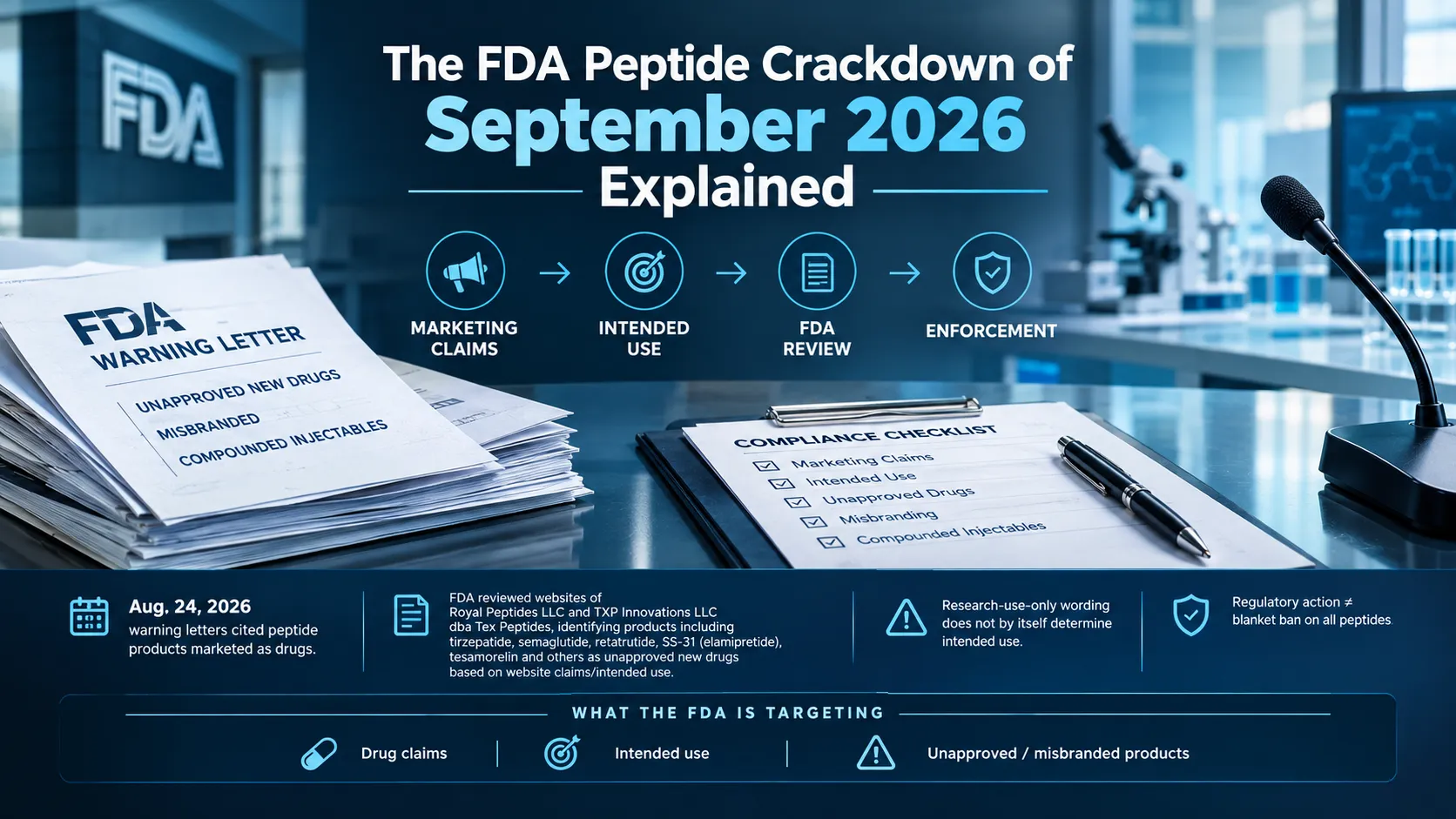
Five peptide sellers got FDA warning letters in September 2026. See who was named, why the research label failed, and the full 2026 enforcement timeline.
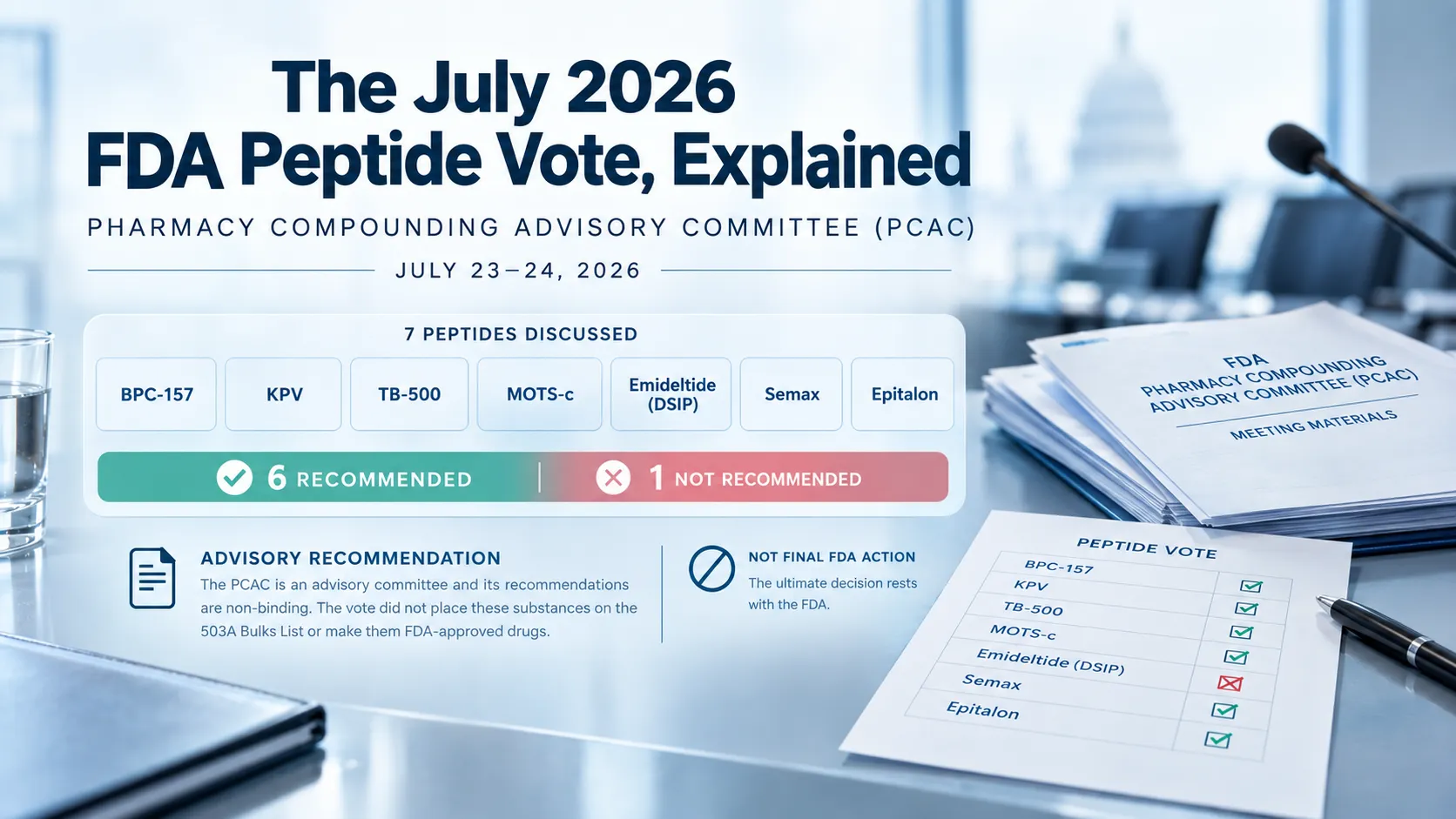
In July 2026, the FDA's advisory committee recommended 6 peptides for the 503A bulk list. None are on it yet. What the vote changed and what it didn't.