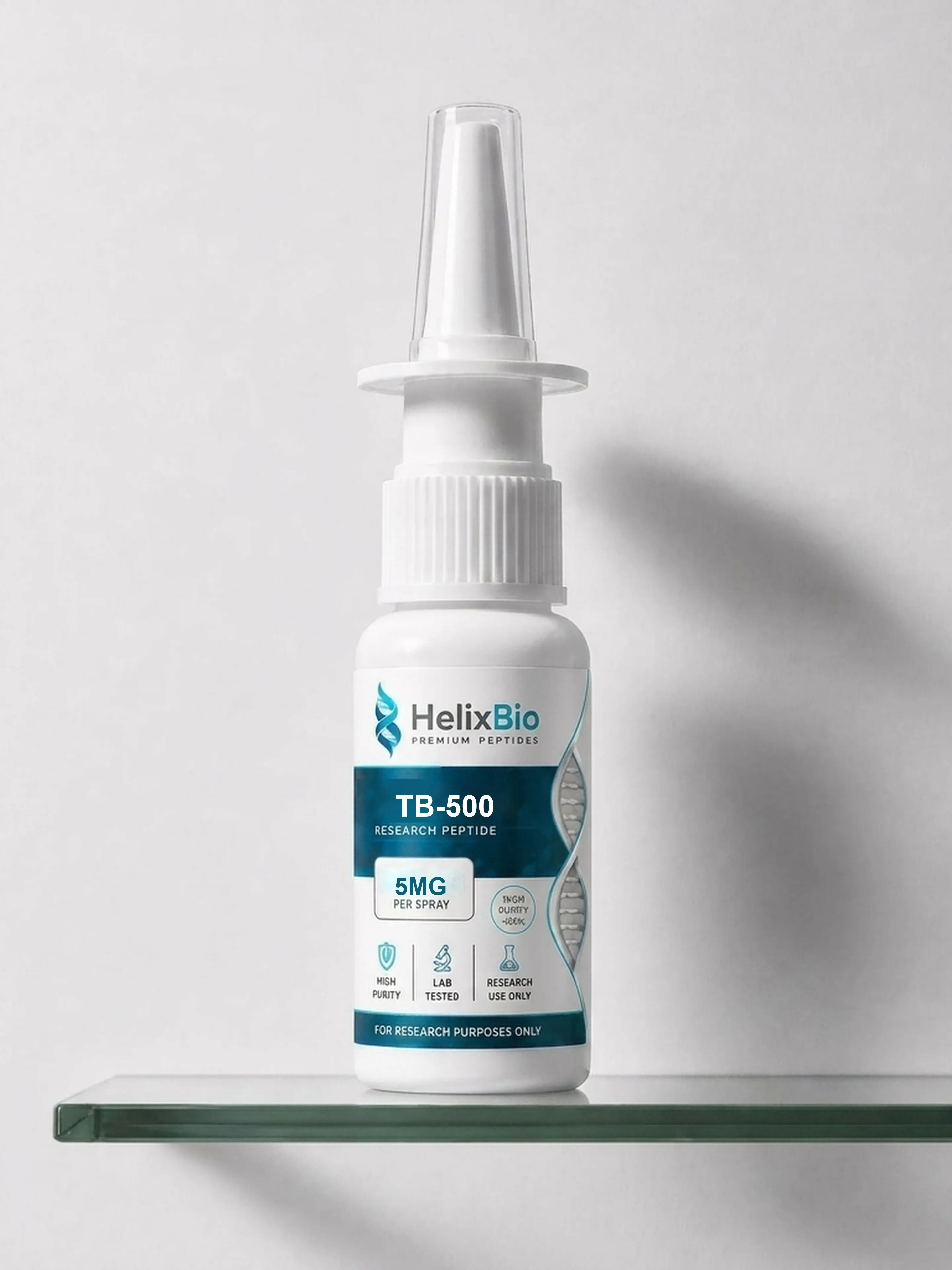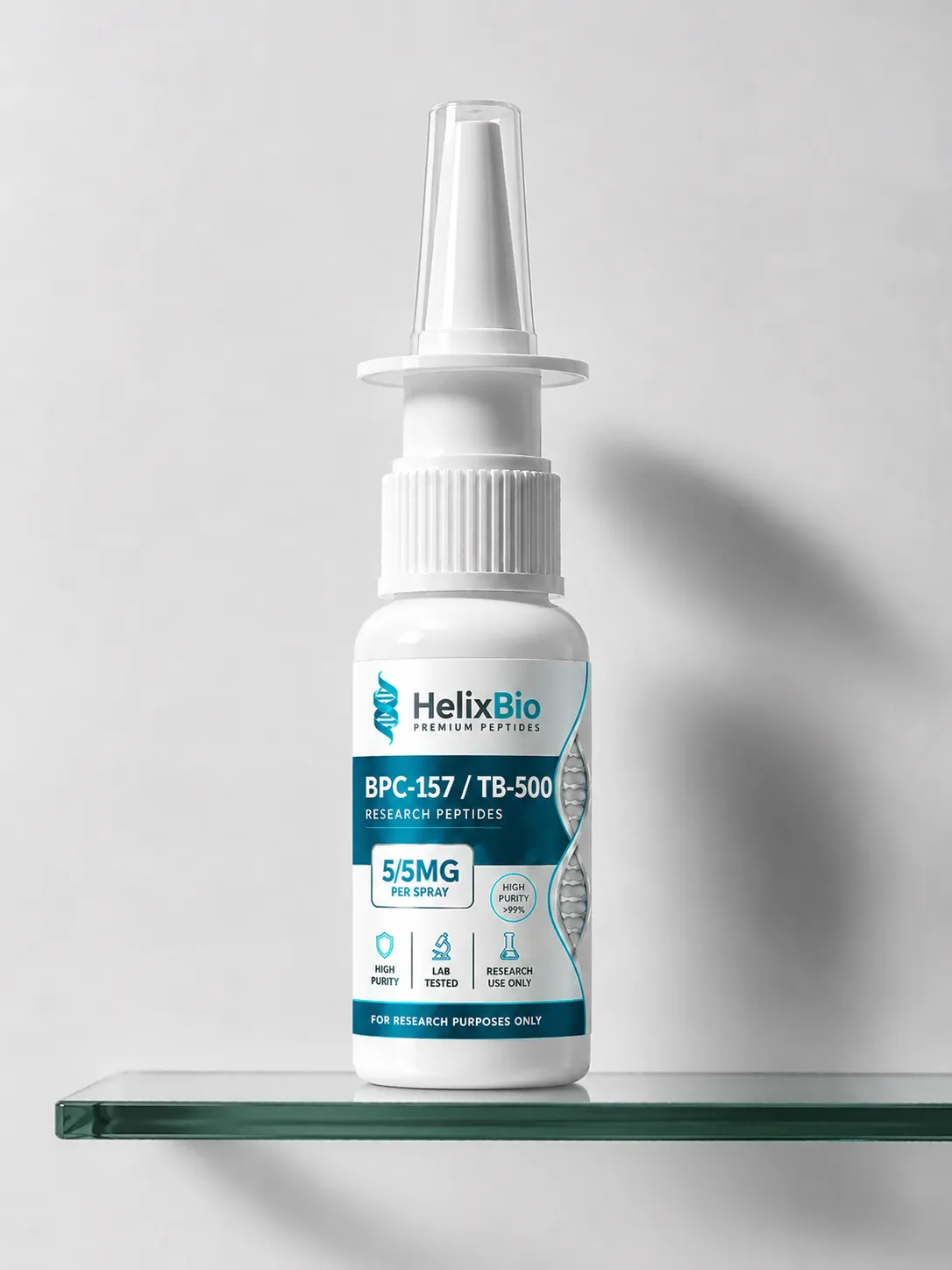
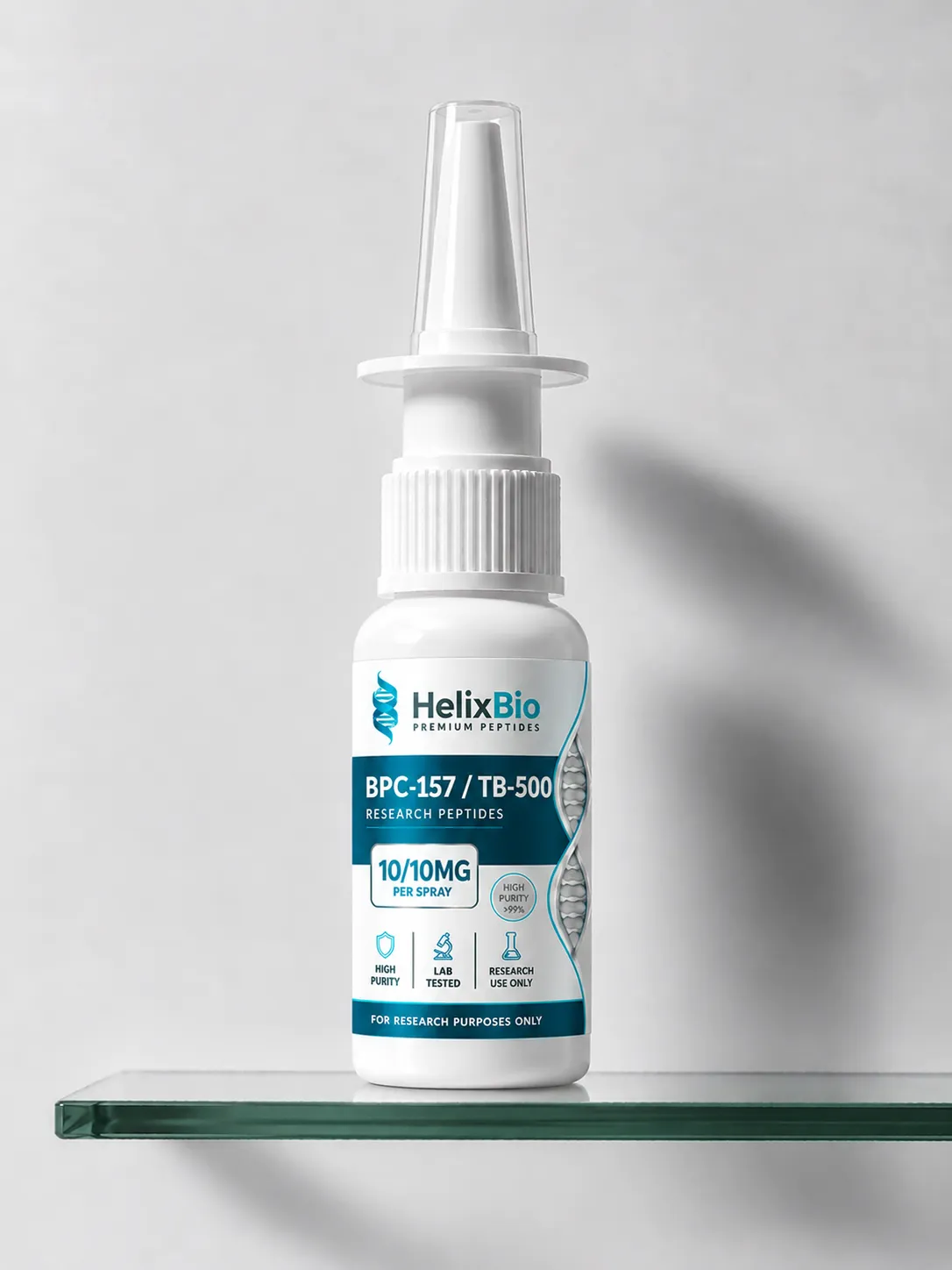
Two peptides, two molecular identities, one container. BPC-157 / TB-500 Blend Spray pairs BPC-157 — a synthetic 15-residue peptide with the sequence GEPPPGKPADDAGLV — with material supplied under the name TB-500, which the analytical literature associates with an N-terminal-acetylated fragment spanning the actin-binding region of thymosin beta-4. The two components differ substantially in size, and that difference shapes how the blend should be characterised, documented and interpreted in an experimental record. Helix Bio supplies this preparation as a spray-format research material for qualified laboratory and scientific work. It is not intended for human or veterinary consumption, diagnosis, treatment, or prevention of disease, and it is not a treatment product of any kind.
HPLC certified
Independent analysis
Highest standard
Full traceability
A blend is not a molecule. It is two separately synthesised peptides co-formulated in a single preparation, and everything from identity confirmation to purity reporting has to be handled per component.
BPC-157 is a synthetic pentadecapeptide, sequence Gly-Glu-Pro-Pro-Pro-Gly-Lys-Pro-Ala-Asp-Asp-Ala-Gly-Leu-Val, with a calculated mass of approximately 1,419 daltons for the free peptide. It has an extensive preclinical research record across gastrointestinal, vascular, tissue and molecular-signalling models.
TB-500 requires more care, because it is a commercial designation rather than a chemical one. Published analytical work characterising a TB-500 formulation by high-resolution mass spectrometry identified Ac-LKKTETQ — the N-terminal-acetylated 17–23 fragment of human thymosin beta-4, seven residues, with a calculated mass of approximately 889 daltons in the acetylated form. Material is also widely sold under the TB-500 name that is full-length thymosin beta-4: a 43-residue, N-terminally acetylated protein with a calculated mass of approximately 4,963 daltons.
Those two candidate identities differ by roughly a factor of 5.6. They are not interchangeable, and the distinction is not academic. The human clinical work that exists in this area — corneal repair and ulcer healing studies — was conducted with full-length thymosin beta-4, not with the heptapeptide fragment. Literature about one is not automatically literature about the other.
There is a useful analytical consequence for this particular blend. BPC-157’s mass sits between the two candidate TB-500 identities. A mass-spectrometric run on the blend therefore does two jobs at once: it confirms the BPC-157 component and it settles which TB-500 entity is present, because approximately 889, 1,419 and 4,963 daltons are three clearly distinguishable answers.
One further naming trap is worth clearing. Thymosin beta-4 and thymosin alpha-1 are unrelated peptides that share a prefix and nothing else. Research concerning one has no bearing on the other.
Co-formulating two peptides in a single solution introduces variables that neither component carries on its own.
The components do not share a molecular size. Depending on which TB-500 entity is present, the mass span inside a single vehicle is either modest or close to five-fold. Solubility, behaviour in solution and analytical response all vary with that span, and a formulation optimised around one component is not automatically optimal for the other.
The proportion between the two components is fixed by the manufacturer. Unlike two separately supplied materials, a blend cannot be adjusted independently — whatever ratio was formulated is the ratio the experiment inherits, which makes the documented component quantities part of the experimental record rather than a packaging detail.
Concentration expressed per millilitre, the mass of each component delivered per actuation, the vehicle composition, and the storage regime are all product facts. They belong to this specific preparation and should be read from the current Helix Bio product listing and the lot-specific Certificate of Analysis — not inferred from a lyophilized blend, from separately supplied components, or from another supplier’s blend of the same two peptides.
Helix Bio does not represent any route of administration for this product. The spray designation describes the physical presentation only.
The literature relevant to this product falls into three separate bodies of evidence, and they should not be merged.
BPC-157 research has examined:
Thymosin beta-4 and TB-500 fragment research has examined:
Combination research is a shorter list. No published controlled study of the BPC-157 plus TB-500 combination was identified. The two components have separate evidence bases and the blend does not inherit either as evidence for the pairing.
Neither peptide is an FDA-approved drug in the United States. Both were among seven peptide bulk drug substances reviewed by FDA’s Pharmacy Compounding Advisory Committee on 23–24 July 2026, where the committee issued advisory recommendations in favour of including both on the 503A Bulks List. Those recommendations are non-binding, they were made against the written recommendation of FDA review staff, and placement on the list requires a rulemaking process that has not concluded. An advisory vote is not an approval and is not a finding of safety or effectiveness.
A single-component peptide raises one identity question. This blend raises three: what the BPC-157 component is, what the TB-500 component is, and in what proportion they are present.
The second of those is the one most likely to be answered incorrectly elsewhere. Material sold as TB-500 is variously the acetylated heptapeptide fragment or the full-length 43-residue protein, and published sources disagree with each other about which. A mass result on the Certificate of Analysis resolves it; a product name does not.
Helix Bio states that its research peptide catalog uses independent HPLC testing for purity assessment and mass spectrometry for molecular identity confirmation, and that batch-specific Certificates of Analysis are available for its products. For this blend, researchers should confirm that the documentation reports results per component rather than as a single combined figure, and should record the component quantities alongside the lot number in their experimental notes.
BPC-157 / TB-500 Blend Spray is intended for qualified users working in legitimate laboratory or scientific research environments, including:
It is not intended for personal experimentation, self-administration, human consumption, veterinary use, diagnosis, treatment, or disease prevention.
| Specification | Details |
|---|---|
| Product Name | BPC-157 / TB-500 Blend Spray |
| Product Type | Two-component peptide blend |
| Format | Spray-format solution |
| Component 1 | BPC-157 |
| BPC-157 Peptide Type | Synthetic pentadecapeptide |
| BPC-157 Sequence | GEPPPGKPADDAGLV |
| BPC-157 Amino Acid Count | 15 |
| BPC-157 Molecular Weight | ≈1,419 Da (free peptide) |
| BPC-157 Chemical Form | Verify current product documentation (free base and acetate are distinct substances) |
| Component 2 | TB-500 |
| TB-500 Reference Entity | Fragment of thymosin beta-4; exact form to be confirmed from lot documentation |
| TB-500 Candidate Identities | Ac-LKKTETQ, 7 residues, ≈889 Da acetylated · or full-length thymosin beta-4, 43 residues, ≈4,963 Da acetylated |
| TB-500 Chemical Form | Verify current product documentation |
| Component Quantities | Refer to current product listing and lot documentation |
| Component Ratio | Refer to current product listing and lot documentation |
| Total Content | Verify current product specification |
| Concentration | Verify current product specification |
| Vehicle / Formulation | Verify current product documentation |
| Intended Use | Laboratory and scientific research only |
| Human Use | Not intended for human administration |
| Veterinary Use | Not intended for veterinary administration |
| Purity | Verify current lot-specific COA; confirm whether reported per component |
| Identity Testing | Refer to applicable Certificate of Analysis |
| Packaging | Verify current product specification |
| Storage | Follow current product label and documentation |
| Shelf Life | Verify current lot documentation |
| Manufacturer / Supplier | Helix Bio |
| Country of Origin | Not specified; verify current documentation |
Specification note: Component quantities, ratio, concentration, chemical forms, vehicle, purity, storage and shelf life must be taken from the current product documentation and the applicable lot-specific Certificate of Analysis. Specifications from other suppliers’ BPC-157 / TB-500 blends should not be substituted, and values from single-component BPC-157 or TB-500 products do not apply to a co-formulated preparation.
The three evidence bodies relevant to this product are described separately below because they support different claims and were generated in different systems.
BPC-157 has been investigated across gastrointestinal models, vascular and endothelial signalling, tissue-level experimental systems and a range of molecular pathways discussed in published reviews. It has also been characterised analytically, including work on its detection and in-vitro metabolism by mass spectrometry. The literature is overwhelmingly preclinical; no published randomised controlled human trial establishes an outcome, and recent reviews identify formulation, pharmacokinetics and permeability as unresolved development questions.
Thymosin beta-4 is an actin-sequestering protein and the most abundant member of the beta-thymosin family. The 17–23 region of its sequence corresponds to the actin-binding domain, and it is that region the TB-500 fragment reproduces.
The distinction matters when reading the evidence. Human clinical work in this area — including studies in corneal repair and ulcer healing — was conducted with full-length thymosin beta-4. Studies conducted with the 43-residue protein do not automatically describe the behaviour of a seven-residue fragment, and a citation to thymosin beta-4 literature is not a citation about TB-500 unless the study used the fragment.
No published controlled study of the BPC-157 plus TB-500 combination was identified in the course of preparing this page.
The rationale commonly offered for pairing them is that their research contexts overlap. That is an observation about literature, not a result. Combining two compounds does not produce evidence for the combination, and nothing in the separate evidence bases for BPC-157 or thymosin beta-4 supports a claim that co-formulation is additive, complementary or superior to either component alone. Researchers designing work with this material should treat the combination itself as the uncharacterised variable it is.
Co-formulated peptides are a legitimate subject of analytical method development in their own right. Separating and quantifying two peptides in one matrix, establishing per-component purity, determining actual versus nominal ratio, and monitoring whether the components degrade at comparable rates in a shared vehicle are all tractable experimental questions — and this blend is a workable system for them, precisely because its components are well separated by mass.
Researchers should evaluate every publication according to the exact compound studied, its chemical form, the model, the analytical method and the endpoints, rather than assuming that findings transfer between components, between fragment and full-length protein, or from single components to a blend.
Purity reporting on a blend is not the same exercise as purity reporting on a single peptide, and the difference is easy to miss.
Chromatographic purity is conventionally reported by area normalisation — the target peak’s area as a percentage of total peak area. On a two-analyte chromatogram that calculation has no single meaningful answer, because the second component is not an impurity. A blend that is exactly what it claims to be will not return a single high-nineties purity figure by naive area normalisation, and a figure reported that way on a two-component product should prompt a question about how it was derived.
What a blend COA needs to establish is different in kind:
For the TB-500 component specifically, the mass result is the item to read first. Approximately 889 daltons indicates the acetylated heptapeptide fragment; approximately 4,963 daltons indicates full-length thymosin beta-4. These are different molecules with different literature behind them, and the distinction cannot be inferred from the label.
No certification, accreditation, third-party test result or purity value should be assumed unless it is explicitly documented for the relevant product and lot.
Storage and handling requirements should be determined from the current BPC-157 / TB-500 Blend Spray product documentation and lot-specific instructions.
General laboratory considerations include:
Two points are specific to this preparation. Storage conditions published for lyophilized BPC-157, for lyophilized TB-500, or for separately supplied components do not transfer to a co-formulated solution — a peptide held in solution is subject to different degradation pathways from the same peptide held as a dry powder. And because the components differ in size and chemistry, there is no basis for assuming they degrade at the same rate in a shared vehicle. Only documentation generated for this formulation and lot describes its actual requirements.
Helix Bio’s website describes research materials as being supplied to laboratories and institutions in the United States and describes tracked shipping and cold-chain handling within its fulfillment process.
Because shipping conditions, packaging specifications, availability, and delivery requirements may change, researchers should review the current Helix Bio shipping information and product listing before ordering.
On receipt, researchers should confirm that the product name matches the order, that packaging is intact, that lot information is recorded, and that the supplied documentation corresponds to the received lot. Product packaging should remain appropriately labeled and handled as research material after delivery, and researchers are responsible for following applicable institutional, federal, state, and local requirements governing research materials.
BPC-157 / TB-500 Blend Spray is supplied by Helix Bio strictly as a laboratory and scientific research material. It is not intended for human or veterinary administration, ingestion, inhalation, injection, diagnosis, treatment, cure, mitigation, or prevention of any disease or medical condition.
Neither BPC-157 nor TB-500 is an FDA-approved drug in the United States. Both were among seven peptide bulk drug substances considered by FDA’s Pharmacy Compounding Advisory Committee on 23–24 July 2026 for possible inclusion on the 503A Bulks List. The committee issued advisory recommendations in favour of both, in each case against the written recommendation of FDA review staff. Those recommendations are non-binding, do not place either substance on the list, and do not constitute approval or a finding of safety or effectiveness. Inclusion would require a rulemaking process that has not concluded.
Helix Bio is not a compounding pharmacy and does not operate as a compounding facility under Section 503A of the Federal Food, Drug, and Cosmetic Act. Nothing on this page should be read as guidance on the eligibility of any substance for pharmacy compounding.
This product is not a dietary supplement, consumer wellness product, or medical treatment. Preclinical research findings do not establish human outcomes, and no published study establishes an outcome for the combination of these two components. Researchers are responsible for determining whether the material is appropriate and lawful for their specific research application and for complying with applicable institutional and regulatory requirements.
Knowledge Base
Knowledge Base
Knowledge Base
Knowledge Base
Knowledge Base
Knowledge Base
Knowledge Base
Knowledge Base
Knowledge Base
Knowledge Base
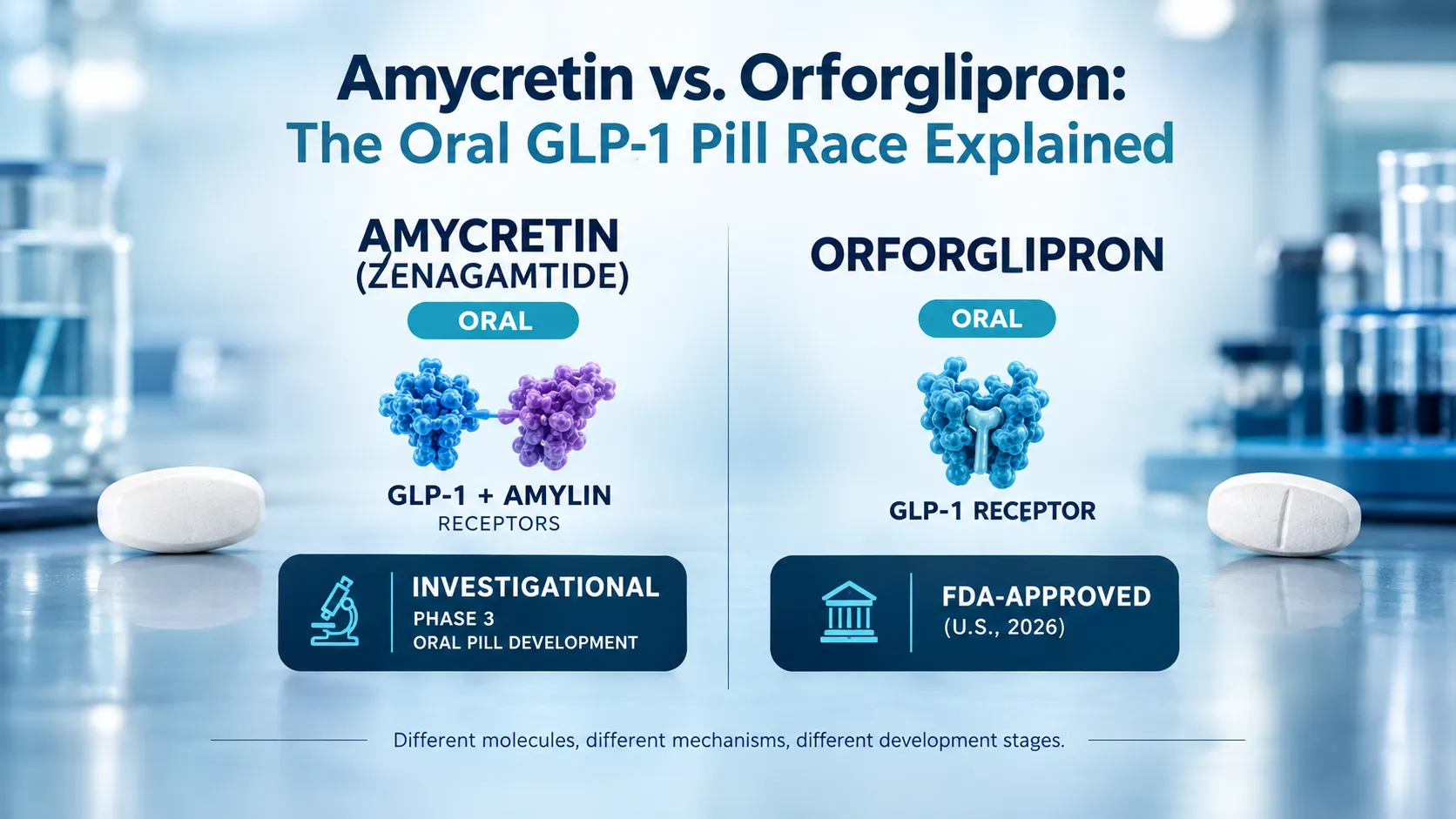
Amycretin is a peptide and orforglipron is not. How that chemistry explains the formulations, trial results, and approval status of both GLP-1 pills.
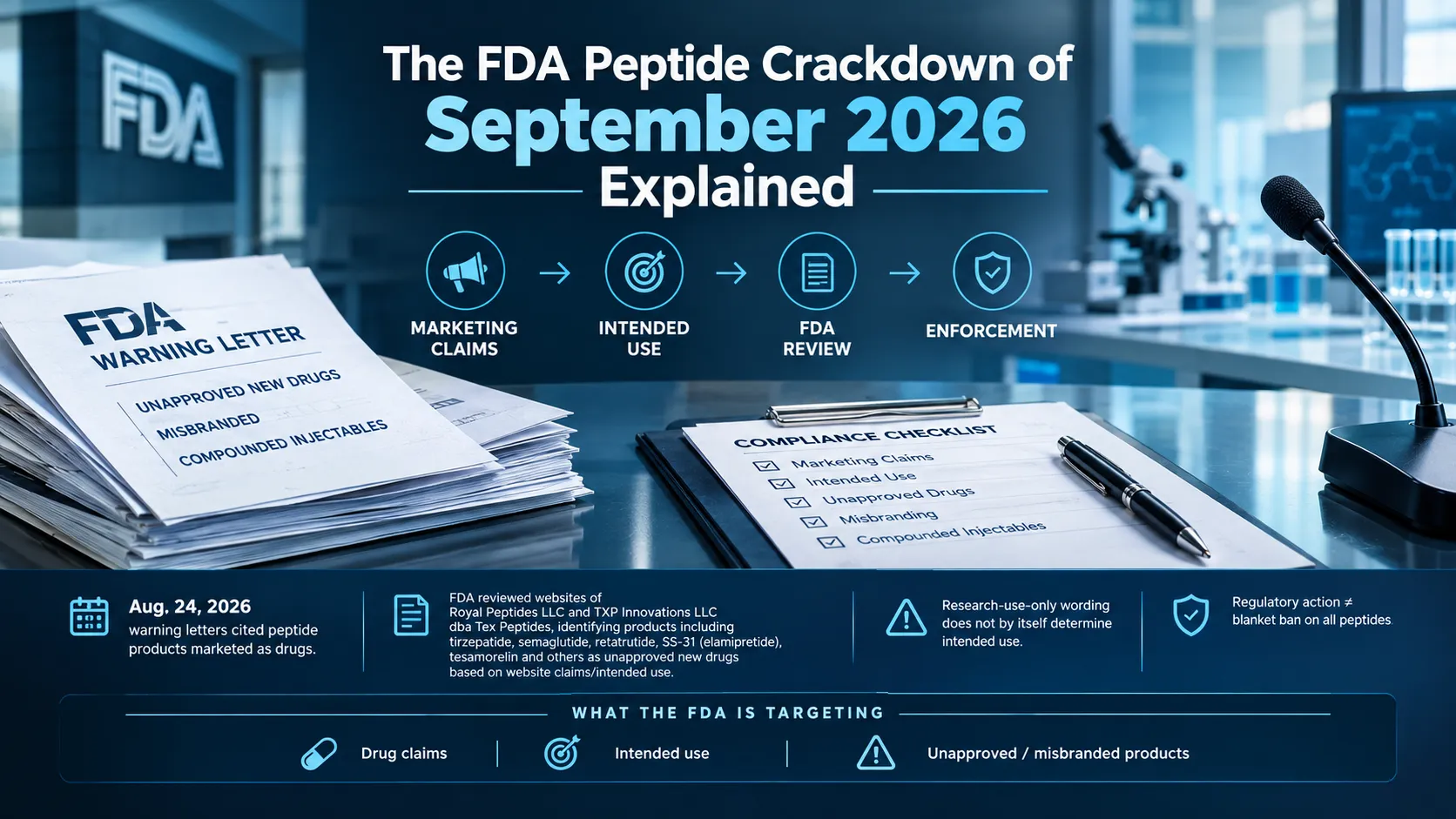
Five peptide sellers got FDA warning letters in September 2026. See who was named, why the research label failed, and the full 2026 enforcement timeline.
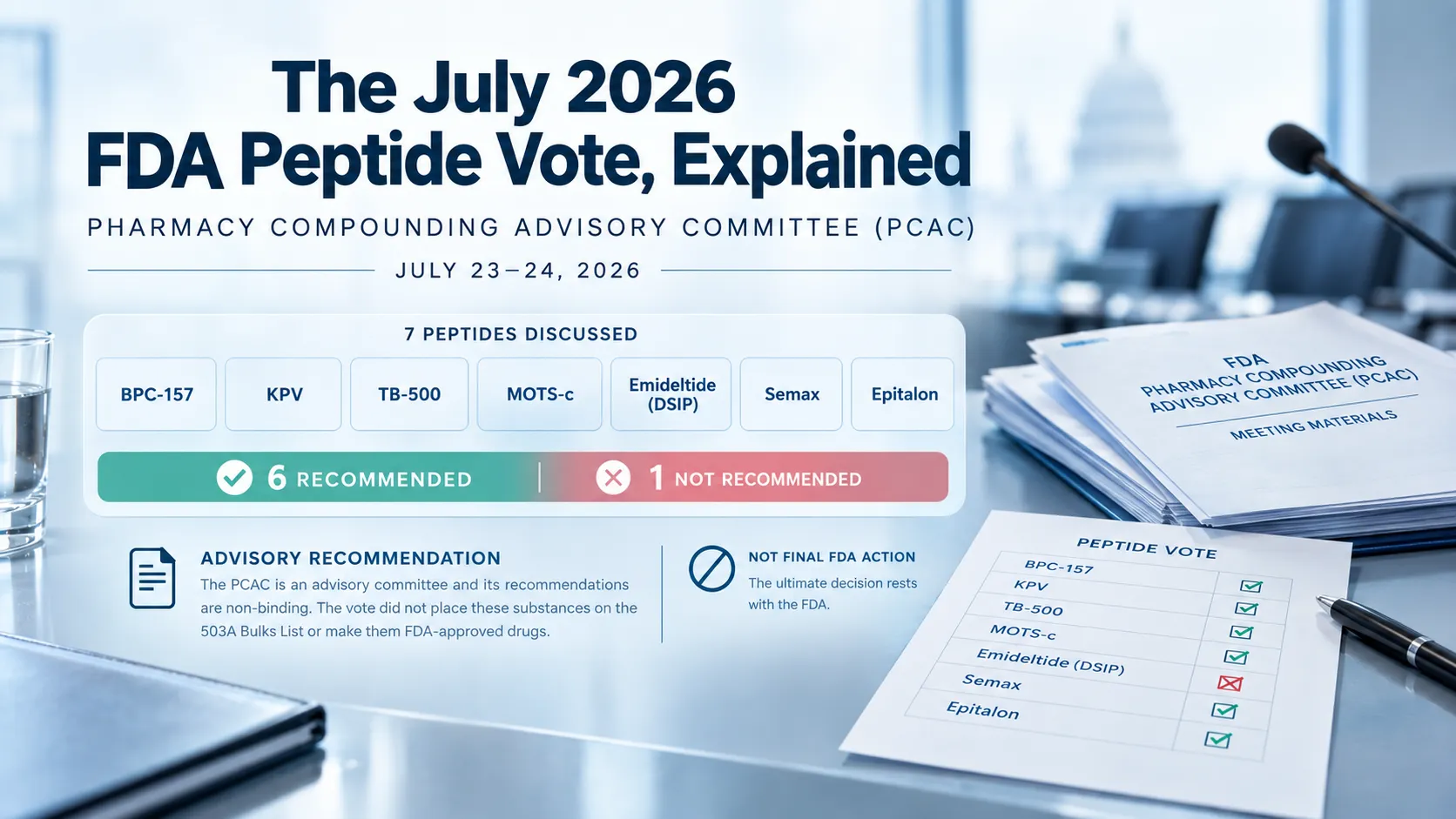
In July 2026, the FDA's advisory committee recommended 6 peptides for the 503A bulk list. None are on it yet. What the vote changed and what it didn't.