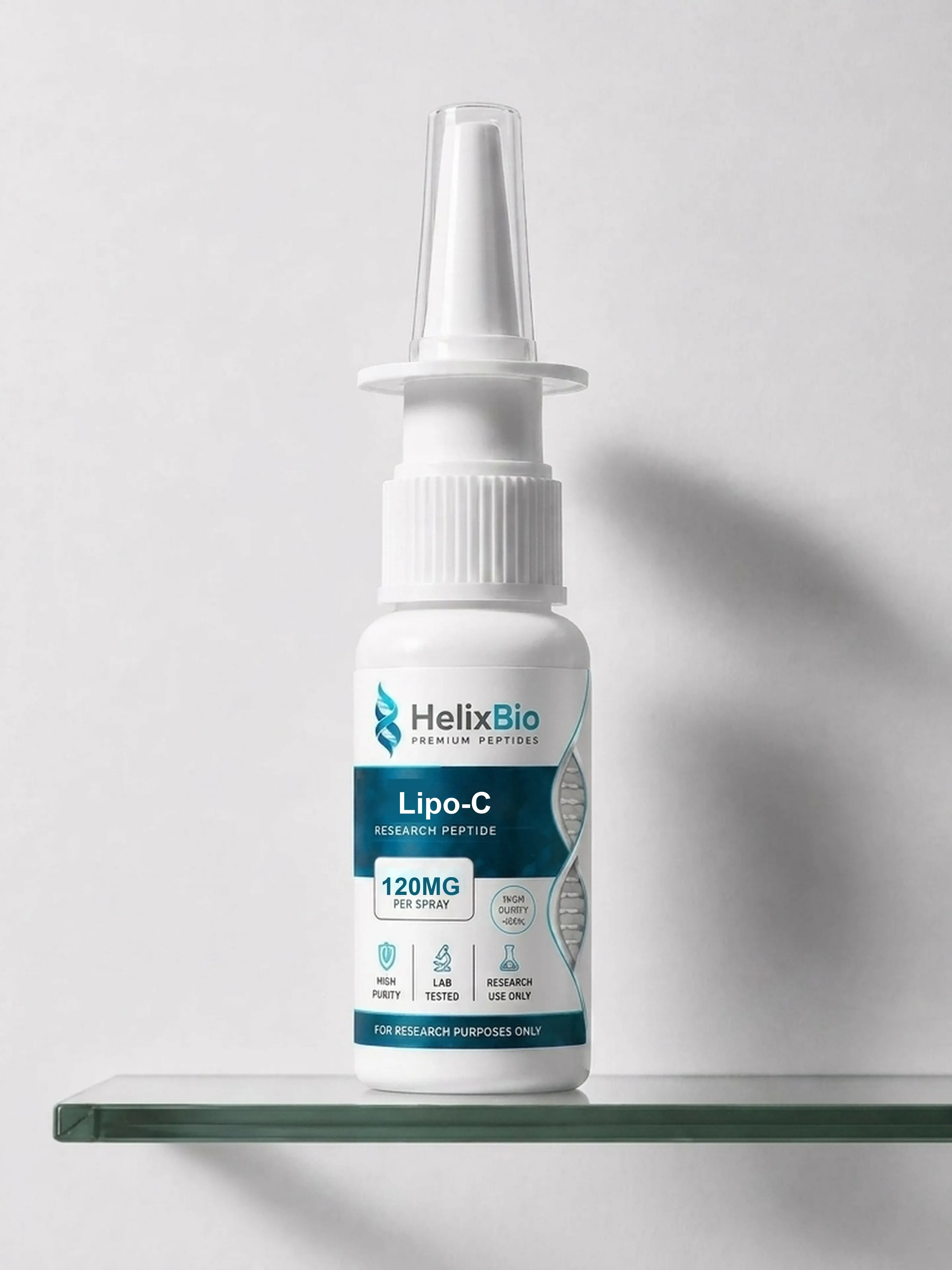
No two suppliers agree on what Lipo-C contains. The name belongs to compounding-pharmacy practice rather than to chemistry, and formulations sold under it range from four components to eight — with the letter C used variously for choline, for carnitine, and for ascorbic acid depending on who prepared the material. Helix Bio supplies Lipo-C Spray as a prepared multi-component solution for qualified laboratory work. The composition that governs an experiment is the one on the documentation for the lot in hand, not the one a search result attributes to the name. Research and laboratory use only; not intended for human or veterinary consumption, or for administration by any route.
HPLC certified
Independent analysis
Highest standard
Full traceability
Lipo-C is a product designation, not a substance. There is no CAS number for it, no PubChem entry, no USP or NF monograph, and no molecular formula — because there is no single molecule to assign one to. The term arose in compounding practice to describe a lipotropic multi-component solution, and each pharmacy that prepares one defines its own.
The consequences are practical rather than academic. Of the publicly documented formulations sold under the name, some contain inositol and some do not. Some contain vitamin B12 and some do not. Where two formulations share a component, they frequently supply it at different strengths — in the case of L-carnitine, published formulations differ by more than threefold. Two vials labelled Lipo-C can therefore be materially different materials, and an experiment run against one does not describe the other.
This matters for how a researcher reads anything written about the term, including anything written about it elsewhere. A study, a specification or a description attached to “Lipo-C” describes whichever formulation the author had. It does not describe this one, and it does not describe a category.
What “lipotropic” denotes. The word is a mid-twentieth-century nutritional term for factors whose dietary absence produced hepatic lipid accumulation in animal models — choline being the original example. It is a description of a historical experimental observation. It is not a claim about fat metabolism in a treated subject, and it is used on this page in its original sense only.
Three things about this material follow from its being a multi-component solution rather than a single compound, and they shape how it should be handled.
Components have separate stability clocks. Methionine carries a thioether side chain that oxidises to the sulfoxide, adding 16 daltons. Cyanocobalamin is photolabile and degrades on light exposure. Ascorbic acid, where present, oxidises readily in aqueous solution. Choline chloride is strongly hygroscopic in the solid state and contributes a substantial chloride load in solution. None of these processes runs at the same rate, which means the ratio between components in a stored solution is a function of storage history and not only of what was filled. A composition figure describes the material at fill.
Colour is a free composition check. Cyanocobalamin is intensely coloured. A formulation containing it at typical strengths is visibly pink or red; one without it is essentially colourless. Appearance therefore carries real information about this class of material in a way it does not for a colourless peptide solution — though it establishes only presence, never amount, and never which cobalamin form.
A prepared solution is not the same article as a solid. Melting point, appearance of the solid, elemental analysis and dry-state assay are all unavailable once a material is in solution, and concentration becomes a property of the preparation rather than of the substance. Documentation for a solution product should therefore be read for concentration and for the basis on which it is stated.
On format. “Spray” describes how this material is presented and packaged. It does not describe an administration route, and this product is not offered for administration by any route. No absorption, permeability or bioavailability property should be inferred from the packaging.
The components documented across Lipo-C formulations have individual biochemical literatures, and those literatures are worth understanding precisely because they are so often misapplied.
Methionine is the precursor of S-adenosylmethionine, the principal biological methyl donor, and sits at the head of one-carbon metabolism. Choline is a precursor of phosphatidylcholine, which hepatic very-low-density lipoprotein assembly structurally requires, and of betaine, which participates in homocysteine remethylation. myo-Inositol forms the core of the phosphatidylinositol phosphates that generate inositol trisphosphate and diacylglycerol as second messengers. L-carnitine carries long-chain fatty acyl groups into mitochondria through the carnitine shuttle. Cyanocobalamin is a synthetic B12 vitamer whose coenzyme form methylcobalamin serves methionine synthase — which places B12 and methionine on one pathway rather than on two.
Component research has been conducted in:
Where this stops. Every item above is a statement about a nutrient. None is a statement about Lipo-C. A pathway in which a component participates is not an effect of a product that contains it, and combining separate component literatures does not produce evidence for a combination.
Direct evidence for the formulation. No published randomised controlled trial of any formulation marketed as Lipo-C was identified. Clinical-education reviews of the wider lipotropic category state that no robust randomised evidence establishes an independent effect on body weight. Where human data on related preparations exist, they concern injectable compounded formulations — which cannot be transferred to a spray-format solution, and which in any case describe whichever formulation was studied rather than this one.
Regulatory position. No formulation marketed as Lipo-C is FDA-approved for any use. Individual components have their own independent regulatory footing — several are actives of approved injectable drug products, and methionine and inositol have USP–NF monographs — but a component’s status never transfers to a formulation containing it. Helix Bio states in its site footer that it is not a 503A or 503B compounding facility, so the compounding framework describes the context in which the name arose rather than the status of this material.
A researcher evaluating a material called Lipo-C faces a problem that does not arise with a single-compound product: the name does not tell them what they are buying. Two suppliers can both be accurate and still be describing different materials.
The answer is documentation rather than description. For this material the questions that matter are which components are present, at what concentration, on what basis that concentration is stated, in what vehicle, and how each of those was determined. A product name answers none of them.
Helix Bio states that its research materials are subjected to independent HPLC testing and mass spectrometry, and that batch-specific Certificates of Analysis are available. For a material of this type, the applicable lot documentation should be consulted for the actual analytical results, including the method used — for reasons the next section sets out, the method is not a detail here.
Lipo-C Spray is intended for qualified users working in legitimate laboratory or scientific research environments, including:
The product is not intended for personal experimentation, self-administration, human consumption, veterinary use, cosmetic application, or medical treatment.
| Specification | Details |
|---|---|
| Product Name | Lipo-C Spray |
| Product Type | Multi-component lipotropic solution |
| Chemical Class | Not applicable — formulation, not a single entity |
| Peptide Sequence | Not applicable — this product is not a peptide |
| Molecular Formula | Not applicable at product level; see component identities |
| Molecular Weight | Not applicable at product level; see component identities |
| CAS Number | None exists for the formulation |
| Format | Prepared spray-format solution |
| Composition | Refer to current lot documentation |
| Total Content | Refer to current product listing |
| Fill Volume | Refer to current product listing |
| Concentration | Refer to current lot documentation |
| Vehicle | Refer to current product documentation |
| Excipients | Refer to current product documentation |
| Appearance | Refer to current product documentation |
| Intended Use | Research and laboratory investigation only |
| Human Use | Not intended for human consumption |
| Veterinary Use | Not intended for veterinary use |
| Administration | Not offered for administration by any route |
| Purity / Assay | Refer to current lot-specific documentation |
| Identity Testing | Refer to applicable Certificate of Analysis |
| Packaging | Refer to current product listing |
| Storage | Follow current product-specific documentation |
| Manufacturer | Helix Bio |
| Country of Origin | Verify current product documentation |
Nutritional biochemistry. The components have long-established roles in amino-acid, methyl-group and lipid metabolism, and are studied individually across biochemical and nutritional research. Component findings describe components.
Analytical method development. Multi-component nutrient solutions are a genuinely useful subject for analytical work, precisely because they combine chromophoric and non-chromophoric analytes over a wide molecular-weight range in one matrix. Method development for such mixtures is an area of active laboratory interest in its own right.
Formulation and stability science. Components with different degradation chemistries in a shared aqueous vehicle — oxidation, photolysis, hydrolysis — make this class of material relevant to stability-indicating method development and to studies of component interaction in solution.
Hepatic lipid metabolism. Choline and methionine have a documented experimental history in models of hepatic lipid accumulation, including the choline-deficient dietary models from which the lipotropic designation originally derives. This is model-system research and should be read as such rather than extrapolated to outcomes.
Each publication should be evaluated on its model, formulation, route, concentration and endpoints. Findings from one experimental system do not transfer to another, and findings about a component do not transfer to a formulation.
For a single compound, a purity percentage has a clear meaning: the proportion of chromatographic peak area attributable to the target. For a material like this one, that meaning does not survive, and it is worth being precise about why.
Most of the candidate components have no UV chromophore. Choline, inositol, carnitine and dexpanthenol contain no aromatic ring and no extended conjugation. On a conventional ultraviolet HPLC run they are effectively invisible, regardless of how much of them is present. Methionine absorbs only weakly and only in the low-ultraviolet region. Cyanocobalamin, thiamine, pyridoxine and ascorbic acid do absorb usefully.
The consequence is direct. A purity figure generated by UV-HPLC on a lipotropic blend can describe only the fraction of the material the detector is capable of seeing — which for a methionine, inositol and choline formulation may be a small minority of the dissolved mass. The number is not wrong so much as it is answering a different question than the one it appears to answer.
What actually characterises this class of material is a set of measurements rather than a single figure: identity confirmation for each component; a quantitative content determination for each component against a reference standard; and a detection method appropriate to each analyte. Charged aerosol detection, evaporative light scattering, refractive index and mass spectrometric detection all respond to compounds that ultraviolet detection does not. Ion chromatography is applicable to quaternary ammonium components.
Researchers should therefore assess, where applicable:
No certification, regulatory approval or quality claim should be inferred unless it is explicitly documented by the manufacturer or the relevant authority. A general catalogue statement is not a substitute for lot-specific documentation, and on this material it is less of a substitute than usual.
Storage and handling requirements should be taken from the current Lipo-C Spray product documentation and lot-specific instructions. No storage condition should be inferred from another Lipo-C preparation, from an injectable formulation, or from any single component’s storage guidance.
General laboratory considerations:
Because components degrade at different rates in a shared vehicle, storage conditions affect the relationship between components and not only the total. Where component ratio matters to an experimental design, that is a reason to work from documentation rather than assumption.
Helix Bio’s website describes research materials as being supplied to laboratories and institutions in the United States, with tracked shipping and cold-chain handling within its fulfilment process.
Because shipping conditions, packaging specifications, availability and delivery requirements may change, researchers should review the current Helix Bio shipping information and product listing before ordering.
Product packaging should remain appropriately labelled and handled as research material after delivery. Researchers are responsible for following applicable institutional, federal, state and local requirements governing research materials.
Lipo-C Spray is supplied by Helix Bio for research and laboratory purposes only. It is not intended for human or veterinary consumption, self-administration, ingestion, injection, nasal administration or administration by any other route, and it is not offered for the diagnosis, treatment, cure, mitigation or prevention of any disease or medical condition.
No formulation marketed as Lipo-C is an FDA-approved drug. Individual components may have independent regulatory status as nutrients or as actives of approved products; that status does not extend to this material, and it should not be inferred from component identity, from published component research, or from the availability of compounded preparations under a similar name.
Helix Bio states in its site disclaimer that it is not a compounding pharmacy and does not operate as a compounding facility under section 503A of the Federal Food, Drug, and Cosmetic Act. This product is not a compounded preparation, a dietary supplement, a consumer wellness product, a cosmetic or a medical treatment.
Statements made on this page about components describe those components. They are not claims about the performance, efficacy or safety of this product. Researchers are responsible for determining whether a material is appropriate for their intended experimental application and for complying with applicable institutional and regulatory requirements.
Knowledge Base
Knowledge Base
Knowledge Base
Knowledge Base
Knowledge Base
Knowledge Base
Knowledge Base
Knowledge Base
Knowledge Base
Knowledge Base
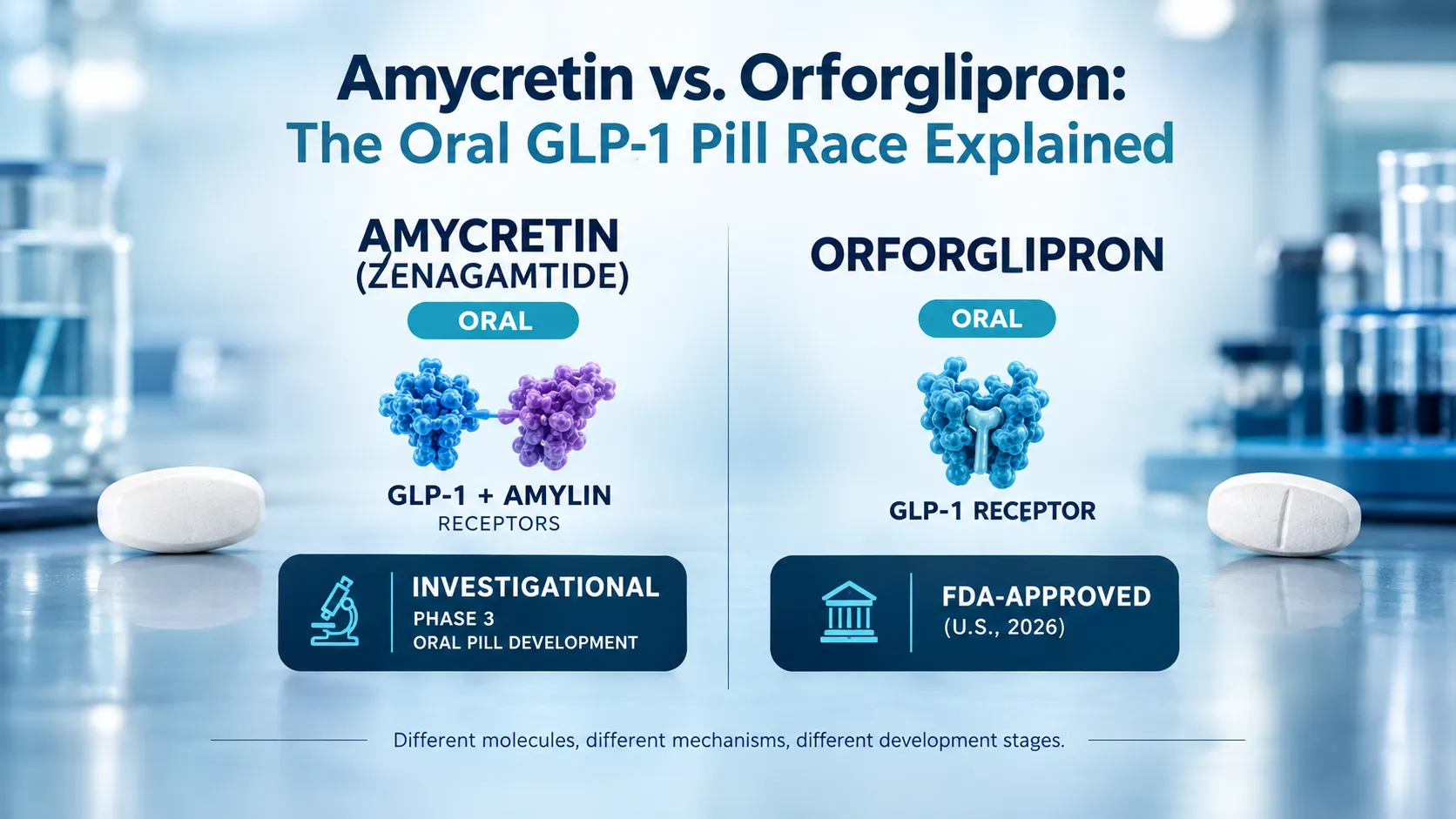
Amycretin is a peptide and orforglipron is not. How that chemistry explains the formulations, trial results, and approval status of both GLP-1 pills.
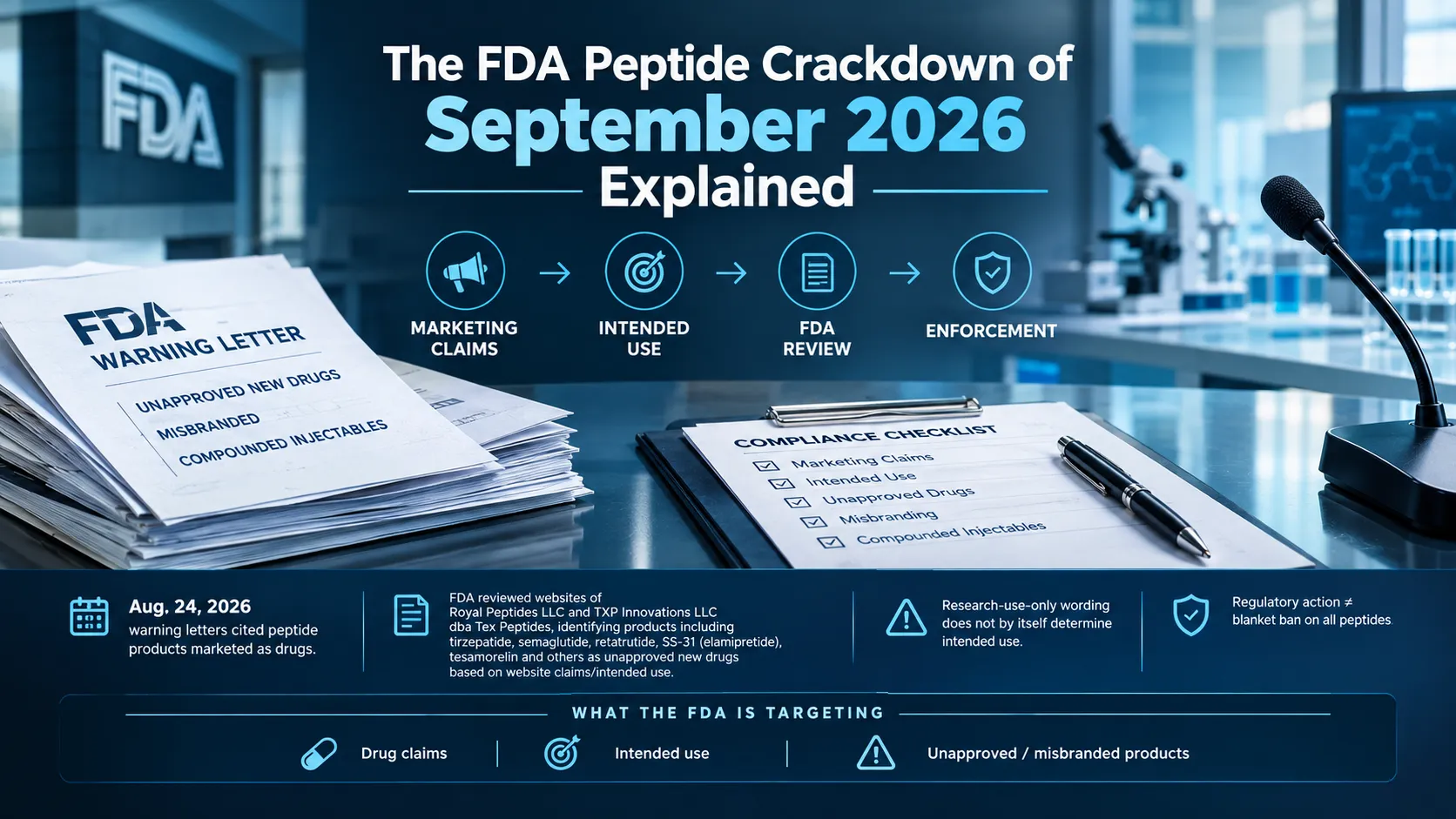
Five peptide sellers got FDA warning letters in September 2026. See who was named, why the research label failed, and the full 2026 enforcement timeline.

In July 2026, the FDA's advisory committee recommended 6 peptides for the 503A bulk list. None are on it yet. What the vote changed and what it didn't.