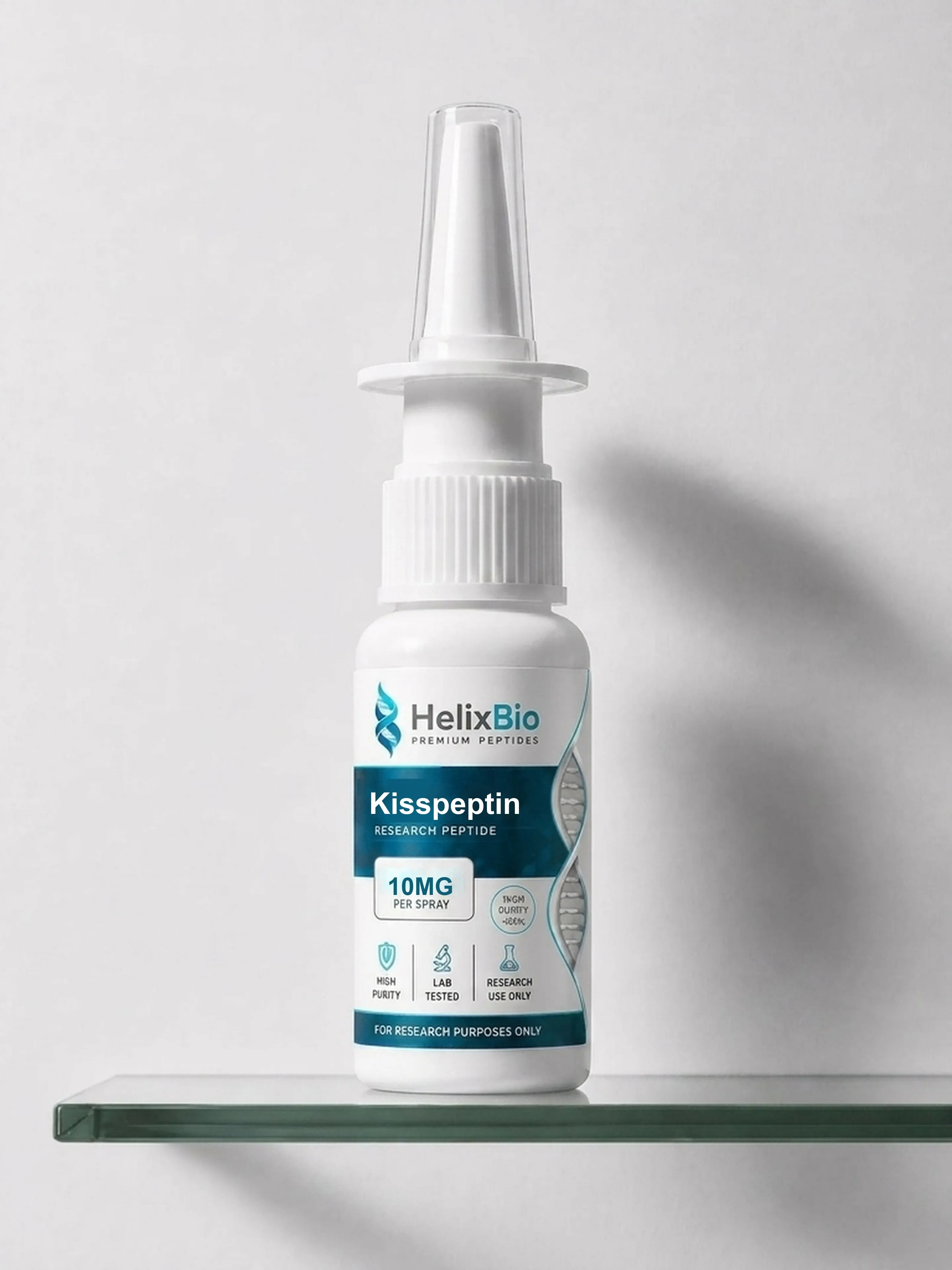
Kisspeptin is not a single peptide. The name covers a group of related fragments produced by proteolytic processing of a precursor encoded by the KISS1 gene — most commonly described as kisspeptin-54, kisspeptin-14, kisspeptin-13 and kisspeptin-10 — all of which share the same C-terminal decapeptide and all of which act at the KISS1R receptor, also known as GPR54. Kisspeptin Spray is Helix Bio’s spray-format preparation supplied for laboratory investigation of that signalling system. Because the forms differ in length, mass and behaviour, the specific fragment supplied in any given lot is a matter for the accompanying documentation rather than the product name. Helix Bio provides research materials for qualified scientific work only. This product is not intended for human or veterinary consumption, self-administration, diagnosis, treatment, or the prevention of any disease.
HPLC certified
Independent analysis
Highest standard
Full traceability
The KISS1 gene, located on human chromosome 1q32, encodes a precursor protein that is cleaved to produce a 54-amino-acid peptide. Further processing of that peptide yields shorter fragments of 14, 13 and 10 residues. Collectively these are the kisspeptins.
What unites them is their C-terminus. Every form ends in the same decapeptide — Tyr-Asn-Trp-Asn-Ser-Phe-Gly-Leu-Arg-Phe-amide — and the scientific literature describes this sequence as essential for activity at the receptor. That terminal Arg-Phe-amide motif places the kisspeptins in the RF-amide peptide family, and the decapeptide itself is what is sold as kisspeptin-10.
What separates them is everything else. Kisspeptin-54 has an average molecular weight near 5,858 daltons; kisspeptin-10 is near 1,302. They carry different CAS registry numbers. In cell-based assays the forms activate the receptor with broadly comparable potency, but their circulating half-lives differ substantially, with kisspeptin-10 reported as roughly six-fold shorter than kisspeptin-54. For any experiment conducted in an organism rather than a dish, they are not interchangeable.
A related point of confusion is worth flagging, because it causes real problems when researchers compare datasheets. Kisspeptin-10 is written both as metastin(45–54) and as KISS-1(112–121). These are the same molecule under two numbering conventions — one counting from the start of the mature 54-residue peptide, the other from the start of the precursor. Sources also disagree on whether the precursor is 145 or 138 residues long. Two suppliers can describe the identical decapeptide in ways that look, at a glance, like different products.
Three further distinctions are worth keeping straight. KISS1 is the gene, not a peptide. KISS1R and GPR54 are two names for one receptor, and the receptor is not a kisspeptin. And metastin is an older name for kisspeptin-54, dating from the discovery of KiSS-1 as a metastasis-suppressor gene before its reproductive role was known.
A spray describes presentation, not route. Two things about this particular material in solution are worth stating directly.
The first concerns the amide. Because the kisspeptins are RF-amide peptides whose terminal amide is required for activity, a preparation that carries the free acid instead is inactive — and it differs in mass by approximately one dalton, roughly 0.08% on the decapeptide. That is a difference low-resolution mass spectrometry can miss, and the amide and acid forms are not reliably separated by routine reversed-phase chromatography. A material can present as high-purity with an approximately correct mass and still be the wrong molecule.
The second concerns what happens in aqueous solution over time. The shared decapeptide contains two asparagine residues, and asparagine deamidation is a well-recognised solution-phase degradation route that also produces a shift of about one dalton. A synthesis defect and a storage defect can therefore look identical on a mass readout alone. The same decapeptide also contains a tryptophan residue, which is sensitive to oxidation and to light — which makes vehicle composition, container headspace and packaging material relevant variables rather than incidental ones.
No published research examining mucosal or intranasal administration of any kisspeptin form was identified in preparing this page. Researchers should treat the spray as a presentation format and obtain formulation details from the current product documentation.
Kisspeptin research sits in two broad areas, and they arrived in the opposite order to what most people assume.
The reproductive endocrinology work came second. Kisspeptins act at KISS1R on GnRH neurons, positioning them upstream in the hypothalamic-pituitary-gonadal axis: kisspeptin regulates GnRH release, GnRH regulates pituitary release of luteinising hormone and follicle-stimulating hormone, and those act at the gonads. The system’s reproductive significance was established through loss-of-function studies of the receptor gene. Studies measuring LH after kisspeptin administration are measuring a response of that axis, not a property of the peptide in isolation.
The metastasis-suppressor work came first. KiSS-1 was identified as a metastasis-suppressor gene, which is why kisspeptin-54 is still called metastin. Kisspeptin-10 has been reported to inhibit migration and invasion in melanoma cell models and in receptor-transfected cell lines. These are cell-model findings.
Human research on kisspeptin exists and is worth describing precisely, because the form matters. The substantial human work used kisspeptin-54, principally from the Imperial College group beginning with a 2005 study in men and extending to studies across the menstrual cycle in women. Kisspeptin-10 has a considerably smaller human literature. Evidence generated with one form does not automatically describe another, and none of it describes any commercial spray formulation.
For most research peptides the identity question is straightforward: the product name names one molecule, and the documentation confirms it. Kisspeptin is not one of those.
Because “kisspeptin” is a family term rather than a molecular name, the first question worth asking about any kisspeptin material is which fragment it actually contains. That answer determines the molecular weight, and therefore every molar calculation downstream. It determines which literature is applicable — the human research base sits with kisspeptin-54, while much commercially supplied material is the decapeptide. And it determines whether two lots are comparable at all.
The good news is that the question is easy to settle analytically. Kisspeptin-54 and kisspeptin-10 differ by roughly 4,555 daltons. A single mass-spectrometry run separates them beyond any ambiguity. What a researcher should look for in the documentation is a named analyte and an observed mass — not a purity percentage alone, which describes how much of a sample is the main peak without establishing which peptide that peak is.
Researchers evaluating Kisspeptin Spray should request the current lot documentation and confirm the specific fragment, the observed mass, and whether the C-terminal amide has been verified, rather than relying on a general catalogue description.
Kisspeptin Spray is intended for qualified users working in legitimate laboratory or scientific research environments, including:
The product is not intended for personal experimentation, self-administration, human consumption, veterinary use, or medical treatment of any kind.
| Specification | Details |
|---|---|
| Product Name | Kisspeptin Spray |
| Active Research Compound | Kisspeptin (KISS1-derived peptide) |
| Compound Class | RF-amide peptide family |
| Gene of Origin | KISS1 (human chromosome 1q32) |
| Receptor Relationship | KISS1R / GPR54 |
| Shared C-Terminal Motif | Tyr-Asn-Trp-Asn-Ser-Phe-Gly-Leu-Arg-Phe-amide |
| Synonyms | Metastin (kisspeptin-54); KP-10, KP-13, KP-14, KP-54 (forms) |
| Product Format | Spray-format solution |
| Research Category | Sexual & Hormonal / Research Peptide |
| Intended Use | Research and laboratory investigation only |
| Human Use | Not intended for human consumption |
| Veterinary Use | Not intended for veterinary use |
| Manufacturer / Supplier | Helix Bio |
KISS1R / GPR54 receptor signalling. The kisspeptins are the endogenous ligands of KISS1R, a G protein-coupled receptor that also appears in older literature as GPR54, AXOR12 and hOT7T175. Reported binding affinities for the decapeptide are in the low-nanomolar range at rat and human receptors, and receptor activation has been characterised in transfected cell systems through calcium mobilisation assays. This is receptor pharmacology; it describes what the receptor does when engaged.
Position in the hypothalamic-pituitary-gonadal axis. Kisspeptin signalling acts on GnRH neurons, placing it upstream of GnRH, which in turn regulates pituitary release of LH and FSH. The axis role was established largely through loss-of-function studies of the receptor gene. Because the readout in most in vivo work is a downstream gonadotropin measurement, findings should be attributed to the axis response rather than treated as a direct property of the peptide.
Human research, by form. The substantial human literature used kisspeptin-54, beginning with work in men published in 2005 and extending to studies across the menstrual cycle in women. Kisspeptin-10 has a smaller human literature and a markedly shorter circulating half-life. Researchers should confirm which form a given publication used before applying its findings, and should not assume that evidence generated with one fragment describes another.
Metastasis-suppressor research. KiSS-1 was characterised as a metastasis-suppressor gene before its reproductive function was known, which is the origin of the name metastin. The decapeptide has been reported to inhibit migration and invasion in melanoma cell models and in receptor-transfected cell lines. These are cell-model findings and should be read as such.
Analytical documentation matters for any research peptide. For the kisspeptins it carries an extra burden, because the product name does not identify the molecule.
Start with identity. A purity figure describes what proportion of a sample is the principal component; it does not establish which peptide that component is. For a material sold under a family name covering fragments that differ by thousands of daltons, an observed molecular mass is the more informative number, and it should appear alongside a named analyte. Kisspeptin-54 and kisspeptin-10 are separated by roughly 4,555 daltons — no analytical subtlety is required to tell them apart, only the willingness to report which one is present.
Then consider the terminal amide. The kisspeptins are RF-amide peptides and the C-terminal amide is required for activity. The corresponding free acid differs by approximately one dalton, which on a decapeptide is a fraction of a percent, and the two forms are not reliably separated by routine reversed-phase chromatography. Confirming amidation generally requires either high-resolution mass measurement or a method developed to resolve the two species.
Then consider what changes in solution. Asparagine deamidation produces the same approximate one-dalton shift as a missing amide, so mass alone cannot distinguish a synthesis defect from a storage defect. Tryptophan oxidation is a separate, light- and oxygen-dependent route with its own mass signature. For a solution-format product these are not hypothetical concerns; they are the reasons vehicle composition and packaging appear in the list below.
Researchers evaluating a specific Kisspeptin Spray lot should establish which of the following the documentation reports:
No certification, regulatory approval, or quality attribute should be inferred unless explicitly documented for the specific lot. Where a general catalogue statement and lot documentation disagree, the lot documentation governs.
Storage and handling requirements should be taken from the current Kisspeptin Spray documentation and lot-specific instructions rather than inferred from general peptide guidance or from another kisspeptin preparation.
The distinction matters here for two reasons. General guidance published elsewhere on this site assumes a lyophilized powder that will be reconstituted; a spray is supplied as a prepared solution. And a lyophilized kisspeptin product and a kisspeptin solution have materially different stability profiles, because the degradation routes that matter most for this sequence — asparagine deamidation and tryptophan oxidation — are accelerated in the aqueous phase.
General laboratory considerations include:
Storage conditions established for lyophilized kisspeptin, for a different kisspeptin fragment, for another supplier’s material, or for other products in this catalogue should not be applied to this preparation.
Helix Bio’s website describes research materials as being supplied to laboratories and institutions in the United States, with tracked shipping and cold-chain handling within its fulfilment process.
Because shipping conditions, packaging specifications, availability and delivery requirements can change, researchers should review the current Helix Bio shipping information and the product listing before ordering. For a solution-format peptide, transit temperature and light exposure are directly relevant to the condition of the material on arrival, and researchers should transfer the product to appropriate storage promptly on receipt.
Product packaging should remain appropriately labelled and handled as research material after delivery, including retention of the lot identifier. Researchers are responsible for compliance with applicable institutional, federal, state and local requirements governing research materials.
Kisspeptin Spray is supplied by Helix Bio for research and laboratory purposes only. It is not intended for human or veterinary consumption, self-administration, injection, ingestion, diagnosis, treatment, cure, mitigation or prevention of any disease or medical condition.
Kisspeptin is not an FDA-approved drug in any form. Human studies of kisspeptin-54 have been conducted under research protocols; investigational study status is not marketing authorisation, does not describe any commercial preparation, and confers nothing on this product. Findings from published research — whether in cell models, animal models or human participants — should not be read as evidence of what this material does.
Kisspeptin does not appear in any category of FDA’s Section 503A bulk drug substances list. Regulatory status should not be inferred from published research, commercial availability, laboratory use, or the status of related compounds.
This product is not a dietary supplement, consumer wellness product, cosmetic, fertility product or medical treatment. Researchers are responsible for determining whether a material is appropriate for their intended experimental application and for complying with applicable institutional and regulatory requirements.
Knowledge Base
Knowledge Base
Knowledge Base
Knowledge Base
Knowledge Base
Knowledge Base
Knowledge Base
Knowledge Base
Knowledge Base
Knowledge Base
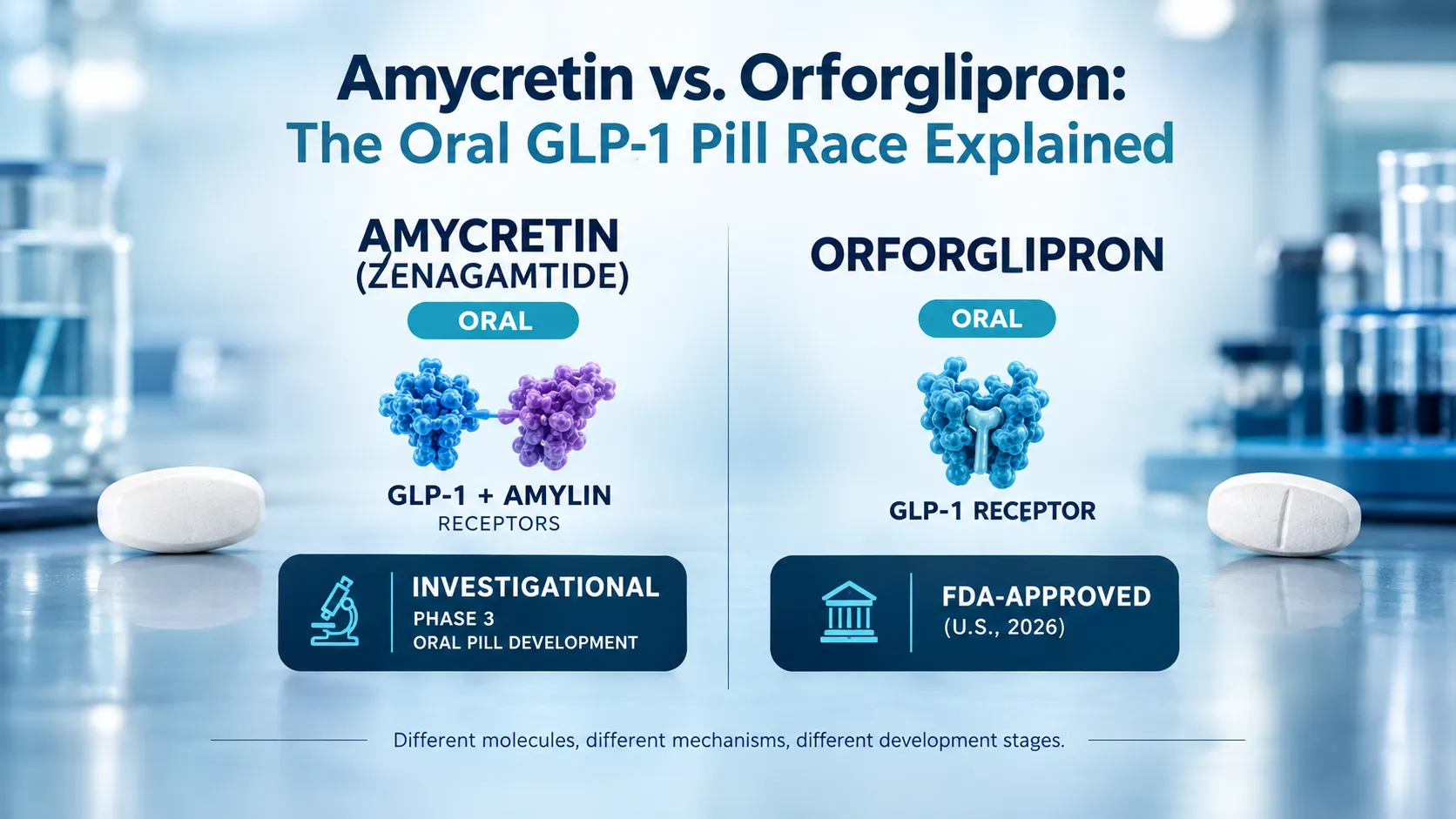
Amycretin is a peptide and orforglipron is not. How that chemistry explains the formulations, trial results, and approval status of both GLP-1 pills.
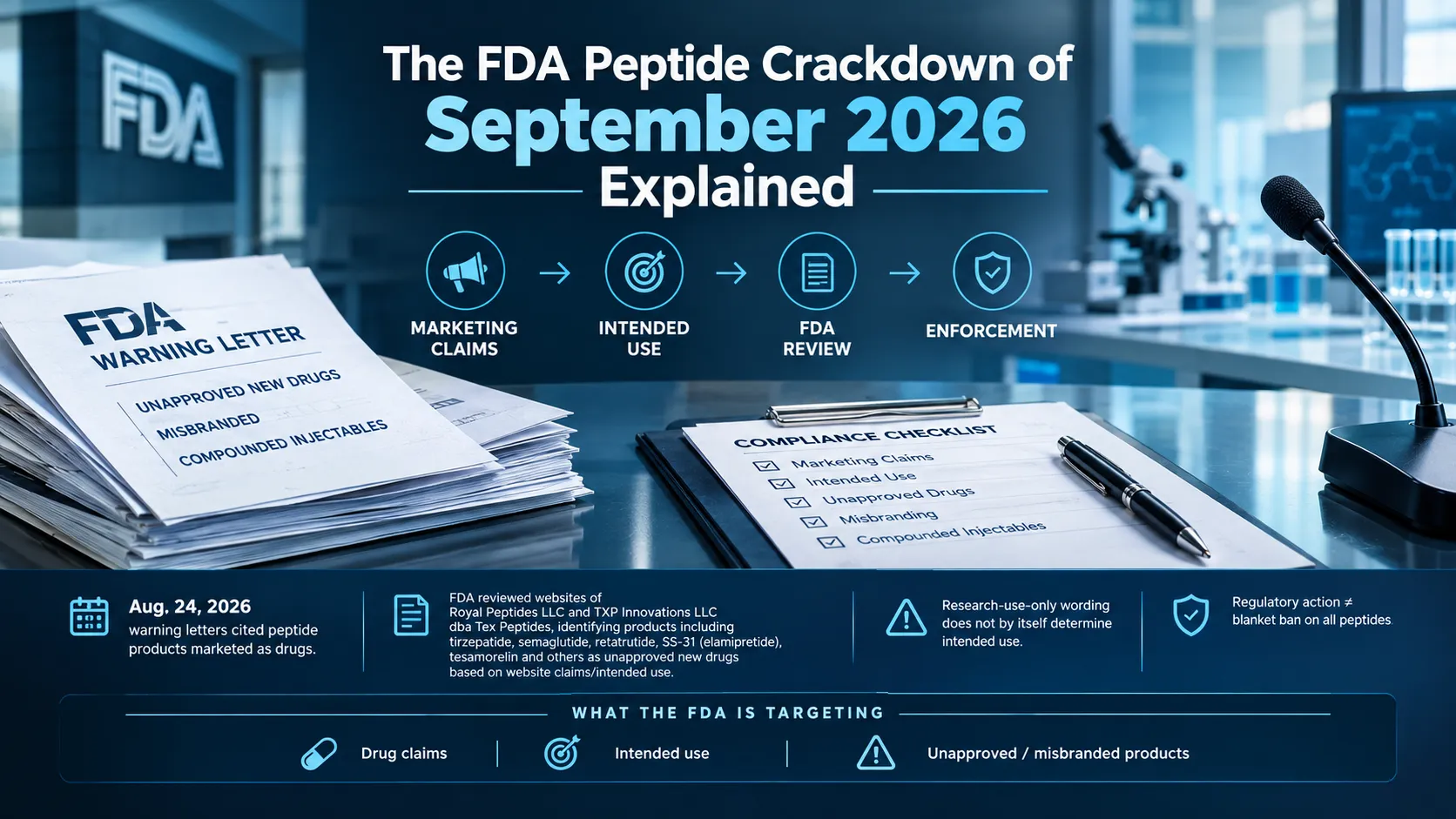
Five peptide sellers got FDA warning letters in September 2026. See who was named, why the research label failed, and the full 2026 enforcement timeline.

In July 2026, the FDA's advisory committee recommended 6 peptides for the 503A bulk list. None are on it yet. What the vote changed and what it didn't.