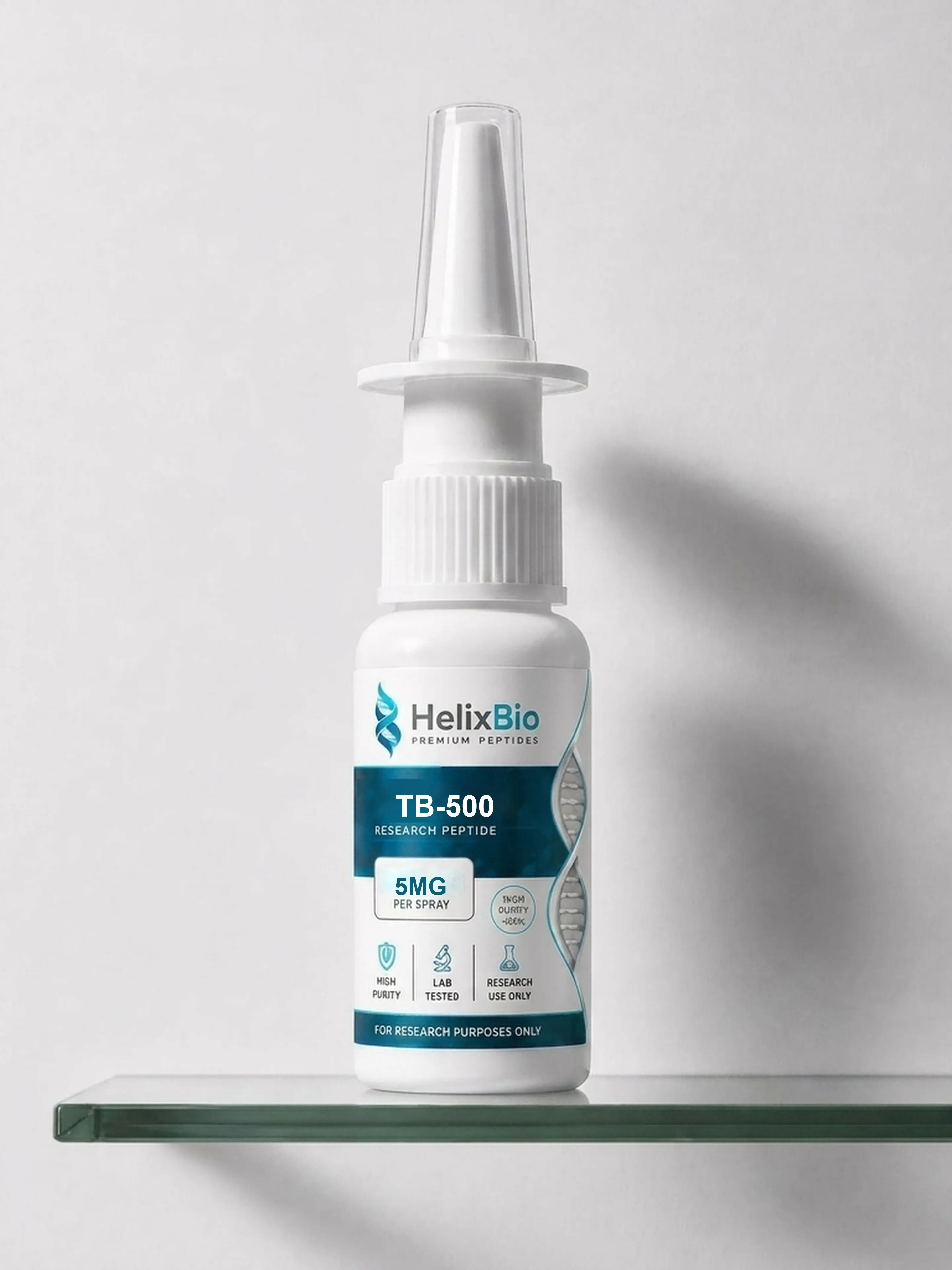
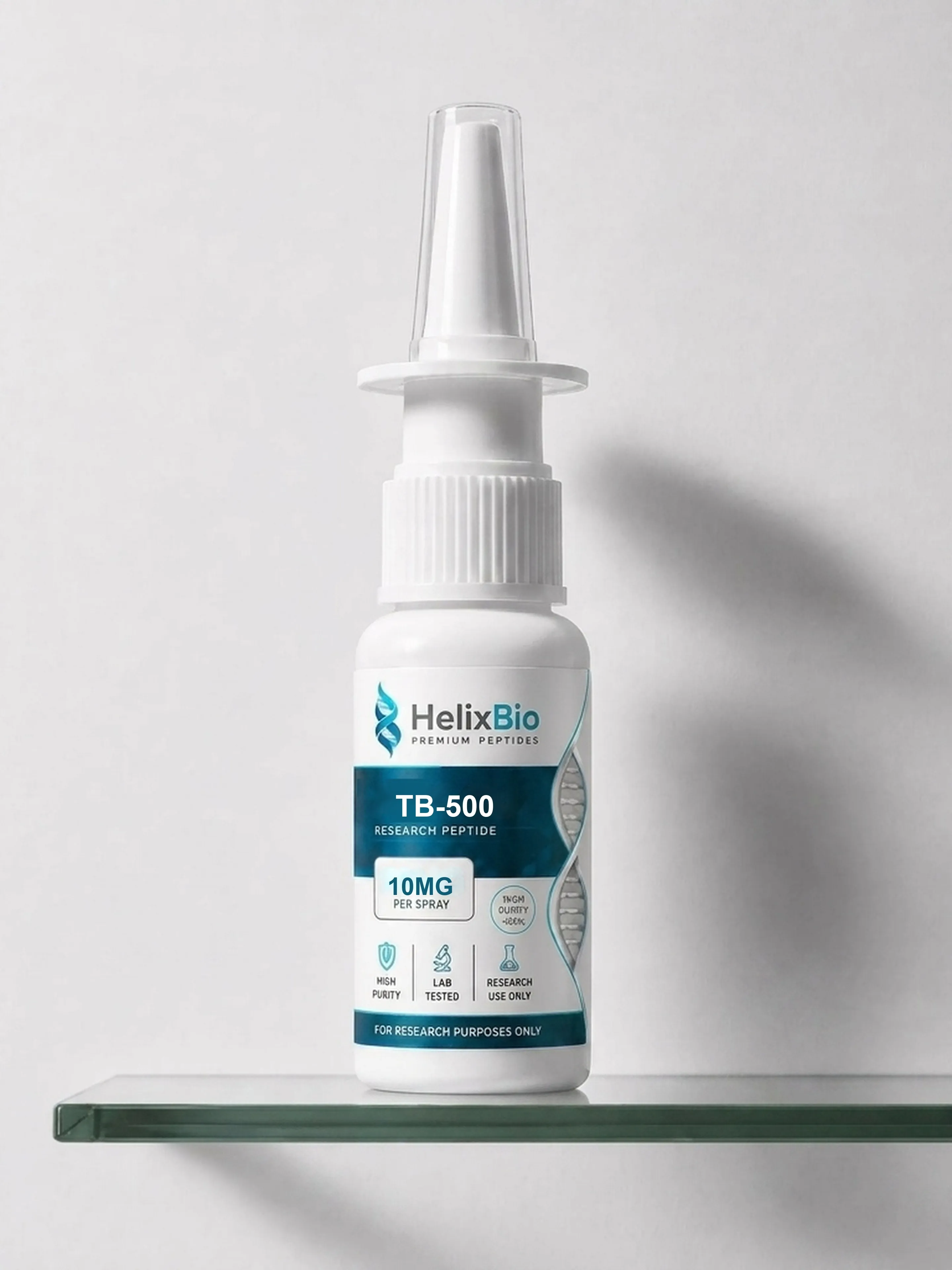
Ask three suppliers what TB-500 is and you can get three different molecules. The name is attached in the marketplace to a seven-residue peptide, to a supposed seventeen-residue peptide, and to the full forty-three-residue thymosin beta-4 protein — substances differing in mass by more than a factor of five. FDA’s bulk drug substances record supplies the definition this page uses: TB-500 is thymosin beta-4, fragment (LKKTETQ), the acetylated heptapeptide corresponding to residues 17 through 23 of the parent protein. Helix Bio supplies TB-500 Spray as a prepared-solution research material for qualified laboratory and scientific applications. It is offered strictly for research use and is not intended for human or veterinary consumption, diagnosis, treatment, or prevention of disease.
HPLC certified
Independent analysis
Highest standard
Full traceability
TB-500 is a synthetic seven-residue peptide, Leu-Lys-Lys-Thr-Glu-Thr-Gln, written LKKTETQ. It corresponds to residues 17 through 23 of thymosin beta-4, the actin-binding motif of that protein. In its commonly supplied acetylated form, Ac-LKKTETQ, its average molecular weight is approximately 889 g/mol. Without the N-terminal acetyl group the same sequence sits near 847 g/mol — a 42 dalton difference that is worth resolving from documentation rather than assumption.
Thymosin beta-4 itself is a different substance: 43 residues, approximately 4963 g/mol, catalogued under UniProt P62328, and one of the most abundant intracellular peptides in mammalian cells. TB-500 is a fragment of it, roughly one-sixth its mass.
Two errors circulate widely enough to be worth naming. The first is describing TB-500 as a seventeen-residue peptide, which comes from reading “residues 17–23” as a length rather than a position — that span is seven residues. The second, more consequential, is selling full-length thymosin beta-4 under the TB-500 name. Some suppliers do this openly and label it accurately; others do not distinguish at all. Either way the purchaser needs the molecular weight to know what arrived.
The sequence is the actin-binding region of a G-actin sequestering protein. Thymosin beta-4’s function in that role was established with the full-length molecule — Sanders, Goldstein and Wang reported it in the Proceedings of the National Academy of Sciences in 1992, showing binding to monomeric actin at 1:1 stoichiometry and inhibition of polymerisation. What the isolated heptapeptide does under comparable conditions is a much smaller question in the literature, and this page does not extend the parent’s findings to the fragment.
A spray-format material arrives as a prepared solution rather than a dry powder, with concentration set by the manufacturer rather than chosen at the bench.
For this particular compound that combination carries a specific risk worth stating. Where identity is ambiguous across the market, a prepared solution removes the step at which a discrepancy would most likely surface. Working from a lyophilised vial, a researcher handles a stated mass and reconstitutes to a chosen molarity, and a mass that does not match the intended peptide tends to become visible in that calculation. Working from a solution labelled in milligrams per millilitre, the same ambiguity stays hidden — and because the heptapeptide and the full-length protein differ in mass by a factor of roughly 5.6, an identical mg/mL figure represents molar concentrations differing by that factor.
That is an argument for confirming which entity is present from the certificate of analysis before the solution enters a workflow, not an argument against prepared solutions. It applies to any TB-500 solution from any supplier.
No published study of intranasal, mucosal or other non-injected TB-500 administration was identified in preparing this page. Product documentation and lot-specific analytical information should be reviewed before a material enters an experimental workflow.
Research directly involving the LKKTETQ fragment is narrower than the literature surrounding its parent protein. Relevant contexts include:
The much larger body of work on angiogenesis, corneal and dermal wound repair, cardiac injury models and neurological injury was generated with full-length thymosin beta-4. It provides context for the sequence’s origin but is not evidence about this fragment, and this page does not present it as such.
TB-500 is not an FDA-approved drug in the United States, and no controlled human clinical trial of the fragment was identified in preparing this page.
For most research peptides the useful supplier-side information is about purity. For TB-500 it is about identity, because the name does not reliably specify the molecule.
There are three mass bands, and a mass spectrum places any material in one of them without difficulty. Approximately 847 g/mol is the non-acetylated heptapeptide. Approximately 889 is the acetylated heptapeptide, the form FDA’s record designates. Approximately 4963 is full-length thymosin beta-4 — a different substance with a different literature and a different regulatory history. These are not fine distinctions requiring careful instrumentation; the fragment and the parent are separated by more than four thousand daltons.
A certificate of analysis reporting a molecular weight therefore settles in one line what no amount of product description can. A certificate reporting only a purity percentage settles nothing, because a highly pure sample of the wrong peptide reports as highly pure.
Two further points. Which salt form applies matters for concentration arithmetic, and FDA evaluates TB-500 acetate and TB-500 free base as separate nominated forms. And for a solution product, the basis on which concentration is expressed should be documented alongside the figure.
Helix Bio states that its research peptide catalogue uses independent HPLC testing for purity assessment and mass spectrometry for molecular identity confirmation, and that batch-specific Certificates of Analysis are available. For TB-500 Spray specifically, the applicable lot documentation is what establishes both identity and analytical result.
TB-500 Spray is intended for qualified users working in legitimate laboratory or scientific research environments, including:
The product is not intended for personal experimentation, self-administration, human consumption, veterinary use, or medical treatment.
| Specification | Details |
|---|---|
| Product Name | TB-500 Spray |
| Compound | TB-500 |
| Scientific Designation | Thymosin beta-4, fragment (LKKTETQ) |
| Synonyms | TB500; TB 500 |
| Sequence | Leu-Lys-Lys-Thr-Glu-Thr-Gln (LKKTETQ) |
| Amino Acid Count | 7 |
| Position in Parent Protein | Residues 17–23 of thymosin beta-4 |
| Compound Type | Synthetic peptide fragment |
| Molecular Weight (acetylated form) | approximately 889 g/mol |
| Molecular Weight (non-acetylated form) | approximately 847 g/mol |
| Parent Protein | Thymosin beta-4, 43 residues, approximately 4963 g/mol, UniProt P62328 |
| Relationship to Parent | Actin-binding motif; a fragment, not the full protein |
| Acetylation Status | Refer to current lot-specific product documentation |
| Format | Spray solution |
| Salt Form | Refer to current lot-specific product documentation |
| Concentration | Refer to current product listing |
| Fill Volume | Refer to current product listing |
| Intended Use | Research and laboratory investigation only |
| Human Use | Not intended for human consumption |
| Veterinary Use | Not intended for veterinary use |
| Purity | Refer to current lot-specific product documentation |
| Identity Testing | Refer to applicable Certificate of Analysis |
| Packaging | Refer to current product listing |
| Storage | Follow current product-specific documentation |
| Manufacturer | Helix Bio |
| Country of Origin | Not specified; verify current product documentation |
The Actin-Binding Motif. LKKTETQ is the region of thymosin beta-4 responsible for its interaction with monomeric actin. The parent protein is a major G-actin sequestering molecule in mammalian cells, binding actin monomers and preventing polymerisation — characterised with the full-length protein by Sanders, Goldstein and Wang in 1992. The fragment reproduces that sequence in isolation, which makes it relevant to structure-function work asking how much of the parent’s actin interaction the motif retains on its own.
Direct Versus Indirect Evidence. This distinction organises everything else on the page, and it is the reason a TB-500 listing needs more care than most.
The large and frequently cited body of work on angiogenesis, corneal and dermal wound repair, cardiac injury and neurological injury models was generated using full-length thymosin beta-4. That includes the programme that progressed to human trials for an ophthalmic indication. None of it was generated with the seven-residue fragment.
Research attributable to TB-500 as such is a much smaller set, largely preclinical. The fragment’s clearest unambiguous appearance in the literature is in anti-doping analytical work, where it was characterised as a distinct target — a context in which the entity being measured had to be specified precisely, which is exactly why those references are reliable on identity.
Commercial descriptions routinely merge the two bodies of work. When a page states that TB-500 promotes angiogenesis or accelerates wound repair, it is almost always describing findings from a 43-residue protein under a 7-residue peptide’s name.
Analytical Differentiation. The gap between the fragment and its parent is roughly 4074 daltons, and the gap between acetylated and non-acetylated fragment is 42. Both are straightforward by mass spectrometry, and together they answer the two identity questions that matter for this compound. This makes TB-500 a practical subject for method work on distinguishing a peptide from the protein it derives from.
TB-500 Compared With BPC-157. Different molecules with different origins. BPC-157 is a fifteen-residue synthetic peptide derived from a sequence identified in human gastric juice, near 1419 g/mol, with a preclinical literature concentrated on gastrointestinal protection and animal injury models. TB-500 is a seven-residue fragment of an intracellular actin-binding protein, near 889 g/mol. There is no analytical overlap and no shared mechanism.
The two are frequently sold together. No robust human evidence establishes that the combination performs differently from either component alone, and no such claim is made here.
Single Component Versus Blend. A blend containing TB-500 is a separate product with its own composition, component ratio, concentration and documentation. Evidence concerning either component individually does not validate a combination, and a blend’s specifications come from that product’s documentation rather than from this one.
Evidence Boundaries. Findings in cell and animal systems describe those systems. They do not establish safety or effectiveness for any use in humans, they do not transfer between the fragment and the parent protein in either direction, and they do not describe any commercial formulation.
For most research peptides, identity is assumed and purity is the question. TB-500 inverts that, because the name is used in the market for at least three different substances.
The certificate of analysis should therefore be read for molecular weight first. Approximately 889 g/mol indicates the acetylated heptapeptide. Approximately 847 indicates the non-acetylated form. Approximately 4963 indicates full-length thymosin beta-4, which is a different substance regardless of what the label says. A certificate without a molecular weight has not established which of these was supplied.
Purity remains a real question once identity is settled. A seven-residue peptide is straightforward to synthesise, and its characteristic impurities — deletion sequences, incompletely deprotected material — are resolvable chromatographically. But purity is a statement about homogeneity, not about which peptide is present.
Helix Bio states that its peptide materials are subjected to independent HPLC testing for purity and mass spectrometry for molecular identity, and that batch-specific Certificates of Analysis are available. For a specific TB-500 Spray lot, the applicable COA carries the actual results.
Researchers should assess, where applicable:
No certification, regulatory approval, or quality claim should be inferred unless explicitly documented by the manufacturer or the relevant regulatory authority.
Storage and handling requirements should be determined from the current TB-500 Spray product documentation and lot-specific instructions.
General laboratory considerations include:
Three transfers to avoid. Storage conditions published for lyophilised TB-500 do not apply to a prepared solution. Conditions established for full-length thymosin beta-4 do not apply to a heptapeptide — a 43-residue protein and a 7-residue fragment have different stability characteristics. And conditions for BPC-157 or for any blend describe those materials. Guidance for this product should come from this product’s documentation.
Helix Bio’s website describes research materials as being supplied to laboratories and institutions in the United States and describes tracked shipping and cold-chain handling within its fulfilment process.
Because shipping conditions, packaging specifications, availability and delivery requirements may change, researchers should review the current Helix Bio shipping information and product listing before ordering.
Product packaging should remain appropriately labelled and handled as research material after delivery. Researchers are responsible for following applicable institutional, federal, state and local requirements governing research materials.
TB-500 Spray is sold by Helix Bio for research and laboratory purposes only. It is not intended for human or veterinary consumption, self-administration, diagnosis, treatment, cure, mitigation, or prevention of any disease or medical condition.
TB-500 is not an FDA-approved drug in the United States. Its status within the compounding framework changed twice recently and is worth stating in sequence rather than summarising.
In September 2023, FDA placed TB-500 in Category 2 of its interim policy on bulk drug substances nominated for compounding under section 503A — the category indicating significant safety concerns. On 15 April 2026, FDA removed TB-500, in both acetate and free base forms, from Category 2 following withdrawal of the nominations, and scheduled it for review by the Pharmacy Compounding Advisory Committee. That committee met on 23 July 2026 and recommended that the TB-500-related substances be considered for inclusion on the 503A Bulks List.
A committee recommendation is advisory and non-binding. Final FDA action remains pending, and none of this constitutes approval of TB-500 for any use. FDA’s review concerned the LKKTETQ fragment specifically, not full-length thymosin beta-4.
TB-500 and thymosin beta-4 derivatives are prohibited at all times under the World Anti-Doping Agency Prohibited List. Laboratories working with athlete samples or in sport-adjacent contexts should account for this.
This product is not a dietary supplement, consumer wellness product, or medical treatment. Researchers are responsible for determining whether a material is appropriate for their intended experimental application and for complying with applicable institutional and regulatory requirements.
Knowledge Base
Knowledge Base
Knowledge Base
Knowledge Base
Knowledge Base
Knowledge Base
Knowledge Base
Knowledge Base
Knowledge Base
Knowledge Base
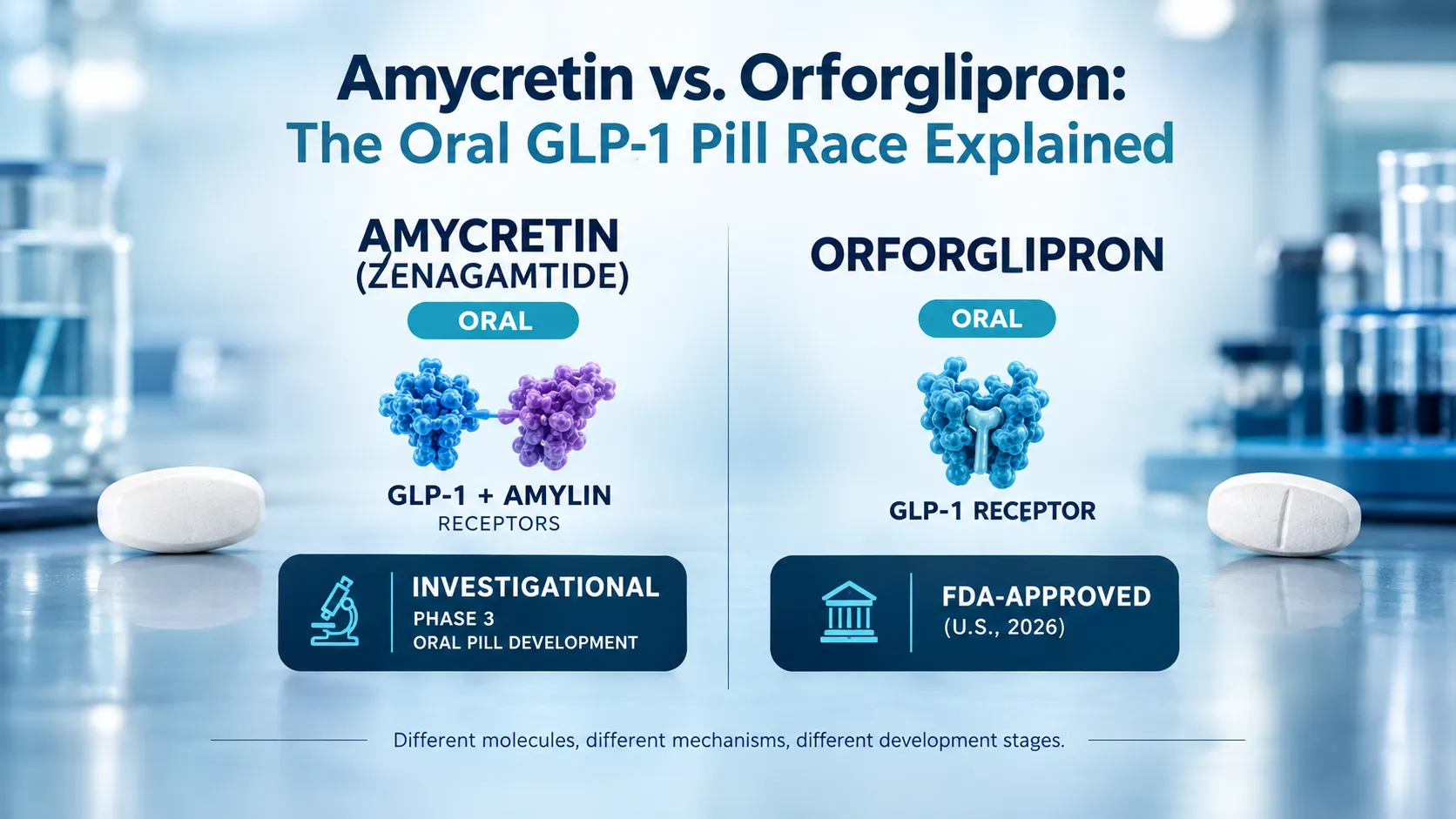
Amycretin is a peptide and orforglipron is not. How that chemistry explains the formulations, trial results, and approval status of both GLP-1 pills.
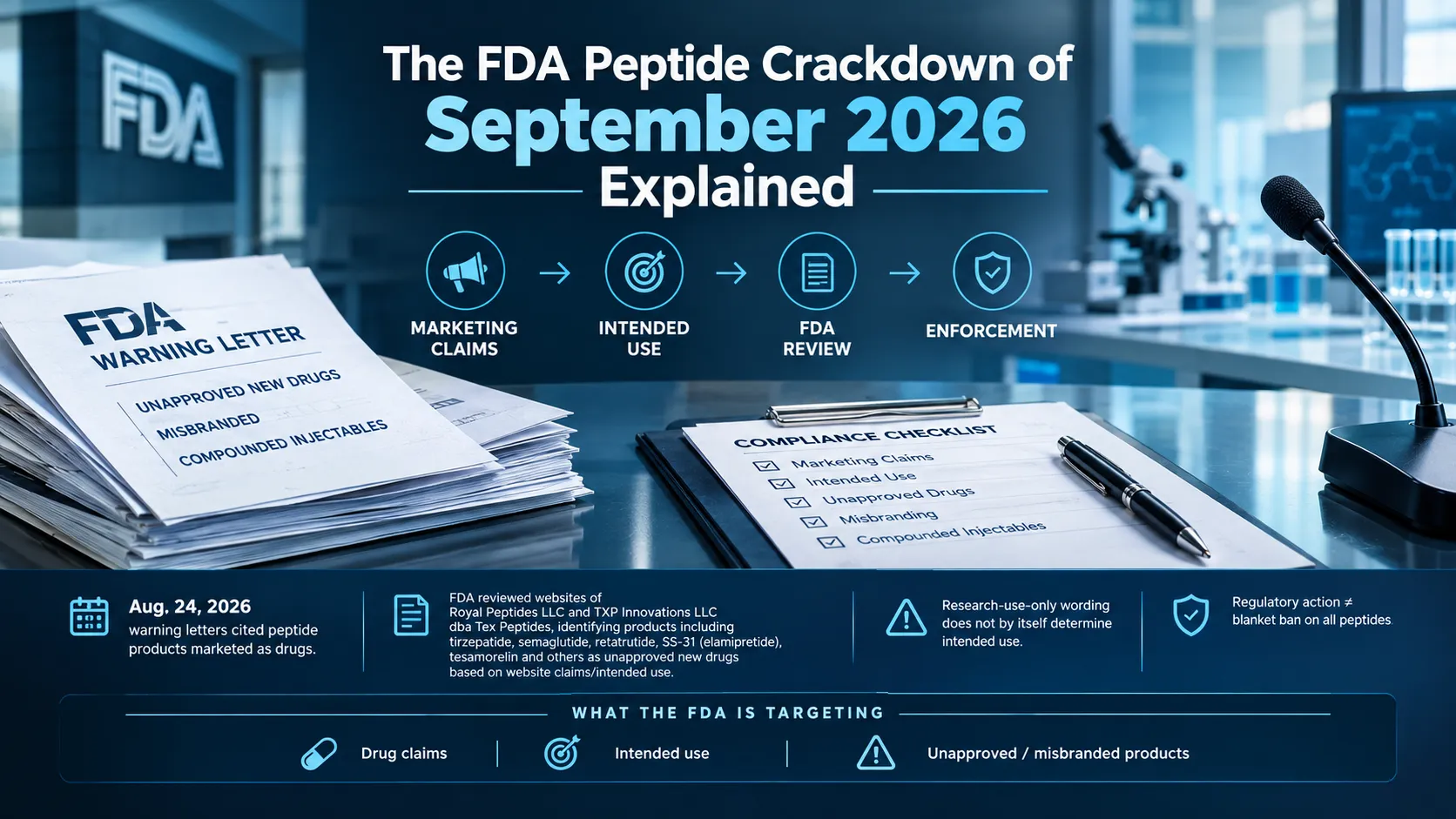
Five peptide sellers got FDA warning letters in September 2026. See who was named, why the research label failed, and the full 2026 enforcement timeline.
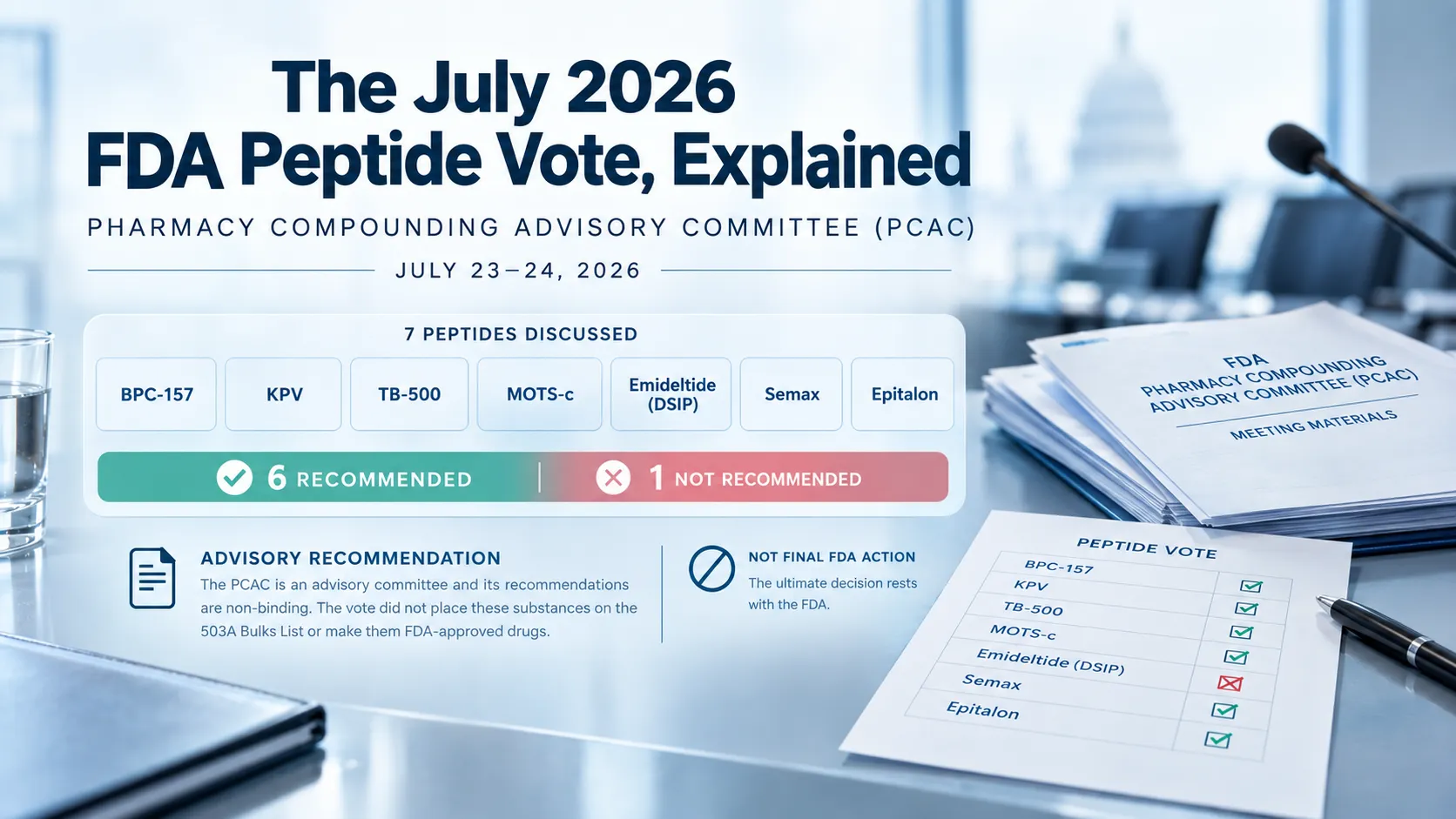
In July 2026, the FDA's advisory committee recommended 6 peptides for the 503A bulk list. None are on it yet. What the vote changed and what it didn't.