- Helix Bio Chem displayed $64.99 for an SS-31 vial on 20 November 2026, and PSPeptides displayed the same $64.99 for a single 10 mg vial that day.
- Helix Bio Chem prices each vial size separately, $64.99 for 10 mg and $119.99 for 50 mg, so cost per milligram works out at $6.50 and $2.40.
- Two certificates published for the same labelled 10 mg SS-31 product reported 9.74 mg and 10.58 mg of measured peptide, both with purity near 99.9 percent.
- On the newer certificate the purity specification was at least 95.0 percent against a reported 99.90 percent, and measured content was marked report only with no pass or fail applied.
- The two lots were tested by two different laboratories about ten weeks apart, and the broader seven-test panel confirmed identity by retention time rather than mass spectrometry.
- Helix Bio Chem's certificates page shows 0 Batches Verified beside a claim of 100 percent independently tested, with no downloadable documents and a route to request a batch certificate.
- Forzinity is an approved elamipretide injection for Barth syndrome at 30 kg and above, approved 19 September 2025, and research SS-31 is not that product.
- SS-31 was named across the five FDA warning letters dated 24 August 2026, where research-use-only wording did not settle the question of intended use.
The short answer on buying SS-31
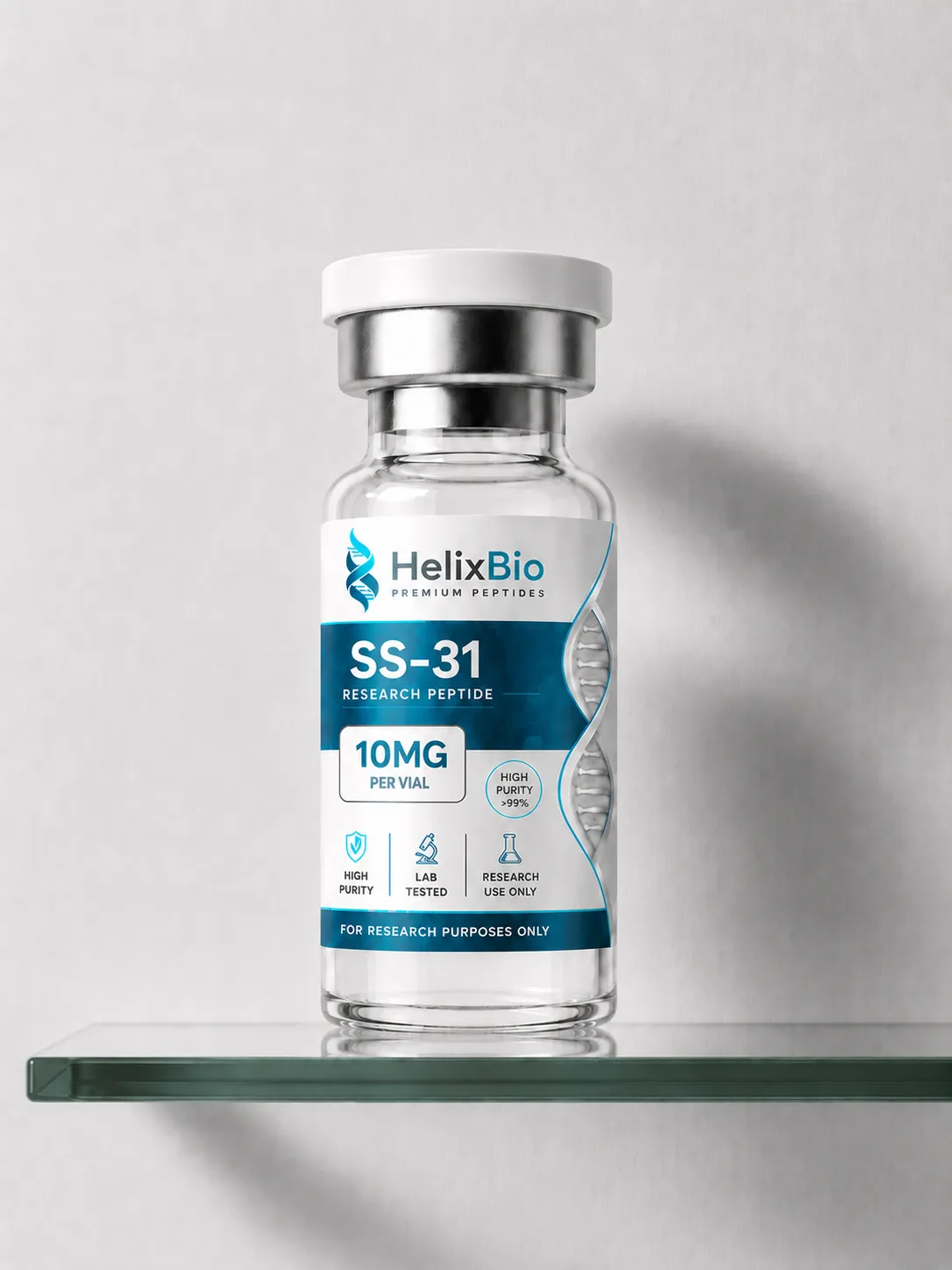
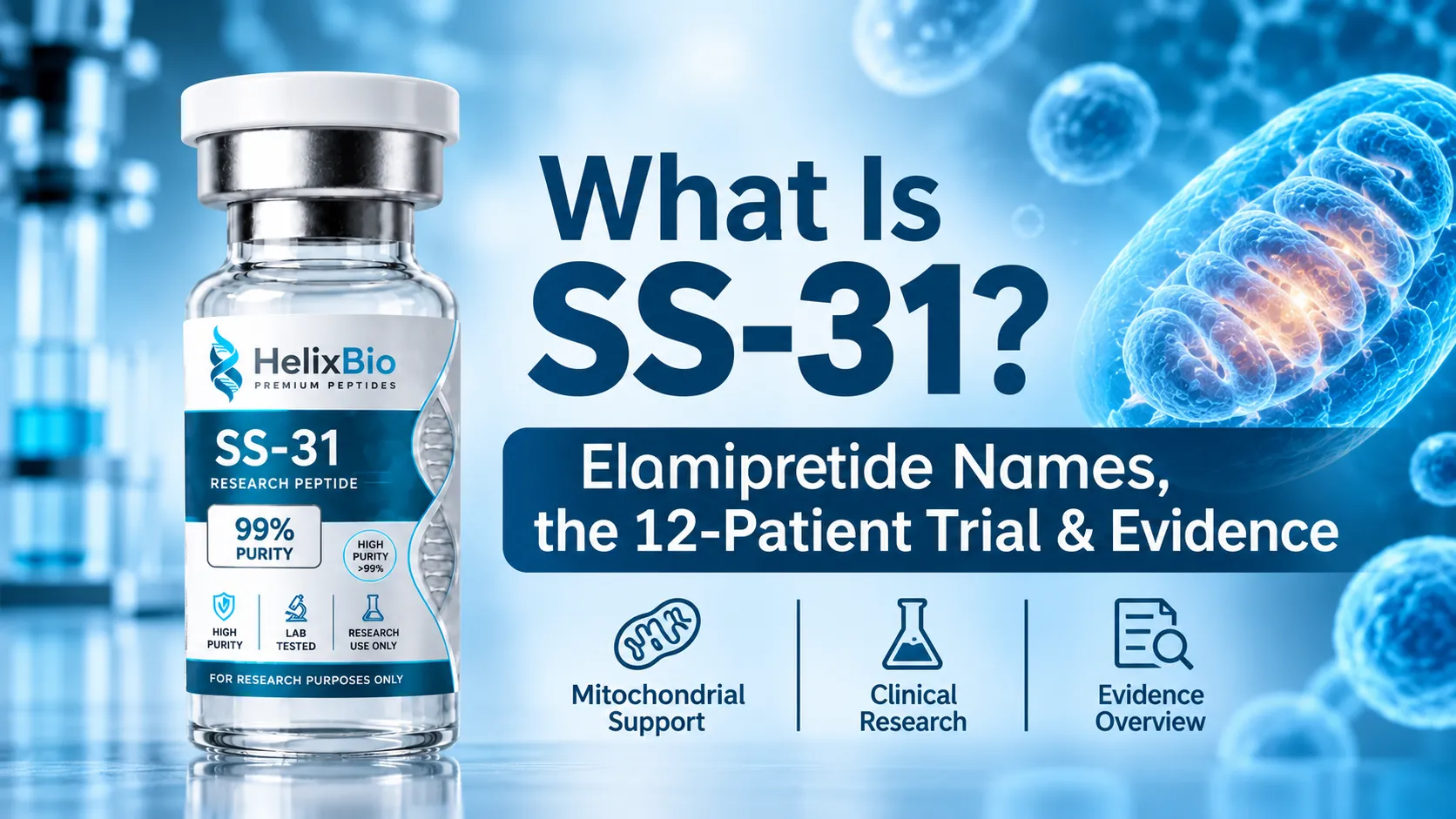
SS-31
RESEARCH PEPTIDE
SS-31, also known as elamipretide, MTP-131, or Bendavia, is a synthetic mitochondria-targeted tetrapeptide studied extensively in laboratory research involving mitochondrial membranes, cardiolipin interactions, cellular bioenergetics, oxidative stress models, and mitochondrial protein interactions. SS-31 is particularly relevant to researchers investigating how small cationic-aromatic peptides interact with mitochondrial membranes and influence molecular processes associated with mitochondrial structure and function. Research has identified interactions between SS-31 and cardiolipin-containing membranes, as well as several mitochondrial proteins associated with energy metabolism. Helix Bio supplies research peptides for laboratory and scientific applications. The company's website states that its products are research and laboratory materials rather than products intended for human or veterinary use.
Helix Bio Chem lists an SS-31 vial at $64.99, checked on 20 November 2026. PSPeptides showed the same $64.99 for a single 10 mg vial on the same day. Published figures elsewhere run from roughly $30 to over $300 for vials described as comparable, so a price on its own settles very little.
What settles something is the lot paperwork. A lot-specific certificate names the laboratory that tested your batch, the method it used, and how much peptide the vial actually held. Two certificates for the same 10 mg product can report different peptide content and both still read PASS.
This guide reads two real SS-31 certificates line by line. It explains what a purity figure does and does not establish. Further down, the guide sets out what Helix Bio Chem currently documents, and why Forzinity is a separate purchase from research SS-31.
What an SS-31 peptide price actually tells you
Any SS-31 peptide price needs a date attached before it means much. Two listings that could be opened and read on 20 November 2026 sat at the same figure.
Supplier | Checked | Displayed price | What the page specifies |
|---|---|---|---|
Helix Bio Chem | 20 Nov 2026 | $64.99 (10 mg) | 50 mg priced separately at $119.99 |
PSPeptides | 20 Nov 2026 | $64.99 for one vial | Also shows a range of $64.99 through $179.99 |
Those two are the live product pages that could be verified that day. Figures circulating for several other suppliers could not be confirmed against a live page. They are left out rather than repeated second-hand.
The spread in published SS-31 numbers has ordinary causes. Comparison sites quote medians in different currencies, which puts a dollar figure and a sterling figure in the same table. Promotional codes get folded into headline prices, so a vial listed near $60 can appear as $30. Vial sizes get compared as though they match, which is how a 50 mg figure ends up beside a 10 mg one. Marketplace and resale listings add their own numbers, with 10 mg vials seen at $97 and $110 on third-party storefronts.
One live detail is worth noting. The PSPeptides page described availability as in stock while also stating that checkout was paused and orders were not being processed. Availability wording and the ability to finish an order are separate things.
The 10 mg and 50 mg problem on these listings
Both pages offer two vial sizes, and they handle pricing differently.
The Helix Bio Chem SS-31 listing prices each size through its selector: $64.99 for 10 mg and $119.99 for 50 mg, which is $6.50 and $2.40 per milligram. PSPeptides shows a range of $64.99 through $179.99 without saying which size sits where, so the endpoints are all you get from that page.
Where a listing shows only a range, ask for the price of the exact vial size in writing, then confirm which size the cart line refers to.
Cost per milligram can be worked out from the Helix Bio Chem listing but not from a bare range. Keep that arithmetic in its place in any case. Cost per milligram is a budgeting convenience, and it says nothing about purity, identity, content or anything else a certificate reports.
What two real SS-31 certificates actually show
PSPeptides publishes certificate documents on its own domain. Two of them cover the same 10 mg SS-31 product, about ten weeks apart. They make a useful pair, because they differ in ways a product page would never reveal.
What to check | August 2026 lot | November 2026 lot |
|---|---|---|
Laboratory named | North American Diagnostics, Austin, Texas | ILS Laboratories, San Diego, California |
Document number | NAD-0036048 | COA-2026-3GHUO9 |
Lot number | PSP-08182026S31 | PSP-10232026S3110 |
Labelled content | 10 mg | 10 mg |
Purity by HPLC | 99.94% | 99.90% |
Purity specification printed | None | At least 95.0% |
Measured peptide content | 9.74 mg | 10.58 mg |
Content specification printed | None | Report only, no pass or fail applied |
Identity method | HPLC with UV detection, coupled with mass spectrometry | HPLC retention time matching |
Verification route printed | None | Access code plus a laboratory portal link |
Signed by | Analysis administration lead | Laboratory director |
Neither document is held up here as a failure. Both report high purity, both name their laboratory, and both tie themselves to a specific lot number. That already puts them ahead of a page that only claims testing happens.
Why the purity figure is a result and not a standard
The November certificate sets its purity specification at a minimum of 95.0 percent, then reports 99.90 percent. A listing advertising 99 percent or better is quoting the result, while the threshold the lot had to clear was lower. Both statements are true at once, and only one of them tends to reach the product page. That certificate also notes it caps reported purity at 99.9 percent to reflect the instrument detection limit, which is why the August figure of 99.94 percent sits above it. The gap is laboratory convention, not a quality difference.
Read the specification column, not just the result. A certificate with no specification printed, as the August document shows, hands you a number with nothing to measure it against.
Why measured content matters more than the purity badge
Here is what makes the pair worth reading together. The two lots of the same labelled 10 mg product reported 9.74 mg and 10.58 mg of peptide.
Purity and content answer different questions. The purity figure describes what share of the material in the vial is the target peptide. Measured content describes how many milligrams of that peptide are present. A vial can be 99.9 percent pure and still hold less peptide than its label suggests. Water, counterion salt and residual solvent make up the remainder.
The November certificate marks its content line report only, so no pass or fail is applied to it. Purity is the line that gates the overall result. Someone reading the headline PASS could reasonably assume the 10 mg figure had been confirmed. On that document it was never tested against a specification.
Helix publishes a general walkthrough in its guide on reading a peptide certificate of analysis. Separately, the contamination data review covers what purity testing has found across the wider market.
Why a vial can weigh right and still measure short
Research peptides are usually supplied as a salt rather than a free base. SS-31 has a free base mass near 639.8, and any salt form carries extra mass from its counterion. A vial filled to a target total weight can therefore hold less peptide than its label implies. That happens before purity enters the picture at all. Water drawn in during handling and residual solvent from synthesis take their own share.
Neither Helix SS-31 page publishes the salt form, and the spray specification table answers that row with an instruction to verify current documentation. That absence is exactly what a measured content line on a certificate closes. It also explains how two lots reporting near-identical purity ended up at 9.74 mg and 10.58 mg.
What these certificates still do not prove
A certificate covers the material the laboratory received, on the date stated, by the methods listed. It does not establish that the document belongs to the vial in your hand unless the lot numbers match. Nor does it confirm that current stock comes from the tested lot.
The identity line deserves a closer look than purity usually gets. Retention time matching compares how long your sample takes to move through a column against a reference run. Mass spectrometry weighs the molecule that comes off the column. Neither method separates D-arginine from L-arginine, and SS-31 depends on a D-arginine at position one plus a dimethylated tyrosine at position two. Identity on the August document rested on mass spectrometry alongside HPLC. The November document relied on retention time instead, so the broader panel was not the stronger identity check.
It helps to keep straight what each test answers.
Method | What it measures | What it does not establish |
|---|---|---|
HPLC purity | The share of material eluting as the main peak | How many milligrams of peptide the vial holds |
Net content assay | The measured mass of target peptide present | Whether the sequence is the correct stereoisomer |
Mass spectrometry | The mass of the molecule detected | Whether a residue is in its D or L form |
Retention time matching | Whether the sample elutes like a reference run | The molecular mass of whatever eluted |
Heavy metals by ICP-MS | Named elemental contaminants | Organic residues such as solvent or counterion |
No single row in that table carries a product on its own. Read across the certificate instead, and note which rows the laboratory left out.
An accreditation claim needs the same kind of care. The PSPeptides page describes ILS Laboratories as ISO/IEC 17025 accredited. Accreditation is granted for named methods inside a stated scope. Read the scope rather than the badge, and check which laboratory tested your lot. The August lot went to a different laboratory entirely. Mismatches like that are what the lab testing verification guide and the COA red flags cross-check are built to catch.
Tests cannot answer questions nobody asked them. A certificate says nothing about approval for human use, clinical effect or safety, whatever its purity figure reads.
Vial or spray is not just a format choice
The SS-31 spray showed Out of Stock on 20 November 2026, with an enquiry form standing in for a checkout. Its listing actually carries fuller molecular detail than the vial page, including the sequence and the free base mass. What it leaves open is the part that matters most for a solution. Concentration, vehicle and salt form are each answered with an instruction to verify current documentation.
Powder can be weighed and reported in milligrams on a certificate. A solution needs a stated concentration before any content figure means anything at all. The page also records that Helix represents no route of administration, and that the spray designation describes the physical presentation only.
Where Helix Bio Chem's own documentation stands
Applying the same test to Helix Bio Chem gives a mixed result, and saying so is more useful than leaving it out.
The SS-31 specification table answers its purity row with an instruction to verify the current lot certificate, rather than a figure. Badges higher on that page read 99.9 and at least 99 percent, and the footer notes that certain items may test below 99 percent. Those three statements point in different directions. Only the lot certificate can settle which one applies to your vial.
Helix's own certificates page is the clearer signal. It shows 0 Batches Verified beside a claim of 100 percent independently tested. The same page states that documents are being added for the current catalogue, and gives a route to request a specific batch certificate. No certificate documents are downloadable there at present, and SS-31 does not appear among them.
For a buyer the practical step matches what that page points to. Request the certificate for the lot you would receive, then read it against the checks above before ordering the SS-31 vial.
SS-31 and Forzinity are not the same purchase
Same active molecule, different product.
Forzinity is an elamipretide injection, supplied at 280 mg per 3.5 mL. FDA granted it accelerated approval on 19 September 2025. The approved use is to improve muscle strength in adult and paediatric patients with Barth syndrome weighing at least 30 kg. Stealth BioTherapeutics holds the application, and the approval carries a requirement to confirm the benefit in a further trial.
The trial behind it was small. According to PubMed, the randomised phase enrolled 12 participants and met neither primary endpoint. Improvements in the six-minute walk test and the symptom assessment scale appeared later, in the open-label extension.
Research SS-31 sold for laboratory work is not that drug product. It carries no approved indication, no approved route and no prescription status. The naming history and regulatory detail sit in the existing SS-31 names and trial evidence guide and the SS-31 FDA status monograph.
What the August 2026 FDA letters mean for a buyer
FDA issued five warning letters to online peptide sellers dated 24 August 2026, posting them the following month. SS-31 appeared among the compounds named across those letters. One finding in them deserves a buyer's attention.
Research-use-only wording did not settle the question of intended use. FDA looked at what else the sites said and sold, including product claims, peptide reconstitution calculators and bacteriostatic water sold alongside injectables.
None of that tells you whether a particular purchase is lawful, and this guide does not attempt that judgment. Helix covers the ground in its RUO compliance explainer and its prescription rules guide. The narrower takeaway is still useful. A disclaimer is not a shield, and a page pairing a research label with human-use claims is telling you something about the seller.
Before you place the order
Five checks cover most of the risk on an SS-31 listing.
Ask for the certificate matching the lot you will receive, and compare its lot number against the vial. Read the specification beside every result, not just the result. Check the measured peptide content against the labelled milligrams, and note whether any specification was applied to it. Look at which laboratory ran the identity test, and by what method. Confirm the price for your exact vial size in writing, since neither listing reviewed here prints one.
The SS-31 vial listing is the page to start that conversation from. For a comparison against another mitochondrial compound, the MOTS-c research overview sets out where the evidence differs.
This article covers research use only. SS-31 sold by Helix Bio Chem is laboratory material and not a medicine. It is not approved, intended or sold for human or veterinary use. Nothing here is dosing guidance, medical advice or a legal opinion.
Frequently Asked Questions
SS-31 is listed by a long roster of online research suppliers. Helix Bio Chem sells an SS-31 vial, and PSPeptides was the other listing whose live page could be opened and verified on 20 November 2026. The supplier matters less than the documentation. Ask any seller for the certificate covering the lot you would receive, and check that its lot number matches the vial before you pay.
Helix Bio Chem displayed $64.99 for an SS-31 vial on 20 November 2026, and PSPeptides displayed $64.99 for a single 10 mg vial the same day. Published figures elsewhere ranged from roughly $30 to over $300 for vials described as comparable. Those gaps come from mixed currencies, promotional pricing folded into headline numbers, and different vial sizes being compared as equals. Treat any SS-31 price without a check date as unreliable.
On price per milligram, yes. Helix Bio Chem listed the 10 mg at $64.99 and the 50 mg at $119.99 on 20 November 2026, which is $6.50 against $2.40 per milligram, so the larger vial costs about 63 percent less per milligram. PSPeptides shows a range of $64.99 through $179.99 without saying which size sits where, so ask for the size-specific figure there. Cost per milligram is a budgeting number, and it tells you nothing about purity, identity or how much peptide a vial holds.
They share the same active molecule and are not the same product. Forzinity is elamipretide hydrochloride injection at 280 mg per 3.5 mL, approved by FDA on 19 September 2025 under accelerated approval, to improve muscle strength in adult and paediatric patients with Barth syndrome weighing at least 30 kg. Research SS-31 is laboratory material with no approved indication, no approved route and no prescription status. Forzinity is a brand of an approved drug product, not another name for the research compound.
No. Research SS-31 has no FDA approval. The approval granted on 19 September 2025 belongs to Forzinity, a specific prescription drug product, for one rare disease indication. That approval does not transfer to research material sold for laboratory use, and it does not make research SS-31 lawful to administer to people.
Start with the lot number and confirm it matches the vial you were sent. Check that the laboratory is named, that the analysis date is recent, and that each result sits beside a stated specification. Look for the identity method as well as the purity method, since they answer different questions. A verification code or portal link lets you confirm the document with the laboratory rather than trusting the seller's copy of it.
At a minimum it should show a lot number, a named laboratory, an analysis date, the purity result with its specification, the measured peptide content, and the method used to confirm identity. Broader panels may add heavy metals, sterility and endotoxin results. More tests is not automatically better. One real SS-31 certificate with a seven-test panel confirmed identity only by retention time, while an earlier certificate for the same product used mass spectrometry.
A purity figure with no certificate behind it is the common one. Watch for a generic certificate with no lot number, a document whose lot does not match your vial, and a purity badge quoted as though it were a specification. Conflicting purity claims on a single page are a signal to ask questions. Human-use or treatment language on a research listing is the clearest warning of all, since FDA has treated exactly that as evidence of intended use.
It is the measured quantity of the target peptide in the vial, reported in milligrams, as distinct from purity. Purity is a percentage of the material present. Content is how much of that material there is. Two certificates for the same labelled 10 mg SS-31 product reported 9.74 mg and 10.58 mg, both alongside purity near 99.9 percent. On one of those documents the content line was marked report only, meaning no pass or fail was applied to it.
Not on its own. Accreditation is granted for named methods within a stated scope, so a laboratory can be accredited while a particular test falls outside that scope. The accreditation named on a product page also belongs to one laboratory, and a different lot may have gone elsewhere. Two certificates for the same SS-31 product came from two different laboratories roughly ten weeks apart. Check the scope, and check which laboratory tested your lot.
The Helix [SS-31 spray listing](/product/ss-31-spray) showed Out of Stock on 20 November 2026, with an enquiry route rather than a checkout. Its specification table leaves concentration, salt form and vehicle to be verified from current documentation. The page also states plainly that Helix represents no route of administration and that the spray designation describes the physical presentation only. Treat it as a format reference rather than an available purchase while that status holds.
This guide cannot answer that for your situation, and anyone telling you it is simple is overreaching. Research material sold for laboratory use sits in a different position from an approved drug product, and the five FDA warning letters dated 24 August 2026 showed that a research-use-only label does not by itself settle how a product is being marketed. Helix sets out the current position in its RUO compliance and prescription rules guides.
- 01Helix Bio Chem SS-31 product page. Displayed price $64.99, size selector offering 10 mg and 50 mg with no size-specific price, purity row answered by an instruction to verify the lot certificate. Verified 20 November 2026.
- 02Helix Bio Chem SS-31 Spray product page. Out of Stock, enquiry route only, concentration and salt form unpublished, no route of administration represented. Verified 20 November 2026.
- 03Helix Bio Chem certificates page. Shows 0 Batches Verified alongside a 100 percent independently tested claim, no downloadable documents, and a batch certificate request route. Verified 20 November 2026.
- 04PSPeptides SS-31 certificate of analysis, ILS Laboratories, COA-2026-3GHUO9, lot PSP-10232026S3110, analysis date 9 November 2026. Purity specification at least 95.0 percent with result 99.90 percent, net peptide content 10.58 mg marked report only, identity by HPLC retention time matching.
- 05PSPeptides SS-31 certificate of analysis, North American Diagnostics, test NAD-0036048, batch PSP-08182026S31, ordered 27 August 2026. HPLC purity 99.94 percent and mass content 9.74 mg, by HPLC with UV detection coupled with mass spectrometry, with no specification column printed.
- 06PSPeptides SS-31 10 mg product page. Displayed $64.99 for one vial, price range $64.99 through $179.99, ILS Laboratories described as ISO/IEC 17025 accredited, availability shown as in stock while checkout was paused. Verified 20 November 2026.
- 07US Food and Drug Administration approval letter, NDA 215244, Forzinity (elamipretide) injection 280 mg/3.5 mL (80 mg/mL). States the approved use as improving muscle strength in adult and pediatric patients with Barth syndrome weighing at least 30 kg.
- 08Reid Thompson W, Hornby B, Manuel R, et al. A phase 2/3 randomized clinical trial followed by an open-label extension to evaluate the effectiveness of elamipretide in Barth syndrome. Genet Med. 2021;23(3):471-478. Retrieved via PubMed, PMID 33077895. Part 1 randomized 12 subjects and neither primary endpoint was met.
- 09ArentFox Schiff legal alert on the five FDA warning letters issued by CDER on 24 August 2026 to Peak Performance Peptides, Royal Peptides, NuScience Peptides, Peptide Partners and TXP Innovations, alleging sale of unapproved new drugs despite research-use-only labelling.
Helix Bio Chem Team
Research & Product Team
Our in-house team tracks published peptide research and translates it into clear, source-cited summaries for the research community.
Reviewed by in-house research chemists
support@helixbiochem.com