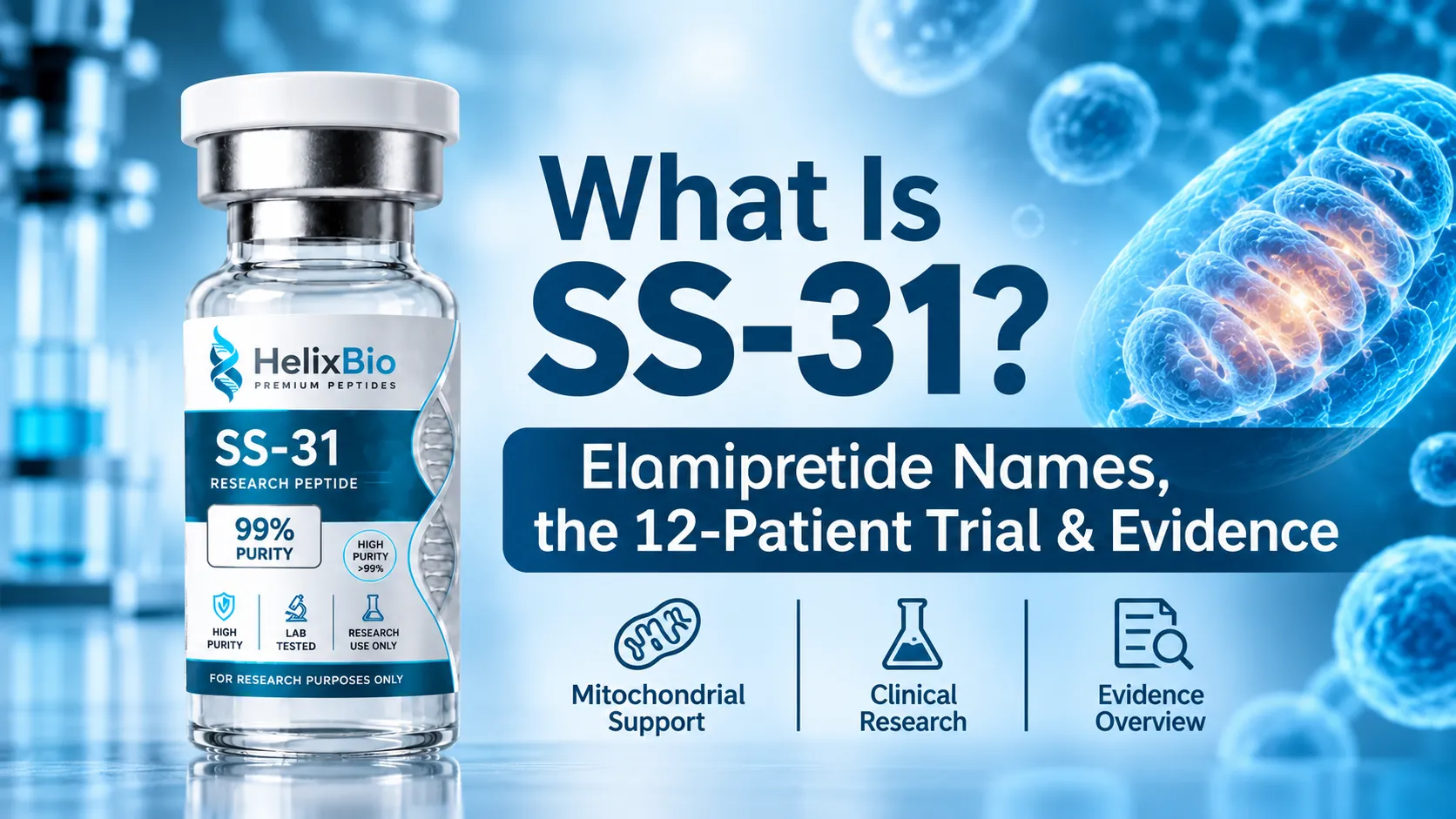
- SS-31, elamipretide, MTP-131, and Bendavia are different names for the same synthetic tetrapeptide, D-Arg-Dmt-Lys-Phe-NH2.
- The often-cited 'pivotal trial with twelve patients' is TAZPOWER (NCT03098797), a phase 2/3 crossover trial of elamipretide in 12 males with Barth syndrome.
- TAZPOWER's randomized phase missed both primary endpoints (6-minute walk, p=0.97; fatigue, p=0.89); improvements appeared in the uncontrolled open-label extension.
- The FDA granted Forzinity (elamipretide) accelerated approval on September 19, 2025, for muscle strength in Barth syndrome patients weighing at least 30 kg — its only approved use.
- SS-31's binding to cardiolipin in the inner mitochondrial membrane is supported by strong biophysical and cross-linking evidence.
- Outside Barth syndrome, major randomized elamipretide trials — including MMPOWER-3 with 218 participants — missed their primary endpoints.
- A meaningful SS-31 COA is lot-specific: it must match the vial's lot number and report identity and purity testing for that exact lot.
- Research-grade SS-31 is a laboratory material and is not interchangeable with the approved prescription product Forzinity.
SS-31 may be the most confusingly named compound in mitochondrial research. The same tetrapeptide appears in the literature as SS-31, elamipretide, MTP-131, and Bendavia, and since September 2025 it has also existed as Forzinity, an FDA-approved prescription product for one rare disease. On top of that, product pages and forum posts routinely reference a "pivotal trial with twelve patients" without ever naming it. This article resolves both problems: it maps every name to the same molecule, and it identifies, cites, and summarizes that twelve-participant trial — TAZPOWER (NCT03098797) — so researchers can evaluate the primary evidence rather than a vague paraphrase of it.
SS-31
RESEARCH PEPTIDE
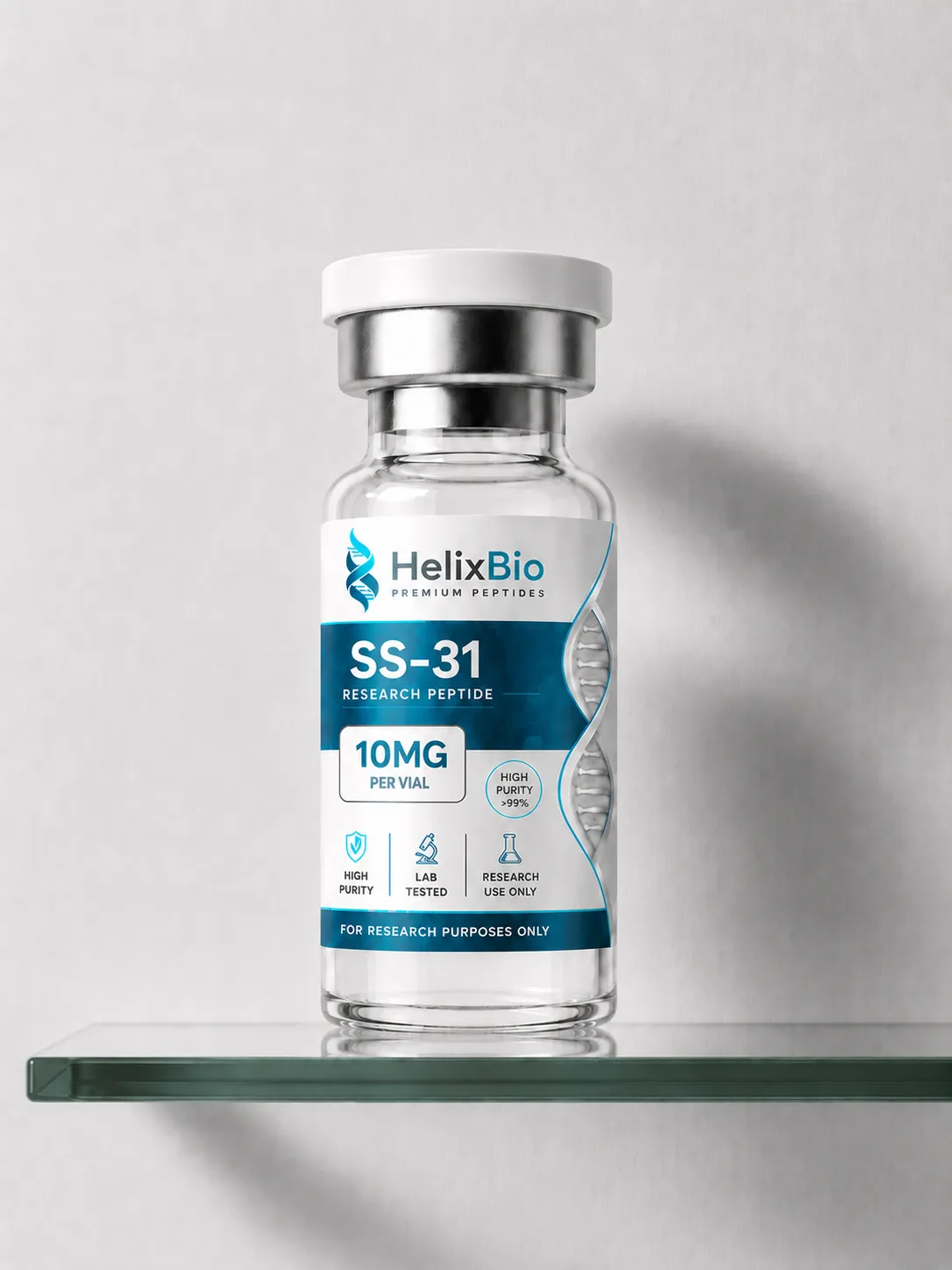
SS-31, also known as elamipretide, MTP-131, or Bendavia, is a synthetic mitochondria-targeted tetrapeptide studied extensively in laboratory research involving mitochondrial membranes, cardiolipin interactions, cellular bioenergetics, oxidative stress models, and mitochondrial protein interactions. SS-31 is particularly relevant to researchers investigating how small cationic-aromatic peptides interact with mitochondrial membranes and influence molecular processes associated with mitochondrial structure and function. Research has identified interactions between SS-31 and cardiolipin-containing membranes, as well as several mitochondrial proteins associated with energy metabolism. Helix Bio supplies research peptides for laboratory and scientific applications. The company's website states that its products are research and laboratory materials rather than products intended for human or veterinary use.
SS-31 Spray
RESEARCH PEPTIDE
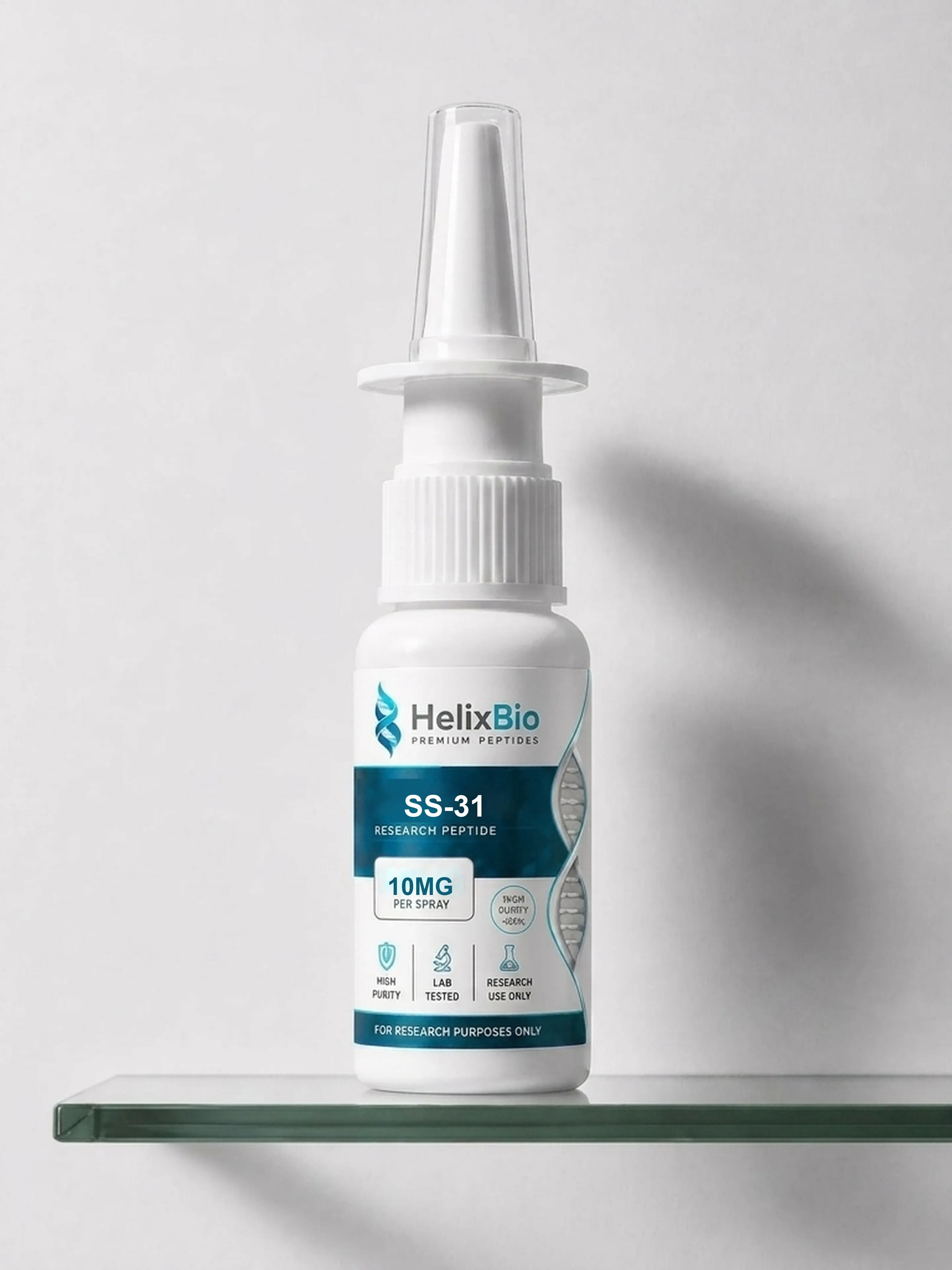
Two of the four residues in SS-31 are not what a peptide chemist would expect. The sequence — D-Arg–Dmt–Lys–Phe–NH₂ — pairs a D-configured arginine with 2′,6′-dimethyltyrosine, a non-proteinogenic residue, in an alternating cationic-aromatic arrangement that gives the molecule a net charge of +3 at neutral pH and an affinity for cardiolipin, the anionic phospholipid of the inner mitochondrial membrane. That combination is why SS-31 has become a reference compound in mitochondrial membrane research. Helix Bio supplies SS-31 Spray as a spray-format research material for qualified laboratory and scientific work. It is not intended for human or veterinary consumption, diagnosis, treatment, or prevention of disease, and it is not a treatment product of any kind.
SS-31, Elamipretide, MTP-131, Bendavia: One Molecule, Five Labels
Every name below refers to the same synthetic tetrapeptide with the sequence D-Arg-Dmt-Lys-Phe-NH2, a member of the Szeto-Schiller (SS) peptide family developed by Hazel Szeto and Peter Schiller.
Name | What it is | Where you will see it |
|---|---|---|
SS-31 | Original Szeto-Schiller lab designation | Preclinical papers, research-material catalogs |
Elamipretide | International nonproprietary (generic) name | Clinical trial publications, FDA documents |
MTP-131 | Development code | Early-phase trial registrations and sponsor materials |
Bendavia | Former trade name used during early development | Older cardiology and ischemia-reperfusion literature |
Forzinity | FDA-approved prescription brand (elamipretide) | Prescribing information, regulatory announcements |
Two practical consequences follow. First, literature searches that use only one name miss large parts of the evidence base — the ischemia-reperfusion work is mostly indexed under Bendavia or MTP-131, while the Barth syndrome program is published under elamipretide. Second, the names are not interchangeable in a regulatory sense: Forzinity is a specific approved drug product, while research-grade SS-31 is a laboratory material. The molecule is shared; the products are not.
What the Forzinity approval does and does not cover
Yes — narrowly. On September 19, 2025, the FDA granted accelerated approval to Forzinity (elamipretide) to improve muscle strength in adult and pediatric patients with Barth syndrome weighing at least 30 kg. Barth syndrome is an ultra-rare X-linked mitochondrial disease; more than 150 cases have been described in the scientific literature worldwide. The approval rests on an intermediate endpoint — knee extensor muscle strength — that the FDA considers reasonably likely to predict benefit, and continued approval is contingent on a confirmatory placebo-controlled trial. That single indication is the entire scope of the approval: elamipretide is not approved for heart failure, mitochondrial myopathy, macular degeneration, aging, or any research application, and research-grade SS-31 is not an approved product of any kind.
The Pivotal Twelve-Participant Trial: TAZPOWER (NCT03098797)
When a product page or review mentions that SS-31 was studied in "a pivotal trial with twelve patients," this is the study it means. TAZPOWER — registered as NCT03098797 and designated SPIBA-201 in regulatory documents — was a phase 2/3 trial of elamipretide conducted at a single U.S. site in patients with genetically confirmed Barth syndrome. It enrolled exactly 12 male participants aged 12 and older, and it is the trial on which the 2025 Forzinity approval was based.
Part 1: the randomized, placebo-controlled crossover phase
In the double-blind crossover phase, participants received 12 weeks of daily 40 mg subcutaneous elamipretide and 12 weeks of placebo in randomized order, separated by a washout period. The two primary endpoints were distance on the 6-minute walk test and total fatigue score on the Barth Syndrome Symptom Assessment. Elamipretide was not superior to placebo on either primary endpoint in this randomized phase — FDA documents record p-values of 0.97 for the walk test and 0.89 for fatigue. Knee extensor strength also did not increase during the randomized comparison. This matters for anyone reading secondary summaries: the controlled portion of the pivotal trial was, on its prespecified endpoints, negative.
Part 2: the open-label extension
Ten of the 12 participants continued into an open-label extension in which everyone received elamipretide for up to 168 weeks. Published extension results (Thompson et al., 2024) report a mean 6-minute walk distance improvement of about 96 meters versus the extension baseline (P=.003) and progressive gains in knee extensor strength. These are real, published findings — but they are uncontrolled, within-group comparisons in a very small cohort, not placebo-controlled results. The FDA's accelerated approval leaned on the knee extensor strength data as an intermediate endpoint, with a post-approval randomized trial required to confirm clinical benefit.
How to cite it correctly
The randomized phase and early extension were published by Thompson, Hornby, Vernon and colleagues in Genetics in Medicine in 2021; the full 168-week open-label extension was published by the same group in Genetics in Medicine in 2024. Both papers, the trial registration, and the FDA documents are listed in the references below. Any claim about this trial should trace to one of those primary records, not to a supplier summary.
How strong is the cardiolipin mechanism evidence?
"SS-31 binds cardiolipin and protects mitochondria" is the standard one-line mechanism claim. The honest version separates what is directly demonstrated from what is inferred.
Claim | Evidence tier | Key support |
|---|---|---|
SS-31 binds cardiolipin in the inner mitochondrial membrane | Strong biophysical evidence | Fluorescence, NMR, and titration studies (Birk 2013, 2014); cross-linking proteomics (Chavez 2020) |
The SS-31/cardiolipin interaction inhibits cytochrome c peroxidase activity | Demonstrated in model membranes and isolated systems | Birk 2013, 2014 |
SS-31 improves ATP synthesis and electron transport efficiency | Demonstrated in isolated mitochondria and preclinical models | Birk 2014 and related preclinical literature |
Membrane-electrostatic modulation refines the original antioxidant framing | Emerging mechanistic model | Structure-activity work on SS-peptide analogs |
These mechanisms translate into broad human clinical benefit | Not established | Outside Barth syndrome, major randomized trials missed primary endpoints |
The first row is on genuinely solid ground: SS-31 binds cardiolipin — the signature phospholipid of the inner mitochondrial membrane — with roughly 1:1 stoichiometry, and chemical cross-linking studies place it adjacent to cardiolipin-binding proteins of the oxidative phosphorylation machinery. The field's framing has also matured: early descriptions of SS-31 as a "mitochondria-targeted antioxidant" have given way to a more specific model in which cardiolipin binding and membrane electrostatics stabilize cristae structure and electron transport, with reduced reactive oxygen species as a downstream consequence rather than the primary action.
The last row is where discipline matters. A well-characterized molecular mechanism did not prevent elamipretide from missing its primary endpoints in trials for primary mitochondrial myopathy (MMPOWER-3, 218 participants), heart failure, STEMI reperfusion injury, and dry age-related macular degeneration. Mechanism explains why a compound is studied; only controlled outcome data establish what it does in a given condition. Research models using SS-31 should treat the cardiolipin interaction as the validated starting point and everything downstream as condition-specific and unproven.
What should an SS-31 COA actually show?
Searches for "SS-31 peptide COA" are usually asking a simple question: how do you confirm what is actually in a research vial? The answer is lot-specific documentation. A certificate of analysis is only meaningful when it matches the exact lot number printed on the vial in hand and reports identity and purity testing (typically HPLC and mass spectrometry) for that lot. A generic purity banner on a website is not a COA, and mass spectrometry confirms composition rather than every aspect of stereochemistry, so the documents should be read for what they actually test. Before working with any lot of SS-31, verify its current lot-specific COA rather than relying on site-wide statements. For the full checklist on reading identity, purity, and testing documentation, see our COA red flags cross-check guide.
Research-grade SS-31 — including the SS-31 spray format — is a laboratory material for research use only. It is not Forzinity, is not manufactured under the approved drug's pharmaceutical requirements, and is not interchangeable with the prescription product in any respect: formulation, quality controls, salt form, or regulatory status. Sharing an active molecule does not make two products equivalent.
Where This Leaves the Evidence Picture
SS-31 occupies an unusual position in peptide research. It is one of the most mechanistically characterized mitochondria-targeted compounds in the literature, it is the first cardiolipin-binding therapeutic to reach FDA approval, and yet its controlled human trial record outside Barth syndrome is predominantly negative on primary endpoints. All three of those statements are true at once, and a credible reading of the SS-31 literature holds them together. For researchers, the practical summary is: cite TAZPOWER by name and registration number rather than as "a twelve-patient trial," search the literature under all of the compound's names, grade mechanism claims by their evidence tier, and anchor every product-level question to lot-specific documentation.
Frequently Asked Questions
SS-31 is a synthetic mitochondria-targeted tetrapeptide (sequence D-Arg-Dmt-Lys-Phe-NH2) from the Szeto-Schiller peptide family. In research models it concentrates in the inner mitochondrial membrane by binding the phospholipid cardiolipin, and it is studied for its effects on mitochondrial structure and bioenergetics.
Yes. Elamipretide is the generic drug name for the same molecule known in the research literature as SS-31. MTP-131 was its development code and Bendavia an earlier trade name, so all four labels refer to one compound.
Elamipretide received FDA accelerated approval on September 19, 2025, as Forzinity, to improve muscle strength in Barth syndrome patients weighing at least 30 kg. That single rare-disease indication is the entire approval; SS-31 is not approved for any other condition, and research-grade SS-31 is not an approved product.
It was TAZPOWER (NCT03098797, also designated SPIBA-201), a phase 2/3 randomized, double-blind, placebo-controlled crossover trial of daily subcutaneous elamipretide in 12 males with genetically confirmed Barth syndrome, followed by an open-label extension in which 10 participants continued for up to 168 weeks.
Its randomized phase missed both primary endpoints — 6-minute walk distance (p=0.97) and fatigue score (p=0.89). The uncontrolled open-label extension showed within-group improvements in walk distance and knee extensor strength, and the FDA based accelerated approval on the knee strength data as an intermediate endpoint, with a confirmatory trial still required.
SS-31 carries a 3+ charge at physiological pH and binds selectively to cardiolipin, an anionic phospholipid concentrated in the inner mitochondrial membrane. This interaction, characterized by fluorescence, NMR, and cross-linking studies, localizes the peptide to the membrane where electron transport occurs.
Calling SS-31 a simple antioxidant is incomplete. Current evidence supports a cardiolipin-binding, membrane-stabilizing mechanism in which reduced reactive oxygen species production is a downstream consequence of improved electron transport efficiency rather than direct radical scavenging.
In isolated mitochondria and preclinical research models, SS-31 has been shown to improve electron transfer efficiency and ATP synthesis. Durable ATP-related benefits in humans have not been established, so this remains a model-level finding rather than a clinical outcome.
Forzinity is an FDA-approved prescription drug manufactured under pharmaceutical regulatory requirements for a specific Barth syndrome indication. Research-grade SS-31 is a laboratory material intended for research use only; sharing the same active molecule does not make the two products equivalent or interchangeable.
A usable certificate of analysis is lot-specific: it matches the lot number on the vial and reports identity confirmation and purity testing, typically by HPLC and mass spectrometry, for that exact lot. Site-wide purity claims are not a substitute for lot-matched documentation.
As with most lyophilized research peptides, unreconstituted SS-31 is generally kept cold and protected from light and moisture, with long-term storage frozen. Researchers should follow the storage conditions stated in the specific product's documentation for the lot in use.
Older cardiology and ischemia-reperfusion studies were published while the compound was being developed under the Bendavia trade name and MTP-131 code, before elamipretide became the standard clinical name. Comprehensive literature searches should include all four names to capture the full evidence base.
- 01Thompson WR, Hornby B, Manuel R, et al. A phase 2/3 randomized clinical trial followed by an open-label extension to evaluate the effectiveness of elamipretide in Barth syndrome. Genetics in Medicine. 2021;23(3):471-478.
- 02Thompson WR, Vernon HJ, et al. Long-term efficacy and safety of elamipretide in patients with Barth syndrome: 168-week open-label extension results of TAZPOWER. Genetics in Medicine. 2024. PMID 38602181.
- 03A Trial to Evaluate Safety, Tolerability and Efficacy of Elamipretide in Subjects With Barth Syndrome (TAZPOWER). ClinicalTrials.gov identifier NCT03098797.
- 04U.S. Food and Drug Administration. FDA Grants Accelerated Approval to First Treatment for Barth Syndrome. News release, September 19, 2025.
- 05Forzinity (elamipretide) prescribing information. NDA 215244. U.S. Food and Drug Administration, September 2025.
- 06Birk AV, Liu S, Soong Y, et al. The mitochondrial-targeted compound SS-31 re-energizes ischemic mitochondria by interacting with cardiolipin. J Am Soc Nephrol. 2013;24(8):1250-1261. PMID 23813215.
- 07Birk AV, Chao WM, Bracken C, Warren JD, Szeto HH. Targeting mitochondrial cardiolipin and the cytochrome c/cardiolipin complex to promote electron transport and optimize mitochondrial ATP synthesis. Br J Pharmacol. 2014;171(8):2017-2028.
- 08Chavez JD, Tang X, Campbell MD, et al. Mitochondrial protein interaction landscape of SS-31. Proc Natl Acad Sci USA. 2020;117(26):15363-15373. PMID 32554501.
- 09U.S. Food and Drug Administration. Opening Remarks, Cellular, Tissue, and Gene Therapies Advisory Committee, NDA 215244 (elamipretide), October 10, 2024.
Helix Bio Chem Team
Research & Product Team
Our in-house team tracks published peptide research and translates it into clear, source-cited summaries for the research community.
Reviewed by in-house research chemists
support@helixbiochem.com