- Kisspeptin is sold online by research-peptide suppliers only, with no pharmacy or prescription route for the research material.
- Across six sellers' own listings checked on 17 November 2026, 10 mg kisspeptin vials ranged from $49.99 to $131.00, a median of $6.60 per milligram.
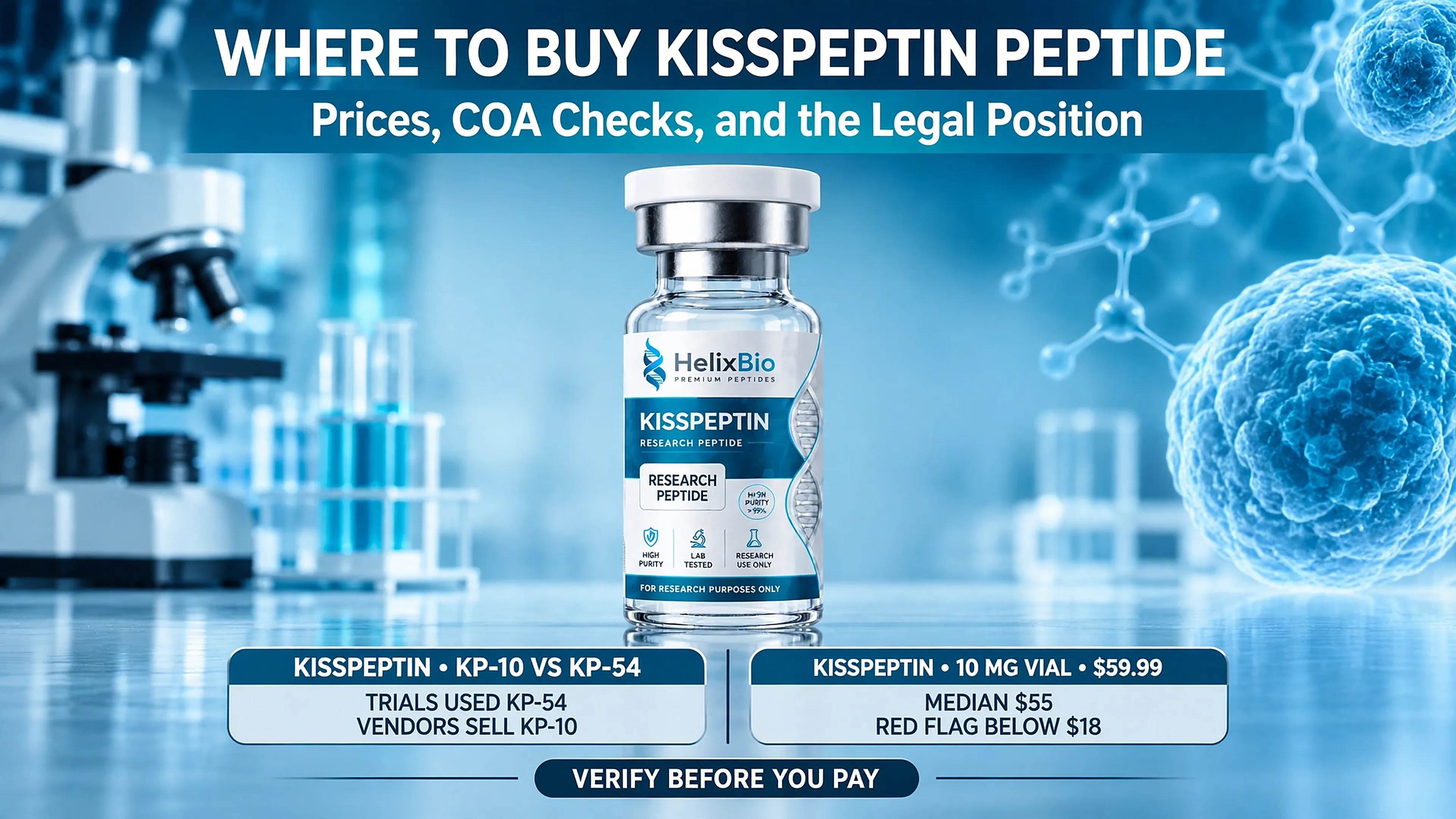
- Helix Bio Chem lists its 10 mg kisspeptin vial at $59.99 and its kisspeptin spray at $94.99 as of 17 November 2026.
- Kisspeptin-10 has been in Category 2 of the FDA's 503A bulk drug substances list since 29 September 2023, which blocks pharmacy compounding for patients.
- FDA's Pharmacy Compounding Advisory Committee voted 0 to 11 on 29 October 2024 against adding kisspeptin-10 to the 503A bulks list.
- The HHS interim enforcement policy published on 30 October 2026 covers six peptides, BPC-157, epitalon, KPV, MOTS-c, semax and TB-500, and kisspeptin is not one of them.
- The 2026 WADA Prohibited List names kisspeptin and its agonist analogues at S2.2.1 as testosterone-stimulating peptides in males, prohibited at all times.
- Kisspeptin-10 has an expected mass near 1,302.4 Da and kisspeptin-54 near 5,857.4 Da, so an observed mass on a batch report settles which fragment a vial contains.
Kisspeptin sells through research-peptide suppliers online, not through pharmacies, and a 10 mg vial runs from roughly $50 to $131 depending on the seller. Helix Bio Chem lists its 10 mg kisspeptin vial at $59.99 and the kisspeptin spray at $94.99, both checked on 17 November 2026. Selling the material for laboratory research is lawful in the United States. But kisspeptin-10 sits on the FDA's 503A Category 2 list, so licensed pharmacies cannot compound it for patients.
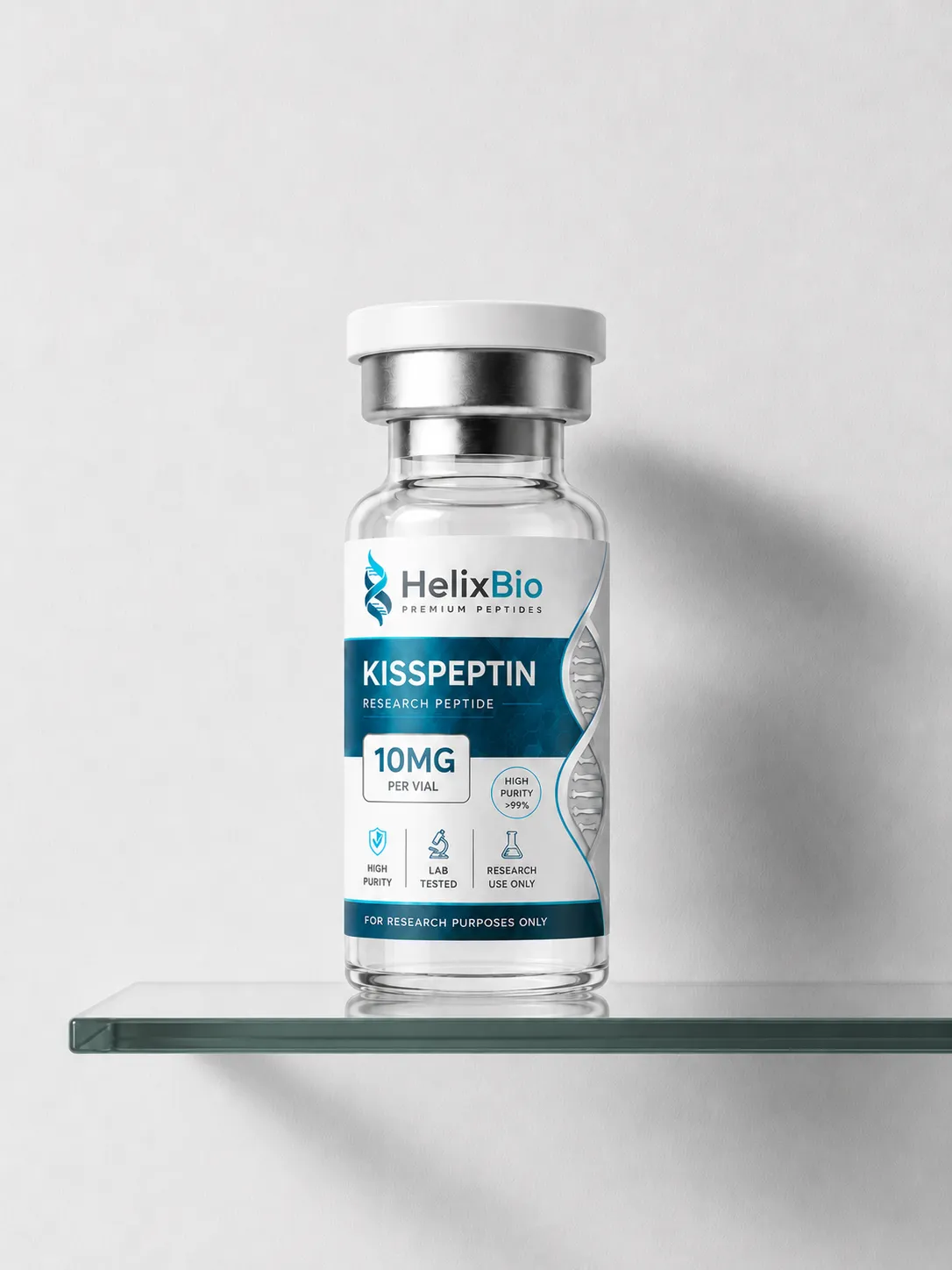
Kisspeptin
RESEARCH PEPTIDE
Kisspeptin is a naturally occurring peptide that plays an important role in scientific research related to reproductive endocrinology, neuroendocrine signaling, and hormonal regulation. Researchers have studied kisspeptin for its interaction with the GPR54 (KISS1R) receptor and its involvement in signaling pathways that regulate gonadotropin-releasing hormone (GnRH). Helix Bio supplies Kisspeptin exclusively for laboratory and research purposes. It is not intended for human or veterinary use, diagnostic procedures, or therapeutic applications.
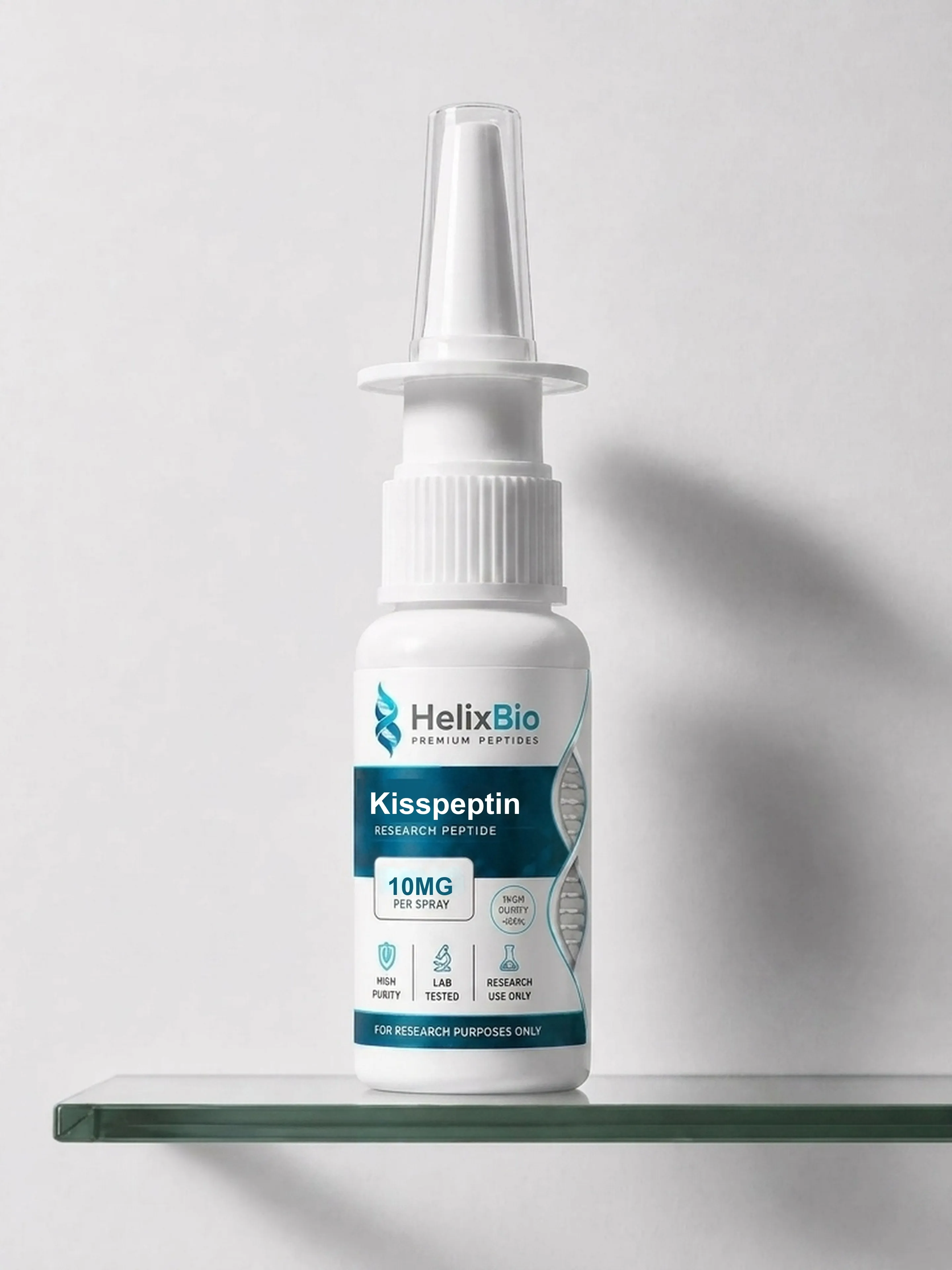
Kisspeptin Spray
RESEARCH PEPTIDE
Kisspeptin is not a single peptide. The name covers a group of related fragments produced by proteolytic processing of a precursor encoded by the KISS1 gene — most commonly described as kisspeptin-54, kisspeptin-14, kisspeptin-13 and kisspeptin-10 — all of which share the same C-terminal decapeptide and all of which act at the KISS1R receptor, also known as GPR54. Kisspeptin Spray is Helix Bio’s spray-format preparation supplied for laboratory investigation of that signalling system. Because the forms differ in length, mass and behaviour, the specific fragment supplied in any given lot is a matter for the accompanying documentation rather than the product name. Helix Bio provides research materials for qualified scientific work only. This product is not intended for human or veterinary consumption, self-administration, diagnosis, treatment, or the prevention of any disease.
Those three facts answer most of this search. One thing they do not answer is which kisspeptin fragment actually arrives in the vial, and that gap is where buyers waste money. A listing that says only "Kisspeptin 10mg" has told you the mass and almost nothing else.
Two purchasing lanes exist and they do not overlap. Research suppliers sell lyophilized material labeled for laboratory use, with no prescription involved. Compounding pharmacies work from a prescription under federal compounding rules, and kisspeptin-10 is currently shut out of that route. Buying a research vial does not open the clinical lane, and it carries no authorization for use in people.
This guide covers what the fragments mean for a purchase and what a seller should disclose. It also covers market pricing per milligram, the decisions US regulators have actually made, and how to work an order without guessing.
Kisspeptin-10 and Kisspeptin-54 Are Not the Same Purchase
The KISS1 gene produces a 145 amino acid precursor. Enzymes cut it into shorter fragments, and the two that matter commercially are kisspeptin-54 and kisspeptin-10. They share the same active C-terminal tail, so vendors sometimes treat them as interchangeable. Analytically the two are not interchangeable at all.
Property | Kisspeptin-10 (KP-10) | Kisspeptin-54 (KP-54) |
|---|---|---|
Length | 10 amino acids | 54 amino acids |
Other names | Metastin (45-54), KiSS-1 (112-121) | Metastin |
Molecular formula | C63H83N17O14 | C258H401N79O78 |
Expected mass | about 1,302.4 Da | about 5,857.4 Da |
CAS number | 374675-21-5 | 374683-24-6 |
Sequence | YNWNSFGLRF-NH2 | 54-residue chain ending YNWNSFGLRF-NH2 |
Research-vendor supply | Common | Uncommon |
That mass difference is the practical test. A report claiming an observed mass near 1,302 Da describes KP-10, whatever the product name says. A report near 5,857 Da describes KP-54. The two cannot be confused once a batch document is in front of you, which is exactly why the document matters more than the label.
Buyers searching "kisspeptin 54 buy" run into a sourcing wall. Research suppliers overwhelmingly stock KP-10, because a decapeptide is cheaper and more reliable to synthesize than a 54-residue chain. KP-54 shows up far less often, and a listing that advertises KP-54 at KP-10 prices deserves a document check before payment rather than after.
The evidence base splits the same way. The strongest human work used KP-54 in IVF settings at Hammersmith Hospital. That includes a 53-patient study published in the Journal of Clinical Investigation in 2014, plus two later Phase 2 trials of 60 and 62 women. None of that transfers automatically to KP-10, which has been studied in humans mainly in small mechanistic and diagnostic work. The full picture sits in the kisspeptin research monograph, and it belongs there rather than in a buying guide.
Neither Helix Bio Chem product page currently names the fragment it supplies. The vial page lists kisspeptin-10, -13, -14 and -54 as forms researchers may study, and the spray page defers the question to lot documentation. Request the batch document and confirm the fragment in writing before paying, through support@helixbiochem.com.
Spray or Vial, and What Each Listing Should Tell You
A lyophilized vial states one number that is easy to compare, which is the nominal peptide mass. A spray listing hides considerably more than that. The same 10 mg of peptide in solution behaves differently depending on fill volume. Without that figure, a price per milligram cannot be calculated at all.
For any spray listing, a buyer should be able to find four things before paying.
- The exact fragment, named, not implied by the product title
- The concentration, stated with its units
- The fill volume in milliliters
- The total peptide content in the container
Helix currently publishes none of those four for its spray. The listing names the compound as a KISS1-derived peptide and points to current product documentation for specifics. That is a reasonable position for a research supplier to take. It still means the numbers have to be requested rather than read off the page. The broader trade-offs between the two formats are covered in the nasal spray and lyophilized vial comparison.
One pricing trap sits in this part of the catalog. An atomizer is not a nasal spray, and some sellers list atomizer hardware alongside peptide products at prices that look like bargains. Read what the listed price actually buys.
Researchers who need the solution format can review the current kisspeptin spray listing and request its lot documentation before ordering.
What to Verify Before You Order Kisspeptin
General supplier vetting is covered in the US research peptide sourcing checklist, and that page handles the seller-level questions well. What follows is the compound-specific layer that a generic checklist cannot provide.
Reading a Kisspeptin COA Line by Line
A certificate of analysis is a record of tests run on a submitted sample. Work through it in this order.
What to check | What a good report shows | Why it matters here |
|---|---|---|
Batch identity | A lot number matching the vial label | Ties the paperwork to the physical product |
Compound identity | KP-10 or KP-54 named explicitly | Settles the fragment question |
Expected mass | 1,302.4 Da or 5,857.4 Da as applicable | Wrong figure means wrong fragment |
Observed mass | A measured value close to expected | Mass spectrometry evidence of identity |
Salt form | TFA salt or free base, stated | Counterion changes net peptide per vial |
HPLC purity | A percentage with the method described | Shows how much of the material is the target |
Chromatogram | The actual trace, not a summary number | Lets a reader see the impurity profile |
Peptide content | Measured content, not the label claim | A 10 mg label is not a 10 mg measurement |
Amidation | The C-terminal amide confirmed | Both fragments end in an amide |
Lab verification | A working portal or code at the testing lab | A vendor screenshot authenticates nothing |
The salt-form line catches people out. Both fragments are frequently supplied as trifluoroacetate salts, and the formula weight of a TFA salt differs from the free-base weight. Reference suppliers say the same thing in their own documentation. Use the batch-specific molecular weight printed on the vial label and certificate, not a catalog figure.
CAS numbers deserve a narrower claim than vendors usually make. The identifiers above are the standard registry numbers for the two human fragments. A listing that prints the CAS of one fragment while advertising the other has made a real error, and it is worth asking about. A matching CAS number still proves nothing about the material in the vial. Only batch-specific testing can establish what a vial holds. The step-by-step mechanics of each test are set out in the certificate of analysis reading guide.
What a COA Does Not Prove
A clean HPLC percentage is narrow evidence. It describes the submitted sample and the tests actually performed, and nothing beyond that.
A 99% purity figure does not establish sterility, endotoxin levels, heavy-metal content, residual solvents, or that the vial in a buyer's hands came from the tested batch.
Each of those needs its own test and its own report. Contamination findings across this market are collected in the peptide purity and contamination data. The pattern there is consistent, because purity and contamination are separate questions.
Helix's own certificates page currently displays zero verified batches and states that COA documents are being added for the catalog. No public batch library exists for kisspeptin or anything else on the site yet. The certificate has to come through support rather than from a download link.
How Much Does Kisspeptin Cost
Prices below were read from each seller's own product listing on 17 November 2026. Promotional pricing and discount codes change without notice, so treat these as a band rather than a quote.
Vendor | Format | Listed price | Price per mg | Notes |
|---|---|---|---|---|
Northwest Peptides | 10 mg vial | $49.99 | $5.00 | Listed in stock |
Peptides Warehouse | 10 mg vial | $51.59 | $5.16 | Lyophilized |
PeakForce Labs | 10 mg vial | $72.00 | $7.20 | Promotional price shown at $50.00 |
Helix Bio Chem | 10 mg vial | $59.99 | $6.00 | Fragment not stated on listing |
Pure Bio Labs | 10 mg vial | $109.99 | $11.00 | References a COA library |
Bench Grade Peptides | 10 mg vial | $131.00 | $13.10 | Publishes CAS, formula and mass on the listing |
Across those six listings the median sits at $66.00 per 10 mg vial, or $6.60 per milligram, with a range of $49.99 to $131.00. A separate aggregator index covered 62 vendors and 91 listings when it was updated on 28 September 2026. It reported a median of $6.00 per milligram and a low of $1.97 per milligram. Both numbers are real and they measure different things.
Why the Same Vial Shows Up at $50 and $131
Wide aggregator samples pull in budget sellers, promotional prices and code-adjusted figures, which drags the median down. A smaller sample of established listings skews higher. Neither median tells a buyer what a fair price is on its own.
Three adjustments make a quoted price comparable.
- Convert everything to price per milligram before comparing anything
- Separate the standard list price from a code-adjusted or promotional price
- Check whether the listing is a single vial or a multi-vial kit
A kit price per milligram will almost always beat a single vial, which is why mixed tables flatter bulk listings. Comparing a 10 mg vial against a bulk pack without saying so is the most common distortion in published price guides.
Helix Bio Chem at $6.00 per milligram sits below the six-listing median and level with the wider aggregator median. Price alone does not justify that position, and this guide will not pretend otherwise. What should justify a higher price is disclosure, which means a named fragment, a batch-matched certificate, a stated salt form and a measured peptide content. Those are the terms on which any seller at the upper end of this market deserves to be judged, including this one. Broader reasons for peptide price spread are set out in why research peptides cost what they do.
Where a Suspiciously Low Price Should Slow You Down
Below roughly $18 for a 10 mg vial, the economics get hard to explain through synthesis costs alone. That is not proof of anything. A cheap vial with a verifiable mass spectrum and a working lab verification code is the better purchase. An expensive vial with a 99% purity banner and no document behind it is not. The correct response to an unusually low price is heavier verification, not an assumption of fraud.
Is Kisspeptin Legal to Buy in the US
Research-use sales of kisspeptin are not prohibited, and no US controlled-substance schedule covers it. Four separate decisions shape the current position, and most of them concern compounding. General research-use rules are covered in the RUO legality and compliance overview.
The 503A Category 2 Listing
FDA placed kisspeptin-10 in Category 2 of the bulk drug substances nominated under section 503A on 29 September 2023. Category 2 covers substances FDA has identified as raising significant safety risks. The practical effect is that licensed pharmacies cannot use it to compound for patients.
Behind that listing sits specific reasoning. Compounded drugs containing kisspeptin-10 may pose an immunogenicity risk for certain routes of administration, and may involve peptide-related impurity and API characterization complexities. The agency also says it holds no more than limited safety information for the proposed routes.
On FDA's category list as updated on 14 May 2026, only six substances remain in 503A Category 2, and kisspeptin-10 is one of them. The others are cesium chloride, domperidone, germanium sesquioxide, ibutamoren mesylate, and quinacrine hydrochloride for intrauterine administration. A reclassification wave later cleared many peptides off that list. Kisspeptin-10 stayed where it was, a sequence traced in the Category 1 and Category 2 reclassification explainer.
The October 2024 PCAC Vote
FDA's Pharmacy Compounding Advisory Committee reviewed kisspeptin-10 on 29 October 2024, for the proposed use of treating secondary hypogonadism in men. The committee voted 0 in favor and 11 against adding it to the 503A bulks list.
That vote was a recommendation to FDA, not a statute and not a ban in itself. It also was not an FDA approval decision of any kind. Read plainly, a federal advisory committee looked at the evidence for one proposed clinical use and unanimously declined to recommend the compounding pathway.
Kisspeptin and the 2026 HHS Interim Policy
HHS published an interim enforcement policy for 503A compounding on 30 October 2026, covering six peptide bulk drug substances. Those six are BPC-157, epitalon, KPV, MOTS-c, semax and TB-500. Kisspeptin is not among those six substances.
Two readings of that absence are both wrong. It does not mean kisspeptin is banned beyond what Category 2 already does, and it does not mean kisspeptin is approved. Enforcement discretion is not legalization even for the six peptides it covers, and the policy runs only until each substance is settled by final rule. State law is a separate matter again, tracked in the peptide laws by state enforcement tracker.
WADA Lists Kisspeptin for Tested Athletes
The 2026 World Anti-Doping Code Prohibited List took effect on 1 January 2026. It names kisspeptin and its agonist analogues at S2.2.1, under the heading of testosterone-stimulating peptides in males. Substances in class S2 are prohibited at all times, in and out of competition, and are classified as non-Specified Substances.
That scoping detail matters, and most buying guides miss it. S2.2.1 addresses testosterone-stimulating peptides in male athletes specifically, which is a narrower framing than a blanket entry. Anyone subject to anti-doping testing should read the current list directly rather than rely on a summary.
How to Order Kisspeptin Without Guessing
Use the sequence below with any research supplier. The Helix path is noted where the live site supports the step.
- Decide which fragment the work requires, KP-10 or KP-54, and write the expected mass down before shopping
- Shortlist sellers that name the fragment on the listing, and treat silence on that point as a question to resolve rather than a dealbreaker
- Request the batch-specific certificate for the lot that will actually ship, which at Helix means emailing support@helixbiochem.com
- Check the report against the mass, salt form, purity, chromatogram and measured peptide content rows in the table above
- Verify the report through the testing laboratory's own portal or verification code, not through a vendor-supplied image
- Convert the price to a per-milligram figure and compare it against the band in this guide
- Read the seller's shipping and returns terms before paying, because remedies vary sharply between suppliers
- Keep the certificate, the lot number and the order record together, so a later result can be traced back to a specific batch
Step seven carries real weight at Helix. Its refund policy states that all sales are final at the time an order is placed, with no returns, refunds or exchanges. No replacement program is described anywhere on that page. A buyer who wants the fragment confirmed has to do it before payment, because no stated route back exists afterwards. The shipping policy sets a 1 to 3 business day review before dispatch. Delivery then runs 3 to 7 business days inside the United States and 7 to 15 internationally, with no rates published.
Nothing about a displayed stock figure should influence timing. Inventory counters on research-peptide sites are frequently placeholders, and they are not evidence of scarcity.
Before You Place the Order
A kisspeptin purchase comes down to one question that price cannot answer. Will the seller state in writing what is actually in the vial? The fragment, the lot, the observed mass and the measured content are all knowable before money changes hands. Ask for them.
For the solution format, the current spray listing sits alongside the vial in the Helix catalog, and the same document request applies to both. Researchers who need the lyophilized format can review the 10 mg vial directly. Whether an order ends up with Helix or elsewhere, the verification sequence is the part worth keeping.
Prescription questions sit outside all of this, and the two lanes are compared in whether peptides need a prescription.
Frequently Asked Questions
Kisspeptin is sold online by research-peptide suppliers, and there is no pharmacy or retail route for the research material. Helix Bio Chem lists a 10 mg lyophilized vial and a spray format, and several other US suppliers list comparable 10 mg vials. Verified product information matters more than the seller's marketing claims, so ask for the batch certificate before paying rather than relying on a purity banner.
Checked on 17 November 2026, 10 mg vials ran from $49.99 to $131.00 across six sellers' own listings, a median of $66.00 per vial or $6.60 per milligram. A wider aggregator index covering 62 vendors reported a median of $6.00 per milligram when it was updated on 28 September 2026. Convert every quote to a price per milligram, and keep standard list prices separate from code-adjusted promotional prices, because mixing the two makes comparison meaningless.
Selling and buying kisspeptin as research material is not prohibited, and no US controlled-substance schedule covers it. The restriction applies to compounding: kisspeptin-10 has been in Category 2 of the 503A bulk drug substances list since 29 September 2023, so licensed pharmacies cannot compound it for patients. Research-use availability is not authorization for use in humans, and state law can add requirements of its own.
No prescription is generally required to purchase kisspeptin as a research-use-only material from a research supplier. Compounded clinical material is a separate lane that requires a prescription and must satisfy federal compounding law, and kisspeptin-10's Category 2 status currently closes that lane. Buying an RUO vial does not authorize administration to people.
Identity comes from mass spectrometry, where the observed mass should sit near 1,302.4 Da for kisspeptin-10 or 5,857.4 Da for kisspeptin-54. Purity comes from reverse-phase HPLC, and the report should include the chromatogram and the method rather than a bare percentage. Both results must carry a lot number that matches the vial label, because an unmatched report describes some other batch.
Kisspeptin-54 is a 54 amino acid peptide of about 5,857.4 Da, and kisspeptin-10 is the 10 amino acid C-terminal fragment of about 1,302.4 Da. They are different purchasing materials with different CAS numbers, and research suppliers stock kisspeptin-10 far more often. Evidence generated with one fragment does not automatically apply to the other, and the scientific comparison is covered in the kisspeptin research monograph.
On the listings checked for this guide, the lowest price per milligram was $5.00 for a 10 mg vial, and a September 2026 aggregator index reported lows near $1.97 per milligram including code-adjusted prices. Below roughly $18 for a 10 mg vial, synthesis economics get difficult to explain, which calls for heavier identity and content verification rather than an assumption of fraud. Lowest price is not a reason to choose a seller when the documentation is weaker.
Check the report through the testing laboratory's own verification portal or code, because a vendor-supplied screenshot authenticates nothing. Confirm that the lot number on the report matches the vial, that the compound is named as a specific fragment, and that the analytical methods are described rather than summarized. A report for a different compound or a different batch is common enough that it is worth checking every time.
Spray-format kisspeptin listings do exist, including one in the Helix catalog at $94.99. Concentration, fill volume and total peptide content are frequently absent from spray listings, and without those figures a price per milligram cannot be calculated. An atomizer is hardware rather than a peptide product, so read carefully what a listed price actually includes.
A seller worth ordering from names the exact fragment, supplies a batch-matched certificate for the lot that will ship, states the salt form and measured peptide content, and publishes contactable company details and clear terms. Refusing to supply a lot-specific report before payment is the single most useful warning sign. This guide does not rank sellers, because a defensible ranking would need comparative evidence that is not publicly available.
Confirmation means a report that a buyer can validate at the testing laboratory itself, through a verification portal or a report code, rather than a PDF hosted by the seller. Helix Bio Chem does not currently publish batch-verified certificates, and its certificates page shows zero verified batches while documents are being added, so its reports must be requested through support. Ranking other suppliers on this point would require checking every claimed portal entry, which this guide has not done.
Treat the phrase lab-tested as a claim to be checked rather than a specification. Useful testing means batch-specific mass spectrometry for identity, reverse-phase HPLC with a chromatogram for purity, a measured peptide content figure, and separate reports for any contamination question such as endotoxin or heavy metals. Request those documents for the specific lot before paying, because a seller's general statement that products are tested tells a buyer nothing about the vial being shipped.
- 01US Food and Drug Administration. Certain Bulk Drug Substances for Use in Compounding that May Present Significant Safety Risks (Category 2). Kisspeptin-10 listed under section 503A, 29 September 2023. Page last updated 22 April 2026.
- 02US Food and Drug Administration. Categories of Substances Nominated for the 503A Bulk Drug Substances List, updated 14 May 2026. Kisspeptin-10 listed in 503A Category 2.
- 03US Food and Drug Administration. Pharmacy Compounding Advisory Committee meeting minutes, 29 October 2024. Kisspeptin-10 vote on inclusion in the 503A bulks list, 0 yes and 11 no, for secondary hypogonadism in men.
- 04World Anti-Doping Agency. The 2026 Prohibited List, World Anti-Doping Code, in force 1 January 2026. Section S2.2.1 names kisspeptin and its agonist analogues.
- 05US Department of Health and Human Services. Interim Enforcement Policy Regarding 503A Compounding Using Certain Peptide Bulk Drug Substances, Appendix A and Appendix B, published 30 October 2026.
- 06Jayasena CN, Abbara A, Comninos AN, et al. Kisspeptin-54 triggers egg maturation in women undergoing in vitro fertilization. Journal of Clinical Investigation. 2014;124(8):3667-77.
- 07Abbara A, Jayasena CN, Christopoulos G, et al. Efficacy of Kisspeptin-54 to Trigger Oocyte Maturation in Women at High Risk of Ovarian Hyperstimulation Syndrome During In Vitro Fertilization Therapy. Journal of Clinical Endocrinology and Metabolism. 2015;100(9):3322-31.
- 08Jayasena CN, Nijher GMK, Chaudhri OB, et al. Subcutaneous injection of kisspeptin-54 acutely stimulates gonadotropin secretion in women with hypothalamic amenorrhea, but chronic administration causes tachyphylaxis. Journal of Clinical Endocrinology and Metabolism. 2009;94(11):4315-23.
Helix Bio Chem Team
Research & Product Team
Our in-house team tracks published peptide research and translates it into clear, source-cited summaries for the research community.
Reviewed by in-house research chemists
support@helixbiochem.com