- Semaglutide is a 31-amino-acid GLP-1 analogue with 94% sequence homology to human GLP-1, molecular formula C187H291N45O59 and molecular weight 4,113.58 g/mol.
- Its week-long duration comes from a C18 fatty diacid at Lys26 that binds serum albumin, with over 99% of circulating semaglutide albumin-bound; the FDA label states a half-life of approximately one week and gives no hour figure.
- The Arg34 substitution exists to ensure that only one fatty diacid attaches to the molecule, and the Aib8 substitution blocks the DPP-4 cleavage site.
- In STEP 1 (n=1,961, 68 weeks), mean body weight fell 14.9% against 2.4% on placebo, with 86.4% of study subjects reaching at least 5% loss against 31.5%.
- STEP UP (n=1,407, 72 weeks) reported 18.7% weight reduction at 7.2 mg weekly on the treatment-policy estimand, not the 20.7% figure circulating from pre-publication trade press.
- SELECT (n=17,604) reduced major adverse cardiovascular events from 8.0% to 6.5%, hazard ratio 0.80, an absolute difference of about 1.5 events per 100 people over roughly three years.
- The evoke and evoke+ trials (n=3,808) found no slowing of progression in early Alzheimer's disease and were discontinued for negative clinical outcome.
- Two 2026 systematic reviews reach opposite conclusions on non-arteritic anterior ischaemic optic neuropathy risk, with extreme heterogeneity in both, so no single frequency estimate is supportable.
Three small chemical edits separate semaglutide from a hormone that leaves the blood in about two minutes. Those edits are why a semaglutide peptide stays in circulation for roughly a week. They are also why it became the most heavily trialled GLP-1 analogue in the literature.
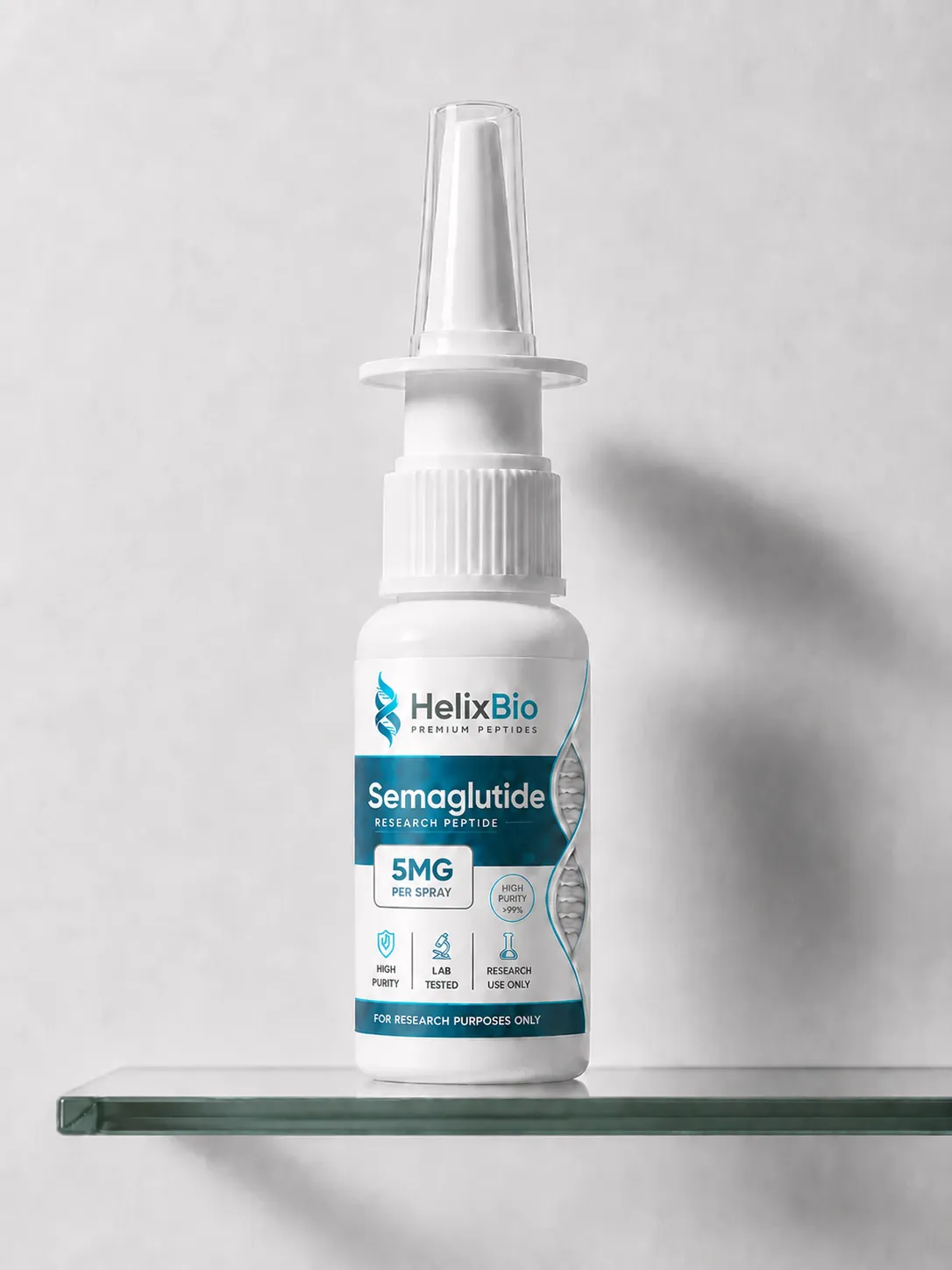
Semaglutide Spray
RESEARCH PEPTIDE
Roughly a sixth of this molecule is not peptide at all. Semaglutide is a 31-residue analogue of glucagon-like peptide-1 carrying a fatty diacid attached to Lys26 through a glutamate and two ethylene-glycol spacers — an engineered side chain that binds albumin and is the reason the molecule persists in circulation for about a week rather than minutes. Helix Bio supplies it, C₁₈₇H₂₉₁N₄₅O₅₉ at 4113.6 g/mol, as a prepared spray solution. This is a research material for qualified laboratory use. It is not a medicine, not a substitute for one, and is not intended for human or veterinary consumption or administration by any route.
This semaglutide research peptide monograph covers the molecule, the GLP-1 receptor mechanism, what the randomised trials measured, and what they do not establish. Four things get conflated constantly. Molecular research describes how a compound behaves. Clinical evidence describes what happened to study subjects in a trial. Regulatory approval describes what a product may be sold to treat. A research-grade material is a laboratory reagent with its own identity questions. A trial result for an approved product says nothing about an unapproved vial.
Every figure below carries its sample size, duration and comparator.
Quick facts
Property | Value |
|---|---|
Compound | Semaglutide |
Class | Long-acting GLP-1 receptor agonist, acylated analogue |
Peptide length | 31 amino acids, GLP-1(7-37) backbone |
Molecular formula | C187H291N45O59 |
Molecular weight | 4,113.58 g/mol |
CAS number | 910463-68-2 |
Homology to human GLP-1 | 94% |
Receptor target | GLP-1 receptor, class B GPCR |
Elimination half-life | Approximately 1 week |
Time to steady state | 4 to 5 weeks of weekly dosing |
Plasma albumin binding | More than 99% |
Design edits | Aib at position 8, Arg at 34, C18 fatty diacid at Lys26 |
One figure needs flagging. Several vendor pages publish a semaglutide half-life of 165 or 168 hours. The FDA label states only "approximately 1 week" and gives no hour figure, so this page follows the label. The 94% homology value also comes from that label.
The three design changes that let semaglutide last a week
Native GLP-1 is cleared fast. Dipeptidyl peptidase-4 clips it near the N-terminus, and the kidneys remove what survives. The published semaglutide structure answers both problems with two amino-acid substitutions and one side-chain modification.
Aib at position 8. Alpha-aminoisobutyric acid replaces alanine at the site DPP-4 attacks, and the label describes position 8 as modified to resist DPP-4 degradation. Blocking that cut keeps the peptide intact in plasma.
Arg at position 34. Arginine replaces lysine. This edit is usually listed without explanation, and the label gives the reason: the substitution ensures that only one fatty diacid attaches. It is a manufacturing-specificity edit, not a potency edit.
C18 fatty diacid at Lys26. A hydrophilic spacer links an eighteen-carbon fatty diacid to lysine 26. The chain binds serum albumin, and albumin binding is the main protraction mechanism, cutting renal clearance and slowing degradation. Over 99% of circulating semaglutide is albumin-bound, and the half-life that follows is approximately one week.
The trade-off is rarely mentioned. Semaglutide's GLP-1 receptor affinity is 0.38 plus or minus 0.06 nM, about three-fold lower than liraglutide's, while albumin affinity is higher. The design bought duration and gave up some receptor binding.
In plain English. One edit stops the enzyme that chews GLP-1 up. One makes sure the fat chain attaches in a single place. The chain itself grips a blood protein, so the peptide rides along and leaves slowly.
What happens after semaglutide binds the GLP-1 receptor
So how does semaglutide work? Semaglutide GLP-1 receptor agonist activity at one target explains everything below. The semaglutide mechanism of action starts there. The GLP-1 receptor is a class B G-protein-coupled receptor. Binding couples to Gs and activates adenylyl cyclase, which raises intracellular cAMP and engages protein kinase A and EPAC2. This pathway is the well-described part of the pharmacology.
Three tissues carry the effects described in the label and the trials.
Pancreas
Receptor activation on beta cells raises insulin secretion, and the effect is glucose-dependent. Release rises when glucose is high, and the stimulus falls away as glucose normalises. Alpha-cell glucagon secretion is suppressed in parallel. That glucose dependence explains a labelling detail: the approved labels flag hypoglycaemia mainly when a GLP-1 agonist is combined with insulin or an insulin secretagogue.
Brain
GLP-1 receptors sit in hypothalamic and brainstem regions involved in appetite, and the broad trial finding is reduced energy intake. The specific neuronal accounting is weaker evidence. POMC and CART activation, and NPY and AgRP inhibition, rest largely on rodent work. Treat that as a proposed pathway with animal support, not an established human mechanism.
Stomach
Gastric emptying slows. The label treats this as a pharmacological effect, and carries a warning about pulmonary aspiration during general anaesthesia or deep sedation. One nuance gets flattened elsewhere. Delayed emptying is clearest early in exposure, and over longer periods the appetite effect appears to do more of the work.
Biased agonism, as described and not as implied
Biased agonism is a live question for incretin analogues. A receptor can favour G-protein signalling over beta-arrestin recruitment, and that balance can change what a cell does. The frequently cited biased-agonism work in this class characterises tirzepatide, not semaglutide. No primary source verified for this page establishes a signalling-bias profile for semaglutide, so this page makes no such claim.
What the randomised trials actually found
The semaglutide clinical trials programme is one of the largest randomised evidence bases of any peptide analogue. Figures below come from the primary publications.
The weight trials
Trial | n | Regimen studied | Duration | Result | Comparator |
|---|---|---|---|---|---|
STEP 1 | 1,961 | 2.4 mg weekly, subcutaneous | 68 weeks | -14.9% | -2.4% placebo |
STEP 2 | 1,210 | 2.4 mg weekly, type 2 diabetes | 68 weeks | -9.6% | -3.4% placebo |
STEP 3 | 611 | 2.4 mg weekly plus behavioural therapy | 68 weeks | -16.0% | -5.7% placebo |
STEP 5 | 304 | 2.4 mg weekly | 104 weeks | -15.2% | -2.6% placebo |
STEP UP | 1,407 | 7.2 mg weekly | 72 weeks | -18.7% | -15.6% at 2.4 mg, -3.9% placebo |
OASIS 4 | 307 | 25 mg oral, daily | endpoint week 64 | -13.6% | -2.2% placebo |
STEP 1 is the anchor. In 1,961 adults with overweight or obesity and without diabetes, the estimated treatment difference was 12.4 percentage points, 95% CI -13.4 to -11.5.
The responder split matters more than the mean. At least 5% weight loss was reached by 1,047 study subjects (86.4%) against 182 (31.5%) on placebo. At least 10% was reached by 69.1% against 12.0%, and at least 15% by 50.5% against 4.9%.
In a diabetes population STEP 2 narrows the effect, and figures circulating for its 1.0 mg comparator arm are not in the published abstract. STEP 3 adds 30 counselling visits and an initial low-calorie diet. STEP 5 extends to two years, with 77.1% against 34.4% reaching at least 5% loss.
One figure in this set needed resolving, and it is STEP UP's. A 20.7% value appears widely, sourced to trade press predating publication. The published treatment-policy result is 18.7%.
The outcome trials
Weight change is a surrogate. These five trials measured events.
SUSTAIN-6 randomised 3,297 adults with type 2 diabetes to 0.5 or 1.0 mg weekly or placebo for 104 weeks. The primary composite occurred in 108 of 1,648 (6.6%) against 146 of 1,649 (8.9%), hazard ratio 0.74, 95% CI 0.58 to 0.95. Two caveats apply. It was designed to test non-inferiority, so it is not a superiority finding. It also produced a signal that still shapes the label. Retinopathy complications were significantly more common, hazard ratio 1.76, 95% CI 1.11 to 2.78.
SELECT enrolled 17,604 adults aged 45 or older with established cardiovascular disease and BMI of 27 or above. A primary event occurred in 569 of 8,803 (6.5%) on 2.4 mg weekly against 701 of 8,801 (8.0%). The hazard ratio was 0.80, 95% CI 0.72 to 0.90, over mean follow-up of 39.8 months. Permanent discontinuation for adverse events ran 16.6% against 8.2%.
FLOW studied kidney outcomes in 3,533 adults with type 2 diabetes and chronic kidney disease, using 1.0 mg weekly. Major kidney disease events were 24% lower, 331 against 410 first events, hazard ratio 0.76, 95% CI 0.66 to 0.88. All-cause death was 20% lower, and the trial stopped early at a prespecified interim analysis.
SOUL tested the oral formulation at up to 14 mg daily in 9,650 adults with type 2 diabetes and cardiovascular or kidney disease. Major adverse cardiovascular events occurred in 579 of 4,825 (12.0%) against 668 of 4,825 (13.8%), hazard ratio 0.86, 95% CI 0.77 to 0.96. One result gets dropped from vendor summaries and belongs here: the confirmatory secondary outcomes, kidney events included, did not differ significantly.
ESSENCE is the MASH trial, and its framing needs care. The published report is a planned interim analysis at week 72, covering the first 800 patients of a 1,197-patient trial running to 240 weeks. Resolution of steatohepatitis without worsening fibrosis reached 62.9% against 34.3%. Fibrosis reduction without worsening steatohepatitis was 36.8% against 22.4%. Both endpoints are histological surrogates, so better biopsy appearance at 72 weeks is not a demonstrated reduction in liver failure, transplant or death.
What happens after it stops
The STEP 1 extension followed 327 study subjects for a year after week 68, once treatment and lifestyle intervention had both ended. Over the treatment phase this subset had lost 17.3% against 2.0%. By week 120 they had regained 11.6 percentage points against 1.9, leaving net losses of 5.6% and 0.1%. The authors describe this as regaining two-thirds of prior weight loss, and all extension analyses were exploratory.
STEP 4 approached the same question by withdrawal design. After a 20-week run-in with mean 10.6% loss, 803 study subjects continued or switched to placebo. From week 20 to week 68, the continued group changed -7.9% while the switched group gained 6.9%. Read together, these describe pharmacology and not willpower. Effect depends on exposure, and it decays when exposure stops.
How to read these numbers
A mean conceals the distribution. STEP 1's 14.9% average contains study subjects who lost over a quarter of their body weight. It also contains roughly one in seven who did not reach 5%.
Relative and absolute risk answer different questions. SELECT's hazard ratio of 0.80 is a 20% relative reduction, and the absolute rates were 6.5% against 8.0%. That is about 1.5 fewer events per 100 people over roughly three years, and only the second framing gives the size of the effect.
Estimands change the number too, and Novo Nordisk funded every semaglutide clinical trial cited here.
What researchers are finding beyond weight
Claimed semaglutide benefits beyond weight vary enormously in evidence quality, so these areas are graded.
Area | Strongest evidence | What it shows | Grade |
|---|---|---|---|
Cardiovascular events | SELECT, n=17,604 | MACE 6.5% vs 8.0%, HR 0.80 | Established, large randomised outcome trial |
Kidney outcomes | FLOW, n=3,533 | Kidney events 24% lower, HR 0.76 | Established, large randomised outcome trial |
Oral cardiovascular | SOUL, n=9,650 | MACE 12.0% vs 13.8%; secondaries not significant | Established for the primary endpoint only |
MASH histology | ESSENCE interim, 800 of 1,197 | Steatohepatitis resolution 62.9% vs 34.3% | Surrogate endpoint, interim, outcomes pending |
Body composition | Systematic review, 35 studies | Median 28.3% of weight lost from muscle indices | Observational synthesis, not pooled |
Alcohol use disorder | Two phase 2 trials, n=48 and n=50 | Primary endpoints missed or partly missed | Small, short, exploratory |
Early Alzheimer's disease | evoke and evoke+, n=3,808 | No slowing of progression | Tested and negative |
Two deserve detail, because the honest reading differs from the promotional one. The alcohol work is two phase 2 trials totalling 98 study subjects, both of which fell short on their primary endpoints.
Alzheimer's disease is a negative result, and a large one. The evoke and evoke+ trials randomised 3,808 study subjects with amyloid-confirmed early Alzheimer's disease. They received oral semaglutide up to 14 mg daily or placebo for up to 156 weeks. Change in Clinical Dementia Rating Sum of Boxes at week 104 showed nothing. The estimated difference was -0.08, p=0.57 in evoke, and 0.10, p=0.46 in evoke+. Both trials were discontinued for negative clinical outcome. Any page listing neuroprotection as a semaglutide benefit without this result is out of date.
Body composition is the most misquoted figure in this space. A 2026 systematic review covered 35 studies. The median share of total weight loss coming from muscle-based indices was 28.3%, IQR 15.9% to 39.9%. Three qualifications usually get stripped off. The review covered liraglutide, semaglutide, tirzepatide and dulaglutide together, so it is not semaglutide-specific. Heterogeneous methods precluded meta-analysis. In the lifestyle and placebo comparator arms, 38% also exceeded the same benchmark, and no study reported objective physical function outcomes. The phenomenon tracks weight loss broadly, not one drug class.
Why oral and injectable semaglutide are not the same formulation
Peptides are poorly absorbed from the gut. The oral formulations pair semaglutide with an absorption enhancer, salcaprozate sodium, which raises local pH and improves uptake across the gastric mucosa. Bioavailability stays low and variable, which is why oral milligram amounts in trials are far larger than injectable ones. OASIS 4 used 25 mg daily and SOUL up to 14 mg daily, against 2.4 mg weekly in STEP 1. Oral and injectable milligram figures are not interchangeable. For the wider oral field see our breakdown of the oral GLP-1 pill race.
What the safety evidence actually shows
Writing about semaglutide side effects goes wrong in one predictable way. Labelled warnings, trial-measured tolerability and unresolved signals are three different categories, and they get merged.
What the trials measured
Gastrointestinal effects dominate and they are common. STEP 1 reported nausea and diarrhoea as the most frequent adverse events, usually transient and mild to moderate. Discontinuation for gastrointestinal events ran 4.5% against 0.8% on placebo. Rates reached 63.5% against 34.3% in STEP 2, 82.8% against 63.2% in STEP 3, and 74.0% against 42.2% in OASIS 4.
Higher exposure costs more tolerability. In STEP UP, gastrointestinal events reached 70.8% at 7.2 mg against 61.2% at 2.4 mg, and dysaesthesia appeared in 22.9% against 6.0%.
What the label warns about
The Ozempic label, revised 05/2026, carries a boxed warning for risk of thyroid C-cell tumours. It also carries ten warnings and precautions sections:
- Thyroid C-cell tumours
- Acute pancreatitis
- Diabetic retinopathy complications
- Never sharing a pen between patients
- Hypoglycaemia with insulin secretagogues or insulin
- Acute kidney injury from volume depletion
- Severe gastrointestinal adverse reactions
- Hypersensitivity reactions
- Acute gallbladder disease
- Pulmonary aspiration during general anaesthesia or deep sedation
Two distinctions matter. The thyroid warning rests on rodent C-cell tumour findings, and human relevance is undetermined. There is also no separate label section for gastroparesis, because delayed gastric emptying is a pharmacological effect.
Signals where the evidence conflicts
Eyes. This is the clearest live disagreement in the literature. The randomised evidence is SUSTAIN-6, which found retinopathy complications significantly more common at hazard ratio 1.76, 95% CI 1.11 to 2.78. Diabetic retinopathy complications are a labelled warning.
On non-arteritic anterior ischaemic optic neuropathy, two 2026 systematic reviews reach opposite conclusions. One was restricted to semaglutide and pooled eight cohorts covering 14,255,247 participants. It reports increased risk at pooled hazard ratio 3.36, 95% CI 1.44 to 7.84 at one year. The other covered 28 observational studies of the whole GLP-1 class, and found no increase at relative risk 1.01, 95% CI 0.62 to 1.64.
Heterogeneity was extreme in both, at I-squared 97% and 89%. These are observational datasets with different comparators, and they cannot settle causation. A single frequency estimate is not supportable, so this page publishes none.
Mood. In January 2026 the FDA asked application holders to remove suicidal ideation and behaviour risk information from the GLP-1 labels that carried it. It stated that it found no increased risk. The review drew on a meta-analysis of 91 placebo-controlled trials covering 107,910 patients. It also drew on an FDA Sentinel claims study of about 2.2 million patients.
The FDA states its own limitations. Individual trials had few events, and the Sentinel analysis is retrospective claims data with an active comparator. The agency says the evidence does not support a causal link, not that all risk is excluded.
How semaglutide differs from other GLP-1 compounds
Receptor count and duration are the short version.
Compound | Receptor targets | Notes |
|---|---|---|
Native GLP-1 | GLP-1 | Minutes of circulating half-life |
Exendin-4 | GLP-1 | Short-acting, lizard-venom derived, not a human GLP-1 analogue |
Liraglutide | GLP-1 | Once daily, higher receptor affinity than semaglutide |
Semaglutide | GLP-1 | Once weekly injectable, once daily oral |
Tirzepatide | GIP and GLP-1 | Once weekly |
Retatrutide | GIP, GLP-1 and glucagon | Once weekly, investigational |
On semaglutide vs tirzepatide, one head-to-head trial matters. SURMOUNT-5 randomised 751 adults with obesity and without diabetes for 72 weeks, and weight fell 20.2% with tirzepatide against 13.7% with semaglutide. The trial was open-label, a genuine limitation in a weight outcome.
The full comparison lives elsewhere on this site. For mechanism see our tirzepatide monograph and the cagrilintide and CagriSema monograph. For side-by-side tables see retatrutide against tirzepatide against semaglutide and the trial-data comparison.
What US approval means for semaglutide research
Semaglutide is approved in the United States under several brand names and formulations, each with its own labelled indications. Injectable and oral products are distinct applications with distinct labels.
The line that matters for a research buyer is prescribable against purchasable. An approved product carries an FDA-reviewed label, an accountable manufacturer, and indications supported by the trials above. A research-grade material carries none of that, and FDA states that unapproved versions do not undergo its review for safety, effectiveness or quality. Nothing in the trial evidence here transfers to an unapproved vial.
Where the compounding rules stand in 2026
FDA declared the semaglutide shortage resolved on 21 February 2025. The 503A transition period ended 22 April 2025, and the 503B period ended 22 May 2025.
Two restrictions still govern. Under 503A, compounders may not produce essential copies of commercially available drugs regularly or in inordinate amounts. Under 503B, a facility may use a bulk substance in only two cases. It must sit on the 503B bulks list, or the drug must be on FDA's shortage list when compounded. FDA states that semaglutide and tirzepatide appear on neither.
Salt forms are treated separately. FDA states that semaglutide sodium and semaglutide acetate are different active ingredients from those in the approved drugs. It is also not aware of any lawful basis for their use in compounding. A salt form is not interchangeable with semaglutide base.
One FDA statement speaks directly to research-use labelling. The agency has warned companies that illegally sold unapproved semaglutide, tirzepatide, retatrutide, survodutide or mazdutide. Those products carried research-purpose or not-for-human-consumption labels, and were in fact sold to consumers for human use with dosing instructions. A research-use label does not make a product lawful to sell for human use.
For the full legal picture see our articles on compounded semaglutide and tirzepatide legality and the FDA 503A bulks list vote.
What a research-grade quality report should establish
A certificate of analysis answers narrow questions, and knowing which ones is the whole skill.
Identity and chemical form. Does the material contain the intended molecule, as base or as a named salt? Retention time alone cannot say; mass spectrometry can, by confirming molecular mass against the expected 4,113.58 g/mol. The form belongs on the report explicitly, because FDA treats semaglutide sodium and semaglutide acetate as different active ingredients from the base.
Purity. An HPLC purity percentage is a relative measure of peak area under one stated method. It is not mass, net peptide content, sterility, endotoxin status or proof of identity. A high percentage on a method that cannot resolve a given impurity says nothing about that impurity.
Quantity, method and lot. A nominal milligram amount is a declaration, not a measurement, and net peptide content needs its own assay. The report should name the method, state the specification, give the actual result, and match the lot in hand by number and test date.
What else to request. Microbial and endotoxin testing, residual solvents, heavy metals and water content. A purity figure implies none of them.
A certificate cannot establish biological activity, suitability for human use, or equivalence to an approved product. For the analytical detail see our guide to reading a peptide certificate of analysis and the purity testing and contamination data.
What laboratory handling information can and cannot establish
Semaglutide is an acylated peptide, and acylated peptides bring characteristic handling problems. The fatty-acid chain promotes surface adsorption and self-association, so material can be lost to container walls and can aggregate in solution.
General handling notes cannot establish how one lot behaves in a given buffer at a given concentration. Supplier documentation for the exact material governs.
This page gives no preparation recipes, solvent volumes, reconstitution procedures or administration methods, and that absence is deliberate. For general principles see our articles on storage mistakes that degrade research compounds and the reconstitution and stability guide. The Semaglutide Spray product page carries the specification for that material.
What this evidence does not establish
Animal findings do not establish human outcomes. Rodent thyroid C-cell tumour data drive a boxed warning, and human relevance is undetermined. The neuronal appetite circuitry above rests substantially on rodent work.
Phase 2 exploratory findings do not establish benefit. The two alcohol trials total 98 study subjects and both missed their primary endpoints.
Surrogate endpoints do not establish clinical outcomes. ESSENCE's histological gains came at a week-72 interim analysis in 800 of 1,197 patients.
Sponsor topline statements establish nothing publishable, so press-release figures without a peer-reviewed publication are excluded here.
Observational syntheses do not establish causation. The two 2026 eye reviews disagree, with extreme heterogeneity in both.
A positive primary endpoint does not validate every secondary. SOUL met its primary endpoint and its confirmatory secondaries did not differ significantly.
Trials of approved medicines establish nothing about a research-grade material. Every figure here came from a manufacturer's product made to a filed specification.
A research-use label establishes no legal or safety status. FDA has warned companies that used exactly that labelling while selling to consumers for human use.
The trial windows have edges. The longest randomised weight data run to 104 weeks, and SELECT's mean follow-up was 39.8 months.
Frequently Asked Questions
Gastrointestinal effects are the most frequently reported in research, and nausea leads them. STEP 1 recorded nausea and diarrhoea as the most common adverse events, usually transient and mild to moderate, and gastrointestinal event rates across trials ran from 63.5% to 82.8% against 34.3% to 63.2% on placebo. The most serious labelled concern is different: a boxed warning for thyroid C-cell tumours, based on rodent data with undetermined human relevance.
At the mechanism level, GLP-1 receptor activation reduces appetite through hypothalamic and brainstem pathways, slows gastric emptying, and raises glucose-dependent insulin secretion while suppressing glucagon. Reduced hunger and steadier glucose are plausible contributors to reported subjective change. Subjective wellbeing was not a primary endpoint in any trial cited here, so this is a mechanistic explanation and not a measured finding.
Three design edits. Aib at position 8 blocks the DPP-4 cleavage site, Arg at position 34 ensures a single fatty diacid attaches, and a C18 fatty diacid on Lys26 binds serum albumin. Albumin binding is the main protraction mechanism, with over 99% of circulating semaglutide albumin-bound, giving an elimination half-life of approximately one week.
The fatty diacid chain grips serum albumin, and the bound fraction exceeds 99%. Albumin-bound peptide is shielded from renal filtration and enzymatic breakdown, and releases slowly back into circulation. Steady state is reached after four to five weeks of weekly dosing in trial protocols.
In STEP 1, 86.4% reached at least 5% weight loss against 31.5% on placebo, 69.1% reached at least 10% against 12.0%, and 50.5% reached at least 15% against 4.9%. Roughly one in seven did not reach 5%. STEP 5 reported 77.1% against 34.4% at two years.
It depends on continued exposure. In the STEP 1 extension, 327 study subjects followed for a year after stopping regained two-thirds of their lost weight, 11.6 percentage points of a 17.3% loss. STEP 4 showed the mirror image, with continued treatment producing a further 7.9% loss while the withdrawal group gained 6.9%.
In the one direct head-to-head trial, tirzepatide produced more weight loss. SURMOUNT-5 randomised 751 adults with obesity and without diabetes for 72 weeks, and weight fell 20.2% with tirzepatide against 13.7% with semaglutide. The trial was open-label, and weight loss is one endpoint among several.
No. GLP-1 receptor agonist is a drug class, semaglutide is one molecule in that class, and Ozempic is one brand of semaglutide. Semaglutide is sold under other brand names in other formulations, each with its own label.
One. Semaglutide is a single 31-amino-acid peptide on the GLP-1(7-37) backbone, with two amino-acid substitutions and a fatty diacid at Lys26. It is not a blend, so a certificate of analysis should characterise one molecular entity.
No. The randomised evidence shows reduced cardiovascular events in a defined population, reduced kidney events in type 2 diabetes with chronic kidney disease, and improved liver histology at an interim analysis. Those are risk reductions and surrogate improvements over defined windows, and effects decay once exposure stops.
The long term is only partly characterised. The longest randomised weight data run to 104 weeks, and SELECT's mean follow-up was 39.8 months. Labelled concerns include pancreatitis, gallbladder disease, retinopathy complications, acute kidney injury and the rodent-based thyroid warning. The eye signals remain open, with two 2026 reviews in conflict.
Diabetic retinopathy complications are a labelled warning, and the randomised evidence behind it is SUSTAIN-6, which found them significantly more common at hazard ratio 1.76. On non-arteritic anterior ischaemic optic neuropathy the picture is unresolved: a 2026 semaglutide-specific review reported raised risk at pooled hazard ratio 3.36 at one year, while a 2026 class-wide review found no increase at relative risk 1.01. Neither establishes causation.
This page does not rank them, because the comparative evidence does not exist. Each approved product carries its own label and warnings, and the head-to-head trials measured efficacy endpoints, not safety hierarchies. SURMOUNT-5 described the adverse-event profiles of tirzepatide and semaglutide as broadly similar, mostly gastrointestinal and concentrated during dose escalation.
Helix Bio Chem supplies semaglutide as a research material for laboratory use only, and the specification sits on the Semaglutide Spray product page. It is not a medicine, and FDA has not evaluated it for safety, effectiveness or quality. FDA has warned companies that sold unapproved GLP-1 compounds under research-use labelling while supplying consumers for human use.
- 01Lau J, Bloch P, Schaffer L, et al. Discovery of the once-weekly glucagon-like peptide-1 (GLP-1) analogue semaglutide. J Med Chem 2015;58(18):7370-80.
- 02US Food and Drug Administration. Ozempic (semaglutide) injection, prescribing information. Revised 05/2026.
- 03Wilding JPH, Batterham RL, Calanna S, et al. Once-weekly semaglutide in adults with overweight or obesity (STEP 1). N Engl J Med 2021;384:989-1002.
- 04Davies M, Faerch L, Jeppesen OK, et al. Semaglutide 2.4 mg once a week in adults with overweight or obesity, and type 2 diabetes (STEP 2). Lancet 2021;397(10278):971-84.
- 05Wadden TA, Bailey TS, Billings LK, et al. Effect of subcutaneous semaglutide vs placebo as an adjunct to intensive behavioral therapy on body weight (STEP 3). JAMA 2021;325(14):1403-13.
- 06Garvey WT, Batterham RL, Bhatta M, et al. Two-year effects of semaglutide in adults with overweight or obesity (STEP 5). Nat Med 2022;28:2083-91.
- 07Wharton S, Freitas P, Hjelmesaeth J, et al. Once-weekly semaglutide 7.2 mg in adults with obesity (STEP UP). Lancet Diabetes Endocrinol 2025;13(11):949-63.
- 08Wharton S, Lingvay I, Bogdanski P, et al. Oral semaglutide at a dose of 25 mg in adults with overweight or obesity (OASIS 4). N Engl J Med 2025;393(11):1077-87.
- 09Rubino D, Abrahamsson N, Davies M, et al. Effect of continued weekly subcutaneous semaglutide vs placebo on weight loss maintenance (STEP 4). JAMA 2021;325(14):1414-25.
- 10Wilding JPH, Batterham RL, Davies M, et al. Weight regain and cardiometabolic effects after withdrawal of semaglutide: the STEP 1 trial extension. Diabetes Obes Metab 2022;24(8):1553-64.
- 11Marso SP, Bain SC, Consoli A, et al. Semaglutide and cardiovascular outcomes in patients with type 2 diabetes (SUSTAIN-6). N Engl J Med 2016;375(19):1834-44.
- 12Lincoff AM, Brown-Frandsen K, Colhoun HM, et al. Semaglutide and cardiovascular outcomes in obesity without diabetes (SELECT). N Engl J Med 2023;389:2221-32.
- 13Perkovic V, Tuttle KR, Rossing P, et al. Effects of semaglutide on chronic kidney disease in patients with type 2 diabetes (FLOW). N Engl J Med 2024;391:109-21.
- 14McGuire DK, Marx N, Mulvagh SL, et al. Oral semaglutide and cardiovascular outcomes in high-risk type 2 diabetes (SOUL). N Engl J Med 2025;392(20):2001-12.
- 15Sanyal AJ, Newsome PN, Kliers I, et al. Phase 3 trial of semaglutide in metabolic dysfunction-associated steatohepatitis (ESSENCE, part 1). N Engl J Med 2025;392(21):2089-99.
- 16Cummings JL, Atri A, Sano M, et al. Efficacy and safety of oral semaglutide 14 mg in early-stage symptomatic Alzheimer's disease (evoke and evoke+). Lancet 2026;407(10544):2167-79.
- 17Hendershot CS, Bremmer MP, Paladino MB, et al. Once-weekly semaglutide in adults with alcohol use disorder: a randomized clinical trial. JAMA Psychiatry 2025;82(4):395-405.
- 18Schacht JP, Sakai JT, Raymond K, Shelton R. Oral semaglutide for alcohol use disorder: a randomized clinical trial. Am J Psychiatry 2026;183(9):636-45.
- 19Batsis JA, Gavras A, Gross DC, et al. Effect of incretin-based and nonpharmacologic weight loss on body composition: a systematic review. Ann Intern Med 2026;179(7):996-1013.
- 20Lampsas S, Agapitou C, Oikonomou E, et al. Semaglutide and risk of non-arteritic anterior ischemic optic neuropathy (NAION) in type 2 diabetes mellitus: a systematic review and meta-analysis. Graefes Arch Clin Exp Ophthalmol 2026;264(9):2611-21.
- 21Anatriello A, Liguori V, Cagnotta C, et al. Ocular disorders during treatment with GLP-1 receptor agonists: a systematic review and meta-analysis of observational studies. Front Pharmacol 2026;17:1808359.
- 22Aronne LJ, Horn DB, le Roux CW, et al. Tirzepatide as compared with semaglutide for the treatment of obesity (SURMOUNT-5). N Engl J Med 2025;393(1):26-36.
- 23US Food and Drug Administration. FDA clarifies policies for compounders as national GLP-1 supply begins to stabilize. Content current as of 04/01/2026.
- 24US Food and Drug Administration. FDA's concerns with unapproved GLP-1 drugs used for weight loss. Content current as of 10/01/2026.
- 25US Food and Drug Administration. Drug safety communication: FDA requests removal of suicidal behavior and ideation warning from GLP-1 receptor agonist medications. 13 January 2026.
- 26US Food and Drug Administration. FDA intends to take action against non-FDA-approved GLP-1 drugs. Press announcement, 6 February 2026.
Helix Bio Chem Team
Research & Product Team
Our in-house team tracks published peptide research and translates it into clear, source-cited summaries for the research community.
Reviewed by in-house research chemists
support@helixbiochem.com