Tirzepatide Research Peptide: Dual GIP and GLP-1 Agonism Explained
Metabolic researchSeptember 17, 202613 min read
Tirzepatide engages GIPR and GLP-1R unequally. What the receptor data, the trial record and the current FDA labeling actually establish about the molecule.
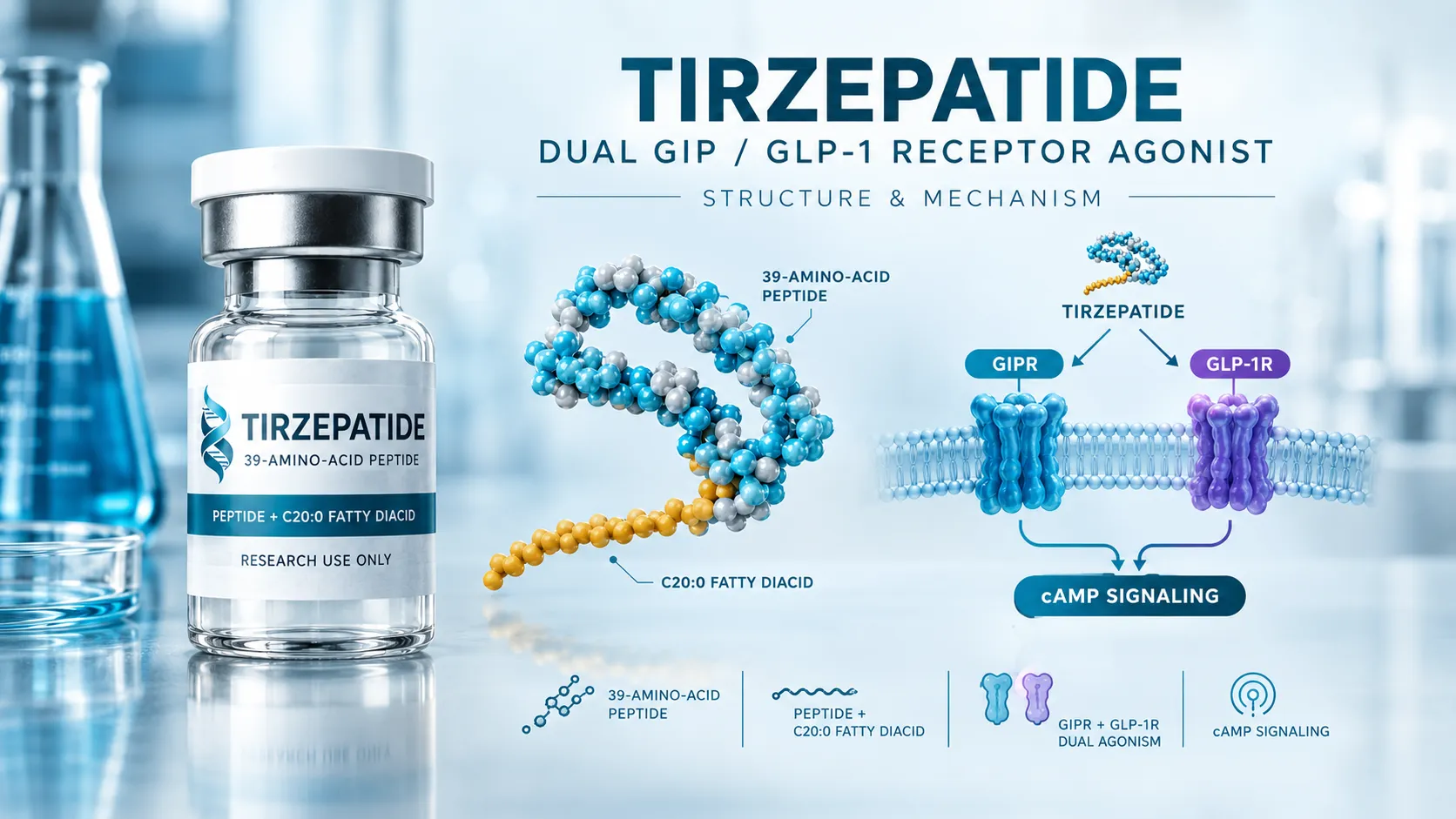
Tirzepatide is a 39-amino-acid linear synthetic peptide based on the GIP sequence, with a molecular weight of 4813.53 Da and the empirical formula C225H348N48O68 per FDA labeling.
Tirzepatide binds GIPR with affinity comparable to native GIP but binds GLP-1R roughly 5-fold more weakly than native GLP-1, which is what imbalanced agonism means.
In albumin-free low-receptor-density cAMP assays, tirzepatide was equipotent with GIP at GIPR and approximately 18 to 20-fold less potent than GLP-1 at GLP-1R.
At GLP-1R tirzepatide shows under 10% maximal efficacy for beta-arrestin-2 recruitment and internalizes the receptor to roughly 40% of the GLP-1 maximum, while behaving like native GIP at GIPR.
Predicted receptor occupancy figures for tirzepatide are modeled estimates derived from albumin binding and measured plasma concentrations, not direct measurements in humans.
SURPASS-CVOT found tirzepatide noninferior but not superior to dulaglutide for three-point MACE, with a hazard ratio of 0.92 and a superiority P value of 0.09.
Tirzepatide is the FDA-approved active ingredient in Mounjaro and Zepbound; the phrase research peptide is a commercial and search term, not a scientific or regulatory classification.
FDA proposed on 30 April 2026 to exclude tirzepatide from the 503B Bulks List, and as of this writing that proposal has not been finalized.
Analytical identity, chromatographic purity, and quantitative content are three separate determinations, and no one of them substitutes for the others.
Semaglutide is a 31-residue GLP-1-only analogue near 4113.6 Da, separating it from tirzepatide by roughly 700 Da in a single mass run.
Two receptors, one molecule, unequal engagement. That asymmetry is the most consistently misreported fact about tirzepatide, and it is the reason most explanations of the compound stop short of what the primary pharmacology actually says. Dual agonism is not balanced agonism. This page covers molecular identity, what the receptor-level work demonstrated and under which conditions, what the randomized human evidence establishes, how the material can be analytically characterized, and how the search phrase "tirzepatide research peptide" relates to the molecule's actual regulatory standing.
Featured In This Article
GLP-1TRZ
RESEARCH PEPTIDE
Highly purified synthetic peptide prepared for rigorous laboratory research.
$83.00
What tirzepatide is, in one section
Tirzepatide (development code LY3298176) is a 39-amino-acid linear synthetic peptide with agonist activity at both the glucose-dependent insulinotropic polypeptide receptor (GIPR) and the glucagon-like peptide-1 receptor (GLP-1R). Its sequence is based on native GIP rather than GLP-1. The FDA-approved labeling states the molecular weight as 4813.53 Da and the empirical formula as C225H348N48O68.
Tirzepatide is the active pharmaceutical ingredient in FDA-approved medicines. It is not an unapproved experimental molecule, and that distinction runs through the rest of this page.
**Research framing.** Everything below describes published laboratory and clinical findings. Research-grade material supplied under research-use-only terms is a laboratory reagent, not an approved drug product, and nothing here is administration guidance.
The design choices that make it not simply modified GIP
Calling tirzepatide "modified GIP" collapses several deliberate engineering decisions into one phrase. The approved labeling describes the specific architecture: the peptide is based on the GIP sequence, contains aminoisobutyric acid (Aib) at positions 2 and 13, carries a C-terminal amide, and has a lysine at position 20 attached to 1,20-eicosanedioic acid through a linker.
Each element does a defined job. Aib is a non-proteinogenic residue that sits where dipeptidyl peptidase-4 would otherwise cleave the backbone. The C20 fatty diacid at Lys20 enables albumin binding, and the label states tirzepatide is 99% bound to plasma albumin with an elimination half-life of roughly 5 to 6 days. The originating paper describes the molecule as having been discovered by engineering GLP-1 activity into the GIP sequence.
The accurate short description is therefore: a synthetic 39-residue peptide whose sequence derives from endogenous GIP, engineered through amino-acid substitution and lipidation to activate two receptors while extending systemic exposure.
Why GIP was written off, and what changed
Both GIP and GLP-1 are incretins, released from the gut after nutrient intake, and both act through class B G-protein-coupled receptors that raise intracellular cAMP. Both enhance insulin secretion in a glucose-dependent manner. GLP-1R activation also slows gastric emptying and reduces food intake.
GIP spent decades as the less interesting incretin. A 1993 human study by Nauck and colleagues infused synthetic human GIP and GLP-1 into nine people with type 2 diabetes and nine matched controls under hyperglycemic clamp conditions, and found GLP-1's insulinotropic activity preserved in the diabetic group while GIP's was markedly reduced. That finding shaped therapeutic development toward GLP-1 for years.
What changed was not a reinterpretation of that study. What changed was a molecule that engages both receptors and outperformed a selective GLP-1 receptor agonist in a head-to-head trial, which made the contribution of the GIPR arm a live question rather than a settled one. It remains a question. Attributing specific clinical outcomes to the GIPR arm is not something the receptor data can do on its own.
The dual-receptor pharmacology map
This table is built from the Willard et al. study (JCI Insight, 2020, PMID 32730231), which is the primary pharmacology paper for this molecule. Every value carries its experimental system with it, because those conditions are what make the numbers meaningful.
Layer
GIPR
GLP-1R
Native ligand
GIP(1-42)
GLP-1(7-36) amide
Binding affinity vs native
Comparable to native GIP
Approximately 5-fold weaker than native GLP-1
cAMP potency, low-density cells, albumin-free
Equipotent with GIP
Roughly 18 to 20-fold lower than GLP-1
cAMP kinetic profile
Similar to native GIP
Monophasic; GLP-1 was biphasic at high concentration
GTP-gamma-S, Gas activation
Full agonist, EC50 0.379 nM
Partial agonist, 51% stimulation, EC50 0.617 nM
Beta-arrestin-2 recruitment
Full agonist, near-equipotent with GIP
The occupancy row deserves a note. Those percentages come from a modeling exercise the authors built by measuring albumin binding (dissociation constant 1.86 micromolar by modified Schild regression), deriving free drug concentration from measured total plasma concentrations in clinical studies, then applying the Hill-Langmuir equation. The authors themselves flag its caveats and propose it mainly for generating hypotheses. It is a calculated estimate, not a measurement of receptor occupancy in a person.
What imbalanced means, and what it does not
Four terms get used interchangeably in secondary coverage and should not be. Affinity is how tightly the molecule binds. Potency is the concentration needed for half-maximal response in a given assay. Efficacy is how much response the molecule can produce at saturation. Occupancy is what fraction of receptors are engaged at a given free concentration. Tirzepatide differs from the native ligands on all four axes, differently at each receptor.
Imbalanced describes that pattern: comparable engagement at GIPR, weaker engagement at GLP-1R. It does not mean incomplete, defective, or that one receptor arm is irrelevant. The Willard authors frame the imbalance as potentially useful, since escalating a selective GLP-1R agonist is limited by gastrointestinal effects while GIPR engagement is not known to be associated with the same events. That is a stated rationale, not a demonstrated causal chain.
Biased agonism, and the line the evidence stops at
Biased agonism means a ligand at a given receptor preferentially drives one downstream pathway over another rather than activating all of them proportionally. At GLP-1R, tirzepatide strongly stimulates cAMP while recruiting beta-arrestin poorly, and it internalizes the receptor far less than GLP-1 does. At GIPR it behaves much more like native GIP across the same readouts.
The functional test came from primary islets. In mice with beta-cell deletion of beta-arrestin-1, glucose-stimulated insulin secretion rose, and the insulin response to GLP-1 rose. The responses to GIP and to tirzepatide did not differ between genotypes. Read carefully, that result says beta-arrestin-1 restrains the GLP-1 response and does not restrain the tirzepatide response in that ex vivo mouse islet system.
That is functional mechanistic evidence in an experimental islet model. It is not evidence that the same mechanism operates in humans, and it is not evidence that signaling bias causes any clinical outcome. The causal link between cellular signaling bias and specific human results has not been directly established. The signaling profile is a plausible mechanistic contributor and should be described as one.
What the randomized human evidence establishes
The clinical record is large. This table shows its architecture rather than reproducing its percentages.
Trial
Population
Design
Main question
Main reported finding
Main limitation
SURPASS-1 (PMID 34186022)
Type 2 diabetes, inadequately controlled on diet and exercise
Greater HbA1c and body-weight reduction than placebo
Placebo comparator; drug-naive population limits generalization
SURPASS-2 (PMID 34170647)
Type 2 diabetes on metformin
40-week open-label randomized phase 3, n=1879
Head-to-head vs semaglutide 1 mg
Noninferior and superior to semaglutide for HbA1c change at 40 weeks
Open-label; one semaglutide dose tested, in one population
SURPASS-CVOT is the one most often reported loosely. The correct framing is noninferiority for MACE against dulaglutide. It was not superior on the primary endpoint. FDA approved a cardiovascular risk-reduction indication for Mounjaro on that evidence on 28 August 2026.
Current FDA status, as of this writing
Tirzepatide is the active ingredient in two approved products, both from Eli Lilly: Mounjaro, first approved in 2022, and Zepbound, first approved in November 2023.
Mounjaro is indicated as an adjunct to diet and exercise to improve glycemic control in adults and pediatric patients 10 years and older with type 2 diabetes, and since August 2026 also to reduce the risk of major adverse cardiovascular events in adults with type 2 diabetes at high risk for them.
Zepbound is indicated, in combination with a reduced-calorie diet and increased physical activity, to reduce excess body weight and maintain that reduction long term in adults with obesity or with overweight plus at least one weight-related comorbid condition, and to treat moderate-to-severe obstructive sleep apnea in adults with obesity. The current Zepbound prescribing information carries a revision date of August 2026 and logs recent changes across January, February and August 2026.
Labels move. Verify the current prescribing information directly before relying on any indication statement, including this one.
Where the phrase "research peptide" actually sits
"Tirzepatide research peptide" is a commercial and search-behavior phrase. It is not a scientific classification and not an FDA category. Research-use-only is a product-labeling and business-policy framing applied by a supplier to material it sells; it says nothing about the molecule's regulatory standing, because the molecule is an approved active ingredient regardless of who labels a vial.
The converse also holds, and matters more. RUO labeling does not make a vial equivalent to an approved drug product. An approved product carries a defined formulation, manufacturing controls, and a label reviewed by the agency. Research material carries none of that by virtue of containing the same molecule.
Compounding: three separate regulatory questions
These get conflated constantly, so take them one at a time.
Shortage status. FDA determined the tirzepatide injection shortage resolved on 19 December 2024. Compounding pathways that depend on shortage-list inclusion closed with it, and enforcement-discretion windows ended in 2025.
503B bulks list. On 30 April 2026 FDA proposed not to include semaglutide, tirzepatide and liraglutide on the 503B Bulks List, having identified no clinical need for outsourcing facilities to compound them from bulk substances. The Federal Register notice published 1 May 2026, and the comment period was extended to 30 July 2026. As of this writing, that remains a proposal. No final determination has been announced. It is not a rule, not a ban, and should not be described as either.
503A. The April 2026 proposal concerns 503B outsourcing facilities. Traditional 503A compounding operates under separate statutory criteria, including patient-specific prescriptions and restrictions on essentially copying commercially available drug products, plus state law.
Analytical characterization, and what each test settles
Four questions get asked of a certificate of analysis, and they are not the same question.
Question
What answers it
What it does not establish
Identity: is this the intended molecular entity?
Mass confirmation by LC-MS against the expected 4813.53 Da; peptide mapping by LC-MS/MS where sequence and modification confirmation is justified
Mass alone does not confirm stereochemistry, nor that Aib sits at positions 2 and 13 rather than elsewhere
Purity: what share of detected material is the principal component?
RP-HPLC area percentage under a stated method
Says nothing about identity, and nothing about how much peptide the vial holds
Assay or content: how much active peptide is present?
A quantitative content determination against a reference standard
Not derivable from a purity percentage
Related substances: what else is detectable?
The full chromatogram, not the headline figure
A single number hides the impurity profile
The lipidation makes this molecule harder than an unmodified peptide. A deletion or an incorrectly assembled linker can sit close to the parent in both retention time and mass, so the combination of methods carries the identity claim rather than any one of them.
Purity is not identity is not assay is not formulation quality. Our guide to reading a peptide certificate of analysis works through the fields, and our review of published peptide contamination testing covers what independent analysis of market material has found. No COA needs to include every possible test; what matters is that the tests it does include are named, are tied to the lot in hand, and are read for what they measure.
How it differs from semaglutide
Strictly as entity disambiguation. Semaglutide is a 31-residue GLP-1 analogue with a C18 fatty diacid at Lys26 and Aib at position 8, molecular weight near 4113.6 Da, and it engages GLP-1R only. Tirzepatide is 39 residues, GIP-derived, C20-lipidated at Lys20, and engages two receptors unequally with the biased GLP-1R profile described above. On a mass basis the two are roughly 700 Da apart, which separates them in a single run.
SURPASS-2 compared them directly and tirzepatide was superior for HbA1c change in that trial. That is a population-specific result against one semaglutide dose in an open-label design, and it does not generalize into a universal ranking. The full class comparison lives on our agonist comparison article.
What this evidence does not establish
Receptor signaling does not explain every clinical outcome. Biased agonism has not been shown to cause the clinical results. Predicted receptor occupancy is a modeled quantity, not an endpoint. Cell and mouse findings do not substitute for human data. Approval for specified indications is not approval for every use. "Research peptide" is not a scientific identity. And a purity percentage does not describe a molecule.
Each is a place where secondary coverage routinely overreaches. Holding them apart separates an accurate account of this molecule from a merely confident one.
Got Questions?
Frequently Asked Questions
Tirzepatide is a 39-amino-acid linear synthetic peptide that activates both the GIP receptor and the GLP-1 receptor. Its sequence derives from native GIP and it carries a C20 fatty diacid at lysine 20 that binds albumin and extends systemic exposure. It is the active pharmaceutical ingredient in the FDA-approved products Mounjaro and Zepbound.
Yes. It is a linear synthetic peptide of 39 amino acids with a C-terminal amide, containing two aminoisobutyric acid residues at positions 2 and 13 and a lipid moiety attached through a linker at lysine 20. Its molecular weight is 4813.53 Da and its empirical formula is C225H348N48O68.
Both are incretin hormones released from the gut after nutrient intake, and both act at class B G-protein-coupled receptors that raise intracellular cAMP. Both enhance insulin secretion in a glucose-dependent manner; GLP-1 receptor activation additionally slows gastric emptying and reduces food intake in research models.
A single molecule carries binding determinants for both receptors because GLP-1 receptor activity was engineered into a GIP-derived sequence. Published receptor pharmacology shows measurable agonist activity at each receptor, though not to the same degree at both.
It means one molecule produces agonist activity at two distinct receptor targets rather than one. It does not imply equal affinity, equal potency, equal efficacy, or equal receptor occupancy at the two targets.
The Willard et al. study reported affinity at GIPR comparable to native GIP alongside roughly 5-fold weaker GLP-1R affinity than native GLP-1, with a corresponding potency difference in cAMP assays. Modeled receptor occupancy at clinically relevant exposures was higher at GIPR than at GLP-1R, which is the basis for the term.
At the GLP-1 receptor, tirzepatide strongly stimulates cAMP while recruiting beta-arrestin with low efficacy and driving less receptor internalization than native GLP-1. At the GIP receptor it behaves more like native GIP across the same readouts. These findings come from cell-based systems and ex vivo primary islets.
No. The signaling bias is demonstrated experimentally in cell systems and in a mouse islet model, and it is a plausible mechanistic contributor. The causal link between cellular signaling bias and specific human clinical outcomes has not been directly established.
The record includes the SURPASS program in type 2 diabetes, the SURMOUNT program in obesity and obstructive sleep apnea, SUMMIT in heart failure with preserved ejection fraction and obesity, and SURPASS-CVOT in type 2 diabetes with established atherosclerotic cardiovascular disease. Each trial answers its own question in its own population, and results do not transfer across populations.
Yes, as the active ingredient in approved drug products. Mounjaro is indicated for glycemic control in type 2 diabetes and, since August 2026, for reducing major adverse cardiovascular event risk in at-risk adults with type 2 diabetes. Zepbound is indicated for chronic weight reduction and maintenance in specified adults and for moderate-to-severe obstructive sleep apnea in adults with obesity.
FDA determined the tirzepatide shortage resolved in December 2024, closing shortage-dependent compounding pathways. On 30 April 2026 FDA proposed not to include tirzepatide on the 503B Bulks List, with the comment period extended to 30 July 2026; as of this writing that proposal has not been finalized. The proposal concerns 503B outsourcing facilities, which operate under different criteria than 503A compounding.
RP-HPLC assesses chromatographic purity under a stated method, LC-MS confirms molecular mass against the expected value, peptide mapping by LC-MS/MS can confirm sequence and modification where justified, and a separate quantitative determination establishes content. Purity, identity and assay are three different results and none substitutes for another.