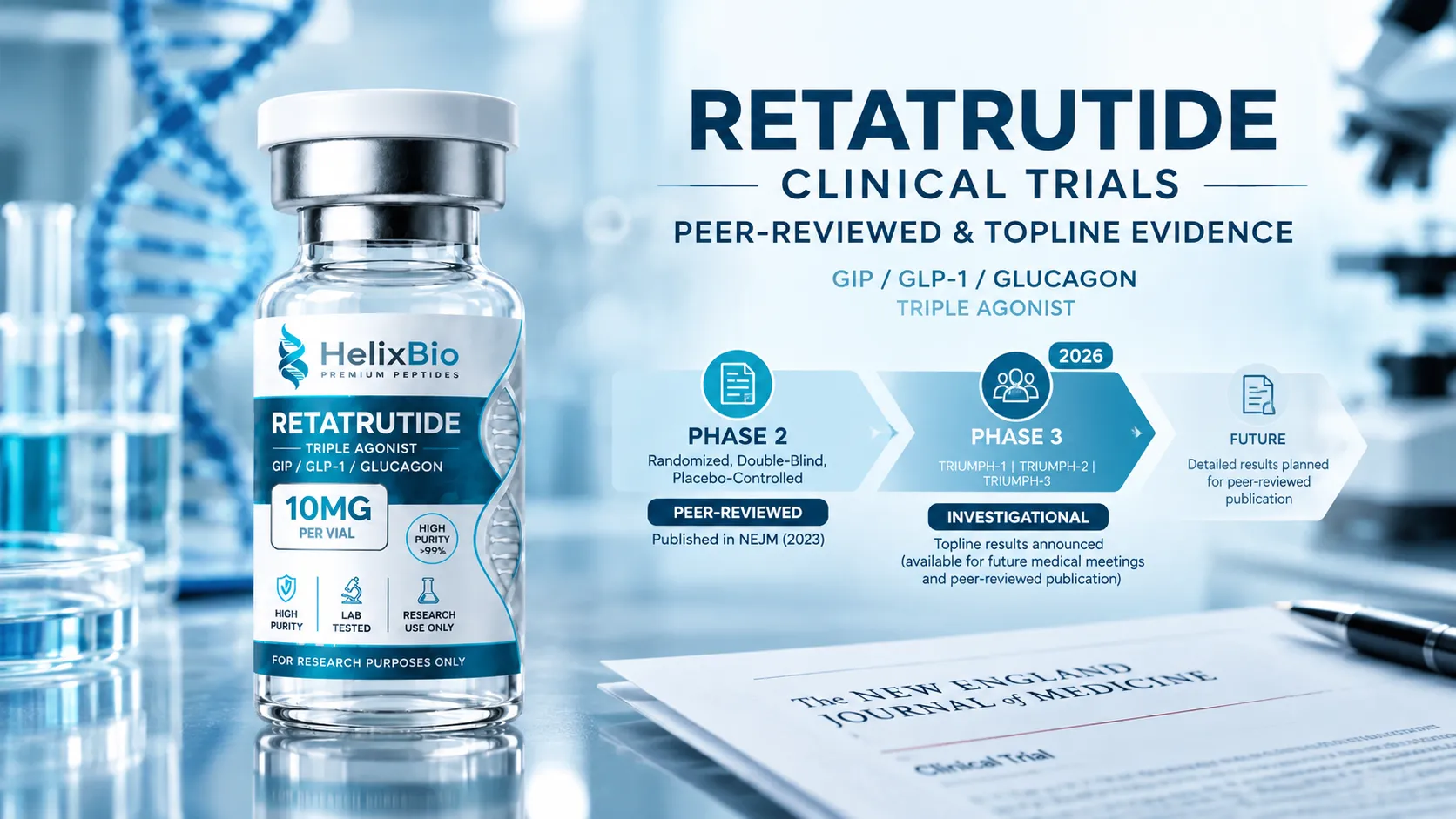
Retatrutide (LY3437943) is an investigational single-molecule agonist of the GIP, GLP-1 and glucagon receptors, and it is not FDA-approved for any use.
The only peer-reviewed phase 3 retatrutide trial so far is TRANSCEND-T2D-1, published in The Lancet in June 2026.
TRANSCEND-T2D-1 reported HbA1c reductions of 1.69% to 1.94% and weight reductions of 11.5% to 15.3% over 40 weeks, against 0.81% and 2.6% on placebo.
TRIUMPH-1, -2, -3 and -4 results are company-reported toplines, not peer-reviewed publications.
In TRIUMPH-1, participants on 12 mg lost 28.3% of body weight at 80 weeks under the efficacy estimand and 25.0% under the treatment-regimen estimand.
Several topline results are not dose-ordered, including knee pain in TRIUMPH-4, where 9 mg reduced WOMAC pain more than 12 mg.
Dysesthesia was reported in 6.4% to 20.9% of highest-dose participants across the four TRIUMPH toplines, against 0.7% to 1.3% on placebo.
No completed head-to-head trial compares retatrutide with tirzepatide or semaglutide; TRIUMPH-5 against tirzepatide is ongoing.
The FDA stated in March 2025 that retatrutide is not eligible for 503A or 503B compounding.
Clinical-trial retatrutide is a sponsor-manufactured investigational product, and its trial results do not describe any research reagent.
Retatrutide (development code LY3437943) is an investigational once-weekly peptide from Eli Lilly that activates three receptors with a single molecule: the GIP receptor, the GLP-1 receptor and the glucagon receptor. As of 17 September 2026 the FDA has not approved it for any use. Its human evidence now includes phase 1 studies, two peer-reviewed phase 2 trials, one peer-reviewed phase 3 trial, and four phase 3 trials whose results so far exist only as company announcements. Those sources carry very different weight, and most coverage merges them into one headline number. This article keeps them apart. Receptor pharmacology is covered in our mechanistic comparison of single, dual and triple agonists, and compound identity on the GLP-3RTA Spray product page. This page covers what the trials actually show.
Retatrutide at a glance
Question
Current answer, September 2026
Source type
Development code
LY3437943
Peer-reviewed literature
Receptors activated
GIP, GLP-1 and glucagon receptors, from one molecule
Peer-reviewed literature
Sponsor
Eli Lilly and Company
Company
Development stage
Phase 3
Registry and company
FDA approval
None, for any indication
FDA
Strongest peer-reviewed human evidence
TRANSCEND-T2D-1, phase 3, The Lancet, June 2026
Peer-reviewed
Largest reported trial
TRIUMPH-1, 2,339 participants, topline May 2026
Company topline
Planned US submission
Biologics License Application in Q1 2027
Company plan
Why the source of each number matters
A retatrutide figure can come from four kinds of document, and each one answers a different question.
Full methods, statistics, safety tables and external review
Results beyond the population and duration studied
Trial registry
ClinicalTrials.gov entries such as NCT06662383 (TRIUMPH-5)
Design, enrolment, endpoints and status
Results, unless the sponsor posts them
Company topline
Lilly announcements for TRIUMPH-1, -2, -3 and -4
Early headline efficacy and common adverse events
Full safety data, subgroup detail and peer scrutiny
Regulatory document
FDA letter of 31 March 2025 and FDA warning letters
Check which estimand a weight figure uses. Lilly reports 28.3% weight loss on 12 mg in TRIUMPH-1 under the efficacy estimand, which estimates the effect had every participant stayed on treatment. Under the treatment-regimen estimand, which counts everyone regardless of adherence, the same arm lost 25.0% against 3.9% on placebo. Both are correct, and they answer different questions.
What one molecule acting at three receptors is meant to do
Retatrutide is one peptide chain, not a mixture of three drugs. The TRANSCEND-T2D-1 and TRIUMPH-1 investigators describe the design goal as curbing appetite and improving insulin response through the incretin receptors, while raising energy expenditure and fat breakdown through the glucagon receptor. That is a hypothesis about how three signals combine in people. The trials measure outcomes such as body weight and HbA1c. None of them measures how much of a result came from each receptor. The informal label "GLP-3" is not a scientific class, since no hormone by that name exists. Structure, reported receptor potencies and the naming question are set out on the product page linked above.
What the early human studies established
First human dosing came in a single-ascending-dose study in healthy participants (NCT03841630). A phase 1b multiple-ascending-dose trial in people with type 2 diabetes followed, published by Urva and colleagues in The Lancet in 2022. It randomised 72 participants at four US centres to retatrutide, placebo or dulaglutide 1.5 mg for 12 weeks. The authors concluded that safety was acceptable and that pharmacokinetics suggested suitability for once-weekly administration. They also judged the glucose and weight reductions strong enough to support phase 2.
Phase 1 could not estimate effect sizes with any precision. Each cohort held about nine retatrutide participants, and 12 weeks is too short for weight outcomes to settle.
The phase 2 obesity trial in the NEJM
Jastreboff and colleagues (NEJM 2023, NCT04881760) randomised 338 adults without diabetes. Participants had a BMI of 30 or more, or a BMI of 27 to under 30 plus a weight-related condition. Treatment lasted 48 weeks, and the primary endpoint was percentage weight change at 24 weeks.
At 24 weeks, the 12 mg group had lost 17.5% of body weight against 1.6% on placebo.
At 48 weeks, a secondary endpoint, the figures were 24.2% and 2.1%.
A reduction of 15% or more occurred in 83% of the 12 mg group and 2% of the placebo group.
Gastrointestinal events were the most common adverse events, dose-related and mostly mild to moderate.
Heart rate rose with dose, peaked at 24 weeks and declined afterward.
The trial ran only in the United States, and splitting 338 people across seven arms left several dose groups small. A liver-fat substudy of 98 participants with at least 10% liver fat, published in Nature Medicine in 2024, reported a mean relative reduction of 82.4% at 24 weeks on 12 mg, against a 0.3% increase on placebo. That result is an MRI measure of fat content, not biopsy evidence about liver disease.
The phase 2 type 2 diabetes trial in The Lancet
Rosenstock and colleagues (Lancet 2023, NCT04867785) randomised 281 adults with type 2 diabetes, mean disease duration 8.1 years, for 36 weeks. Arms included placebo, the GLP-1 agonist dulaglutide 1.5 mg, and several retatrutide regimens. The primary endpoint was HbA1c change at 24 weeks.
HbA1c fell more than on placebo at every retatrutide dose except 0.5 mg, and more than on dulaglutide at 8 mg and 12 mg. At 36 weeks the 12 mg group had lost 16.94% of body weight, against 3.00% on placebo and 2.02% on dulaglutide. No severe hypoglycaemia was reported. The investigators' meeting presentation reported that up to 31% of participants reached an HbA1c below 5.7%. Some secondary summaries print a much higher share for that threshold, and the presentation does not support it. The active comparator is useful, but it remains one GLP-1 agonist at one dose over 36 weeks.
The first peer-reviewed phase 3 result
TRANSCEND-T2D-1 (NCT06354660) was published by Bajaj and colleagues in The Lancet on 6 June 2026. It randomised 537 adults whose type 2 diabetes was inadequately controlled with diet and exercise, at 48 sites in the United States, Mexico and India. Mean diabetes duration was 2.5 years, and most participants had never used a glucose-lowering medicine. Treatment ran for 40 weeks.
HbA1c fell from a mean baseline of 7.9% by 1.69%, 1.86% and 1.94% on 4, 9 and 12 mg, against 0.81% on placebo.
The placebo-adjusted difference at 12 mg was 1.12 percentage points.
Body weight fell by 11.5%, 13.9% and 15.3%, against 2.6% on placebo.
No severe hypoglycaemia was reported, and the two deaths, both on 4 mg, were judged unrelated to treatment.
Two limits matter. Weight had not plateaued by week 40, so the final effect size is unknown. The authors also note that a largely medication-naive population limits how far the findings extend to people already on glucose-lowering drugs or insulin.
Phase 3 results reported only by Lilly so far
The four TRIUMPH readouts below were announced in company releases and presented at meetings. None had a full peer-reviewed publication in the sources checked for this article.
Trial
Population
Randomised
Length
Primary endpoint
Highest dose vs placebo
Announced
TRIUMPH-4 (NCT05931367)
Obesity or overweight with knee osteoarthritis, no diabetes
445
68 weeks
Weight and WOMAC pain, co-primary
Weight 28.7% vs 2.1% on 12 mg (efficacy estimand); WOMAC pain 3.7 vs 2.1 points (treatment-regimen estimand)
11 Dec 2025
TRIUMPH-1 (NCT05929066)
Obesity or overweight with a comorbidity, no diabetes
2,339
80 weeks
Weight change
Figures for TRIUMPH-1, -2 and -3 are the efficacy-estimand values labelled as such in Lilly's releases. TRIUMPH-4 reports both estimands, and each figure above is labelled with the one it comes from.
Details the headlines leave out
Several topline results do not follow a simple more-is-better pattern. In TRIUMPH-4, the WOMAC pain score fell by 4.0 points on 9 mg and 3.7 points on 12 mg, so the lower dose did numerically better. The release headlines a reduction of "up to" 4.5 points, which is the 9 mg efficacy-estimand value rather than the 12 mg one a reader would expect from a top-dose headline. In TRIUMPH-2, HbA1c fell 1.6% on 9 mg and 1.5% on 12 mg, and discontinuation for adverse events was 11.6% on 9 mg against 7.7% on 12 mg.
The 104-week TRIUMPH-1 figure of 30.3% needs its own caveat. That extension enrolled 532 participants with a BMI of 35 or more who had completed 80 weeks and tolerated their dose. Placebo participants moved onto retatrutide. The number describes a selected group of tolerant completers, not the randomised population.
TRIUMPH-3 also reported cardiovascular events, which occurred less often than expected in both arms. The hazard ratio was 0.82 (95% CI 0.55 to 1.22) for a five-component MACE outcome and 1.12 (0.64 to 1.96) for three-component MACE. Neither excludes benefit or harm. A dedicated event-driven cardiovascular and kidney outcomes trial is still running.
Other indications under study
Lilly lists knee osteoarthritis pain, obstructive sleep apnea, chronic low back pain, cardiovascular and renal outcomes, and metabolic dysfunction-associated steatotic liver disease among its phase 3 programmes. Sleep apnea and knee osteoarthritis results from the TRIUMPH-1 basket trials were presented at the ADA meeting in June 2026 and are conference data. No chronic low back pain results had been reported in the sources reviewed.
Safety signals in the studied populations
Adverse-event reporting in the topline releases is limited to the most common events. The table compares the highest dose with placebo.
Event, highest dose vs placebo
TRIUMPH-1
TRIUMPH-2
TRIUMPH-3
TRIUMPH-4
Nausea
42.4% vs 14.8%
28.0% vs 8.0%
22.4% vs 5.8%
43.2% vs 10.7%
Diarrhea
32.0% vs 13.5%
33.6% vs 13.2%
24.4% vs 8.7%
33.1% vs 13.4%
Dysesthesia
12.5% vs 0.9%
7.3% vs 0.7%
6.4% vs 1.3%
20.9% vs 0.7%
Stopped for adverse events
Dysesthesia, an abnormal and often unpleasant skin sensation, is the signal most specific to this programme so far. Lilly describes the events as generally mild to moderate and mostly resolved during treatment. The topline releases do not explain its mechanism. In TRIUMPH-4, Lilly linked discontinuation rates to baseline BMI and said they included stopping for perceived excessive weight loss.
Every safety statement above applies only to the populations, doses and durations studied. No trial has established long-term safety, safety in pregnancy, children or severe organ impairment, or cardiovascular benefit. Topline releases omit most of the safety data that full publication will contain.
Retatrutide compared with tirzepatide and semaglutide
Lilly's own medical information service states that no head-to-head trial against another incretin medicine has been completed, so no efficacy or safety comparison can be made yet. TRIUMPH-5 (NCT06662383) is randomising about 800 adults with obesity to retatrutide or tirzepatide for roughly 80 weeks, with primary completion estimated for November 2026. TRANSCEND-T2D-2 compares retatrutide with semaglutide in type 2 diabetes under an open-label design.
Placing retatrutide's numbers beside SURMOUNT or STEP results is a cross-trial comparison. Baseline BMI differs (TRIUMPH-1 enrolled a mean BMI of 40.0), and so do trial length, dose escalation, diabetes status and the estimand behind each headline. Any one of these can move a weight figure by several percentage points. A claim that retatrutide "beats" tirzepatide therefore has no direct evidence behind it until TRIUMPH-5 reports.
Research material is not clinical-trial material
Every result above comes from a sponsor-manufactured investigational product, injected under the skin to enrolled participants under a protocol. Lilly's July 2026 release describes retatrutide as an investigational molecule that cannot be legally sold or marketed for human use. Research-grade material supplied under a catalogue name, such as Helix Bio's GLP-3RTA Spray, has to establish identity from its registry number (CAS 2381089-83-2) and its own lot documentation.
A high HPLC purity figure reports what the method separated for that lot. It says nothing about the trial product's safety or efficacy, and trial data say nothing about a reagent. Our [guide to reading a certificate of analysis](/how-to-read-peptide-certificate-of-analysis) covers what identity and purity testing can and cannot confirm.
Regulatory status in September 2026
The FDA has not approved retatrutide for any indication. Lilly says it plans to submit a Biologics License Application in the first quarter of 2027, after completing its chemistry, manufacturing and controls package. A planned submission is not an approval.
In a letter dated 31 March 2025 to the Federation of State Medical Boards, the FDA stated that retatrutide has no USP or NF monograph, is not a component of an FDA-approved drug and is not on the 503A bulks list. It is also absent from the 503B bulks list and the drug shortage list. Compounded retatrutide therefore does not qualify for either compounding exemption, and FDA warning letters issued on 9 September 2025 repeat that reasoning. The same March letter says the FDA has warned companies selling unapproved retatrutide products falsely labelled "for research purposes" or "not for human consumption" that were sold to consumers for human use with dosing instructions.
Approval, investigational use, compounding eligibility and research-reagent sale are separate questions. The first three have direct FDA answers above. Background on the bulks framework is in our explainer on the 503A bulks list, and research-use-only rules in our guide to RUO compliance in the USA.
One molecule acts at GIPR, GLP-1R and GCGR; weekly profile
Contribution of each receptor to outcomes
Obesity efficacy, phase 2
Peer-reviewed RCT
NEJM 2023, n=338
24.2% weight loss at 48 weeks on 12 mg
Durability, long-term safety, other populations
Diabetes efficacy, phase 2
Peer-reviewed RCT
Lancet 2023, n=281
HbA1c and weight benefit over placebo and dulaglutide
What the current evidence does not establish
Phase 3 topline results are not a peer-reviewed full analysis.
Positive phase 3 results are not FDA approval.
Weight loss does not prove every downstream health outcome.
One trial population does not represent everyone.
Follow-up of up to two years does not establish lifelong safety.
A secondary endpoint does not carry the weight of a primary one.
Indirect comparison does not show superiority over tirzepatide or semaglutide.
A company report is not independent peer review.
Trial material is not commercial research material.
A receptor mechanism is not a clinical outcome.
Strong average efficacy does not mean universal tolerability.
Evidence in obesity and diabetes does not prove benefit in indications still under study.
Got Questions?
Frequently Asked Questions
Retatrutide, development code LY3437943, is an investigational once-weekly peptide from Eli Lilly that activates the GIP, GLP-1 and glucagon receptors from one molecule. It remains in phase 3 development and is not approved by the FDA for any indication.
Retatrutide activates the GLP-1 receptor, but only as one of three targets alongside the GIP and glucagon receptors. It is classed as a triple hormone receptor agonist rather than a GLP-1 receptor agonist.
In the 338-participant NEJM trial, the 12 mg group lost 17.5% of body weight at 24 weeks and 24.2% at 48 weeks, against 1.6% and 2.1% on placebo. Gastrointestinal adverse events were the most common and were dose-related.
One phase 3 trial, TRANSCEND-T2D-1, is peer-reviewed and showed HbA1c and weight reductions in early type 2 diabetes over 40 weeks. Four TRIUMPH trials have reported 20.8% to 28.7% highest-dose weight loss at 68 to 80 weeks, but only as company toplines.
A peer-reviewed paper includes full methods, statistics and safety tables checked by external reviewers. A company topline release gives headline efficacy and common adverse events without that detail or scrutiny, so the two should not be cited as equivalent.
Yes. A 281-participant phase 2 trial was published in The Lancet in 2023, the phase 3 TRANSCEND-T2D-1 trial was published in The Lancet in 2026, and TRIUMPH-2 reported topline results in adults with obesity and type 2 diabetes in July 2026.
Tirzepatide activates GIP and GLP-1 receptors, while retatrutide adds the glucagon receptor. No completed trial compares them directly; the head-to-head TRIUMPH-5 study had an estimated primary completion of November 2026.
Semaglutide activates the GLP-1 receptor only, while retatrutide acts at three receptors. Lilly's TRANSCEND-T2D-2 trial compares the two in type 2 diabetes, and cross-trial comparisons are unreliable because populations, durations and estimands differ.
Trials report dose-related nausea, diarrhea, constipation and vomiting, a heart-rate increase that peaked at 24 weeks in phase 2, and dysesthesia in phase 3. These findings apply only to the populations and durations studied, and long-term safety is not established.
Dysesthesia is an abnormal, often unpleasant skin sensation, reported in 6.4% to 20.9% of highest-dose participants across four TRIUMPH toplines. Lilly describes most events as mild to moderate and resolving during treatment, and the releases do not explain the mechanism.
No. Retatrutide has no FDA approval for any indication as of September 2026, and Lilly has stated it plans to submit a Biologics License Application in the first quarter of 2027.
The FDA stated in March 2025 that retatrutide has no USP or NF monograph, is not a component of an approved drug and is not on the 503A or 503B bulks lists. Compounded retatrutide therefore does not qualify for either compounding exemption.
No. There is no hormone called GLP-3, and the label is informal shorthand for a triple agonist. The scientifically accurate description is a GIP, GLP-1 and glucagon triple receptor agonist.
No. Trial retatrutide is a sponsor-manufactured investigational product given under protocol, while research-grade material must establish its own identity from its CAS number and lot documentation. Trial efficacy and safety results do not transfer to a research reagent.