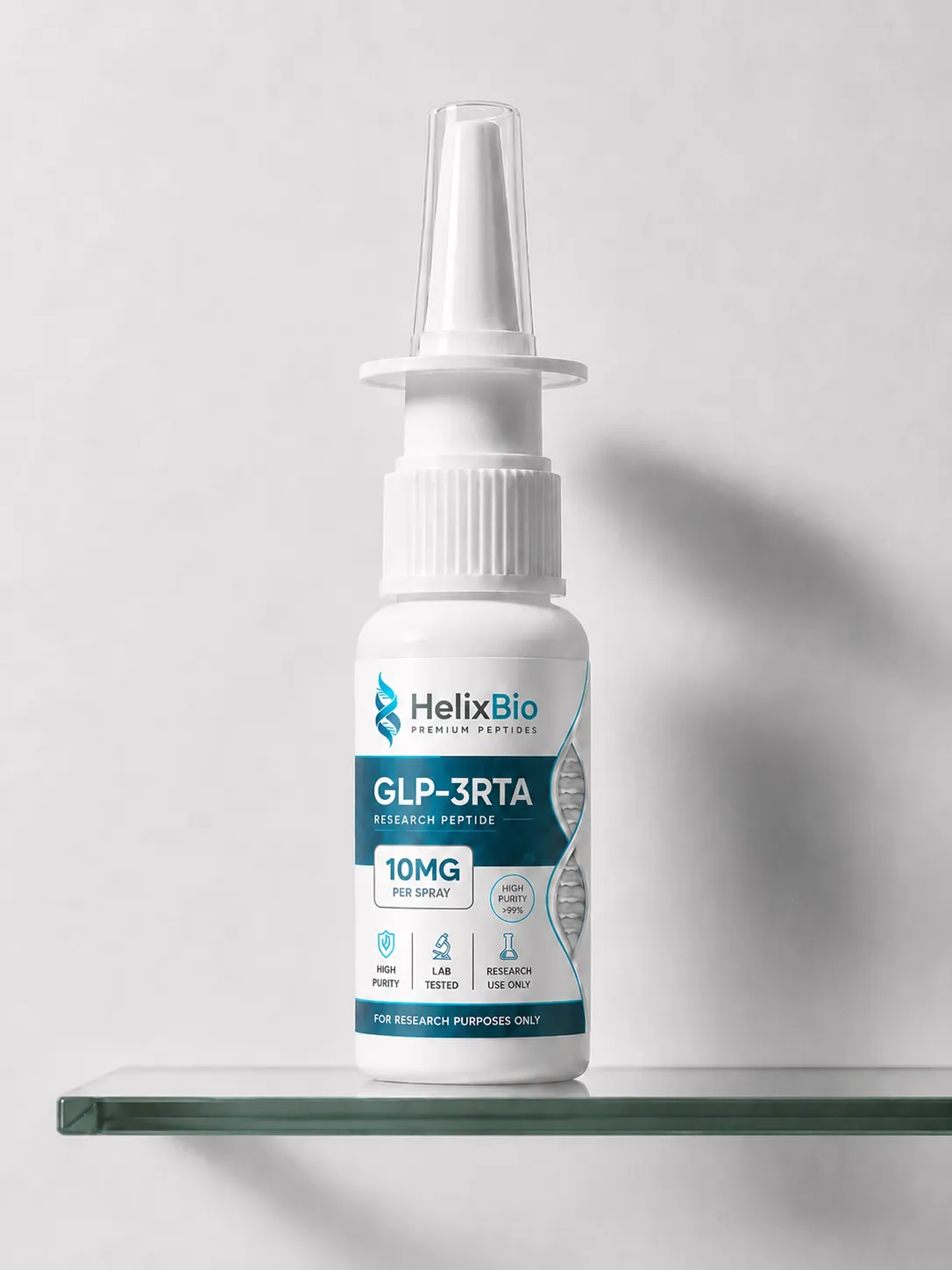
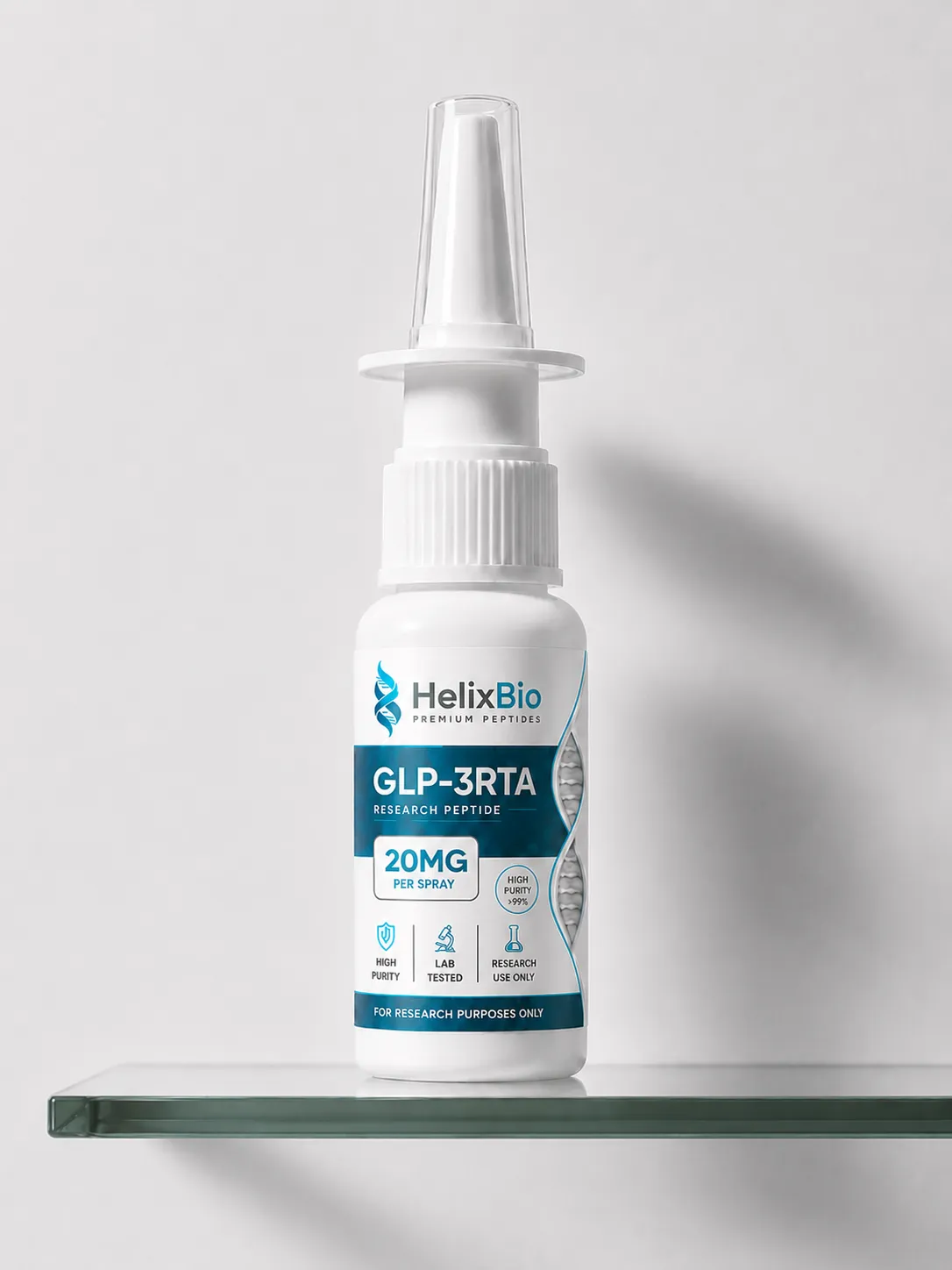
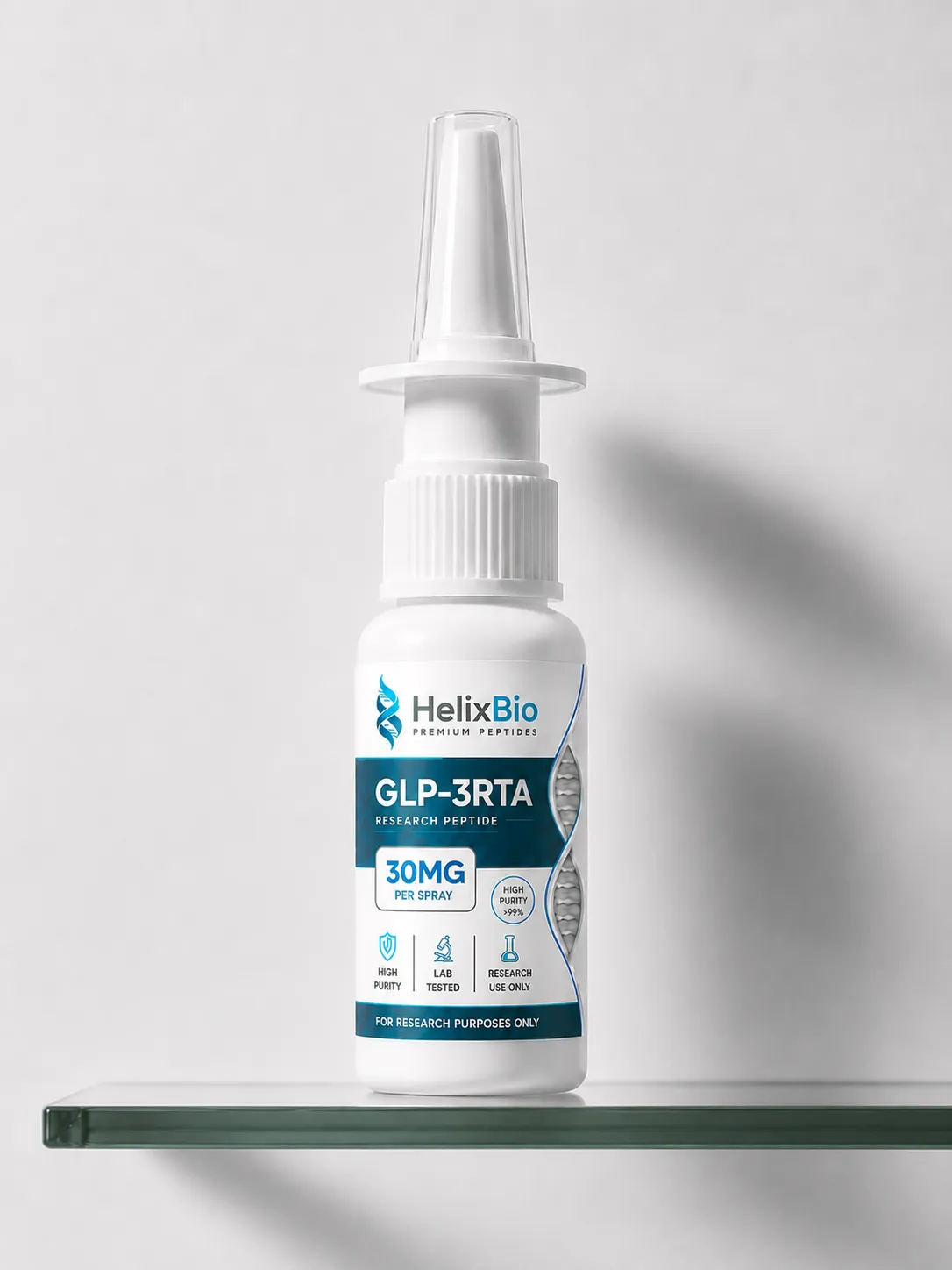
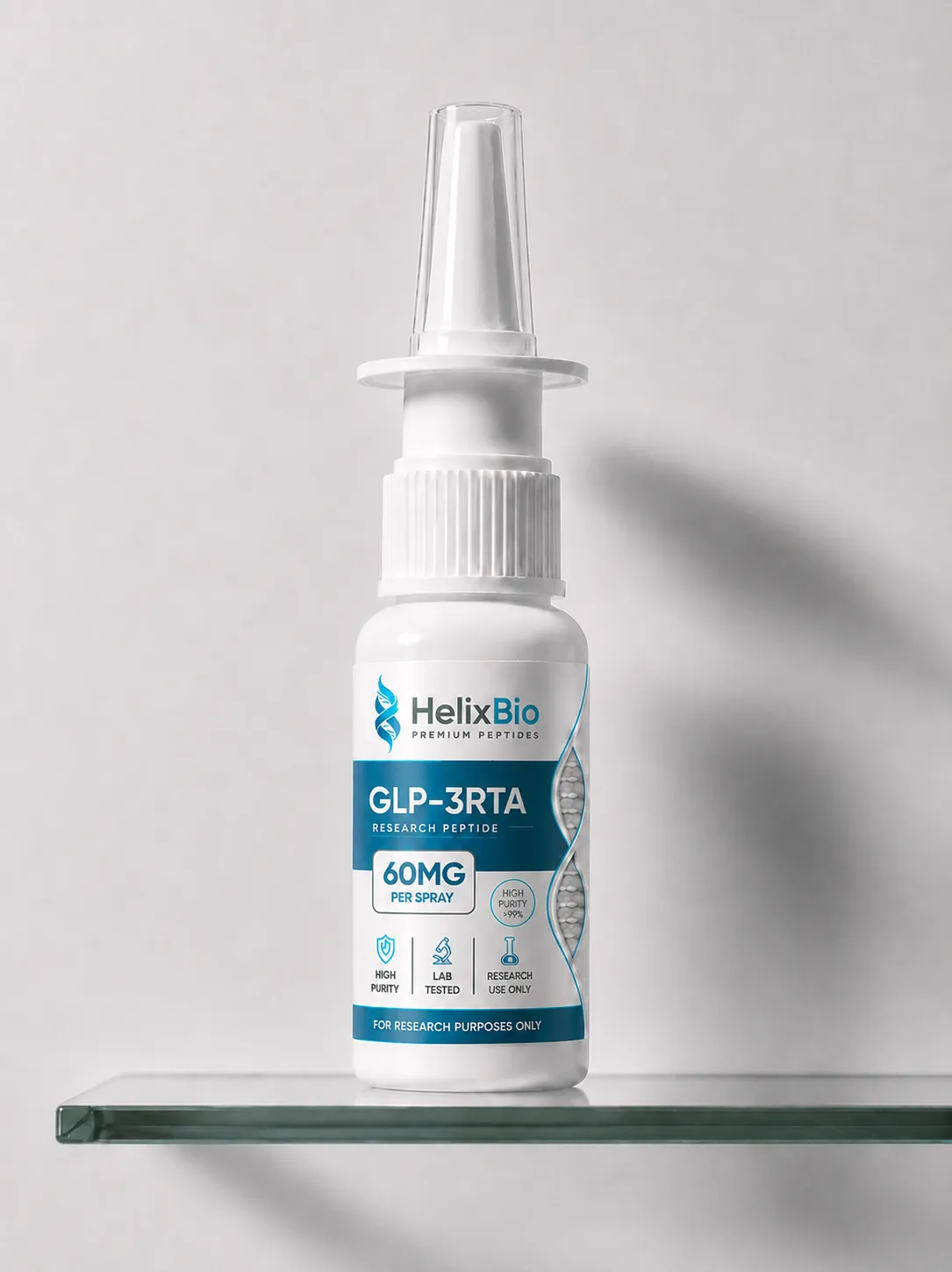
GLP-3RTA is a synthetic 39-residue lipidated peptide — registered under CAS 2381089-83-2 and developed under the code LY-3437943 — engineered to act at three receptors simultaneously: the GIP receptor, the GLP-1 receptor and the glucagon receptor. Helix Bio supplies it here as a prepared spray-format solution for controlled laboratory work. Research and laboratory use only; not for human or veterinary administration, and not a treatment for any condition. One point about the name deserves stating up front, because researchers ask about it. GLP-3RTA is a catalog designation, not a hormone name. There is no hormone called GLP-3, and this compound’s backbone comes from GIP rather than from GLP-1. The section below explains what the designation does and does not mean, and the rest of the page keeps the compound’s clinical development programme carefully separate from anything supplied as a research reagent.
HPLC certified
Independent analysis
Highest standard
Full traceability
GLP-3RTA is a synthetic peptide of 39 amino acids, catalogued under CAS 2381089-83-2 and originally developed under the code LY-3437943. The scientific literature describes it as a unimolecular triple receptor agonist: a single molecule engineered to activate the glucose-dependent insulinotropic polypeptide receptor (GIPR), the glucagon-like peptide-1 receptor (GLP-1R) and the glucagon receptor (GCGR).
The “GLP-3” element of the designation is a catalog and media convention rather than a scientific classification, and it is worth being direct about that. No hormone called GLP-3 exists. The proglucagon precursor yields glucagon, GLP-1, GLP-2, glicentin and oxyntomodulin — there is no third glucagon-like peptide and no GLP-3 receptor. The compound’s pharmaceutical developer states this explicitly, describing “GLP-3” as a scientifically inaccurate label used informally in the media, arising because the molecule targets three receptors rather than because it denotes a real classification, and identifying “triple agonist” as the appropriate term. The “RTA” component has no established scientific meaning; researchers evaluating material under any catalog designation of this kind should confirm identity from the CAS number and the supplier’s analytical documentation rather than from the name.
The prefix is misleading in a second, more consequential way. This compound’s peptide backbone derives from the GIP sequence, not from GLP-1. And among its three targets, the highest reported in vitro potency is at GIPR — an EC₅₀ near 0.064 nM, against roughly 0.78 nM at GLP-1R and 5.8 nM at GCGR. Both the structural origin and the most potently engaged receptor point away from GLP-1, so a researcher selecting a reference ligand on the strength of the prefix would be reasoning from the wrong premise. For GIPR work in particular, that matters.
Structurally, the molecule carries three non-canonical residues that distinguish it from a straightforward native-sequence peptide: α-aminoisobutyric acid at position 2, which blocks DPP-4 cleavage at the N-terminus; α-methyl-leucine at position 13; and a second α-aminoisobutyric acid at position 20. A C20 fatty diacid is attached to a lysine side chain through a γ-glutamyl-(AEEA) linker, and the chain terminates in a serinamide. The lipid conjugation promotes albumin binding, which is the design feature underlying the long circulating half-life of roughly six days reported in human studies of the pharmaceutical formulation.
The word “spray” describes the physical presentation of this material. It is a prepared solution in a spray-format container. It does not designate nasal, oral, sublingual, inhaled, topical or any other route, and Helix Bio does not supply this material for administration to humans or animals by any means. Worth noting alongside that: every published human study of this compound used subcutaneous injection of a pharmaceutical formulation.
What the solution format genuinely changes is handling chemistry. This molecule is unusual in the catalog for its size and construction: at roughly 4.7 kDa it is an order of magnitude larger than most peptides on this site, and the C20 diacid makes it an amphiphile — a large hydrophilic peptide chain carrying a substantial lipid tail. Amphiphilic peptides in dilute aqueous solution tend to accumulate at interfaces, so container-surface adsorption and air-liquid interface effects are more consequential here than for a small unmodified peptide, and self-association is a recognised behaviour of lipidated peptides generally.
None of that is a statement about this formulation. Vehicle composition, concentration, pH, ionic strength, the presence of any surfactant and the container material determine how those tendencies actually behave, and those are product facts belonging in the product documentation rather than inferences from the molecular class.
GLP-3RTA appears in receptor pharmacology and metabolic research, including:
The existence of a substantial clinical development programme for this compound does not establish that a research material is safe or effective for any purpose. Those studies used a sponsor-manufactured pharmaceutical product administered by a defined route under clinical oversight, and their findings describe that product under those conditions.
Two things make this material harder to characterise than most peptides in a research catalog, and both are worth knowing before a lot is accepted.
The first is size and construction. A 39-residue chain carrying a C20 fatty diacid behaves differently in a chromatographic system than a short unmodified peptide. Closely related impurities — deletion sequences, des-lipidated material, incompletely deprotected species — elute near the main peak, and a single area-percent figure compresses all of that into one number. The number is still worth having; it simply carries less information per digit than the same figure would on a seven-residue peptide, and the method behind it matters correspondingly more.
The second is mass basis. Published sources do not agree on this compound’s molecular formula and weight: the majority report C₂₂₁H₃₄₂N₄₆O₆₈ at approximately 4731 g/mol, while at least one reference resource reports a formula around 4895 g/mol, and several suppliers describe a sodium salt form. On a molecule of this size those differences are a few percent — small enough to pass unnoticed, large enough to matter to a concentration calculation. Anyone preparing a defined molar concentration should confirm which mass the documentation refers to, and whether stated content is expressed on a peptide or salt basis.
There is a third consideration specific to material sold under catalog designations. Because “GLP-3RTA” is a trade convention rather than a registry name, the CAS number is the anchor that ties a shipment to a defined molecular entity. Documentation that states the CAS number, the observed mass and the analytical method is doing something a product name cannot do on its own. Helix Bio states that its research materials are supported by batch-specific Certificates of Analysis and by HPLC and mass spectrometry testing; the applicable lot documentation, not this page, is the authoritative record of what a given container holds.
GLP-3RTA Spray is intended for qualified users working in legitimate laboratory or scientific research environments, including:
The product is not intended for personal experimentation, self-administration, human consumption, veterinary use, weight management, metabolic self-treatment or medical treatment of any kind.
| Specification | Details |
|---|---|
| Product Name | GLP-3RTA Spray |
| Research Category | GLP-1 & Metabolic Research Compounds |
| Compound | GLP-3RTA |
| CAS Number | 2381089-83-2 |
| Development Code | LY-3437943 |
| Compound Class | Synthetic lipidated peptide; unimolecular triple receptor agonist |
| Peptide Length | 39 amino acids |
| Backbone Origin | Derived from the GIP sequence |
| Non-Canonical Residues | Aib at positions 2 and 20; α-methyl-leucine at position 13 |
| Lipid Modification | C20 fatty diacid via γGlu-(AEEA) linker at a lysine side chain |
| C-Terminus | Serinamide |
| Receptor Targets | GIPR, GLP-1R, GCGR |
| Molecular Formula | Commonly reported as C₂₂₁H₃₄₂N₄₆O₆₈; confirm against lot documentation |
| Molecular Weight | Commonly reported as approximately 4731 g/mol; sources vary — confirm against lot documentation |
| Salt Form | Confirm against current lot-specific documentation |
| Format | Prepared solution, spray-format container |
| Concentration | Refer to current product listing and lot documentation |
| Fill Volume | Refer to current product listing |
| Formulation and Vehicle | Refer to current product documentation |
| Purity | Refer to current lot-specific Certificate of Analysis |
| Identity Testing | Refer to applicable Certificate of Analysis, including observed mass and mass basis |
| Storage | Follow current product-specific documentation |
| Packaging | Refer to current product listing |
| Intended Use | Research and laboratory investigation only |
| Human Use | Not intended for human consumption or administration |
| Veterinary Use | Not intended for veterinary use |
| Regulatory Status | Investigational compound; not approved by any regulatory authority |
| Manufacturer | Helix Bio |
| Country of Origin | Verify current product documentation |
The areas below describe experimental use of this compound. They are descriptions of research activity, not statements of outcomes attributable to this or any other supplied preparation.
Multi-Receptor Agonist Pharmacology. GLP-3RTA is studied as a reference example of unimolecular polypharmacology — a single peptide engineered for balanced activity across three related class B G-protein-coupled receptors. Comparative work in this area examines how one sequence can be tuned to different potencies at GIPR, GLP-1R and GCGR, and how those relative potencies are measured and reported.
Receptor Binding and Functional Assays. Reported EC₅₀ and Kᵢ values differ substantially between human and rodent receptor systems, which makes species a material variable rather than a footnote in any assay design using this compound as a ligand or comparator.
Peptide Design and Structure–Activity Research. The molecule combines several design strategies in one construct: backbone constraint through α-aminoisobutyric acid and α-methyl-leucine substitutions, N-terminal protection against DPP-4 cleavage, and lipidation for albumin binding. That makes it a useful case study in analogue design independent of any metabolic endpoint.
Lipidated Peptide Chemistry and Analytics. Synthesis, purification and characterisation of a lipid-conjugated 39-mer are non-trivial, and the compound appears in methodological work on large modified peptides — including chromatographic separation of closely related impurities and confirmation of conjugation.
Preclinical Metabolic Research. Published preclinical work has examined receptor-mediated responses in cellular and animal models. Findings in those systems describe those systems.
Each publication should be evaluated according to the exact molecular entity used, the species and receptor system, the concentration and preparation, and the endpoints measured.
Analytical documentation matters for any research material, and it matters in a particular way for a large lipidated peptide, because two of the usual reassurances carry less weight than they would elsewhere.
Purity. A reversed-phase area-percent figure reports what the method separates. On a 39-residue chain bearing a fatty diacid, the impurities most likely to be present — single-residue deletions, des-lipidated peptide, diastereomeric or incompletely deprotected species — are chemically close to the target and can co-elute or elute nearby. A high area-percent figure obtained on a method not developed to resolve those species is not the same claim as a high figure obtained on one that does. The method is the useful information.
Identity and mass. Mass spectrometry answers identity well for a molecule of this construction, and the lipid conjugation is large enough that its absence is unmistakable in a spectrum. The complication is knowing what mass to expect. Reported values for this compound differ between sources, and salt form changes the basis again. A COA is more useful when it states the observed mass alongside the theoretical value it was compared against, and when it names the CAS number the material was released against.
Researchers should assess, where applicable:
No certification, regulatory approval or quality claim should be inferred unless it is explicitly documented by the manufacturer or a relevant regulatory authority. A general catalog statement is not a substitute for lot-specific documentation.
Storage and handling requirements should be taken from the current GLP-3RTA Spray product documentation and lot-specific instructions. The considerations below explain why a prepared solution of this particular molecule differs from a lyophilised solid, and are not a substitute for that documentation.
A prepared solution has no reconstitution step, so guidance written for dry material — moisture protection, reconstitution technique, post-reconstitution windows — does not transfer. What matters instead follows from the molecule’s amphiphilic construction. A large peptide carrying a C20 lipid tends to accumulate at surfaces and interfaces in dilute aqueous solution, so container material, fill level, headspace and handling that introduces air-liquid interface — vigorous shaking, repeated transfer — are more consequential than they would be for a small unmodified peptide. Self-association is a recognised general behaviour of lipidated peptides and is concentration- and formulation-dependent.
General laboratory considerations:
Storage guidance should not be carried over from a lyophilised presentation of this compound, from a pharmaceutical formulation, from another supplier’s material, or from another Helix Bio spray, because vehicle, concentration, container and any excipients all affect the behaviour of a lipidated peptide in solution.
Helix Bio’s website describes research materials as being supplied to laboratories and institutions in the United States, and describes tracked shipping and temperature-controlled handling within its fulfilment process.
Because shipping conditions, packaging specifications, availability and delivery requirements may change, researchers should review the current Helix Bio shipping information and product listing before ordering. Containers should be inspected on receipt and transferred to appropriate storage promptly.
Product packaging should remain appropriately labelled and handled as research material after delivery. Researchers are responsible for following applicable institutional, federal, state and local requirements governing research materials.
GLP-3RTA Spray is sold by Helix Bio for research and laboratory purposes only. It is not intended for human or veterinary consumption, self-administration, injection, weight management, diagnosis, treatment, cure, mitigation or prevention of any disease or condition.
The compound supplied under this designation is an investigational compound. It has not been approved by the U.S. Food and Drug Administration or by any other regulatory authority, for any indication, in any jurisdiction. It remains under clinical investigation by its pharmaceutical developer. The existence of a large and widely reported clinical development programme is not an approval, and it does not establish that any material sold as a research reagent is safe or effective for any purpose.
Published trial results for this compound were generated with a sponsor-manufactured pharmaceutical product, administered subcutaneously, at defined doses, to enrolled participants under clinical supervision, with manufacturing and release controls that do not apply to research materials. Those results describe that product under those conditions. They do not describe this material, this formulation or this format, and they must not be read as doing so.
GLP-3RTA is a catalog designation used to identify this research material. It is not a hormone name, not an approved product name, and not a statement of therapeutic classification.
This product is not a medicine, dietary supplement, weight-loss product or consumer wellness product. Researchers are responsible for determining whether a material is appropriate for their intended experimental application and for complying with applicable institutional and regulatory requirements.
Knowledge Base
Knowledge Base
Knowledge Base
Knowledge Base
Knowledge Base
Knowledge Base
Knowledge Base
Knowledge Base
Knowledge Base
Knowledge Base
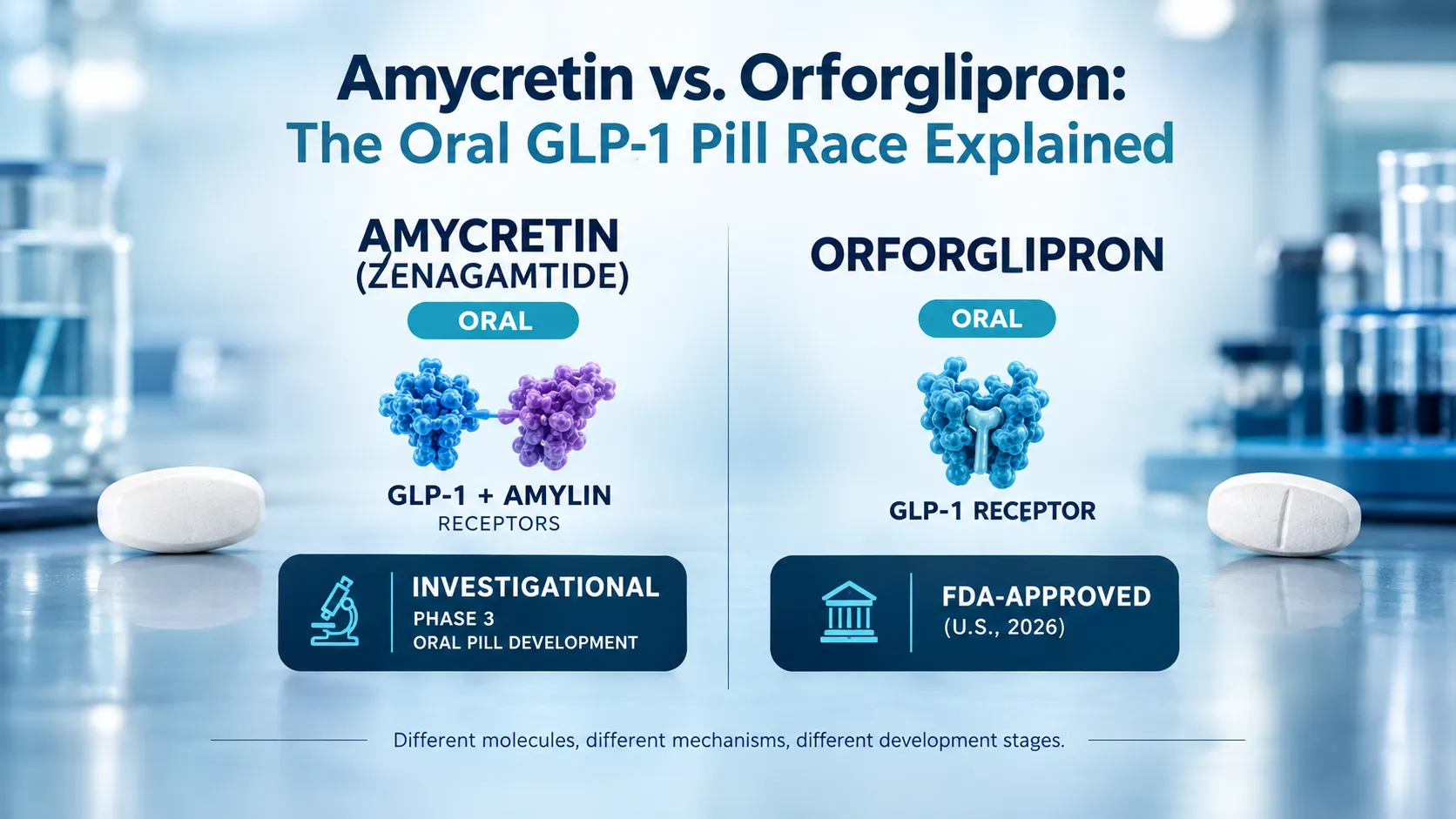
Amycretin is a peptide and orforglipron is not. How that chemistry explains the formulations, trial results, and approval status of both GLP-1 pills.
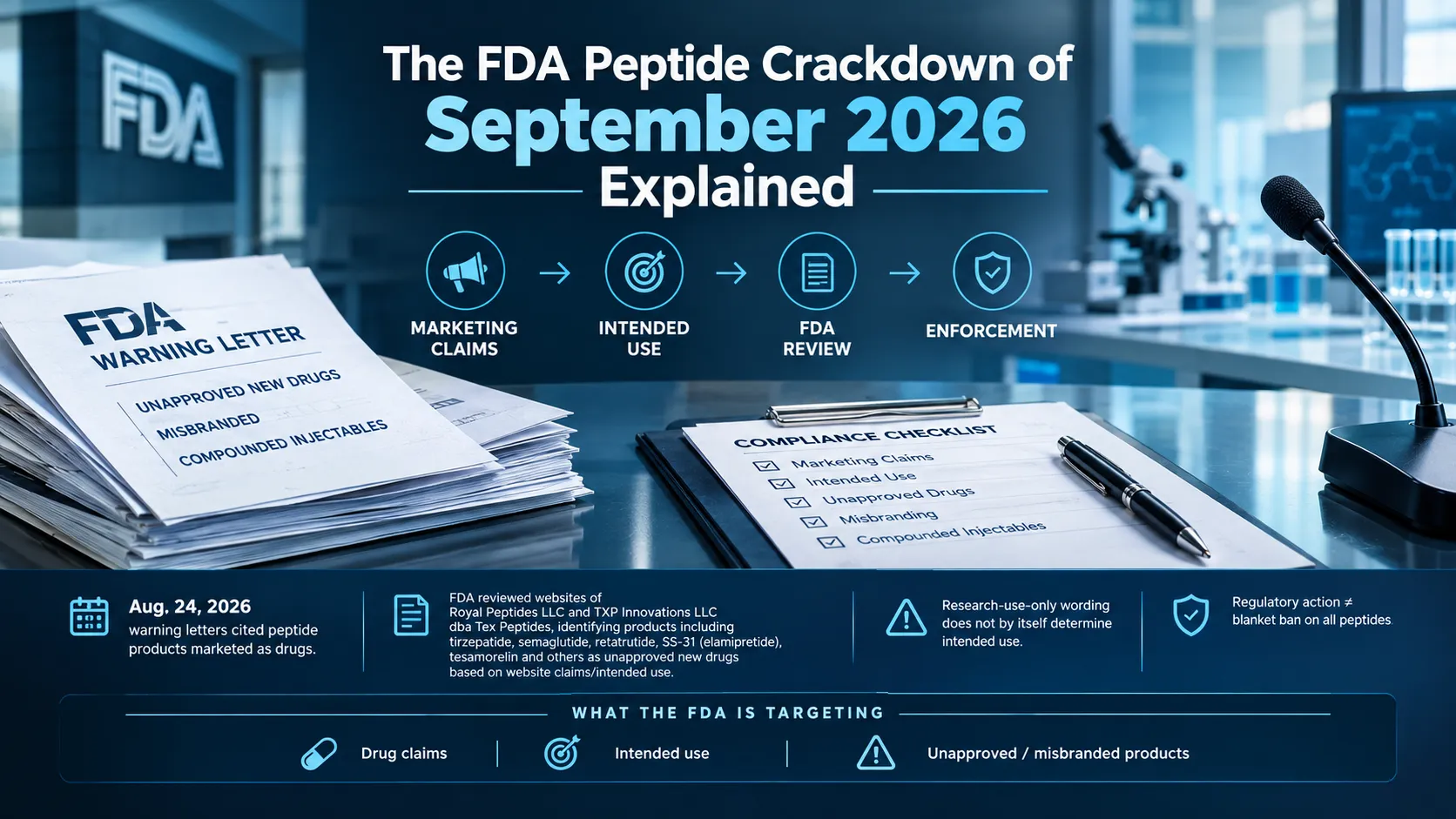
Five peptide sellers got FDA warning letters in September 2026. See who was named, why the research label failed, and the full 2026 enforcement timeline.

In July 2026, the FDA's advisory committee recommended 6 peptides for the 503A bulk list. None are on it yet. What the vote changed and what it didn't.