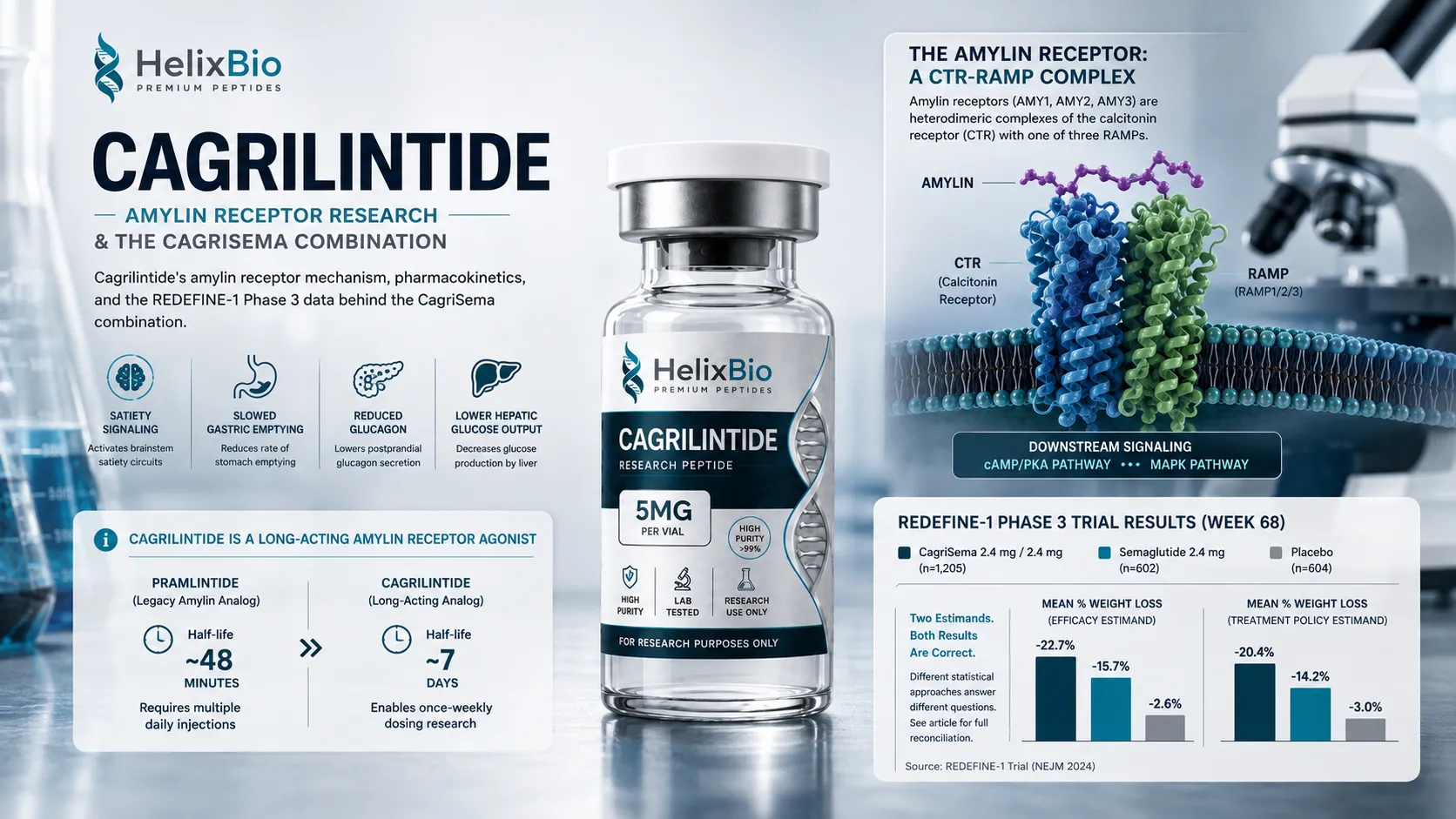
- Cagrilintide is a long-acting amylin receptor agonist that signals through CTR-RAMP heterodimeric complexes (AMY1, AMY2, AMY3), distinct from the single-receptor GLP-1 pathway.
- A fatty-acid albumin-binding modification extends cagrilintide's half-life from about 4 minutes (native amylin) to approximately 7 days, enabling once-weekly dosing.
- A Phase 1b Lancet trial (PMID 33894838) found gastrointestinal adverse events in 72.5% of cagrilintide-semaglutide-treated participants versus 34.4% on placebo.
- The Phase 3 REDEFINE-1 trial (n=3,417) reported 22.7% mean weight loss for CagriSema under the trial product estimand and 20.4% under the treatment policy estimand — both valid, non-conflicting figures.
- REDEFINE-1 included cagrilintide-alone and semaglutide-alone comparator arms, allowing researchers to isolate each compound's independent contribution to the combined result.
- Neither cagrilintide nor CagriSema is FDA-approved; both remain Research Use Only pending regulatory review.
Amylin receptor research has become the third major pillar of metabolic peptide science, alongside GLP-1 and GIP pathway research. Cagrilintide is the long-acting amylin receptor agonist at the center of that research, both as a standalone compound and as the amylin component of CagriSema, its combination with semaglutide. This guide covers cagrilintide's receptor mechanism, its pharmacokinetic profile, and what the completed Phase 3 REDEFINE-1 trial data actually shows — including a precise reconciliation of two different weight-loss figures that are both correct but frequently reported without the statistical context that explains why they differ.
Cagrilintide
RESEARCH PEPTIDE
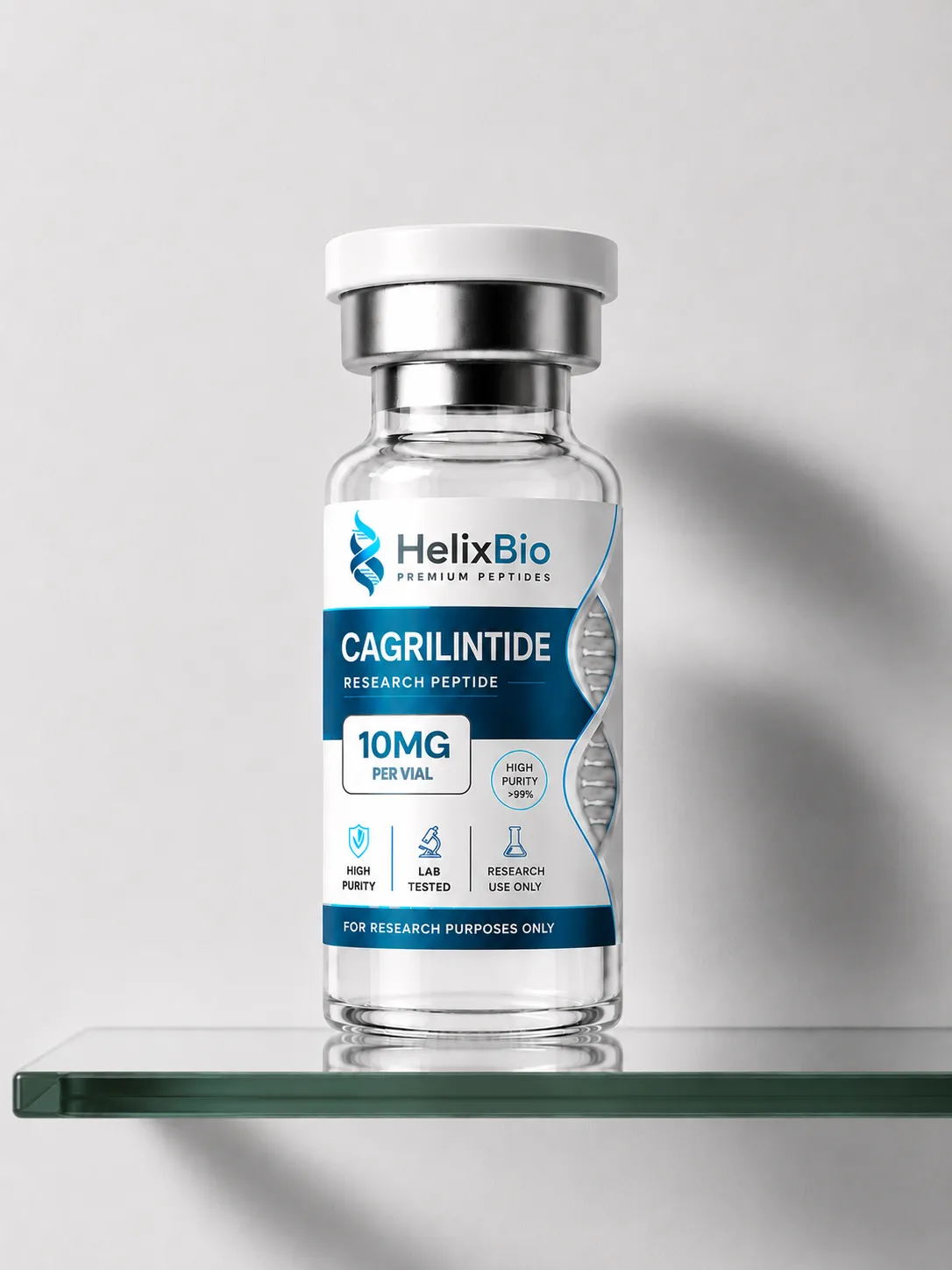
Cagrilintide is a synthetic research peptide studied as a long-acting amylin receptor agonist — a mechanism distinct from the GLP-1, GIP, and glucagon receptor pathways targeted by compounds like semaglutide, GLP-1TRZ, and GLP-3RTA. Developed originally by Novo Nordisk, cagrilintide has drawn significant research interest both as a standalone amylin analog and as the amylin component of CagriSema, a fixed-dose combination studied alongside semaglutide in the REDEFINE clinical trial program. Helix Bio supplies Cagrilintide as a lyophilized powder intended strictly for laboratory and preclinical research, manufactured to a high-purity standard and backed by third-party verification. It is not intended for human consumption, diagnostic use, or any therapeutic application.
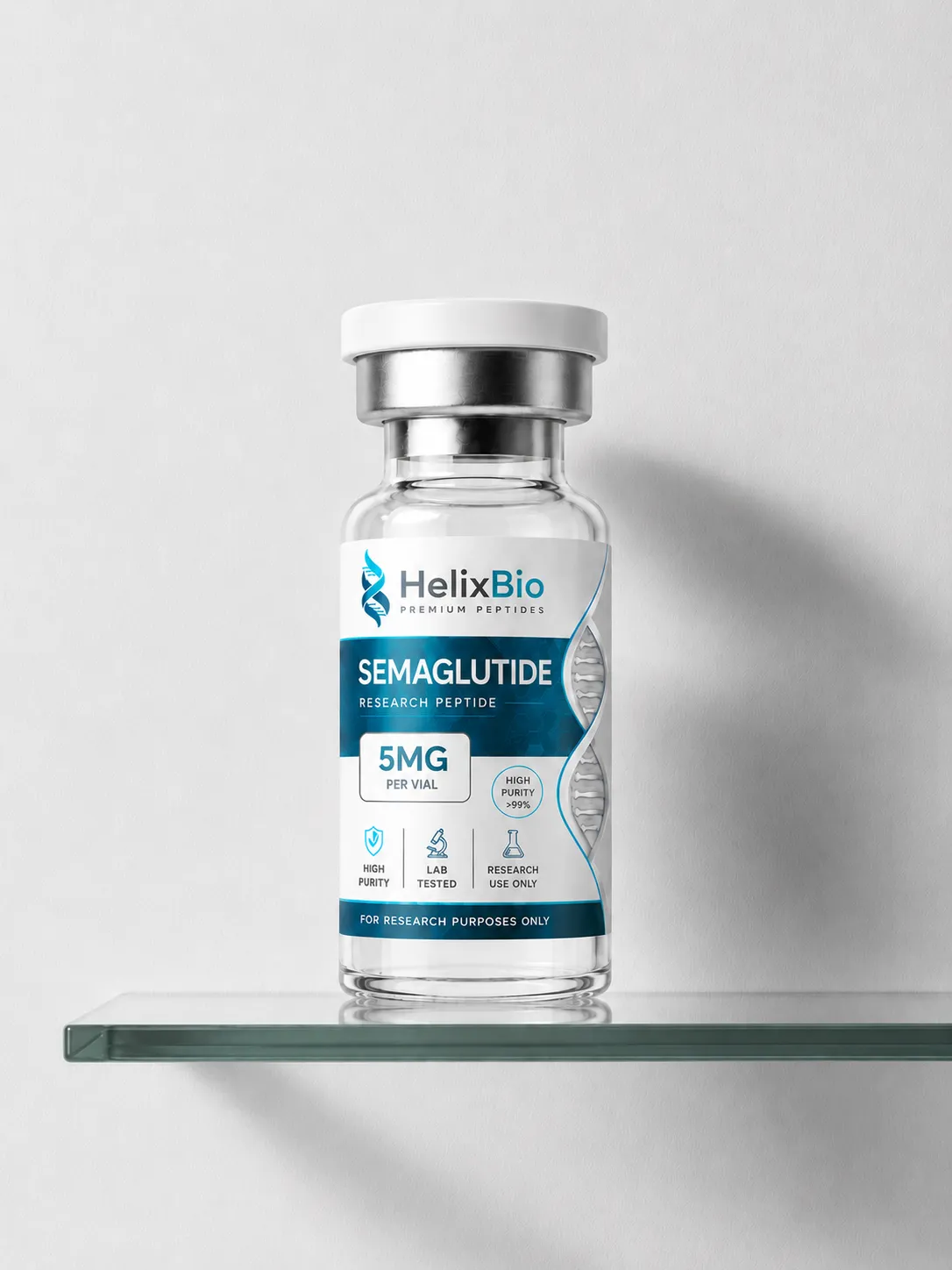
Semaglutide
RESEARCH PEPTIDE
Semaglutide is a synthetic research peptide studied for its activity as a GLP-1 receptor agonist — one of the most extensively documented compounds in incretin pharmacology, with a clinical trial record (the STEP and SUSTAIN programs) that spans over a decade. Developed originally by Novo Nordisk, Semaglutide is the reference point most researchers use when evaluating newer dual- and triple-agonist peptides such as GLP-1TRZ and GLP-3RTA. Helix Bio supplies Semaglutide as a lyophilized powder intended strictly for laboratory and preclinical research, manufactured to a high-purity standard and backed by third-party verification. It is not intended for human consumption, diagnostic use, or any therapeutic application, and it is a separate product from FDA-approved branded medications.
From Pramlintide to Cagrilintide: Why Amylin Research Took Decades to Catch Up to GLP-1
Amylin is a hormone co-secreted with insulin from pancreatic beta cells, discovered and characterized well before the current generation of GLP-1 receptor agonists existed. The first amylin analog to reach the market was pramlintide, approved by the FDA in March 2005 as an adjunct to mealtime insulin therapy in patients with type 1 or type 2 diabetes with inadequate glycemic control. Pramlintide is a 37-amino acid peptide differing from native human amylin at three positions, a modification that extends its half-life to approximately 48 minutes — a meaningful improvement over unmodified amylin, but still short enough to require injection before every meal.
That short half-life is precisely why amylin-pathway research stalled for so long relative to GLP-1 research: a compound requiring multiple daily injections was never going to compete, from an adherence standpoint, with once-weekly GLP-1 agonists once those became available. Cagrilintide's fatty-acid albumin-binding modification is the specific innovation that resolved this gap, extending amylin-pathway half-life from pramlintide's 48 minutes to roughly 7 days and making once-weekly amylin-receptor research and dosing pharmacologically comparable to the GLP-1 drugs it is now being studied alongside.
The Amylin Receptor: A CTR-RAMP Complex, Not a Single Protein
Unlike GLP-1, which signals through a single dedicated receptor, amylin signals through amylin receptors (AMY1, AMY2, AMY3) — heterodimeric complexes formed by the calcitonin receptor (CTR) paired with one of three receptor activity-modifying proteins (RAMP1, RAMP2, or RAMP3). This structural detail matters for research design: an amylin receptor is not a fixed, single-gene target but a combinatorial complex whose pharmacology depends on which RAMP is co-expressed with CTR in a given tissue.
Downstream Signaling and Satiety Circuits
Cagrilintide engagement of the amylin receptor complex activates both cAMP/PKA and MAPK intracellular signaling cascades. Research has connected this signaling to four distinct physiological effects: slowed gastric emptying, reduced postprandial glucagon secretion, reduced hepatic glucose output, and — the effect most relevant to weight-management research — activation of satiety-signaling circuits in the area postrema and nucleus tractus solitarius, brainstem regions with limited blood-brain barrier restriction that are positioned to integrate peripheral metabolic signals into centrally mediated reductions in meal size.
A cryo-electron microscopy study published in *Nature Communications* in 2025 by researchers at Monash University and Novo Nordisk resolved cagrilintide bound to all three amylin receptor subtypes (AMY1, AMY2, AMY3) and to CTR alone in active, Gs-protein-coupled conformations — the first complete structural dataset across every receptor this drug class engages, providing a direct structural explanation for cagrilintide's receptor engagement pattern rather than one inferred solely from functional assays.
The distinction between amylin receptor subtypes is not merely academic. AMY1, AMY2, and AMY3 are distributed differently across tissues implicated in energy homeostasis, and CTR itself can also signal independently of any RAMP partner in bone and calcium-regulating tissue, a pathway unrelated to cagrilintide's metabolic research applications but relevant to researchers designing binding-selectivity assays who need to account for CTR-alone signaling as a confound. The 2025 structural dataset is significant precisely because it resolved cagrilintide's binding pose across all four of these possible engagement states in one coordinated study, rather than requiring researchers to stitch together conclusions from separate, methodologically inconsistent assays run at different times by different groups.
Cagrilintide: Structural Basis for Its Extended Half-Life
Cagrilintide is built on the native amylin peptide backbone with a fatty-acid chain modification that enables reversible, non-covalent binding to serum albumin — the same design principle used in long-acting GLP-1 analogs. This modification extends cagrilintide's half-life from roughly 4 minutes for native, unmodified amylin to approximately 7 days, which is what makes once-weekly subcutaneous dosing pharmacologically feasible for a peptide whose native form would otherwise require continuous infusion to maintain stable receptor engagement.
Phase 1b Safety and Tolerability Data
Before any Phase 3 efficacy trial, cagrilintide's safety and pharmacokinetic profile in combination with semaglutide was characterized in a randomized, placebo-controlled, multiple-ascending-dose Phase 1b trial published in *The Lancet* in 2021. The trial enrolled participants across six sequential dose cohorts (0.16 mg to 4.5 mg cagrilintide, each combined with once-weekly semaglutide 2.4 mg) and found gastrointestinal adverse events in 72.5% of the combined cagrilintide-semaglutide group compared with 34.4% on placebo — a substantial difference, though the trial reported these events as predominantly transient and mild-to-moderate in severity. This early trial did not test cagrilintide's weight-loss efficacy at the scale later examined in REDEFINE-1; its purpose was strictly to characterize safety, tolerability, and pharmacokinetics before larger efficacy trials were designed.
CagriSema: The Cagrilintide and Semaglutide Combination
CagriSema pairs cagrilintide with semaglutide — Novo Nordisk's GLP-1 receptor agonist — in a single once-weekly injection, on the research rationale that amylin and GLP-1 pathways act on complementary, non-redundant satiety and glucose-regulation circuits rather than duplicating the same mechanism. Semaglutide alone acts through the GLP-1 receptor to slow gastric emptying and enhance glucose-dependent insulin secretion; adding cagrilintide's amylin-receptor-mediated satiety signaling was designed to produce an additive, rather than merely overlapping, effect on food intake regulation.
This complementary-pathway rationale is grounded in preclinical research showing that amylin and GLP-1 signaling converge on overlapping but not identical brainstem and hypothalamic circuits, meaning that blocking or activating one pathway does not simply substitute for the other. Because amylin receptor activation contributes its own independent satiety signal through the area postrema rather than solely amplifying GLP-1 receptor signaling, researchers have treated cagrilintide and semaglutide as a genuine test case for whether combining two mechanistically distinct anorexigenic pathways in a single molecule produces a greater effect than either pathway alone — the specific hypothesis REDEFINE-1 was designed to test using its cagrilintide-alone and semaglutide-alone comparator arms.
REDEFINE-1: What the Phase 3 Data Actually Shows
The Phase 3 REDEFINE-1 trial, published in the *New England Journal of Medicine* in 2025, randomized 3,417 adults with obesity or overweight and at least one weight-related comorbidity (without type 2 diabetes) to once-weekly CagriSema 2.4 mg/2.4 mg, cagrilintide 2.4 mg alone, semaglutide 2.4 mg alone, or placebo, over 68 weeks.
Metric (68 weeks) | CagriSema | Semaglutide alone | Placebo |
|---|---|---|---|
Mean weight loss (trial product estimand) | 22.7% | 16.1% | 2.3% |
Mean weight loss (treatment policy estimand) | 20.4% | 14.9% | 3.0% |
Participants losing ≥25% body weight | 40.4% | 16.2% | Not reported at this threshold |
Participants reaching BMI below 30 | 50.7% | Not reported at this threshold | 10.2% |
The 22.7% and 20.4% figures reported across different sources for CagriSema's weight-loss result are not a discrepancy — they are two different, both statistically valid estimands from the same trial. The trial product estimand (22.7%) reflects the treatment effect assuming continuous adherence to assigned treatment, the standard efficacy measure. The treatment policy estimand (20.4%) reflects the effect regardless of adherence or premature discontinuation, closer to a real-world intent-to-treat measure. Research citing REDEFINE-1 should specify which estimand a given figure refers to, since conflating them without attribution is a common source of confusion in secondary coverage of this trial.
Why the Trial Fell Short of Its Original Target
REDEFINE-1's result, while substantial, was reported by multiple outlets as falling short of Novo Nordisk's originally stated 25% weight-loss target for the CagriSema combination. Researchers examining the gap between the anticipated additive effect and the observed 22.7%/20.4% result have pointed to dose-titration schedules and discontinuation patterns as contributing factors, an active area of continued analysis rather than a fully resolved question.
Isolating the Amylin Contribution: What the Comparator Arms Show
REDEFINE-1's inclusion of both a cagrilintide-alone arm and a semaglutide-alone arm is what makes this trial particularly useful for mechanistic research, as distinct from simply evaluating the combination's headline efficacy number. By comparing the combined CagriSema result against each monotherapy arm, researchers can estimate how much of the total effect is attributable to amylin-receptor engagement specifically, versus how much is carried by the GLP-1 receptor pathway already well-characterized from semaglutide's own trial history. This comparator design is the reason REDEFINE-1 is cited in amylin-receptor mechanistic research as well as in obesity-treatment research — the trial was built to answer both questions simultaneously rather than only the combination's clinical efficacy question.
Research Applications
- Amylin receptor pharmacology research, using cagrilintide as a tool compound to probe AMY1/AMY2/AMY3 versus CTR-alone signaling, particularly now that structural data across all four binding states is available.
- Combination-therapy research design, using cagrilintide and semaglutide as a case study in how two distinct GPCR pathways can be combined to test for additive versus synergistic metabolic effects.
- Comparative dose-response research, since REDEFINE-1's inclusion of cagrilintide-alone and semaglutide-alone arms allows researchers to isolate each compound's independent contribution to the combined CagriSema result.
- Long-acting peptide pharmacokinetics research, using cagrilintide's albumin-binding fatty-acid modification as a model for extending peptide half-life from minutes to days, and as a comparison point against pramlintide's shorter-acting, non-albumin-bound design.
- Statistical-methodology research and trial-design education, using REDEFINE-1's dual-estimand reporting (trial product versus treatment policy) as a working example of how modern obesity-drug trials report adherence-sensitive outcomes, relevant to researchers designing or interpreting any long-duration weekly-injection trial.
- Satiety-circuit neuroscience research, given cagrilintide's documented activation of area postrema and nucleus tractus solitarius signaling, which offers a distinct entry point into central appetite-regulation research relative to GLP-1's more peripherally weighted mechanism.
This isolation matters for researchers designing follow-on studies: a compound that shows a clear independent contribution in a well-controlled monotherapy arm is a stronger candidate for further mechanistic investigation than one whose effect can only be observed in combination, where confounding between the two active agents cannot be ruled out.
Reconstitution and Handling
Cagrilintide is typically supplied as lyophilized powder requiring reconstitution before laboratory use. Standard handling principles apply: bacteriostatic water introduced slowly down the vial wall, gentle swirling rather than shaking to avoid protein denaturation, and refrigerated storage of the reconstituted solution within its documented stability window. Our peptide reconstitution guide covers solvent selection and stability timelines in detail, and our guide to common peptide storage mistakes covers the handling errors most likely to affect potency in long-acting, fatty-acid-modified peptides like this one.
Regulatory and Compliance Context
Neither cagrilintide nor CagriSema is FDA-approved as of this writing; REDEFINE-1 is a completed Phase 3 trial supporting a regulatory submission, not evidence of an approved product. Cagrilintide is supplied in the United States strictly as a Research Use Only laboratory compound, not evaluated for human safety or efficacy outside a research setting and not intended for human consumption. For a full walkthrough of what RUO classification permits, see our guide on whether research peptides are legal in the USA.
Conclusion
Cagrilintide's amylin-receptor mechanism gives it a distinct, non-redundant research rationale alongside GLP-1 pathway compounds like semaglutide, and the REDEFINE-1 trial provides one of the more rigorously documented Phase 3 datasets in current metabolic peptide research — provided researchers cite it with the correct estimand attached to each figure. Its research value lies as much in what it reveals about combining two distinct metabolic signaling pathways as in the weight-loss outcome itself. From the decades-long gap between pramlintide's short-acting amylin signal and cagrilintide's week-long half-life, to the 2025 structural data resolving its full receptor-engagement profile, cagrilintide represents a case study in how a single pharmacokinetic modification — reversible albumin binding — can reopen an entire research pathway that had otherwise been sidelined by its own biology for nearly two decades.
Frequently Asked Questions
Both figures are correct and come from the same trial. 22.7% is the trial product estimand, reflecting the effect assuming full treatment adherence. 20.4% is the treatment policy estimand, reflecting the effect regardless of adherence or discontinuation. Sources should specify which estimand a cited figure refers to.
Cagrilintide activates amylin receptors, which are heterodimeric complexes of the calcitonin receptor (CTR) combined with receptor activity-modifying proteins RAMP1, RAMP2, or RAMP3, forming the AMY1, AMY2, and AMY3 receptor subtypes respectively.
Cagrilintide carries a fatty-acid chain modification enabling reversible binding to serum albumin, extending its half-life from roughly 4 minutes for native amylin to approximately 7 days, which allows once-weekly dosing instead of continuous infusion.
CagriSema is the combination of cagrilintide (an amylin receptor agonist) and semaglutide (a GLP-1 receptor agonist) in a single once-weekly injection, designed to test whether combining two distinct, non-redundant metabolic signaling pathways produces an additive effect on weight management research outcomes.
REDEFINE-1 randomized 3,417 adults with obesity or overweight and at least one weight-related comorbidity, without type 2 diabetes, across CagriSema, cagrilintide-alone, semaglutide-alone, and placebo arms over 68 weeks.
No. Novo Nordisk had previously indicated an expectation of around 25% weight loss, and multiple outlets reported the REDEFINE-1 result of 22.7% (trial product estimand) as falling short of that original target, though still substantially greater than semaglutide alone.
A Phase 1b trial published in The Lancet found gastrointestinal adverse events in 72.5% of participants receiving combined cagrilintide and semaglutide, compared with 34.4% on placebo, with most events reported as transient and mild to moderate.
No. Semaglutide acts through the GLP-1 receptor to slow gastric emptying and enhance glucose-dependent insulin secretion. Cagrilintide acts through amylin receptors (CTR-RAMP complexes), activating satiety circuits in the area postrema and nucleus tractus solitarius through a distinct signaling pathway.
No. As of this writing, neither cagrilintide nor the CagriSema combination has FDA approval. REDEFINE-1 is a completed Phase 3 trial intended to support a future regulatory submission, not evidence of an already-approved product.
Participants receiving semaglutide 2.4 mg alone lost a mean of 16.1% of body weight under the trial product estimand and 14.9% under the treatment policy estimand at 68 weeks, compared with 22.7%/20.4% for CagriSema, allowing researchers to isolate the amylin component's added contribution.
A cryo-electron microscopy study published in Nature Communications in 2025 resolved cagrilintide bound to all three amylin receptor subtypes (AMY1, AMY2, AMY3) and to the calcitonin receptor alone, in active Gs-protein-coupled states — providing the first complete structural dataset across every receptor conformation this compound engages.
40.4% of participants receiving CagriSema achieved 25% or greater weight loss at 68 weeks, compared with 16.2% of those receiving semaglutide alone.
- 01Safety, tolerability, pharmacokinetics, and pharmacodynamics of concomitant administration of multiple doses of cagrilintide with semaglutide 2.4 mg for weight management: a randomised, controlled, phase 1b trial. The Lancet, 2021. PMID: 33894838.
- 02Garvey WT, Bluher M, et al. Coadministered Cagrilintide and Semaglutide in Adults with Overweight or Obesity (REDEFINE 1). New England Journal of Medicine, 2025. DOI: 10.1056/NEJMoa2502081.
- 03Structural and dynamic features of cagrilintide binding to calcitonin and amylin receptors. Nature Communications, 2025. DOI: 10.1038/s41467-025-58680-y.
- 04Cagrilintide lowers bodyweight through brain amylin receptors 1 and 3.
- 05SYMLIN (pramlintide acetate) injection prescribing information. U.S. Food and Drug Administration.
Helix Bio Chem Team
Research & Product Team
Our in-house team tracks published peptide research and translates it into clear, source-cited summaries for the research community.
Reviewed by in-house research chemists
support@helixbiochem.com