- Federal law never banned semaglutide or tirzepatide, and what closed was the shortage-list exception that made copying them lawful at scale.
- The FDA declared the tirzepatide shortage resolved on December 19, 2024 and the semaglutide shortage resolved on February 21, 2025.
- Enforcement discretion for 503A pharmacies ended in spring 2025, on March 5 for tirzepatide and April 24 for semaglutide.
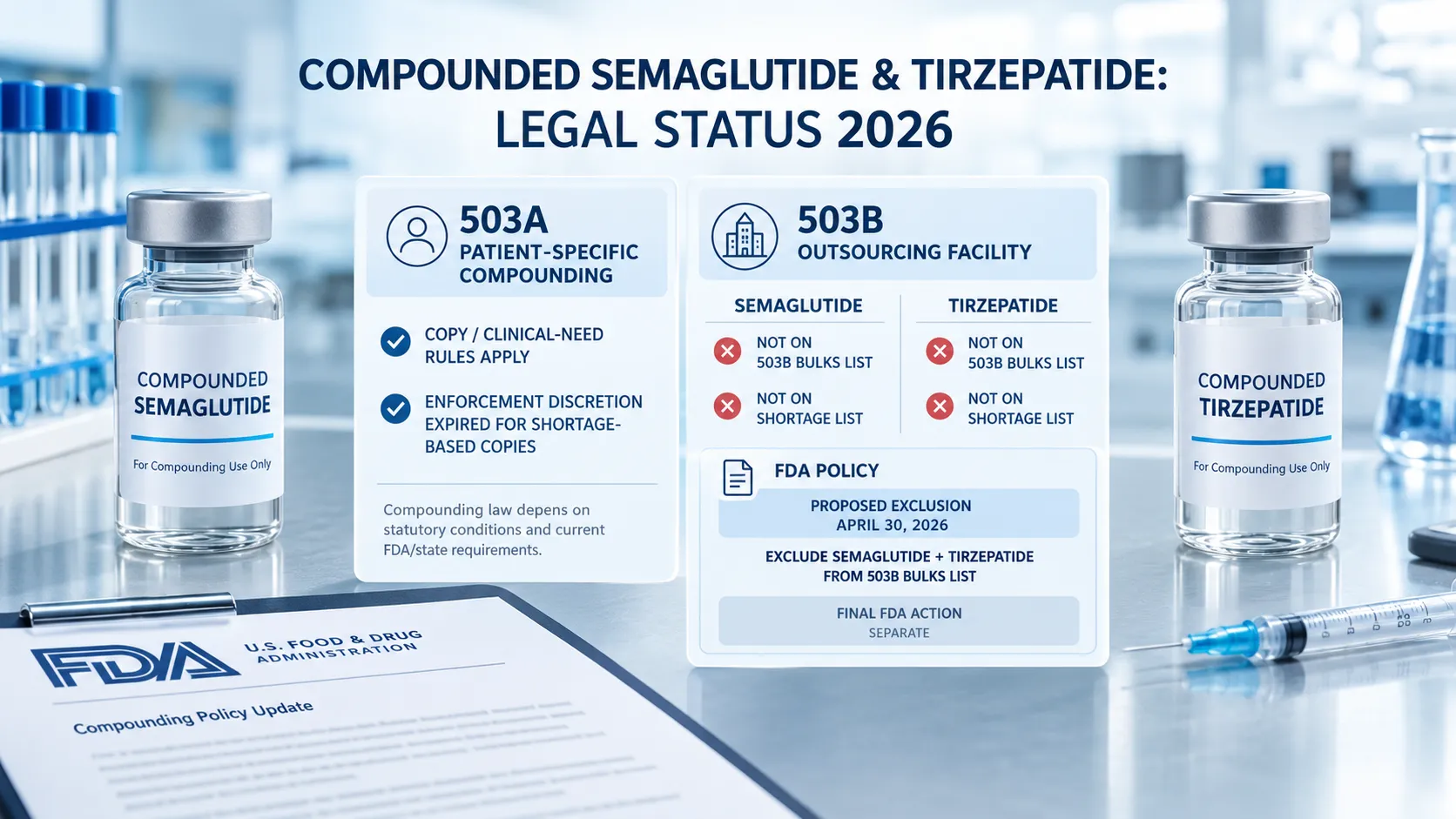
- On April 30, 2026 the FDA proposed excluding semaglutide, tirzepatide, and liraglutide from the 503B Bulks List, and that proposal is not final.
- A bulks-list exclusion is not a ban on compounding, because section 503B separately allows bulk compounding while a drug sits on the shortage list.
- Adding vitamin B12 does not automatically stop a compounded product being a copy, and the FDA said so in writing on April 1, 2026.
- The FDA reported 990 adverse event reports for compounded semaglutide and more than 730 for compounded tirzepatide as of May 31, 2026.
Compounded semaglutide and tirzepatide are not banned in 2026. The shortage exception that allowed mass-market compounding ended, tirzepatide in December 2024 and semaglutide in February 2025. What bars routine copies today is the separate essentially-a-copy prohibition. A narrow patient-specific pathway survives at 503A pharmacies, and a pending FDA proposal would close the 503B bulk route while supply stays normal.
This explainer tracks the dated federal record behind that shift. Every date below is traceable to an FDA page, a declaratory order, or a Federal Register notice. Warning letters record FDA allegations and not court findings.
What is compounded semaglutide?
A compounded drug is mixed or altered by a pharmacy to make something an approved product does not provide. Two different regimes govern who may do that. Under 503A, a pharmacy compounds for an identified patient on a valid prescription. A 503B outsourcing facility may compound bulk stock without individual prescriptions, provided the bulks-list or shortage-list conditions are met.
Neither route produces an FDA-approved drug. The agency does not review compounded preparations for safety, effectiveness, or quality before they reach the market.
Semaglutide is the active ingredient in Ozempic, Wegovy, and Rybelsus, which are Novo Nordisk trademarks. Tirzepatide is the active ingredient in Mounjaro and Zepbound, both Eli Lilly trademarks. Liraglutide appears in Victoza and Saxenda, also Novo Nordisk. Those brands went through the full approval process, and a compounded version carrying the same active ingredient did not.
Why was compounding allowed during the shortage?
Federal law keeps a safety valve open for shortages. The FDA maintains a public list of drugs whose demand exceeds supply. While a drug sits on that list, the agency does not treat it as commercially available, and the usual restriction on copying it falls away.
Demand for GLP-1 drugs outran supply quickly. Semaglutide injection products joined the shortage list in 2022, and tirzepatide injection products were added on December 15, 2022. For roughly two years, compounders could lawfully produce copies of both.
The regulatory timeline
Date | What happened |
|---|---|
Dec 15, 2022 | Tirzepatide injection products added to the FDA shortage list |
Oct 2, 2024 | FDA determines the tirzepatide shortage resolved |
Oct 2024 | Court remands that decision for reevaluation after the Outsourcing Facilities Association sues |
Dec 19, 2024 | Declaratory order confirms the tirzepatide shortage resolved, revoking the October decision |
Feb 21, 2025 | FDA determines the semaglutide shortage resolved |
Mar 5, 2025 | Court denies the injunction motion on tirzepatide, closing the 503A window |
Mar 19, 2025 | 503B enforcement discretion for tirzepatide expires |
Apr 24, 2025 | Court denies the injunction motion on semaglutide, closing the 503A window |
May 22, 2025 | 503B enforcement discretion for semaglutide expires |
Feb 6, 2026 | FDA announces intent to restrict GLP-1 ingredients for non-approved compounded drugs |
Mar 3, 2026 | Thirty warning letters issued to telehealth companies |
Apr 1, 2026 | FDA clarification names semaglutide with vitamin B12 as a possible copy |
Apr 30, 2026 | FDA proposes excluding the three GLP-1 substances from the 503B Bulks List |
Jun 16, 2026 | Twenty-five further telehealth warning letters posted |
Jun 26, 2026 | Comment period extended by 30 days |
Jul 30, 2026 | Comment period closes with no final determination |
Sep 18, 2026 | Warning letter to Empower Pharmacy names two GLP-1 combination products |
Which rule made compounded copies unlawful?
One phrase carries most of the legal weight here. The Federal Food, Drug, and Cosmetic Act sets the limit. A compounding pharmacy may not compound drug products that are essentially copies of a commercially available drug, regularly or in inordinate amounts. That restriction sits in section 503A, and section 503B carries a parallel one for outsourcing facilities.
Here is the mechanism in plain terms. A drug on the shortage list is not treated as commercially available, so the copy restriction does not bite. Remove the drug from that list and it becomes commercially available again, which switches the restriction back on.
Two conditions generally make a compounded product essentially a copy. It carries the same active ingredient at the same, similar, or easily substitutable strength. The approved product can also be given by the same route. One documented exception survives, and a later section covers it.
How do 503A and 503B pharmacies differ?
Feature | 503A pharmacy | 503B outsourcing facility |
|---|---|---|
Who it serves | An identified patient on a valid prescription | Providers, as bulk stock without individual prescriptions |
Registration | State-licensed | Registered with and inspected by the FDA |
cGMP obligations | None | Must comply |
Governing ingredient rule | The 503A bulks framework and its categories | The 503B Bulks List, or the shortage list at the time |
What changed for GLP-1s | Lost the shortage exception in spring 2025 | Lost it too, and the April 2026 proposal targets the bulks route |
What would the FDA proposal change for 503B?
On April 30, 2026, the FDA announced a proposal to exclude semaglutide, tirzepatide, and liraglutide from the 503B Bulks List. The Federal Register notice published on May 1, 2026 under docket FDA-2018-N-3240.
Clinical need is the governing test. To earn a place on the list, a substance must show the FDA that outsourcing facilities have a clinical reason to compound it from bulk. The agency reviewed the nominations for all three GLP-1 substances and found no such reason. Convenience of a ready-to-use form does not count toward clinical need, and neither does cost compared with an approved product.
This is a proposed determination, not a final rule. The comment period opened on May 1, 2026 and ran 60 days. A 30-day extension published June 26 pushed the close to July 30, 2026. No final determination has been announced.
What the proposal would and would not do
Two qualifications keep this in proportion. A bulks-list exclusion is not a ban on compounding, and it closes only one route. The prohibition that actually ended routine copying in 2025 is the separate essentially-a-copy restriction, and this proposal does not touch it.
Section 503B also keeps a second door open. A facility may compound from a bulk substance while the finished drug appears on the FDA shortage list. That must hold at the time of compounding, distribution, and dispensing, and the condition is independent of the bulks list. So a future shortage listing could reopen the 503B route even if the exclusion is finalized.
Liraglutide shows how that works in practice. The injection remained on the shortage list in the weeks after the proposal. That left it available for 503B bulk compounding, despite being named in the same notice.
What compounding is still legal in 2026?
Under 503A, a pharmacy may still compound semaglutide or tirzepatide for an identified individual patient. The prescriber must determine and document that the compounded product contains a change producing a significant difference for that specific patient. Without that documented determination, the product falls back inside the copy restriction.
Cost alone does not qualify, and neither does convenience or a preference for a particular vial format. The difference has to be clinical and it has to belong to one identified person.
Volume tells its own story here. The FDA does not intend to act on essentially-copy compounding when a compounder fills four or fewer prescriptions of that product in a calendar month. Read that figure against a subscription business and the gap becomes obvious.
Do B12 blends and salt forms change the legal status?
Vitamin B12 combinations. The FDA addressed this directly on April 1, 2026. Semaglutide combined with another active ingredient such as cyanocobalamin may still count as essentially a copy. Two conditions trigger that reading, and both must hold. The route of administration matches, and both amounts fall within 10 percent of the respective commercially available strengths.
The September 2026 warning letter to Empower Pharmacy, a licensed 503A pharmacy, tested that position. The FDA named semaglutide with cyanocobalamin and tirzepatide with niacinamide, and said the production volumes suggested the differences were pretextual. The agency also questioned prescriber determinations that were missing from some orders and repeated word for word across others.
Salt forms. Some products sold as semaglutide are salt forms, including semaglutide sodium and semaglutide acetate. The FDA states these are different active ingredients from the one used in the approved drugs. The agency says it lacks information on whether they share the same chemical and pharmacologic properties. It adds that it is not aware of any lawful basis for using them in compounding.
Post-deadline rebranding. Language like personalized dosing or custom titration describes a marketing posture, not a legal category. The test remains exactly the same one.
What has the FDA reported about safety?
As of May 31, 2026, the FDA reported 990 adverse event reports associated with compounded semaglutide and more than 730 associated with compounded tirzepatide. State-licensed pharmacies that are not outsourcing facilities need not submit adverse event reports. The agency says the real figures are likely higher, and it notes that many reported events resemble those seen with the approved versions.
An adverse event report records a suspected association, and it does not establish that the drug caused the event.
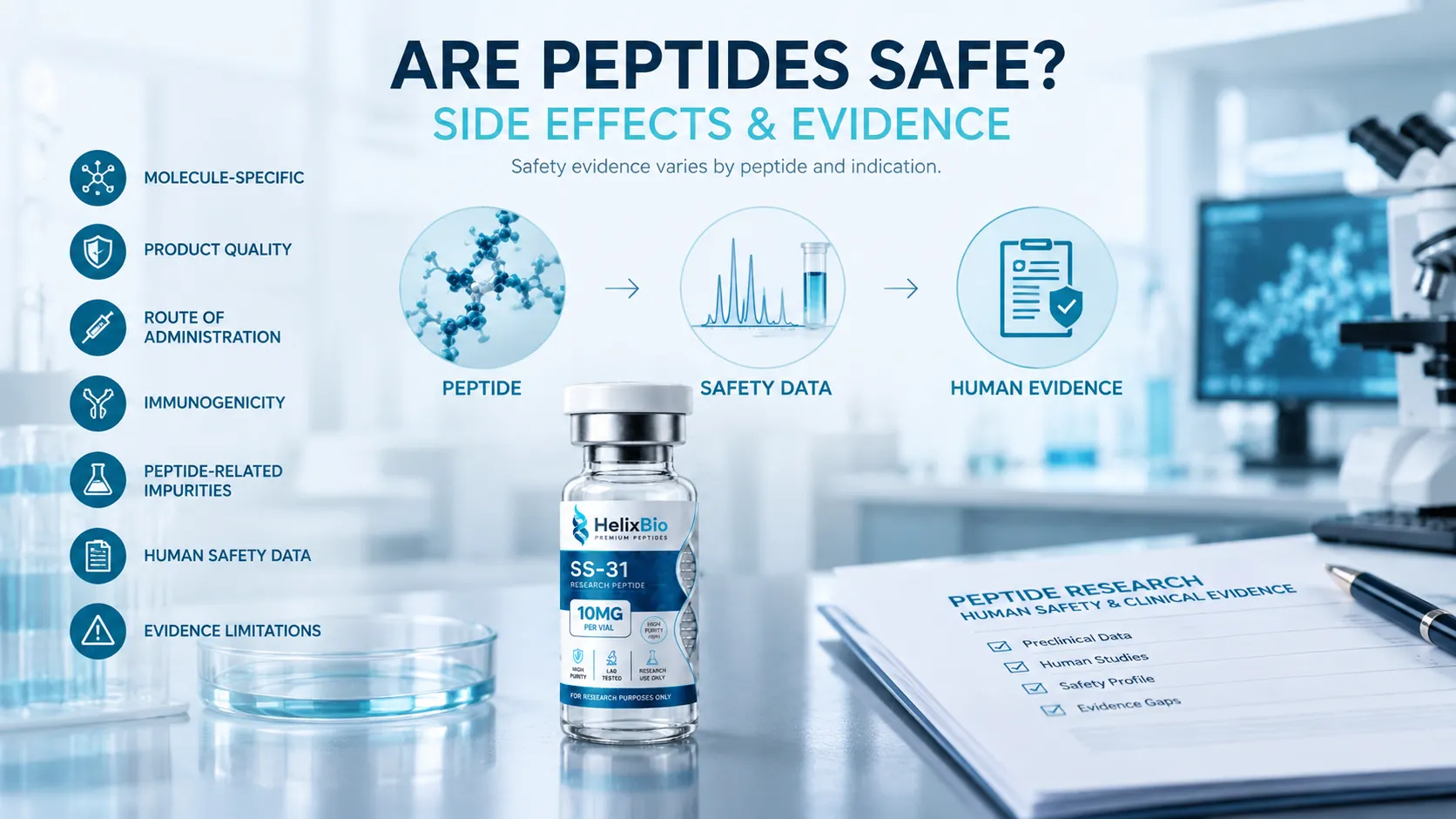
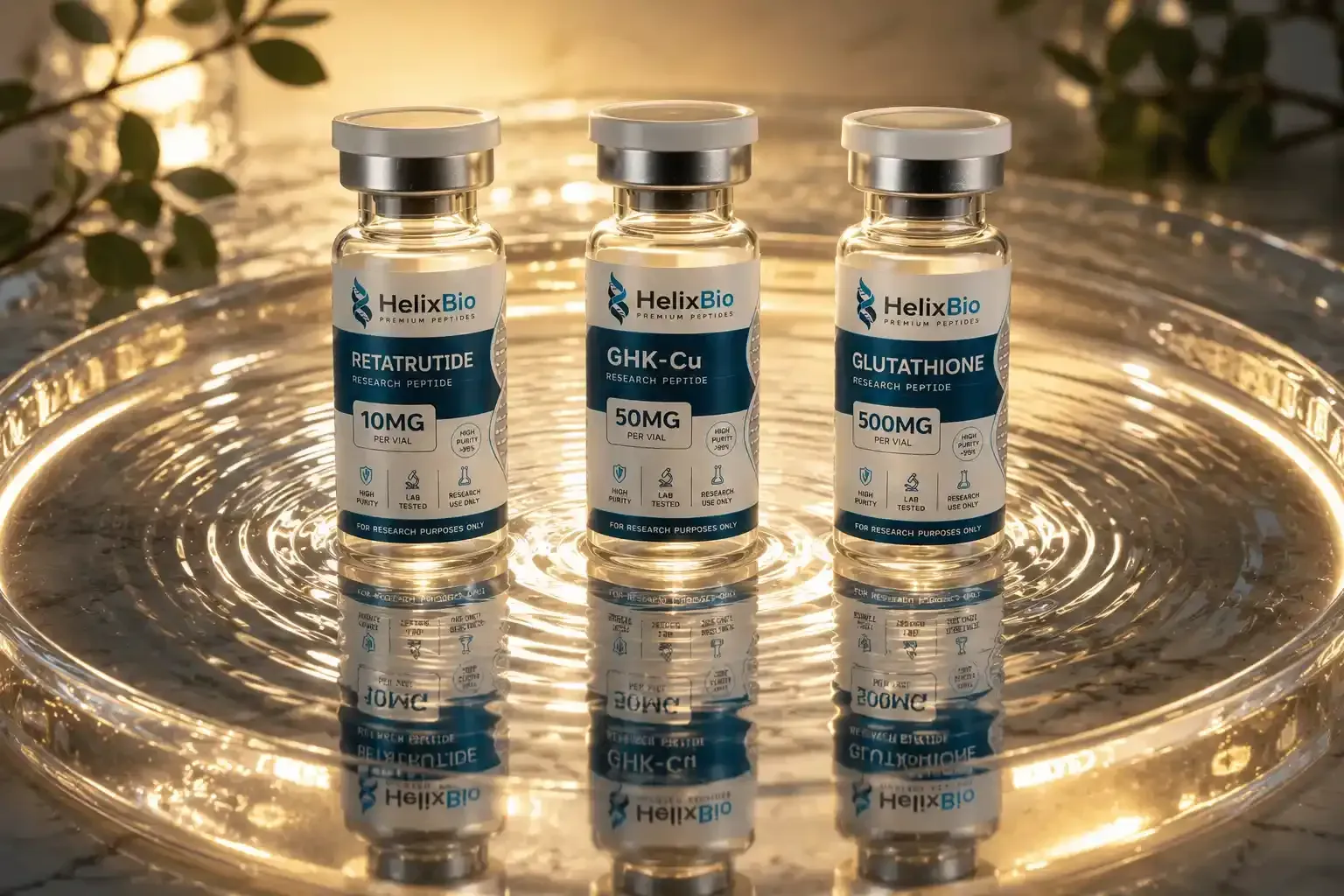
A certificate of analysis reports purity and identity for a single batch. It says nothing about whether a preparation is safe for a person, because purity is not safety. Helix Bio Chem materials are supplied for laboratory research use only, and not for human use, veterinary use, or compounding.
What the evidence does not show
Several things remain open, and saying so is part of reporting this accurately. The 503B proposal has no final determination, so it changes nothing on its own yet. Clinical significance has no bright-line test in the agency's published guidance.
Warning letters remain allegations from start to finish. No company named through 2026 has been found liable by a court on the basis of those letters. Salt-form behavior is unstudied and not disproven, because the FDA says it lacks information. Adverse event totals are floors and not measurements, since reporting is voluntary for most 503A pharmacies.
Are research-grade GLP-1 peptides legal?
A separate market runs alongside the compounding one. Vendors sell GLP-1 active ingredients and peptides described as research grade. The FDA has warned companies that illegally sold unapproved drugs under research-purposes labeling. Those drugs contained semaglutide, tirzepatide, retatrutide, survodutide, or mazdutide, and the agency found they reached consumers for human use with dosing instructions.
That last detail is the hinge. The agency judges a product by its intended use, and it reads intended use from everything a seller says and does. A disclaimer is one input among many, and the rest of a website can outweigh it. Our September 2026 enforcement explainer covers how that standard reached five named vendors.
Upstream action has followed the letters. In September 2025 the FDA established a green list import alert, numbered 66-80, to stop GLP-1 active ingredients with potential quality concerns at the border.
What does a certificate of analysis actually prove?
A certificate of analysis is a lab report for one batch. Several specific things appear on a genuine third-party certificate. The document identifies the batch or lot, so it can be matched against the vial in hand. Identity comes next, usually by mass spectrometry. Purity follows, usually by high-performance liquid chromatography, expressed as a percentage of the chromatogram area.
The limits matter just as much. A certificate cannot confirm sterility unless sterility testing was performed and reported. It cannot confirm the contents of a different lot, since each batch needs its own report. Salt form and mass basis are absent unless the certificate states them. Counterion mass changes how much active material a stated milligram figure represents.
Read the lot number before anything else. If it does not match the vial, the rest of the document is describing something else.
Where does that leave compounded GLP-1s?
Compounded semaglutide and tirzepatide remain legal in one narrow form, which is 503A compounding for an identified patient with a documented clinical reason. Wider routine copying closed in spring 2025 under the essentially-a-copy prohibition. A pending proposal would shut the 503B bulks-list route while supply stays normal.
For the compounding-access side, see the July 2026 PCAC peptide vote. State-level action is tracked in our peptide laws by state tracker.
Frequently Asked Questions
Yes, but only in a narrow form, because the shortage exception that permitted routine copying ended in 2025. A 503A pharmacy may still compound it for an identified individual patient, provided the prescriber documents a clinically significant difference for that person. Routine monthly compounding at subscription scale falls outside what the FDA currently allows.
Only through the same narrow route, since the FDA declared the tirzepatide shortage resolved on December 19, 2024. Enforcement discretion for 503A pharmacies ended March 5, 2025, when a court denied the compounders' injunction motion. Outsourcing facilities lost their window on March 19, 2025, so a documented patient-specific 503A prescription is the remaining route.
It never became illegal as a molecule, because what actually changed was commercial availability. Federal law bars compounding drugs that are essentially copies of commercially available approved drugs, unless a prescriber documents a difference. A drug on the shortage list is not commercially available, and semaglutide came off that list on February 21, 2025.
No, and the distinction between lawful and approved matters a great deal. Compounded drugs are not FDA-approved, and the agency does not review them for safety, effectiveness, or quality before marketing. A compounded preparation may be lawful under 503A or 503B while still sitting outside the approval process Ozempic and Wegovy completed.
Not by itself, because the FDA addressed this directly on April 1, 2026. It named semaglutide with cyanocobalamin as a possible copy when the route matches and strengths sit within 10 percent. In September 2026 the agency called one pharmacy's claimed differences pretextual, citing production volumes and repeated prescriber determinations.
Salt forms such as semaglutide sodium and semaglutide acetate pair the molecule with a counterion. The FDA states these are different active ingredients from the one in the approved drugs. It says it lacks information on whether their properties match, and knows of no lawful basis for using them in compounding.
It is the FDA list of bulk active ingredients that outsourcing facilities may use in compounding. A 503B facility generally cannot compound from a bulk substance missing from that list. The one alternative is the finished drug sitting on the shortage list, which would survive the April 30, 2026 proposed exclusion.
A 503A pharmacy is state-licensed and compounds for identified patients against prescriptions, without current good manufacturing practice obligations. A 503B outsourcing facility registers with the FDA, compounds in larger batches without patient-specific prescriptions, and must meet cGMP requirements. They answer to different regulators, so what is lawful for one may not be lawful for the other.
No, and saying so in marketing has drawn FDA warning letters. Ozempic and Wegovy are approved Novo Nordisk products with reviewed formulations, labels, and manufacturing oversight. A compounded preparation is unreviewed, varies by pharmacy and batch, and may contain a salt form the FDA treats as a different ingredient.
The FDA reads two conditions together, and both must hold. The compounded product holds the same active ingredient at the same, similar, or easily substitutable strength, and the approved product serves the same route. One exception survives, which is a prescriber-documented change producing a significant difference for one identified patient.
Yes, and it has happened repeatedly through 2026. The agency issued 30 warning letters to telehealth companies on March 3, then 25 more posted on June 16. On September 18 it warned Empower Pharmacy, a licensed 503A pharmacy, over two GLP-1 combination products, and warning letters record allegations and not court findings.
Legality turns on intended use and not on the wording of a label. The FDA has warned companies selling unapproved semaglutide, tirzepatide, retatrutide, survodutide, or mazdutide under research-purposes labeling. Those products reached consumers for human use with dosing instructions, and the agency reads a whole website before deciding.
- 01U.S. Food and Drug Administration. “FDA clarifies policies for compounders as national GLP-1 supply begins to stabilize.” Current as of April 1, 2026.
- 02U.S. Food and Drug Administration. “FDA’s Concerns with Unapproved GLP-1 Drugs Used for Weight Loss.” Current as of September 1, 2026.
- 03U.S. Food and Drug Administration. “Declaratory Order: Resolution of Shortages of Tirzepatide Injection Products.” December 19, 2024.
- 04U.S. Food and Drug Administration. “Resolution of Semaglutide Injection Product Shortage and Supply Status.” February 21, 2025.
- 05U.S. Food and Drug Administration. “FDA Proposes to Exclude Semaglutide, Tirzepatide, and Liraglutide on 503B Bulks List.” Press release, April 30, 2026.
- 06Food and Drug Administration. “List of Bulk Drug Substances for Which There Is a Clinical Need Under Section 503B of the Federal Food, Drug, and Cosmetic Act.” 91 FR 23431, May 1, 2026. Docket No. FDA-2018-N-3240.
- 07Food and Drug Administration. “List of Bulk Drug Substances for Which There Is a Clinical Need Under Section 503B of the Federal Food, Drug, and Cosmetic Act; Extension of Comment Period.” 91 FR 38719, June 26, 2026.
- 08U.S. Food and Drug Administration. “Warning Letter: Empower Clinic Services, LLC dba Empower Pharmacy (MARCS-CMS 738238).” September 18, 2026.
Helix Bio Chem Team
Research & Product Team
Our in-house team tracks published peptide research and translates it into clear, source-cited summaries for the research community.
Reviewed by in-house research chemists
support@helixbiochem.com