- Approved peptides have trial-measured adverse event profiles. Most research peptides have no such profiles.
- Gastrointestinal effects dominate the GLP-1 labels, with nausea at 44.2% in STEP 1 versus 17.4% on placebo.
- The Egrifta label carries the tightest immunogenicity signal, with anti-drug antibodies in 50% of patients at 26 weeks.
- BPC-157 has zero published human randomized controlled trials, and fourteen people total across two uncontrolled pilots.
- Ibutamoren's phase 2b hip-fracture trial stopped early over a heart-failure signal.
- Contamination is the best-documented risk, with only 44% of 98 tested peptides meeting the purity their certificates claimed.
- Caution splits into label-verified contraindications and mechanism-inferred concerns, and the two should never be presented alike.
- Purity never equals safety, since a pure compound with no human data is still a compound with no human data.
BPC-157 is the most discussed healing peptide on the internet. It has never been tested in a published randomized controlled trial in humans. Its entire published human safety record is two small uncontrolled pilot studies. One infused two healthy adults over three days (PMID 40131143). The other treated twelve women with interstitial cystitis (PMID 39325560). Fourteen people, no control group, no blinding, and no long-term follow-up.
That gap is the pattern across most compounds sold as research peptides. A handful of peptides have been through multi-phase trials with published adverse event tables, and the rest have not. This article separates the two, compound by compound, and names the evidence tier behind every number.
Are peptides safe? The short answer
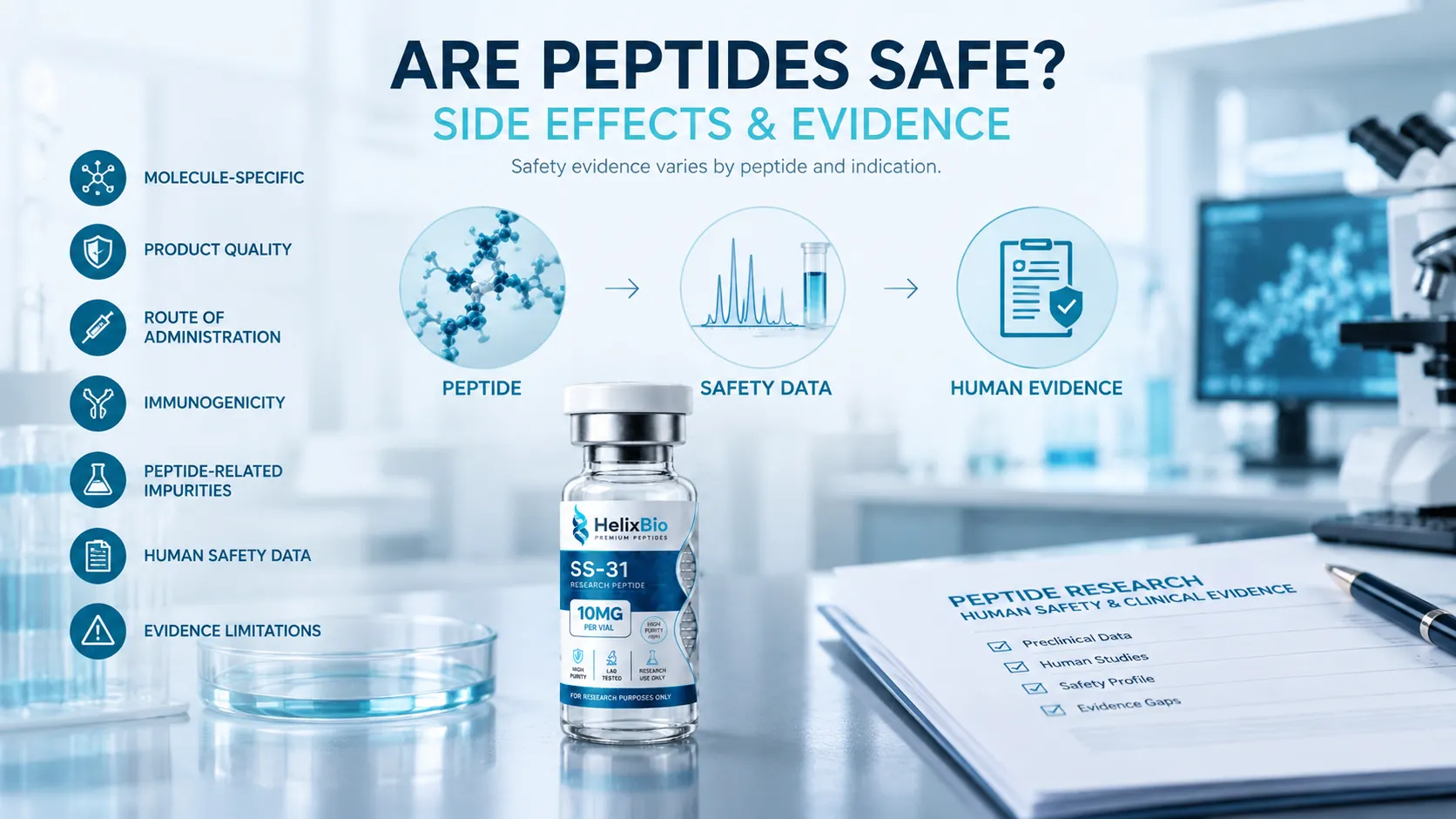
Safety depends entirely on which peptide you mean. FDA-approved peptides have measured adverse event rates from trials in thousands of participants (the label-verified and trial-reported tiers). Most research peptides have no published human safety data at all (the absent tier). Contamination and mislabeling are the best-documented risks across the research-peptide market, and they apply regardless of the compound.
Three evidence tiers run through everything below. Label-verified means the rate appears in an FDA-approved prescribing information document. Trial-reported means it comes from a published clinical trial with a stated sample size. Absent means no published human data exists. Every table in this article marks which tier applies to each row.
Helix Bio Chem supplies peptides as research materials for laboratory use only. Nothing on this page describes dosing, administration, reconstitution, or use in humans.
How does safety differ between approved and research peptides?
The split is not a matter of degree. It is a matter of whether the data exists.
Semaglutide reached the market through the STEP and SUSTAIN phase 3 programs. STEP 1 alone randomized 1,961 adults over 68 weeks and published a full adverse event table (PMID 33567185). Tirzepatide and its SURMOUNT-1 trial enrolled 2,539 participants across 72 weeks (PMID 35658024). Both compounds carry prescribing information that lists event rates against placebo, dose by dose.
BPC-157 has fourteen people across two uncontrolled pilots. Nobody randomized them, and nobody compared them to anything.
Research-use-only compounds were never required to produce this evidence, because they were never submitted for approval. That regulatory position is covered in what research-use-only actually means and in the FDA's recent enforcement posture. Absence of data is not evidence of safety; it is only absence of data.
What are the most common side effects of peptides?
Two event classes dominate wherever trials have actually measured anything. Gastrointestinal effects dominate the GLP-1 compounds. Injection-site reactions show up in nearly every injectable peptide that has a label.
The Egrifta (tesamorelin) label gives the clearest single number. Injection site reactions occurred in 17% of treated patients versus 6% on placebo, across 543 treated and 263 placebo participants in the 26-week phase.
Compound class | Most reported events | Rate where trial-measured | Evidence tier |
|---|---|---|---|
GLP-1 agonists (semaglutide) | Nausea, diarrhea, vomiting, constipation | 44.2% / 31.5% / 24.8% / 23.4% vs 17.4 / 15.9 / 6.6 / 9.5 placebo (STEP 1) | Phase 3 trial |
GLP-1/GIP agonists (tirzepatide) | Nausea, diarrhea, vomiting | 24.6-33.3% / 18.7-23.0% / 8.3-12.2% vs 9.5 / 7.3 / 1.7 placebo | Phase 3 trial |
GHRH analogs (tesamorelin) | Injection site reaction, arthralgia, myalgia | 17% / 13% / 6% vs 6 / 11 / 2 placebo | FDA label |
Melanocortin agonists (bremelanotide) | Nausea, flushing, headache | 40.0% / 20.3% / 11.3% vs 1.3 / 0.3 / 1.9 placebo | FDA label |
GH secretagogues (ipamorelin) | Surgical-population events, no separation from placebo | 87.5% any event vs 94.8% placebo | Phase 2 trial |
BPC-157, TB-500, GHK-Cu (systemic) | None measured in controlled human trials | No published rate | Absent |
Notice what "common" means in each row. In the top four rows it means counted against a placebo group. In the bottom row it means nothing has been counted.
What do the GLP-1 trial tables actually show?
These are the densest safety numbers in the whole peptide space, so they are worth reading closely.
In STEP 1, nausea reached 44.2% on semaglutide 2.4 mg versus 17.4% on placebo. Diarrhea hit 31.5% versus 15.9%, vomiting 24.8% versus 6.6%, and constipation 23.4% versus 9.5%. Discontinuation for adverse events ran 7.0% versus 3.1%, most of it driven by gastrointestinal events at 4.5% versus 0.8%. Gallbladder disorders occurred in 2.6% versus 1.2%. Acute pancreatitis was reported in 0.2% of the semaglutide group and none on placebo.
SURMOUNT-1 tested tirzepatide at three doses. Nausea ran 24.6%, 33.3% and 31.0% at 5, 10 and 15 mg against 9.5% on placebo. Diarrhea ran 18.7%, 21.2% and 23.0% against 7.3%. Vomiting ran 8.3%, 10.7% and 12.2% against 1.7%. Discontinuation for adverse events was 4.3%, 7.1% and 6.2% against 2.6%.
The Ozempic label carries a boxed warning about thyroid C-cell tumors. The label states that semaglutide causes these tumors in rodents. Whether it causes them in humans is unknown, because the human relevance of the rodent finding has not been determined. The label is careful with that wording, and so should anyone citing it be.
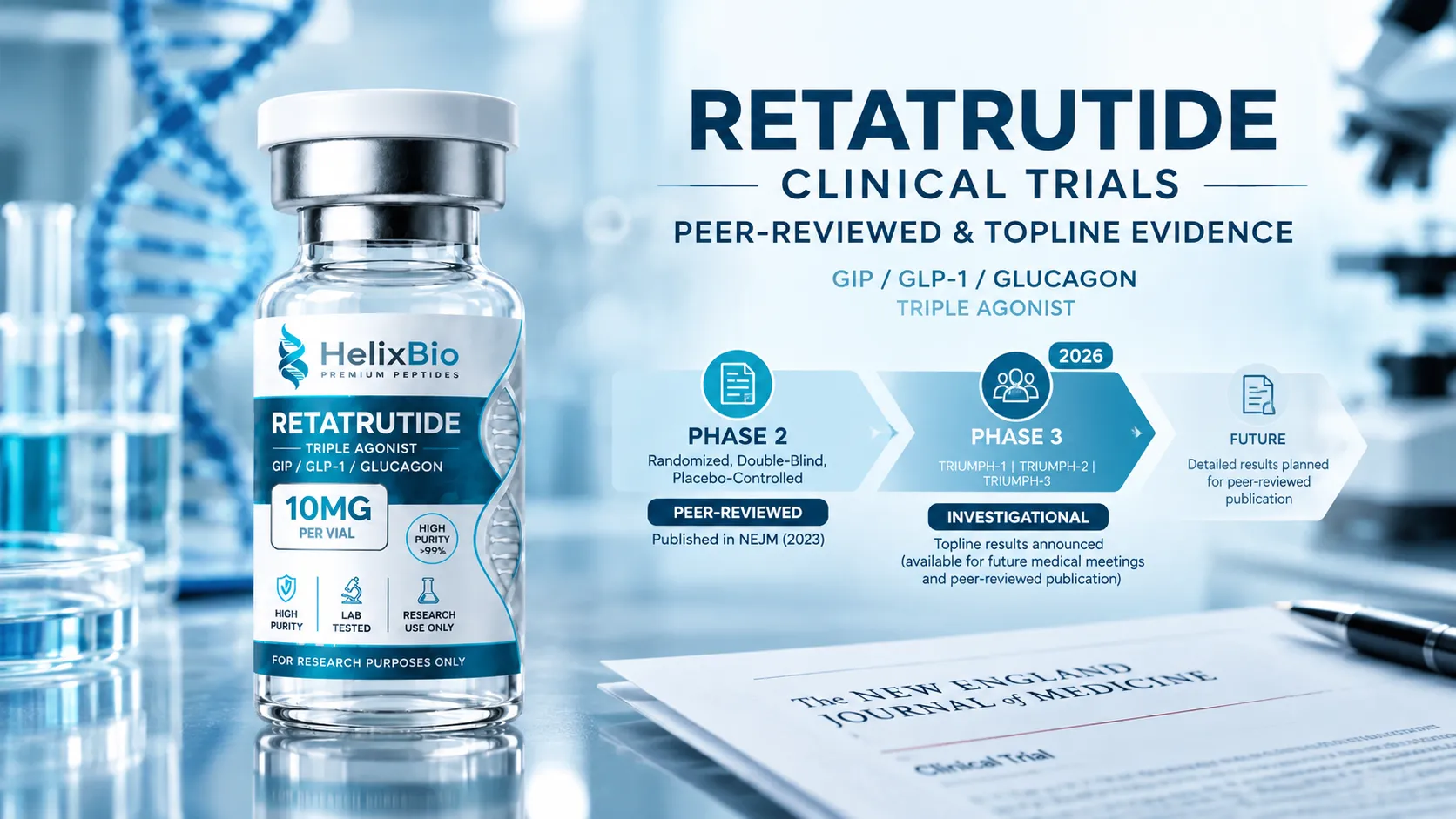
Retatrutide sits one tier lower in the evidence. Its phase 2 trial randomized 338 adults over 48 weeks (PMID 37366315). Adverse events were reported in 73% to 94% of retatrutide groups versus 70% on placebo, rising with dose. Discontinuation for adverse events ran 6% to 16% across doses, with none on placebo. There is no approved label and no long-term human data. More on this class sits in the GLP-1 and GIP agonist research overview.
What about sermorelin, ipamorelin, and the other GH peptides?
The growth-hormone peptides have one real label between them, and it is worth reading.
Egrifta (tesamorelin) is a GHRH analog with an FDA label built on 543 treated patients. Injection site reactions ran 17% versus 6% on placebo. Arthralgia ran 13% versus 11%, extremity pain 6% versus 5%, myalgia 6% versus 2%, peripheral edema 6% versus 2%, and paresthesia 5% versus 2%. New-onset diabetes, defined as HbA1c reaching 6.5% or higher, occurred in 5% versus 1%, with a hazard ratio of 3.3.
The immunogenicity data is the part nobody quotes. Anti-tesamorelin IgG antibodies appeared in 50% of patients at 26 weeks and 47% at 52 weeks. Roughly 60% of those antibodies cross-reacted with the body's own GHRH. That is a labeled, measured finding about a peptide that closely resembles a natural hormone.
Ipamorelin has exactly one human safety trial of any size. Beck and colleagues ran a phase 2 study in 117 bowel-resection patients (PMID 25331030). Treatment-emergent adverse events occurred in 87.5% of the ipamorelin group and 94.8% on placebo. The authors described it as well tolerated. No efficacy endpoint separated from placebo, and no long-term data exists.
Sermorelin and its regulatory record are often misread. Geref was approved in 1990 and again in 1997, then discontinued by its manufacturer in 2008. FDA withdrew the applications in 2009. A later determination found formally that the products were not withdrawn for reasons of safety or effectiveness (FR Doc 2013-04827, Docket FDA-2012-P-1071). The exit was commercial. Anyone citing that withdrawal as a safety finding is contradicting the document itself.
Ibutamoren is the cautionary tale in this group. Adunsky and colleagues studied 123 elderly hip-fracture patients and stopped the trial early (PMID 21067829). Congestive heart failure occurred in 4 of 62 treated patients versus 1 of 61 on placebo. The published conclusion stated the compound had an unfavorable safety profile in that population. A separate two-year trial followed 65 healthy older adults (PMID 18981485). Increased appetite occurred in 29 of 43 treated participants versus 8 of 22 on placebo. Edema occurred in 19 versus 6, and muscle pain in 14 versus 2. Fasting glucose rose by about 5 mg/dL and insulin sensitivity declined.
BPC-157 and TB-500, and what human safety data actually exists
Competitor pages tend to say "limited data" and then imply the compounds are probably fine. Enumerating the absence is more useful.
For BPC-157, there are no published human randomized controlled trials. The IV pilot dosed two healthy adults and reported no adverse effects (PMID 40131143). The intravesical pilot treated twelve women and reported none either (PMID 39325560). Neither study had a control group, and neither was blinded. Neither study followed patients beyond a few weeks. Two subjects cannot detect an event that occurs in one person out of a hundred. Background on the compound itself sits in the BPC-157 structure and mechanism review.
TB-500 has a subtler evidence problem. Human trials of thymosin beta-4 do exist, in dermal wound gels, eye drops and intravenous formulations under pharmaceutical designations. Those trials used the full-length protein, applied topically or infused. TB-500 as sold is a shorter fragment given by injection. The published safety narrative belongs to a different molecule delivered by a different route. No peer-reviewed trial publishes a full adverse event table for injected TB-500 in humans. The identity question is covered in the TB-500 and thymosin beta-4 identity review.
PT-141 and melanotan II, and what the labels and case reports say
These two compounds share a mechanism and sit two full tiers apart on evidence.
Bremelanotide has an FDA label built on 627 treated and 620 placebo patients. Nausea occurred in 40.0% versus 1.3%. The label adds useful detail here. Nausea hit 21% after the first dose, then dropped to roughly 3% on later doses. Thirteen percent of patients needed an anti-emetic, and 8% left the trials because of it. Flushing ran 20.3% versus 0.3%, and headache 11.3% versus 1.9%. Blood pressure rose transiently after each dose, peaking two to four hours later. Focal hyperpigmentation appeared in 1% at labeled dosing versus none on placebo, and in 38% of patients who took it daily for eight days.
Melanotan II has no approval anywhere. Its evidence tier is case reports. Published cases describe darkening of existing moles and new pigmented lesions. One case report describes a melanoma in a 20-year-old woman who had also been using sunbeds, and causation was not established (PMID 24355990). The authors noted that because the drug is unlicensed and incompletely tested, the range of its adverse effects is simply unknown.
One compound has a label, and the other has anecdotes. They are not comparable, and no honest table should present them as though they were.
Do peptides cause cancer?
The GLP-1 labels carry the only carcinogenicity signal in this space that has been formally evaluated, and it comes from rodents. Semaglutide produced dose-dependent thyroid C-cell tumors in mice and rats at clinically relevant exposures. The label states plainly that human relevance has not been determined. It does not say the risk transfers to people, and neither should anyone citing it.
The growth-hormone peptides raise a different question. Elevated IGF-1 is a theoretical concern for cell proliferation, and that is the whole basis for caution. It is a mechanism, not a finding. Tesamorelin is contraindicated in active malignancy for that reason, and its label states the effects of prolonged IGF-1 elevation are unknown. Ibutamoren's development ended over a cardiac signal, so no long-term cancer follow-up was ever collected.
For BPC-157, TB-500, GHK-Cu and melanotan II, no human carcinogenicity program exists. The honest answer is that nobody has looked. That is where the evidence ends.
What about your liver, kidneys, and long-term use?
Can peptides damage your liver or kidneys? For approved peptides, trial and label data exist and do not show consistent organ toxicity at labeled use. The bremelanotide label describes a single case of acute hepatitis in one patient. She had received ten doses over a year, and another cause was never identified. For research peptides, no human organ-safety monitoring data has been published at all.
Are peptides safe for long-term use? Only the approved compounds have data past a year. Tesamorelin has 52-week label data, and the GLP-1 programs ran 68 to 72 weeks. Ibutamoren has two-year data in 65 healthy older adults. For BPC-157, TB-500 and the rest, the longest published observation is measured in weeks.
ISMP and ECRI have both argued that reliable safety information is lacking for many compounds sold in this market. That position is defensible on the record above. The counterpoint is that absence of reported harm is not the same as demonstrated harm. Both statements are true, and neither one supports a confident claim in either direction.
What is the best-documented safety risk of research peptides?
Here is the finding that should change how people read a certificate of analysis.
Researchers at Ghent University ordered 98 synthetic peptides at a requested purity of at least 95%. Every single one arrived with a certificate of analysis stating that it met that specification. In-house quality control found that only 43 of the 98, or 44%, actually did (PMID 29403929). One sample's main chromatographic peak was not even the requested sequence. Among nine cyclic peptides, none exceeded 90% purity, and the suppliers later admitted they could not make them to spec. Roughly three-quarters of the identified impurities were sequences missing at least one amino acid.
That was a university lab buying from commercial suppliers for published research. The consumer market has less oversight, not more.
FDA acted on the commercial side in December 2024, issuing warning letters to four online peptide sellers: Xcel Peptides, Swisschems, Summit Research and Prime Peptides. The letters alleged the marketing of unapproved new drugs, covering GLP-1 compounds sold under research-use-only labeling. The agency's position was that the disclaimer did not change what was being sold.
FDA repeated the action in August 2026, with five warning letters dated August 24 and posted September 1. The recipients were Peak Performance Peptides, Royal Peptides LLC, NuScience Peptides LLC, Peptide Partners LLC, and TXP Innovations LLC, trading as Tex Peptides. Cited products included semaglutide, tirzepatide, retatrutide, SS-31, PT-141 and tesamorelin, among others. As in 2024, the agency found the research-use-only disclaimers did not change how the sites marketed the products for human use.
A useful third-party COA shows five things. Identity, confirmed by mass spectrometry against the theoretical mass. Purity, by HPLC, with the chromatogram included. Quantity, so the stated concentration can be checked. Method, including column, gradient and detection wavelength, so the result could be reproduced. Limitations, meaning what the test did not measure, such as sterility or endotoxin.
Purity does not equal safety. A 99% pure compound with no human safety data is still a compound with no human safety data, and a clean certificate of analysis answers a narrower question than most buyers assume.
Practical guidance sits in how to read a peptide certificate of analysis, the purity and contamination data review, and the sourcing checklist.
Who should be extra careful with peptides?
Most safety lists mix verified contraindications with educated guesses. Keeping the two tiers separate matters for readers.
Tier | Situation | Basis |
|---|---|---|
Label-verified | Personal or family history of medullary thyroid carcinoma, or MEN 2, with GLP-1 compounds | Contraindication in the Ozempic label |
Label-verified | Pregnancy, with tesamorelin | Contraindication in the Egrifta label |
Label-verified | Active malignancy, with tesamorelin | Contraindication in the Egrifta label |
Label-verified | Acute critical illness, with tesamorelin (open-heart surgery, abdominal surgery, multiple trauma, or acute respiratory failure) | Warning in the Egrifta SV label, section 5.7, which advises considering discontinuation in critically ill patients |
Label-verified | Uncontrolled hypertension or known cardiovascular disease, with bremelanotide | Contraindication in the Vyleesi label |
Label-verified | Pregnancy, with bremelanotide | Precaution in the Vyleesi label, which advises discontinuing if pregnancy is suspected. Not a contraindication |
Mechanism-inferred | Cardiac vulnerability, with GH secretagogues | Inference from the ibutamoren trial's heart-failure signal |
Mechanism-inferred | Hormone-sensitive conditions, with GH-axis peptides | Inference from IGF-1 elevation, not a measured outcome |
The top rows come from documents FDA reviewed. The bottom rows come from reasoning about mechanisms. Both are worth knowing, but they are not the same kind of claim.
What the evidence does not show
This section is the point of the article.
BPC-157. No published human randomized trial exists, and no carcinogenicity study has been run. Long-term safety data, drug-interaction data and human pharmacokinetics are all absent beyond a two-person pilot.
TB-500. No peer-reviewed trial publishes a full adverse event table for the injected fragment. The human trial record belongs to full-length thymosin beta-4 in topical and intravenous formulations.
GHK-Cu. Human evidence is topical and cosmetic only. No systemic human safety data has been published.
Ipamorelin. One phase 2 trial ran in a post-surgical population, with no efficacy separation and no long-term follow-up. The larger phase 2 program never published results.
Melanotan II. No approval, controlled trial or measured event rate exists anywhere. The published record is case reports.
Retatrutide. Phase 2 data is all that exists, with no label and no approval. Long-term human data has not been collected.
None of that means these compounds are dangerous. It means nobody can currently say whether they are, and any page telling you otherwise is filling a gap with confidence.
Are peptides steroids?
No, and the confusion is worth clearing up.
Anabolic steroids are synthetic derivatives of testosterone. They bind androgen receptors directly and suppress the body's own hormone production. In the United States they are Schedule III controlled substances.
Peptides are short chains of amino acids that act as signaling molecules. A GHRH analog like tesamorelin asks the pituitary to release growth hormone. It does not replace a hormone or shut down the gland that makes it. Most peptides are not scheduled under the Controlled Substances Act at all, though many are unapproved drugs, which is a separate legal category entirely. The structural and classification differences are laid out in peptides versus SARMs.
What does the peptide safety evidence actually support?
Safety is a compound-specific question, and the answer depends on which of three tiers the compound sits in. Label-verified compounds have measured rates you can look up. Trial-reported compounds have numbers with stated limits. For everything in the absent tier, there is no answer, only an unfilled space.
Across the whole market, the risk with the most supporting data is not a pharmacological one. It is contamination and mislabeling, documented in a study where 56 of 98 peptides failed the purity their own certificates claimed.
For the next step, the purity and contamination data and the COA reading guide cover what documentation can and cannot tell you.
Frequently Asked Questions
Gastrointestinal events and injection site reactions dominate wherever trials have measured. In STEP 1, semaglutide produced nausea in 44.2% of participants versus 17.4% on placebo. The Egrifta label reports injection site reactions in 17% versus 6%. For most research peptides, no measured rates exist.
Only approved peptides have data beyond a year. Tesamorelin has 52-week label data, and the GLP-1 obesity programs ran 68 to 72 weeks. Ibutamoren has two-year data in 65 adults. For BPC-157, TB-500 and similar compounds, published observation is measured in weeks.
Approved peptides have not shown consistent organ toxicity at labeled use in trials. The bremelanotide label records one unexplained case of acute hepatitis in a patient who received ten doses. For research peptides, no published human organ-safety monitoring data exists in either direction.
Semaglutide causes thyroid C-cell tumors in rodents, and its label states that human relevance has not been determined. Growth-hormone peptides raise a theoretical IGF-1 concern that has not been tested as a human outcome. No carcinogenicity program exists for the research compounds.
Nobody can currently say with confidence. Research-use-only compounds were never submitted for approval, so they carry no trial data, no label and no measured event rates. The documented risks are contamination and mislabeling, which apply to the product regardless of which compound is named on it.
No published randomized trial has measured them. Two uncontrolled pilots totaling fourteen participants reported no adverse effects, one in two healthy adults and one in twelve women. A study that size cannot detect an event occurring in one person out of a hundred.
No peer-reviewed trial publishes an adverse event table for injected TB-500 in humans. Human thymosin beta-4 trials used the full-length protein in topical or intravenous formulations. That is a different molecule by a different route from the injected fragment sold today.
Retatrutide is investigational, with no approved label and no long-term data. Its phase 2 trial in 338 adults reported adverse events in 73% to 94% of dose groups versus 70% on placebo. Discontinuation for adverse events ran 6% to 16%, with none on placebo.
Published human evidence for GHK-Cu is topical and cosmetic. No systemic human safety data exists, meaning no trial has measured what happens when it is given by injection. Any claim about systemic safety is an extrapolation from topical use, not a finding.
Standard workplace panels screen for drugs of abuse and do not look for peptides. Anti-doping programs are different, because several peptides appear on prohibited lists and have dedicated detection methods. Sources here are secondary, and testing panels vary by program.
No, peptides and steroids are different drug classes. Anabolic steroids are testosterone derivatives that bind androgen receptors and suppress the body's own hormone production. Peptides are amino acid chains that act as signaling molecules. Steroids are Schedule III controlled substances, while most peptides are unapproved drugs.
The question cannot be answered on current evidence. Compounds with no reported side effects are usually compounds nobody has measured. Reported rates exist only where trials ran. A peptide with a long label can look worse than one with no data, regardless of actual risk.
A useful COA reports identity by mass spectrometry, purity by HPLC with the chromatogram included, quantity so concentration can be checked, the analytical method in enough detail to reproduce, and the limitations of what was not tested, such as sterility or endotoxin.
- 01Wilding JPH, et al. Once-Weekly Semaglutide in Adults with Overweight or Obesity (STEP 1). N Engl J Med. 2021.
- 02Jastreboff AM, et al. Tirzepatide Once Weekly for the Treatment of Obesity (SURMOUNT-1). N Engl J Med. 2022.
- 03Jastreboff AM, et al. Triple-Hormone-Receptor Agonist Retatrutide for Obesity, A Phase 2 Trial. N Engl J Med. 2023.
- 04Verbeke F, et al. Quality evaluation of synthetic quorum sensing peptides used in R&D. J Pharm Anal. 2015.
- 05Adunsky A, et al. MK-0677 (ibutamoren mesylate) for patients recovering from hip fracture, a phase IIb study. Arch Gerontol Geriatr. 2011.
- 06EGRIFTA SV (tesamorelin) for injection, full prescribing information. DailyMed, U.S. National Library of Medicine.
- 07VYLEESI (bremelanotide) injection, full prescribing information. DailyMed, U.S. National Library of Medicine.
- 08OZEMPIC (semaglutide) injection, full prescribing information. DailyMed, U.S. National Library of Medicine.
Helix Bio Chem Team
Research & Product Team
Our in-house team tracks published peptide research and translates it into clear, source-cited summaries for the research community.
Reviewed by in-house research chemists
support@helixbiochem.com