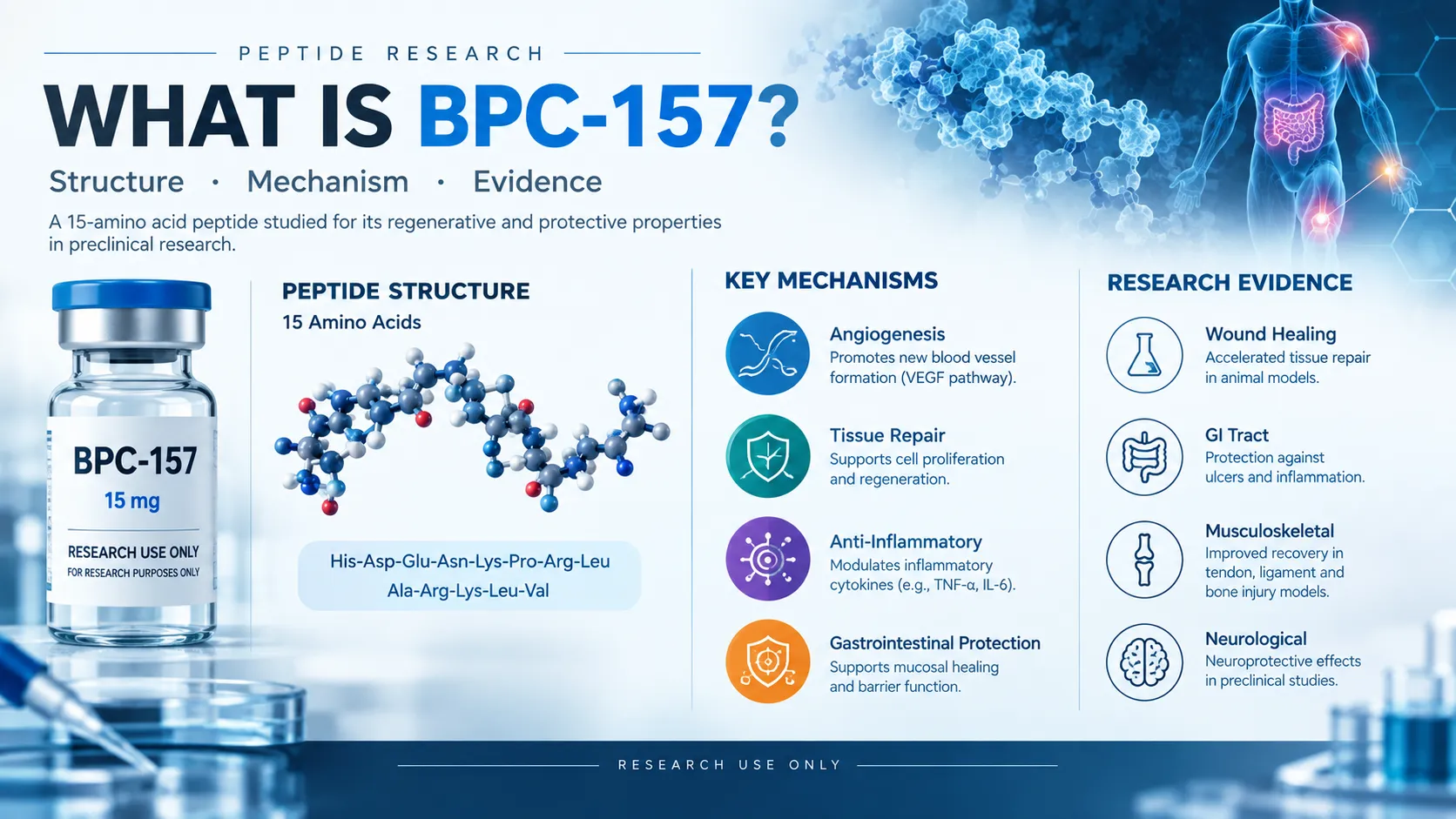
BPC-157 is a synthetic pentadecapeptide of 15 amino acids with the sequence GEPPPGKPADDAGLV.
Its molecular formula is C62H98N16O22 and its average molecular weight is approximately 1419.55 g/mol for the free peptide.
BPC-157 contains no tryptophan, tyrosine or phenylalanine, so A280 cannot determine peptide content and UV detection must run near 214 nm.
The peptide supplied for research is synthetic; the naturally occurring entity is the larger gastric protein its sequence is described from.
VEGFR2-Akt-eNOS is the most studied proposed pathway in preclinical models, not an established mechanism of action.
A 2025 systematic review included 36 studies, of which 35 were preclinical and one was clinical, and found no clinical safety data.
Three small uncontrolled human reports have been published as full papers, and all three share an author and a single journal.
Three randomised controlled trials are registered and none has posted results; the only randomised human outcome is a 2005 conference abstract that found no significant difference from placebo.
BPC-157 is not approved by the FDA for any indication and is not a lawful US dietary supplement ingredient.
FDA materials treat BPC-157 free base and BPC-157 acetate as different active ingredients, which changes the mass basis on a certificate of analysis.
Searches for BPC-157 return two very different pictures. One is a large, internally consistent body of animal work reaching back to the early 1990s. The other is a human record short enough to fit in a single table. This page is about BPC-157 itself — what the molecule is, what its sequence and mass actually are, which proposed mechanisms have been observed repeatedly and which have been reported once, and where the evidence stops. Combination research, handling and sourcing questions belong to other pages and are not repeated here.
Featured In This Article
BPC-157
RESEARCH PEPTIDE
Highly purified synthetic peptide prepared for rigorous laboratory research.
$61.00
Quick Answer: What Is BPC-157?
BPC-157 is a synthetic pentadecapeptide — one linear chain of 15 amino acids — with the sequence GEPPPGKPADDAGLV. Its full name is Body Protection Compound 157, and it appears in the literature under the synonyms bepecin and PL 14736. It is described as corresponding to a partial sequence of a larger protective protein identified in human gastric juice, characterised by Sikirić and colleagues in the early 1990s. Material supplied for laboratory work is produced by solid-phase peptide synthesis, not extracted from tissue.
Nearly everything reported about its biological activity comes from rodent and cell-culture models. The published human record consists of three small uncontrolled reports in full papers; the only randomised, placebo-controlled human data are conference abstracts from the early 2000s, and no randomised trial has been published as a full peer-reviewed paper. BPC-157 is not approved by the FDA for any use.
BPC-157 Structure and Sequence
The structural data are settled and agree across chemical databases and peer-reviewed reviews.
8ED8NXK95P (free peptide; the acetate salt is PAR2FC72XP)
Structural description
Linear chain, unmodified termini, no cysteine and therefore no disulfide bond
Two features of that sequence matter at the bench. The first is the proline-rich core — three consecutive proline residues at positions three to five — which is repeatedly cited as a contributor to the conformational rigidity and aqueous stability described for the peptide.
The second is easy to overlook. GEPPPGKPADDAGLV contains no tryptophan, no tyrosine and no phenylalanine. With no aromatic residue anywhere in the chain, the peptide has effectively no absorbance at 280 nm, so A280 cannot be used to determine peptide content, and chromatographic detection has to run in the low-UV region near 214 nm. A reported purity figure for BPC-157 is only interpretable alongside the detection wavelength it was measured at, a point covered in more depth in the guide to reading a peptide certificate of analysis.
Why BPC-157 Is Called a Pentadecapeptide
"Pentadecapeptide" is a count, not a property. Penta (five) and deca (ten) give fifteen, so the word simply means a peptide of 15 residues. It implies nothing about origin, activity or purity. The term is used so consistently in this literature that it has become part of how the compound is named — the phrase "stable gastric pentadecapeptide BPC 157" appears in the titles of a large share of the primary papers.
Biological Origin: What Is Actually Claimed
Origin is where most published summaries of BPC-157 lose precision, and the imprecision runs in one direction.
The widely repeated description — that BPC-157 is a "naturally occurring peptide" — collapses two separate things. What was described in gastric juice is a larger protein. BPC-157 is a 15-residue sequence corresponding to a portion of that protein, prepared synthetically. Reviews also note that the sequence shows no homology with known gastrointestinal peptides. The peptide in a research vial has never been inside a stomach.
This is not only a vendor habit. The background sentence of the 2025 systematic review discussed below opens by calling BPC-157 "a naturally occurring gastric peptide," so the loose phrasing has reached peer review as well. The defensible statement is narrower and easy to write: BPC-157 is a synthetic pentadecapeptide whose sequence is described as derived from a protective protein identified in human gastric juice.
Published sources, including peer-reviewed ones, describe BPC-157 as both "naturally occurring" and "synthetic." For a methods section, the accurate description is that the material is a synthetic pentadecapeptide corresponding to a sequence described from a gastric protein — not that the peptide itself occurs naturally.
Proposed Mechanisms, Graded by Evidence
No single mechanism of action has been established for BPC-157. Several pathways have been proposed, and they differ substantially in how often each has been reported.
Proposed pathway
Reported models
Evidence level
Principal limitation
VEGFR2 upregulation and internalisation
Rodent ischemia models, endothelial cell culture
Repeated preclinical observation
Animal and cell models only
Akt phosphorylation
Rodent models, cell culture
Repeated preclinical observation
Downstream readout, not a binding target
eNOS activation and nitric oxide signalling
Multiple rodent models, ex vivo vascular assays
Repeated preclinical observation
Direction consistent, magnitude model-dependent
FAK–paxillin signalling
Tendon fibroblast culture
Few preclinical reports
The most investigated of these is the VEGFR2–Akt–eNOS axis, which has been reported across separate rodent and endothelial-culture experiments with a consistent direction of effect. That consistency is worth something, and it is also the ceiling: no receptor-binding constant, no human tissue work, and no demonstration that this pathway accounts for the outcomes seen in whole-animal injury models. Presenting it as "the mechanism of BPC-157," as many summaries do, states more than the data support. The accurate framing is that VEGFR2–Akt–eNOS is the most studied proposed pathway.
A limitation applies to every row equally. Each observation comes from an animal or cell model, and no human mechanistic study of BPC-157 has been published.
What the Preclinical Evidence Shows
The most useful single source for the size and shape of this literature is a 2025 systematic review in HSS Journal. Its authors identified 544 articles and included 36 studies published between 1993 and June 2024. Of those, 35 were preclinical and one was clinical.
In the preclinical set, BPC-157 was associated with improved functional, structural and biomechanical outcomes in muscle, tendon, ligament and bone injury models. Preclinical safety studies reported no adverse effects across several organ systems. The review found no clinical safety data at all, and classified the included work as level IV and level V evidence.
Outside the musculoskeletal scope of that review, the preclinical literature clusters into three further areas. Gastrointestinal models came first and remain the largest group, reflecting the compound's origin story: experiments in gastric and duodenal lesion models, intestinal permeability and colitis. Vascular and endothelial work forms the second cluster and supplies most of the mechanistic material, including the angiogenesis and nitric oxide findings. A third, more recent group covers neurological and organ-protection models. The breadth is genuine, and it is also a reason for caution — a compound reported to improve outcomes in almost every model it is tested in is a compound whose effect size and specificity have not been pinned down.
Two qualifications belong next to those findings. The first is that consistency across many small animal studies is not the same as replication by independent teams: a substantial proportion of the primary BPC-157 literature originates from one research group in Zagreb and its collaborators, a concentration repeatedly noted in critical commentary on the field. The second is that the outcome measures are model endpoints — load to failure, histological scores, lesion area — which describe the model, not a person.
Human Evidence: What Exists and What Does Not
"There are no human studies" is a common claim and it is wrong. The accurate position is that human studies exist, are few, are small, and are almost entirely uncontrolled.
Report or record
Design
Subjects
Reported finding
Principal limitation
Lee & Padgett, 2021
Retrospective case series, intra-articular route
12
7 of 12 with pain relief beyond six months
Retrospective, uncontrolled, single site
Lee, Walker & Ayadi, 2024
Pilot study, interstitial cystitis
Small, uncontrolled
Symptom improvement reported
No control group, no blinding
Lee & Burgess, 2025
Open-label intravenous safety pilot
2
No measurable change in cardiac, hepatic, renal, thyroid or glucose markers; well tolerated
Three things in that table are rarely stated together anywhere else.
First, the published human literature is unusually concentrated. All three reports share an author, and all three appeared in the same journal. That does not make them wrong, but it means the human record is not three independent confirmations of anything — it is one group's series of small reports, and independent replication has not yet happened.
Second, the intravenous safety pilot is frequently described as the first human safety study of BPC-157. Its own abstract records that both participants had received intravenous BPC-157 before the trial. A two-person study in subjects already known to tolerate the compound cannot characterise first-exposure risk, which is the question a safety study is usually asked to answer.
Third, the registry contradicts the strongest version of the "no trials" claim. A randomised, placebo-controlled Phase I in healthy volunteers was registered in 2015, and randomised controlled trials in acute hamstring strain and in rotator cuff repair are registered now. None has published results. So the precise statement is not that no randomised trial exists — it is that no randomised controlled trial has been published as a full peer-reviewed paper; the only randomised results are conference abstracts from the early-2000s development programme.
What BPC-157 Research Does Not Establish
Specific gaps, rather than a general disclaimer:
No demonstrated clinical efficacy. The only controlled efficacy data, a 2005 conference abstract of a randomised placebo-controlled study in ulcerative colitis, showed no statistically significant difference from placebo.
No established human safety profile. Preclinical safety findings and a two-subject open-label infusion cannot support a general safety claim, and the 2025 review found no clinical safety data.
No usable human pharmacokinetics. The only human plasma measurements, reported in early-2000s conference abstracts, found BPC-157 undetectable or mostly below the assay's quantification limit. The registered study designed to measure human PK has not reported results, so half-life, bioavailability and clearance figures circulating for BPC-157 in humans are not traceable to a published human dataset.
No confirmed molecular target. Pathways have been observed downstream; no receptor or binding partner has been established as the point of action.
No route or formulation comparison. Animal work uses routes and vehicles that do not transfer between formats, and reviews have identified formulation and characterisation as open development questions.
No transfer from animal endpoints to human outcomes. Improved load to failure in a rodent tendon is a finding about rodent tendons.
What Would Change the Picture
The gaps above are specific, which means the evidence that would close them is specific too. Naming it is more useful than repeating that more research is needed.
Open question
Evidence that would address it
Does any effect occur in humans?
A randomised, controlled, adequately powered trial with a prespecified primary endpoint and published results
Is it safe on first exposure?
A dose-ranging safety study in participants with no prior exposure, with a control arm and defined follow-up
What does the body do with it?
Published human pharmacokinetics — measured concentrations over time, by a stated route
Is the mechanism real?
Identification of a binding target, and demonstration that blocking the proposed pathway removes the observed effect
Do the animal findings replicate?
The same protocols run by groups independent of the originating laboratory
Until published results exist for at least the first of those, BPC-157 remains what a second 2025 review called it: investigational.
Regulatory Position
BPC-157 is not approved by the FDA for any indication, and there is no approved product, monograph or labelled use. It is not a lawful dietary supplement ingredient in the United States, and it is not a scheduled controlled substance.
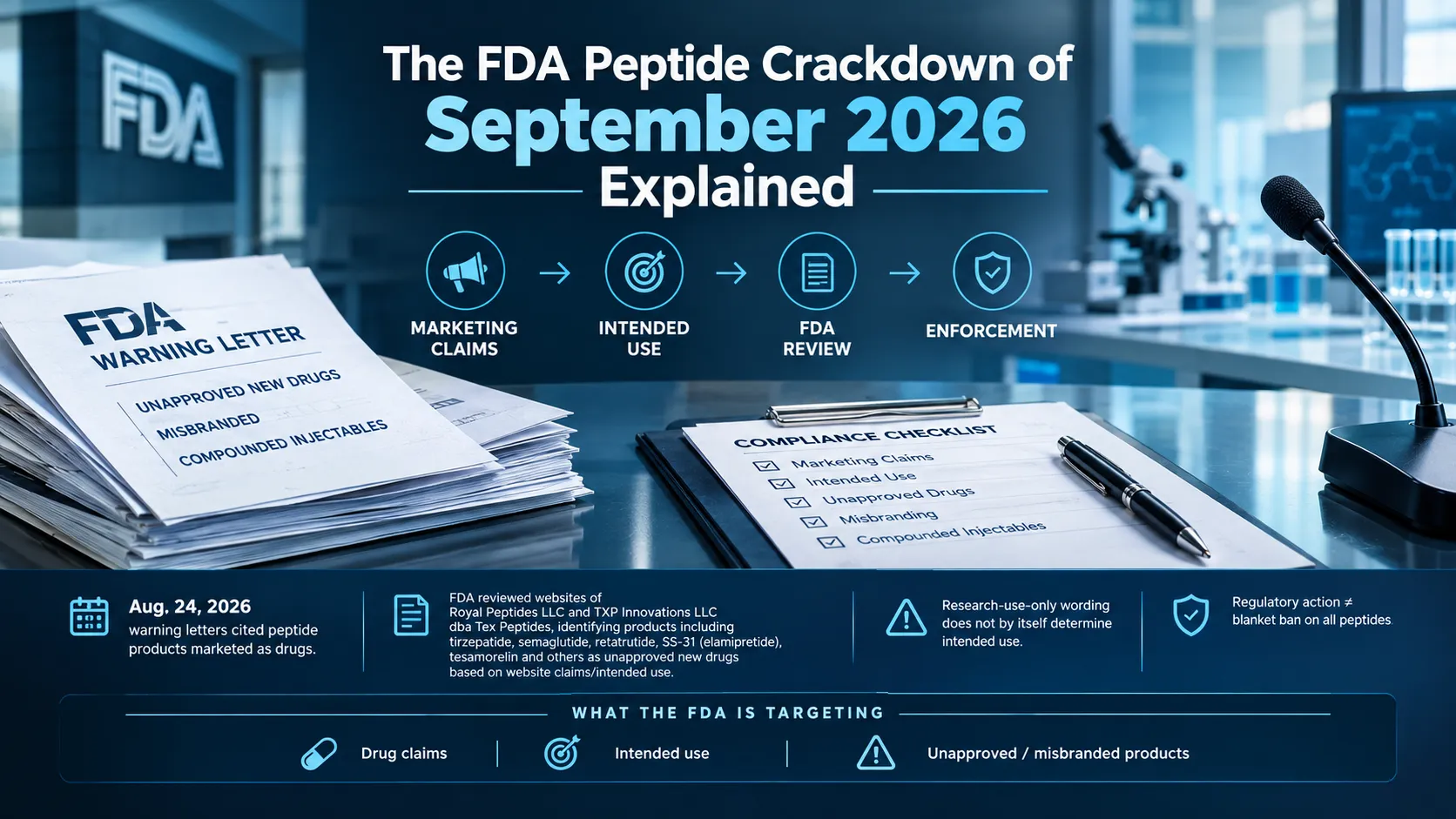
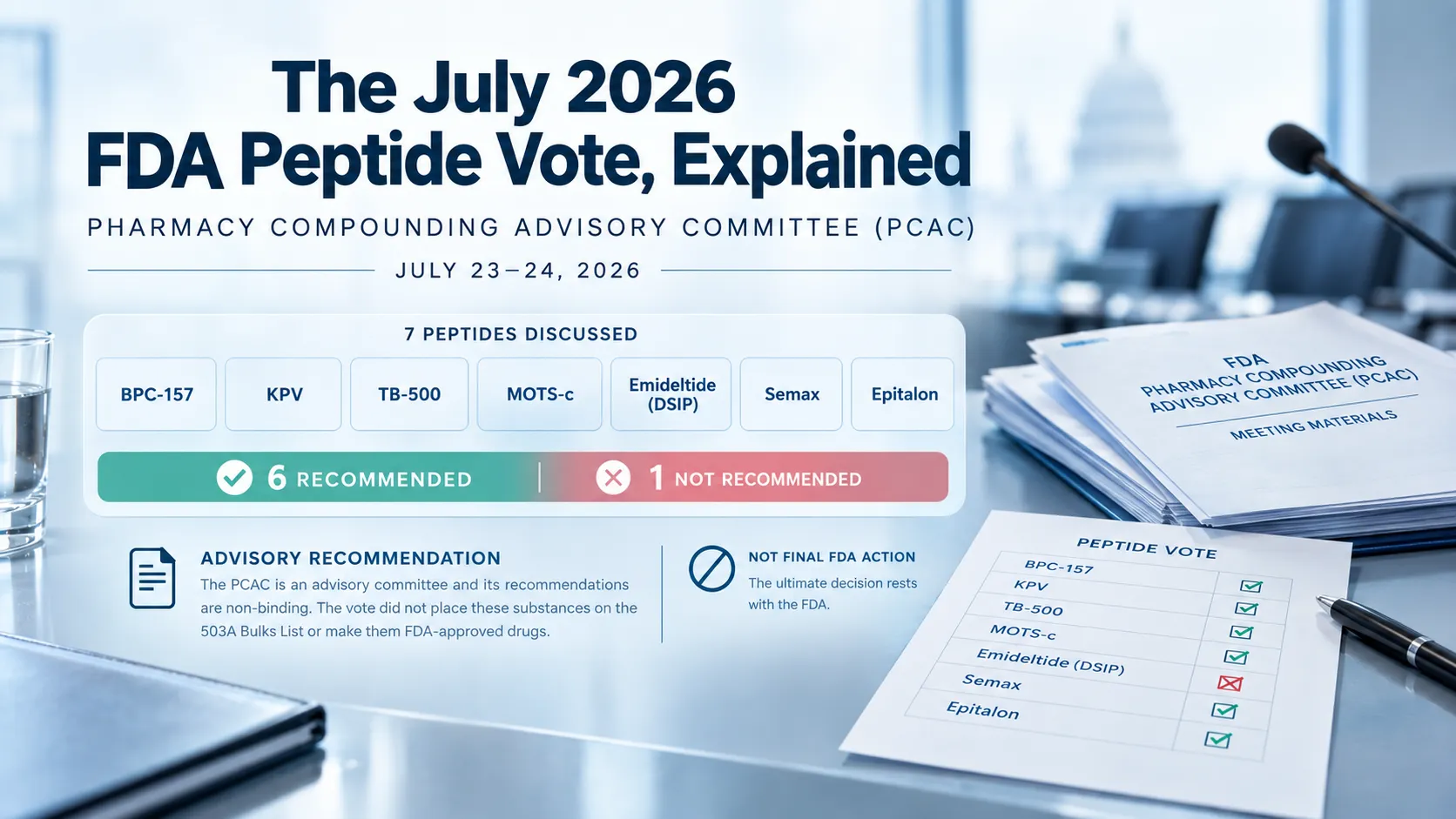
Its position in FDA's compounding framework has moved more than once, including a nominator withdrawal in April 2026 and an advisory committee vote in July 2026 that was recommendatory rather than binding. The July 2026 advisory committee vote is covered in the article on the FDA 503A bulks list and the 2026 peptide vote. Nothing in that process constitutes FDA approval, and a compounding decision is not a scientific finding about safety or efficacy.
Anti-doping status is a separate question that is often reported contradictorily. A 2025 peer-reviewed review states that BPC-157 is not currently listed as banned by WADA, but that is incorrect. BPC-157 has been named on the WADA Prohibited List since 2022 as an example substance in class S0 (non-approved substances), which covers any pharmacological substance with no current approval by any governmental health authority for human therapeutic use. It remains named on the current List, and S0 substances are prohibited at all times.
FDA's 2026 briefing materials treat BPC-157 free base and BPC-157 acetate as different active ingredients. Since the salt form changes what fraction of a weighed mass is peptide, the chemical form should be read off the lot documentation rather than assumed. The [BPC-157 Spray](/product/bpc-157-spray) page covers this distinction in its product context.
BPC-157 and TB-500 Are Separate Research Subjects
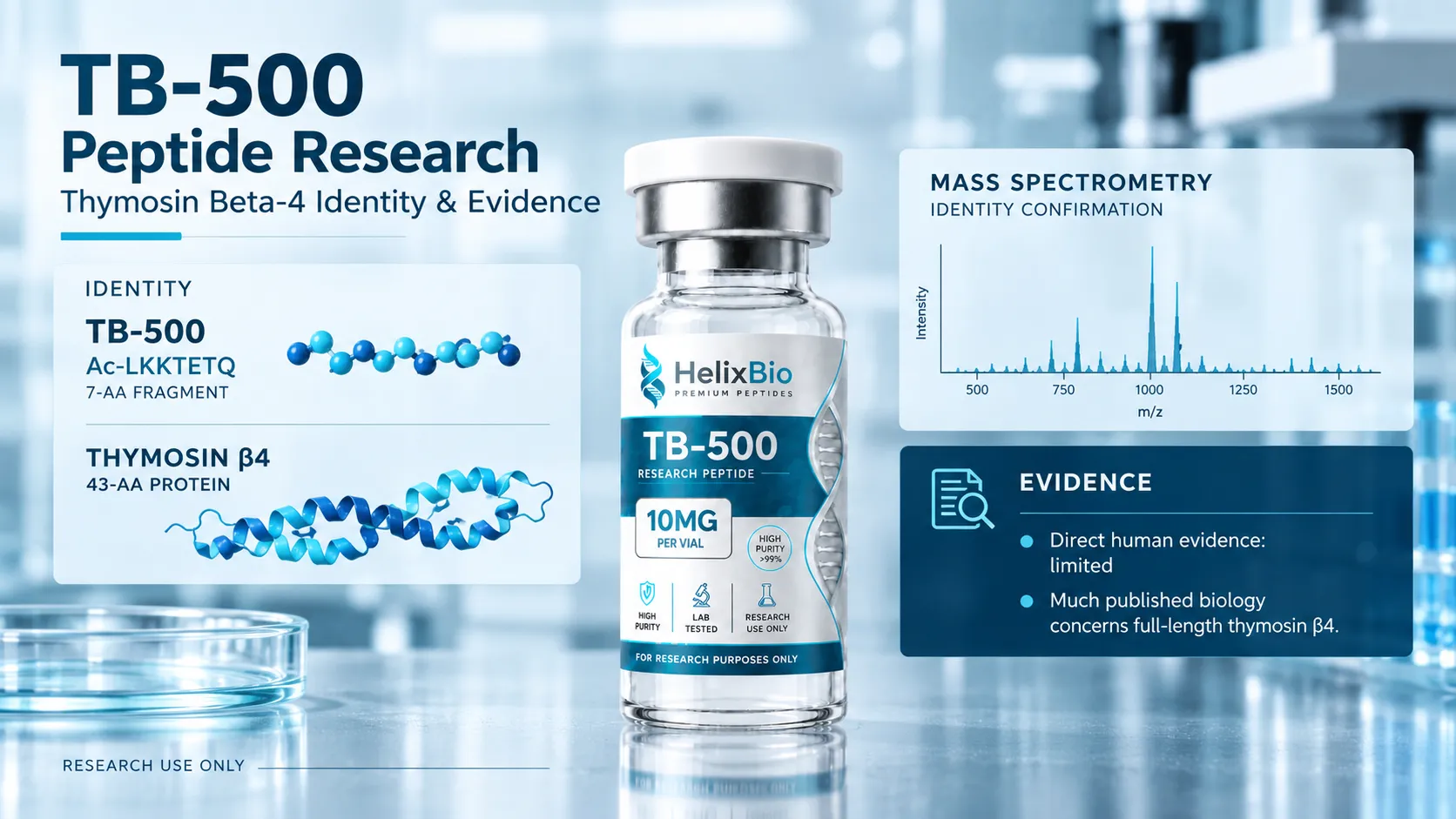
BPC-157 and TB-500 are frequently discussed together and are not interchangeable: they are different molecules with different sequences, different masses and different proposed mechanisms, and evidence for one does not carry to the other. That comparison, and the question of what happens when the two are studied in combination, are handled on dedicated pages — the direct BPC-157 and TB-500 comparison and the review of what the combination evidence shows. This page deliberately stops at the boundary.
For laboratories sourcing the compound itself, lot-specific documentation is the part that matters most: identity, chemical form, purity with its detection wavelength, and the batch record behind them. Helix Bio supplies BPC-157 research peptide as a lyophilised research material for laboratory use only.
Got Questions?
Frequently Asked Questions
BPC-157 is a synthetic pentadecapeptide, meaning a single chain of 15 amino acids, with the sequence GEPPPGKPADDAGLV. It is described in the literature as corresponding to a partial sequence of a protective protein identified in human gastric juice, and it is supplied for laboratory research only.
Yes. BPC-157 is a peptide by definition: 15 amino acid residues joined by peptide bonds in a single linear chain, with no disulfide bridge and no modified termini. Its 15-residue length is why the literature consistently calls it a pentadecapeptide.
The reported sequence is GEPPPGKPADDAGLV, or Gly-Glu-Pro-Pro-Pro-Gly-Lys-Pro-Ala-Asp-Asp-Ala-Gly-Leu-Val in three-letter notation. The three consecutive proline residues at positions three to five are a recognisable feature of the chain.
The average molecular weight of the free peptide is approximately 1419.55 g/mol, corresponding to the molecular formula C62H98N16O22. Salt forms such as the acetate carry additional mass, so a certificate of analysis should state which form the reported value refers to.
Because penta means five and deca means ten, so pentadecapeptide describes a peptide of 15 residues. The term is purely a count of amino acids and says nothing about the compound's origin, activity or purity.
Not as supplied. The larger protective protein described in gastric juice is the naturally occurring entity; BPC-157 is a 15-residue sequence corresponding to part of it, produced by chemical synthesis. Describing the peptide itself as naturally occurring conflates the synthetic material with the protein its sequence was described from.
No mechanism has been established. The most investigated proposal in preclinical research is the VEGFR2-Akt-eNOS pathway, reported across rodent and endothelial cell models, with nitric oxide signalling, FAK-paxillin, JAK-2 and EGR-1/NAB2 appearing in smaller numbers of reports. All of these are observations in animal or cell models, and no human mechanistic study has been published.
It shows a large preclinical literature and a very small human one. A 2025 systematic review included 36 studies, of which 35 were preclinical, reporting improved functional, structural and biomechanical outcomes in animal models of muscle, tendon, ligament and bone injury. The same review found no clinical safety data and classified the evidence as level IV and level V.
Yes, but few. Three small reports have been published: a retrospective series of 12 patients following intra-articular administration, a small uncontrolled pilot in interstitial cystitis, and a two-subject open-label intravenous safety pilot. All three share an author and appeared in the same journal, and none included a control group.
Not as a full paper. The only randomised, placebo-controlled human data are conference abstracts from the early 2000s, including a 2005 ulcerative colitis study that found no significant difference from placebo. Three randomised trials are registered — a Phase I in healthy volunteers registered in 2015, one in acute hamstring strain, and one in rotator cuff repair registered in 2026 — and none has posted results. Registration is not evidence of an outcome.
No. BPC-157 is not approved by the FDA for any indication, has no approved product or labelled use, and is not a lawful dietary supplement ingredient in the United States. Developments in FDA's compounding framework are a separate regulatory process and do not constitute approval.
They are different chemical forms, and FDA's 2026 briefing materials treat them as different active ingredients. The practical consequence is mass basis: an acetate salt contains less peptide per milligram of weighed material than the free base, so the form should be confirmed from lot documentation rather than inferred from the product name.